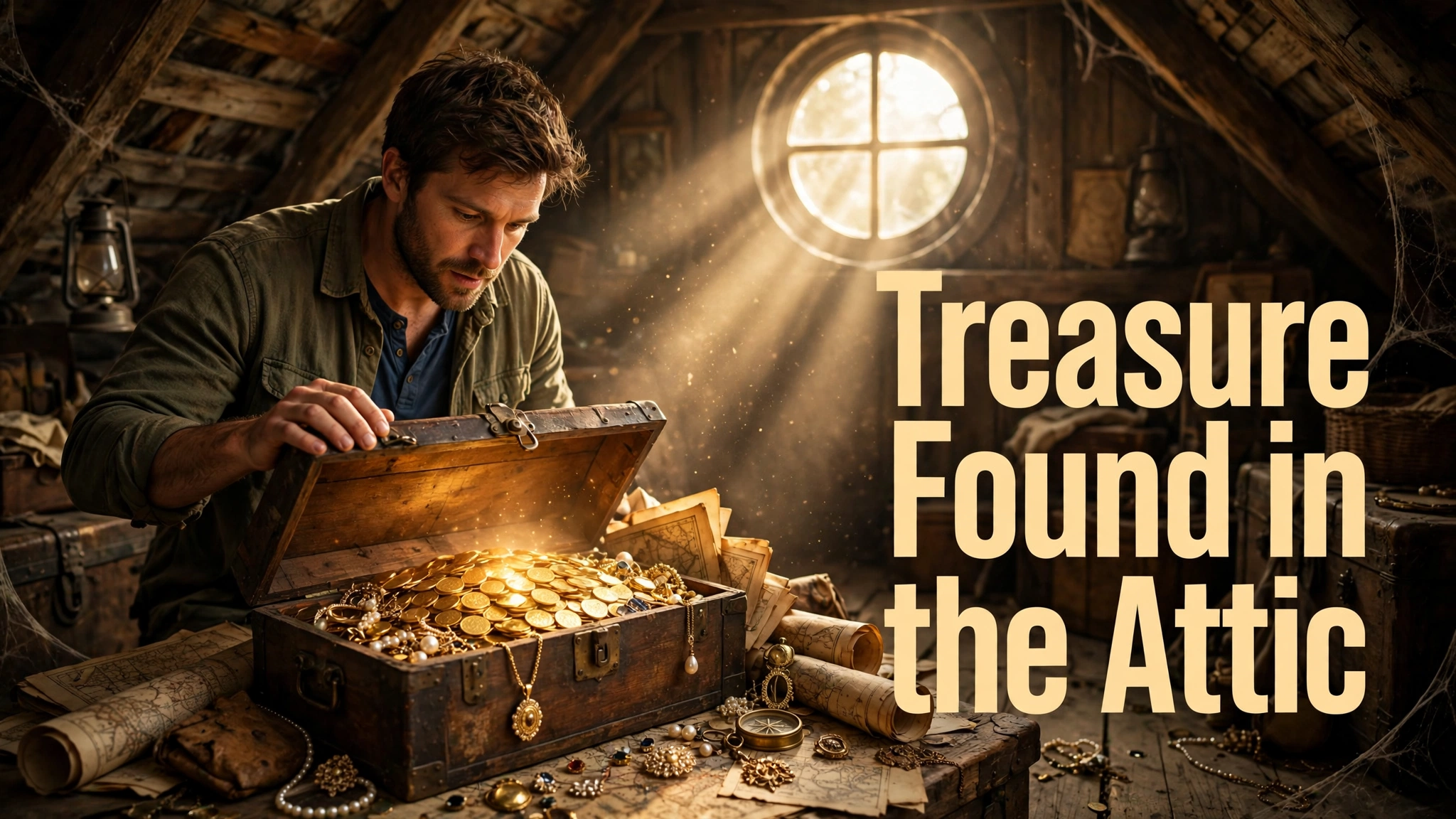
Man Who Found Treasure in His Attic
In this post
The attic treasure story is one of the most satisfying tales in everyday life: a man clearing a dusty attic, expecting rubbish, opens a box, a trunk, or a forgotten drawer and finds something valuable. Sometimes it is a painting, sometimes a collection of comics, coins, stamps, or vintage toys, and sometimes it is a family document that changes what is known about an ancestor. The value may be in money, in history, or in both, and the discovery often happens during the most ordinary moments: a house move, a bereavement clearance, a renovation, or a long-delayed tidy.
This article does not present one invented attic find as a verified news story. Instead, it explains the pattern behind genuine attic discoveries, what kinds of items actually hold value, how to identify and protect a find without damaging it, how valuation and selling work, and what legal and family issues can arise. Attic treasure is real, but it is rarer and more complicated than social media suggests, and a careful approach protects both the value and the family story attached to an object.
Why Attics Hide Treasure
Attics hide treasure for a simple reason: they are where families store things they cannot throw away but do not currently need. A child’s toys, a grandparent’s papers, a wedding dress, a set of books, and a box of photographs all migrate upward when rooms are needed for daily life. Over decades, those boxes accumulate, labels fade, and the person who knew what was inside moves away or dies. The attic becomes an unintentional archive, preserving items that the rest of the house has forgotten.
Historical change adds value to that archive. Items that were common and cheap when stored, such as first-edition books, early comics, vinyl records, or branded toys, may become scarce because most copies were thrown away, damaged, or played with until they broke. Scarcity, plus condition, plus collector demand, creates value where none was expected. A toy kept in its box, a comic kept flat and dry, or a record kept in its sleeve can be worth far more than the same item used daily, which is why attic storage, despite its dust and temperature swings, sometimes preserves value better than a garage or a damp basement.
Family history also hides in attics in non-monetary forms. Letters, diaries, photographs, military records, and immigration papers may have little auction value but immense value to descendants trying to understand their origins. A man who finds a grandparent’s letters may discover a migration story, a wartime experience, or a family connection that changes his sense of identity. That kind of treasure does not appear in a valuation, but it is often the discovery the finder remembers longest, and it deserves the same care as a valuable object.
What Attic Finds Are Actually Valuable
The most valuable attic finds usually share three traits: rarity, condition, and demand. Rarity means few examples survive, whether because production was limited, because most were discarded, or because a particular variant, misprint, or early edition is scarce. Condition means the item survives as close as possible to its original state, with minimal damage, fading, or repair, and with original packaging or accessories where relevant. Demand means collectors, museums, or enthusiasts actively want that type of item, which creates a market and a price. An item can be old without being valuable if it is common, damaged, or unwanted, and age alone is not a reliable guide.
Common categories with attic potential include comics and books, especially first editions, early issues, and signed copies; coins, banknotes, and stamps, especially complete sets, errors, and items in uncirculated condition; vintage toys and games, especially in original boxes; vinyl records, especially early pressings and limited editions; jewellery, watches, and silver, especially with hallmarks and provenance; art and posters, especially original works and limited prints; and sports memorabilia, especially rookie cards and signed items with authentication. Military items, such as medals, uniforms, and documents, can hold both monetary and historical value, but weapons and certain items may be subject to legal restrictions and should be checked with authorities rather than sold casually.
It is equally important to know what is usually not valuable, despite looking old. Mass-produced ornaments, common books without first-edition status, incomplete toy sets, damaged furniture, and everyday household items from recent decades rarely command high prices, though they may hold sentimental value. A professional valuation, rather than an online guess, is the reliable way to distinguish a genuine find from a common item, because condition details, edition points, and market trends are difficult for a non-specialist to judge from photographs alone.
First Steps: Do Not Clean, Repair, or Throw Anything Away
The most common mistake after an attic discovery is well-intentioned damage: cleaning a painting with water, polishing silver aggressively, unfolding a fragile letter, or throwing away packaging that proves authenticity. Collectors value original condition, including patina on metal, original dust jackets on books, and boxes for toys, and aggressive cleaning can reduce value sharply. The safest first step is to stop, photograph the item and its surroundings, note where it was found and what else was in the same box, and handle it as little as possible with clean, dry hands or gloves where appropriate.
Storage matters immediately after discovery. Move the item to a stable, dry, room-temperature location away from direct sunlight, damp, and pests, and avoid attics, garages, and basements for long-term storage of valuable items. Paper items should lie flat, supported, and protected from folding; textiles should be kept clean and dry, not in plastic bags that trap moisture; metals should be kept dry and separated so they do not scratch each other. If an item appears fragile, mouldy, or infested, seek advice from a conservator or archivist before attempting to clean it, because improper treatment can cause irreversible harm.
Documentation is part of protection. Write down who owned the item if known, when it was bought or received, and any family stories attached to it, because provenance, which is the documented history of ownership, can increase both monetary and historical value. Keep original receipts, letters, photographs of the item in use, and any certificates together with the item, and make digital copies of paper documents. If several family members have an interest in the find, agree in writing how it will be stored, valued, and decided upon, before any sale, to avoid disputes that can damage both relationships and value.
Common Attic Finds and Their Realistic Prospects
A realistic tour of an attic usually begins with books and papers, which are the most common finds and the most variable in value. A first edition in good condition with its dust jacket can be significant, while a book club edition of the same title, or a first edition without its jacket and with damage, may be worth very little. The difference lies in edition points, such as publisher, printing, and jacket details, which a specialist can identify. Similarly, a complete run of a magazine or comic series in good condition is worth more than scattered, damaged issues, and a single rare issue can be worth more than a whole box of common ones. Patience in identifying exactly what you have, rather than assuming all old books are valuable, prevents disappointment and wasted appraisal fees.
Toys, records, and household collectibles follow a similar pattern. A toy in its original box, with all accessories and instructions, can command a premium, while the same toy loose, worn, and incomplete may be a modest collectible at best. Vinyl records are valued by pressing, condition of both disc and sleeve, and demand for the artist and album, with early pressings and limited editions at the top and common reissues at the bottom. Coins and stamps require even more specialist knowledge, because mint marks, errors, and grading differences that are invisible to a casual viewer can change value dramatically. In all these categories, condition grading is a skill, and a professional opinion is worth its fee when the item might be significant.
How Valuation and Authentication Work
Valuation begins with identification: what exactly is the item, when was it made, by whom, in what edition or variant, and in what condition? A specialist dealer, auction house, museum curator, or professional appraiser can answer those questions, often from photographs initially, followed by in-person examination. Reputable appraisers explain their method, cite comparable sales, and distinguish between insurance value, which is replacement cost, auction estimate, which is a range, and retail value, which may be higher. A single online price for a similar item is not a valuation, because condition and variant differences can change value dramatically.
Authentication is a separate step, especially for art, autographs, sports memorabilia, and high-value collectibles, where forgeries exist. Authentication may involve examining materials, printing methods, signatures, hallmarks, and provenance, and may require a recognised authentication service or expert opinion. A certificate from an unknown online seller is not equivalent to authentication by a recognised authority, and buyers, auction houses, and insurers will check the source. If authentication is uncertain, a reputable appraiser will say so rather than invent certainty, and that honesty protects both seller and buyer.
Costs and timing should be understood before committing. Some auction houses offer free initial estimates, while formal written appraisals for insurance or probate usually carry a fee. Selling through auction involves commission and possibly other charges, while selling to a dealer is faster but may yield a lower price because the dealer must resell at a profit. Private sales to collectors can achieve good prices but require care with payment, shipping, and fraud prevention. Comparing at least two reputable opinions, and understanding fees in writing, prevents a hurried sale at a fraction of true value.
Selling Safely, and Alternatives to Selling
If you decide to sell, choose the channel that fits the item. Auction houses suit rare, high-value, or specialist items with a collector market, because competitive bidding can raise the price, though the process takes time and involves fees. Specialist dealers suit items where expertise and a quick, private sale matter more than maximising price. Online marketplaces suit lower-value items, but they require careful listing, accurate condition description, secure payment, and insured shipping, and they expose sellers to scams, including fake payment confirmations and return fraud. For very high-value items, a solicitor or financial adviser can help with contracts, tax, and secure payment.
Tax and legal considerations vary by country and by item, and professional advice is wise before a large sale. In some jurisdictions, gains on collectibles may be taxable, inherited items may involve estate processes, and certain cultural, military, or archaeological items may be subject to export controls or ownership laws. Items found in a rented property, a purchased house, or a deceased relative’s home may involve questions about who owns them, which should be resolved before sale. A sale made without clear ownership can lead to disputes, repayment, or legal action, even if the seller acted in good faith.
Selling is not the only option, and for many families it is not the best one. Donating to a museum or archive can preserve a historically significant item, provide public access, and in some countries offer tax benefits, while keeping the family story attached through provenance records. Keeping an item as a family heirloom, with proper storage and documentation, preserves sentimental value that money cannot replace. Sharing a find, through digitised photographs or a family history record, allows relatives to enjoy it without dividing a single object. The right choice depends on financial need, family wishes, and the item’s significance, not only on its auction estimate.
Famous Patterns, and Why Headlines Mislead
News stories about attic treasure often focus on the highest price, which creates a misleading impression that attics commonly contain fortunes. In reality, most attic clearances yield sentimental items, common collectibles of modest value, and a large amount of material suitable for recycling or donation. The spectacular finds that make headlines are newsworthy precisely because they are rare, and they often involve a combination of rarity, condition, and a collector market that aligned at the right moment. A headline that says a painting found in an attic sold for a large sum usually omits the years of research, authentication, and auction preparation that preceded the sale.
Another misleading pattern is the valuation given before authentication. An item described online as worth a large sum based on a similar listing may later be identified as a reproduction, a later edition, or a damaged variant worth far less. Reputable reporting distinguishes between an initial estimate, an authenticated valuation, and a final sale price, because those three figures can differ widely. Readers should treat any attic treasure story that gives a precise price without naming an appraiser, an auction house, or a sale record as an estimate, not a fact.
The most reliable attic stories share a quieter pattern: a finder who did not rush, who sought expert advice, who documented provenance, and who made a considered decision about selling, keeping, or donating. Those stories rarely go viral, because they lack a dramatic overnight fortune, but they represent how attic treasure actually works. Patience, expertise, and care are the real methods behind a successful find, and they protect both value and family relationships far better than a hurried sale based on an internet search.
My Take:
My view is that attic treasure stories appeal to us because they promise a reward for patience and for not throwing things away, and there is something genuinely hopeful in that idea. In a world that encourages constant disposal and replacement, an attic full of old boxes suggests that the past might still have value, and that a family’s history might still be recoverable. I think that hope is worth honouring, but it should be directed toward the right treasure. The most valuable attic find is often not the object that sells for the most money, but the letter, photograph, or document that tells a family who they are and where they came from. Money can be spent and forgotten, but a recovered family story can change how descendants understand themselves for generations.
I also think we should be honest about the odds, because false hope can lead to real harm. A person who expects a fortune in every attic may spend money on appraisals for common items, may delay a house sale while searching for treasure that is not there, or may argue with relatives over boxes of modest value. A healthier approach is to treat an attic clearance as an archaeological dig and a family project: sort carefully, document what you find, seek advice for anything that looks specialist, and accept that most items will be sentimental rather than valuable. That approach still allows for a genuine surprise, but it does not depend on one, and it preserves relationships that a dispute over a supposed fortune can easily damage.
There is a practical point about care that I feel strongly about. The moment of discovery is also the moment of greatest risk, because excitement leads to cleaning, unfolding, and handling that can reduce value or destroy fragile material. I would urge anyone who finds something that looks old, rare, or delicate to pause before touching it further, to photograph it, and to ask an expert before cleaning or repairing it. That pause costs nothing and can save a great deal, whether the item turns out to be valuable, historically significant, or simply a beloved family object that deserves to survive intact for the next generation.
Finally, I believe the best outcome for an attic find is a considered one, not a hurried one. If an item is valuable, take time to get two opinions, understand fees and taxes, and agree with family before selling. If it is historically significant, consider whether a museum or archive could preserve it better than a private sale. If it is sentimental, store it properly and share its story with relatives while the people who remember it are still alive. An attic treasure is not only an object. It is a connection to people who stored it, used it, and left it for someone to find, and honouring that connection, through care, documentation, and a thoughtful decision, is worth more than any single sale price. The treasure, in the end, is both the thing and the story it carries.
There is another dimension to attic finds that is easy to overlook: the emotional work of clearing a home after a death. A man sorting a parent’s attic is not only sorting objects. He is sorting memories, grief, and guilt about what to keep and what to let go, often under time pressure from a house sale or a family disagreement. In that context, a supposed treasure can become a source of conflict, with relatives arguing over ownership or value while still grieving. I think the wisest approach in those circumstances is to slow the process where possible, to set aside disputed items without selling them immediately, and to agree a process for valuation and decision-making before money enters the conversation. Grief and money are a difficult combination, and a pause protects both relationships and value.
I also think about the responsibility that comes with finding something historically significant, such as wartime letters, photographs of a community, or records of a local industry. Such items may belong, in a moral sense, not only to one family but to a wider history, and donating copies, digitised images, or the originals to a local archive can preserve that history for researchers and descendants who would otherwise never see it. That does not mean every family must give away its heritage, but it does mean considering whether a private sale to an unknown collector is the best fate for an item that illuminates a shared past. A local museum, a university archive, or a community history project may offer a home where the item is studied, conserved, and shared, which can be a more fitting outcome than a price tag.
Finally, there is a simple joy in attic discovery that should not be lost in talk of valuation and law. Opening a box and finding a childhood toy, a parent’s handwriting, or a photograph of a grandparent as a young person is a moment of connection across time, and it reminds us that ordinary lives leave traces worth preserving. Not every trace needs a price, and not every attic needs to yield a fortune to be worth clearing carefully. The habit of keeping, labelling, and passing on family objects, with their stories attached, is itself a form of treasure, because it gives the next generation something that money cannot buy: a sense of where they came from. If you clear an attic, do it slowly, document what you find, and share the stories while the people who remember them are still here to tell them.
That sharing matters more than most people realise, because stories attached to objects fade faster than the objects themselves. A photograph without a name, a medal without a record of service, or a letter without context loses much of its meaning within a generation, even if the object survives in perfect condition. Writing a few lines about who owned an item, when it was used, and why it mattered takes only minutes, but it preserves the connection that makes an attic find a treasure rather than an anonymous antique. Future family members will thank you for those lines far more than for the object alone, because the lines tell them why the object was kept in the first place.
Frequently Asked Questions
What are the most valuable things found in attics? Items with rarity, excellent condition, and active collector demand tend to hold value, including first-edition books, early comics, rare coins and stamps, vintage toys in original boxes, early vinyl pressings, hallmarked jewellery and silver, and authenticated art or memorabilia. Age alone does not guarantee value.
How do I know if something in my attic is valuable? Start by identifying the item, edition, maker, and condition, photograph it without cleaning or repairing it, and seek an opinion from a reputable dealer, auction house, or appraiser. Compare at least two opinions and ask for comparable sales, because online listings for similar items are not a reliable valuation.
Should I clean an old item found in the attic? Generally no, not before expert advice, because aggressive cleaning can damage patina, dust jackets, packaging, and fragile surfaces and can reduce value. Move the item to a dry, stable location, handle it minimally, and consult a conservator or specialist for fragile, mouldy, or infested items.
Who owns treasure found in an attic? Ownership depends on who owned the house, whether the item was inherited, rented, or left by a previous owner, and on local law, including rules for found property and cultural items. Resolve ownership and family agreement in writing before selling, and seek legal advice for high-value or disputed finds.
Where is the best place to sell attic antiques? Auction houses suit rare or high-value specialist items, dealers suit quick private sales, and online marketplaces suit lower-value items with careful listings and secure payment. Understand commissions, fees, taxes, and shipping insurance in writing before committing to a channel.
Can I donate an attic find to a museum? Yes, museums and archives accept historically significant items, subject to their collection policies, condition, and provenance, and donation can preserve public access and, in some countries, offer tax benefits. Contact the relevant curator with photographs and provenance information before delivering an item.