Marco Mengoni: The Life Story Behind Italy's Modern Voice
In this post
- A Boy From Ronciglione
- X Factor and a Sudden Breakthrough
- The First Albums and Finding His Sound
- L’essenziale and Winning Sanremo
- Parole in Circolo and a New Direction
- Atlantico and an International Sound
- Due Vite and a Second Sanremo Win
- A Modern Voice in Italian Music
- Mengoni and the Challenge of Talent Show Fame
- The Voice and the Live Stage
- My Take:
Marco Mengoni has one of the most recognisable voices in modern Italian music. It is deep, warm, and powerful, and it can move from a quiet whisper to a soaring chorus without losing its character. He became famous as a teenager, when he won the Italian X Factor in 2009, and he has spent the years since then building a career that is both popular and respected. He has won the Sanremo Music Festival twice, he has represented Italy at the Eurovision Song Contest twice, and he has released albums that have topped the Italian charts again and again.
He was born in Ronciglione, a small town in Lazio, on Christmas Day 1988, and he grew up in a family that loved music. He sang as a boy, he played in local bands, and he dreamed of a life on a stage. When he entered X Factor, he was a young man with a big voice and a clear sense of who he was, and the Italian public responded to him at once. He did not become a star by accident. He became a star because his voice was exceptional, and because he worked hard to use it well.
His story is about a modern Italian singer, about television, about talent shows, and about the challenge of building a long career after a sudden breakthrough. Many winners of talent shows fade quickly, but Mengoni did not. He kept growing, kept changing his sound, and kept his audience with him. This is the story of how a boy from Ronciglione became one of the most important Italian singers of his generation.
A Boy From Ronciglione
Marco Mengoni was born on 25 December 1988 in Ronciglione, a small town in the province of Viterbo, in Lazio. He grew up in a family that supported his interest in music, and he began to sing as a child. He was drawn to the music he heard at home and on the radio, and he learned to use his voice in a way that was natural and powerful. As a teenager, he played in local bands, he sang at local events, and he began to understand that music could be more than a hobby. It could be a life.
Ronciglione is a small and historic town, with a strong sense of community, and growing up there gave Mengoni a sense of where he came from. He was not from Rome or Milan, and he did not have the connections that singers from big cities often have. He had to make his own way, and he had to rely on his voice and his determination. That experience gave him a humility that has stayed with him, even after he became famous. He is known as a singer who is grounded, who remembers his roots, and who does not take his success for granted.
He studied at school, he worked on his music, and he began to look for a chance to be heard beyond his town. He entered singing competitions, he performed in clubs, and he built a small reputation in his region. Those early years were important, because they taught him how to perform, how to handle an audience, and how to keep going when the road was hard. The boy from Ronciglione was preparing for a moment that would change his life, and he did not know when it would come.
X Factor and a Sudden Breakthrough
In 2009, Marco Mengoni entered the third series of the Italian X Factor, a television talent show that was watched by millions of people. He was twenty years old, and he was one of many young singers competing for a record deal. From his first audition, it was clear that he had something special. His voice was deep, warm, and powerful, and he sang with a confidence that was unusual for a singer of his age. The judges noticed him, the audience noticed him, and week by week, he became one of the favourites to win.
He won the competition in December 2009, with the song Dove si vola, which became a hit in Italy. The victory changed his life overnight. He went from being a young singer in a small town to being a national star, with a record deal, with television appearances, and with a large and loyal fan base. The transition was fast, and it was not easy. He had to learn how to handle fame, how to deal with the press, and how to keep his music honest while the whole country was watching him.
The X Factor win was important because it gave him a platform, but it did not guarantee a long career. Many winners of talent shows fade after a year or two, because they cannot find their own sound, or because the public moves on to the next winner. Mengoni did not fade. He used the platform to build a career, to make records, and to grow as an artist. That is a rare achievement, and it shows that his talent was real, not just a television moment.
The First Albums and Finding His Sound
After X Factor, Mengoni released his first album, Dove si vola, in 2009, and his second album, Re matto, in 2010. Those records showed a young singer who was still finding his sound, but who already had a strong voice and a clear sense of style. He sang pop songs with a rock edge, with a voice that was deep and powerful, and with a stage presence that was confident and engaging. His fans, who had followed him on X Factor, bought his records, came to his concerts, and stayed with him.
In 2011, he released the album Solo 2.0, which showed a more mature sound, with songs that were more personal and more reflective. He was growing as a songwriter, and he was beginning to write about his own life, about love, about doubt, and about the experience of being famous at a young age. That growth was important, because it showed that he was not just a singer of other people’s songs. He was an artist who was learning to express himself in his own words.
Those early albums were successful, but they were also a learning experience. He was learning how to work in the studio, how to tour, and how to handle the pressures of a career in music. He made mistakes, he learned from them, and he kept going. That willingness to learn, and to grow, is one of the reasons his career has lasted. He did not try to stay the same. He tried to get better, year by year, album by album.
L’essenziale and Winning Sanremo
In 2013, Marco Mengoni won the Sanremo Music Festival with the song L’essenziale, a song about the essential things in life, about love, and about what really matters. The song was a huge hit in Italy, and it became one of his most famous recordings. It was also a turning point in his career, because it showed that he was not just a talent show winner. He was a serious artist, capable of winning the most important music festival in Italy, and capable of writing a song that would be loved by millions of people.
The Sanremo win also gave him the chance to represent Italy at the Eurovision Song Contest in 2013, in Malmö, Sweden, where he performed L’essenziale and finished in seventh place. Eurovision was a new experience for him, and it introduced him to a European audience. He performed with confidence, and he was praised for his voice and his stage presence. The experience taught him about performing for a large international audience, and it gave him a taste of a career beyond Italy.
In the years after Sanremo, he released the album Pronto a correre in 2013, which was a commercial success, and he toured Italy and Europe. He was now one of the biggest names in Italian music, and he was filling large venues. He had come a long way from Ronciglione, and he was now a star in his own right. But he was also aware that fame is fragile, and that a singer must keep working to stay relevant. He did, and his career continued to grow.
Parole in Circolo and a New Direction
In 2015, Mengoni released the album Parole in circolo, the first part of a two-album project, followed by Le cose che non ho in 2016. Those albums showed a new direction in his music, with a more electronic and modern sound, and with songs that were more personal and more experimental. He worked with new producers, he tried new styles, and he showed that he was not afraid to change. That willingness to change is important for a modern singer, because the music business changes quickly, and a singer who does not change can be left behind.
The albums were successful, and they produced hits such as Guerriero, Esseri umani, and Io ti aspetto. Those songs showed a singer who was thinking about the world, about relationships, and about the experience of being a young man in a changing Italy. He was not just singing love songs. He was singing about life, about the challenges of growing up, and about the need to be honest with oneself. That honesty resonated with his audience, who had grown up with him, and who were facing the same challenges.
He also toured extensively during those years, performing in large venues in Italy and abroad, and building a reputation as a powerful live performer. His concerts were known for their energy, their production, and their emotional intensity. He was not a singer who stood still and sang. He was a performer who moved, who talked to the audience, and who made a concert feel like a shared experience. That live reputation is a large part of his success, and it is one of the reasons his fans are so loyal.
Atlantico and an International Sound
In 2018, Mengoni released the album Atlantico, which showed a further evolution in his sound, with influences from Latin music, from electronic music, and from international pop. The album included the songs Voglio, Buona vita, and Hola, a duet with the British singer Tom Walker. The album was a commercial success, and it showed that Mengoni was thinking beyond Italy, and that he wanted to make music that could be heard around the world. He toured in Europe and in Latin America, and he built an audience beyond Italy.
The Atlantico period was also a period of personal growth. He spoke about his life, about his travels, and about the need to take time for oneself. He was a singer who had been famous since he was twenty, and he was learning how to live with that fame, how to take care of himself, and how to keep his music honest. That maturity is visible in his later work, which is more reflective, more personal, and more confident than his early records.
He also became involved in charity work, and he used his fame to support causes he believed in. He was not a singer who only thought about his own career. He thought about the world, about other people, and about how he could use his platform to help. That generosity is a part of his public image, and it is one of the reasons he is respected, not only as a singer, but as a person.
Due Vite and a Second Sanremo Win
In 2023, Marco Mengoni won the Sanremo Music Festival for a second time, with the song Due vite, a song about two lives, about love, and about the choices that shape a life. The song was a huge hit in Italy, and it became one of his most loved recordings. It was also a confirmation that he was still at the top of Italian music, fourteen years after his X Factor win. Few singers win Sanremo twice, and even fewer do it with a gap of ten years between victories. That achievement showed his longevity, his talent, and his ability to keep growing.
The win also gave him a second chance at Eurovision, in Liverpool in 2023, where he performed Due vite and finished in fourth place, one of Italy’s best results in recent years. Eurovision introduced him to a new European audience, and he was praised for his voice, his stage presence, and his professionalism. The experience was a highlight of his career, and it showed that he could compete at the highest level in Europe, not just in Italy.
In the same year, he released the album Materia, a project that showed his maturity as an artist, with songs that were personal, reflective, and beautifully produced. The album was a success, and it confirmed that Mengoni was not a singer from the past. He was a singer of the present, still making relevant and powerful music, and still growing as an artist.
A Modern Voice in Italian Music
Today, Marco Mengoni is seen as one of the most important Italian singers of his generation, and his career is still going strong. He has sold millions of records, he has won major awards, he has performed in large venues in Italy and abroad, and he has built a loyal audience that has grown up with him. He is respected by other musicians, by critics, and by fans, for his voice, his work ethic, and his willingness to change and to grow.
His legacy is still being written, because he is still young, still recording, and still performing. He has already achieved more than most singers achieve in a lifetime, and he has done it by being himself, by trusting his voice, and by working hard. He is a modern voice in Italian music, a singer who came from television, but who became much more than a television star. He became an artist, and his story is still unfolding.
Mengoni and the Challenge of Talent Show Fame
Marco Mengoni’s story is also a story about talent shows, and about the challenge of building a long career after a sudden television breakthrough. When a singer wins a show like X Factor, the whole country knows their name in a few weeks, but that fame is fragile. The audience moves on, the next winner arrives, and the previous winner can be forgotten. Mengoni understood that risk, and he worked hard to avoid it. He did not rely on his television fame. He built a career on records, on concerts, and on songs that were his own.
He also had to learn how to be a public figure at a young age. He was twenty when he won, and he had to deal with the press, with fans, and with the pressures of a career in music, all at once. That is a lot for a young person, and many young stars struggle with it. Mengoni handled it by staying grounded, by remembering his roots in Ronciglione, and by focusing on his music. He did not chase scandal, he did not seek attention for its own sake, and he did not let fame change who he was. That maturity is one of the reasons his career has lasted.
His success also shows that a talent show can be a real platform for a real artist, if the artist has the talent and the work ethic to use it. X Factor gave him a chance, but it did not give him a career. He gave himself a career, by working hard, by writing songs, and by performing for his audience, year after year. That is a lesson for anyone who dreams of fame through television. A show can open a door, but only hard work can keep it open.
The Voice and the Live Stage
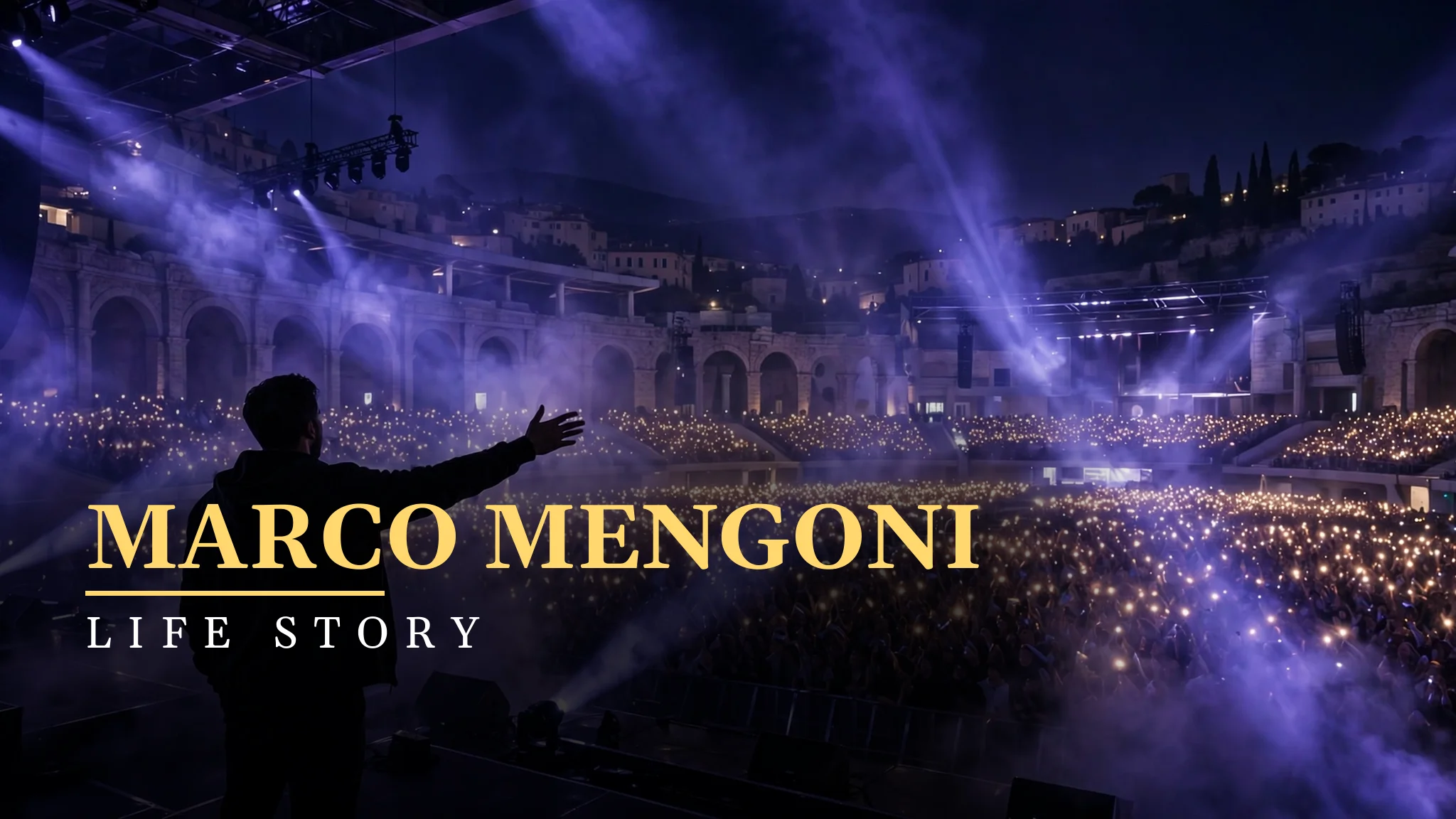
One of the most important parts of Mengoni’s career is his live performance, and his reputation as a powerful concert singer. He has performed in large venues in Italy, including stadiums and arenas, and his concerts are known for their energy, their production, and their emotional power. He does not just sing his songs. He performs them, with a band, with lights, and with a stage presence that fills a large space. His audience comes to hear his voice, but they also come to feel the energy of a live show, and he delivers it.
His voice is particularly suited to a live stage, because it is deep, warm, and powerful, and it can fill a large venue without losing its character. He can sing a quiet ballad, and the audience will listen in silence, and he can sing a loud and energetic song, and the audience will sing along. That range is rare, and it is one of the reasons his concerts are so popular. He is not a singer who sounds good only in the studio. He sounds good live, and that is a different and more difficult skill.
He has also toured abroad, in Europe and in Latin America, and he has built an international audience. That touring has taught him how to perform for audiences who do not share his language, and how to connect with them through music alone. He has learned that a good song, sung with feeling, can cross borders, and that a live performance can be a universal language. That experience has made him a more confident and more versatile performer.
He also showed that a singer can grow up in public and still stay true to himself. From the age of twenty, his life has been watched, his songs have been judged, and his choices have been discussed. That is a hard way to grow up, and many young stars lose themselves in it. Mengoni did not lose himself. He grew, he learned, and he became a more mature artist, while keeping the warmth and the honesty that made people love him in the first place. That is a remarkable achievement, and it is one that deserves respect.
His albums also tell a story of a man who is always learning. From Dove si vola to Materia, each record shows a new side of him, a new sound, and a new way of thinking about music. He has not been afraid to try, to fail, and to try again, and that courage is what keeps his music fresh. A singer who is afraid to change will soon sound old. Mengoni is not afraid, and his music still sounds new.
His story also reminds me that a small town can produce a great singer, and that talent does not care where you were born. Ronciglione is not a famous city for music, but it produced Marco Mengoni, and his voice has now been heard around the world. That is a hopeful thought for young people in small towns everywhere, who may feel that their dreams are too big for the place where they live. Mengoni proved that a dream can be bigger than a town, and that a voice can travel far beyond the place where it was first heard.
My Take:
When I think about Marco Mengoni, the first thing I think about is his voice. It is deep, warm, and powerful, and it has a character that makes it instantly recognisable. When he sings, I do not just hear notes. I hear a person who feels the song, who understands the words, and who is singing with his whole heart. That is a rare gift, and it is one of the reasons he has been loved for so long. Many singers have a good voice, but few have a voice that feels like a person.
I admire the way he won X Factor and then built a real career, because that is a hard thing to do. Many winners of talent shows become famous for a year, and then they disappear. Mengoni did not disappear. He used the platform to make records, to tour, and to grow as an artist. That takes discipline, and it takes a clear sense of who you are. He knew who he was, and he did not let the television show define him. He defined himself, through his music, year by year.
I think about L’essenziale, and about how that song captures the feeling of wanting to keep only the essential things in life. It is a song about love, about simplicity, and about what really matters when everything else is stripped away. I love that, because it is a message that is easy to forget in a busy and noisy world. Mengoni sang it with a sincerity that made people listen, and it became one of his most famous songs. That is a testament to his ability to choose a song that speaks to a universal feeling.
What I find most impressive in his story is his second Sanremo win, with Due vite, ten years after the first. To win Sanremo once is a great achievement. To win it twice, with a gap of ten years, is extraordinary, because it shows that a singer has not just had a moment. He has had a career. He has grown, he has changed, and he has kept his audience with him. That longevity is rare in modern pop music, where singers often fade after a few years. Mengoni has not faded. He has grown stronger.
I also think about his Eurovision performances, and about how he represented Italy with dignity and professionalism. Eurovision is a strange and difficult contest, with a huge audience and a lot of pressure, and Mengoni handled it well, twice. He sang with confidence, he performed with style, and he was praised by audiences across Europe. That is a credit to him, and it shows that his talent is not limited to Italy. He can sing for the whole of Europe, and be heard.
There is a part of his story that makes me think about his hometown, Ronciglione, and about how a boy from a small town can become a national star. He did not come from Rome or Milan, and he did not have connections. He had a voice, a determination, and a willingness to work. That is a powerful example for young people from small towns, who may feel that fame is only for people from big cities. Mengoni proved that it is not. It is for anyone with talent and with the courage to try.
I think about his albums, too, and about how he has changed his sound over the years. He started with pop, he moved to a more electronic sound, he tried Latin influences, and he kept his music fresh. That willingness to change is important, because the music business changes quickly, and a singer who does not change can be left behind. Mengoni has changed, and he has done it without losing his voice or his identity. That is a difficult balance, and he has managed it well.
When I compare him with other singers of his generation, I think his greatest strength is his consistency. He has released album after album, hit after hit, and concert after concert, and he has done it with a professionalism that is rare. He does not take long breaks, he does not disappear, and he does not disappoint his fans. He works, he sings, and he keeps going. That consistency is a form of respect for his audience, and it is one of the reasons his fans are so loyal.
I think about his live performances, and about how powerful they are. He is not a singer who stands still and sings. He moves, he talks to the audience, and he makes a concert feel like a shared experience. I admire that, because a live performance is a different skill from a studio recording, and Mengoni has mastered both. He can make a record that sounds beautiful, and he can make a concert that feels alive. That is a rare combination.
If I have a sadness in his story, it is the sadness that fame came so early, when he was only twenty, and that he had to grow up in public. That is a hard thing for a young person, and it is a pressure that few people understand. He handled it well, but it must have been difficult. I respect the way he has managed it, by staying grounded, by remembering his roots, and by taking care of himself. That is a mature response to a difficult situation.
For a young reader, I think the lesson of Marco Mengoni is to trust your voice, and to work hard at it. He trusted his voice, he entered X Factor, he won, and then he kept working, year after year, to get better. He did not rest on his victory. He built on it, and he is still building. That is a lesson for anyone who has a talent. A victory is not the end. It is the beginning, and the work that follows is what makes a career.
I keep returning to the image of the boy from Ronciglione, singing in a small town, dreaming of a life on a stage. He could not have known then that he would win X Factor, win Sanremo twice, and represent Italy at Eurovision twice. He just knew that he loved to sing, and that he wanted to be heard. That love carried him through a long career, and it is the heart of his story.
In the end, I think Marco Mengoni teaches us that a modern singer can also be a real artist, and that television fame does not have to be shallow. He came from a talent show, but he became much more than a talent show winner. He became a songwriter, a performer, and a voice that Italy trusts. When I hear him sing now, I do not think about X Factor. I think about a man who has grown, who has learned, and who is still singing with the same warmth and power that made people listen in the first place.
I also think about his future, and about what he might do next. He is still young, still recording, and still performing, and his best work may still be ahead of him. That is an exciting thought, and it is one that his fans share. They have followed him from X Factor to Sanremo to Eurovision, and they will follow him wherever he goes next. That loyalty is a testament to his talent, and to the trust he has built with his audience over fifteen years.
Finally, I think about what I would say to someone who has never heard his music. I would tell them to listen to Due vite, to close their eyes, and to hear the voice. I would tell them that the song is about two lives, about love, and about the choices that shape a life. I would tell them that Marco Mengoni is a singer who understands those choices, and who sings about them with honesty and with warmth. That is why I admire him, and that is why his story matters.
I also think about the challenge of talent show fame, and about how hard it is to build a long career after a sudden breakthrough. Mengoni did it, and he did it by working hard, by writing songs, and by performing for his audience, year after year. I respect that, because it shows that his talent was real, not just a television moment. He did not rely on his X Factor win. He built on it, and he is still building.
Another thought that stays with me is about his live performances, and about how powerful they are. A singer who can fill a stadium, and make a large audience feel as if he is singing to them personally, has a rare gift. Mengoni has that gift, and his concerts are a testament to it. I think about the energy of a live show, the lights, the band, and the voice, and I understand why his fans are so loyal. They do not just hear his songs. They experience them, live, in a room full of other people who love the same music.
I think about his work ethic, too, and about how consistent he has been. He has released album after album, hit after hit, and concert after concert, and he has done it with a professionalism that is rare. He does not take long breaks, he does not disappear, and he does not disappoint his fans. He works, he sings, and he keeps going. That consistency is a form of respect for his audience, and it is one of the reasons his fans trust him.
When I think about his future, I think about how young he still is, and about how much more he might do. He is in his thirties, he is still recording, and he is still performing, and his best work may still be ahead of him. That is an exciting thought, and it is one that his fans share. They have followed him from X Factor to Sanremo to Eurovision, and they will follow him wherever he goes next.
I also think about his kindness, and about the way he has used his fame to help others. He has supported charity work, he has spoken about important issues, and he has been a positive figure in Italian public life. That generosity is not a small thing, and it is one that many famous people forget. Mengoni has not forgotten it, and that is a credit to him.
Finally, I think about what his story means for young singers who dream of a career in music. It means that a talent show can be a start, but it is not a career. A career is built by hard work, by good songs, and by a loyal audience, and Mengoni has built his career that way, step by step, year by year. That is a lesson worth remembering, and it is one that I hope young singers hear.
I also think about the song Due vite, and about how it speaks to the idea that a person can live two lives, one in the past and one in the present, and that both are a part of who they are. That is a deep idea for a pop song, and Mengoni sang it with a sincerity that made it feel true. I love songs that do that, songs that take a simple idea and make it feel large and important. Due vite does that, and it is one of the reasons it won Sanremo.
Another thought that stays with me is about his audience, and about how they have grown up with him. The fans who watched him on X Factor in 2009 were teenagers, and now they are adults, with jobs, families, and lives of their own. Mengoni has grown up with them, and his songs have grown up with them too. That shared journey is a powerful bond, and it is one of the reasons his concerts feel like a reunion, not just a show.
Finally, I think about the future, and about the music he has yet to make. He is still young, still curious, and still hungry to learn, and I believe his best songs may still be ahead of him. That is an exciting thought, and it is one that makes me look forward to his next album, his next concert, and his next song. Marco Mengoni is a modern voice, a warm voice, and a voice that Italy trusts, and I think that trust will last for many years to come.
Frequently Asked Questions
Where was Marco Mengoni born and when did he win X Factor?
Marco Mengoni was born on 25 December 1988 in Ronciglione, Lazio, and he won the third series of the Italian X Factor in December 2009, with the song Dove si vola. The win made him a national star at the age of twenty.
What is Marco Mengoni’s most famous song?
L’essenziale, his Sanremo winner from 2013, is one of his most famous songs, and Due vite, his second Sanremo winner from 2023, is another beloved hit. Other well-known songs include Guerriero, Esseri umani, and Hola.
How many times has Marco Mengoni won Sanremo?
He has won the Sanremo Music Festival twice, in 2013 with L’essenziale and in 2023 with Due vite, a gap of ten years that shows his longevity and his ability to keep growing as an artist.
Has Marco Mengoni represented Italy at Eurovision?
Yes, he represented Italy at Eurovision twice, in 2013 in Malmö with L’essenziale, finishing seventh, and in 2023 in Liverpool with Due vite, finishing fourth, one of Italy’s best recent results.
What albums has Marco Mengoni released?
His albums include Dove si vola, Re matto, Solo 2.0, Pronto a correre, Parole in circolo, Le cose che non ho, Atlantico, and Materia, each showing a different stage in his growth as a singer and songwriter.
Is Marco Mengoni still performing?
Yes, he continues to record and to perform in Italy and abroad, with large concerts and new music. He is regarded as one of the most important Italian singers of his generation, with a career that is still going strong.


