Maria de Medeiros: The Life Story Behind Portugal's International Actress
In this post
- Growing Up in a House Full of Music
- First Steps on Stage and Screen
- Pulp Fiction and the Role of Fabienne
- A Director, a Singer, and Many Lives in Art
- Working in Many Countries, Speaking Many Languages
- The Legacy of a Woman Who Crossed Borders
- The Theatre: Her First and Lasting Home
- A Life in Music and Song
- My Take:
Maria de Medeiros is an actress who has lived in many worlds. She was born in Lisbon, she trained in Paris, she acted in French and Portuguese films, and she became known to audiences around the world as Fabienne in Quentin Tarantino’s Pulp Fiction. She is also a director, a singer, and a writer, and her career has moved between countries, languages, and art forms with a freedom that few actors enjoy. Her story is the story of a woman who refused to stay in one place, and who made a life out of crossing borders, both on screen and off it.
She was born on 19 August 1965 in Lisbon, into a family where music and culture were part of everyday life. Her father was a composer and a conductor, and her mother was a journalist, so she grew up in a home where art was taken seriously. She studied acting in Lisbon and then in Paris, and she began her career on the stage and in films in both countries. She was young, talented, and curious, and she wanted to learn everything she could about acting, about directing, and about telling stories. That curiosity has stayed with her for her whole career.
Her international breakthrough came in the early 1990s, first with Henry & June, and then with Pulp Fiction in 1994, a film that became one of the most famous of its decade. In Pulp Fiction, she played Fabienne, the French girlfriend of the boxer Butch, and her performance, warm, funny, and a little strange, became one of the film’s most memorable parts. After that, she could have stayed in Hollywood and chased fame. Instead, she kept moving between Portugal, France, and other countries, acting, directing, and singing, and building a career that was hers alone. This is her story.
Growing Up in a House Full of Music
Maria de Medeiros Esteves Victorino de Almeida was born on 19 August 1965 in Lisbon. Her father, António Victorino de Almeida, was a well-known Portuguese composer and conductor, and her mother was a journalist, so Maria grew up in a home where music, books, and ideas were part of daily life. She heard music from an early age, she met artists and musicians who visited her family, and she learned that art was not a hobby. It was a way of living, a way of thinking, and a way of understanding the world. That early lesson shaped her whole life.
As a child, she was drawn to performing. She liked to act, to sing, and to tell stories, and her family encouraged her. She studied piano and music, and she began to act in the theatre while she was still young. Lisbon in the 1970s was a city that was changing fast after the revolution, and its theatres and cultural life were opening up. A young girl who wanted to act had more chances than her mother’s generation had, and Maria took them. She was serious about her work from the start, and she wanted to learn properly, not only to be seen.
She studied acting in Lisbon, and then she went to Paris to continue her training. Paris was the right place for her, because it was a city where theatre and film were taken very seriously, and where a young actress could learn from great teachers and great actors. She studied at the Conservatoire in Paris, and she began to work in French theatre and film. She learned to act in French as well as in Portuguese, and that ability to move between languages became one of the keys to her career. She was not only a Portuguese actress. She was a European actress, at home in more than one culture.
The years of training were hard, but they gave her a foundation that has lasted her whole career. She learned how to use her voice, how to move on stage, how to work with a director, and how to build a character from the inside out. She also learned that acting is not only about talent. It is about work, about discipline, and about listening. Those lessons stayed with her, and they are part of why she has been able to work in so many different kinds of films and plays, in so many countries, and for so many years.
First Steps on Stage and Screen
Maria de Medeiros began her professional career in the theatre and in film in the 1980s, working in Portugal and in France. She took small roles at first, and she learned her craft by working with different directors and different actors. Theatre was her first home, and it taught her the discipline of live performance: there is no second take on a stage, and an actor must be ready every night. She loved that discipline, and she has returned to the stage throughout her career, even after she became known in film.
Her early film work was in Portuguese and French cinema, and she quickly became known as a talented and serious young actress. She had a natural presence on screen, a face that the camera loved, and a way of playing characters who were intelligent, sensitive, and a little mysterious. Directors noticed her, and she began to get bigger roles. She was not a star yet, but she was building a reputation as an actress who could be trusted with difficult parts, and who brought something special to every film she made.
One of her early important films was Henry & June, released in 1990, directed by Philip Kaufman and based on the diaries of Anaïs Nin. In the film, she played Anaïs Nin, a writer caught between two worlds, and her performance brought her to the attention of audiences outside Europe. The film was about love, art, and freedom, and Maria’s performance captured the intelligence and the longing of the character. It was a role that asked a great deal of a young actress, and she gave it everything she had. The film made her name known in the United States, and it opened the door to the role that would change her life.
By the early 1990s, Maria de Medeiros was an actress with a growing international reputation. She had worked in Portugal, in France, and in America, and she had shown that she could play in different languages and different styles. She was ready for a bigger stage, and that stage arrived in 1994, in the form of a film that would become one of the most famous of the decade, and that would make her face familiar to audiences around the world.
Pulp Fiction and the Role of Fabienne
In 1994, Maria de Medeiros appeared in Pulp Fiction, directed by Quentin Tarantino, playing Fabienne, the French girlfriend of the boxer Butch Coolidge, played by Bruce Willis. The film became a sensation, winning the Palme d’Or at the Cannes Film Festival and becoming one of the most talked-about films of the 1990s. Fabienne is a small role in the film, but it is a memorable one. She is a young woman who is funny, dreamy, and a little odd, and who talks about her belly, her breakfast, and her dreams in a way that is both charming and strange. Maria played her with warmth and with humour, and the audience loved her for it.
The role was perfect for her, because it used her ability to be both French and foreign, both funny and serious, and both innocent and knowing. Fabienne speaks in a French accent, and she is a character who lives in her own world, a world of small pleasures and big dreams. Maria understood that world, and she played it without making fun of it. She treated Fabienne as a real person, not as a joke, and that respect made the character work. In a film full of tough men and violent scenes, Fabienne is a soft and human presence, and Maria’s performance is a big part of why the film feels balanced.
Pulp Fiction made Maria de Medeiros known to millions of people who had never seen her work before. She was suddenly a familiar face in the United States, in Britain, and in many other countries, and she was invited to work in Hollywood. But she did not move to Los Angeles and try to become a Hollywood star. She kept her base in Europe, and she kept choosing roles that interested her, rather than roles that would make her famous. That choice tells a great deal about her. She was interested in acting, not in fame, and she wanted to keep control of her own career.
The film’s success also gave her a freedom that few actors have. She could choose her work, she could work in different countries, and she could take on projects that were small and personal as well as projects that were large and commercial. She used that freedom well, and her career after Pulp Fiction is a story of choices made for art, not for money. Fabienne remains her best-known role, but it is only one part of a much larger and more interesting career.
A Director, a Singer, and Many Lives in Art
After Pulp Fiction, Maria de Medeiros continued to act in films in many countries, but she also began to build a career as a director. Her most important work as a director is Capitães de Abril, released in 2000, a film about the Carnation Revolution of 25 April 1974 in Portugal. The film tells the story of the young army captains who overthrew the dictatorship, and it is a film that is close to Maria’s heart, because it is about the moment when Portugal became free. Directing it was a way for her to tell a Portuguese story, and to do it with the care and the knowledge of someone who had grown up in the country after the revolution.
Capitães de Abril was well received, and it showed that Maria was not only an actress. She was a filmmaker with a clear vision, and with the ability to tell a complex historical story in a human and moving way. The film’s success gave her confidence as a director, and she went on to direct other films, including documentaries and shorter works. She has also worked in theatre as a director, and she has continued to act on stage, showing that her love of the theatre has never left her. She is an artist who does many things, and who does them all with the same seriousness.
She is also a singer, and she has recorded albums of songs in Portuguese, French, and other languages. Her singing is an extension of her acting, a way of telling stories through music, and it has brought her another audience. She has performed her songs in concerts, and she has shown that her voice, like her acting, is warm, clear, and full of feeling. A woman who can act, direct, and sing is a rare artist, and Maria is one of them. She does not do these things to show off. She does them because she loves them, and because each one teaches her something about the others.
Her career as a whole is a story of crossing borders. She has crossed the border between Portugal and France, between acting and directing, between film and theatre, and between acting and singing. Each crossing has made her work richer, and each one has shown that an artist does not have to stay in one place. Maria de Medeiros has made a life out of moving, and out of learning, and that movement is the heart of her story.
Working in Many Countries, Speaking Many Languages
One of the most remarkable things about Maria de Medeiros is the range of her work. She has acted in Portuguese, French, English, Italian, and Spanish films, and she has worked with directors from many countries. She has played in art films and in commercial films, in comedies and in dramas, and in roles that are large and roles that are small. That range is not an accident. It comes from her training, from her curiosity, and from her willingness to take risks. She has never been afraid to try something new, and that fearlessness has kept her career fresh for decades.
Her work in France has been especially important. She has lived in Paris for long periods, and she has become a familiar figure in French cinema and theatre. French audiences know her as one of their own, even though she was born in Lisbon, and that acceptance is a sign of how well she has bridged two cultures. She has also worked in Italy, in Spain, and in other European countries, and each time she has brought her own style to the work. She is an actress who carries Portugal with her, but who is at home in many places.
This international life has not always been easy. Living between countries means living between languages, between homes, and between audiences, and it can be lonely. But Maria has made it work, and she has used it to build a career that is richer than a career in one country could be. She has learned from each place she has worked, and she has brought what she learned back to her other work. A role in France teaches her something she can use in Portugal. A film in Portugal teaches her something she can use in France. That exchange is the secret of her long career.
She has also been honoured for her work, and she has been recognised in Portugal and in France for her contribution to culture. But the truest sign of her standing is simpler: directors keep asking her to work with them, audiences keep coming to see her, and young actors look up to her as an example of what an international career can be. She has shown that a Portuguese actress can work anywhere, and can do it with grace, with intelligence, and with a love of the craft that never fades.
The Legacy of a Woman Who Crossed Borders
Maria de Medeiros’s legacy is the legacy of a woman who refused to be limited by one country, one language, or one art form. She showed that a Portuguese actress could become known around the world, and could do it without giving up her own identity. She showed that an actress could also be a director, a singer, and a writer, and that each of those roles could make the others stronger. She showed that a career in the arts could be a life of learning, of travelling, and of growing, and that it did not have to end when youth ended.
Her role as Fabienne in Pulp Fiction will always be part of her legacy, because it is the role that most people remember. But her legacy is bigger than that one role. It includes her work as a director, especially Capitães de Abril, a film that tells an important Portuguese story with honesty and with heart. It includes her work on the stage, her work as a singer, and her work in films in many countries. It is a legacy of range, of curiosity, and of a refusal to stand still.
For young Portuguese actors, especially young women, Maria de Medeiros is an example of what is possible. She came from Lisbon, she trained in Paris, she acted in Hollywood, and she directed a film about her own country’s history. She did it all while staying true to herself, and while keeping control of her own career. That is a powerful example, and it is one that will inspire other actors for a long time. She proved that a woman from a small country can have a big life in art, and can do it on her own terms.
Her story is still going on. She continues to act, to direct, and to sing, and she continues to move between countries and languages. She is an artist who has never stopped learning, and who has never stopped working. The girl from Lisbon who grew up in a house full of music became a woman whose work is known around the world, and she did it by being curious, by being brave, and by being true to the art she loves. That is a legacy worth remembering.
The Theatre: Her First and Lasting Home
For all her fame in film, Maria de Medeiros has always returned to the theatre, and it is the theatre that remains her first home. She began there, she learned her craft there, and she has continued to act and to direct on stage throughout her career. The theatre is a demanding place for an actor. There is no camera to hide behind, no second take, and no editing to save a weak moment. An actor must be present, must be alive, and must hold an audience for two hours with only her voice, her body, and her truth. Maria has done that again and again, in Lisbon, in Paris, and in other cities, and she has done it with a grace that has earned her the respect of her fellow actors.
Her stage work has included both classical and modern plays, and she has played roles that range from the great heroines of the past to the complex women of the present. She has a particular love for the theatre of her own time, for plays that speak about the world we live in, and she has used the stage to explore ideas that film does not always allow. A play can be intimate, can be experimental, and can ask the audience to think, and Maria has embraced those qualities. Her theatre work is less famous than her films, but it is no less important, and it is where her talent is most fully visible.
Directing for the theatre has also been a part of her work. She has directed plays, and she has brought to that work the same care and the same intelligence that she brings to her acting. A director in the theatre must work closely with actors, must build a world on a bare stage, and must trust the audience to imagine what is not there. Maria understands that, because she has been an actor herself, and she directs with a sympathy for actors that few directors possess. Her theatre directing is an extension of her acting, and it shows another side of her artistry.
The theatre is also where she feels most free. In film, an actor is often at the mercy of the camera, the lighting, and the editing. On stage, the actor is in control, and the audience is in the same room, breathing the same air. Maria loves that closeness, and she has said, in her work if not in words, that the stage is where acting is most alive. Her long commitment to the theatre, even after film fame, is a sign of a serious artist, one who loves the craft for its own sake, and who will keep returning to it as long as she can perform.
A Life in Music and Song
Maria de Medeiros is also a singer, and her singing is an important part of her artistic life. She has recorded albums of songs in Portuguese, French, and other languages, and she has performed them in concerts that are intimate and moving. Her voice is warm and clear, and it carries the same qualities as her acting: honesty, intelligence, and feeling. She does not sing to show off. She sings to tell a story, and her songs are stories, about love, about longing, and about the world she has lived in. Her singing is an extension of her acting, and it shows that her talent is not limited to one art form.
Her albums include songs by great writers, and songs that she has chosen with care, because they speak to her and to her audience. She has sung the songs of her father, the composer António Victorino de Almeida, and she has sung songs from many traditions, from fado to French chanson to Brazilian music. That range shows her curiosity, and her love of music in all its forms. She is not a singer who stays in one style. She is a singer who explores, who learns, and who brings what she learns back to her audience. Her concerts are journeys through many kinds of music, and they are journeys that her audiences love to take with her.
Singing has also given her a different kind of connection with her audience. In a concert, the singer and the audience are close, and the songs create a shared feeling that is hard to describe. Maria’s concerts are known for their warmth, for their intimacy, and for the way she talks to the audience between songs, telling them about the music and about her life. That closeness is part of her charm, and it is why her concerts are remembered by those who attend them. She is not a distant star on a stage. She is a woman sharing her songs with friends, and that sharing is the heart of her singing.
Her work as a singer also links her to her family, and to the musical home in which she grew up. Her father was a composer, and music was the air she breathed as a child. To sing is, for her, a way of returning to that home, and of honouring the music that shaped her. It is also a way of keeping her artistic life full and varied. An actress who also sings is an artist who has more ways to speak, and Maria has used all of them. Her singing is not a side project. It is a central part of who she is, and it deserves to be heard alongside her acting and her directing.
My Take:
When I think about Maria de Medeiros, I think about freedom, because her whole career is a story of a woman who refused to be put in a box. She could have stayed in Lisbon and been a Portuguese actress. She could have stayed in Paris and been a French actress. She could have stayed in Hollywood after Pulp Fiction and been a Hollywood actress. She did none of those things. She moved between all of them, and she made a career that was hers alone. I admire that freedom, because it takes courage to say no to the easy path, and to choose the harder path of being yourself in many places at once.
I think about Fabienne, and about how a small role can become unforgettable. Fabienne is not the hero of Pulp Fiction. She is not in the film for long. But people remember her, because Maria played her with such warmth and such honesty. She is funny, she is strange, she is loving, and she is real. I think that is a lesson for actors and for anyone who does creative work: you do not need the biggest role to make the biggest impression. You need to bring truth to the role you have, no matter how small it is. Maria brought truth to Fabienne, and the audience still remembers her more than thirty years later.
What I like most about her is that she is not only an actress. She is also a director, a singer, and a writer, and she does all of those things with the same care. I think that is a brave way to live, because each new art form is a risk. An actress who directs a film is risking failure, and a director who sings is risking being laughed at. Maria took those risks, and she succeeded, because she took them seriously. She did not do them as a hobby. She studied, she worked, and she learned. That is a lesson for anyone who wants to do more than one thing: you can, but you must take each thing seriously, and you must be willing to learn.
I think about Capitães de Abril, and about how important it is that she directed a film about the Carnation Revolution. That revolution is the moment when Portugal became free, and it is a story that every Portuguese person knows. For Maria to direct that story is a way of saying, this is my country, and this is my history, and I want to tell it. I respect that, because it shows that she has not forgotten where she came from, even though she has lived and worked in many countries. She came home, in her art, to tell a Portuguese story, and she told it well. That is a powerful act, and it is one that I admire deeply.
I also think about her childhood, growing up in a house full of music, with a father who was a composer. That must have been a wonderful and a demanding childhood. Wonderful, because music and art were everywhere. Demanding, because when your father is a famous composer, people expect you to be talented too. Maria met that expectation, not by copying her father, but by finding her own path. She became an actress, a director, and a singer, and she made her own name. I think that takes a special kind of strength, to grow up in the shadow of a talented parent and to step out into your own light. She did it, and she did it with grace.
I think about the languages she speaks, and about what it means to act in many languages. Acting is already hard in one language. Acting in four or five languages is much harder, because each language has its own rhythm, its own humour, and its own way of feeling. Maria has done it, and she has done it well, and that tells me she is not only talented. She is also curious, and she is willing to work hard to understand other cultures. That curiosity is one of the best qualities an artist can have, and it is one of the reasons her career has lasted so long.
There is a sadness in her story too, and it is the sadness of a life lived between places. When you live in many countries, you are at home in many places, but you are also never fully at home in any one place. Maria has lived in Lisbon and in Paris, and she has worked in many other cities, and that life must sometimes feel lonely. I think about that, and I feel sympathy for her, because a life of movement is a life of goodbyes. But I also think she has made that life work, and she has turned it into art. Her work is richer because she has lived in many places, and her audiences are richer for it too.
I think about young actresses in Portugal who look at Maria and see what is possible. A girl in Lisbon who wants to act can look at her and think, I can train in Paris, I can act in Hollywood, I can direct a film about my own country, and I can do it all while staying true to myself. That is a powerful example, and it is one that matters. Maria did not only build a career for herself. She built a path that other women can follow, and that is a legacy that goes beyond any single film or role.
If I have a criticism, it is not a criticism of Maria herself. It is a sadness that the world knows her mostly for one role, Fabienne, when her career is so much bigger than that. A woman who has directed films, sung on albums, and acted on stages in many countries deserves to be known for all of it, not only for a few minutes in Pulp Fiction. I hope more people discover her other work, because it is worth discovering. Capitães de Abril alone is a film that deserves to be seen by more people, and her stage work deserves more attention too. She is more than Fabienne, and the world should know that.
I also think about the theatre, and about how Maria has never left it, even after film fame. Theatre is a hard life for an actor. The pay is often low, the work is demanding, and the audience is small. But Maria keeps returning to it, and that tells me she loves acting for its own sake, not only for fame. She loves the feeling of being on a stage, of telling a story live, of sharing a moment with an audience that is in the same room. That love is the heart of a real actor, and it is why her career has lasted. She does not act for the camera only. She acts for the people in the room, and that is a beautiful thing.
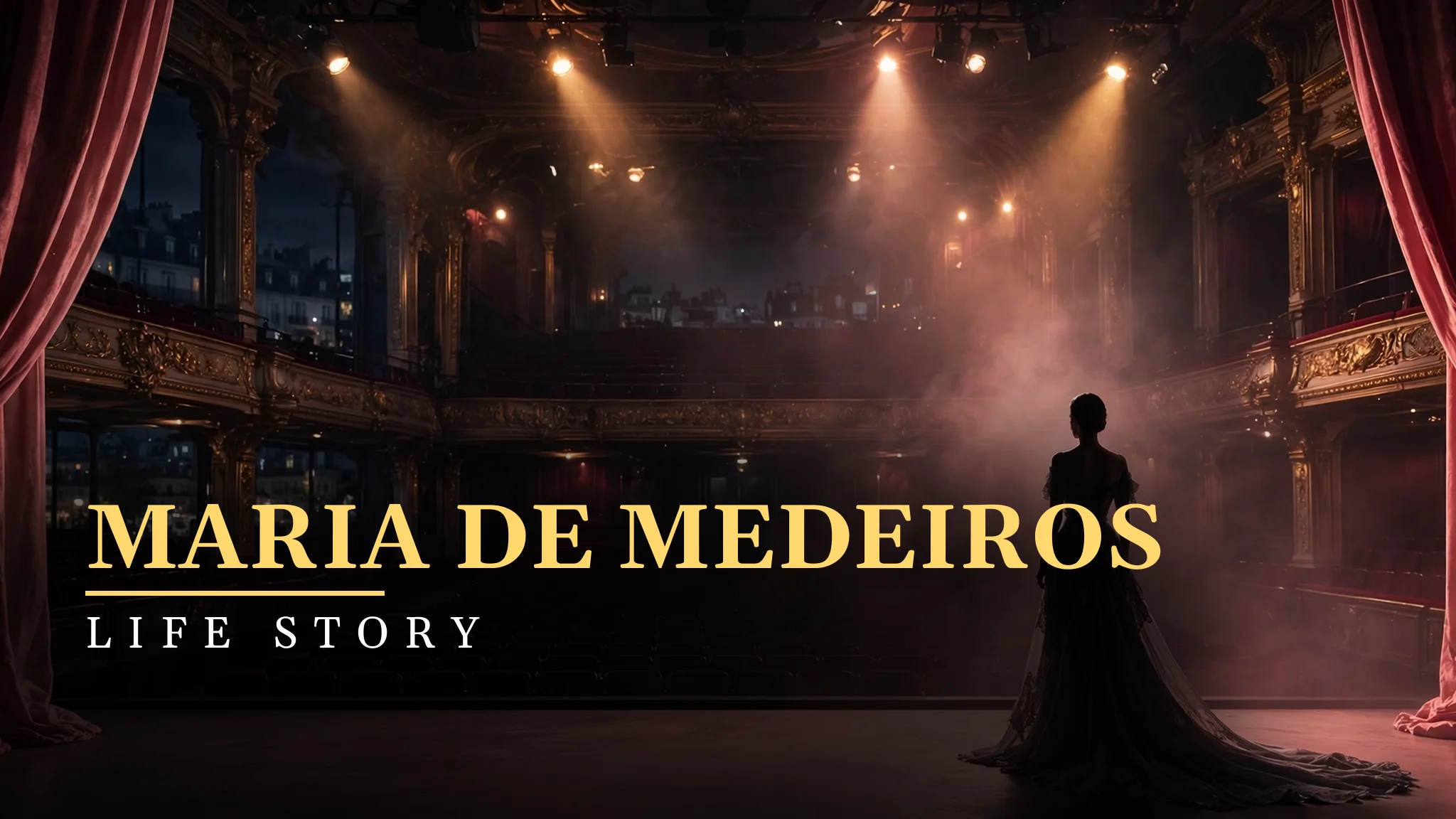
One more thought stays with me, and it is about the image of a woman alone on a grand stage, in a long gown, under warm lights, with empty seats in front of her. That image fits Maria, because she is an actress who is comfortable being alone on a stage, with only her voice and her presence to hold an audience. It takes great confidence to stand alone like that, and Maria has it. She has stood alone on stages in many countries, and she has held audiences with her talent. I think that is a good picture of her whole career: a woman, alone on a stage, telling a story, and the world listening.
In the end, I think Maria de Medeiros teaches us that a life in art does not have to be a life in one place. It can be a life of movement, of learning, and of crossing borders, and it can be richer for it. She was born in Lisbon, she trained in Paris, she acted in Hollywood, and she directed a film about Portugal’s freedom. She did it all with curiosity, with courage, and with a love of art that has never faded. I would tell a young reader to start with Pulp Fiction, then to watch Capitães de Abril, and then to look for her stage work and her songs. You will find an artist who is much bigger than one role, and a woman whose life is a lesson in freedom.
I think about the theatre, and about how Maria has never left it, even after film fame. That tells me she loves acting for its own sake, not only for the rewards it brings. The theatre is a hard life, with low pay, long rehearsals, and small audiences, but it is also the place where an actor is most alive. Maria knows that, and she keeps returning to it, because it is where she feels most herself. I respect that, because it shows that her love of acting is real, and that it is not dependent on fame or money. She acts because she loves to act, and that love is the heart of her career.
I also think about her singing, and about how it shows another side of her talent. A woman who can act, direct, and sing is a woman with many gifts, and Maria uses them all. Her singing is not a hobby. It is a serious part of her art, and it shows her love of music, a love that began in her childhood home, where her father composed. When she sings, she is returning to that home, and she is sharing it with her audience. I think that is a beautiful thing, and it is one reason her concerts feel so warm and so personal.
I think about the languages she speaks, and about the effort it must take to act in four or five of them. Each language has its own music, its own humour, and its own way of feeling, and an actor must learn all of that, not only the words. Maria has done it, and she has done it well, and that tells me she is not only talented. She is also disciplined, curious, and willing to work hard. Those are qualities that matter more than talent alone, because talent without work fades, but talent with work lasts. Maria’s career has lasted because she has worked, in many languages, in many countries, and in many art forms.
I think about her father, and about the shadow of a famous parent. It is not easy to grow up with a father who is a well-known composer, and to make your own name. People compare you, they expect you to be like him, and they watch you closely. Maria met that challenge by finding her own path, by becoming an actress, a director, and a singer, and by making a name that is hers alone. I admire that, because it takes strength to step out of a parent’s shadow and into your own light. She did it, and she did it with grace.
I also think about the future, and about what she might do next. She is still working, still acting, still directing, and still singing, and she shows no sign of stopping. I hope she continues, because the world needs artists like her, artists who are curious, who are brave, and who refuse to stay in one place. I hope young actresses look at her and see that a career can be long, varied, and full of learning, and that it does not have to end when youth ends. Maria’s career is proof of that, and it is an inspiration.
One more thought stays with me, and it is about freedom. Maria’s whole life is a lesson in freedom: freedom to move between countries, freedom to work in many art forms, and freedom to be herself. She did not let anyone put her in a box, and she did not let fame trap her. She stayed free, and she used that freedom to make art that is honest and beautiful. That is a lesson for anyone who wants to live a creative life: stay free, keep learning, and never let one success define you. Maria did that, and her life is the proof that it works.
Frequently Asked Questions
When and where was Maria de Medeiros born?
Maria de Medeiros was born on 19 August 1965 in Lisbon, Portugal, into a family where music and culture were central. Her father was the composer and conductor António Victorino de Almeida, and she grew up surrounded by art and music.
What is Maria de Medeiros best known for?
She is best known internationally as Fabienne in Quentin Tarantino’s Pulp Fiction (1994), and earlier as Anaïs Nin in Henry & June (1990). She is also known as a director, especially for Capitães de Abril (2000), a film about Portugal’s Carnation Revolution.
Did Maria de Medeiros direct films?
Yes, she directed Capitães de Abril in 2000, a film about the 1974 Carnation Revolution in Portugal, and she has directed other films and theatre work. Her directing shows another side of her talent beyond acting.
Where did Maria de Medeiros train as an actress?
She studied acting in Lisbon and then in Paris, where she trained at the Conservatoire and began working in French theatre and film. Her training in both countries gave her the ability to act in Portuguese, French, and English.
Is Maria de Medeiros also a singer?
Yes, she has recorded albums and performed songs in Portuguese, French, and other languages. Her singing is another part of her artistic life, alongside her acting and directing work.
Does Maria de Medeiros still work today?
Yes, she continues to act, direct, and sing, working in Portugal, France, and other countries. Her career has lasted for decades, and she remains a respected figure in European cinema and theatre.


