Maria Schell: The Life Story Behind the Austrian Film Star
In this post
Maria Schell was one of the most loved actresses in European cinema in the 1950s and 1960s, and she was known for a gift that is rare in film: the ability to show deep feeling with a quiet face, a small movement, and a look that stayed with the audience long after the film ended. She was born in Vienna, she grew up in a family of actors, and she became a star in Austria, Germany, France, and Italy. She won Best Actress at the Cannes Film Festival, she was nominated for awards in many countries, and she worked with some of the best directors in Europe. Audiences loved her because she was warm, honest, and real, and because she played women who felt like people you might know.
Her story is also a story about a family. Her brother Maximilian became an Oscar-winning actor, her sister Immy became an actress, and her family was one of the great acting families of Austria. Maria was the eldest of the children who became actors, and she was a star before her brother. She was a woman who worked hard, who loved her family, and who faced hard times in her later life with courage. She died in Austria in 2005, at the age of seventy-nine, and she left behind a body of work that still moves people who watch her films today.
This is the story of a girl from Vienna who became a European star, who played women in pain, in love, and in hope, and who showed that a quiet performance can be more powerful than a loud one. It is a story about talent, about family, about the golden age of European film, and about a woman who gave her whole heart to her work.
A Family of Actors in Vienna
Maria Schell was born on 15 January 1926 in Vienna, Austria, into a family that lived and breathed the theatre. Her father, Hermann Ferdinand Schell, was a Swiss poet, novelist, and playwright, and her mother, Margarethe Noé von Nordberg, was an actress. The family home was full of books, plays, and talk about acting, and Maria grew up hearing about the stage from the very start. She was the eldest child, and she learned early that acting was not only a job. It was a way of life, a way of thinking, and a way of telling the truth about people. Her younger brother Maximilian and her sister Immy would also become actors, and the Schell family would become famous in European theatre and film.
Her childhood was shaped by the Second World War. The family left Vienna and lived in Switzerland for a time, and Maria grew up in a world that was changing fast. She was a young girl who liked to act, who liked to perform, and who had a natural warmth that people noticed. She was not a loud child. She was thoughtful, she watched people, and she learned to understand feelings. She studied acting, she worked in theatre, and she began to build a career while she was still young. The war years were hard, but they also taught her to be strong, to be patient, and to value family, and those lessons stayed with her for the rest of her life.
When the war ended, Maria began to work in films in Switzerland and Austria. She appeared in small roles, she learned how a film set worked, and she began to show her talent. She was a young woman with a beautiful face and a warm smile, but she was also a serious actress who cared about her roles. She did not want to be only a pretty star. She wanted to play real women, women with problems, with feelings, and with strength. Her early films gave her a chance to learn, and they gave directors a chance to see that she was a special talent. She was on her way to becoming a star, and she was doing it with hard work and with honesty.
The most important thing about those early years is that Maria came from a family that understood acting, and she learned from them. She learned from her mother, she learned from her father, and she later learned with her brother Maximilian. Acting was a family business, but it was also a family love, and Maria carried that love with her into every film she made. She was a daughter of the theatre, and she would spend her whole life trying to be true to that theatre, to tell stories that mattered, and to play women who felt real.
The Last Bridge, Cannes, and Stardom
Maria Schell became a star in the 1950s, when she appeared in a series of films that showed her talent to audiences across Europe. One of her most important early films was The Last Bridge, made in 1954, a film about a German doctor who is captured by Yugoslav partisans during the Second World War. Maria played the doctor with great skill, showing a woman who is strong, who is afraid, and who learns to understand the people around her. The film was a success, and it won her the Best Actress award at the Cannes Film Festival in 1954. It was a huge honour, and it made her known around the world as a serious actress.
She followed that success with other important films, including Gervaise in 1956, based on the novel by Émile Zola. In Gervaise, she played a woman who works in a laundry in Paris, who tries to build a better life, and who faces poverty, love, and loss. The film was a great success, it was nominated for an Oscar for Best Foreign Language Film, and Maria’s performance was praised for its honesty and its power. She showed a woman who was poor, who was hopeful, and who was broken by life, and she did it with a warmth that moved audiences. It remains one of her most famous roles, and it is still watched today as an example of great acting.
During those years, she also worked in Germany, France, and Italy, and she became one of the most popular actresses in Europe. She starred in films such as The Brothers Karamazov in 1958, a film based on the novel by Dostoevsky, in which she played Grushenka, and White Nights in 1957, directed by Luchino Visconti. She worked with famous directors, she worked with famous actors, and she was in demand. She was a star who could play in many languages, in many countries, and in many kinds of films, and she did it with a natural ease that made her work feel real.
The 1950s were the peak years of her fame. She was on magazine covers, she was interviewed, and she was loved by audiences in many countries. But she was not only a star. She was a serious actress who cared about her roles, who worked hard, and who chose films that mattered to her. She was known for her warmth, for her kindness, and for her ability to show feeling without overacting. That is a rare gift, and it is why her films from this time are still remembered. She was a star of the golden age of European cinema, and she earned that place with talent and with hard work.
Working Across Europe in Many Languages
One of the most remarkable things about Maria Schell was her ability to work in many languages and in many countries. She acted in German, in French, in Italian, and in English, and she did it with a naturalness that made audiences forget that she was not a native speaker. She worked in Austria, in Germany, in France, in Italy, and in Britain, and she was at home in each place. She was a European actress in the truest sense, a woman who belonged to all of Europe, not only to one country. That was rare in the 1950s, and it made her a symbol of European cinema.
She worked with directors such as Luchino Visconti, René Clément, and Helmut Käutner, and she learned from each of them. She was a actress who listened, who watched, and who adapted to different styles. In France, she learned a French way of acting, in Italy she learned an Italian way, and in Germany she kept her Austrian roots. She was flexible, she was open, and she was willing to learn. That openness made her a better actress, and it made her films richer. She was not afraid to try new things, and she was not afraid to work in a language that was not her own.
Her work in many countries also meant that she travelled a great deal, she met many people, and she lived a life that was full of change. She was married twice, first to the director Horst Hächler and later to the actor Veit Relin, and she had children. She tried to balance her work with her family life, and she tried to be a good mother as well as a good actress. It was not always easy, because the life of a film star is a life of travel, of long days, and of time away from home. But she tried, and she kept her family close, even when work took her far away.
During the 1960s, she continued to work in films and in television, and she remained a popular actress. She appeared in films in many countries, she worked in theatre, and she kept her reputation as a warm and honest actress. She was no longer the young star of the 1950s, but she was a mature actress with a deep understanding of her craft. She played mothers, wives, and women facing hard times, and she played them with the same warmth and honesty that had made her famous. Her ability to work across Europe, in many languages, remains one of the most impressive parts of her career.
A Sister, a Mother, and a Life in the Public Eye
Maria Schell’s family life was closely tied to her career. Her brother Maximilian became a famous actor, winning an Oscar for Judgment at Nuremberg in 1961, and her sister Immy also acted. The Schell family was often in the news, and Maria was proud of her brother and sister. She had been a star first, and she watched with pride as Maximilian became a world-famous actor. They were a family of actors who supported each other, who understood the pressure of fame, and who shared a love of theatre and film. Maria was the eldest, and she was a kind of anchor for the family, a warm and caring sister who was always there.
She was married twice, and she had two children, a son and a daughter. She loved her children, and she tried to give them a normal life, even though their mother was a famous star. She lived in Austria and Germany, she worked, and she tried to keep her family life private. But the life of a star is never fully private, and the press often wrote about her, about her family, and about her marriages. She faced that pressure with dignity, and she did not let it stop her from working or from loving her family. She was a woman who valued family, and who tried to protect it, even in the public eye.
In her later years, Maria faced health problems and personal difficulties. She had a stroke, she had problems with her health, and she lived a quieter life. She was no longer making many films, but she was still remembered, still loved, and still respected by people who had watched her films. She lived in Austria, she was cared for by her family, and she spent her last years in a peaceful place, away from the cameras. She was a woman who had given a great deal to film, and who now needed rest and care.
She died on 26 April 2005 in Preitenegg, Austria, at the age of seventy-nine. Her death was reported in Austria, Germany, and France, and people remembered her as a great actress of European cinema. Her brother Maximilian spoke of her with love, and her family mourned her. She was buried in Austria, in the country where she was born, and where she had lived her last years. Her life had come full circle, from Vienna to the world and back to Austria, and her story remains a touching part of European film history.
The Later Years and a Quiet Goodbye
In the 1970s and 1980s, Maria Schell worked less in film and more in television and theatre. She appeared in television films and series in Germany and Austria, and she continued to act, even though she was no longer the young star of the 1950s. She played older women, mothers, and grandmothers, and she brought the same warmth and honesty to those roles that she had brought to her early films. She was a mature actress, and she was respected for her experience, her skill, and her kindness. She was a woman who had spent her life acting, and she did not want to stop, even when the roles became smaller.
She also faced difficult times in her later life. She had health problems, she had financial problems at times, and she was open about the fact that life had not always been easy. She was a star who had been famous, and now she was living a quieter life, and that change was hard. But she faced it with courage, and she did not complain. She was grateful for her family, for her friends, and for the work she had done. She was a woman who had lived a full life, and who accepted the later years with dignity.
Her last years were spent in Austria, where she was cared for by her family. She had a stroke in the 1990s, and her health declined. She lived in a care home for a time, and she was visited by her family. She died in 2005, and her death marked the end of an era in European cinema. She was one of the last great stars of the 1950s, a woman who had worked with the best directors, who had won at Cannes, and who had moved audiences in many countries. Her death was sad, but it was also a moment to remember a life well lived, a career well spent, and a woman who had given her heart to her art.
Today, Maria Schell is remembered as a warm and honest actress, a star of European cinema, and a member of one of Austria’s great acting families. Her films are still shown, her performance in Gervaise is still praised, and her Cannes win is still remembered. She is not as famous today as she was in the 1950s, but her work is still there, waiting to be discovered by new audiences. She was a woman who acted with her heart, and that heart is still visible in her films.
A Legacy of Warmth and Honest Acting
Maria Schell’s legacy is a legacy of warmth, honesty, and quiet power. She showed that an actress does not need to shout or to overact to move an audience. She can be quiet, she can be warm, and she can show feeling with a look, with a pause, and with a small gesture. That is a lesson that many young actors can learn from her. She was a master of subtle acting, and her films are still studied by people who want to learn how to act with truth.
Her legacy is also in her family. She was part of the Schell family, a family that gave European cinema two great actors, Maria and Maximilian, and that family is still remembered in Austria. She was the eldest, she was the first star, and she paved the way for her brother. She showed that a girl from Vienna could become a star in many countries, in many languages, and in many kinds of films. That is a legacy that matters, and it is a legacy that will last.
Her films, especially Gervaise and The Last Bridge, remain important works of European cinema. They are films about real people, about poverty, about war, about love, and about hope, and they are films that still speak to audiences today. Maria’s performances in those films are still moving, still honest, and still powerful. She left behind a body of work that is rich, varied, and deeply human, and that work is her true legacy. She was a star who acted with her heart, and her heart is still in her films.
The Quiet Power of a Look
Maria Schell’s acting was known for its quiet power, for the way she could show deep feeling with a look, a pause, and a small movement. She did not need big gestures or loud speeches to move an audience. She could look at another actor, and the audience could see love, pain, hope, or fear in her eyes. That gift is rare, and it is one that film directors valued, because the camera can see a look very clearly, and it can capture a feeling that words cannot. Maria understood the camera, she trusted it, and she let it see her feelings. That trust made her performances feel intimate, as if she was speaking directly to each person in the audience.
Her work in Gervaise is a perfect example of that quiet power. She plays a woman who is poor, who works in a laundry, and who tries to build a better life, and she shows that woman’s hope and her pain with a warmth that is deeply moving. She does not overact. She is simple, she is honest, and she lets the audience feel what she feels. That simplicity is hard to achieve, because it requires a great deal of skill and a great deal of courage to be simple on screen. Maria had that skill, and she had that courage, and her performance in Gervaise is still praised today as one of the great performances in European cinema.
Her Cannes win for The Last Bridge also showed her quiet power. She played a doctor in wartime, a woman who is strong, who is afraid, and who learns to understand the people around her, and she did it with a dignity that moved the jury at Cannes. She was not a loud actress. She was a quiet actress, and Cannes recognised that quiet power with its highest acting honour. That recognition is a testament to her talent, and it is a reminder that a quiet performance can be the most powerful of all.
My Take:
When I think about Maria Schell, I think about warmth, and I think about a kind of acting that is quiet but very strong. She did not shout, she did not overact, and she did not try to be dramatic in a loud way. She acted with her eyes, with a small smile, with a pause, and with a feeling that was real. I think that is a rare gift, and it is a gift that is easy to miss if you are looking for big performances. Maria’s performances are like a quiet conversation with a friend: they do not shout at you, they speak to you, and they stay with you. I admire that, because it takes more skill to be quiet and true than to be loud and false. She was a master of that quiet truth, and I think her films deserve to be watched more today.
I think about Gervaise, and I feel the power of her performance. She plays a woman who works in a laundry in Paris, who tries to build a better life, and who faces poverty and loss. It is not a glamorous role. It is a role about a poor woman, a working woman, a woman who is trying to survive. Maria played her with dignity, with warmth, and with an honesty that makes you care for her. You do not watch Gervaise and think about a star. You watch her and think about a real woman, a woman you might know, a woman who is trying her best. That is a great achievement, and it is why her performance is still praised. She made a poor woman into a hero, not by making her grand, but by making her real.
What impresses me is her ability to work in many languages and in many countries. She acted in German, French, Italian, and English, and she did it with ease. That is not easy, and it shows a kind of openness, a willingness to learn, and a respect for other cultures. She was a European actress, not only an Austrian one, and she belonged to all of Europe. I think that is a beautiful thing, especially today, when Europe is often divided. Maria showed that art can cross borders, that a story can be told in many languages, and that a woman from Vienna can move audiences in Paris, Rome, and London. That is a lesson about openness, about learning, and about the power of art to bring people together.
I also think about her family, and I feel a deep warmth. She was the eldest child in a family of actors, she was a star before her brother Maximilian, and she watched him become an Oscar winner. She was proud of him, and he was proud of her, and they shared a love of acting that came from their parents. That family bond is a beautiful part of her story. Acting was not only a job for the Schells. It was a family love, a way of life, and a way of being together. Maria was the anchor of that family, a warm and caring sister, and I think that tells me a lot about who she was. She was not only a star. She was a sister, a mother, and a daughter, and she cared for her family deeply.
What saddens me is her later life, when she faced health problems and when she lived more quietly. She had been a star, she had been loved by millions, and then she faced illness, a stroke, and a quieter life in a care home. That is a hard change, and it is a change that many stars face. Fame does not protect you from illness, and it does not protect you from old age. Maria faced those years with dignity, and she did not complain. I respect that dignity, and I feel compassion for her. She gave a great deal to film, and she deserved a peaceful and happy later life. I wish she had had more comfort, more care, and more recognition in her last years, because she had earned it with a lifetime of work.
I think about her Cannes win for The Last Bridge, and I am glad that she was honoured while she was young and active. She won Best Actress at Cannes in 1954, and that was a recognition of her talent at a time when she was at her peak. That is important, because many artists are only recognised after they are gone. Maria was recognised in her lifetime, and she knew that her work was valued. That must have meant a great deal to her, and it is a good thing that the film world honoured her when she could still enjoy it. I think we should honour artists while they are alive, and Maria’s Cannes win is a good example of that.
If I compare Maria with other actresses of her time, I think what makes her special is her warmth. Many actresses are beautiful, many are talented, but Maria had a warmth that made audiences feel close to her. She was not distant or cold. She was warm, she was human, and she made you feel that she understood you. That warmth is a rare quality, and it is why people loved her. She played women who were in pain, but she played them with warmth, and that warmth made the pain bearable. I think that is a gift, and it is a gift that I want to remember: to be warm, to be kind, and to show feeling with honesty is a strength, not a weakness.
For a young reader, I think the lesson is to act with truth, not with noise. Maria did not need to shout to be heard. She spoke quietly, she acted with honesty, and she was heard around Europe. That tells me that you do not need to be loud to be powerful. You need to be true, to be honest, and to care about the people you are playing or the work you are doing. If you do that, people will listen, even if you speak quietly. That is a lesson for actors, for writers, for singers, and for anyone who wants to be heard. Be true, be warm, and be honest, and your work will last.
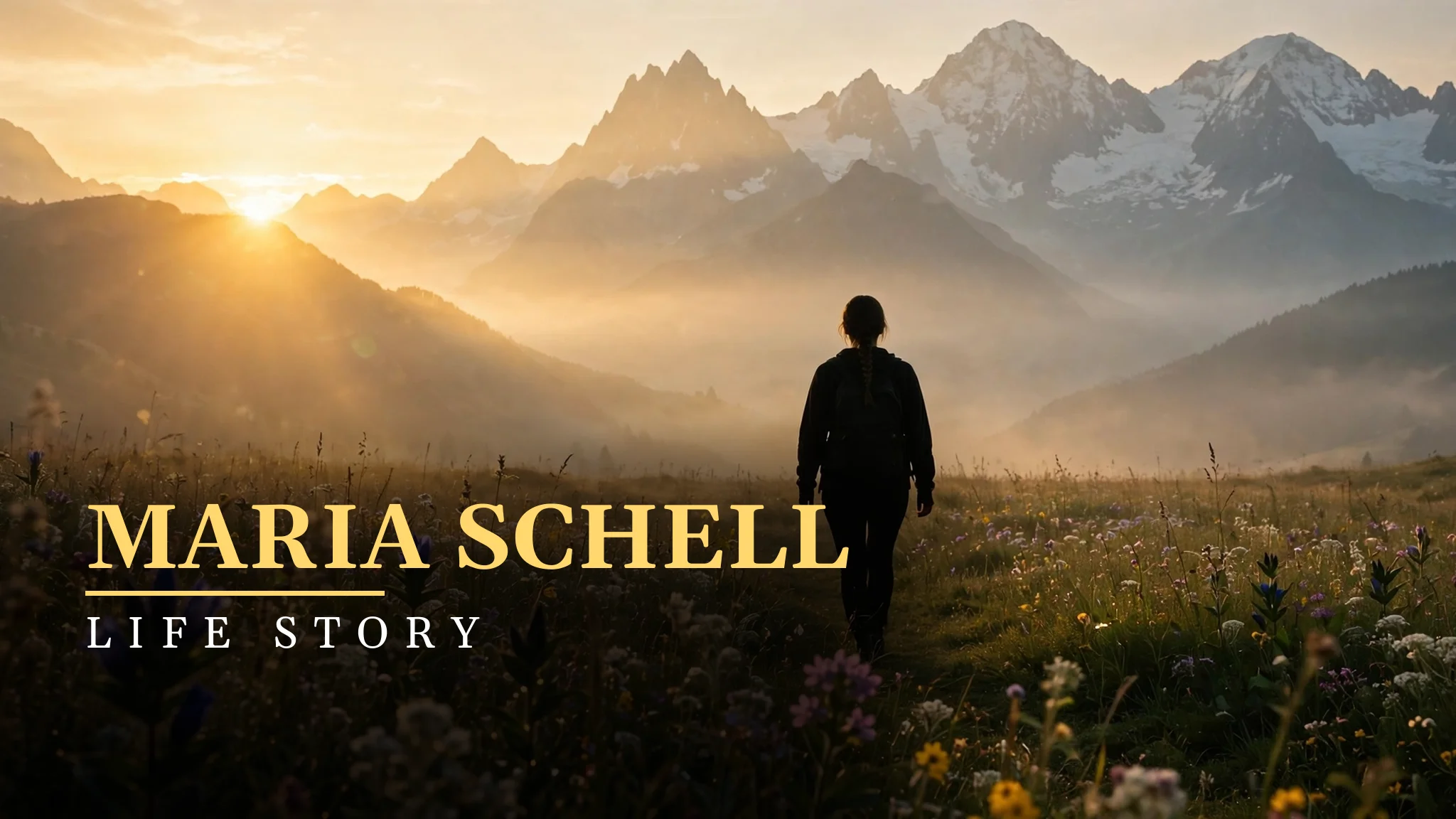
I keep thinking about the image of Maria walking through a meadow at sunrise, facing the mountains, and I think it fits her. She was a woman who faced life with hope, with warmth, and with a quiet strength, like a person walking towards the light. She was not a star who chased fame. She was a woman who loved her family, loved her work, and tried to be true to herself. That is a life worth honouring, and a story worth telling. I will remember her as a warm and honest actress, a sister, a mother, and a star of European cinema who gave her heart to her films.
In the end, I think Maria Schell teaches us that a quiet performance can be the most powerful, that warmth can move an audience more than drama, and that a life lived with family, with work, and with honesty is a good life. She was a girl from Vienna who became a star, who won at Cannes, who worked across Europe, and who faced her later years with dignity. She did not have a loud or dramatic ending, but she had a life that mattered, and films that still move people. That is a legacy I respect, and a story I will not forget.
One more thought stays with me, and it is about her brother Maximilian. Maria and Maximilian were two stars from one family, and they both achieved great things. Maria won at Cannes, Maximilian won an Oscar, and together they showed that talent can run in a family, but it also needs hard work, courage, and love. I think their story is a reminder that family matters, that support matters, and that a sister who paves the way for her brother is a gift. Maria paved the way, and Maximilian followed, and both of them made European cinema richer. That is a family legacy worth celebrating.
I think about Maria’s quiet power, and I realise how much it matters in a world that is often loud. Many actors try to be big, to shout, to gesture, and to be noticed, but Maria was quiet, and she was noticed because she was true. She showed feeling with a look, with a pause, and with a small movement, and that quietness made her performances feel real. I think that is a lesson for all of us: you do not need to shout to be heard. You need to be true, to be honest, and to let your feelings show in a quiet way. Maria did that, and her films are still moving because of it.
I also think about her family, and about how acting was a family love for the Schells. She was the eldest, she was a star first, and she watched her brother Maximilian become an Oscar winner. She was proud of him, and he was proud of her, and they shared a love of theatre that came from their parents. That family bond is a beautiful part of her story, because it shows that talent can be shared, that support matters, and that a sister who paves the way for her brother is a gift. I think their story is a reminder that family matters, and that we should support each other, even when we are both stars.
There is a warmth in Maria’s work that I love, a warmth that makes audiences feel close to her. She was not distant or cold. She was warm, she was human, and she made you feel that she understood you. That warmth is a rare quality, and it is why people loved her. She played women who were in pain, but she played them with warmth, and that warmth made the pain bearable. I think that is a gift, and it is a gift that I want to remember: to be warm, to be kind, and to show feeling with honesty is a strength, not a weakness. Maria did that, and her films are warmer for it.
I think about her later life, when she faced illness and a quieter life, and I feel compassion for her. She had been a star, she had been loved by millions, and then she faced a stroke, health problems, and a life in a care home. That is a hard change, and it is a change that many stars face. Fame does not protect you from illness, and it does not protect you from old age. Maria faced those years with dignity, and she did not complain. I respect that dignity, and I wish she had had more comfort and more recognition in her last years, because she had earned it with a lifetime of work.
Another thought stays with me, and it is about her ability to work in many languages. She acted in German, French, Italian, and English, and she did it with ease. That is not easy, and it shows a kind of openness, a willingness to learn, and a respect for other cultures. She was a European actress, not only an Austrian one, and she belonged to all of Europe. I think that is a beautiful thing, especially today, when Europe is often divided. Maria showed that art can cross borders, that a story can be told in many languages, and that a woman from Vienna can move audiences in Paris, Rome, and London. That is a lesson about openness that still matters.
I keep thinking about the image of Maria walking through a meadow at sunrise, facing the mountains, and I think it fits her. She was a woman who faced life with hope, with warmth, and with a quiet strength, like a person walking towards the light. She was not a star who chased fame. She was a woman who loved her family, loved her work, and tried to be true to herself. I will remember her as a warm and honest actress, a sister, a mother, and a star who gave her heart to her films.
Frequently Asked Questions
When was Maria Schell born and when did she die?
Maria Schell was born on 15 January 1926 in Vienna, Austria, and she died on 26 April 2005 in Preitenegg, Austria, at the age of seventy-nine.
What film won Maria Schell Best Actress at Cannes?
She won Best Actress at the Cannes Film Festival in 1954 for The Last Bridge, a film about a German doctor captured by Yugoslav partisans during the Second World War.
What is Gervaise and why is it famous?
Gervaise, made in 1956 and based on the novel by Émile Zola, stars Maria Schell as a Paris laundry worker trying to build a better life. The film was a great success and was nominated for an Oscar for Best Foreign Language Film.
Who were Maria Schell’s famous family members?
Her brother was the Oscar-winning actor Maximilian Schell, her sister Immy was also an actress, her father was the writer Hermann Ferdinand Schell, and her mother was the actress Margarethe Noé von Nordberg.
In which languages did Maria Schell act?
She acted in German, French, Italian, and English, and she worked in Austria, Germany, France, Italy, and Britain, becoming one of the great European actresses of the 1950s and 1960s.
Was Maria Schell married and did she have children?
Yes, she was married twice, to the director Horst Hächler and later to the actor Veit Relin, and she had two children, a son and a daughter.
What happened to Maria Schell in her later years?
In her later years she worked more in television and theatre, faced health problems including a stroke, and lived a quieter life in Austria before her death in 2005.


