Marina Abramović: The Life Story Behind the Fearless Artist
In this post
- Belgrade, Partisan Parents, and a Strict Home
- Art School, the Body, and the Rhythm Series
- Ulay, Love, and the Great Wall Walk
- Balkan Baroque, the Golden Lion, and a New Fame
- The Artist Is Present and the MoMA Show
- Teaching, the Method, and a Life Still in Progress
- The Body as Art, the Audience as Partner
- The Memoir, the Film, and Teaching a New Generation
- My Take:
Marina Abramović is the most famous performance artist in the world, and she became famous by doing something that most artists would never dare to do, which is to use her own body as the work of art. She has cut herself, she has sat still for hundreds of hours, she has stared into the eyes of strangers, and she has asked audiences to do things to her that no one should ever do to another person. People call her fearless, and they are right, but fearlessness is only part of her story.
She was born in Belgrade, in what was then Yugoslavia, to parents who had been heroes in the Second World War, and she grew up in a strict home where discipline, duty, and control were part of everyday life. She learned to be strong, to endure pain, and to keep going when things were hard, and those lessons became the foundation of her art. She did not become an artist who painted pictures to hang on a wall. She became an artist who put her body on the line, and who asked the audience to look, and to think, and sometimes to take part.
What makes her story worth telling is how long she has kept going, and how far she has taken an art form that many people did not understand at first. She worked for years in small galleries, with little money and little fame, and then, in her sixties, she became a star, with a show at the Museum of Modern Art in New York that drew hundreds of thousands of people. She is still working, still teaching, and still asking hard questions about the body, about pain, and about what it means to be present with another person.
This is the story of a girl from Belgrade who became the grandmother of performance art, a woman who turned her own life, her own body, and her own pain into art, and who changed the way the world thinks about what art can be.
Belgrade, Partisan Parents, and a Strict Home
Marina Abramović was born on 30 November 1946 in Belgrade, the capital of Serbia, which was then part of Yugoslavia, just after the end of the Second World War. Her parents, Vojin and Danica, had both been Partisans, fighters in the resistance against the Nazis, and they were heroes in the new Yugoslavia. Her father was a general, and her mother was a major, and they were strict, disciplined people who believed in duty, in order, and in the Communist Party. Their home was not a warm and easy place for a child.
As a girl, Marina lived under strict rules. Her mother controlled her life in detail, telling her what time to come home, what to wear, and how to behave, and she enforced those rules with a firm hand. Marina has spoken about how hard that was, and how it made her feel trapped, but she has also said that it taught her discipline, endurance, and the ability to control her body and her mind. She learned to sit still, to bear pain, and to keep going, and those lessons stayed with her for the rest of her life.
She was a bright child, and she was drawn to art from an early age. She liked to paint, she liked to draw, and she liked to imagine worlds that were different from the strict home she lived in. Art gave her a freedom that everyday life did not, a place where she could express feelings that she was not allowed to express at home. She studied art at the Academy of Fine Arts in Belgrade, and she began to think about what kind of artist she wanted to be.
The Belgrade of her youth was a city rebuilding after war, with new buildings, new ideas, and a sense that the future could be different from the past. Young artists in Belgrade in the 1960s and 1970s were experimenting with new forms, with performance, with video, and with the body, and Marina was part of that world. She was not content to paint pictures. She wanted to do something more direct, more physical, and more honest.
Her parents’ war shaped her in another way too, because she grew up hearing stories of courage, of suffering, and of sacrifice, and she learned that the body could endure a great deal. She also learned that pain was a part of life, not something to be hidden, and that a person could face it and survive. Those ideas became central to her art, and they explain why she was willing to put her body through things that other artists would never attempt.
Art School, the Body, and the Rhythm Series
At the Academy of Fine Arts in Belgrade, Abramović studied painting, but she soon became interested in performance, in using her own body as the material of her art. She was part of a group of young artists in Belgrade who were experimenting with new ideas, and she began to make works in which she did things to her body, or asked the audience to do things, in order to test the limits of endurance, of pain, and of control. It was a bold choice, and it was not understood by everyone.
In the early 1970s, she made a series of works called the Rhythm series, in which she tested her body in extreme ways. In Rhythm 10, she played a knife game with her hands, stabbing a knife between her fingers faster and faster, and cutting herself when she made a mistake. In Rhythm 5, she lay inside a burning star shape and lost consciousness from lack of air. In Rhythm 2, she took drugs that affected her muscles and her mind, and she let the audience watch her body react. These were dangerous works, and they shocked many people.
The most famous work of that time was Rhythm 0, performed in Naples in 1974, in which she stood still for six hours next to a table with seventy-two objects on it, including a rose, a feather, a whip, a scalpel, and a loaded gun, and she invited the audience to use the objects on her as they wished. At first, people were gentle, but as time passed, some became cruel, cutting her clothes, cutting her skin, and pointing the gun at her. The work showed, in a frightening way, how quickly people can become violent when they are given permission, and it became one of the most talked-about works in modern art.
These early works made her famous in the art world, but they also made her a controversial figure. Some people said she was brave, and that she was asking important questions about violence, about control, and about the audience’s responsibility. Others said she was reckless, and that she was putting herself in danger for no good reason. She did not stop. She believed that art should be honest, and that honesty meant facing pain, not hiding from it.
By the late 1970s, she was known across Europe as one of the leading performance artists of her generation. She had left painting behind, and she had made the body her canvas. She was still young, but she had already made works that would be studied for decades, and she had shown that performance art could be as serious, as powerful, and as disturbing as any other kind of art.
Ulay, Love, and the Great Wall Walk
In 1975, Abramović met Ulay, a German artist whose real name was Frank Uwe Laysiepen, and they began a partnership that lasted for twelve years, as lovers, as collaborators, and as fellow artists. They lived together, they worked together, and they made some of the most famous performance works of the twentieth century, works in which two bodies became one work of art. They were a striking pair, and their work together changed the way people thought about performance.
Together, they made works in which they leaned against each other, breathed each other’s breath, screamed at each other, and pushed each other to the limits of endurance. In one work, they sat back to back for hours, sharing breath through a tube. In another, they ran at each other and collided, again and again, until they were exhausted. Their work was about trust, about dependence, and about what happens when two people give themselves completely to each other and to the work.
In 1988, they decided to end their partnership with a final work, a walk along the Great Wall of China. Abramović started at one end, in the east, and Ulay started at the other end, in the west, and they walked toward each other for ninety days, covering thousands of kilometres. When they met in the middle, they embraced, and then they said goodbye. It was a beautiful and sad ending to a great partnership, and it became one of the most famous performances in art history.
The walk was hard, with long days of walking, with heat, with cold, and with loneliness, but it was also a work about a relationship ending, about two people who had shared everything and who were now going their separate ways. Abramović has spoken about how painful it was, and how it taught her about letting go, about the end of love, and about the need to move on. It was not just a walk. It was a farewell.
After Ulay, she worked alone again, and she had to find a new way of working without a partner. That was a difficult time, but it also freed her to explore new ideas, to work with the audience in new ways, and to become a solo artist in her own right. The years with Ulay had made her famous, but the years after him made her into the artist the world knows today.
Balkan Baroque, the Golden Lion, and a New Fame
In the 1990s, Abramović made works that dealt with the wars in Yugoslavia, and with the pain of her home country breaking apart. In 1997, she performed Balkan Baroque at the Venice Biennale, one of the most important art exhibitions in the world, in which she sat for hours scrubbing bloody cow bones, singing folk songs from the Balkans, in a room filled with the smell of the bones and with video images of her parents. It was a powerful work about war, about cleaning, and about the impossibility of washing away blood, and it won the Golden Lion, the top prize at the Biennale.
Balkan Baroque showed that she could take the pain of her country and turn it into art that spoke to people everywhere. A viewer did not need to know the details of the wars in Yugoslavia to understand a woman scrubbing bones, trying to clean something that could not be cleaned. The work was visceral, it was smelly, it was uncomfortable, and it was unforgettable, and it made her one of the most respected artists in the world.
In the years that followed, she continued to make works about the body, about endurance, and about the audience, including works in which she sat still for long periods, in which she lay under a skeleton, and in which she invited the audience to sit with her. She also began to teach, to write, and to think about how performance art could be preserved, since a performance, unlike a painting, disappears when it ends. She founded the Marina Abramović Institute, to support performance art and to teach young artists her method.
She also became a public figure in a new way, with books, with films, and with interviews in which she spoke about her life, her art, and her ideas. She was no longer only an artist for the art world. She was a person whose name was known to a wider public, and whose work was discussed in newspapers and on television. She was in her sixties, and she was more famous than she had ever been.
The Golden Lion and the years that followed proved that her early work had not been a passing fashion. She had built a career that lasted for decades, and she had made works that were still relevant, still powerful, and still talked about. She was not a young artist anymore. She was a master, and the art world treated her as one.
The Artist Is Present and the MoMA Show
In 2010, the Museum of Modern Art in New York, MoMA, held a major retrospective of Abramović’s work, called The Artist Is Present, and it became one of the most famous art exhibitions of the twenty-first century. The centrepiece was a performance in which she sat still in a chair, in the museum, for seven hours a day, six days a week, for three months, a total of more than seven hundred hours, and visitors were invited to sit opposite her, one at a time, and to look into her eyes in silence. More than a thousand people sat with her, and many cried, and many said it changed their lives.
The performance was simple, and that simplicity was its power. There was no music, no speaking, no movement, just two people looking at each other. In a world full of noise, of phones, and of hurry, sitting still and looking into another person’s eyes felt radical, and it made people feel seen in a way they rarely felt in everyday life. The show drew huge crowds, with people queuing for hours to sit with her, and it made her a star far beyond the art world.
One of the most famous moments came when Ulay, her former partner, came to sit opposite her, after many years apart, and they looked at each other and reached out and held hands. It was a moment that moved many people, because it was a meeting of two people who had shared a great love and a great art, and who had not seen each other for a long time. The photograph of that moment was shared around the world, and it became an image of forgiveness and of connection.
The MoMA show also included re-performances of her early works by young artists, and it showed the full range of her career, from the dangerous works of the 1970s to the quiet works of the 2010s. It proved that performance art could fill a major museum, that it could draw crowds, and that it could change people’s lives. It also made Abramović a household name, a person whose work was known to people who had never been to an art gallery.
After MoMA, she became a global figure, with exhibitions, books, and a film about her life, and she continued to work, to teach, and to perform. She was in her sixties and seventies, and she was still pushing herself, still sitting still for long hours, still asking audiences to be present, and still believing that art could change a person. The show was not an ending. It was a new beginning.
Teaching, the Method, and a Life Still in Progress
Since the MoMA show, Abramović has focused on teaching and on passing on her knowledge to younger artists. She developed the Abramović Method, a set of exercises in breathing, in stillness, in walking, and in looking, designed to help people become more present, more aware, and more open. She has taught the method in workshops around the world, to artists, to students, and to people who have never made art, and she believes it can help anyone to live more fully.
She has also continued to make new work, including performances in which she sits, walks, and interacts with audiences in new ways, and she has worked with musicians, with fashion designers, and with filmmakers, bringing performance art into new places. She has written a memoir, Walk Through Walls, in which she tells the story of her life, her parents, her lovers, and her art, with honesty and with humour, and it became a bestseller in many countries.
She lives between New York and the wider world, and she is still a striking figure, with her long dark hair, her strong presence, and her willingness to speak her mind. She has been criticised, she has been praised, and she has been misunderstood, but she has never stopped working, and she has never stopped believing that art matters. She is in her late seventies, and she is still planning new works, still teaching, and still looking for new ways to be present.
Her legacy is already clear. She is known as the grandmother of performance art, a title she accepts with pride, and she has inspired a generation of young artists who use their bodies, their voices, and their presence in their work. She has shown that a woman artist can be strong, can be fearless, and can be respected, and that performance art is a serious art form, not a passing fashion.
Her story is still being written, and that is part of its power. She is not a figure from the past. She is a living artist, still working, still teaching, and still asking the same question she asked in Rhythm 0, which is what happens when a person is truly present, truly honest, and truly willing to face another person without hiding. That question has no easy answer, and that is why her work still matters.
The Body as Art, the Audience as Partner
Looking back, Abramović’s career is a story of a woman who took the hardest material she had, her own body, and made it into art. She did not paint a picture of pain. She lived it, in front of an audience, and she asked the audience to live it with her. That is a brave and frightening thing to do, and it is why her work is still talked about, still studied, and still argued about.
Her legacy is not only in the works she made, but in the way she changed the art world. She proved that performance could fill a museum, that a woman could be a leading artist in a field that was once dominated by men, and that an audience could be a partner in a work of art, not just a spectator. She also proved that an artist can keep growing, from the dangerous works of youth to the quiet works of age, without losing her power.
Young artists today look up to her, not only because she is famous, but because she is still working, still learning, and still willing to take a risk. She did not become a star and then stop. She kept going, and she kept asking hard questions, and that is a lesson that lasts longer than any single performance.
She remains a woman from Belgrade who became a world artist, a person who turned a strict childhood, a painful love, and a broken country into art that speaks to people everywhere. Her story is a reminder that art is not only about beauty. It is also about truth, about pain, and about the courage to be present, and that is a story worth telling.
Today, when people sit opposite a stranger and look into their eyes, when they sit still and breathe, when they ask what it means to be present, they are living in a world that Marina Abramović helped to make. Her work is not finished, and her influence is not finished, and that is the best tribute an artist can receive.
The Memoir, the Film, and Teaching a New Generation
Her memoir, Walk Through Walls, published in 2016, is one of the most honest books by an artist in recent years, because it tells the story of her life, her strict parents, her lovers, her performances, and her art, with a directness that does not hide the pain, the fear, or the joy, and it became a bestseller in many countries, read by people who had never been to an art gallery, and who discovered, through her words, a woman who had lived a remarkable life, and who was willing to share it.
The book also gave her a new audience, of readers who knew her name, but who did not know her story, and who learned, through her memoir, about Rhythm 0, about Ulay, about the Great Wall, and about MoMA, and who came to understand why her work mattered, and why she had been willing to put her body through so much, for art, and for truth, and that understanding, spread through a book, is a form of teaching, as powerful as any workshop.
A documentary film about her, Marina Abramović: The Artist Is Present, released in 2012, also brought her work to a wider audience, showing the MoMA performance, the preparations, the visitors, and the moment when Ulay sat opposite her, and the film was watched by many people, in cinemas and on television, and it made her a household name, a person whose work was known to people who had never been to a museum, and whose story was told in a way that was moving, and accessible.
She has also taught young artists, through workshops, through the Marina Abramović Institute, and through the Abramović Method, a set of exercises in breathing, in stillness, in walking, and in looking, designed to help people become more present, more aware, and more open, and she has taught the method to artists, to students, and to people who have never made art, believing that it can help anyone to live more fully, and to be more honest with themselves, and with others.
The method is not a trick, and it is not a shortcut, because it asks people to slow down, to breathe, to look, and to listen, in a world that is fast, loud, and distracted, and that slowness is hard, and it takes practice, and Abramović teaches it with the same discipline she learned as a child, in a strict home, and as an artist, in performances that lasted for hours, and that discipline, passed on to others, is a gift that lasts longer than any single performance.
She has also worked with musicians, with fashion designers, and with filmmakers, bringing performance art into new places, into concerts, into fashion shows, and into films, and showing that her work is not limited to a gallery, but can live anywhere, where people are present, and where they are willing to look, and to listen, and that openness, to new collaborations, has kept her work fresh, even in her late seventies.
Today, she continues to teach, to perform, and to plan new works, and she remains a living artist, not a figure from the past, but a person who is still asking the same question she asked in Rhythm 0, which is what happens when a person is truly present, truly honest, and truly willing to face another person without hiding, and that question has no easy answer, and that is why her work still matters, and why young artists still look up to her.
My Take:
I think the first thing I feel about Marina Abramović is awe, because she did things with her own body that I would never dare to do, and she did them in front of strangers, without hiding, and without knowing what would happen. Rhythm 0 frightens me, because it shows how cruel people can become when they are given permission, and it shows how brave she was to stand there and to let it happen. I admire that bravery, even when it scares me, because it was not bravery for show. It was bravery for a question, about what people do when no one stops them.
I admire her discipline most of all, because sitting still for seven hundred hours, as she did at MoMA, is not a trick. It is a test of the body and the mind, and it takes a kind of strength that most people do not have. I try to sit still for five minutes and my mind wanders, my legs ache, and I want to check my phone. She sat still for hours, day after day, looking into the eyes of strangers, and she did it with grace. That discipline comes from her strict childhood, I believe, and she turned a hard upbringing into a gift.
What moves me about her story is the walk on the Great Wall with Ulay, because it is one of the saddest and most beautiful endings to a love I have ever heard about. Two people walked toward each other for ninety days, they met, they embraced, and they said goodbye. That is not a normal break-up. It is a work of art about the end of love, and it is also a real farewell between two people who had shared everything. I find it heartbreaking, and I find it honest, because love does end, and it deserves a proper goodbye.
I also think about Balkan Baroque, and about the way she scrubbed bloody bones for hours, singing folk songs, in a room that smelled of death. That work is hard to watch, and it is meant to be hard, because war is hard, and cleaning up after war is impossible. She did not make a pretty picture about war. She made a work that made the audience feel the smell, the weight, and the impossibility of it. I respect that honesty, because it is easy to make art about war that is safe and distant. It is hard to make art that makes people uncomfortable in a good way.
Her work with the audience matters to me too, because she treats the audience as a partner, not as a spectator. In Rhythm 0, the audience became part of the work, for better and for worse. At MoMA, the audience became part of the work by sitting and looking. That is a generous idea, and it is also a frightening one, because it means the artist gives up control. I admire that generosity, and I think it is why her work touches people so deeply. She does not perform at people. She performs with them.
There is a part of her story that I find hard, and it is the danger of her early work. She cut herself, she lost consciousness, she took drugs that harmed her body, and she put herself in real danger. I understand why she did it, and I understand that it was art, but I also worry about a young artist who feels she has to hurt herself to be taken seriously. I hope young artists today learn from her discipline and her honesty, without feeling they have to harm themselves to make good art. That is a lesson I would want to pass on.
I also think about her parents, and about the strict home she grew up in, because I believe that home shaped her in two ways. It gave her discipline, and it gave her a need to be free. She learned to endure, and she also learned to rebel, by using her body in ways her mother would never have allowed. That tension, between control and freedom, is in all her work, and it is what makes it powerful. She did not forget her childhood. She turned it into art.
For a young person who wants to make art, I think the lesson is to be honest, even when honesty is uncomfortable. Abramović did not make art to please people. She made art to ask questions, about pain, about trust, about presence, and about what it means to be human. Some people hated her work, some people loved it, but no one could ignore it. That is a better goal than being liked, in my view, because being liked fades, but asking a real question lasts.
I also learn from her that it is never too late to become famous for the right reasons. She worked for decades in small galleries, with little money, and then, in her sixties, she had the biggest show of her life at MoMA, and she became a star. That tells me that a person should not give up if success does not come early. It can come late, and it can be bigger than anyone expected, if the work is good and the person keeps going.
In the end, I think Marina Abramović teaches us that being present is one of the hardest and most important things a person can do. In a world full of phones, of noise, and of hurry, she asks us to sit still, to look into another person’s eyes, and to be there, fully, without hiding. That is a simple idea, and it is a radical one, and I believe it is why her work still matters. She did not just make art. She taught people how to be with each other, and that is a gift that lasts longer than any exhibition.
I keep thinking about her memoir, because a book is a different kind of honesty from a performance, and it asks the writer to sit alone, to remember, and to tell the truth, without an audience, without applause, and without a body to hide behind, and Abramović did that, in Walk Through Walls, with a directness that surprised many readers, and that made them love her, not only as an artist, but as a person, who had lived, loved, and suffered, and who was willing to share it.
I also think about the documentary film, and about how it brought her work to people who would never go to a museum, because a film can travel, it can be watched at home, and it can show a performance that lasted for months, in two hours, and that film, The Artist Is Present, made her famous in a new way, and it showed the moment with Ulay, a moment that moved millions of people, and that became an image of forgiveness, and of connection, shared around the world.
Her teaching also matters to me, because a great artist who teaches is a generous artist, and Abramović teaches, not only through her performances, but through her method, through workshops, and through her institute, and she gives young artists tools, not just inspiration, tools for breathing, for stillness, for looking, and for being present, and those tools, passed on, will outlast her, and will help a new generation to make art that is honest, and brave.
I think about the Abramović Method, and about what it means to teach people to be present, in a world where most people are distracted, by phones, by noise, and by hurry, and I realise that her method is not only for artists, but for anyone, because we all need to learn to sit still, to breathe, and to look into another person’s eyes, and to be there, fully, without hiding, and that is a lesson that is more important now than ever before.
Another thought that stays with me is about her age, and about the fact that she is still working, still teaching, and still performing, in her late seventies, and I realise that this is a lesson in itself, because many people retire, and stop, and fade, but she keeps going, and she keeps asking hard questions, and that refusal to stop is a form of courage, and a reminder that a life in art does not have an end date, unless the artist chooses one, and she has not chosen one.
I also reflect on the criticism she has faced, from people who say her work is dangerous, or self-indulgent, or a trick, and I think there is a point in that criticism, because her early work was dangerous, and it did put her body at risk, and I worry about young artists who feel they must harm themselves to be taken seriously, and I hope they learn from her discipline and her honesty, without feeling they must hurt themselves, because good art does not require pain, even if her art did include it.
There is a lesson here about generosity, and it is a lesson I want to remember, because Abramović shares her method, she teaches, she writes, and she performs with audiences, not at them, and that generosity is a part of her art, and a part of why people love her, because she does not keep her knowledge for herself, but gives it away, to anyone who is willing to learn, and to be present, and that is a rare and precious quality in an artist.
I think about her parents, and about the strict home she grew up in, and about how that home shaped her, giving her discipline, and giving her a need to be free, and I realise that her whole career is a dialogue with that home, a conversation between control and freedom, between pain and endurance, and between a daughter and her mother, and that dialogue, played out in performances, in a memoir, and in teaching, is what makes her work so powerful, and so personal.
Her work with Ulay also deserves more thought, because their partnership was not only a love affair, but a collaboration, in which two bodies became one work of art, and in which trust, dependence, and letting go were the themes, and their final walk on the Great Wall, a farewell in the form of a performance, is one of the most beautiful endings to a love I have ever heard about, and it teaches us that love can end, and that it deserves a proper goodbye, with dignity, and with art.
I also think about the future, and about young performance artists who look up to her, as the grandmother of performance art, and who learn from her, not only about endurance, but about presence, about honesty, and about the courage to use your own body, your own life, and your own pain, as art, and I hope they learn the right lessons, about discipline, about respect, and about the audience, and that they make work that is honest, and brave, and kind.
In the end, I think the extra chapter of her life, the memoir, the film, and the teaching, makes her story richer, because it shows a woman who is not only a performer, but a writer, a teacher, and a mentor, with many ways to speak, and with a life that is still growing, still learning, and still giving, and that completeness is what makes her career last, and what makes it worth telling, for a long time to come.
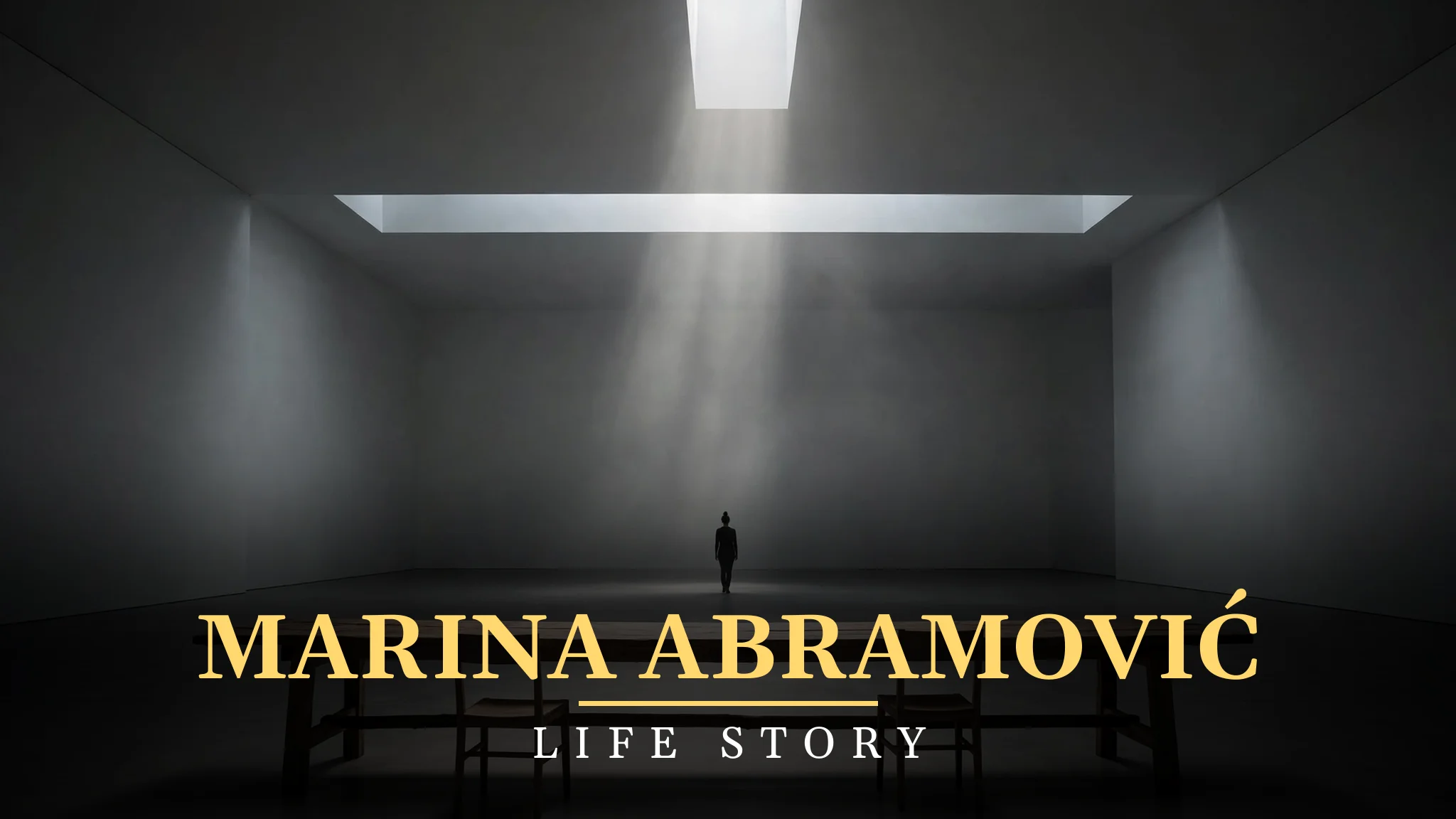
Finally, I return to the image of the empty gallery, with its shaft of light, and its long wooden table, because that image captures her story, a lone figure, in a vast space, under a light, with a table and two chairs, waiting for someone to sit, and to be present, and I hope that image stays with readers, as a picture of an artist who asks us to sit, to look, and to be there, fully, without hiding, and that is a gift that lasts longer than any exhibition.
I also think about the visitors at MoMA, who queued for hours to sit opposite her, and about what they found there, in silence, looking into her eyes, because many of them cried, and many said it changed their lives, and I realise that this is a rare thing for art to do, to change a person, in a few minutes, by asking them to be present, and to look, and that is a power that Abramović has, and that she uses, not for herself, but for the audience, and that generosity, to give a stranger a moment of being seen, is a gift that lasts longer than any exhibition.
And I think about the young artists who learn her method, who practise breathing, stillness, and looking, and who take those exercises into their own work, and into their own lives, because a method is not only for art, but for living, and Abramović teaches people to slow down, to breathe, and to be present, in a world that is fast, and distracted, and that lesson, passed on, will help a new generation, not only to make art, but to live more fully, and more honestly, and that is a legacy that no museum can contain.
Frequently Asked Questions
When and where was Marina Abramović born?
Marina Abramović was born on 30 November 1946 in Belgrade, Serbia, which was then part of Yugoslavia. Her parents had both been Partisan fighters in the Second World War, and she grew up in a strict and disciplined home.
What was Rhythm 0?
Rhythm 0 was a performance in Naples in 1974 in which Abramović stood still for six hours beside a table with seventy-two objects, including a rose, a whip, and a loaded gun, and invited the audience to use them on her. It showed how quickly people can become cruel when given permission, and it became one of her most famous works.
Who was Ulay and what did they do together?
Ulay, whose real name was Frank Uwe Laysiepen, was a German artist who was Abramović’s partner and collaborator for twelve years. Together they made famous performances, and they ended their partnership in 1988 by walking toward each other along the Great Wall of China for ninety days.
What was The Artist Is Present?
The Artist Is Present was a 2010 retrospective at the Museum of Modern Art in New York, in which Abramović sat still for more than seven hundred hours over three months, inviting visitors to sit opposite her in silence. More than a thousand people sat with her, and the show made her famous around the world.
What is Balkan Baroque?
Balkan Baroque was a performance at the Venice Biennale in 1997 in which Abramović scrubbed bloody cow bones for hours while singing Balkan folk songs. It was a work about the wars in Yugoslavia, and it won the Golden Lion, the top prize at the Biennale.
What is the Abramović Method?
The Abramović Method is a set of exercises in breathing, stillness, walking, and looking that she developed to help people become more present and aware. She teaches it in workshops around the world, to artists and to people who have never made art.


