Mario Moreno Cantinflas: The Life Story Behind Mexico's Comedy Legend
In this post
Mario Moreno, known to the world as Cantinflas, was the greatest comedian Mexico has ever produced, a man whose baggy trousers, whose moustache, and whose way of talking made millions of people laugh, in Mexico and around the world. He played a poor man, a clever man, a man who talked a great deal and said very little, and who somehow always came out on top, and the audience loved him for it, because they saw themselves in him. He was not a rich man pretending to be poor. He was a poor man who had become famous, and he never forgot it.
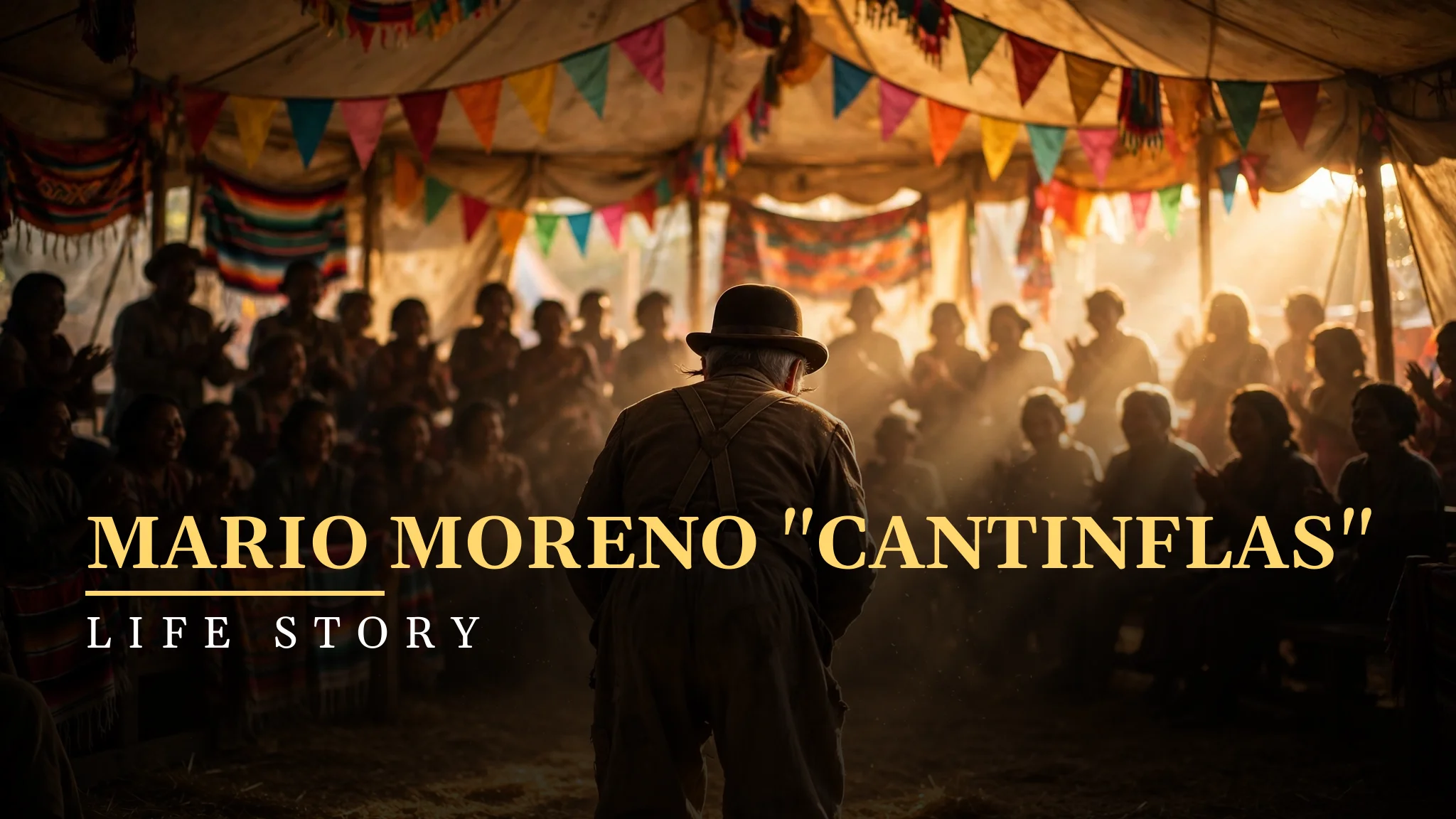
He was born in Mexico City, in a large and poor family, and he grew up in the tough neighbourhoods of the capital, learning to survive by his wits, by his humour, and by his ability to talk his way out of trouble. He began his career in the carpas, the travelling tent theatres of Mexico, where comedians performed for working people, and he learned his craft there, in front of a live audience, night after night, until he became the most famous comedian in the Spanish-speaking world.
What makes his story worth telling is not only the laughter. It is the way he used comedy to speak about real life, about poverty, about injustice, and about the cleverness of ordinary people. He made people laugh, but he also made them think, and he did it in a way that was uniquely Mexican, with a language, a humour, and a warmth that no one else could copy. His life is the story of a poor boy who became a legend, through laughter, through hard work, and through a deep love for the people of Mexico.
A Poor Boy From Mexico City
Mario Fortino Alfonso Moreno Reyes was born on 12 August 1911 in Mexico City, in the neighbourhood of Santa María la Redonda, a poor and lively part of the capital. He was one of many children in a large family, the son of Pedro Moreno, a postman, and María de la Soledad Reyes, and he grew up in a small home, with little money, but with a great deal of love and laughter. Life in those neighbourhoods was hard, but it was also full of life, of music, of jokes, and of people who knew how to survive with very little.
As a boy, he learned to be clever, to be quick, and to use his words to get what he needed. He watched the people around him, the workers, the vendors, the policemen, and the priests, and he learned how they spoke, how they moved, and how they thought. Those observations later became the raw material of his comedy. When he played Cantinflas, he was not inventing a character from nothing. He was remembering the men he had seen growing up, and he was giving them a new life on stage and on screen.
He left school early, and he worked at many jobs, as a shoeshiner, as a messenger, and in other small trades, learning the hard way what it meant to be poor in Mexico City. He also tried his hand at boxing, and he learned to dance, and he was drawn to the world of entertainment, to the carpas, the tent theatres where comedians, singers, and dancers performed for working people. The carpas were his school, and they were a hard school, because the audience there was honest. If they did not like you, they told you at once, and if they liked you, they laughed, they cheered, and they came back the next night.
The years of his youth mattered because they gave him a deep understanding of the poor, of the workers, and of the ordinary people of Mexico. He was one of them, and he never forgot it, even when he became famous and rich. When he played Cantinflas, the poor man who talks his way out of trouble, he was playing himself, and the audience knew it. That is why they loved him so much, and why his comedy feels so real, even today.
He also learned the value of humour in those years. Humour is not just a way to make people laugh. It is a way to survive, a way to face a hard life with courage, and a way to speak the truth without being punished for it. Mario learned that lesson young, and he used it for the rest of his life, on stage, on screen, and in his work for others. He was a comedian, but he was also a philosopher, a man who understood life, and who taught it through laughter.
The Carpas and the Birth of Cantinflas
The carpas were travelling tent theatres that toured Mexico, performing for working people in towns and cities across the country. Mario Moreno joined them as a young man, first as a dancer and then as a comedian, and it was there that he created the character that would make him famous: Cantinflas. The name has no clear meaning, and Mario himself gave different explanations for it, but the character was clear. He was a poor man, with baggy trousers held up by a rope, a small moustache, a hat worn at an angle, and a way of talking that was fast, confusing, and very funny.
Cantinflas talked a great deal, but he said very little. He used long, complicated sentences that went around in circles, and he confused the people he was talking to, especially policemen, judges, and other figures of authority. The audience loved it, because they had all felt confused by authority, and they had all wished they could talk their way out of trouble as Cantinflas did. He was their hero, a poor man who used his words as a weapon, and who always won, not by force, but by cleverness.
In the carpas, Mario learned his craft. He learned how to move, how to speak, how to time a joke, and how to read an audience. He performed night after night, in front of people who were tired after a long day’s work, and who wanted to laugh. He made them laugh, and he learned that laughter is a serious business. It takes hard work, it takes timing, and it takes a deep understanding of people. He worked at it, and he became the best comedian in the carpas, and then the best comedian in Mexico.
The character of Cantinflas was also a way for Mario to speak about real life. Through comedy, he could talk about poverty, about injustice, and about the way ordinary people were treated by those in power, without being censored or punished. The audience understood the message, even when they were laughing, and that is why his comedy was more than entertainment. It was a form of protest, a way of saying that the poor were clever, that they were human, and that they deserved respect.
By the late 1930s, Cantinflas was famous in Mexico City, and he was ready to move from the tent to the screen. He had learned his craft, he had created a character that the whole country loved, and he had earned the trust of audiences who would follow him anywhere. The next chapter would be the one that made him a film star, and it would be a chapter that changed Mexican cinema forever.
Ahí Está el Detalle and Film Stardom
The film that made Cantinflas a movie star was Ahí está el detalle, released in 1940 and directed by Juan Bustillo Oro. In it, he played Cantinflas, a poor man who is mistaken for a murderer and who must talk his way out of trouble in court. The film was a huge success, and it became one of the classics of Mexican cinema. The courtroom scene, in which Cantinflas confuses the judge with his long, circular way of talking, is still one of the most famous scenes in Mexican film, and it is still quoted today.
Ahí está el detalle worked because it was funny, because it was clever, and because it spoke to the audience’s experience. Everyone in Mexico had felt confused by the law, by the courts, and by authority, and Cantinflas gave them a hero who could face that authority and win, not by force, but by words. The film made Mario Moreno the most popular comedian in Mexico, and it set the pattern for his career. He would play Cantinflas, the poor man who talks his way through life, in film after film, and the audience would love him for it.
After Ahí está el detalle, he starred in a series of great films, including Ni sangre ni arena in 1941, in which he played a barber who dreams of becoming a bullfighter, and El gendarme desconocido in 1941, in which he played a policeman. Each film was a success, and each one added to his legend. He was not just a comedian. He was a star, and his name sold tickets, in Mexico and across Latin America. He became one of the richest and most famous actors in Mexico, and he used his fame to help others, founding a union for actors and working to improve their lives.
The 1940s were the peak of his early film career, and they were years of enormous work. He made film after film, he toured, he performed on stage, and he became a household name. He was loved by the poor, because he was one of them, and he was loved by the rich, because he made them laugh. That is a rare achievement, and it is one that few comedians ever reach. He was a comedian for everyone, and that is why he is still loved today.
By the end of the 1940s, he was not just a Mexican star. He was a Latin American star, known across the Spanish-speaking world, and he was ready to take his talent to the wider world. He had proved himself in Mexico, and he was ready to prove himself in Hollywood, as a comedian, as an actor, and as Cantinflas, the poor man who could make the whole world laugh.
Around the World in 80 Days and Hollywood
The film that made Cantinflas famous around the world was Around the World in 80 Days, released in 1956 and based on the novel by Jules Verne. In it, he played Passepartout, the loyal servant of Phileas Fogg, played by David Niven, and he brought his own humour, his own warmth, and his own Mexican spirit to the role. The film was a huge success, it won the Academy Award for Best Picture, and Cantinflas won the Golden Globe for Best Actor in a Musical or Comedy. He became an international star, known in the United States, in Europe, and around the world.
Working in Hollywood was a new experience for him. He had to work in English, with new directors, new actors, and new expectations, and he did it with the same humour and the same professionalism he had always shown. He did not try to be an American comedian. He was Cantinflas, a Mexican comedian, and he brought his own style to the film. The audience loved it, because it was fresh, because it was different, and because it was real. He showed Hollywood that Mexican comedy could travel, and that laughter has no borders.
After Around the World in 80 Days, he was offered more work in Hollywood, but he chose to return to Mexico, where his heart was, and where his audience was. He continued to make films in Mexico, including El bolero de Raquel in 1957, El padrecito in 1964, in which he played a priest, and Su excelencia in 1967, in which he played a diplomat. Each film was a success, and each one showed a different side of his talent. He could play a priest, a diplomat, a barber, and a bullfighter, and he played them all as Cantinflas, the poor man who talks his way through life.
The Hollywood years were important because they proved that his comedy was universal. People in the United States, in Europe, and in Asia laughed at Cantinflas, even when they did not understand Spanish, because his humour was physical, visual, and human. He used his body, his face, and his voice to make people laugh, and that kind of humour needs no translation. He was a clown in the best sense of the word, a man who could make the whole world laugh, and who did it with kindness and with heart.
He also used his fame to help others. He founded the actors’ union in Mexico, he built a theatre, and he worked to improve the lives of actors and of poor people. He was not just a comedian. He was a citizen, and he took that responsibility seriously. He understood that fame brings power, and that power should be used to help others, not just to enrich oneself. That is a lesson that many stars forget, but Cantinflas never did.
El Padrecito, El Profe, and the Later Films
In the 1960s and 1970s, Cantinflas continued to make films, playing new characters and telling new stories, but always as the same beloved figure. In El padrecito in 1964, he played a young priest who comes to a small town and who must win the trust of its people. The film was a success, and it showed a softer, kinder side of Cantinflas, a man who could be funny and also good, a man who could make people laugh and also make them think about faith, about community, and about love.
In El profe in 1971, he played a teacher who goes to a remote village to bring education to its children, a role that echoed the story of María Félix in Río Escondido, but told in Cantinflas’s own comic way. The film was a success, and it showed that he could play a serious role, a man with a mission, and still make the audience laugh. He was not just a clown. He was an actor, one who could play many kinds of men, and who could make each one feel real.
He also starred in El ministro y yo, in which he played a man who becomes a government minister, and in other films that used comedy to talk about politics, about power, and about the lives of ordinary people. Through these films, he continued to speak about the things that mattered to him, about poverty, about justice, and about the cleverness of the poor, and he did it with humour, so that the audience would listen, and would laugh, and would think.
The later films were not always as successful as his early work, and some critics said that his comedy had become repetitive, that he was playing the same character again and again. There was some truth in that, but there was also a deeper truth: the audience still loved him, still went to see his films, and still laughed at his jokes, because Cantinflas was not just a character. He was a friend, a man they had grown up with, and they did not want him to change. They wanted him to be Cantinflas, and he was, until the end.
In his later years, he worked less, but he remained a beloved figure in Mexico, a living legend who was honoured by the film industry, by the government, and by the public. He was no longer the young comedian from the carpas, but he was still Cantinflas, and that name still meant laughter, still meant warmth, and still meant Mexico. He had become a symbol of his country, and that is a rare and remarkable achievement for a comedian.
A Generous Man and a Quiet Goodbye
Mario Moreno was known for his generosity, for his kindness to other actors, and for his work to help the poor. He founded the Asociación Nacional de Actores, the actors’ union in Mexico, and he worked to improve the pay and the conditions of actors. He built the Teatro Insurgentes in Mexico City, a theatre that is still used today, and he gave money to charities, to schools, and to people in need. He did not talk about his generosity. He simply did it, quietly, because he believed that a man who has been given a great deal should give a great deal back.
He was married to Valentina Ivanova, a Russian-Mexican actress, and they had a son, Mario Moreno Ivanova, who became an actor and a businessman. His family life was important to him, and he was a loving father and husband, even when his career kept him busy. He was a private man in many ways, despite his fame, and he kept his family life out of the press as much as he could. That privacy was part of his dignity, and it is one of the reasons he was respected.
He died on 20 April 1993 in Mexico City, at the age of eighty-one, after a long and remarkable life. His death was mourned across Mexico, and tributes came from actors, politicians, and ordinary people, all of whom had known a different side of the same man. He was remembered as a great comedian, as a generous man, and as a legend, and his funeral was a moment of national sadness. Mexico had lost its greatest comedian, and the loss was felt by everyone who had ever laughed at Cantinflas.
His legacy lives on in his films, in his character, and in the word cantinflear, a verb in the Spanish language that means to talk in a confusing, circular way, as Cantinflas did. That is a rare honour, to have your name become a word in the language, and it shows how deeply he entered the culture of Mexico and of the Spanish-speaking world. He is not just a comedian from the past. He is a part of the language itself, and that is a legacy that will last as long as Spanish is spoken.
A Comedian Who Spoke for the Poor
The legacy of Cantinflas is the legacy of a comedian who spoke for the poor. He showed Mexico, and the world, that a poor man could be clever, that he could be funny, and that he could win, not by force, but by words. He made people laugh, but he also made them think, about poverty, about injustice, and about the dignity of ordinary people. That is a powerful kind of comedy, and it is one that few comedians ever achieve.
His work also shows the power of Mexican humour, a humour that is warm, clever, and deeply human. He did not copy American comedy or European comedy. He created a Mexican comedy, with a Mexican character, a Mexican language, and a Mexican heart, and he shared it with the world. That is a remarkable achievement, and it is one that still matters today, when Mexican comedy is still loved around the world.
As new generations of Mexican comedians come forward, they will look at Cantinflas and see a path. They will see that comedy can be more than jokes, that it can be a way to speak the truth, and that a poor boy from Mexico City can become a legend, through laughter, through hard work, and through a deep love for the people. That is a valuable lesson, and it is one that his life teaches well. He is a reminder that laughter is not a small thing. It is a big thing, and it can change the world.
His film Su excelencia also deserves attention, because it used comedy to talk about politics, about diplomacy, and about the way small countries are treated by big ones. Cantinflas played a diplomat, a poor man who becomes an ambassador, and who must navigate a world of power, of protocol, and of lies, using only his words and his wit. The film was funny, but it was also serious, and it showed that Cantinflas could use comedy to speak about important things, about justice, about dignity, and about the rights of small nations. That is a powerful use of laughter, and it is one that I admire.
My Take:
When I think about Cantinflas, I think about laughter, and about how important laughter is. Life can be hard, especially for poor people, and laughter is a way to face that hardness with courage. Cantinflas understood that, and he gave people laughter, not as an escape, but as a weapon, a way to fight back against a world that was unfair. I admire that deeply, because it is a kind of comedy that is both funny and serious, and it is rare. Many comedians make people laugh and then forget. Cantinflas made people laugh and then think, and that is a greater achievement.
I admire the way he talked, the famous cantinfleo, the long, confusing sentences that went around in circles. At first, it seems like nonsense, but when you listen carefully, you realise that it is clever. He is confusing the judge, the policeman, and the man in power, and he is doing it with words, not with force. That is a beautiful idea, and it is one that poor people understand at once. Words can be a weapon, and a clever man can win with words, even when he has no money and no power. I think that is a hopeful message, and I think it is one that still matters today.
I also admire the way he came from the carpas, from the tent theatres, and learned his craft in front of a live audience. That is a hard school, and it is a good one. In a tent, there is no editing, no second take, and no hiding. You either make the audience laugh, or you fail, and you know at once. Cantinflas learned to make them laugh, night after night, and that skill never left him. When he moved to film, he brought that live energy with him, and it is visible in every scene. He is not acting for a camera. He is performing for people, and that makes his films feel alive.
What I find sad in his story is that he died at eighty-one, after a long life, but that his later films were not as good as his early ones, and that some people forgot how great he had been. I think that is unfair, and I think it is a problem that many great artists face. They are judged by their last work, not by their best work, and their best work is forgotten. Cantinflas’s best work, Ahí está el detalle, El padrecito, and Around the World in 80 Days, is still great, and it deserves to be remembered, not just as old films, but as great comedy, as great art.
I think about his generosity, and about the way he founded the actors’ union and built a theatre. That is not the work of a selfish star. That is the work of a man who understood that fame brings responsibility, and who used his fame to help others. I respect that deeply, because many stars take everything and give nothing back. Cantinflas gave a great deal back, to actors, to poor people, and to his country, and he did it quietly, without asking for praise. That is a kind of goodness that is rare, and it is one I admire.
I also think about the word cantinflear, and about how remarkable it is that a man’s name became a verb in the Spanish language. That means he did not just entertain people. He changed the way they speak, the way they think, and the way they understand language itself. That is a legacy that few artists ever achieve, in any country, in any language. It is a sign that he was not just a comedian. He was a part of the culture, a part of the language, and a part of the soul of Mexico.
If I have a criticism, it is that his comedy sometimes repeated itself, and that he played the same character so many times that it became hard to see anything else. I understand why he did it, because the audience loved Cantinflas, and they wanted to see him again and again. But I wonder what else he could have done, if he had been given more chances to play different kinds of men. A sad man, a serious man, a man who does not talk at all. I think he had the talent for those roles, but the business kept him in the same place because it was safe. That is not his fault. It is the fault of a system that likes to repeat what works.
I think about his life in Mexico City, growing up poor, working at many jobs, and learning to survive by his wits. That life shaped his comedy, and it made it real. He was not a rich man pretending to be poor. He was a poor man who had become rich, and he never forgot what it was like to be poor. That honesty is visible in his work, and it is why the audience loved him. They knew he was one of them, and they knew he would not betray them. That trust is a precious thing, and Cantinflas earned it, and kept it, for his whole life.
The lesson I take from him is about the power of words. He showed that words can be funny, that they can be clever, and that they can be a weapon against power. In a world where poor people often feel powerless, he gave them a hero who won with words, and that is a hopeful message. It tells people that they do not need money or force to win. They need cleverness, courage, and a sense of humour, and those are things that anyone can have, no matter how poor they are. I find that message very inspiring.
I also think about the audience, the millions of people who laughed at Cantinflas, in Mexico and around the world. For them, he was not just a comedian. He was a friend, a man who understood their lives, who spoke their language, and who made them laugh when life was hard. That is a special kind of fame, and it is a special kind of trust. I think Cantinflas understood that trust, and I think he tried to honour it, in every film, in every performance, and in every act of generosity. He gave his best, and he gave it for a very long time.
In the end, I see Cantinflas as a man who made the world laugh, and who made it think, and who did it with a baggy pair of trousers, a small moustache, and a way of talking that no one else could copy. He was a poor boy from Mexico City who became a legend, and he did it through laughter, through hard work, and through a deep love for the people of Mexico. I admire him for it, and I feel sad that his later work was not as strong as his early work, but I am glad that his best films are there, for new viewers to discover, and that his name is still a word in the Spanish language.
I keep returning to the idea of the tent theatre, the carpa, and how it shaped him. In a tent, you learn to be honest, because the audience is right there, and they will tell you at once if you are false. Cantinflas learned that honesty, and he kept it, even when he became a film star, even when he worked in Hollywood, and even when he became rich. That honesty is the heart of his comedy, and it is why it still works today. People can tell when a comedian is honest, and they can tell when he is not, and Cantinflas was always honest.
There is also something I respect about the way he used his fame to help other actors. He founded a union, he built a theatre, and he fought for better pay and better conditions. That is not glamorous work, and it does not make headlines, but it matters a great deal to the people it helps. Cantinflas did it because he remembered what it was like to be a poor actor in a tent, and he wanted to make life better for the actors who came after him. That is a generous and far-sighted way to live, and I admire it.
Finally, I think his story teaches me that laughter is not a small thing. It is a big thing, and it can change the world, or at least it can change the way people see the world. Cantinflas made people laugh, and in laughing, they saw that the poor were clever, that authority could be confused, and that a man with words could win. That is a powerful lesson, and it is one that I will remember. Mario Moreno, Cantinflas, was a comedian, but he was also a teacher, and his lessons are still worth learning today.
I think about the rope that held up his trousers, and about how a simple piece of rope became a symbol, a sign of poverty, of cleverness, and of a man who makes do with what he has. Cantinflas did not need a belt, or a suit, or a uniform. He needed a rope, a hat, and a moustache, and with those three things he became the most famous comedian in the Spanish-speaking world. That is a beautiful lesson, that you do not need much to be great, and that a simple image, used well, can become a legend. I will always remember that rope, and what it meant.
There is something about his moustache that I keep noticing, a small, thin moustache, worn at an angle, that became as famous as his trousers, and that made his face instantly recognisable. It was not a grand moustache, or a fashionable one. It was a small, humble one, the moustache of a poor man, and it suited him perfectly, because it was honest, because it was simple, and because it was his. That is a reminder that a great character does not need elaborate costumes. He needs a few simple things, used with love, and with a deep understanding of who he is.
I also think about the children who laughed at Cantinflas, and who still laugh at him today, in Mexico and around the world. Children understand his comedy at once, because it is physical, because it is visual, and because it is kind. He does not make fun of the weak. He makes fun of the powerful, of the judge, of the policeman, and of the man in charge, and children love that, because they have all felt small in front of authority, and they have all wished they could talk their way out of trouble as Cantinflas does. That is a universal kind of laughter, and it is one that will last for generations.
When I watch the courtroom scene in Ahí está el detalle, I am struck by how clever it is, how Cantinflas confuses the judge with long, circular sentences, and how the audience laughs, because they have all felt confused by the law, and they have all wished they could do what he does. That scene is not just funny. It is a form of justice, a way of saying that the law is confusing, that authority is not always right, and that a poor man can win, with words alone. That is a powerful message, and it is one that still matters today, in Mexico and everywhere.
Finally, I want to say that I respect the way he used his fame to build a theatre, to found a union, and to help other actors. That is not glamorous work, and it does not make headlines, but it matters a great deal to the people it helps. He remembered what it was like to be a poor actor in a tent, and he wanted to make life better for the actors who came after him. That is a generous and far-sighted way to live, and I admire it deeply. He was a comedian, but he was also a builder, and his buildings, his union, and his theatre, are still there, helping people today.
Frequently Asked Questions
Who was Cantinflas and what was his real name?
Cantinflas was the stage name of Mario Fortino Alfonso Moreno Reyes, a Mexican comedian and actor. He created the character Cantinflas in the carpas, the travelling tent theatres, and became the greatest comedian in Mexican history.
What does the word cantinflear mean?
Cantinflear is a verb in Spanish that means to talk in a long, confusing, circular way, as Cantinflas did. The word entered the language because his way of speaking became so famous, and it is still used today.
What is Cantinflas’s most famous film?
Cantinflas’s most famous Mexican film is Ahí está el detalle from 1940, in which he confuses a judge in court. His most famous international film is Around the World in 80 Days from 1956, for which he won a Golden Globe.
Did Cantinflas win a Golden Globe?
Yes, Cantinflas won the Golden Globe for Best Actor in a Musical or Comedy for Around the World in 80 Days in 1956. The film also won the Academy Award for Best Picture, making him an international star.
What did Cantinflas do for other actors?
Cantinflas founded the Asociación Nacional de Actores, the actors’ union in Mexico, and built the Teatro Insurgentes in Mexico City. He worked to improve pay and conditions for actors and gave money to charities and schools.
When did Cantinflas die?
Cantinflas, Mario Moreno, died on 20 April 1993 in Mexico City, at the age of eighty-one. His death was mourned across Mexico, and he is remembered as the country’s greatest comedian and a legend of its cinema.


