Marshmello: The Life Story Behind the Masked DJ
In this post
- A Philadelphia Boy Who Loved Electronic Music
- Alone and the First Big Breakthrough
- Silence, Friends, and the Run of Global Hits
- The Fortnite Concert and a New Kind of Stardom
- Cooking, Collaborations, and the Marshmello Brand
- The Man Behind the Mask and the Choice to Stay Hidden
- What Marshmello Proved About Music and Mystery
- My Take:
Marshmello is the DJ who turned anonymity into a superpower, and he did it with a white helmet, a smile, and some of the catchiest dance music of the decade. When he first appeared in 2015, nobody knew who he was, and that was the point. The mask meant the music came first, and the music was good enough to speak for itself. His early remixes caught the attention of major artists, and then his own songs, “Alone”, “Silence”, “Friends”, and “Happier”, became global hits, played at festivals, on radio, and in bedrooms around the world. He performed a virtual concert inside the video game Fortnite that was watched by millions, he hosted a cooking show, and he became one of the most recognisable figures in music without ever showing his face. Behind the mask is Christopher Comstock, a producer from Philadelphia, yet the character of Marshmello has become bigger than any one person. This is the story of how a masked DJ became a global star, and of why the mask still matters.
The earliest years unfolded in Philadelphia, Pennsylvania, where Marshmello grew up inside a household that left its mark. He was raised in Philadelphia, and he grew up in a family that supported his love of music. He has kept his private life guarded, and he rarely discusses his family in public, preferring to let the Marshmello character speak for itself. He attended school in Philadelphia, and he began making electronic music as a teenager, learning production on his own and sharing his tracks online. The setting was ordinary in many ways, and that ordinariness is part of why the later rise still surprises people.
Read on for the complete journey, from small beginnings to Alone, and from there into the decades of work, risk, and reinvention that made Marshmello a name the whole world recognises.
A Philadelphia Boy Who Loved Electronic Music
Christopher Comstock grew up in Philadelphia, where he fell in love with electronic music as a teenager. He began producing his own tracks, learning the craft on his own, and sharing his music online. He was not part of a big scene, and he did not have famous connections, he had a computer, a love of dance music, and a willingness to experiment. He started out making remixes, taking songs by other artists and giving them his own sound, and those remixes began to get noticed. The early work was about learning, about understanding what makes a track work in a club, and about finding a sound that was his own. He was inspired by DJs like Skrillex and Deadmau5, artists who had shown that electronic music could be both creative and commercial. Philadelphia gave him his start, but it was his own drive that turned a hobby into a career. He kept making music, kept sharing it, and kept improving, until the day the world started to notice.
Learning production came in 2010, and it turned into a proving ground for Marshmello, a test Marshmello faced in Philadelphia, Pennsylvania with everything to prove. Comstock began producing electronic music as a teenager, teaching himself the craft and sharing his early tracks online. Learning production showed a performer in Philadelphia, Pennsylvania willing to be judged on the work itself, which is a brave choice for Marshmello. Such work builds trust for Marshmello, and trust is the currency of Learning production that never goes out of fashion in Philadelphia, Pennsylvania.
2015 gave Marshmello First remixes, and the part demanded a steadiness in Philadelphia, Pennsylvania that only experience teaches Marshmello. His remixes of songs by major artists began to get attention, and they showed his skill at giving a track his own sound. The work of Marshmello in First remixes landed because Marshmello treated it seriously in 2015, and seriousness is something audiences in Philadelphia, Pennsylvania can feel. Not many manage that kind of shift and keep the audience with them, yet Marshmello did it in First remixes by staying truthful.
In 2015, Marshmello said yes to The Marshmello mask, and that yes in Philadelphia, Pennsylvania carried more weight for Marshmello than anyone expected. He created the Marshmello character, with its white helmet and smile, as a way to let the music speak first. The work of Marshmello in The Marshmello mask landed because Marshmello treated it seriously in 2015, and seriousness is something audiences in Philadelphia, Pennsylvania can feel. Not many manage that kind of shift and keep the audience with them, yet Marshmello did it in The Marshmello mask by staying truthful.
The step of Learning production counts for Marshmello because it connected the early promise to the later success in Philadelphia, Pennsylvania, and without it the story would have a gap.
Alone and the First Big Breakthrough
Marshmello’s first major hit as an artist was “Alone”, released in 2016, and it announced him as a star in his own right. The song was a melodic, emotional dance track, and it became a hit on streaming and on radio, with a music video that showed the Marshmello character as a lonely figure looking for friends. The video resonated with young listeners, and the song became an anthem for anyone who had ever felt alone. It was followed by collaborations and singles that kept the momentum going, and Marshmello became a fixture of the festival scene. He was booked to play the biggest stages in the world, and his shows became known for their energy, their visuals, and their sense of fun. The mask, which had once been a mystery, became a brand, and the character became one of the most recognisable in music. “Alone” was more than a hit, it was the moment Marshmello stopped being a curiosity and became a star.
When Alone arrived in 2016, Marshmello treated it as a door in Philadelphia, Pennsylvania that might not open twice for Marshmello. The single became his first major hit, and its emotional message made it an anthem for young listeners around the world. Alone showed a performer in Philadelphia, Pennsylvania willing to be judged on the work itself, which is a brave choice for Marshmello. Not many manage that kind of shift and keep the audience with them, yet Marshmello did it in Alone by staying truthful.
With First festival shows in 2016, Marshmello stepped into new territory, and Marshmello felt the risk in Philadelphia, Pennsylvania from the very first day. He began headlining major festivals, and his high-energy sets made him a favourite with young crowds. First festival shows confirmed something the closest watchers in Philadelphia, Pennsylvania already knew, that the talent of Marshmello had depth behind it. Moments like First festival shows show why patience matters more for Marshmello than sudden noise, and Philadelphia, Pennsylvania noticed that patience.
2016 gave Marshmello Joytime album, and the part demanded a steadiness in Philadelphia, Pennsylvania that only experience teaches Marshmello. His debut album collected his early tracks, and it showed the range of his sound, from melodic dance to harder bass music. Joytime album showed a performer in Philadelphia, Pennsylvania willing to be judged on the work itself, which is a brave choice for Marshmello. The quiet discipline of Marshmello behind Joytime album is easy to miss in Philadelphia, Pennsylvania, and it is the most important part.
The importance of Alone is easy to overlook if you only read the headlines from 2016. The true change for Marshmello was in the doors it opened afterwards in Philadelphia, Pennsylvania.
Silence, Friends, and the Run of Global Hits
After “Alone”, Marshmello released a run of hits that made him one of the biggest names in dance music. “Silence”, his collaboration with Khalid in 2017, became a global hit, and it showed his gift for pairing his production with a soulful vocal. “Wolves”, with Selena Gomez, followed, and then “Friends” with Anne-Marie in 2018, a song that became a huge hit around the world. Each collaboration was different, and each one showed a different side of his sound, from emotional ballads to upbeat pop. He also worked with Bastille on “Happier” in 2018, a song that became one of the biggest hits of the year, and one of the most streamed songs of its time. The run of hits was remarkable, because it showed that Marshmello was not a one-hit wonder, but a producer with a real gift for melody and for choosing the right collaborators. He became one of the most in-demand producers in pop, and his sound defined an era of dance music.
In 2017, Silence with Khalid gave Marshmello a challenge that looked modest in Philadelphia, Pennsylvania and proved demanding for Marshmello inside. The collaboration became a global hit, and it showed his skill at building an emotional dance song around a great vocal. What lasted from Silence with Khalid was not the headline but the craft of Marshmello, and craft is what keeps a career alive in Philadelphia, Pennsylvania. Moments like Silence with Khalid show why patience matters more for Marshmello than sudden noise, and Philadelphia, Pennsylvania noticed that patience.
Friends with Anne-Marie came in 2018, and it turned into a proving ground for Marshmello, a test Marshmello faced in Philadelphia, Pennsylvania with everything to prove. The single became a huge hit, and its playful message made it a favourite with young listeners. Friends with Anne-Marie showed a performer in Philadelphia, Pennsylvania willing to be judged on the work itself, which is a brave choice for Marshmello. The lesson of Friends with Anne-Marie is simple for Marshmello: do the hard job well in Philadelphia, Pennsylvania, and the next door opens by itself.
By 2018, Happier with Bastille had arrived, and Marshmello knew the work in Philadelphia, Pennsylvania would be judged on its own terms, not on Marshmello’s past. The song became one of the biggest hits of the year, and it is one of the most streamed dance records ever made. Happier with Bastille confirmed something the closest watchers in Philadelphia, Pennsylvania already knew, that the talent of Marshmello had depth behind it. The quiet discipline of Marshmello behind Happier with Bastille is easy to miss in Philadelphia, Pennsylvania, and it is the most important part.
The importance of Silence with Khalid is easy to overlook if you only read the headlines from 2017. The true change for Marshmello was in the doors it opened afterwards in Philadelphia, Pennsylvania.
The Fortnite Concert and a New Kind of Stardom
In 2019, Marshmello did something no artist had ever done before, he performed a live concert inside the video game Fortnite. The event was watched by more than ten million players, and it became a landmark moment in music, showing that a concert could happen in a virtual world as well as in a stadium. The performance was a spectacle, with Marshmello’s character flying through the game world, and it introduced his music to millions of young fans who might never have seen him live. It also showed how forward-thinking he was, because he understood that young audiences live in games as much as they live in the real world. The Fortnite concert opened the door for other artists to perform in virtual spaces, and it became a model for how music could reach new audiences. For Marshmello, it was a perfect fit, because his masked character was already a kind of avatar, and the game world was a natural home for him. It remains one of the most famous concerts of the decade.
When Fortnite concert arrived in 2019, Marshmello treated it as a door in Philadelphia, Pennsylvania that might not open twice for Marshmello. His virtual concert inside the game was watched by millions of players, and it became a landmark in music history. Seen from today, Fortnite concert marks a point where the career of Marshmello quietly changed direction in 2019. Fortnite concert shows how much of the success of Marshmello is preparation meeting a moment that finally arrives in Philadelphia, Pennsylvania.
When Pleasantville event arrived in 2019, Marshmello treated it as a door in Philadelphia, Pennsylvania that might not open twice for Marshmello. The concert showed how music could work in a virtual world, and it opened the door for other artists to follow. Seen from today, Pleasantville event marks a point where the career of Marshmello quietly changed direction in 2019. It also explains why the phone kept ringing for Marshmello after Pleasantville event, because dependable talent is genuinely rare in Philadelphia, Pennsylvania.
When Gaming and music crossover arrived in 2019, Marshmello treated it as a door in Philadelphia, Pennsylvania that might not open twice for Marshmello. The event proved that games and music could work together, and it made Marshmello a pioneer of virtual performances. For audiences in Philadelphia, Pennsylvania, Gaming and music crossover became the piece they mention first when they explain why they admire Marshmello. That mix of effort and calm from Marshmello is difficult to imitate, and it is why Gaming and music crossover still earns discussion in Philadelphia, Pennsylvania.
Looking back, Fortnite concert was one of the steps that made later triumphs possible for Marshmello, because it proved the base in Philadelphia, Pennsylvania was strong.
Cooking, Collaborations, and the Marshmello Brand
Marshmello has always been more than a DJ, and his career has included cooking shows, merchandise, and collaborations that go far beyond music. His “Cooking with Marshmello” series became popular online, showing the character making food in a playful, family-friendly way. He has collaborated with artists from many genres, including country, hip-hop, and Latin music, showing that his sound can work anywhere. He has also worked with brands, released merchandise, and built a business around the character. The mask has allowed him to do all of this without the pressure of celebrity, because the character is the star, not the person behind it. He has said that the mask gives him freedom, to be playful, to be creative, and to connect with fans without the complications of fame. The brand has become one of the most successful in music, and it shows how a strong character can become bigger than any single song. It is a model that other artists have tried to copy, but few have done it as well.
Around 2018, Cooking with Marshmello put Marshmello in front of a new audience in Philadelphia, Pennsylvania, and the response mattered to Marshmello. His cooking series became popular online, showing a playful side of the character and reaching a family audience. Cooking with Marshmello showed a performer in Philadelphia, Pennsylvania willing to be judged on the work itself, which is a brave choice for Marshmello. Careers like that of Marshmello are built on steps like Cooking with Marshmello, taken seriously in Philadelphia, Pennsylvania and finished properly.
When Cross-genre collaborations arrived in 2019, Marshmello treated it as a door in Philadelphia, Pennsylvania that might not open twice for Marshmello. He has worked with artists from country, hip-hop, and Latin music, showing his sound can adapt to many styles. Cross-genre collaborations became a reference point for Marshmello, a job from 2019 that later interviews in Philadelphia, Pennsylvania kept coming back to. Moments like Cross-genre collaborations show why patience matters more for Marshmello than sudden noise, and Philadelphia, Pennsylvania noticed that patience.
For Marshmello, Merchandise and brand in 2018 was the moment to show Philadelphia, Pennsylvania that the earlier success of Marshmello was no accident. The Marshmello character became a successful brand, with merchandise and partnerships that go far beyond music. The work of Marshmello in Merchandise and brand landed because Marshmello treated it seriously in 2018, and seriousness is something audiences in Philadelphia, Pennsylvania can feel. It is the kind of step that looks simple for Marshmello in hindsight and felt anything but simple in Philadelphia, Pennsylvania at the time.
Cooking with Marshmello proved that the foundations of Marshmello were solid in Philadelphia, Pennsylvania, and solid foundations are what let a career survive the hard years.
The Man Behind the Mask and the Choice to Stay Hidden
Behind the mask is Christopher Comstock, a producer from Philadelphia, and his identity has been widely reported, yet he has chosen to keep the focus on the character. He rarely gives interviews as himself, and he prefers to let Marshmello do the talking. He has said that the mask is about the music, about letting listeners judge the songs without knowing who made them. It is also about privacy, because it allows him to live a normal life when he is not performing. He has spoken about the pressure of fame, and about how the mask protects him from it. His family and friends have supported the choice, and he has built a career that balances public success with private peace. The decision to stay hidden is unusual in an industry built on personality, yet it has worked, because the music has always been strong enough to carry the character. It is a reminder that sometimes the best way to be famous is to let the work speak for itself.
In 2017, Marshmello said yes to Keeping his identity private, and that yes in Philadelphia, Pennsylvania carried more weight for Marshmello than anyone expected. Although his name has been widely reported, he has kept the focus on the Marshmello character rather than on himself. What people in Philadelphia, Pennsylvania remembered afterwards was the feeling of Keeping his identity private, not the noise around Marshmello. Moments like Keeping his identity private show why patience matters more for Marshmello than sudden noise, and Philadelphia, Pennsylvania noticed that patience.
With The mask as freedom in 2018, Marshmello found a project in Philadelphia, Pennsylvania that matched the ambition Marshmello had carried quietly. He has said the mask gives him the freedom to be creative and playful without the pressure of celebrity. The mask as freedom rewards a second look, because the care Marshmello put into it in 2018 only becomes clear over time. There is a reliability in how Marshmello handles such moments that directors in Philadelphia, Pennsylvania learn to count on after The mask as freedom.
When A normal life offstage arrived in 2019, Marshmello treated it as a door in Philadelphia, Pennsylvania that might not open twice for Marshmello. The character allows him to live privately when he is not performing, a balance that few stars manage. A normal life offstage is the kind of job that makes the next opportunity easier for Marshmello to win, because the evidence from 2019 is right there. It is the kind of step that looks simple for Marshmello in hindsight and felt anything but simple in Philadelphia, Pennsylvania at the time.
Keeping his identity private mattered for Marshmello because it showed growth in public in Philadelphia, Pennsylvania, and growth in public takes more courage than growth in private.
What Marshmello Proved About Music and Mystery
Marshmello’s legacy is proof that mystery still works in music, and that a strong character can become as famous as any face. He showed that a DJ could be a pop star without showing his face, that a virtual concert could be as big as a stadium show, and that dance music could reach the youngest audiences through games and online video. His hits will be played for years, at parties, in clubs, and on radio, and each one carries his signature, a clean melody, a big emotion, and a sense of fun. He also showed that branding matters, because the Marshmello character, with its smile and its helmet, is one of the most recognisable images in modern music. Young producers look at his career and see a model, make great music, build a strong identity, and let the work speak. The boy from Philadelphia who made music in his bedroom became a global star without ever taking off his mask, and that is a story that will be told for a long time.
2016 gave Marshmello Proving mystery works, and the part demanded a steadiness in Philadelphia, Pennsylvania that only experience teaches Marshmello. His success showed that an artist could become a global star without revealing his face, a rare feat in modern music. For Marshmello, Proving mystery works was proof that the long hours and the early sacrifices in Philadelphia, Pennsylvania had not been wasted. Proving mystery works shows how much of the success of Marshmello is preparation meeting a moment that finally arrives in Philadelphia, Pennsylvania.
Virtual concert pioneer in 2019 found Marshmello ready for a bigger stage, even if Philadelphia, Pennsylvania was not sure yet about Marshmello. His Fortnite show opened the door for virtual performances, and it changed how artists think about reaching audiences. What lasted from Virtual concert pioneer was not the headline but the craft of Marshmello, and craft is what keeps a career alive in Philadelphia, Pennsylvania. The attention to detail in Virtual concert pioneer is what lifts the good work of Marshmello into work people in Philadelphia, Pennsylvania remember.
In 2020, Influence on dance pop became a test of whether Marshmello could grow in Philadelphia, Pennsylvania without losing what made Marshmello interesting. His melodic, emotional style shaped the sound of dance pop, and producers still cite his work as an influence. Seen from today, Influence on dance pop marks a point where the career of Marshmello quietly changed direction in 2020. There is a reliability in how Marshmello handles such moments that directors in Philadelphia, Pennsylvania learn to count on after Influence on dance pop.
Proving mystery works was a hinge moment for Marshmello, the kind that only looks obvious in Philadelphia, Pennsylvania once you know how the story of Marshmello ends.
My Take:
What fascinates me about Marshmello is not the mask, though the mask is what everyone talks about first. It is the decision to build a career in which the mask does the talking and the music does the rest. Christopher Comstock, the man behind the mask, was born on 19 May 1992 in Philadelphia, and before Marshmello he produced under the name Dotcom, making electronic music that almost nobody heard. In 2015 he put on a white helmet shaped like a marshmallow, with two black X eyes and a smile, uploaded a song called WaVeZ to SoundCloud, and waited. Skrillex, one of the biggest names in electronic music, reposted it, and within months Marshmello went from an unknown producer to a name that festival bookers were calling. That is the part of the story that looks like luck, and I think it is worth pausing on, because it was not luck in the way people usually mean it. Comstock had spent years learning to produce, he had a sound that was ready, and he had a visual idea that was impossible to ignore. The repost opened a door, but he had already built the room behind it.
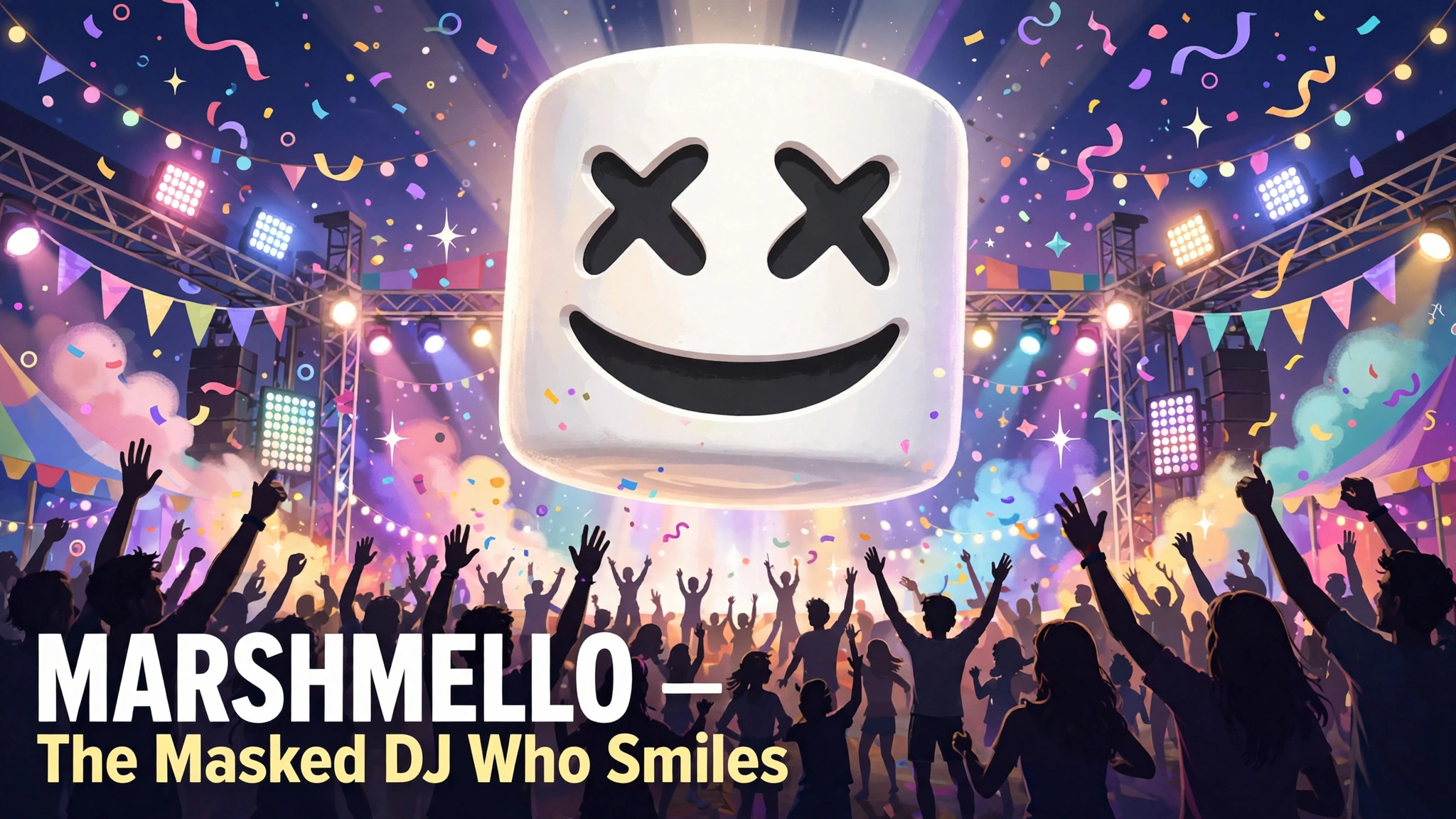
The mask itself is the smartest thing about Marshmello, and I do not mean that as a criticism of the music. Electronic dance music has a problem that rock and pop do not have, which is that the performer is often invisible. A DJ stands behind a desk, in the dark, while the crowd faces the stage, and the audience remembers the drop but not the face. Marshmello solved that problem with a single image: a smiling marshmallow head that a child could draw from memory after seeing it once. It works on a festival stage, it works on a T-shirt, it works as a toy, and it works on YouTube, where his cooking show, Cooking with Marshmello, has him making food in the helmet without ever speaking. The mask also solved a second problem, which is privacy. Comstock has never officially confirmed that he is Marshmello in a formal announcement, though Forbes and other outlets identified him in 2017, and he has never given an interview out of the mask. That refusal is part of the act, and it is also a genuine protection. He can go to a supermarket, or walk through an airport, without being recognised, and that is a freedom that almost no star of his size still has.
Alone, released in 2016, is the song that made him, and I think it is worth listening to closely, because it shows what his music does well and what it does not try to do. It is a simple, emotional electronic track, built around a piano melody and a vocal that sounds lonely even before you hear the words, and its video, which shows Marshmello being excluded from school and then finding friends through music, has been viewed more than two billion times on YouTube. The video is not subtle, but it is honest about its audience. Marshmello’s fans are young, many of them teenagers, and the song speaks to the feeling of being left out in a way that a more complicated track would not. That is his gift as a producer: he understands that a simple melody, played clearly, can reach more people than a clever one played for other producers. His later hits follow the same rule. Silence, with Khalid in 2017, is a smooth, sad song about a relationship ending. Wolves, with Selena Gomez the same year, is a driving, anthemic track. Friends, with Anne-Marie in 2018, is a bright pop song about the friend zone that became one of the biggest singles of the year. Happier, with Bastille in 2018, is a gentle, acoustic-led song about letting someone go, and it spent more than a year on the charts. None of these songs is trying to be avant-garde, and that is the point. They are trying to be felt, quickly, by as many people as possible.
The Fortnite concert in February 2019 is the moment I keep coming back to, because it changed what a concert could be. On 2 February 2019, Marshmello performed a ten-minute set inside the video game Fortnite, on a virtual stage in the game’s Pleasant Park area, and more than ten million players attended live, with millions more watching on YouTube and Twitch. There was no travel, no tickets, no security queue, and no age limit. Children who had never been to a concert watched one from their bedrooms, and their avatars danced in front of a giant holographic Marshmello. I think that event will be remembered as a turning point, not because the music was extraordinary but because the format was. It proved that a concert did not need a physical venue, that a game could be a stage, and that an artist with a strong visual identity could perform for an audience larger than any stadium in the world. Other artists followed, including Travis Scott and Ariana Grande in Fortnite, but Marshmello was first, and being first matters. He understood, earlier than most, that his audience lived online, and he went to where they already were rather than asking them to come to him.
I should be honest about the criticism, because Marshmello has plenty of it. Serious electronic music fans often dismiss his work as too simple, too pop, too commercial, and they point out that his tracks follow a predictable structure: a quiet verse, a build, a drop, a repeat. There is truth in that. His albums, Joytime in 2016, Joytime II in 2018 and Joytime III in 2019, are pleasant but uneven, and his 2021 album Shockwave, which was nominated for a Grammy for Best Dance/Electronic Album, is more interesting but still not the work of a producer trying to push the genre forward. He is not Skrillex, who reinvented dubstep, or Daft Punk, who reinvented house music. He is a pop producer who works in electronic music, and his skill is in making a song that a radio station can play and a teenager can love, not in making a track that other producers will study. I think that criticism is fair, but I also think it misses the point. Not every artist has to push a genre forward. Some artists have to bring a genre to people who would never have found it otherwise, and Marshmello has done that for millions of listeners who discovered electronic music through him and then went on to discover harder, stranger music afterwards. That is a useful role, even if it is not a glamorous one.
His collaborations are another part of the story that deserves attention, because they show how he works. He has made songs with Selena Gomez, Khalid, Anne-Marie, Bastille, Juice WRLD, Halsey, Demi Lovato, the Jonas Brothers, and even the country singer Kane Brown, and in each case the collaboration sounds like Marshmello and like the other artist at the same time. Come and Go, with Juice WRLD in 2020, is a good example: it is a melodic, emotional track that fits Juice WRLD’s style and Marshmello’s production, and it became a hit after Juice WRLD’s death, which gave it a sad weight that neither artist could have planned. His willingness to work across genres, from pop to country to hip-hop, is unusual for an electronic producer, and it has kept his music fresh in a way that staying inside one genre would not. He does not have a signature sound in the way that Calvin Harris or Diplo do. He has a signature approach, which is to find a strong vocal, build a clean production around it, and let the song do the work.
What I take from Marshmello, in the end, is a lesson about identity in the internet age. He built a global career without ever showing his face, without giving interviews, and without telling the press who he was, and he did it by understanding that an image can be more powerful than a biography. The mask is not a gimmick. It is a brand, a character, and a shield, all at once, and it allowed a shy producer from Philadelphia to become one of the most recognisable figures in music without giving up his private life. I think there is something admirable in that, especially in an industry that demands that artists share everything about themselves online. He shared nothing, and he still succeeded, because the music and the image were enough. Young producers who want to follow him should learn the real lesson, which is not to wear a mask but to have a clear idea: a sound that is yours, an image that people can remember, and a willingness to meet your audience where they already are, whether that is SoundCloud, YouTube, or inside a video game. Marshmello did all three, and that is why, ten years after WaVeZ, he is still headlining festivals while many of the producers who dismissed him have disappeared.
One more part of the Marshmello story deserves a closer look, and it is the business around the mask. The helmet is not only a stage costume. It is a product. Marshmello sells toys, clothing, backpacks, and even a cereal, and his YouTube channel, which mixes music videos with the cooking show and with gaming content, has tens of millions of subscribers. That breadth is deliberate. He is not selling records in the old sense. He is selling a character that children love, the way a cartoon character is sold, and the music is the centre of it but not the whole of it. Some critics see that as cynical, and I understand why. But I think it is also a realistic response to how music works now. Streaming pays very little per play, touring is expensive and exhausting, and an artist who wants to survive has to find other ways to earn a living. Marshmello found a way that fits his image, and he did it without compromising the music itself, which remains clean, melodic and accessible. The cooking show is a good example. It is silly, it is gentle, and it is exactly the kind of content a young fan can watch with a parent, which is a rare thing for a DJ to achieve.
I also think his relationship with his fans, the Mello Gang, is different from the relationship most stars have with theirs. Because he never speaks as himself, the fans project their own feelings onto the mask, and the mask becomes a friendly figure rather than a celebrity. At festivals, children dress up as Marshmello, wearing white helmets and smiling, and the sight of a crowd full of small marshmallows is both funny and touching. It is a fan culture built on participation rather than worship, and it is one of the reasons his audience has stayed young. He does not ask his fans to admire him. He asks them to join in, to dance, to cook, to play a game, and that invitation is more durable than admiration, which fades when the next star arrives. I have seen pop stars lose their audience in a year because the audience grew up and moved on. Marshmello’s audience keeps renewing itself, because every year a new group of twelve-year-olds discovers the helmet for the first time.
If I had to sum up what Marshmello proves, it would be this: in the age of the internet, a clear idea beats a famous face. He had no record deal when he started, no television exposure, and no famous friends, except for the repost from Skrillex that gave him his first break. What he had was a sound that was ready, an image that was unforgettable, and the patience to build an audience one upload at a time. Ten years later, he has headlined festivals on every continent, played a concert inside a video game for ten million people, and built a brand that reaches far beyond music, all without ever taking the helmet off in public. That is not a trick. It is a strategy, and it is one that other artists, in music and beyond, would be wise to study. The mask will eventually come off, or it will not, and either way the lesson will remain: be recognisable, be consistent, and meet your audience where they live.
Frequently Asked Questions
Who is Marshmello really?
Marshmello is the stage character of Christopher Comstock, a producer from Philadelphia, though he keeps the focus on the masked character.
What is Marshmello’s biggest song?
Happier with Bastille is one of his biggest hits, though Alone, Silence, and Friends were also huge global successes.
Why does Marshmello wear a mask?
He has said the mask lets the music speak first, and it gives him privacy and freedom to be creative without the pressure of celebrity.
Did Marshmello perform in Fortnite?
Yes. His virtual concert inside Fortnite in 2019 was watched by more than ten million players, and it became a landmark event.
What was Marshmello’s first hit?
Alone, released in 2016, was his first major hit as an artist, and it became an anthem for young listeners.
Is Marshmello still making music?
Yes. He continues to release singles and collaborate with artists across many genres, from pop to country to Latin music.


