Martin Kove: The Life Story Behind the Karate Kid Star
In this post
- A Brooklyn Childhood and the Road to Acting
- Early Films, Westerns, and the Working Actor Years
- John Kreese and The Karate Kid
- The Years Between: Television, Family, and Keeping Going
- Cobra Kai and an Older, Deeper Kreese
- What Remains of a Long Career
- Kreese, Conventions, and the Fans Who Never Forgot Him
- My Take:
Martin Kove was already a working actor for more than a decade when he was cast as John Kreese, and that experience mattered. He had played soldiers, policemen, and tough men in films and on television, and he knew how to make a character feel real in a short time. He had also learned how to be professional on a set, how to work with a director, and how to trust his fellow actors. When he walked into the audition for The Karate Kid, he was not a young man hoping for a lucky break. He was a seasoned actor who knew his craft, and who was ready to play a difficult role with honesty.
What is easy to miss is how much Kove brought to Kreese from his own life. He grew up in Brooklyn, a tough place where you learned to stand up for yourself, and he understood the kind of man who believes that the world is a fight. He did not agree with Kreese, but he understood him, and that understanding made his performance believable. He played Kreese as a man who truly believed what he was teaching, and that belief is what made the character frightening. A villain who believes he is right is always more dangerous than a villain who knows he is wrong.
Martin Kove is the actor who gave the world John Kreese, one of the most feared teachers in film history. When Kreese walked into a room in The Karate Kid, the air changed. He was cold, hard, and certain that mercy was a weakness, and Kove played him with a stillness that made audiences uneasy. For many viewers, Kreese was not just a villain. He was the voice of a harsh kind of teaching that many people had met in real life, in a coach, a boss, or a parent who believed that being soft was the same as being weak. Kove understood that character deeply, and he played him for forty years.
His life, however, is much longer and richer than a single role. Kove was born in Brooklyn in 1946, and he worked as an actor for more than a decade before The Karate Kid made him famous. He appeared in westerns, crime films, and television dramas, and he built a reputation as a reliable character actor who could play tough men. He worked with Sylvester Stallone in Rambo, he played a police detective on television, and he kept working through the years when many actors of his generation faded away. Then, like his co-star William Zabka, he found a second life in Cobra Kai, where Kreese returned as an older man who was still dangerous, but also more human than before.
What makes Kove’s story interesting is the gap between the man and the character. In real life, people who meet him often say he is warm, funny, and kind. On screen, he plays a man who seems to have no warmth at all. That gap is the mark of a good actor. He can step into a dark character, live in that darkness for a scene, and then step out of it again. This is the story of how a boy from Brooklyn became one of the most memorable villains in American film, and how he learned to live with that fame for the rest of his life.
A Brooklyn Childhood and the Road to Acting
Martin Kove was born on 6 March 1946 in Brooklyn, New York. Brooklyn in the 1940s and 1950s was a busy place, full of families, shops, and streets where children played until dark. Kove grew up in that world, and he learned early how to stand up for himself. He was not from a rich family, and he did not have an easy path into acting. He had to find his own way, and he did it by watching people, by listening, and by learning how to carry himself in a room full of strangers.
As a young man, he became interested in acting, and he began to study the craft. Acting in New York in the 1960s meant hard work and long hours. There were many young actors competing for a small number of parts, and most of them had to take other jobs to pay the rent. Kove did what he had to do, and he kept going to auditions. He learned that acting was not only about talent. It was also about patience, about showing up, and about being ready when a chance finally came. Those lessons stayed with him for his whole career.
He moved to California as his career grew, because that was where most film and television work was. Los Angeles was a different world from Brooklyn. It was sunny, spread out, and full of people who had come from all over America to try their luck in Hollywood. Kove found his place there as a character actor. He was tall, strong-looking, and he had a face that could look kind or threatening, depending on the light and the role. Casting directors noticed that, and they began to offer him parts as soldiers, policemen, and tough men. He took those parts, and he did them well.
His early work was steady rather than famous. He appeared in small roles in films and on television, and he learned how a film set worked. He learned how to hit his mark, how to work with a camera, and how to make a small part feel real. Many actors want to be stars from the first day, but Kove was content to be a working actor. He knew that a long career is built one job at a time, and he was willing to build his slowly. That patience would matter later, when a single role changed everything.
Early Films, Westerns, and the Working Actor Years
In the 1970s, Kove began to appear in more films. He worked in westerns and action films, and he learned the physical side of acting. He rode horses, he handled guns on screen, and he learned how to make a fight look real without hurting anyone. He appeared in films such as The Last House on the Left in 1972, an early horror film, and in other low-budget films that gave young actors a chance to learn. These were not glamorous jobs, but they were honest work, and they taught him how to be professional on a set.
He also worked on television, which was a good place for a character actor to make a living. Television in the 1970s and early 1980s had many crime shows, westerns, and dramas, and each episode needed new actors to play guest roles. Kove appeared in many of these shows, and he became a familiar face to viewers even if they did not know his name. He played policemen, criminals, soldiers, and other tough men, and he did each part with care. A guest role on television might last only a few days of work, but it had to be done well, because the audience would judge it in a single night.
One of his most important early television roles was in Cagney and Lacey, a popular police drama. He played Detective Victor Isbecki, a steady and reliable policeman who worked with the two main characters. The role lasted for several years, and it gave Kove a regular job and a chance to build a character over time. It also showed a different side of him. Isbecki was not a villain. He was a working man doing a hard job, and Kove played him with warmth and humour. That role proved that he could play a good man as well as a bad one, and it is a part of his career that many fans still remember fondly.
By the early 1980s, Kove had been working for more than a decade. He was respected by directors and other actors, but he was not famous. He was the kind of actor who could be trusted to do a good job, and that trust is a valuable thing in Hollywood. He had a wife and children, and he was making a living. He did not know that his most famous role was still ahead of him, and that it would change the way the whole world saw him.
John Kreese and The Karate Kid
In 1984, Kove was cast as John Kreese in The Karate Kid. Kreese was the sensei of the Cobra Kai dojo, the teacher who told his students that the best defence was to strike first, and that mercy was for the weak. He was a Vietnam veteran, a man who had learned his lessons in war and who believed that life was a fight. Kove played him with a cold calm that made him frightening. He did not shout all the time. He spoke quietly, and that quietness made his words feel more dangerous.
The film was a huge success, and Kreese became one of the most hated villains of the decade. Children who watched the film were afraid of him, and adults remembered him as the worst kind of teacher. Kove did his job so well that many people thought he must be like Kreese in real life. That is a common problem for actors who play villains, but it was especially strong for Kove, because Kreese was so believable. He was not a cartoon monster. He was a man who truly believed what he was teaching, and that belief made him more dangerous than a simple bully.
Kove returned as Kreese in The Karate Kid Part II in 1986 and in The Karate Kid Part III in 1989. In the third film, Kreese was the main villain, and he tried to get revenge on Daniel LaRusso and Mr Miyagi. The film was not as successful as the first one, but Kove’s performance was still strong. He played Kreese as a man who could not let go of the past, and who was willing to destroy himself to win. After the third film, many people thought that Kreese was finished, and Kove moved on to other work. He did not know that Kreese would come back, more than thirty years later, in a way that no one expected.
He also appeared in Rambo: First Blood Part II in 1985, playing a soldier in Sylvester Stallone’s famous action film. The film was a huge hit, and it gave Kove another memorable role in a major Hollywood film. He played a tough, professional soldier, and he held his own next to Stallone. That film, along with The Karate Kid, made the mid-1980s the peak of his fame. He was now known around the world, and his face was familiar to millions of people, even if they did not always know his name.
The Years Between: Television, Family, and Keeping Going
After the 1980s, Kove continued to work in film and television, but the big roles became less frequent. He appeared in action films, in television guest roles, and in smaller projects. He was still a working actor, and he was still respected, but he was no longer at the centre of Hollywood’s attention. Many actors find this part of a career hard, because they miss the excitement of being in demand. Kove seemed to accept it as a normal part of an actor’s life. He kept showing up, he kept doing good work, and he kept his family life going.
He was married to Vivienne Kove from 1981 until their divorce in 2005, and they had twins, a son named Jesse and a daughter named Rachel. Family was important to him, and he tried to balance his work with his life at home. He has spoken in interviews about the difficulty of being away on film sets while raising children, and about the importance of being present for his family when he could. Like many actors, he learned that a career in Hollywood can take you away from home for long periods, and that you have to work hard to keep your family close.
He also kept his love of martial arts alive. He had trained for The Karate Kid, and he stayed interested in the discipline of martial arts throughout his life. He understood that karate was not only about fighting. It was about control, respect, and self-discipline. That understanding helped him to play Kreese with more depth than a simple villain. He knew what a real sensei looked like, and he knew how a bad teacher could twist those ideas into something harmful. That knowledge made his performance more believable, and it is one of the reasons the character has lasted so long.
During these years, he also appeared at fan conventions and events, where he met people who had grown up watching The Karate Kid. Many of those fans told him that Kreese had scared them as children, and he would laugh and tell them that he was not really like that. He enjoyed meeting fans, and he was generous with his time. He understood that the film had meant a lot to people, and he was grateful for that, even if the character he played was not a kind man. He was proud of the work, and he was proud that people still remembered it.
Cobra Kai and an Older, Deeper Kreese
In 2018, Cobra Kai brought Kreese back. At first, he appeared only at the end of the first season, and his return shocked fans. In the later seasons, he became a central character again, and Kove was given a chance to show a new side of Kreese. This Kreese was older, and he was still dangerous, but he was also more human. The show explored his past, including his time in Vietnam, and it showed how a young soldier had become a hard and bitter man. Kove played those scenes with a quiet sadness that had not been in the original films.
The show also gave Kreese a new relationship with his students, especially with Tory Nichols and with Johnny Lawrence. Kreese wanted to control the dojo, and he was willing to lie and manipulate to do it. At the same time, he seemed to care about his students in his own twisted way. He believed he was teaching them how to survive in a hard world, and he could not see that his lessons were hurting them. Kove played that contradiction well. He made Kreese a man who was wrong, but who believed he was right, and that is a much more interesting villain than a man who is simply evil.
Working on Cobra Kai in his seventies was not easy. The show required long days, and Kove had to be physically active for some scenes. He took the work seriously, and he prepared carefully. He worked with the younger actors, and he gave them advice about the craft. Many of them have said that he was kind and generous on set, which is the opposite of Kreese. That kindness helped the younger cast to do their best work, and it made the set a better place to be.
The success of Cobra Kai gave Kove a new audience. Young viewers who had never seen the original films met Kreese for the first time on Netflix, and they were fascinated by him. Older viewers saw a character they had known for thirty years, now played by an older man with more depth. Kove became a star again, in his seventies, which is a rare thing in Hollywood. He handled the new fame with grace, and he thanked the fans for keeping the character alive for so long.
What Remains of a Long Career
Martin Kove’s career has now lasted for more than fifty years. He has worked in film, television, and streaming, and he has played heroes, policemen, soldiers, and villains. He will always be remembered most for John Kreese, and he has accepted that. He does not fight against the role. He understands that Kreese is a part of film history, and he is proud to have created him. He has also shown that he is more than Kreese, through his work as Victor Isbecki, through his roles in Rambo and other films, and through his kindness to fans.
His legacy is also about longevity. Many actors who were famous in the 1980s have disappeared. Kove is still working, still meeting fans, and still talking about his craft with enthusiasm. He has shown that a career does not have to end when the big roles stop coming. It can continue, quietly, for many years, and then it can bloom again when the right project arrives. That is a lesson for any young actor who worries that their time has passed.
For the audience, Kreese remains a warning. He is a reminder that a teacher can do great harm when he teaches hate instead of respect, and that a young person can be led astray by a strong voice that sounds certain. Kove’s performance makes that warning feel real, because he plays Kreese as a man who believes his own words. That is why the character still matters, and why people still talk about him. Martin Kove gave the world a villain who feels true, and that is a gift to film, even if it is a dark one.
Kreese, Conventions, and the Fans Who Never Forgot Him
John Kreese did not disappear after the 1980s, even when Martin Kove moved on to other work. Fans kept the character alive in their memories, in jokes, in costumes, and in conversations about the best villains in film history. Kove met those fans at conventions, where people would tell him that Kreese had scared them as children, and that they still remembered his cold stare. He listened to those stories with patience, and he often laughed with the fans, because he knew that their fear was a compliment to his work. He had played Kreese so well that people believed in him, and that belief lasted for decades.
Those conventions also gave Kove a chance to show a different side of himself. On stage, he is warm, funny, and generous with his time. He tells stories about making The Karate Kid, about working with young actors, and about the long career that followed. He answers questions, he signs autographs, and he takes photographs with fans who have travelled a long way to meet him. That generosity matters, because it shows that he is grateful for his fans, and that he does not take their loyalty for granted. Many actors forget their fans when fame fades. Kove did not forget, and his fans have not forgotten him.
The character of Kreese also became a subject of discussion in a way that Kove did not expect. People began to talk about Kreese as a symbol of bad teaching, and about how a teacher can harm young people by teaching hate instead of respect. Kove has spoken about that discussion, and he has said that he understands why people see Kreese that way. He played Kreese as a man who believed his own lessons, and that belief made him dangerous. That discussion has kept Kreese relevant, because it is not only about a film. It is about real life, about coaches, teachers, and leaders who use fear instead of kindness, and about the damage they can do.
Kove has also watched a new generation discover Kreese through Cobra Kai, and he has enjoyed seeing young viewers react to the character for the first time. Those young viewers did not grow up with the original films, and they meet Kreese as an older man with a long past. They are fascinated by him, and they argue about whether he can change, whether he deserves forgiveness, and whether he is truly evil. Kove listens to those arguments with interest, because they show that the character is still alive, still provoking thought, and still making people feel something. That is a rare achievement for a villain, and it is one that Kove is proud of.
His work on Rambo also deserves to be remembered, because it showed a different side of him. In Rambo: First Blood Part II, he played a soldier, a professional man doing a hard job, and he held his own next to Sylvester Stallone. That film was a huge hit, and it gave Kove another memorable role in a major Hollywood film. He has often said that he enjoyed working on Rambo, because it was a big, exciting production, and because it let him play a man who was brave and loyal. That role, along with Kreese, made the mid-1980s the peak of his fame, and it is a part of his career that fans still talk about today.
In the end, Kove’s long relationship with his fans is a reminder that a good performance can live for a very long time. He played Kreese in 1984, and people are still talking about him in the 2020s. That is not an accident. It is the result of honest work, of patience, and of a willingness to meet fans with kindness. Kove did all of those things, and he is still doing them, even in his late seventies. That is a good way to end a career, and it is a good way to live a life.
My Take:
When I think about Martin Kove, I think first about the difference between a man and the character he plays. I have met people in my life who look tough on the outside but are kind on the inside, and I have met people who look kind but are not. Kove seems to be the first kind. He plays a man with no mercy, but in real life he is warm, funny, and generous with fans. That tells me that acting is a real skill, and that a good actor can step into a dark place and come back out again. I admire that, because it is not easy to play a villain well without letting the darkness stay with you.
I also think about how hard it must be to be hated for doing your job well. When children watched The Karate Kid, they were afraid of Kreese, and some of them carried that fear into adult life. They would meet Kove and feel nervous, even though he had done nothing wrong. He was only acting. I find that unfair, but I also find it a sign of how good his performance was. If people believe you are a villain, it means you made the villain real. That is a compliment, even if it does not always feel like one. I am glad that Cobra Kai finally let people see that Kove could play Kreese with sadness and depth, not only with anger.
What I find most interesting about Kreese is that he is not a simple monster. He is a man who learned the wrong lessons in war, and who then taught those lessons to young people. That is a sad story, and it is also a true one. In real life, people who have been hurt often hurt others, not because they are evil, but because they do not know another way. Kove plays that truth with care. He does not excuse Kreese, but he shows us how Kreese became who he is. I think that is important, because it helps us to understand how bad teaching can damage young people, and why we need teachers who teach respect, not fear.
I also respect Kove’s long career, because it was not built on luck alone. He worked for more than ten years before The Karate Kid, and he kept working for thirty years after it. That is a long time to keep showing up, to keep learning lines, to keep going to auditions, and to keep doing good work when no one is watching. Many people give up when the fame fades. Kove did not. He kept going, and he was ready when Cobra Kai called. I think that is a lesson for anyone who works in a hard job. You do not always get the reward right away. Sometimes you have to wait, and sometimes the reward comes when you are old enough to appreciate it.
There is something I admire about his work on Cagney and Lacey too. Victor Isbecki was a good man, a steady policeman who did his job and cared about his colleagues. That role shows that Kove could play kindness as well as cruelty, and I wish more people knew about it. It is easy to remember a villain, because villains are loud and frightening. It is harder to remember a kind policeman, because kindness is quiet. But Kove played both, and he played both well. I think that is the mark of a real actor, not just a man who got lucky with one part.
I also think about his family life, and about the difficulty of raising twins while working as an actor. Acting takes you away from home, and it is hard to be a good father when you are on a film set in another city. Kove has spoken about that difficulty, and I respect his honesty. He did not pretend that it was easy. He admitted that it was hard, and that he tried his best. That is all any parent can do, and I think it is a good example for young fathers who are trying to balance work and family. You cannot be in two places at once, but you can try to be present when you are home.
If I have a criticism, it is not about Kove. It is about the way the film business uses actors who play villains. It takes their performance, it makes money from it, and then it forgets them when the film is over. Kove deserved more good roles after The Karate Kid, and he did not always get them. Hollywood is often lazy, and it puts actors in boxes. Kove was put in the villain box, and it took thirty years for Cobra Kai to let him out of it, even a little. I think that is a waste, and I hope that young actors who read his story will understand that one great role can be both a gift and a trap.
I also think about what Kreese teaches us about teaching. A teacher has great power over young people. A good teacher can change a life for the better. A bad teacher can change a life for the worse. Kreese is a bad teacher, but he is a powerful one, because he speaks with certainty. Young people often follow certainty, even when it is wrong. Kove’s performance is a warning to all of us who teach, coach, or lead young people. We must be careful about what we teach, because our students will believe us. That is a serious responsibility, and Kove makes us feel it.
Another thought stays with me, which is about age. Kove returned to Cobra Kai in his seventies, and he was still strong, still sharp, and still able to command a scene. That is inspiring to me, because it shows that age does not have to mean the end of work. If you take care of yourself, if you keep learning, and if you keep your passion alive, you can still do great work when you are old. Many people think that life ends at sixty, but Kove proves that it does not. He is still working, still meeting fans, and still talking about acting with enthusiasm. I hope I have that kind of energy when I am his age.
I also admire the way he treats fans. He goes to conventions, he signs autographs, he takes photographs, and he listens to people’s stories. He does not act as if he is above his fans. He acts as if he is grateful to them. That is a good attitude, because without fans, there is no career. Many famous people forget that, and they become rude or distant. Kove has not. He understands that the people who watched his films kept his career alive for forty years, and he thanks them for it. That gratitude is a sign of a good character.
In the end, I think Martin Kove’s story is about endurance. He endured rejection, he endured being typecast, he endured the long quiet years, and he endured the return of fame in old age. He did it with dignity, and he did it without losing his kindness. He is not the most famous actor of his generation, but he is one of the most durable, and durability is a kind of success that is often overlooked. I would rather have a long, honest career than a short, bright one that burns out quickly. Kove chose the long road, and he is still walking it.
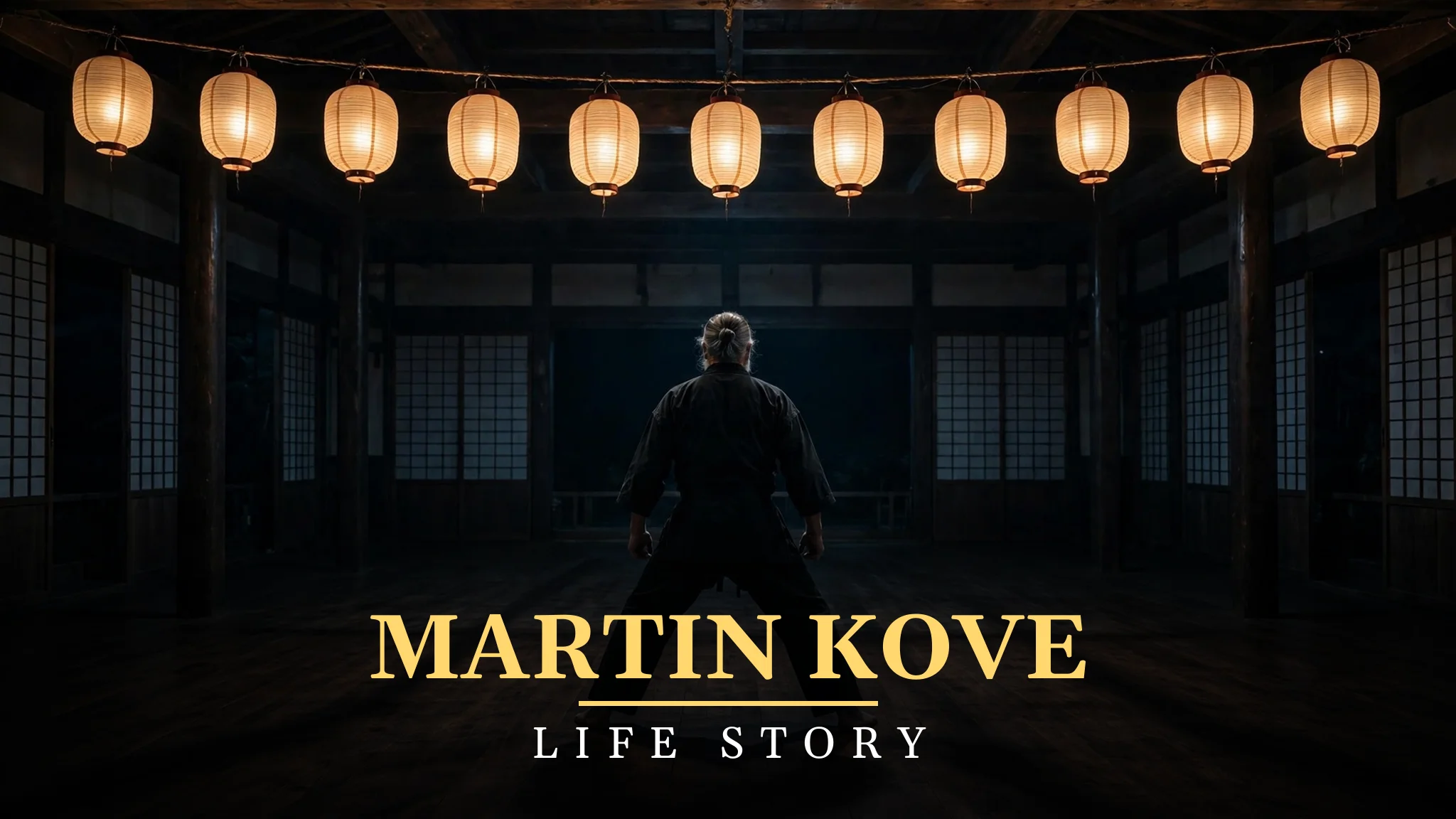
One last thought stays with me. When I picture Kove standing alone in a dark dojo, under the warm light of paper lanterns, I see a man who has spent his life thinking about what it means to be strong. Kreese thinks strength means never showing mercy. Kove, I believe, knows better. He knows that real strength is patience, kindness, and the ability to keep going when life is hard. That is the lesson I take from his story, and it is a lesson I want to remember. Strength is not about hurting others. It is about standing firm, being honest, and helping the people around you to be better. Martin Kove has done that, both as an actor and as a man.
I keep thinking about how patient Martin Kove had to be. He worked for more than ten years before The Karate Kid, and then he worked for thirty years after it, often in small roles that few people noticed. That is a long career built on showing up, doing good work, and not giving up. I admire that, because it is easy to be patient when things are going well, and very hard to be patient when they are not. Kove was patient in both cases, and that patience is what allowed him to be ready when Cobra Kai called him back in his seventies.
I also think about the difference between Kove and Kreese, and about how hard it must be to play a man who is so cold. Kove is warm and funny in real life, and he is kind to fans. Kreese is the opposite. He is cold, hard, and certain that mercy is a weakness. To play Kreese well, Kove had to step into a dark place, live there for a scene, and then step out again. That takes skill, and it takes emotional strength. I respect him for doing it so well, and for doing it for so many years without letting the darkness stay with him.
There is something I find sad about Kreese, which is that he is a man who learned the wrong lessons in war and then taught them to young people. He is not a monster who enjoys hurting others for fun. He is a man who believes that life is a fight, and that being soft will get you killed. That belief is wrong, but it is understandable if you have been through war. Kove plays that sadness with care, especially in Cobra Kai, where we learn more about Kreese’s past. He shows us a young soldier who became a hard man, and he makes us feel sorry for that young soldier, even as we dislike the older man he became.
I also think about his work on Cagney and Lacey as Victor Isbecki, and about how few people remember that role compared to Kreese. Isbecki was a good man, a steady policeman who did his job and cared about his colleagues. Kove played him with warmth and humour, and he did it for several years. I wish more people knew about that role, because it shows that Kove could play kindness as well as cruelty. It is easy to remember a villain, because villains are loud. It is harder to remember a kind policeman, because kindness is quiet. But Kove played both, and he played both well, and that is the mark of a real actor.
Another thought stays with me, which is about age. Kove returned to Cobra Kai in his seventies, and he was still strong, still sharp, and still able to command a scene. That is inspiring, because it shows that age does not have to mean the end of work. If you take care of yourself, if you keep learning, and if you keep your passion alive, you can still do great work when you are old. Many people think that life ends at sixty, but Kove proves that it does not. He is still working, still meeting fans, and still talking about acting with enthusiasm, and I hope I have that kind of energy when I am his age.
I also admire the way he treats fans at conventions. He goes, he signs, he talks, and he listens. He does not act as if he is above his fans. He acts as if he is grateful to them. That is a good attitude, because without fans, there is no career. Many famous people forget that, and they become rude or distant. Kove has not forgotten, and I respect him for it. He understands that the people who watched his films kept his career alive for forty years, and he thanks them for it with his time and his kindness.
I keep returning to the idea of teaching, because Kreese is a teacher, and a bad one. A teacher has great power over young people, and a good teacher can change a life for the better, while a bad teacher can change it for the worse. Kove’s performance is a warning to all of us who teach, coach, or lead young people. We must be careful about what we teach, because our students will believe us. That is a serious responsibility, and Kove makes us feel it every time Kreese speaks. I think that is an important lesson, and it is one that goes beyond film.
I also think about his family, and about the difficulty of raising twins while working as an actor. Acting takes you away from home, and it is hard to be a good father when you are on a film set in another city. Kove has spoken about that difficulty, and I respect his honesty. He did not pretend that it was easy. He admitted that it was hard, and that he tried his best. That is all any parent can do, and I think it is a good example for young fathers who are trying to balance work and family.
In the end, I think Martin Kove’s story is about endurance. He endured rejection, he endured being typecast, he endured the long quiet years, and he endured the return of fame in old age. He did it with dignity, and he did it without losing his kindness. He is not the most famous actor of his generation, but he is one of the most durable, and durability is a kind of success that is often overlooked. I would rather have a long, honest career than a short, bright one that burns out quickly, and Kove chose the long road, and he is still walking it.
Frequently Asked Questions
Who did Martin Kove play in The Karate Kid?
He played John Kreese, the sensei of the Cobra Kai dojo and the teacher who told his students that mercy was a weakness. Kreese is the main villain of the first film and returns in the later films and in Cobra Kai.
Where was Martin Kove born and when?
He was born on 6 March 1946 in Brooklyn, New York. He grew up in New York and later moved to California to build his acting career in film and television.
Was Martin Kove in Rambo as well?
Yes, he appeared in Rambo: First Blood Part II in 1985, playing a soldier alongside Sylvester Stallone. The film was a major hit and came out the year after the first Karate Kid film.
What role did Martin Kove play on Cagney and Lacey?
He played Detective Victor Isbecki, a regular character on the police drama. Unlike Kreese, Isbecki was a steady and likeable policeman, which showed Kove’s range as an actor.
Is Martin Kove like John Kreese in real life?
No, people who meet him say he is warm, funny, and kind, which is the opposite of Kreese. He has often said that Kreese is a character he plays, not who he is, and he enjoys meeting fans who grew up watching the films.
How did Martin Kove return in Cobra Kai?
He first reappeared at the end of the first season, and then became a central character in later seasons. The show explored Kreese’s past in Vietnam and gave him a deeper, sadder story than the original films had shown.
Does Martin Kove have children?
Yes, he has twins, a son named Jesse and a daughter named Rachel, from his marriage to Vivienne Kove. He has spoken about the challenge of balancing acting work with family life.


