Martin Luther King Jr.: The Life Story Behind the Dreamer Who Changed America
In this post
- A Preacher’s Son in Atlanta
- Montgomery and the Bus Boycott That Made Him a Leader
- Birmingham, the Letter, and the Children Who Marched
- The Nobel Prize and the Laws That Changed America
- Memphis, the Final Speech, and a Life Cut Short
- The Poor People’s Campaign and a Wider Vision
- Coretta, the Children, and the Family That Carried On
- My Take:
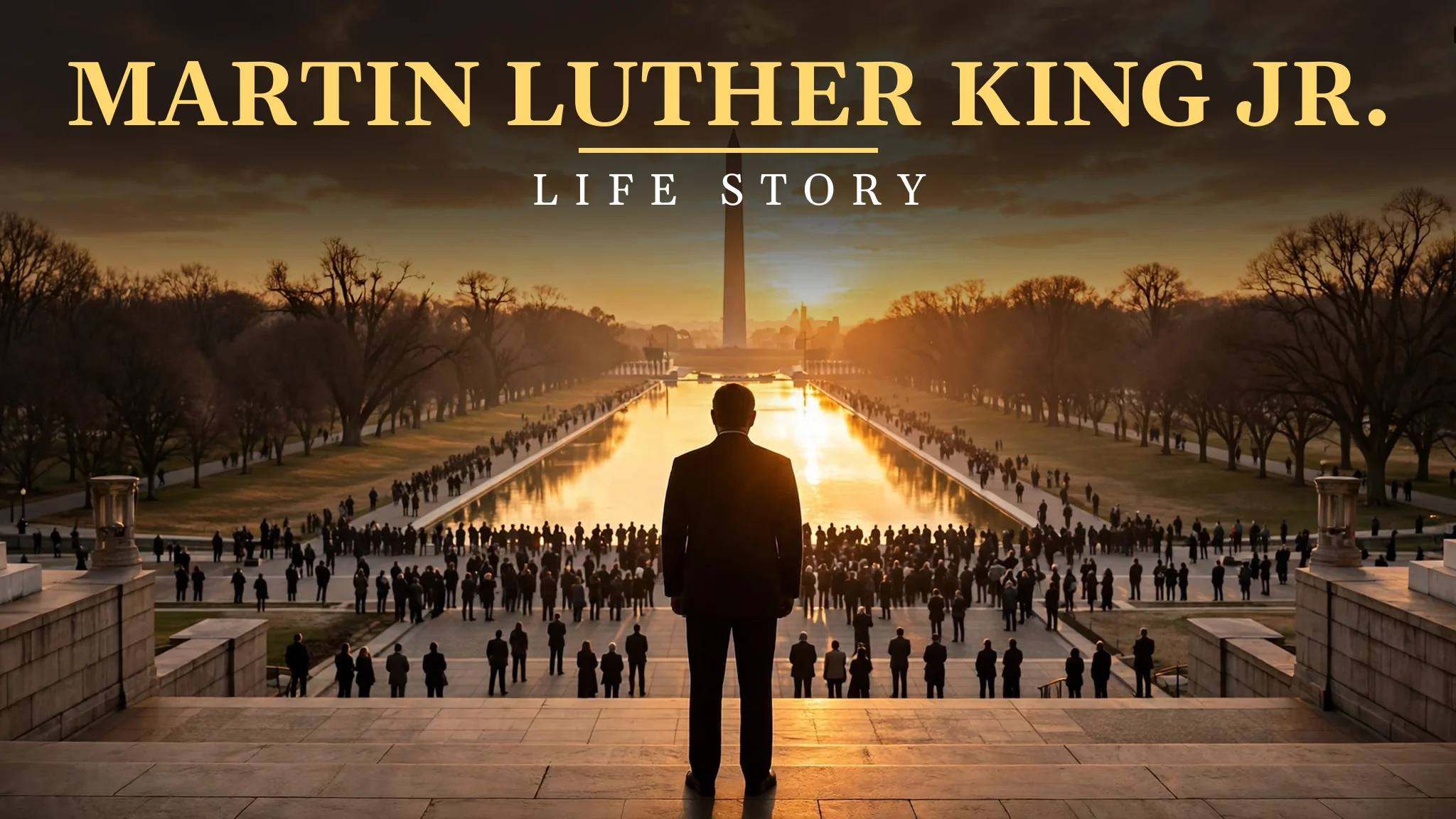
On 28 August 1963, a young preacher from Atlanta stood on the steps of the Lincoln Memorial in Washington, in front of a crowd of more than two hundred thousand people, and he spoke about a dream. He said that he dreamed of a day when his children would be judged not by the colour of their skin but by the content of their character, and he said it in a voice that was calm, strong, and full of faith. The crowd listened, the cameras carried his words around the world, and the speech became one of the most famous in history. The man was Martin Luther King Jr., and the dream he spoke about was not only his dream. It was the dream of millions of Black Americans who had lived for centuries under slavery and segregation, and who were asking, at last, to be treated as equal citizens.
He was born on 15 January 1929 in Atlanta, Georgia, to a Baptist preacher and his wife, and he grew up in a home where faith, education, and dignity were the most important things. He became a preacher himself, and then a leader, and then the most important voice of the civil rights movement in America. He led boycotts, marches, and protests, and he did it without violence, because he believed that love was stronger than hate, and that non-violence could change the world. He was arrested many times, his home was bombed, and he was threatened constantly, but he kept going, because he believed that the cause was just.
He won the Nobel Peace Prize in 1964, when he was only thirty-five years old, and he became the youngest man ever to receive it at that time. He died on 4 April 1968 in Memphis, Tennessee, at the age of thirty-nine, and his death shocked the world. He had lived a short life, but he had changed his country forever, and his words are still read, quoted, and taught in schools around the world. This is the story of how a preacher’s son from Atlanta became the conscience of America.
A Preacher’s Son in Atlanta
Martin Luther King Jr. was born Michael King Jr. on 15 January 1929 in Atlanta, Georgia, and his father later changed both their names to Martin Luther King, after the German reformer Martin Luther. His father, Martin Luther King Sr., was the pastor of the Ebenezer Baptist Church in Atlanta, one of the most important Black churches in the South, and his mother, Alberta Williams King, was a teacher and a church organist. The family lived in a comfortable home, by the standards of Black families in the segregated South, and young Martin grew up in a house where books, music, and church were part of daily life.
Atlanta in the 1930s was a city of segregation. Black people and white people lived apart, went to different schools, drank from different water fountains, and sat in different parts of buses and trains. Martin learned about segregation early, and he learned that it was not a natural thing. It was a system made by people, and it could be changed by people. He was a bright child, and he skipped grades at school, entering Morehouse College, a historically Black college in Atlanta, at the age of fifteen. At Morehouse he studied sociology, he read widely, and he began to think seriously about the problems of his country and about what he could do to help solve them.
His father wanted him to become a preacher, and Martin was not sure at first. He was interested in many things, including law and medicine, and he was not certain that the church was the right place for him. But as he studied, he began to see that the church could be a place for social change, not only for prayer, and that a preacher could be a leader in the community. He decided to follow his father into the ministry, and he went on to study theology at Crozer Theological Seminary in Pennsylvania, and then to earn a doctorate at Boston University. It was at Boston that he met Coretta Scott, a young woman from Alabama who was studying music, and they married in 1953.
In Boston, King also read the works of Mahatma Gandhi, the Indian leader who had used non-violent protest to win independence for India, and he was deeply influenced by Gandhi’s ideas. He learned that non-violence was not weakness, but a powerful way to resist injustice, and that it could win the sympathy of the public and the support of the world. He also read the American philosopher Henry David Thoreau, who had written about civil disobedience, the idea that a person has a duty to disobey an unjust law. Those ideas became the foundation of King’s work, and they stayed with him for the rest of his life.
Montgomery and the Bus Boycott That Made Him a Leader
In 1954, King became the pastor of the Dexter Avenue Baptist Church in Montgomery, Alabama, and he settled there with Coretta and their young family. Montgomery was a city of deep segregation, and the buses were a daily reminder of it: Black passengers had to sit at the back, and they had to give up their seats to white passengers if the bus was full. On 1 December 1955, a Black woman named Rosa Parks refused to give up her seat on a Montgomery bus, and she was arrested. The Black community of Montgomery decided to boycott the buses, to refuse to ride them until the system was changed, and they chose the young pastor, Martin Luther King Jr., to lead the boycott.
The boycott lasted for more than a year, from December 1955 to December 1956, and it was a test of endurance, courage, and organisation. Black people in Montgomery walked to work, they shared cars, and they organised a system of lifts, and they did it in all weathers, for more than a year, even though the bus company lost money and the city tried to stop them. King was arrested, his home was bombed, and he was threatened, but he kept speaking, kept organising, and kept urging the people to remain non-violent, even when they were attacked. His speeches during the boycott made him famous across America, and they showed that a young preacher could lead a movement.
The boycott ended in victory. In November 1956, the United States Supreme Court ruled that segregation on buses was unconstitutional, and in December the buses of Montgomery were desegregated. It was the first great victory of the civil rights movement, and it made King a national figure. He was twenty-seven years old, and he had led a movement that had changed the law. He had also learned a lesson that would guide him for the rest of his life: that ordinary people, working together peacefully, could change a system that seemed unchangeable.
After Montgomery, King founded the Southern Christian Leadership Conference, known as the SCLC, an organisation of Black churches and leaders that would coordinate the civil rights movement across the South. He travelled, he spoke, he wrote, and he organised, and he became the most visible leader of the movement. He was not the only leader, and he often worked with other men and women who were just as brave, but his voice, his calm, and his ability to speak to both Black and white audiences made him the face of the movement, and the person the nation looked to for leadership.
Birmingham, the Letter, and the Children Who Marched
In the early 1960s, King and the SCLC turned their attention to Birmingham, Alabama, one of the most segregated cities in America, where the police commissioner, Bull Connor, was known for his brutality. In the spring of 1963, King led a campaign of non-violent protests in Birmingham, including sit-ins, marches, and boycotts, and he was arrested and put in jail. While he was in jail, he wrote one of his most famous works, the Letter from Birmingham Jail, in which he explained why he believed that non-violent protest was necessary, and why waiting for justice was not an option. The letter was written on scraps of paper, smuggled out of the jail, and published in newspapers across the country, and it became a classic of American writing.
The Birmingham campaign was also marked by the Children’s Crusade, in which young people, some of them still in school, marched in the streets and were attacked by police dogs and fire hoses. The images of children being attacked were shown on television around the world, and they shocked the American public. It was a painful moment, and King was criticised by some people for allowing children to march, but the campaign worked: the city agreed to desegregate its public facilities, and the nation began to pay attention to the civil rights movement in a new way. The violence of Birmingham showed the world what segregation really meant, and it made it impossible for the country to look away.
King’s work in Birmingham also led directly to the March on Washington, the great demonstration of August 1963, in which more than two hundred thousand people, Black and white, gathered in the capital to demand jobs and freedom. It was at that march that King gave his I Have a Dream speech, the speech that is still remembered today. The speech was not planned word for word. King had prepared a text, but in the middle of the speech he departed from it, and he spoke from his heart, about a dream of a future in which his children would live in a nation where they would not be judged by the colour of their skin. The words were powerful, and the crowd responded with cheers, and the speech became a defining moment in American history.
The March on Washington was a triumph, but it was also a reminder that the work was not finished. The civil rights movement still faced opposition, still faced violence, and still faced a Congress that was slow to act. King knew that a speech, however beautiful, was not enough. He needed laws, and he needed the support of the president, and he worked tirelessly to get them.
The Nobel Prize and the Laws That Changed America
In 1964, King won the Nobel Peace Prize, at the age of thirty-five, for his leadership of the non-violent civil rights movement. He was the youngest person ever to win the prize at that time, and he accepted it with humility, saying that it belonged not to him but to the movement, and to the people who had marched, been arrested, and suffered for the cause. He gave the prize money to the movement, and he continued to work, because the prize was an honour, but it was not the end of the struggle.
The same year, the United States Congress passed the Civil Rights Act of 1964, a law that outlawed segregation in public places, in schools, and in employment, and that was one of the most important laws in American history. King had worked for that law, he had marched for it, and he had spoken for it, and its passage was a victory for the movement. The following year, in 1965, Congress passed the Voting Rights Act, which protected the right of Black Americans to vote, and which was a direct result of the Selma to Montgomery marches, in which King and thousands of others marched for the right to vote, and in which marchers were attacked by police on the Edmund Pettus Bridge in Selma, Alabama.
The Selma marches were a turning point, because the images of the violence on the bridge were shown on television, and they shocked the nation. President Lyndon Johnson, who had been a supporter of civil rights, pushed the Voting Rights Act through Congress, and it became law in August 1965. King had achieved, in less than a decade, what many people had thought impossible: the end of legal segregation, and the protection of the right to vote. He was a national hero, and he was also a man who was increasingly criticised, by people who thought he was moving too fast, and by people who thought he was not moving fast enough.
In the years after the great laws were passed, King began to speak about other problems: poverty, the war in Vietnam, and the economic inequality that affected Black Americans and poor Americans of all races. He spoke against the Vietnam War, which made him unpopular with the president and with many Americans, and he began to plan a Poor People’s Campaign, a march on Washington by poor people of all races, to demand jobs, housing, and a decent life. It was a wider vision, and it was a more difficult one, because it asked the country to change not only its laws but its economy, and that was a harder task than ending segregation.
Memphis, the Final Speech, and a Life Cut Short
In the spring of 1968, King went to Memphis, Tennessee, to support a strike by sanitation workers, Black men who collected the city’s rubbish and who were paid low wages and treated badly. The workers had gone on strike after two of their colleagues were killed in an accident, and they were demanding better pay and safer conditions. King went to Memphis to march with them, to speak for them, and to show that the civil rights movement was also a movement for economic justice, for the rights of working people.
On the evening of 3 April 1968, King gave a speech at the Mason Temple in Memphis, a speech that is now known as the I’ve Been to the Mountaintop speech. In it, he spoke about his life, about the threats he had faced, and about his belief that he might not live to see the promised land, but that his people would get there. It was a powerful, emotional speech, and it was his last. The next day, on 4 April 1968, he was shot and killed while standing on the balcony of the Lorraine Motel in Memphis, where he was staying. He was thirty-nine years old.
His death shocked the world, and it led to riots in many American cities, as people expressed their grief and their anger. His funeral was held in Atlanta, and it was attended by thousands of people, including leaders from around the world. He was buried in Atlanta, and his grave became a place of pilgrimage, where people come to remember him and to learn about his life. In the years that followed, his birthday became a national holiday in the United States, Martin Luther King Jr. Day, which is observed on the third Monday in January, and his words became part of the national story.
His legacy is enormous. He changed the laws of his country, he changed the way Americans thought about race, and he showed the world that non-violence could be a powerful force for change. He also left behind a body of writing and speaking that is still studied today, including his speeches, his letters, and his books, which include Stride Toward Freedom, about the Montgomery bus boycott, and Why We Can’t Wait, about the Birmingham campaign. His children, and his wife Coretta, who died in 2006, worked to keep his memory alive, and the King Center in Atlanta continues his work.
The Poor People’s Campaign and a Wider Vision
After the great laws of 1964 and 1965, King began to speak about a wider vision, one that went beyond race and into the lives of all poor Americans, Black and white, and about the war in Vietnam, which he believed was wrong, and which was taking money and lives that should have been spent at home. In 1967, he gave a speech at Riverside Church in New York, in which he spoke against the Vietnam War, saying that it was a war that was hurting the poor, and that America should seek peace, not victory. The speech made him unpopular with President Johnson, and with many Americans, including some of his own supporters, who thought that he should stick to civil rights, and not talk about war. King did not listen, because he believed that justice was indivisible, and that a man who spoke about peace at home must also speak about peace abroad.
He also began to plan the Poor People’s Campaign, a march on Washington by poor people of all races, who would demand jobs, housing, and a decent income, and who would camp in the capital until the government listened. It was a bold idea, and it was a difficult one, because it asked the country to change its economy, not just its laws, and because it brought together people who had never worked together before, Black and white, Latino and Native American, all poor, all demanding a fair share. King was working on the campaign when he went to Memphis in April 1968, and the campaign went ahead after his death, although it did not achieve all that he had hoped, because the country was in mourning, and because the leadership was gone.
Coretta, the Children, and the Family That Carried On
King’s wife, Coretta Scott King, was a partner in his work in every sense, and she deserves to be remembered as a leader in her own right. She was a singer, a musician, and an activist, and she marched, she spoke, and she raised their four children, Yolanda, Martin III, Dexter, and Bernice, while her husband was travelling, in jail, and in danger. She kept the family together, she kept the home, and she kept the faith, even when the threats were constant, and even when the house was bombed. After King’s death, she worked for the rest of her life to keep his memory alive, founding the King Center in Atlanta, campaigning for the national holiday in his honour, and speaking out for peace and justice, until her own death in 2006.
His children also carried on his work, in different ways, speaking, writing, and leading organisations that promote non-violence, and they have spoken about the difficulty of growing up as the children of a man who belonged to the whole world, and who was often absent from home. They have also spoken about the pain of losing their father when they were young, and about the pride they feel in his legacy. The King family is a reminder that behind every great leader is a family that sacrifices, that supports, and that suffers, and that the work of a movement is never done by one person alone, but by a whole community, and by a family that believes in the cause.
My Take:
I think Martin Luther King Jr. is one of the greatest leaders who ever lived, and I do not say that lightly, because there are many great leaders in history, and many of them were flawed, and King was flawed too. But his greatness is not in doubt, because he changed his country, he changed the law, and he changed the way people thought about each other, and he did it without violence, without hate, and without giving up, even when his life was threatened every day. That is a kind of greatness that is rare, and it is a kind of greatness that I admire more than any military victory or any political triumph, because it was won with words, with faith, and with love.
What I love most about King is his belief in non-violence, because it is a belief that is easy to say and very hard to live. When people are attacking you, when your home is bombed, when your children are threatened, the natural response is to fight back, to hit back, to hate. King said no. He said that hate cannot drive out hate, only love can do that, and that darkness cannot drive out darkness, only light can do that. He said it, and he lived it, and he asked the people who followed him to live it too. I think that is the most difficult thing he ever did, harder than any march, harder than any speech, because it asked people who had suffered for centuries to respond to suffering with love. That is not a small thing. That is a revolution of the heart.
I also think about his youth, and how young he was when he did all of this. He was twenty-six when he led the Montgomery bus boycott, he was thirty-four when he gave the I Have a Dream speech, and he was thirty-five when he won the Nobel Peace Prize. He was thirty-nine when he died. He did more in thirteen years than most people do in a lifetime, and he did it while he was still a young man, with a young family, and with a life that was constantly in danger. I think about that when I feel tired or when I think I am too young to make a difference. King was young, and he made a difference, and his age was not an excuse. It was a reason to act, because he knew that the future belonged to the young, and that the young had a duty to shape it.
The I Have a Dream speech is the part of his story that I return to most often, because it is a perfect example of what a speech can do. It was not a policy paper, and it was not a list of demands. It was a dream, a picture of a future in which children would be judged by their character, not by their skin, and in which the sons of former slaves and the sons of former slave owners would sit together at a table. That picture was so clear, and so beautiful, that it moved people who had never thought about civil rights before, and it gave the movement a language that everyone could understand. I think that is the power of a dream: it does not argue, it does not accuse, it shows you a better world, and it asks you to help build it.
I think about the Letter from Birmingham Jail, too, because it is a work of great moral clarity. King wrote it in a jail cell, on scraps of paper, to answer the white clergymen who had told him to wait, to be patient, and to let the courts handle the problem. He wrote that justice too long delayed is justice denied, and that the white moderate, who prefers order to justice, is a greater obstacle than the open racist. Those words are still true today, and they are still uncomfortable, because they ask us to look at ourselves, not only at the obvious villains. I think that is the mark of a great moral thinker: he does not only condemn the enemy, he also challenges his friends, and he asks everyone to do better.
I want to be honest about his flaws, because a full picture includes them. King was not a perfect man. He was unfaithful to his wife, and that is a painful truth that has been documented by historians, and it is a truth that his family has had to live with. He was also criticised by younger activists who thought his non-violence was too slow, and by older leaders who thought he was too radical. He made mistakes, he had doubts, and he was often tired and afraid. I do not think those flaws make him less great. I think they make him more human, and more admirable, because he achieved what he achieved not as a saint, but as a man who struggled with his own weaknesses and who kept going anyway. A saint would be easy to admire and hard to follow. A flawed man who does great things is a better example for the rest of us.
I think about his death, and how young he was, and how much more he could have done. He was planning the Poor People’s Campaign, he was speaking about poverty and about the war, and he was beginning to see that the struggle for justice was wider than race, that it was also about class, about economics, and about peace. If he had lived, he might have changed the country even more, or he might have faced new difficulties and new criticisms. We will never know. What we know is that he died doing the work he believed in, supporting sanitation workers in Memphis, men who collected rubbish and who were treated as if they did not matter. He died for them, and for the idea that every worker deserves dignity. That is a fitting end to a life, even if it is a tragic one.
I think his legacy is not only in the laws he helped to pass, but in the way he taught people to protest. He taught that protest should be non-violent, that it should be disciplined, and that it should appeal to the conscience of the nation, not to its fear. That lesson has been used by movements around the world, from South Africa to Eastern Europe to the Middle East, and it is still used today by people who want to change their countries without violence. King did not invent non-violence, but he showed the world how powerful it could be, and he gave it a voice that the whole world could hear. That is a gift that goes beyond America, and beyond his own time.
I also think about the holiday that bears his name, Martin Luther King Jr. Day, and how it is celebrated in America. It is a day of service, a day when people are asked to volunteer, to help their neighbours, and to do the work that King did. I think that is the right way to remember him, not only with speeches and parades, but with work, because King was a man of work, and he believed that faith without works is dead. If we want to honour him, we should do the work, in our own communities, in our own way, for the people who need it most. That is a lesson I try to carry with me, even in small things.
I also think about Coretta, and about how much of King’s work would not have been possible without her. She raised four children, she kept the home, she marched, she sang, and she spoke, and she did it while her husband was in jail, while the house was bombed, and while the threats never stopped. After his death, she spent almost forty years keeping his memory alive, founding the King Center, campaigning for the holiday, and speaking for peace. That is a lifetime of work, and it is work that is often forgotten when we talk about King, because we focus on the man and forget the woman beside him. I think we should remember her, and I think we should remember that behind every great leader is a partner who sacrifices, and who believes, and who carries on when the leader is gone.
Another thought that stays with me is about the Poor People’s Campaign, and about how King was beginning to see that the struggle was wider than race. He saw that poor white people, poor Black people, and poor people of every colour shared the same problems, and that they needed to work together, not against each other. That is a vision that is still relevant today, when the world is divided by race, by class, and by politics, and when the poor are often pitted against each other, while the rich stay rich. King saw that, and he tried to bring people together, and he was killed while he was trying. I think that is a tragedy, not only for America, but for the world, because his wider vision might have changed the country even more than his civil rights work did, if he had lived to see it through.
I think about the holiday, Martin Luther King Jr. Day, and about how it is observed in America, with a day of service, when people volunteer, help their neighbours, and do the work that King did. I like that idea, because it turns a holiday into a day of action, not just a day off, and it reminds people that King’s legacy is not a statue, but a job to do. I try to think about that in my own life, in small ways, by helping someone, by speaking up when I see something unfair, and by not waiting for someone else to do it. King did not wait, and neither should we.
Finally, I want to say something about his faith, because it was the foundation of everything he did. He was a Baptist preacher, and he believed in God, in love, and in the idea that all people are children of God, and that no one is better than anyone else because of the colour of their skin. That faith gave him strength when he was afraid, it gave him hope when the road was long, and it gave him a language to speak to people who did not share his politics, but who shared his faith. I am not a preacher, and I do not share all of his beliefs, but I respect the way his faith made him brave, and made him kind, and made him unwilling to hate, even when hate would have been easier. That is a kind of faith that I admire, whatever my own beliefs are.
In the end, I think King’s life teaches a simple and powerful lesson: that one person, with faith, with courage, and with love, can change the world, and that change does not require violence, or hate, or power, but only the willingness to stand up, to speak, and to keep going, even when the road is long and the danger is real. He stood up, he spoke, and he kept going, until the day he died, and the world is better because he did. I hope his dream is still alive, and I hope that we, the people who read his words today, will help to make it real. I also think about the way King is taught in schools today, and about whether we teach the whole King, or only the safe parts. Many schools teach the I Have a Dream speech, and they teach that King was a good man who wanted peace, and they leave out the parts where he spoke against the war, where he spoke about poverty, and where he was criticised by his own government. I think that is a shame, because the whole King is more interesting, and more challenging, than the safe King, and because young people deserve to know that he was a man who grew, who changed, and who was willing to be unpopular for what he believed. Teaching only the dream, without the struggle, makes him seem like a saint, and saints are easy to admire and hard to follow. A man who struggled is a better example.
Frequently Asked Questions
When and where was Martin Luther King Jr. born?
Martin Luther King Jr. was born on 15 January 1929 in Atlanta, Georgia, to Martin Luther King Sr., pastor of Ebenezer Baptist Church, and Alberta Williams King. He grew up in Atlanta, entered Morehouse College at fifteen, and later studied theology at Crozer and Boston University.
What was the Montgomery bus boycott?
The Montgomery bus boycott began in December 1955 after Rosa Parks refused to give up her seat on a bus, and Black residents of Montgomery refused to ride the buses for more than a year. King led the boycott, and in 1956 the Supreme Court ruled that segregation on buses was unconstitutional.
What did Martin Luther King Jr. say in his I Have a Dream speech?
On 28 August 1963, at the March on Washington, King spoke of his dream that his children would one day live in a nation where they would not be judged by the colour of their skin but by the content of their character. The speech was given on the steps of the Lincoln Memorial to more than two hundred thousand people.
When did Martin Luther King Jr. win the Nobel Peace Prize?
King won the Nobel Peace Prize in 1964, at the age of thirty-five, for his leadership of the non-violent civil rights movement. He was the youngest person to win the prize at that time, and he gave the prize money to the movement.
What laws did the civil rights movement help to pass?
The movement helped to pass the Civil Rights Act of 1964, which outlawed segregation in public places, schools, and employment, and the Voting Rights Act of 1965, which protected the right of Black Americans to vote after the Selma to Montgomery marches.
When and how did Martin Luther King Jr. die?
Martin Luther King Jr. died on 4 April 1968 in Memphis, Tennessee, at the age of thirty-nine. He was in Memphis to support striking sanitation workers, and the day before his death he gave his final speech, known as the I’ve Been to the Mountaintop speech.


