Martinho da Vila: The Life Story Behind Brazil's Samba Storyteller
In this post
- A Boy From Duas Barras
- Vila Isabel and the Samba School
- Casa de Bamba and the First Album
- Canta, Canta, Minha Gente and the Voice of the People
- Books, History, and the Keeper of Samba
- Eighty Years Old and Still Singing
- The Voice and the Guitar of a Storyteller
- The Family, Mart’nália, and the Next Generation
- Martinho and the History of Black Brazil
- The Writer and the Books of Samba
- Martinho and the Carnival of Vila Isabel
- Martinho and the Old Sambistas
- Martinho and the Children Who Sing
- My Take:
Martinho da Vila is the storyteller of Brazilian samba. For more than fifty years he has written songs that tell the story of Brazil: its people, its neighbourhoods, its history, and its joy. His voice is warm and gentle, his guitar is steady, and his words are like a conversation with an old friend who knows everything about the city and wants to share it with you.
He was born in the countryside, in the small town of Duas Barras, and he grew up in Vila Isabel, a neighbourhood in Rio de Janeiro that is famous for its samba school. He took the name of that neighbourhood as his own, and he became its voice. His songs “Casa de Bamba”, “Canta, Canta, Minha Gente”, and “O Pequeno Burguês” are classics, and they have been sung by generations of Brazilians.
His story is a story of patience, of learning, and of a love for samba that has never faded. He is a singer, a songwriter, a writer of books, and a keeper of the history of samba. He is also a man who has lived a long, full life, and who is still working today, in his eighties, with the same passion he had as a young man. This is the story of Martinho da Vila.
A Boy From Duas Barras
Martinho José Ferreira was born on 12 February 1938 in Duas Barras, a small town in the state of Rio de Janeiro. He was the son of a farmer, and he grew up in the countryside, surrounded by nature, by music, and by the simple life of a small town. As a boy, he listened to the music of the countryside, to the songs his family sang, and to the sounds of the land. That early life gave him a love of stories, of people, and of the Brazil that exists far from the big cities.
When he was still young, his family moved to Rio de Janeiro, to the neighbourhood of Vila Isabel. Vila Isabel was a working-class neighbourhood with a strong samba tradition, and it was home to the samba school Unidos de Vila Isabel. Martinho grew up in that world, and he fell in love with samba. He learned to play the guitar, he learned the old sambas, and he began to write his own songs. He took the name “da Vila”, which means “of Vila”, as his stage name, and it became a promise: he would be the voice of his neighbourhood.
Vila Isabel in the 1950s was a place of music, of parties, and of community. Martinho was part of it all. He played at gatherings, he sang at the samba school, and he learned the craft of songwriting from the older sambistas who had been doing it for decades. He was a patient student, and he listened carefully. That patience would serve him well, because his career would be built slowly, one song at a time.
Vila Isabel and the Samba School
The samba school Unidos de Vila Isabel is one of the most important in Rio de Janeiro, and Martinho da Vila became one of its most loved figures. Samba schools are not only about Carnival. They are community centres, places where people gather, learn, and celebrate their neighbourhood. Martinho was part of that community, and he wrote songs for the school, he performed with it, and he carried its name with pride.
His early work was as a composer of samba-enredo, the songs written for the Carnival parade, and as a singer of partido-alto, the traditional style of samba singing. He learned the rules of samba, and he learned how to break them gently, how to write a song that was both traditional and new. His songs were full of images from Vila Isabel, from Rio, and from Brazil, and they were sung with a warmth that made people feel at home.
He also worked in other jobs to support himself, as many sambistas did. He was not a star at first. He was a working man who sang, and he built his career slowly. That slow building gave him a deep understanding of samba and of the people who make it. He was not an outsider looking in. He was an insider, a man of the neighbourhood, and his songs came from inside the world he sang about.
Casa de Bamba and the First Album
Martinho’s first big step came in the late 1960s, when he began to record. His first album, released in 1969, included “Casa de Bamba”, a song about a house where samba is played, and “O Pequeno Burguês”, a song about a small middle-class man. Both songs became famous, and they showed what Martinho could do: he could write about everyday life with humour, with warmth, and with a deep understanding of people. “O Pequeno Burguês” is a gentle, funny song about a man who wants to be respectable, and it became one of his most loved works.
The album was a success, and it gave Martinho a name in Brazilian music. He was not a loud star. He was a quiet, thoughtful singer, and his music was different from the rock and pop that were popular at the time. But his songs were so good, and his voice was so warm, that people listened. He became known as a songwriter’s songwriter, a man who wrote songs that other singers wanted to record.
The early 1970s were a time of growth. He recorded more albums, he toured, and he built a reputation as one of the great sambistas of his generation. He was a man who respected tradition, but who was not afraid to write about modern life. His songs were about the Brazil of his time, and they were sung by people who recognised themselves in his words.
Canta, Canta, Minha Gente and the Voice of the People
In 1974, Martinho released one of his most famous songs, “Canta, Canta, Minha Gente”, which means “Sing, Sing, My People”. The song is a call to the Brazilian people to sing, to celebrate, and to keep their culture alive. It became an anthem, and it is still sung today at samba gatherings, at concerts, and at parties. The song’s message is simple: singing is a way of living, and a people who sing are a people who are alive.
The song showed Martinho’s gift for writing anthems that are also intimate. It is a big song, a song for a crowd, but it is also a personal song, a song about the joy of singing together. That balance is rare, and it is one of the reasons Martinho is so loved. He can write a song for a stadium and a song for a living room, and both will feel true.
Other famous songs followed. “Devagar, Devagarinho” is a gentle song about taking life slowly. “Mulheres” is a song about women, sung with respect and warmth. Each song added to his reputation as a storyteller, a man who could take a small moment and turn it into a song that everyone understood. His catalogue grew, and it became one of the richest in Brazilian music.
Books, History, and the Keeper of Samba
Martinho da Vila is not only a singer. He is also a writer, and he has written books about samba, about Vila Isabel, and about the history of Brazil. His books show his love of learning and his desire to preserve the stories of the people he has known. He has written about the great sambistas of the past, about the samba schools, and about the culture of Rio, and his books are valued as records of a world that is changing.
He has also been a keeper of history in his songs. His music tells the story of Black Brazil, of the people who built samba, and of the neighbourhoods that made it. He sings about the past with respect, and he sings about the present with honesty. That work of memory is important, because samba is not only music. It is history, and Martinho has spent his life making sure that history is not forgotten.
He has received many honours for his work, including awards for his music and his writing. He has been celebrated as one of the great figures of Brazilian culture, and his name is known across the country. But he has remained a humble man, a man of Vila Isabel, who still sings with the same warmth he had as a young man. He has never forgotten where he came from, and he has never stopped telling its story.
Eighty Years Old and Still Singing
Today, Martinho da Vila is in his eighties, and he is still performing and recording. He sings with his children and grandchildren, who have followed him into music, and his concerts are family affairs, full of warmth and joy. He has celebrated more than fifty years of his career with special shows, and his fans have celebrated with him. He is a living legend, a man whose music has become part of the identity of Rio de Janeiro.
His later years have also been a time of family. His children, including the singer Mart’nália, have become artists in their own right, and they carry on his work. That continuity is beautiful: a father who sings, a daughter who sings, and a family that keeps samba alive together. Martinho’s legacy is not only his songs. It is his family, his neighbourhood, and the community he has built around his music.
He continues to write, to record, and to perform, and he shows no sign of stopping. His voice is still warm, his guitar is still steady, and his stories are still worth hearing. For Brazil, he is a treasure, a man who has spent his life telling the story of his people, and who is still telling it today.
The Voice and the Guitar of a Storyteller
Martinho da Vila’s voice is warm, gentle, and steady, and it is the voice of a storyteller. He does not shout or show off. He sings as if he is talking to a friend, and his words are clear and easy to understand. That simplicity is his gift. In a world of loud singers, Martinho’s quiet voice stands out, because it feels honest and close. When he sings, you feel as if you are sitting with him, listening to a story that only he can tell.
His guitar playing is also simple and steady. He plays with a rhythmic, gentle style that supports his voice without overpowering it. The guitar is not the star. The story is the star, and the guitar is there to carry it. That humility is part of his art. He does not try to impress with speed or with tricks. He tries to tell the truth, and he lets the guitar help him do it.
He has taken care of his voice for more than fifty years, and it remains strong in his eighties. That is a remarkable achievement, and it is the result of a steady, disciplined life. He sings with care, he rests when he needs to, and he treats his voice with respect. A voice that has sung for fifty years is a voice that has been loved, and Martinho’s voice is loved by millions.
The Family, Mart’nália, and the Next Generation
Martinho da Vila’s family is part of his story, and his children have followed him into music. His daughter Mart’nália is a singer in her own right, and she has built a successful career with her own voice and her own style. She learned from her father, but she is not a copy of him. She is an artist in her own right, and her success is a tribute to the home she grew up in, a home full of music, of stories, and of love for samba.
His family concerts are famous for their warmth. Martinho performs with his children and grandchildren, and the stage becomes a family gathering, full of joy and of music. That continuity is beautiful: a father who sings, a daughter who sings, and a family that keeps samba alive together. It shows that music is not only a career. It is a heritage, passed from one generation to the next.
That family legacy is one of Martinho’s greatest gifts. He has not only written songs. He has raised a family of musicians, and he has shown them that a life in music is a good life. His children carry his work forward, and they will carry it to new audiences. That is a legacy that will last long after Martinho himself has stopped singing.
Martinho and the History of Black Brazil
Martinho da Vila’s music tells the story of Black Brazil, of the people who built samba, and of the neighbourhoods that made it. He sings about the past with respect, and he sings about the present with honesty. His songs are a record of a history that is often forgotten, and they keep that history alive for new generations. That work of memory is important, because samba is not only music. It is history, and Martinho has spent his life making sure that history is not forgotten.
He has written about the great sambistas of the past, about the samba schools, and about the culture of Rio, and his books and songs are valued as records of a world that is changing. He has also spoken about the need for respect for Black culture, and about the importance of remembering where samba came from. That work is part of his legacy, and it is one that will last.
For the people of Vila Isabel, he is a hero. He is their son, a man who became a star without ever leaving his roots. For the people of Brazil, he is a reminder that the best stories come from home, from the neighbourhood, and from the people who live there. Martinho’s stories are Brazil’s stories, and they deserve to be told.
The Writer and the Books of Samba
Martinho da Vila is a writer as well as a singer, and his books are an important part of his legacy. He has written about samba, about Vila Isabel, and about the history of Brazil, and his books are valued as records of a world that is changing. Writing gave him a new way to tell the truth, and he took to it with the same energy he brought to music. His books show his love of learning, and his desire to preserve the stories of the people he has known.
His writing is simple and clear, like his songs, and it is full of stories about the great sambistas, about the samba schools, and about the culture of Rio. Readers love his books because they feel like a conversation with an old friend who knows everything about the city. That is a rare gift for a writer, and it is one that Martinho shares with his singing. Both his songs and his books are stories, and both are told with warmth and with honesty.
Martinho and the Carnival of Vila Isabel
The Carnival parade of Unidos de Vila Isabel is one of the great events in Rio, and Martinho da Vila has been part of it for decades. He has written samba-enredo for the school, he has performed with it, and he has carried its name with pride. The parade is a moment when a neighbourhood tells its story to the whole country, and Martinho’s songs have been part of that story. His work for the school shows his loyalty to his home, and his belief that a neighbourhood can speak to the world.
His Carnival work is also a reminder that samba is not only music. It is a community, a history, and a celebration. Martinho has spent his life serving that community, and the community has loved him for it. When Vila Isabel parades, Martinho is there, in spirit if not always in person, and his songs are in the air. That is a beautiful thing, and it is a legacy that will last as long as the school parades.
Martinho and the Old Sambistas
Martinho da Vila learned his craft from the old sambistas, the masters who had been singing samba for decades before he was born. He listened to them, he played with them, and he learned their songs by heart. Those old men were his teachers, and he has spent his life honouring them. He sings their songs, he tells their stories, and he makes sure that young people know their names. That work of memory is one of the most important things he has done, because a tradition lives only if someone keeps singing it, and Martinho has kept samba alive by singing the songs of the past.
His respect for the old masters is also a lesson for young musicians. In a world that is always looking for the new, Martinho shows that the old is valuable too, and that a young artist should learn from those who came before. He was a patient student, and he became a great teacher, passing on what he learned to his children and to a new generation. That chain, from the old masters to Martinho to the young, is the history of samba, and it is a chain that Martinho has kept strong for fifty years.
Martinho and the Children Who Sing
Martinho da Vila’s greatest joy in his later years has been singing with his children and grandchildren. His family concerts are famous for their warmth, and they show a side of his art that is deeply personal. He is not only a singer on a stage. He is a father and a grandfather, sharing his music with the people he loves most. Those family performances are a reminder that music is not only a career. It is a heritage, passed from one generation to the next, and Martinho has passed his heritage on with love and with pride.
His children, including Mart’nália, have built careers of their own, and they carry his work forward. They sing his songs, they write their own, and they keep samba alive for a new generation. That continuity is beautiful, and it is one of the most important parts of Martinho’s legacy. A singer who raises a family of musicians has given Brazil more than songs. He has given it a future, and that future is singing today.
My Take:
When I think about Martinho da Vila, I think about a storyteller sitting in a circle, with a guitar, telling stories that everyone wants to hear. His music feels like that: warm, patient, and full of life. He does not shout. He speaks, he sings, and he lets the story do the work. I think that is a beautiful way to make music, and it is a way that takes great skill. It is easy to be loud. It is hard to be quiet and still hold a room. Martinho holds a room with a whisper, and that is a rare gift.
What I admire most is his patience. He built his career slowly, one song at a time, and he never rushed. He learned from the older sambistas, he respected tradition, and he earned his place. That patience is a lesson for anyone who wants to build something real. Good work takes time, and the people who are willing to wait are often the ones who make the best work. Martinho waited, and he made a catalogue of songs that will last for generations.
I also admire his love for his neighbourhood. He took the name “da Vila” and he made it a promise. He would be the voice of Vila Isabel, and he has kept that promise for fifty years. That loyalty is rare. Many artists leave their home and forget it. Martinho carried his home with him, and he made it famous. He showed that a neighbourhood can be a world, and that a small place can hold a great story. That is a lesson for anyone who comes from a small place: your home is not a limitation. It is a gift.
There is a gentle sadness in his story too, and it is the sadness of time passing. The old sambistas he learned from are gone, the world of Vila Isabel has changed, and the samba he knew as a young man is not the same. I feel sad for what has been lost, but I feel glad that Martinho has written it down, in his songs and in his books. He is a keeper of memory, and because of him, the stories will not be forgotten. That is a precious thing.
For a reader, I think the lesson of Martinho da Vila is to listen, to learn, and to tell stories. Listen to the older people around you, learn from them, and then tell their stories in your own voice. Be patient, be loyal to your home, and do not rush. A life built slowly, with care, is a life well lived. Martinho has lived that life, and his songs are the proof.
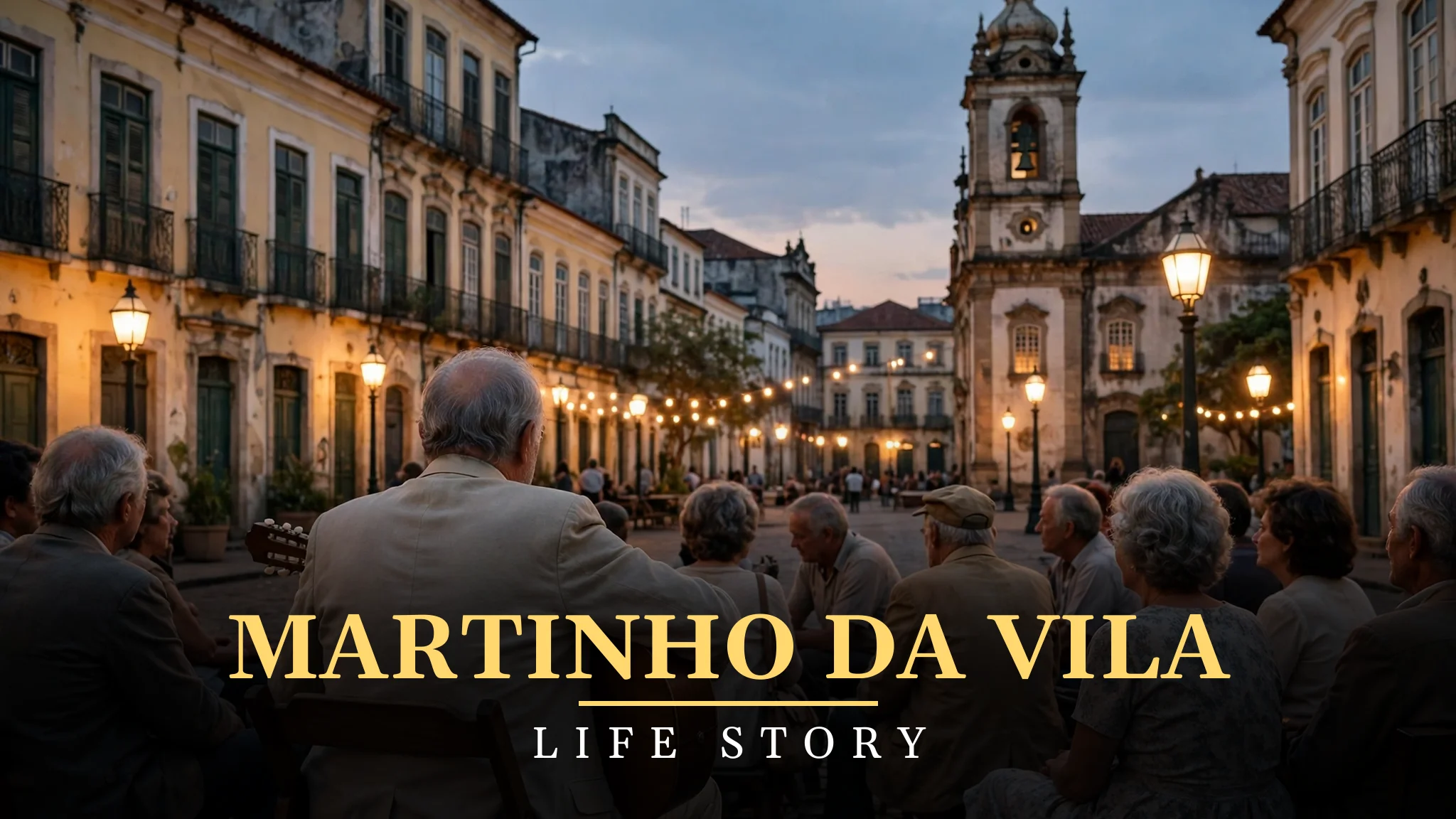
I will end with the image that stays with me: an old man with a guitar, sitting in a circle of friends in a square at dusk, singing a song that everyone knows. That is Martinho da Vila, and that is his gift to Brazil. He has given us fifty years of stories, and he is still giving them. That is a legacy worth celebrating.
I also think about his voice, and how it sounds like a storyteller. It is warm, gentle, and steady, and it makes listeners feel as if they are sitting with a friend. That simplicity is a gift. In a world of loud singers, Martinho’s quiet voice stands out, because it feels honest and close. A voice does not have to be loud to be powerful. It has to be true, and Martinho’s voice is true.
I think about his family, and how beautiful it is that his daughter Mart’nália sings too. A father who raises a daughter who becomes an artist has given her a great gift: the belief that music is a good life. That gift is passed from one generation to the next, and it keeps samba alive. Martinho’s legacy is not only his songs. It is his family, and the music they will make together and after him.
I also reflect on his work as a keeper of history, and how important it is. Samba is not only music. It is the history of Black Brazil, of the neighbourhoods, and of the people who built it. Martinho has spent his life telling that history, in his songs and in his books, and he has made sure it is not forgotten. That is a precious thing, and it is a lesson for all of us: remember where you come from, and tell the story, so that others can remember too.
There is a lesson here about patience and about the value of a slow career. Martinho built his career one song at a time, and he never rushed. He learned from the older sambistas, he respected tradition, and he earned his place. That patience is a lesson for anyone who wants to build something real. Good work takes time, and the people who are willing to wait are often the ones who make the best work.
I feel sadness when I think about the old sambistas he learned from, and how they are gone. The world of Vila Isabel has changed, and the samba he knew as a young man is not the same. I feel sad for what has been lost, but I feel glad that Martinho has written it down, in his songs and in his books. He is a keeper of memory, and because of him, the stories will not be forgotten. That is a gift to Brazil.
For a young person reading this, I would say: listen to the older people around you, learn from them, and then tell their stories in your own voice. Be patient, be loyal to your home, and do not rush. A life built slowly, with care, is a life well lived. Martinho has lived that life, and his songs are the proof. Your home is not a limitation. It is a gift, and it is the source of your best stories.
I also think about the samba school Unidos de Vila Isabel, and what it means to Martinho. The school is not only about Carnival. It is a community, a place where people gather, learn, and celebrate. Martinho is part of that community, and he has carried its name with pride for fifty years. That loyalty is rare, and it is a lesson: a community that sings together stays together, and a singer who serves his community will be loved by it.
When I think about “Canta, Canta, Minha Gente”, I think about the power of a simple call to sing. The song says: sing, my people, and keep your culture alive. That is a message that matters, not only for Brazil, but for every people in the world. A people who sing are a people who are alive, and Martinho has spent his life reminding Brazil to sing. That is a beautiful mission, and it is one that deserves respect.
I also take a lesson about humility from his story. He is one of the great figures of Brazilian culture, but he remains a humble man, a man of Vila Isabel, who still sings with the same warmth he had as a young man. He has never forgotten where he came from, and he has never stopped telling its story. That humility is a form of strength, and it is one that anyone can learn from.
Finally, I want to say that Martinho da Vila reminds me why stories matter. A story can keep a history alive, can bring people together, and can teach a new generation about the past. Martinho has told Brazil’s stories for fifty years, and he is still telling them. That is a legacy worth celebrating, and it is why his story will be told for a long time.
I will close with the image that stays with me: an old man with a guitar, sitting in a circle of friends in a square at dusk, singing a song that everyone knows. That is Martinho da Vila, and that is his gift to Brazil. He has given us fifty years of stories, and he is still giving them. That is a beautiful thing, and it is a reminder that the best music is the music that tells the truth about home.
I also think about his books, and how they show a different side of his talent. Writing gave him a new way to tell the truth, and he took to it with the same energy he brought to music. His books are simple and clear, like his songs, and they are full of stories about the great sambistas and the culture of Rio. That is a lesson for any artist: your gift may be bigger than you think, and it may work in forms you have not yet tried. Do not be afraid to try.
I think about the Carnival parade of Vila Isabel, and what it means to Martinho. The parade is a moment when a neighbourhood tells its story to the whole country, and Martinho’s songs have been part of that story for decades. That is a beautiful thing: a small neighbourhood, speaking to a whole nation, through music. It shows that a local story can be a universal one, if it is told with honesty and with love.
There is a lesson here about loyalty to home. Martinho has carried the name of Vila Isabel for fifty years, and he has never forgotten where he came from. That loyalty is rare, and it is a lesson for anyone who comes from a small place. Your home is not a limitation. It is a gift, and it is the source of your best stories. Tell those stories, and the world will listen.
I also reflect on his patience, and how it shaped his career. He built his work one song at a time, and he never rushed. That kind of patience teaches anyone hoping to build something real a valuable lesson. Fine work needs time, and those who are ready to wait often create the finest work. Martinho waited, and he made a catalogue of songs that will last for generations.
For a young person, I would say: listen to the older people around you, learn from them, and then tell their stories in your own voice. Stay patient, stay loyal to your home, and never rush. A life built slowly and with care is a life lived well. Martinho has lived such a life, and his songs stand as the proof. Your stories matter, and they deserve to be told.
Finally, I want to say that Martinho da Vila reminds me why stories matter. A story can keep a history alive, can bring people together, and can teach a new generation about the past. Martinho has told Brazil’s stories for fifty years, and he is still telling them. That is a legacy worth celebrating, and it is why his story will be told for a long time.
I also think about the old sambistas, and how Martinho learned from them. He listened, he played with them, and he kept their songs alive. That work of memory is one of the most important things he has done, because a tradition lives only if someone keeps singing it. Martinho has kept samba alive by singing the songs of the past, and by teaching them to a new generation. That is a gift to Brazil, and it is one that will last.
I will end by saying that Martinho da Vila’s stories are a reminder that home matters. He has told the story of Vila Isabel for fifty years, and his songs are the story of a neighbourhood, a city, and a country. That is a wonderful legacy, and it is one that will last. When I hear his songs, I hear an old man with a guitar, telling stories that everyone wants to hear, and that is a beautiful thing.
I will add one more thought about Martinho’s gift. His stories are the stories of a neighbourhood, a city, and a country, and they deserve to be told. A man who tells those stories with warmth and with honesty is a treasure, and Martinho is a treasure of Brazil. His songs will be sung for a long time, and his stories will be told for even longer.
Frequently Asked Questions
Where was Martinho da Vila born?
Martinho da Vila was born Martinho José Ferreira on 12 February 1938 in Duas Barras, a small town in the state of Rio de Janeiro. His family later moved to Rio, where he grew up in the neighbourhood of Vila Isabel and took its name as his stage name.
What is Martinho da Vila’s most famous song?
“Canta, Canta, Minha Gente”, released in 1974, is one of his most famous songs, a call for Brazilians to sing and celebrate their culture. Other beloved songs include “Casa de Bamba”, “O Pequeno Burguês”, “Devagar, Devagarinho”, and “Mulheres”.
Why is he called Martinho da Vila?
He is called Martinho da Vila because he grew up in Vila Isabel, a neighbourhood in Rio de Janeiro famous for its samba school, Unidos de Vila Isabel. “Da Vila” means “of Vila”, and the name marks him as the voice of his neighbourhood.
Has Martinho da Vila written books?
Yes, Martinho da Vila has written books about samba, about Vila Isabel, and about the history of Brazilian culture. His writing preserves the stories of the great sambistas and the neighbourhoods that created samba, and it is valued as a record of that world.
Is Martinho da Vila still performing?
Yes, Martinho da Vila is still performing and recording in his eighties, often with his children and grandchildren, including his daughter Mart’nália, who is also a singer. He has celebrated more than fifty years of his career with special concerts.
What is Unidos de Vila Isabel?
Unidos de Vila Isabel is the samba school of the Vila Isabel neighbourhood in Rio de Janeiro, one of the most important samba schools in the city. Martinho da Vila has been one of its most loved figures, writing songs for it and performing with it throughout his career.


