Masaki Suda: The Life Story Behind Japan's Versatile Star
In this post
- A Boy from Osaka with a Bright Energy
- Kamen Rider W and a Hero’s Beginning
- Moving into Film and Finding Serious Roles
- Drowning Love, We Made a Beautiful Bouquet, and the Big Films
- Singing, Radio, and a Star Who Does Everything
- Marriage to Nana Komatsu and a New Chapter
- The Versatile Star He Is Now
- Suda as a Singer and the Songs That Tell Stories
- My Take:
Masaki Suda is one of those actors who can do almost anything, and that is why directors in Japan keep calling him. He can play a hero in a children’s show, a troubled teenager in a dark film, a funny man in a comedy, a singer on stage, and a serious leading man in a romance, and he can make each one feel true. He is not a star who depends on one look or one kind of role. He depends on skill, on energy, and on a willingness to try new things, and that willingness has made him one of the busiest and most respected actors of his generation.
He started as a teenager in a tokusatsu show, the kind of show that many young actors use as a first step, and he could have stayed in that world. Instead he moved into film, into television drama, and into music, and he built a career that is wider than most. He has worked with famous directors, he has won awards, he has released songs, and he has married a fellow star, Nana Komatsu, and built a family life while keeping his career at the top. That is a lot to do in a short time, and Suda has done it with an energy that never seems to run out.
This is the story of Masaki Suda, a boy from Osaka who became one of Japan’s most versatile stars, and a look at how a young actor can grow from a children’s hero into a serious artist without losing the joy that made him special in the first place.
A Boy from Osaka with a Bright Energy
Masaki Suda was born on 21 February 1993 in Minoh, Osaka, Japan. Osaka is a city known for its humour, its food, and its loud, warm people, and a child growing up there learns to be direct, funny, and full of life. Suda grew up in that world, and the energy of Osaka stayed with him. Even now, when people describe him, they often use words like bright, funny, and full of life, and those words fit the place he came from as much as they fit him.
His family life was ordinary, and he grew up with a younger brother. A home with a brother is a home full of play, of small fights, and of learning how to share, and Suda learned those lessons young. He was a lively child, and he liked to perform, to make people laugh, and to be the centre of attention in a good way. That liveliness is not something you can learn in a class. It is something you are born with, and Suda was born with it.
As a schoolboy in Osaka, he was not yet thinking of a career in Tokyo. He was living a normal life, going to school, spending time with friends, and enjoying the city around him. But he had a face that stood out, and he had a natural way in front of a camera that other people noticed. In Japan, a young boy with that kind of presence can be spotted by a talent scout, and that is what happened to Suda. He was still a teenager when he was noticed, and the notice changed the direction of his life.
The move from Osaka to Tokyo is a big one for any teenager. It means leaving home, leaving friends, and living in a city where everything is faster and more crowded. Suda made that move, and he made it while he was still at school. He had to learn to live in Tokyo, to study, and to work, all at the same time. That is a hard life for a young person, but it taught him to be independent early, and it taught him to take his work seriously, because the work was the reason he had come to Tokyo.
Kamen Rider W and a Hero’s Beginning
In 2009, when Suda was sixteen, he was cast as Philip in Kamen Rider W, a television series in the long-running Kamen Rider franchise. Kamen Rider is a famous tokusatsu show in Japan, about heroes who fight monsters with special powers, and it is watched by children all over the country. Suda played Philip, a young man with a strange, brilliant mind, who shares a body with his partner Shotaro to become Kamen Rider W. The role asked him to be clever, funny, and a little strange, and he played it with an energy that made children love him.
Kamen Rider W was a success, and it gave Suda a fan base of young viewers who grew up with him. A role in Kamen Rider is a good start for a young actor, because it teaches him how to work on a set, how to do action scenes, how to speak clearly, and how to carry a show that is watched by millions. Suda learned those lessons, and he also learned how to be a hero in a way that felt real, not just like a costume. Philip is not a normal hero. He is a boy who lives in a room, who reads books, and who sees the world in a different way, and Suda made him feel human.
The show ran for a year, and during that year Suda became a familiar face to children and to their parents. He was no longer an unknown teenager from Osaka. He was Philip, and people remembered him. That fame could have trapped him in children’s television, but Suda did not let it. He used the show as a school, and when it ended, he moved on to other kinds of work, with the skills he had learned on set.
He also appeared in the films connected to Kamen Rider W, and he began to get small roles in other television dramas and films. Each new role was a chance to show that he could do more than play a hero in a children’s show. He could play a teenager in trouble, a young man in love, a funny friend, and many other kinds of people. Directors began to notice that range, and they began to offer him bigger parts.
Moving into Film and Finding Serious Roles
After Kamen Rider W, Suda moved into film with a speed that surprised people. He appeared in films that were darker, more serious, and more adult than a children’s show, and he showed that he could handle them. He played characters who were in trouble, who were angry, who were sad, and who were trying to find their place in the world, and he played them with an honesty that made audiences take notice.
One of his early important film roles was in The Backwater, released in 2013, a film about a young man who returns to his home town and faces the past he left behind. The film was quiet and sad, and it asked Suda to play a man who is lost and who is trying to find himself. He played the part with a stillness that was new for him, and it showed that he could be quiet as well as loud, and that he could carry a serious film.
He also appeared in films such as Princess Jellyfish, in which he played a young man who dresses as a woman, a role that asked for humour, for courage, and for a willingness to be different. Suda played the part with a lightness that made audiences laugh and care at the same time, and the film showed that he was not afraid of strange or difficult roles. That fearlessness became one of his trademarks. He would take a role that other young actors might avoid, and he would make it work.
During those years he also worked in television dramas, and he began to build a reputation as an actor who could do anything. He played a detective, a student, a lover, a friend, and a man in trouble, and he made each one feel real. That range is rare, and it is one of the reasons his career kept growing. Directors could cast him in many kinds of stories, because he did not bring the same face to every role.
Drowning Love, We Made a Beautiful Bouquet, and the Big Films
In 2016, Suda starred in Drowning Love with Nana Komatsu, a film about a young model who moves from Tokyo to the countryside and falls in love, while the story turns dark and painful. The film was based on a manga, and it asked Suda to play a boy who is charming, who is troubled, and who is capable of cruelty. He played the part with an intensity that made audiences uncomfortable in a good way, because the character felt real, not like a simple villain. The film was a success, and it showed that Suda could play a difficult, even unlikeable character, and still make the audience watch him.
The film also brought him together with Komatsu, the actress he would later marry. At the time, they were two young stars working on a difficult film, and they gave performances that were praised by critics. The film’s success gave both of them a new level of fame, and it gave Suda a reputation as an actor who was not afraid of dark material. He had moved far from Kamen Rider W, and he had proved that he could handle the hardest kinds of roles.
In 2021, he starred again with Komatsu in We Made a Beautiful Bouquet, a romance film about a young couple who meet, fall in love, and slowly grow apart. Suda played Mugi, a young man who is hopeful at first, then tired, then sad, and he played the part with a quiet sadness that grew over the film. The film was a hit, and it showed Suda at his best, as a leading man who could carry a whole film with a performance that was honest and unshowy. It was a different kind of role from Drowning Love, and it showed his range: he could be dark and intense in one film, and gentle and sad in another.
He also appeared in many other films in those years, including The Emperor in August, Seto and Utsumi, a film about two high school boys who talk by a river, and many other stories that showed his flexibility. Seto and Utsumi is a good example of his skill, because it is a film about two boys who mostly talk, and it depends on the actors to make talking feel interesting. Suda made it interesting, with humour, with timing, and with a natural way of speaking that felt like real life. That is a hard thing to do, and he did it well.
Singing, Radio, and a Star Who Does Everything
Suda is not only an actor. He is also a singer, and his music career has become a real part of his life. He began to release songs in 2017, and his songs were loved by fans who liked his clear, warm voice. He sang songs that were soft, hopeful, and full of feeling, and he performed them in concerts and on television, where audiences could see the same energy that they saw in his acting. His music was not a side job. It was a real career, and it showed that he could tell a story with a song as well as with a film.
He also worked in radio, hosting a popular radio show where he talked, played music, and spoke to listeners in a relaxed, funny way. Radio is a different skill from acting, because it asks for a voice that can hold an audience without a face, without a set, and without a script that is fully written. Suda did that work well, and his radio show became popular with young listeners who liked his honest, funny manner. It also showed that he was a person who could talk to people, not only act for them.
The mix of acting, singing, and radio is unusual, and it is hard to keep up. Each kind of work asks for different skills, different hours, and different kinds of energy. Suda kept up that mix, and he did it by being organised, by being energetic, and by loving each kind of work for its own sake. He did not treat singing as a break from acting, or radio as a break from singing. He treated each as a real job, and he gave each his full care.
That versatility has made him one of the most popular stars in Japan, and it has also made him a star who is hard to define. Is he an actor? Yes. Is he a singer? Yes. Is he a radio host? Yes. He is all of those things, and together they make a career that is wider than most. That width is his strength, and it is why audiences have stayed with him for so many years.
Marriage to Nana Komatsu and a New Chapter
In 2021, Suda married Nana Komatsu, the actress he had worked with in Drowning Love and in We Made a Beautiful Bouquet. The news was shared in a simple and quiet way, without a big public show. That suited both of them. They are two of the most respected young actors in Japan, and their marriage brought together two careers that had already been linked by film. Fans were happy for them, and the press covered the news, but the couple kept the details of their life together to themselves.
In 2024, it was reported that the couple had welcomed their first child. Again, the news was shared simply, and the couple asked for privacy. Suda has always been careful about his private life, even though he is a lively and open person in his work. He gives his acting and his music to the public, and he keeps his family for himself. That line matters to him, and it is one of the reasons people respect him. He can be funny and open on radio, and still keep his home life private.
Balancing a busy career with a new family is hard for any actor, and it is harder still for a star as busy as Suda. He has worked in film, television, music, and radio, all at once, for many years, and adding a family to that life means making choices about time, about rest, and about what matters most. Suda has made those choices in his own way, taking work that fits his life and his values, and stepping back when he needs to. That patience is part of his character, and it shows in the way his career has lasted without burning out.
His marriage to Komatsu also changed how people see him, in a small way. He is no longer only the bright young man from Osaka. He is a husband and a father, and a working actor who is building a life as well as a career. That change is normal, and it is also important, because it shows that a star can grow up in public without losing himself. Suda has grown up in public, from a teenage hero in Kamen Rider W to a married actor and father, and he has done it without scandal, without noise, and without losing the bright energy that made people notice him in the first place.
The Versatile Star He Is Now
Today, Masaki Suda stands as one of Japan’s most versatile and most trusted actors, and his career has a shape that is easy to admire. He started in a children’s show, moved into serious film, played dark and gentle roles, sang songs, hosted radio, and married a fellow star. He did all of that while keeping his energy, his humour, and his willingness to try new things. That is a remarkable career for someone still in his early thirties.
His legacy is still being written, because he is still young and still working. But even now, his story has a clear lesson. It is a lesson about versatility, about the idea that an actor does not have to be only one thing. He can be a hero, a lover, a singer, a radio host, and a father, all at once, and each part can make the others stronger. Suda shows that a career can be wide and deep at the same time, and that a star who tries many things can last longer than a star who tries only one.
For young people who want to act in Japan, he is a useful example. He shows that a start in a children’s show can lead to serious film, that a dark role can be better than a safe one, and that singing and acting can live together in one career. He also shows that a person can be famous and still keep a private life, and that a career can grow fast and still last. Masaki Suda did not rush to be one thing. He tried many things, and he did them well, and that is why his name still means something today.
He also stands for a kind of Japanese stardom that is bright and honest. His work is not about shock or scandal. It is about energy, about feeling, about stories that touch people. That brightness is his strength, and it is why audiences have stayed with him from Kamen Rider W to We Made a Beautiful Bouquet and beyond.
Suda as a Singer and the Songs That Tell Stories
Suda’s music career began in 2017, when he released his first songs, and it quickly became a real part of his life, not a hobby. He sings with a clear, warm voice, and his songs are soft, hopeful, and full of feeling. They are not loud pop songs made to be shouted in a stadium. They are songs that tell a story, that speak about love, about loss, about growing up, and about the small moments that make a life. Fans love them because they feel honest, and honesty is the thread that runs through all of Suda’s work, whether he is acting, singing, or talking on the radio.
He has released albums and singles, and he has performed in concerts where audiences can hear his voice live, without a studio, without a second take. A concert is a different kind of work from a film. In a film, you can try again. In a concert, you must sing well in front of real people, in real time, and you must hold their attention with only your voice and your presence. Suda does that, and he does it with an energy that makes audiences feel alive. He does not stand still and sing. He moves, he talks to the audience, and he makes a concert feel like a conversation, not like a performance.
His songs have also been used in films and in dramas, and those songs have become linked with the stories they belong to. A song that is used in a film must capture the feeling of that film, and Suda understands that. He writes and sings songs that feel like part of a story, not like a separate piece of music. When people hear his songs, they remember the film, and when they watch the film, they remember his voice. That link between song and story is a beautiful thing, and it is one that Suda has built with care.
Singing also helps his acting, and acting helps his singing. When he acts, he hears the rhythm of a line, the pause in a scene, and the rise and fall of a feeling, in the same way a singer hears a song. When he sings, he tells a story, in the same way an actor tells a story in a film. The two skills feed each other, and together they make him a performer who is more than an actor or more than a singer. He is both, and he is both well, and that is why his career is so wide and so strong.
My Take:
I think Masaki Suda is one of the most exciting actors in Japan, because he can do so many things and he does them all well. When I look at his career, I do not see a star who found one thing and stuck to it. I see a star who tried many things, and who kept trying new things, even when he was already successful. That takes courage. It is easy to stay where you are comfortable. It is hard to move into a new kind of work and risk failing in public. Suda has moved again and again, from a children’s hero to a serious film actor to a singer to a radio host, and he has made each move work. I admire that, because it shows a person who is not afraid to learn.
I think about his start in Osaka, and I think it gave him something that Tokyo cannot give. Osaka is known for humour, for directness, for a kind of warmth that is loud and honest. Suda has that warmth in his work. He can be funny, he can be bright, and he can make a scene feel alive with his energy. I think that energy comes from growing up in Osaka, where people speak plainly and laugh loudly. It is a good base for an actor, because it means he does not need to pretend to be lively. He is lively, and that liveliness shows in his performances. I think audiences feel it, and I think they love him for it.
Kamen Rider W is the part of his story that I find most interesting, because it is a children’s show, and many actors who start in a children’s show never escape it. Suda escaped it, not by rejecting it, but by using it as a school. He learned how to work on a set, how to do action, how to speak clearly, and how to carry a show. Then he moved on, and he used those skills in serious films. I think that is a smart way to start a career. You do not need to start in a serious film to become a serious actor. You can start in a children’s show, learn your craft, and then move on. Suda did that, and he did it well.
Drowning Love is a film that I think about a lot, because it is dark, and Suda played a boy who is charming and cruel at the same time. That is a hard role, because the audience must watch a person who is not good, and still find him interesting. Suda made that character interesting, not by making him likeable, but by making him real. He showed the boy’s charm, his anger, his fear, and his cruelty, all together, and he let the audience judge him. I think that is a brave performance, and it is a performance that a young actor should be proud of. It showed that Suda was not afraid of dark material, and that he could handle roles that other young actors might avoid.
We Made a Beautiful Bouquet is the film that moves me most, because it is about a couple who love each other and still grow apart. Suda played Mugi as a young man who is hopeful at first, then tired, then sad, and he played the part with a quiet sadness that grew slowly. He did not cry loudly. He did not shout. He let the sadness show in small ways, in the way he looked at his partner, in the way he spoke, in the way he moved through a room. I think that is how real sadness works. It is not always loud. It is often quiet, and it grows over time. I admire that he trusted the audience to see it without making it big. That trust is a sign of a mature actor.
I also think about his singing, and I think it is not a side job. He sings with a clear, warm voice, and his songs feel like stories. I think about how many actors try to sing and fail, because they treat singing as a trick. Suda does not treat it as a trick. He treats it as a craft, and he practises it, and he respects it. That respect shows in his voice. It is steady, it is full of feeling, and it is honest. I think his fans love his songs because they feel true, and honesty is the thread that runs through all his work, whether he is acting, singing, or talking on the radio.
His radio work is another part of his career that I admire, because radio asks for a different kind of skill. On radio, you cannot be seen. You must hold an audience with only your voice, with your words, with your humour. Suda did that, and his show became popular with young listeners. I think that shows he is a person who can talk to people, not only act for them. He is open, he is funny, and he is honest, and those qualities make him a good radio host as well as a good actor. I think that openness is part of who he is, and it is why people like him.
What I learn from him is that versatility is a strength, not a weakness. I think many young people are told to pick one thing, to be only an actor, or only a singer, or only a radio host. Suda shows that you can be all three, and that each one can make the others better. His acting makes his singing more honest. His singing makes his acting more musical. His radio work makes both of them more natural. I think that is a beautiful lesson, and it is one that applies to many kinds of work. You do not have to be only one thing. You can be many things, if you work hard at each one and respect each one.
I also learn from him that energy matters. He brings a bright, lively energy to his work, and that energy makes his performances feel alive. I think many actors are quiet and still, and that is fine, but Suda shows that energy can also be a form of honesty. When he is happy, you feel the happiness. When he is angry, you feel the anger. When he is sad, you feel the sadness, even if it is quiet. That energy is not an act. It is part of who he is, and it is why audiences love him. I think young actors should learn from that: bring your whole self to a role, and let your energy show.
I do feel a little worry for him, because a career that asks for so much, in so many fields, can be tiring. He must act, sing, host radio, and be a husband and a father, all at the same time. I hope he rests, I hope he looks after himself, and I hope he does not try to do everything at once for too long. A tired actor cannot give his best work, and Suda has always given his best work. I hope the people around him give him space to rest, and I hope he takes that space when he needs it. His energy is a gift, and gifts need care.
In the end, I think Masaki Suda matters because he shows that a star can be many things at once. He is an actor, a singer, a radio host, a husband, and a father, and he does each one with care. He is bright, he is versatile, and he is honest in his work. I will keep watching his films, listening to his songs, and expecting him to try new things, because trying new things is what he has always done. That is my take on him, and it is a take I feel with real respect and warmth.
I want to add one last thought about his marriage to Nana Komatsu, because I think it is a beautiful part of his story. Two young stars, both talented, both respected, both private, building a life together while building careers: that is a rare and happy thing. I hope they support each other, I hope they keep choosing good work, and I hope they keep their family safe from the noise of fame. That image, of two actors who met on a film set and built a life together, is the image I will keep when I think of Masaki Suda. It is a simple image, and it is a true one, and it explains a great deal about who he is.
I also think about his music, and I think it deserves more praise than it usually gets. Many actors try to sing, and they fail, because they treat singing as a trick. Suda does not treat it as a trick. He treats it as a craft, and he practises it, and he respects it. His songs are soft, hopeful, and full of feeling, and they feel like stories, not like products. I think his fans love his songs because they feel honest, and honesty is the thread that runs through all his work. When he sings, you believe the words. When he acts, you believe the character. That trust is the most valuable thing a performer can earn, and Suda has earned it in both fields.
There is something else I notice about him, and it is the way he brings energy to everything he does. He is bright, he is lively, and he makes a scene feel alive with his presence. I think that energy comes from Osaka, from growing up in a city known for humour and warmth, and it is a gift that many actors do not have. It is easy to be quiet and serious. It is harder to be bright and serious at the same time, and Suda does that. He can be funny in one scene and sad in the next, and both feelings feel true. That range is rare, and it is one of the reasons his career has lasted.
I also wonder what he will do next, now that he is a husband and a father as well as an actor and a singer. I hope he plays fathers, I hope he sings songs about family, I hope he keeps working on radio, and I hope he keeps the bright, honest style that has always been his. Fatherhood changes a person, and it can change an artist too, in a good way. It can give him a deeper understanding of love, of responsibility, and of what it means to look after someone else. I think Suda will bring that understanding to his next roles, and I think those roles will be even better because of it. I will be watching, and I will be hoping for the best for him.
When I think about his future, I also think about the kind of films he might make with directors outside Japan. He has already worked in Japanese films that are loved abroad, and I hope he works in films from other countries, not because Japanese film is not enough, but because his bright energy could bring something new to stories from anywhere. A Korean film, a European film, an American film: his face and his manner could fit them all, because energy does not belong to one country. I think that is a gift he has, and I hope he uses it. He does not need to leave Japan to be a world star. He already is one, and the world will come to him if he keeps choosing well.
I also think about Philip, the boy in Kamen Rider W, and I wonder what that character would think of the man Suda is now. Philip was a strange, brilliant boy who lived in a room and saw the world in a different way. Suda played him at sixteen, and he played him with an energy that made children love him. Now Suda is a man in his early thirties, a husband, a father, a singer, and a leading actor, and he has proved he can do far more than play one hero. I think that distance is a good thing. It shows that he was not trapped by one role. He used Philip as a beginning, not as a cage, and he built a whole career after it. That is a brave way to work, and a wise way to continue.
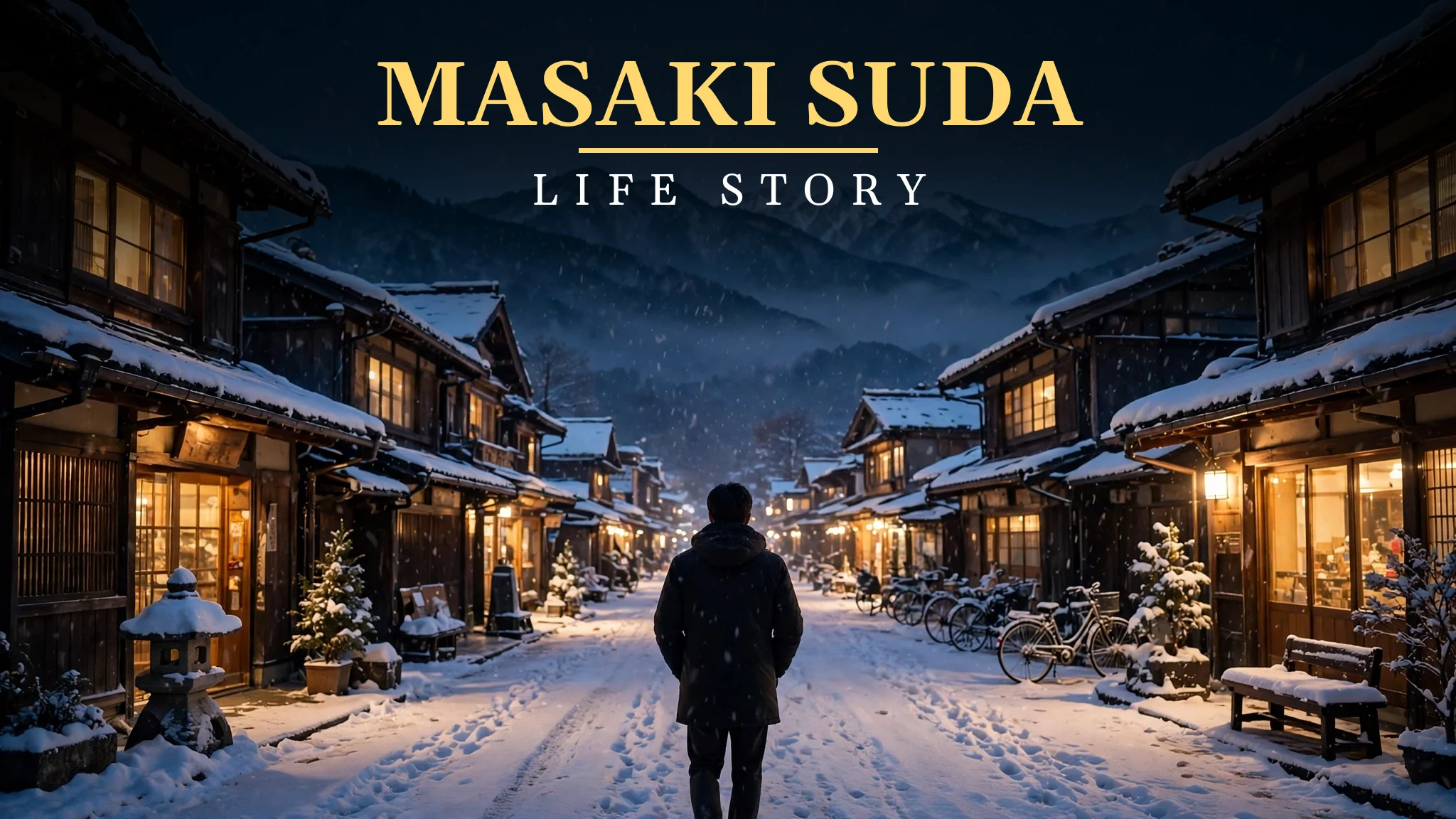
And I think about the snowy street in his cover image, the man in a dark coat walking down an old Japanese street at night toward mountains as snow falls, and I think it fits him. He is a person who walks his own path, quietly, in his own direction, while the snow falls around him. He does not need a crowd. He needs a good role, a good song, and a quiet night to do his work. I will keep watching for his next film, and I will keep expecting it to be chosen with care, because that is what he has always done, from Osaka to the world.
I want to say one more thing about Suda, and it is about his radio show, where he talks to listeners late at night, week after week, in a voice that is warm, funny, and completely his own. A radio host must talk without a script, must answer messages from strangers, and must keep people listening when there is nothing to look at, only a voice in the dark. Suda does that beautifully, and I think it shows a side of him that films cannot show: the side that is simply himself, talking, laughing, and thinking out loud. His songs work the same way. When he sings Sayonara Elegy, a song about saying goodbye to someone you love, he does not sing like a trained pop star. He sings like a man who has felt the words, and that honesty is why audiences love his music. Acting, singing, radio: he does all three, and he does them all as himself. That is a rare thing, and it is why I will keep following his work.
Frequently Asked Questions
When was Masaki Suda born?
Masaki Suda was born on 21 February 1993 in Minoh, Osaka, Japan, and he grew up in a city known for humour and warmth.
How did Masaki Suda become famous?
He became widely known as Philip in Kamen Rider W in 2009, a television series in the long-running Kamen Rider franchise.
Did Masaki Suda star in Drowning Love?
Yes, he starred in Drowning Love in 2016 with Nana Komatsu, playing a charming and troubled boy in a dark romance based on a manga.
What is We Made a Beautiful Bouquet about?
We Made a Beautiful Bouquet is a 2021 romance film in which Suda plays Mugi, a young man whose love slowly fades as he and his partner grow apart.
Is Masaki Suda also a singer?
Yes, he is a singer as well as an actor, and he began releasing songs in 2017, with a clear and warm voice loved by fans.
Is Masaki Suda married?
Yes, he married actress Nana Komatsu in 2021, and it was later reported that the couple welcomed their first child in 2024.
Has Masaki Suda worked in radio?
Yes, he hosted a popular radio show where he talked, played music, and spoke to listeners in a relaxed and funny way.


