Matthias Schweighöfer: The Life Story Behind the German Leading Man
In this post
- Anklam and a Childhood in a Family of Actors
- First Roles and the Road to the Screen
- Soloalbum and the First Leading Roles
- Keinohrhasen, Zweiohrküken, and Stardom in Germany
- What a Man, Directing, and a New Direction
- Army of Thieves, Oppenheimer, and the World Stage
- What Matthias Schweighöfer Means to German Film
- My Take:
Some actors are born to be leading men. They have the smile, the charm, and the easy way with a camera that makes an audience like them at once. Matthias Schweighöfer is one of those actors, but he is more than a charming face. He is a man who grew up in a family of actors, who learned the craft from the start, who became one of the most popular German actors of his generation, and who then became a director, a producer, and an international star, with roles in films like Army of Thieves and Oppenheimer. He did it with a warmth that is rare, with a humour that is real, and with a work ethic that has kept him at the top for more than twenty years.
He was born in Anklam, in what was then East Germany, in 1981, the son of actors Michael and Gitta Schweighöfer, and he grew up in the world of theatre and film. He did not choose acting because it was fashionable. He chose it because it was the world he knew, the world of rehearsals, of stages, of stories told in a dark room. He learned the craft from the start, not in a classroom, but by watching the people around him work, and by learning what it means to be honest on stage.
His best known German films include Soloalbum, Keinohrhasen, Zweiohrküken, and What a Man, films that made him a star in Germany, loved for his charm, his humour, and his ability to play a man who is both funny and serious at the same time. He then moved into international work, with Army of Thieves on Netflix and with a role in Oppenheimer, one of the most successful films of recent years. That journey, from a small town in East Germany to Hollywood, is the story of a man who never stopped learning, never stopped working, and never lost his charm.
This is the story of Matthias Schweighöfer, from a childhood in a family of actors to the rooftops of Berlin, and through a career that has made him one of the most loved German actors of his generation. It is a story about talent, about family, and about the hard work of staying true to a craft in a world that often rewards fame over skill.
Anklam and a Childhood in a Family of Actors
Matthias Schweighöfer was born on 11 March 1981 in Anklam, a town in Mecklenburg-Vorpommern, in what was then East Germany. His parents, Michael and Gitta Schweighöfer, were both actors, and he grew up in a home where theatre was work, where a play was not only entertainment but a job, and where the people around him took acting seriously as a craft. He did not grow up in a normal home. He grew up in a home where stories were told every day, where rehearsals were part of life, and where the sound of actors learning their lines was as normal as the sound of a radio.
He was eight years old when the Berlin Wall fell in 1989, and nine when Germany was reunified in 1990. For a child, that change must have felt enormous, as if the whole world had turned upside down in a single year. He grew up in a time of change, and he learned to watch people carefully, to see how they adapt, how they cope, and how they keep going when the world around them is different. That watching became the base of his acting, a way of looking at people from the inside, of asking what they want, what they fear, and what they hide.
As a child, he was often on the edges of the theatre world, watching, listening, and learning. He did not start acting as a small child in a formal way, but he absorbed the world around him, and he learned how actors think, how they move, and how they tell a story. That early learning was a gift, because it gave him a base that no school could give. He knew what a good performance felt like before he ever gave one himself, and that knowledge guided him when he began to act.
When he was older, he began to act himself, first in small roles, and then in larger ones. He studied acting at the Ernst Busch Academy in Berlin, one of the most respected drama schools in Germany, and he learned the craft properly, with discipline, with practice, and with a respect for the work. He did not rush to become famous. He took time to learn, to work in theatre, and to build his skill step by step. He knew that a long career is built on a strong base, not on a single lucky role, and he worked to build that base, even when the work was hard and the pay was low.
First Roles and the Road to the Screen
Schweighöfer began his acting career in the late 1990s, with roles in German television and film that gave him a chance to learn on the job. He appeared in small parts, he worked with different directors, and he learned how a film set works, how a camera sees an actor, and how a performance must be different on film from on stage. On stage, an actor must reach the back row. On film, an actor must be still, must let the camera come to him, and must trust that a small movement can say more than a large gesture. Schweighöfer learned that difference, and he learned it well.
He also worked in theatre, where he learned the discipline of a live performance, of playing the same role night after night and finding something fresh in it each time. Theatre is a hard school, because there is no second take, no editing, and no hiding. An actor must be ready, must know the lines, and must be present in the moment. Schweighöfer took that discipline with him to film, and it gave his film performances a strength and a focus that many film actors lack. He was not an actor who relied on luck. He relied on work.
In the early 2000s, he began to get larger roles, and people in the German film world began to notice him. He had a look that was warm and open, a face that could be funny and serious at the same time, and a voice that could carry a scene. He was not a tough actor. He was a charming actor, a man who looked like a real person, and that made him believable in roles that called for a man in love, a man in trouble, or a man trying to find his way. That believability became his mark.
He did not become famous overnight, and that was a good thing. He had time to learn, to make mistakes, and to grow, without the pressure of fame. By the time the big role came, he was ready for it, not because he had been lucky, but because he had spent years learning his craft in small roles and in theatre. That preparation is the part of his story that is easy to miss, but it is the part that matters most, because it is what made the success that followed possible.
Soloalbum and the First Leading Roles
One of his early successes was the film Soloalbum, released in 2003, based on a popular novel about a young man in Berlin who is dealing with love, with work, and with the feeling of being lost in a large city. Schweighöfer played the lead role, Ben, a man who is funny, sad, and trying to find his way, and he gave a performance that was warm and honest. The film was a success in Germany, and it showed that he could carry a film, that he could play a complex character, and that he could make an audience care about a person who was not perfect.
The film gave him a wider audience, and it showed that he could be a leading man, not only a supporting actor. He learned from working on a successful film, from seeing how a hit is made, and from feeling the energy of an audience that loves a story. That experience gave him confidence, and it prepared him for the films that would make him famous in Germany. He was now a name that directors wanted to work with, and he was ready to take on larger roles.
In those years, German cinema was changing, with new directors and new actors who wanted to tell stories in a fresh way. Schweighöfer was part of that change, a young actor who was not afraid to play a man in love, a man in trouble, or a man who is funny and sad at the same time, and who brought a modern energy to German film. He was not tied to the old style of German acting. He was part of a new generation, and that generation would soon make films that were seen around the world.
The success of Soloalbum was a step, not a peak. It showed Schweighöfer that he could be in a hit film, and it showed the film world that he was an actor to watch. The next step would be larger, and it would come in a film that became one of the most popular German films of all time, a romantic comedy that made his name known to every person in Germany who loved cinema. That film was Keinohrhasen, and it was about to change everything.
Keinohrhasen, Zweiohrküken, and Stardom in Germany
Keinohrhasen, released in 2007 and directed by Til Schweiger, became one of the most successful German films of its time. The title means rabbit without ears in German, and the film told the story of a journalist, played by Til Schweiger, and a woman, played by Nora Tschirner, who had known each other as children, and who meet again as adults. Schweighöfer played a supporting role, but it was a strong one, and the film became a hit, loved for its humour, its warmth, and its sense of romance. It was a film that showed a new kind of German comedy, one that was funny and touching at the same time.
The film was followed by a sequel, Zweiohrküken, released in 2009, in which Schweighöfer returned, and the sequel was also a success. The two films made him a star in Germany, a man who was known to audiences across the country, and who was loved for his charm, his humour, and his ability to play a man who is both funny and serious. He had become a leading man, not only in the sense of playing the lead, but in the sense of being a person the audience wanted to see, again and again.
After Keinohrhasen, he had more offers, from Germany and from other countries, and he had to choose carefully. He could have tried to become a Hollywood star at once, but he chose to stay in Germany for a time, to work on films that interested him, and to build a career that was based on good roles rather than on fame. That choice showed his character, a man who cared about the work more than about the spotlight, and who wanted to be an actor, not only a star. He also began to direct, and that move would change his career in a new way.
What a Man, Directing, and a New Direction
In 2011, Schweighöfer directed his first feature film, What a Man, a comedy about a man who is left by his girlfriend and who tries to become a real man, with the help of his friends. He also starred in the film, and it became a success in Germany, loved for its humour and its warmth. Directing was a new challenge, and it asked him to see the whole film, not only one character, but he had learned a great deal from working with directors for many years, and he brought that learning to his own work. He directed with a light touch, he let the actors be funny, and he made a film that felt real and joyful.
He continued to direct, with films like Schlussmacher in 2013 and Der Nanny in 2015, and he also worked as a producer, helping to make films that he believed in. He became a figure in German cinema who was respected not only as an actor but as a filmmaker, a man who could do both, who could be in front of the camera and behind it, and who understood film from both sides. That understanding made him a better actor, because he knew what a director needs, and it made him a better director, because he knew what an actor needs.
His work as a director did not replace his work as an actor. He continued to act, and he continued to take on roles that challenged him. He became a man who could do many things in film, who could act, direct, and produce, and who did them all with a warmth and a humour that made people want to work with him. That range is rare, and it is a large part of why he has stayed at the top in Germany for so long. He did not settle for one job. He learned many, and he did them well.
In those years, he also became a well known figure in German public life, appearing on television, in interviews, and in public events, with a charm that made him popular with audiences of all ages. He was not a star who hid from the public. He was a star who talked to the public, who made them laugh, and who shared his love of film with them. That openness made him even more loved, because fans felt they knew him, not only as an actor, but as a person.
Army of Thieves, Oppenheimer, and the World Stage
In 2021, Schweighöfer took on an international role that changed his career, playing Ludwig Dieter, a safe cracker, in Army of Thieves, a film on Netflix that was a prequel to Army of the Dead. He also directed the film, and it became a success around the world, watched by millions of people on Netflix. The role was funny, charming, and full of energy, and it showed that Schweighöfer could carry an international film, in English, with the same warmth that had made him a star in Germany. He was now known to audiences around the world, not only in Germany.
The film gave him a new audience, and it gave him a new confidence. He had shown that he could work in English, that he could direct a large film for a global audience, and that he could make a character who was loved by people in many countries. That is a rare achievement for a German actor, and it opened a door to more international work. He did not rush through that door. He chose carefully, and he waited for the right role, a role that would show a different side of his talent.
That role came in 2023, when he appeared in Oppenheimer, directed by Christopher Nolan, one of the most successful and most praised films of recent years. Schweighöfer played Werner Heisenberg, the German physicist, a small but important role in a film about the making of the atomic bomb. The film won many Academy Awards, including Best Picture, and it was seen by millions of people around the world. Schweighöfer’s role was not large, but it was a sign that he was now working with the best directors in the world, and that his talent was recognised at the highest level.
He also continued to work in German film and television, and he kept the balance between his German work and his international work that would define his later career. He did not leave Germany when Hollywood came. He kept his home in Germany, he kept working on German films, and he took on international roles when they interested him. That balance is a large part of why he is respected, because he has not forgotten where he came from, even as he has gone far.
What Matthias Schweighöfer Means to German Film
Matthias Schweighöfer matters to German film because he has been one of its most popular and most versatile stars for more than twenty years. He has made audiences laugh, he has made them cry, and he has shown that a German actor can be charming, funny, and serious, all at the same time. He has helped to make German cinema popular at home, with films like Keinohrhasen that were loved by millions, and he has helped to make it known abroad, with films like Army of Thieves and Oppenheimer that reached a global audience.
He also matters because he has shown that an actor can also be a director and a producer, and can do all of those jobs well. He did not settle for one role in film. He learned many, and he used that learning to make films that he believed in, films that were funny, warm, and honest. That range is a lesson for any young actor who wants a long career. Do not only learn to act. Learn how a film is made, learn how to direct, learn how to produce, and you will have more ways to tell the stories you love.
His story also shows the value of family and of learning from the people around you. He grew up in a family of actors, he learned from his parents, and he carried that learning with him into his own career. That kind of learning, from watching and from doing, is often stronger than learning from a book, and it is a large part of why Schweighöfer became such a strong actor and director. He did not learn film in a classroom alone. He learned it at home, in the theatre, and on the set, and that learning has lasted.
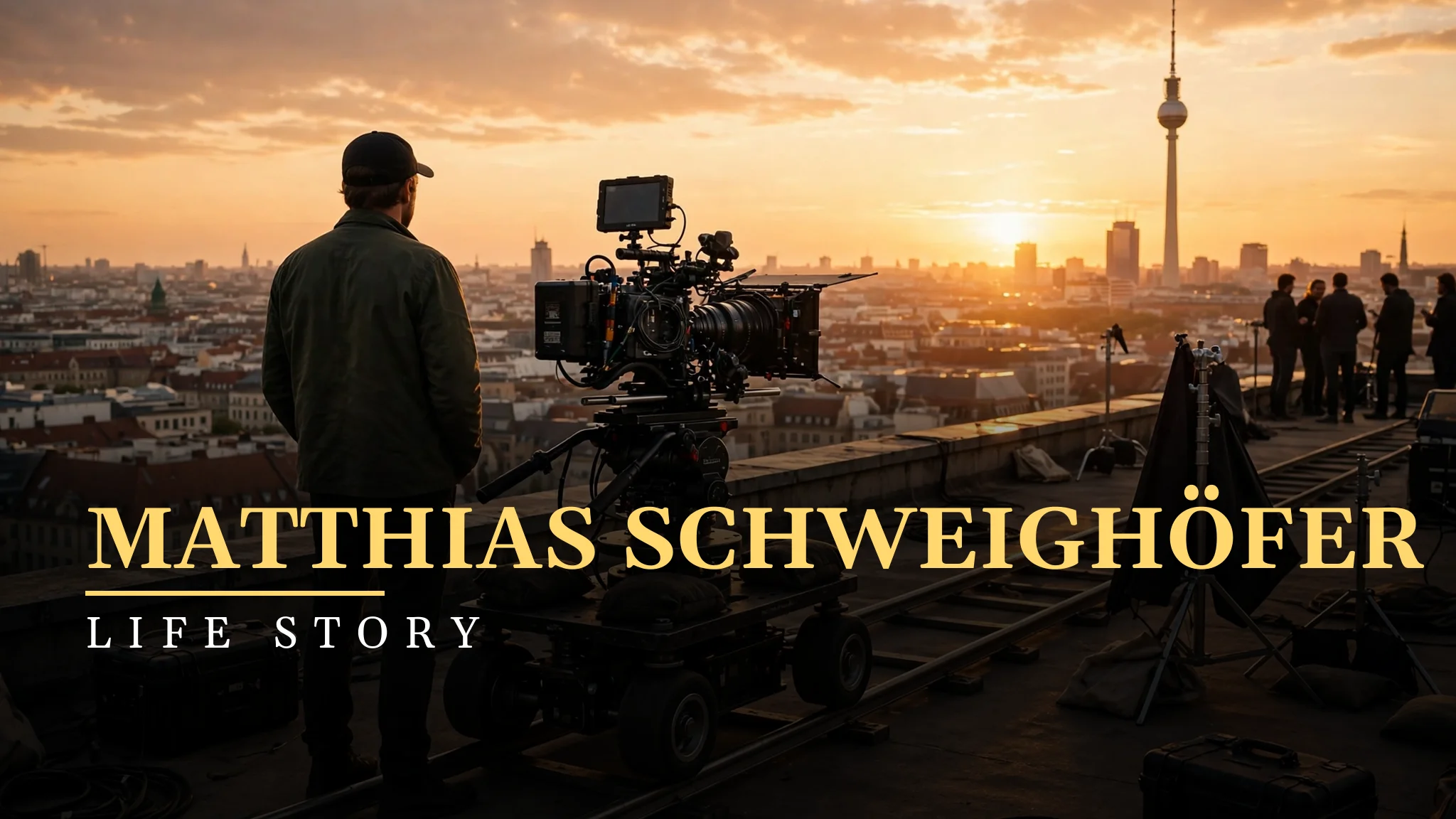
In the end, Matthias Schweighöfer is remembered as one of the most loved German actors of his generation, a man who stood on a rooftop in Berlin at sunset, with a camera beside him, and who looked out over a city that had given him so much. That image is the heart of his career, a man who loves film, who loves acting, and who loves telling stories, and who has done it with a warmth that has made him a star in Germany and around the world.
My Take:
When I think about Matthias Schweighöfer, the first thing I feel is warmth. I have seen many actors who are cold, who are distant, who seem to be acting from far away, but Schweighöfer is warm, he is open, and he makes the audience feel welcome. That warmth is in his smile, in his voice, and in the way he plays a character who is trying his best, even when life is hard. I think that warmth is why he became so popular in Germany, because audiences felt they knew him, not only as an actor, but as a person. That feeling is rare, and it is a gift that cannot be learned from a book.
I think about Keinohrhasen, and I think about how that film changed German comedy. Before it, many German comedies were simple, and they did not reach a wide audience. Keinohrhasen was funny, it was warm, and it was loved by millions, and Schweighöfer was part of that success. He played his role with a charm that made the audience laugh, and he showed that a German film could be both funny and touching, and that it could be a hit at home. That is a hard thing to do, to make a comedy that is also a love story, and Schweighöfer helped to do it with a performance that was both funny and honest.
I admire his family background, and I think it matters more than people say. He grew up in a home where acting was work, where his parents took the craft seriously, and where he learned that a good performance takes hard work, not luck. That learning gave him a base that many young actors never get, because they learn acting from a school, not from a home. Schweighöfer learned it from life, from watching his parents, from being in the theatre, and that learning is in every performance he gives. I can feel it, in the way he stands, in the way he looks, in the way he listens to the other actors on screen.
I think about Army of Thieves, and I think about how brave it was to take on an international film, in English, as both an actor and a director. Many German actors are afraid to work in English, because they worry about their accent, about their voice, and about being judged. Schweighöfer was not afraid. He played Ludwig Dieter with a charm that made the character loved around the world, and he directed the film with a confidence that showed he could work on a global scale. That is a lesson for any artist who is afraid to try something new. Do not be afraid. Try, and trust that your talent will carry you, even in a new language.
I love Oppenheimer, and I want to say why his role in it matters, even though it was small. He played Werner Heisenberg, a German physicist, in a film about the making of the atomic bomb, and he played it with a seriousness that showed a different side of his talent. He was not funny in that role. He was serious, thoughtful, and a little sad, and he showed that he could play a real person from history with respect and with care. That range, from a funny safe cracker to a serious physicist, is rare, and it is what makes him a complete actor. A man who can do both is a man who understands people, and Schweighöfer understands people well.
I feel a hope when I think about his work as a director, because it shows a man who is still learning, still growing, and still curious about film. Many actors stop learning after they become famous, and they repeat the same performance again and again. Schweighöfer did not stop. He directed What a Man, he directed Army of Thieves, and he tried to tell stories in a new way, from behind the camera. That curiosity is a gift, and it is one that I wish more artists had. A person who keeps learning is a person who keeps growing, and Schweighöfer has kept growing for more than twenty years.
I think about his decision to stay in Germany, and I respect it deeply. He could have moved to Hollywood, he could have tried to become a big star in America, and he might have succeeded, but he chose to keep his home in Germany, to work on German films, and to take on international roles when they interested him. That choice takes courage, because Hollywood is where the money is, and where the fame is, and to turn away from it is to say that home matters more than money. Schweighöfer said that, with his life, and I admire him for it.
I also think about the way he talks to his fans, and I think it is a model for any public person. He is open, he is funny, and he shares his love of film with the people who watch him. He does not hide, he does not pretend to be perfect, and he makes his fans feel like they are part of his journey. That openness is a strength, and it is why his fans love him so much. When an actor is open, the audience trusts him, and when the audience trusts him, they will follow him to any role, in any film, in any language.
If I have a criticism, it is that some of his films are lighter than others, and that his charm, which is his strength, can sometimes make a serious role feel too easy. I think that is a small criticism, because his charm is also what makes him so loved, and I would rather have an actor who is charming than an actor who is cold. But I hope he keeps taking on serious roles, like the one in Oppenheimer, because those roles show a depth that his comedies do not always show. A great actor needs both, the light and the dark, and Schweighöfer has both, and I hope he keeps showing both.
I think about young actors in Germany, and I hope they look at Schweighöfer and learn the right lesson. The lesson is not to copy his roles, because his roles belong to him. The lesson is to learn the craft, to work in theatre, to take small roles, to be patient, and to build a career that is based on skill, not on luck. Schweighöfer studied at a serious school, he worked in theatre, he took small roles, and he was ready when the big roles came. That patience is the real lesson, and it is a lesson that is still true today, when many young actors want fame in a week and give up when it does not come.
I also think about the city of Berlin, and I think about how Schweighöfer has made Berlin his home, as an actor, as a director, and as a person. Berlin is a city that values film, that values humour, and that values a thoughtful public life, and Schweighöfer fits that city well. He is not a star who lives in Hollywood. He is an actor who lives in Berlin, who works in Berlin, and who is part of the city’s story. That is a beautiful thing, to belong to a place and to help make that place better through your work. I hope he stays in Berlin, and I hope Berlin keeps valuing him, because they belong together.
For a young reader, I think the lesson from Matthias Schweighöfer is to be warm, to be patient, and to be curious. Do not try to be cold or distant, do not rush to be famous, and do not stop learning. Learn your craft, work hard, try directing, try producing, and trust that the audience will follow you when you are ready. Schweighöfer learned his craft, he worked hard, he tried new things, and the audience has followed him for more than twenty years. That trust was not luck. It was work, and it is work that anyone can do, if they are willing to keep going when no one is watching.
I also think his story teaches us about Germany, and about the power of a popular cinema to bring people together. Keinohrhasen was loved by millions in Germany, Army of Thieves was watched by millions around the world, and Oppenheimer was seen by millions more. Schweighöfer helped to make those films, and he gave them a human face, a warm smile, and a charm that made people want to watch. That is a hopeful message for any young person in any country who thinks their country’s films are not good enough. You can make them good, if you are willing to work, to be brave, and to tell stories with warmth. Schweighöfer did, and German cinema is better for it.
In the end, I keep coming back to the image of a man on a rooftop in Berlin at sunset, with a camera beside him, looking out over a city that has given him so much. That image is the heart of Matthias Schweighöfer, a man who loves film, who loves acting, and who loves telling stories, and who has done it with a warmth that has made him a star. I hope he is remembered for that image, for his honesty, and for his long career of good work. He is not the most famous actor in the world, but he is one of the most loved, and being loved is worth more than fame. I will keep watching his films, I will keep telling people about him, and I will keep believing that an actor who works this hard deserves to be heard.
I also want to say something about the way he makes people laugh, because it is a skill that is easy to miss. Many actors try to be funny by shouting or by making big gestures, but Schweighöfer is funny by being real, by playing a man who is trying his best and who sometimes fails, and who laughs at himself when he does. That kind of humour is honest, and it is why audiences love him. A man who can laugh at himself is a man who is not afraid to be human, and Schweighöfer is not afraid. I think that is a rare gift, and it is one that I wish more actors had.
Finally, I want to say that Matthias Schweighöfer taught me that acting is not about being famous. It is about being true, about finding the truth in a character, and about trusting the audience to follow you there. He has spent his career doing that, in many different roles, in many different films, and he has done it with a warmth and a care that I admire deeply. I hope he keeps acting, keeps directing, and keeps telling stories, because the world needs more actors like him, actors who care about the work more than about the fame.
I also think about the way Schweighöfer works with other actors, and I think it is a model for any team. He is known for being generous on set, for listening, for making other actors feel comfortable, and for helping them give their best. That generosity is rare, because many stars want to be the centre of attention, and they forget that a film is made by a team. Schweighöfer does not forget. He knows that a good film needs every actor to be good, and he helps them be good. I respect that, because it is a kind of leadership that is quiet and strong at the same time.
One last thought stays with me, and it is about the future. Schweighöfer is still young, still working, and still trying new things, and I hope his best work is still ahead of him. He has already made films that are loved in Germany and around the world, he has worked with great directors, and he has shown that he can act, direct, and produce. If he keeps learning, keeps growing, and keeps telling stories with warmth, his next film may be his best yet. I will be watching, and I will be waiting for whatever he does next.
Frequently Asked Questions
Where was Matthias Schweighöfer born and when?
Matthias Schweighöfer was born on 11 March 1981 in Anklam, in what was then East Germany, the son of actors Michael and Gitta Schweighöfer. He grew up in a family of actors and studied at the Ernst Busch Academy in Berlin.
What was Matthias Schweighöfer’s early breakthrough film?
His early breakthrough was Soloalbum in 2003, where he played the lead role of Ben, a young man in Berlin dealing with love and work. The film showed he could carry a film and made him known in German cinema.
What is Keinohrhasen about?
Keinohrhasen, released in 2007 and directed by Til Schweiger, is a romantic comedy about a journalist and a woman who knew each other as children and meet again as adults. Schweighöfer played a supporting role, and the film became one of the most successful German films of its time.
Did Matthias Schweighöfer direct films?
Yes, he directed his first feature film, What a Man, in 2011, and he also directed films like Schlussmacher and Der Nanny. He later directed Army of Thieves in 2021, which he also starred in.
What is Army of Thieves?
Army of Thieves is a 2021 film on Netflix, a prequel to Army of the Dead, in which Schweighöfer played Ludwig Dieter, a safe cracker, and also directed the film. It was watched by millions around the world and made him known to a global audience.
Who did Matthias Schweighöfer play in Oppenheimer?
He played Werner Heisenberg, the German physicist, in Oppenheimer in 2023, directed by Christopher Nolan. The film won many Academy Awards, including Best Picture, and his role showed a serious side of his acting.
Is Matthias Schweighöfer still working in German film?
Yes, he continues to work in German film and television, while also taking on international roles when they interest him. He keeps his home in Germany and balances his German work with his work abroad.


