Max von Sydow: The Life Story Behind the Seventh Seal Star
In this post
- A Boy From Lund in Sweden
- Ingmar Bergman and The Seventh Seal
- Hollywood, The Exorcist, and a New Career
- Later Films, Star Wars, and Game of Thrones
- Death and a Legacy of Dignity
- A Life in Many Languages and Many Countries
- The Theatre, Bergman’s Stage, and a First Love
- Honours, Nominations, and a Career Without an Oscar Win
- My Take:
Max von Sydow was one of the greatest actors of the twentieth century, and his face is known to millions of people around the world, even if they do not know his name. He played a knight who played chess with Death in The Seventh Seal, he played a priest in The Exorcist, he played a villain in Flash Gordon, and he played a wise old man in Star Wars and in Game of Thrones. He was a tall, serious, and dignified actor, with a deep voice and a calm presence, and he could play a king, a priest, a father, or a villain with the same truth and the same power.
He was born in Sweden in 1929, and he grew up in a country that was neutral during the Second World War, but that was still affected by it. He studied acting in Stockholm, he worked in the theatre, and he began to work with Ingmar Bergman, one of the greatest directors in the history of cinema. Bergman made him a star in Sweden, and then he became a star in Hollywood and in Europe, working in films in many languages and in many countries. He worked for more than seventy years, from the 1940s until his death in 2020, and he never stopped.
What makes his story worth telling is the way he combined a long career in art cinema with a long career in popular films, and the way he stayed true to himself through all of it. He was a serious actor who loved the theatre, who loved Bergman, and who also loved to work in big Hollywood films. He was a man who spoke several languages, who lived in Sweden, in France, and in other countries, and who became a citizen of France in his later years. This is the story of how a boy from Lund became one of the most respected actors in the world.
A Boy From Lund in Sweden
Max von Sydow was born on 10 April 1929 in Lund, a town in southern Sweden, to a family that valued learning and culture. His father was a professor, and his mother was a teacher, so Max grew up in a home where books, ideas, and art were important. He was a tall and serious child, and he liked to read, to think, and to act in school plays. He was not a loud or showy boy. He was quiet, thoughtful, and observant, and those qualities stayed with him for his whole life as an actor.
As a young man, he studied at the Royal Dramatic Theatre in Stockholm, one of the most famous theatre schools in Sweden, and he learned how to act on stage. He was a dedicated student, and he worked hard to learn his craft. He appeared in plays, he learned how to use his voice, and he learned how to stand on a stage and make an audience believe in a character. He was tall, with a strong presence, and directors noticed him. He was ready to become a professional actor.
In the early 1950s, he began to work in the theatre in Stockholm, and he also began to work in films. Sweden had a strong film tradition, and its directors were known all over the world for their serious and artistic films. Max was lucky to be in Sweden at a time when its cinema was at its height, and he was about to meet the director who would change his life. The boy from Lund was becoming an actor, and his journey was only just beginning.
Ingmar Bergman and The Seventh Seal
The most important meeting in Max von Sydow’s life was with Ingmar Bergman, the great Swedish director, who cast him in many of his films. Bergman was a director who made serious, thoughtful films about life, death, love, and faith, and Max was the perfect actor for him, because he had a calm and serious presence that fitted Bergman’s world. They worked together on many films, including The Seventh Seal in 1957, Wild Strawberries in 1957, and The Virgin Spring in 1960, and those films made both of them famous around the world.
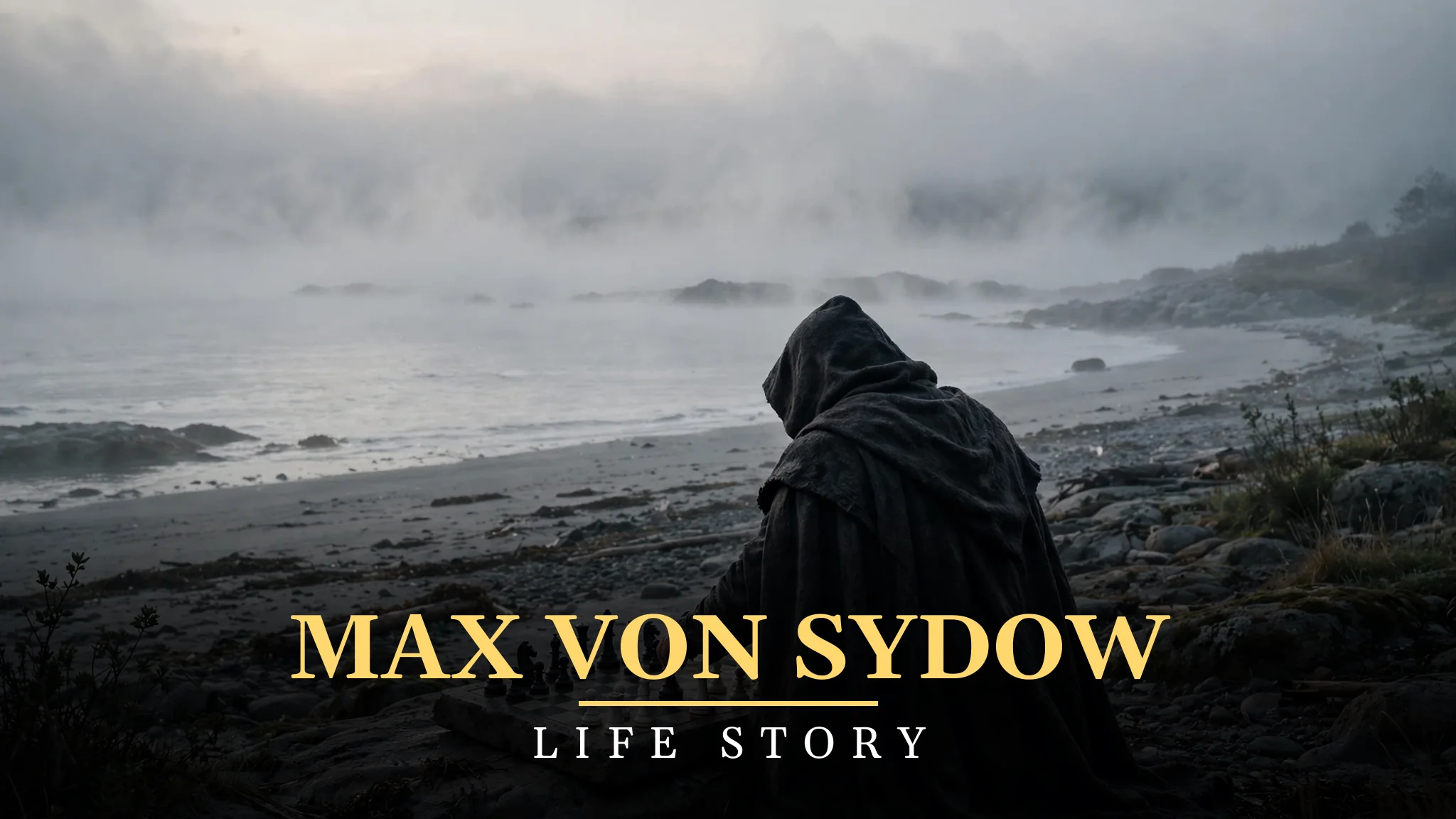
The Seventh Seal is the film that most people remember Max von Sydow for, and it is one of the most famous films in the history of cinema. In it, he plays Antonius Block, a knight who returns from the Crusades and finds his country in the grip of the plague. He meets Death, played by Bengt Ekerot, and he challenges Death to a game of chess, hoping to gain time to find meaning in his life. The image of the knight playing chess with Death on a beach has become one of the most famous images in cinema, and it is still shown in books, in films, and in art today.
Working with Bergman taught Max a great deal about acting, about film, and about life. Bergman was a demanding director, and he asked his actors to be honest, to be brave, and to explore difficult questions. Max learned to act with stillness, with silence, and with a look, not only with words. He learned that an actor could say a great deal by doing very little, and that lesson stayed with him for his whole career. He was not only a star. He was an artist, and Bergman helped him to become one.
By the end of the 1950s, Max von Sydow was one of the most respected actors in Europe, and his films with Bergman were shown at festivals all over the world. He had found his director, and he had found his style. He was a serious actor, a man who could play a knight, a priest, or a father with the same dignity, and he was ready to take his talent to the rest of the world.
Hollywood, The Exorcist, and a New Career
In the 1960s, Max von Sydow began to work in Hollywood and in international films, and he became known to audiences in America and in other countries. He played Jesus in The Greatest Story Ever Told in 1965, a huge and ambitious film, and he played other roles in European and American films. He was a tall and dignified actor, and directors liked to cast him as a wise man, a priest, or a king, because he had a presence that made those roles feel real.
His most famous Hollywood role came in 1973, when he played Father Merrin in The Exorcist, one of the most famous horror films ever made. Father Merrin is an old priest who comes to help a young girl who is possessed, and Max played him with a calm and serious strength that made the film even more frightening. He was only in his forties at the time, but he was made up to look old, and his performance was so convincing that many people thought he was really an old man. The Exorcist became a huge success, and it made Max von Sydow known to millions of people who had never seen a Bergman film.
He also played the villain Ming the Merciless in Flash Gordon in 1980, a colourful and fun science fiction film, and he showed that he could play a villain as well as a hero. He played in Dune in 1984, in Hannah and Her Sisters in 1986, and in many other films, and he worked with directors from many countries. He was an actor who could work in Swedish, in English, in French, and in other languages, and he was comfortable in many different kinds of films, from art cinema to popular entertainment.
His Hollywood career showed that he was not only a Bergman actor. He was a versatile actor who could do many things, and who was respected by directors in many countries. He did not lose his seriousness when he worked in Hollywood. He brought his Bergman training with him, and he gave even a small role a sense of dignity and truth. That is why directors kept asking him to work with them, and why audiences kept remembering him.
Later Films, Star Wars, and Game of Thrones
In his later years, Max von Sydow continued to work, and he appeared in many important films. He played in Minority Report in 2002, directed by Steven Spielberg, and he played in The Diving Bell and the Butterfly in 2007, a French film about a man who can only move his eyes. He was nominated for an Academy Award for Best Actor for Pelle the Conqueror in 1987, a Danish film about a father and son who move to Denmark, and he was nominated again for Best Supporting Actor for Extremely Loud and Incredibly Close in 2011, when he was eighty-two years old. He was one of the oldest actors ever to be nominated for an Oscar, and it showed that his work was still respected.
He also appeared in Star Wars: The Force Awakens in 2015, playing Lor San Tekka, a wise old man who gives a map to the resistance. It was a small role, but it was important, and it introduced him to a new generation of young viewers who knew Star Wars but did not know Bergman. He also played the Three-Eyed Raven in Game of Thrones, the famous television series, in 2016, and he brought his calm and serious presence to that role as well. He was an actor who could work in a fantasy series and still make it feel real.
He lived in France in his later years, and he became a French citizen in 2002, after marrying his second wife, Catherine Brelet, a French filmmaker. He had two sons from his first marriage, and two sons from his second marriage, and he lived a quiet and private life in Provence, in southern France, when he was not working. He was a man who loved his family, who loved his work, and who loved the quiet life of the French countryside.
He continued to act into his nineties, and he was still working when he was almost ninety. That is a very long career, and it shows his love of acting. He did not retire, because acting was not a job for him. It was a way of life, a way of thinking, and a way of being. He was an actor until the end, and he was respected for it.
Death and a Legacy of Dignity
Max von Sydow died on 8 March 2020 in Provence, France, at the age of ninety, after a long and full life. His death was mourned all over the world, and tributes came from actors, directors, and film lovers in many countries. People spoke about him as one of the greatest actors of his generation, a man who had worked with Bergman, who had played chess with Death, who had been a priest in The Exorcist, and who had been a wise old man in Star Wars. He had lived a life that spanned the history of modern cinema, from the 1940s to the 2020s.
His legacy is not only his films. It is also his example as an actor who was serious, dignified, and honest. He did not chase fame, and he did not try to be a star in the usual sense. He tried to be a good actor, to choose good roles, and to give each role his best. He worked in many languages, in many countries, and in many kinds of films, and he did each of them with care. That is a powerful legacy, and it is why people still speak about him with respect.
His films are still watched today, in film schools, in cinemas, and in homes all over the world. The Seventh Seal is still shown to students, The Exorcist is still watched by horror fans, and his later films are still loved by new audiences. He left behind a body of work that is still alive, and that will keep being watched for many years. He was a great actor, and his work will not be forgotten.
A Life in Many Languages and Many Countries
Max von Sydow was an actor who lived and worked in many languages and in many countries, and that is part of what made him special. He was born in Sweden, he spoke Swedish, he learned English, French, and other languages, and he worked in films in Sweden, in France, in Italy, in America, and in many other places. He was not only a Swedish actor. He was a European actor, a world actor, and his work belonged to everyone. That is a rare thing, and it shows how open and curious he was as a person.
He lived in Sweden for many years, then he moved to France, where he lived in Provence, in the south of the country, and he became a French citizen in 2002. He loved the French countryside, the quiet life, and the culture of France, and he made a home there with his second wife, Catherine Brelet. He also worked in French films, including The Diving Bell and the Butterfly, and he spoke French with a clear and beautiful accent. He was a man who could belong to more than one country, and who loved both Sweden and France.
His ability to work in many languages also helped his career, because directors in many countries wanted to work with him. He could play a role in English, in French, or in Swedish, and he could do each of them with the same dignity and truth. That is a difficult skill, and it is one that few actors have. It takes a good ear, a good memory, and a willingness to learn, and Max had all of those things. He was a professional in the full sense of the word, and he took his work seriously in every language.
That international life also shows that art can cross borders, and that a great actor can be loved in many countries. Max von Sydow was loved in Sweden, in France, in America, and all over the world, because his acting was universal, because it spoke of things that people everywhere understand: dignity, love, loss, and the search for meaning. That is a beautiful legacy, and it is one that he built, one film at a time, over more than seventy years.
The Theatre, Bergman’s Stage, and a First Love
Max von Sydow began his career in the theatre, and the stage was always his first love, even after he became famous in films. He studied at the Royal Dramatic Theatre in Stockholm, and he worked there for many years, appearing in plays by Shakespeare, by Strindberg, and by other great writers. The theatre taught him how to act with his whole body, how to use his voice in a large hall, and how to connect with a live audience. It was a hard training, but it gave him a foundation that stayed with him for his whole career in film.
He worked closely with Ingmar Bergman in the theatre as well as in film, and Bergman’s stage productions were famous for their intensity and their honesty. Max learned from Bergman how to be still on stage, how to listen, and how to let a silence speak. That lesson was just as important in film as it was in theatre, and it is part of why his film performances feel so powerful. He did not need to shout or to move a great deal. He could stand still, look, and make the audience feel everything.
Even after he became a film star, he returned to the theatre whenever he could, because he loved the feeling of a live audience, the risk of a live performance, and the discipline of rehearsing a play for weeks. He believed that theatre kept an actor honest, because there is no editing, no second take, and no camera to hide behind. An actor on stage must be true in the moment, and Max was true. That love of theatre is part of why he was such a great actor, and it is a legacy that young actors should remember.
Honours, Nominations, and a Career Without an Oscar Win
Max von Sydow was nominated for two Academy Awards, for Best Actor for Pelle the Conqueror in 1987 and for Best Supporting Actor for Extremely Loud and Incredibly Close in 2011, but he never won an Oscar, even though he was one of the greatest actors of his generation. That fact is often mentioned when people talk about him, because it seems strange that a man who gave so many great performances was never given the highest prize in film. He also received many other honours, including awards at film festivals, a knighthood in France, and the respect of directors and actors all over the world, but the Oscar eluded him. He did not seem to mind very much, because he knew that awards are not the measure of a great actor, and that his work spoke for itself.
His nominations are still an honour, especially the second one, when he was eighty-two years old and one of the oldest actors ever nominated. It showed that his work was still respected, even in his later years, and that directors still wanted to work with him. He was a man who worked for more than seventy years, who gave great performances in many languages and in many countries, and who was loved by audiences and by fellow actors. That is a legacy that no award can give, and it is a legacy that will last long after the Oscars are forgotten.
His life also shows that an actor can grow old with grace, and that age does not have to mean the end of good work. He was still giving strong performances in his eighties, still learning new roles, and still working with young directors who admired him. That is a hopeful message for older artists, and it is a message that Max von Sydow lived by: keep working, keep learning, and let your work speak for itself, no matter how old you are.
He was also a man who loved his family, and who kept his private life separate from his public work, spending quiet time in Provence with his wife and children when he was not filming. That balance between a busy career and a peaceful home is part of what allowed him to work for so long, and it is a reminder that even a great actor needs rest, family, and a place to call home.
My Take:
When I think about Max von Sydow, I think about dignity, and I think that is the first word that comes to mind. He was a tall, serious, and calm actor, with a deep voice and a presence that made every role feel important. He did not shout, he did not overact, and he did not try to impress people with tricks. He stood still, he looked, he spoke quietly, and he made you believe in the character. That is a rare gift, and it is a gift that few actors have. I respect him for it, because it shows that acting can be quiet and still be powerful.
I also think about The Seventh Seal, and about the image of the knight playing chess with Death on a beach. That is one of the most famous images in cinema, and it is a beautiful and frightening idea: a man who knows he is going to die, but who wants more time to find meaning in his life. Max played that knight with a calm and a sadness that made the film unforgettable. I think that film is important because it asks a question that we all ask: what is the meaning of life, and what do we do when we know we are going to die? Max gave that question a face, and that is a wonderful thing for an actor to do.
What I admire most is the way he worked with Bergman, and the way he learned to act with stillness. Bergman was a demanding director, and he asked his actors to be honest and brave, and Max learned from him. He learned that an actor could say a great deal by doing very little, and that lesson stayed with him for his whole career. I think that is a good lesson for anyone, not only for actors. Sometimes the most powerful thing you can do is to be quiet, to listen, and to let the moment speak for itself.
I also think about The Exorcist, and about how he played Father Merrin, an old priest who comes to help a young girl. He was only in his forties, but he was made up to look old, and his performance was so convincing that many people thought he was really old. That shows his skill as an actor, because he did not only play a priest. He played an old man, a wise man, a man who had seen a great deal and who was not afraid. That is a difficult role, and he played it with dignity and with strength.
There is something I like about his later career, when he played in Star Wars and in Game of Thrones. He was in his eighties and nineties, and he was still working, still playing wise old men, and still introducing himself to new generations of viewers. Young people who had never seen a Bergman film saw him in Star Wars, and they remembered him. That is a beautiful thing, because it means that his work reached new audiences, and that his dignity and his calm were appreciated by young people as well as by old people.
I also think about his life in France, and about how he became a French citizen and lived quietly in Provence. He was a Swedish actor who lived in France, who spoke several languages, and who worked in many countries. That is a life that crosses borders, and it shows that art can be international. He was not only a Swedish actor. He was a European actor, a world actor, and his work belonged to everyone. I think that is an important message, especially today, when the world is divided by borders.
When I think about his Oscar nominations, I think it is sad that he never won an Oscar, even though he was nominated twice, once for Pelle the Conqueror and once for Extremely Loud and Incredibly Close. He deserved to win, because his work was so good, but awards do not always go to the best actor. I think that says more about awards than about him. He did not need an Oscar to be great, and his work speaks for itself. He was a great actor with or without an award.
If I have a criticism, it is not really a criticism of him. It is a sadness that many young people today do not know his Bergman films, and that they only know him from Star Wars or Game of Thrones. His Bergman films are beautiful and important, and they deserve to be watched by new generations. I hope young people will discover The Seventh Seal, Wild Strawberries, and The Virgin Spring, and that they will see what made him great. Those films are not easy, but they are rewarding, and they teach you to think about life and death.
For a young reader, I think the lesson from Max von Sydow is simple. Be serious, be honest, and do not be afraid to be quiet. He was a serious actor, he was honest in his work, and he was not afraid to be still. He did not chase fame, and he did not try to be a star in the usual sense. He tried to be a good actor, and he worked for more than seventy years. That is the lesson I take from his story, and it is a lesson that applies not only to acting but to any work that matters.
In the end, I think Max von Sydow teaches us that dignity is a kind of strength. He was dignified on screen and in life, and he gave his roles a sense of importance that few actors can match. He lived a long life, he worked until the end, and he left behind films that will keep being watched. I would rather be remembered like that, for the dignity I gave and the truth I shared, than for a single famous moment, and I believe he would say the same.
I also think about his life in many languages and many countries, and I find it inspiring. He was Swedish, he lived in France, he worked in America, Italy, and many other places, and he spoke several languages. That is a life that crosses borders, and it shows that art can be international. He was not only a Swedish actor. He was a world actor, and his work belonged to everyone. I think that is an important message today, when the world is divided by borders, because it shows that a great artist can belong to many places at once.
I think about his quiet life in Provence, and I like that he chose to live in the countryside, away from the noise of Hollywood. He was a famous actor, but he lived a quiet life, with his family, in a beautiful place. That tells me that he knew what mattered, and that he did not need fame to be happy. He needed his family, his work, and a quiet home. That is a wise choice, and it is a choice that many famous people do not make. He made it, and he lived a long and happy life because of it.
Another thing I notice is how he kept working into his nineties, and how he never really retired. He was still acting when he was almost ninety, and he was still giving strong performances. That shows his love of acting, because he did not do it for money or for fame. He did it because he loved it, because it was his life, and because he wanted to keep telling stories. I respect that, because it shows that work can be a joy, not only a job, and that a person can keep doing what they love for a very long time.
I also think about the future, and about whether young actors will learn from him. I hope they will, because his acting was quiet, dignified, and honest, and that is a style that is needed today, when many actors try to be loud and dramatic. Max showed that you can be powerful by being still, by listening, and by letting a look speak for you. That is a lesson that young actors should learn, and it is a lesson that will make them better artists.
In the end, I keep coming back to dignity. He was dignified on screen and in life, and he gave his roles a sense of importance that few actors can match. He lived a long life, he worked until the end, and he left behind films that will keep being watched. He showed that a quiet life, well lived, can be as powerful as any film.
I also think about his love of theatre, and I find it inspiring. He began on stage, he learned his craft there, and he returned to it throughout his life, even after he became a film star. The theatre taught him discipline, honesty, and the power of stillness, and those lessons stayed with him in every film he made. I think that is a good lesson for young actors: learn on stage first, because the stage will teach you things that a camera cannot. Max proved that, because his film acting was so strong, and it came from his theatre training.
I think about his stillness again, and about how he could say a great deal by doing very little. That is a rare gift, and it is a gift that comes from theatre, from learning how to stand, how to listen, and how to let a silence speak. Many actors today try to be loud and dramatic, but Max showed that quiet acting can be more powerful. I hope young actors learn from him, and that they discover the power of stillness, of listening, and of being honest in the moment.
Another thing I notice is how he worked with Bergman in both theatre and film, and how that partnership shaped his whole career. Bergman was a demanding director, but he was also a generous teacher, and Max learned a great deal from him. Their work together is one of the great partnerships in cinema, and it shows what can happen when a great director and a great actor trust each other. I think that is a beautiful story, and it is a story that film lovers will keep telling.
I also think about the future, and about whether young people will discover his Bergman films. I hope they will, because those films are beautiful, thoughtful, and important, and they teach us to think about life, death, love, and faith. They are not easy films, but they are rewarding, and they show what cinema can be when it is made with honesty and with art. Max von Sydow’s performances in those films will keep being watched, and they will keep inspiring new generations of actors.
In the end, I keep coming back to dignity and to theatre. He was a theatre actor who became a film star, but he never forgot the stage, and he never lost his dignity. He lived a long life, he worked until the end, and he left behind films and stage performances that will keep being remembered. His work speaks for itself, and it will keep speaking to new audiences for many years.
I also think about his Oscar nominations, and about how he never won, even though he deserved to. He was nominated at fifty-eight and again at eighty-two, and both times he went home without the award. That must have been disappointing, but he did not let it make him bitter. He kept working, he kept giving great performances, and he let his work speak for itself. I think that is a dignified way to handle disappointment, and it is a lesson for anyone who has worked hard and not been recognised. Awards are nice, but they are not the measure of a life’s work.
I think about his age, too, and about how he was still being nominated at eighty-two. That is a rare achievement, and it shows that talent does not fade with age, if you keep working and keep learning. He was an old man, but he was still a great actor, and directors still wanted him. That gives hope to older artists, and it shows that a long career is possible if you take care of your craft and stay true to yourself.
Frequently Asked Questions
Where was Max von Sydow born?
Max von Sydow was born on 10 April 1929 in Lund, Sweden, and he studied acting at the Royal Dramatic Theatre in Stockholm.
What is Max von Sydow’s most famous film?
His most famous film is The Seventh Seal from 1957, in which he plays a knight who plays chess with Death, a role that became one of the most famous images in cinema.
Who was the director Max von Sydow worked with most?
He worked most closely with Ingmar Bergman, the great Swedish director, appearing in many of his films including The Seventh Seal, Wild Strawberries, and The Virgin Spring.
What role did Max von Sydow play in The Exorcist?
He played Father Merrin, the old priest who comes to help a young girl who is possessed, in the 1973 horror film The Exorcist.
Did Max von Sydow appear in Star Wars?
Yes, he played Lor San Tekka in Star Wars: The Force Awakens in 2015, and he also played the Three-Eyed Raven in Game of Thrones in 2016.
When did Max von Sydow die?
He died on 8 March 2020 in Provence, France, at the age of ninety, after a career in film and theatre that lasted more than seventy years.


