Mélanie Laurent: The Life Story Behind France's Actress and Director
In this post
- A Paris Girl Discovered by Chance
- Je vais bien and the First Awards
- Inglourious Basterds: Shosanna and the World Stage
- Behind the Camera: A Director Is Born
- Music, Activism, and a Life of Her Own
- Le Bal des folles: Women Who Fight Back
- A Voice for the Planet
- Le Concert and the Violinist with a Secret
- Les Adoptés: A First Film About Family
- My Take:
Mélanie Laurent is a woman who refuses to stay in one place. She is an actress who became a director, a singer who became an activist, and a French star who became known around the world. She was discovered as a teenager, she won awards as a young actress, she played a heroine in one of the biggest films of her generation, and then she stepped behind the camera and made films of her own. She did not wait for permission. She made her own chances, and she made them with courage and with heart.
She is best known to the world as Shosanna in Inglourious Basterds, the young woman who plans revenge against the Nazis in a Paris cinema. That role made her famous in America and in many other countries, and it showed her talent for playing strong, complex women. But her story does not end there. She has directed films about friendship, about the planet, and about women locked away in a hospital, and she has used her fame to speak about the environment and about the future of the world.
Her story is about a young woman who grew up fast, who learned to work hard, and who decided to tell her own stories. It is a story about talent, about courage, and about a woman who will not be put in a box.
A Paris Girl Discovered by Chance
Mélanie Laurent was born on 21 February 1983 in Paris. She grew up in the French capital, in a family that loved art and culture. Her father was a voice actor, and her mother was a ballet teacher, so she grew up around performance, music, and movement. She was a lively, curious child, and she loved to watch films, to listen to music, and to dream about the stage. She was not from a family of film stars, but she was from a family that understood the arts, and that gave her a good start.
As a teenager, she was spotted by the actor Gérard Depardieu, who saw her talent and encouraged her to act. It was a chance meeting that changed her life. Depardieu was one of the biggest stars in France, and his belief in her gave her confidence. She began to take acting seriously, and she began to work in films while she was still young. She was not a child star in the usual sense. She was a young woman who was learning her craft, film by film, and who was determined to do it well.
Her early films were small, but they showed her talent. She played young women who were strong, sensitive, and a little lost, and audiences noticed her. She had a natural gift for being real on camera, for listening, and for letting her face show what her character felt. She did not overact. She trusted the camera to see her, and the camera did. She was building a career, step by step, without rushing, and without trying to be famous too fast.
By her early twenties, she was already a respected young actress in France. She had worked with good directors, she had learned from older actors, and she had begun to think about what kind of actress she wanted to be. She did not want to play only pretty girls. She wanted to play women with depth, with pain, and with strength. That wish would guide her choices for the rest of her career, and it would lead her to some of the most important roles of her generation.
Je vais bien and the First Awards
Laurent’s first great success came in 2006, when she starred in Je vais bien, ne t’en fais pas, a film about a young woman whose twin brother disappears. She played the sister who searches for him, and who tries to hold her family together. The film was moving, sad, and full of heart, and Laurent’s performance was at its centre. She played the role with a quiet strength, showing a young woman who is broken by loss, but who keeps going. The film was a success, and it won her the César Award for Most Promising Actress.
The award was a turning point. She was no longer only a young actress with promise. She was a star, and directors began to offer her bigger roles. She chose her films carefully, looking for stories that mattered to her, and for characters who were real. She starred in Le Concert in 2009, a film about a Russian orchestra, and she played a violinist with a secret past. The film was a success, and it showed that she could play complex, adult roles with depth and with grace.
In these years, she also began to think about directing. She had watched directors on set, she had learned how films were made, and she had ideas of her own. She did not want to only act in other people’s stories. She wanted to tell her own stories, in her own way. She began to write, to plan, and to dream about the films she would make. She was a young actress with a director’s mind, and that mind would soon find its voice.
Her early career was also a time of learning about fame. She was becoming known, not only in France, but in other countries, and she had to learn how to handle the attention. She kept her private life private, she focused on her work, and she did not chase gossip. She was a professional, and she wanted to be known for her films, not for her life off screen. That focus has stayed with her throughout her career.
Inglourious Basterds: Shosanna and the World Stage
In 2009, Laurent starred in Inglourious Basterds, directed by Quentin Tarantino, one of the most famous directors in the world. She played Shosanna Dreyfus, a young Jewish woman in Paris during the Second World War, whose family is murdered by the Nazis, and who plans revenge by burning down a cinema full of Nazi officers. It was a powerful, demanding role, and Laurent gave it everything she had. She played Shosanna with anger, with pain, and with a quiet, burning courage, and the world noticed.
The film was a huge success, and it was nominated for many awards, including the Academy Award for Best Picture. Laurent became known to audiences in America, in Britain, and in many other countries, and she was praised by critics for her performance. She had gone from French cinema to world cinema, and she had done it with a role that was both strong and deeply human. Shosanna is not a simple heroine. She is a woman who has lost everything, and who chooses revenge, and Laurent played that choice with honesty and with depth.
The film also changed her life. She was now an international star, and she was offered roles in Hollywood and in other countries. She chose carefully, taking on films that interested her, and not taking on films only for fame or money. She appeared in films in English and in French, and she kept her base in Paris, where she felt at home. She was a star, but she was also a woman who knew what she wanted, and who was not going to let fame decide her life for her.
Inglourious Basterds remains the film that most people outside France know her for, and it is a fitting one. It is a film about a woman who fights back, who uses her intelligence and her courage to stand up to evil, and who does it alone. Laurent played that woman with a fire that audiences have never forgotten. It was a role that asked for everything, and she gave it.
Behind the Camera: A Director Is Born
Laurent did not stop at acting. In 2011, she directed her first feature film, Les Adoptés, a drama about two women, a mother and a daughter, and the men in their lives. The film was personal, tender, and full of feeling, and it showed that Laurent had a talent for directing. She directed her actors with care, she told a story about family and love, and she proved that she was not only an actress who wanted to try directing. She was a director with a voice of her own.
She followed it with Respire in 2014, a film about two teenage girls, their friendship, and the pain of growing up. The film was intense, honest, and beautifully made, and it was praised at the Cannes Film Festival. Laurent directed the young actresses with a deep understanding of what it feels like to be a teenage girl, to love a friend, and to be hurt by that friend. The film showed that she could tell stories about young women with truth and with courage, and that she was not afraid of difficult subjects.
In 2015, she co-directed Demain, a documentary about the environment, about climate change, and about the people around the world who are finding solutions to the problems of the planet. The film was a huge success in France, seen by more than a million people, and it won the César Award for Best Documentary. Laurent had used her fame to make a film about the future of the world, and she had done it with hope, not with despair. The film showed solutions, not only problems, and it inspired many people to think about what they could do.
She continued to direct, making Le Bal des folles in 2021, a film about women locked in a hospital in nineteenth-century Paris, and about a woman who fights for her freedom. The film was dark, powerful, and full of anger at the way women have been treated, and it showed Laurent’s growth as a director. She was no longer a young actress trying directing. She was a mature film maker, with a clear vision, and with stories that mattered to her.
Music, Activism, and a Life of Her Own
Laurent is also a singer. In 2011, she released an album, En t’attendant, a collection of gentle, folk songs that showed another side of her talent. She sang in French and in English, and she toured with her music, sharing a quieter, more personal part of herself with her audiences. Music has always been a part of her life, and her songs, like her films, are honest, tender, and full of feeling.
She is also an activist, speaking out about the environment, about climate change, and about the need to protect the planet. She has used her fame to support causes she believes in, and she has taken part in campaigns to raise awareness about the future of the world. She is not an activist who only talks. She has made films about the environment, she has worked with organisations, and she has tried to live by the values she speaks about. Her activism is a part of who she is, not a performance for the cameras.
Her personal life has been kept private, but she has spoken about becoming a mother, and about balancing work and family. She is a woman who has built a life that includes acting, directing, singing, and activism, and she has done it on her own terms. She has not let the film industry decide who she should be. She has decided for herself, and she has done it with courage and with grace.
Today, Mélanie Laurent is still working, still acting, and still directing. She is one of the most respected figures in French cinema, a woman who has succeeded as an actress and as a director, and who has used her success to speak about the things that matter to her. Her story is not finished, and French cinema, and world cinema, are better for it.
Le Bal des folles: Women Who Fight Back
In 2021, Laurent directed Le Bal des folles, a film about women locked in a hospital in nineteenth-century Paris, in a place called the Salpêtrière, where women who were called mad were kept away from the world. The film told the story of Eugénie, a young woman who can see spirits, and who is locked away by her family because they do not understand her. Laurent directed the film with anger, with beauty, and with a deep sense of justice. It was a film about how women have been treated, about how their voices have been silenced, and about how they fight back. It was dark, powerful, and full of feeling, and it showed Laurent’s growth as a director.
The film was based on a novel, and Laurent brought it to the screen with care, with strong performances, and with a visual style that made the hospital feel both beautiful and frightening. She played a small role in the film herself, as a nurse, and she directed her actors with a deep understanding of what it feels like to be a woman who is not believed. The film was praised by critics, and it was watched by audiences around the world on a streaming platform. It showed that Laurent was not afraid of difficult subjects, and that she was willing to tell stories about injustice, even when they were painful.
Le Bal des folles is a film about women, made by a woman, and it matters because it gives a voice to women who were silenced. Laurent has always been interested in women’s stories, in their strength, and in their pain, and this film is one of her most powerful statements. She did not make it to be safe. She made it to be true, and that truth is what makes it last. It is a film that asks the audience to listen to women, to believe them, and to stand with them, and that is a message that is still needed today.
A Voice for the Planet
Laurent is also known for her work for the environment. She co-directed Demain in 2015, a documentary about climate change and about the people who are finding solutions, and the film became a phenomenon in France. It was seen by more than a million people, it won the César for Best Documentary, and it inspired many viewers to think about what they could do for the planet. Laurent did not make a film about despair. She made a film about hope, about solutions, and about the power of ordinary people to change the world. That choice, to focus on hope, is one of the reasons the film was so loved.
She has continued to speak about the environment, about the need to protect nature, and about the future of the planet. She has taken part in campaigns, she has worked with organisations, and she has used her fame to raise awareness. She is not an activist who only talks. She has made films, she has planted trees, and she has tried to live by the values she speaks about. Her activism is a part of who she is, not a performance, and it is one of the reasons she is respected by so many people.
Her work for the planet is connected to her work as a film maker. She believes that films can change minds, that stories can inspire action, and that art has a duty to speak about the world. She has used her films to talk about the environment, about women, and about the future, and she has done it with hope, not with fear. That hope is a gift, and it is a gift that she gives to her audiences, film after film. She shows that it is possible to care, to act, and to hope, all at the same time, and that is a powerful lesson.
Le Concert and the Violinist with a Secret
In 2009, Laurent starred in Le Concert, a film about a Russian orchestra and a violinist with a secret past. She played Anne-Marie Jacquet, a young French violinist who is invited to play with the orchestra in Paris, and who discovers that her own history is connected to the conductor’s past. The film was beautiful, moving, and full of music, and Laurent’s performance was at its heart. She played the violinist with grace, with sensitivity, and with a quiet strength, and she made the audience feel the power of music to heal old wounds. The film was a success in France and around the world, and it showed that Laurent could carry a major film with elegance and with depth.
Le Concert was a film about music, about history, and about the way the past lives on in the present. Laurent learned to play the violin for the role, or at least to make it look real, and she worked hard to understand the music. She was a young actress, but she was already serious about her craft, and she gave the role her best. The film remains one of her most loved performances, and it is a reminder that she is an actress who can play many kinds of women, from a violinist to a resistance fighter, and make each one feel true.
The film also showed her range. She had played a sister searching for her brother, a violinist with a secret, and then Shosanna in Inglourious Basterds, all within a few years. Each role was different, and each one showed a new side of her talent. She was not an actress who played one kind of woman. She was an actress who could play any woman, and who did it with honesty and with heart.
Les Adoptés: A First Film About Family
In 2011, Laurent directed her first feature film, Les Adoptés, a drama about two women, Lisa and Marine, and the men in their lives. The film was about family, about love, and about the bonds that hold people together, even when life is hard. Laurent directed it with tenderness, with care, and with a deep understanding of what it means to be a mother, a daughter, and a sister. She played Lisa herself, and she gave a performance that was both strong and vulnerable. The film was praised by critics, and it showed that Laurent was not only an actress who wanted to try directing. She was a director with a voice of her own, and with stories that mattered to her.
Les Adoptés was a personal film, about the family she knew, about the women she had watched, and about the love that holds a family together. She did not make a grand film about heroes. She made a quiet film about ordinary people, and she made it with honesty. That choice, to tell a small, human story, is a brave one for a first film, and it showed her confidence as a director. She trusted her audience to care about ordinary people, and they did. The film was the start of her career as a director, and it remains one of her most tender works.
My Take:
When I think about Mélanie Laurent, I think about a woman who refused to wait. She did not wait for someone to give her a good role. She did not wait for someone to let her direct. She acted, she learned, and then she directed her own films. I admire that, because so many people wait for permission, and they wait for years. Laurent did not wait. She saw what she wanted to do, and she did it. That is a brave way to live, and it is a way that takes confidence, hard work, and a belief in yourself. I think about the young women who want to direct, who want to tell their own stories, and I wish they knew Laurent’s story. She shows that it is possible, if you are willing to work and to take the risk.
I admire her performance as Shosanna, because it is a performance about revenge, and revenge is a hard thing to play well. Shosanna has lost her family, she is alone, and she plans to burn down a cinema full of Nazis. It would be easy to play her as only angry, or only sad. Laurent plays her as a whole person: angry, sad, brave, and afraid, all at the same time. I think about the weight of that role, and about the courage it took to play it. She was a young French actress, working with one of the most famous directors in the world, in a film that the whole world would see. She did not shrink from it. She gave everything, and the world saw it. That is a performance I will never forget.
What moves me most is her work as a director, especially Demain. It is a documentary about the environment, but it is not a film that makes you feel hopeless. It is a film that shows solutions, that shows people around the world who are making things better, and that gives the audience hope. I think that is a brave choice, because it is easy to make a film about the end of the world, and to leave the audience feeling sad. It is much harder to make a film that says: here is the problem, and here is what we can do. Laurent chose hope, and that hope has inspired many people. I respect that choice, because hope is not naive. Hope is a decision, and it is a decision that takes courage.
I think about Respire, and about the friendship between two teenage girls, and I feel the pain of that story. Laurent directed it with a deep understanding of what it means to be young, to love a friend, and to be hurt by that friend. She did not make the film from the outside, as an adult looking back. She made it from the inside, as if she remembered exactly what it felt like to be seventeen. That honesty is rare, and it is a sign of a director who listens to young people, and who respects them. I think about the teenage girls who watch that film, and who see their own lives on screen, and I know that it matters to them. A film that tells the truth about being young is a gift.
There is something I respect about the way Laurent has handled fame. She became famous around the world, and she could have moved to Hollywood, chased bigger roles, and become a different kind of star. She did not. She stayed in Paris, she chose her films carefully, and she built a career that includes acting, directing, singing, and activism. She did not let fame decide her life. She decided her own life, and she did it with a quiet strength. I think about the pressures of fame, and about how easy it is to lose yourself in it. Laurent did not lose herself. She stayed herself, and that is a kind of strength that I admire.
I also think about her as a mother and as a woman who balances work and family. She has spoken about the difficulty of being a working mother, about the choices she has had to make, and about the love she has for her child. I do not want to make her life sound simple, because it is not simple. It is hard to be an actress, a director, and a mother, all at the same time. Laurent does it, and she does it with grace. I respect that, because it shows that a woman does not have to choose between her work and her family. She can do both, if she is willing to work hard, and if she is honest about the difficulty.
For a young reader, I think the lesson of Laurent’s life is to tell your own story. Do not wait for someone else to tell it for you. Learn the craft, work hard, and then make your own film, write your own song, and speak about what matters to you. Laurent did that, and she has built a career that is entirely her own. She is an actress, a director, a singer, and an activist, and she is all of those things because she chose to be. That is a powerful lesson: you are not only one thing. You can be many things, if you are brave enough to try.
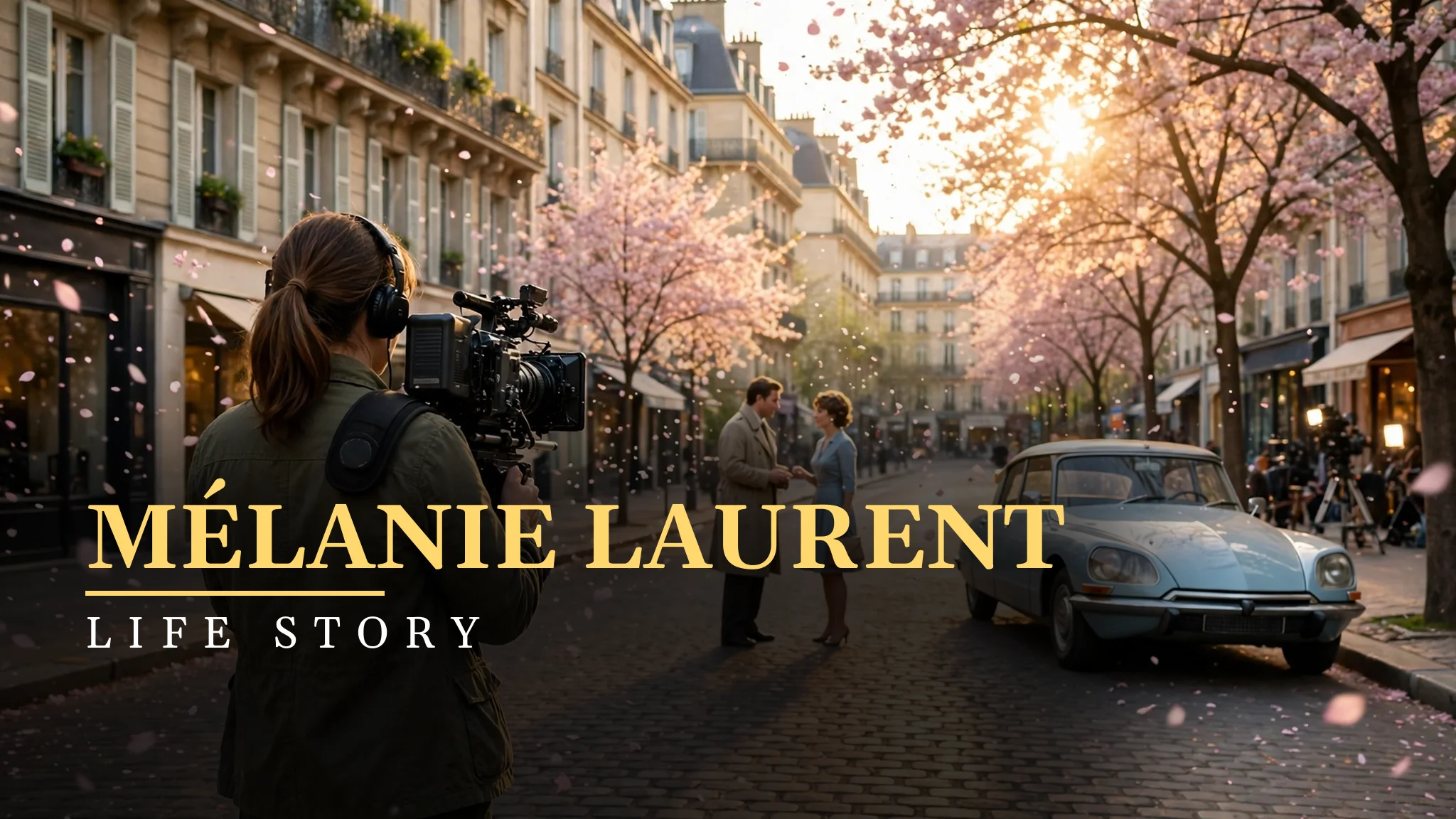
I keep thinking about the woman with the camera on a Paris street in cherry blossom, filming a couple, with a vintage car nearby. It is a picture of a director at work, a woman behind the camera, telling a story. That is Laurent for me: a woman behind the camera, and in front of it, telling stories about love, about courage, and about the future. She is not waiting for someone else to tell her story. She is telling it herself, and she is inviting us to listen. In the end, I think that is her gift: she tells the truth, in her own voice, and she asks us to hear it.
I also think about her work as a singer, and about the album En t’attendant. It is a collection of gentle, folk songs, sung in French and in English, and it shows a quieter side of Laurent. She is not only an actress and a director. She is also a musician, a woman who loves to sing, and who shares her songs with her audiences. I think about the artists who have more than one talent, and who are told to choose one. Laurent did not choose. She acts, she directs, and she sings, and she does all three with honesty. That is a lesson for anyone who feels torn between two dreams: you can follow both, if you are willing to work hard, and if you love both. Her songs are gentle, like her films, and they show a woman who is tender, thoughtful, and true.
I think about Le Bal des folles, and about the women locked away in a hospital because they were called mad. It is a painful story, and Laurent tells it with anger and with love. She shows how women have been silenced, how their voices have been ignored, and how they fight back. I think about the women today who are not believed, who are told that they are too emotional, or too difficult, and I see them in Eugénie. Laurent gives them a voice, and she asks the audience to listen. That is a brave thing for a director to do, and it is a necessary thing. A film that gives a voice to the silenced is a gift, and Laurent has given that gift more than once.
I also think about Demain, and about the hope it gives. It is easy to make a film about the end of the world, and to leave the audience feeling sad and helpless. Laurent chose a different path. She made a film about solutions, about people who are making things better, and about the power of hope. I think about the young people today who worry about the planet, who feel afraid about the future, and who do not know what to do. Demain tells them that there is hope, that people are working, and that they can join in. That is a generous gift, and it is one that Laurent gives with her whole heart. Hope is not naive. Hope is a decision, and Laurent has made that decision, film after film.
There is something I respect about the way Laurent has balanced work and family. She is an actress, a director, a singer, and a mother, and she does it all with grace. She has spoken about the difficulty of being a working mother, about the choices she has had to make, and about the love she has for her child. I do not want to make her life sound simple, because it is not simple. It is hard to do all of those things at once, and it takes a lot of energy, a lot of love, and a lot of organisation. Laurent does it, and she does it well, and that is a powerful example for women everywhere. She shows that a woman does not have to choose between her work and her family. She can do both, if she is honest about the difficulty, and if she keeps going.
Finally, I think about the woman with the camera on a Paris street in cherry blossom, filming a couple, with a vintage car nearby. She is telling it herself, and she is inviting us to listen. She tells the truth, in her own voice, and she asks us to hear it, and that is a gift that will last as long as people watch her films.
I also think about Le Concert, and about the violinist who discovers her past through music. It is a beautiful film, and Laurent plays her role with a grace that makes the audience feel the music. I think about the power of music to heal, to connect, and to tell a story without words. Laurent understands that power, because she is a singer herself, and she brings her love of music to her acting. She does not just play a violinist. She feels the music, and the audience feels it too. That is a gift, and it is one that comes from a deep love of art in all its forms.
I think about her as a director, and about the films she has made about women. She directed Les Adoptés, Respire, and Le Bal des folles, and each one is about women, about their friendships, their pain, and their strength. She tells women’s stories with honesty, and she gives them a voice. I think about the women who watch her films, and who see their own lives on screen, and I know that it matters to them. A film that tells the truth about being a woman is a gift, and Laurent gives that gift again and again. She is a director who listens to women, and who respects them, and that respect shows in every frame.
Finally, I think about the woman with the camera on a Paris street in cherry blossom, filming a couple, with a vintage car nearby. She is telling it herself, and she is inviting us to listen, and to hear the truth in her own voice.
I also think about Les Adoptés, and about the quiet film she made as her first feature. It is about two women, about family, and about the love that holds people together, and Laurent directed it with tenderness and with care. She did not try to make a grand film. She made a small, human film, and she trusted her audience to care. I think about the small stories in my own life, the family dinners, the quiet moments, and the love that holds us together, and I see them in Les Adoptés. Laurent shows that a small story, told with honesty, can be as powerful as a big one, and that is a lesson for any artist.
Frequently Asked Questions
When and where was Mélanie Laurent born?
Mélanie Laurent was born on 21 February 1983 in Paris, France. Her father was a voice actor and her mother was a ballet teacher, so she grew up in a family that loved art, music, and performance.
How was Mélanie Laurent discovered?
She was spotted as a teenager by the actor Gérard Depardieu, who saw her talent and encouraged her to act. She began working in films while still young, learning her craft film by film, and she soon became one of France’s most respected young actresses.
What role did Mélanie Laurent play in Inglourious Basterds?
In Inglourious Basterds, released in 2009 and directed by Quentin Tarantino, she played Shosanna Dreyfus, a young Jewish woman in Paris whose family is murdered by the Nazis and who plans revenge by burning down a cinema. The role made her famous around the world.
What was Mélanie Laurent’s first award as an actress?
She won the César Award for Most Promising Actress for her performance in Je vais bien, ne t’en fais pas, released in 2006, in which she played a young woman searching for her missing twin brother. The film was a turning point in her career.
What films has Mélanie Laurent directed?
She has directed Les Adoptés, Respire, Demain, and Le Bal des folles. Demain, a documentary about the environment co-directed in 2015, won the César Award for Best Documentary and was seen by more than a million people in France.
Is Mélanie Laurent also a singer?
Yes, she released an album called En t’attendant in 2011, a collection of gentle folk songs in French and English. Music has always been part of her life, alongside her work as an actress, director, and environmental activist.


