Melina Mercouri: The Life Story Behind Greece's Fiery Star
In this post
- Growing Up in Athens in a Political Family
- The Stage, the Screen, and Jules Dassin
- Never on Sunday and a Star Is Born
- Exile, Resistance, and the Fight Against the Junta
- Minister of Culture and the Fight for the Marbles
- The Legacy of Greece’s Fiery Star
- The Song That Became an Anthem: Ta Pediá tou Pireá
- My Take:
Melina Mercouri was a woman of fire. She was an actress with a laugh that could fill a room, a singer with a voice that could make a whole country sing, and a politician with a courage that could stand up to a dictatorship. She starred in Never on Sunday, a film that made her famous around the world, and she sang its song, Ta Pediá tou Pireá, a song that became an anthem of Greece. Then, when her country was ruled by a military junta, she fought against it from exile, and when democracy returned, she became Greece’s minister of culture, and she fought for the return of the Parthenon Marbles from Britain. Her life was a life of art and of politics, of laughter and of struggle, and it is one of the most remarkable stories in modern Greek history.
She was born on 18 October 1920 in Athens, into a family where politics was part of everyday life. Her grandfather had been a mayor of Athens, and her father had been a politician, so she grew up in a world where public life mattered. She studied acting, she began her career on the stage, and she became a star of Greek theatre and film. She married the American director Jules Dassin, and together they made films that were shown around the world. Never on Sunday, released in 1960, was the peak of her film career, and it won her the Best Actress award at the Cannes Film Festival and an Academy Award nomination.
Her story is not only about films. It is about a woman who loved her country so deeply that she gave her life to it, first as an actress who carried Greece to the world, and then as a minister who fought for its culture. She died on 6 March 1994 in New York, and she was mourned as a national heroine in Greece. This is the story of Melina Mercouri, Greece’s fiery star.
Growing Up in Athens in a Political Family
Maria Amalia Mercouri, known as Melina Mercouri, was born on 18 October 1920 in Athens. Her family was well known in Greek public life. Her grandfather, Spyros Mercouris, had been the mayor of Athens for many years, and her father, Stamatis Mercouris, was a politician and a member of parliament. Melina grew up in a house where politics, debate, and public service were part of daily conversation. She learned early that a person could, and should, take part in the life of their country, and that lesson stayed with her for the rest of her life.
As a girl, she was drawn to the theatre. She loved to act, to sing, and to perform, and she had a natural warmth and a natural humour that made people love her. She studied acting in Athens, at the National Theatre’s drama school, and she began her career on the stage. She was not a quiet actress. She was a lively, passionate performer, with a laugh that was famous, and with a presence that filled a theatre. Audiences loved her, because she was not distant. She was warm, she was funny, and she seemed to be speaking directly to each person in the room.
Athens in the 1940s was a city going through war and hardship. Greece was occupied during the Second World War, and the years that followed were hard. Melina lived through those years, and they shaped her. She saw what war does to a country, and she saw the strength of ordinary people. That experience gave her acting a depth, and it gave her a sense of responsibility. She was not only an actress. She was a Greek woman who had lived through her country’s hardest times, and who wanted to give something back.
Her early career on the stage made her a star in Greece. She played in comedies and in dramas, and she became known for her energy, her humour, and her ability to make an audience laugh and cry in the same evening. She was a star of the Greek theatre, and she was loved for it. But she wanted more. She wanted to work in film, and she wanted the world to see Greek acting. That ambition would take her to France, to America, and to the film that would make her famous around the world.
The Stage, the Screen, and Jules Dassin
Melina Mercouri’s film career began in Greece, but it grew when she began to work abroad. She appeared in French films, and she became known in Paris, a city where she was loved for her warmth, her humour, and her Mediterranean spirit. She was an actress who could play comedy and drama, and who could make an audience feel at home with her. Her performances were full of life, and they stood out in a world of cinema that was often serious and cold. Melina was warm, and that warmth was her gift.
In the 1950s, she met Jules Dassin, an American film director who had been blacklisted in Hollywood during the anti-communist investigations. Dassin had moved to Europe, and he and Melina fell in love. They married in 1966, and they became one of the most famous couples in European cinema. Dassin directed Melina in several films, and their partnership, both personal and artistic, was at the heart of her greatest success. He understood her talent, and he gave her roles that used it fully. She understood his vision, and she brought it to life with her warmth and her fire.
Their most famous film together was Never on Sunday, released in 1960. The film tells the story of Ilya, a free-spirited prostitute in the port of Piraeus, and Homer, an American scholar who tries to change her. Melina played Ilya with a joy, a humour, and a freedom that made the character unforgettable. She laughed, she danced, she sang, and she refused to be changed. The film was a huge success, and it became one of the best-known films of its decade. It was a film about freedom, about joy, and about a woman who would not be tamed, and Melina was perfect in it.
The film’s song, Ta Pediá tou Pireá, sung by Melina, became a worldwide hit, and it won the Academy Award for Best Original Song. The song is a celebration of Piraeus, of its children, of its port, and of its life, and Melina sang it with a happiness that made the whole world want to sing along. It is still one of the most famous Greek songs ever recorded, and it is still played in Greece and around the world. For Melina, it was a song that tied her to Piraeus, to Greece, and to the joy of life itself.
Never on Sunday and a Star Is Born
Never on Sunday made Melina Mercouri a world star. The film was shown at the Cannes Film Festival, and she won the Best Actress award there, one of the highest honours in cinema. She was also nominated for the Academy Award for Best Actress, a rare honour for a performance in a foreign-language film. The film’s success made her face familiar around the world, and it made her a symbol of Greece: warm, free, joyful, and unafraid. She was not a distant star. She was a woman who laughed, who danced, and who loved life, and audiences loved her for it.
The film also showed her gift for comedy. Ilya is a funny character, but she is also a serious one. She is a woman who knows who she is, and who will not let anyone change her. Melina played her with a humour that was never cruel, and with a strength that was never hard. She made Ilya a person, not a symbol, and that is why the character has lasted. People still watch Never on Sunday, and they still laugh with Ilya, and they still love her, because Melina made her real.
After Never on Sunday, Melina continued to work in film, with Dassin and with other directors. She appeared in Phaedra in 1962, a film based on the Greek tragedy, in which she played a woman torn between love and duty. She appeared in Topkapi in 1964, a clever and funny film about a jewel theft in Istanbul, in which she played a thief with charm and wit. These films showed her range: she could play tragedy and comedy, she could play a free spirit and a tormented queen, and she could do each one with the same warmth and the same truth.
Her film career made her one of the most famous Greek actresses in the world, and it gave her a platform that she would later use for politics. She was not only a star. She was a voice for Greece, and the world listened to her because it had loved her on screen. That love, and that fame, would become a weapon when her country needed her, and she would use it with a courage that surprised many people.
Exile, Resistance, and the Fight Against the Junta
In 1967, a military junta seized power in Greece, and Melina Mercouri’s life changed. She was abroad when the coup happened, and she spoke out against the new regime. The junta took away her Greek citizenship, and she became an exile. She lived in Paris, and she travelled the world, speaking against the dictatorship, and calling on the world to help Greece. She was a famous actress, and her voice carried weight. When she spoke, people listened, because they knew her from her films, and because they could see her passion and her courage.
Her years in exile were years of struggle. She could not go home, she could not see her family and friends in Greece, and she lived with the pain of being separated from her country. But she did not give up. She used her fame to keep the world’s attention on Greece, and she worked with other exiles to oppose the junta. She was a symbol of resistance, a woman who had lost her citizenship but not her country, and who refused to be silenced. Her speeches, her interviews, and her songs became a part of the fight for Greek democracy, and they gave hope to people in Greece who were living under the dictatorship.
The junta fell in 1974, and democracy returned to Greece. Melina was able to go home, and she was welcomed as a heroine. Her citizenship was restored, and she was honoured for her resistance. But she did not return only to be celebrated. She returned to work, and to serve her country in a new way. She had fought for Greece from abroad, and now she would fight for it at home, in politics, as a minister who would work for its culture. Her exile had taught her that culture matters, that a country’s art and history are part of its freedom, and that they must be protected.
Her story of exile is one of the most moving parts of her life. A woman who had everything, fame, success, and a happy marriage, gave it all up to speak the truth about her country, and to fight for its freedom. She did it because she loved Greece, and because she believed that silence in the face of dictatorship was a betrayal. That courage is part of why she is loved in Greece, not only as an actress, but as a patriot, and as a woman who stood up when it mattered most.
Minister of Culture and the Fight for the Marbles
After the return of democracy, Melina Mercouri entered politics, and in 1981 she became Greece’s minister of culture, a post she held for many years. It was a new role for her, but it was one she took seriously. As minister, she worked to protect Greece’s cultural heritage, to support its artists, and to bring Greek culture to the world. She was a minister who understood culture from the inside, because she had lived it as an actress and a singer, and she brought that understanding to her work. She was not a bureaucrat. She was an artist in government, and she used her office to make culture a priority.
One of her most famous campaigns as minister was for the return of the Parthenon Marbles from the British Museum. The Marbles, also known as the Elgin Marbles, are sculptures from the Parthenon in Athens, taken to Britain in the early nineteenth century. Melina believed, passionately, that they belonged in Greece, in Athens, near the Parthenon where they were made. She travelled the world, she spoke to governments, and she made the case for their return with a fire and a clarity that made the whole world listen. She said that the Marbles were not only art. They were a part of Greece’s soul, and they should come home.
Her campaign did not succeed in her lifetime, but it changed the debate. Before Melina, the return of the Marbles was a subject known mainly to specialists. After her, it was a subject known around the world, and it became a cause that many people supported. She gave the campaign a voice, a face, and a passion, and that voice is still heard today. The campaign continues, and it owes a great deal to her. She also founded the European Capital of Culture programme, an idea that has brought culture to cities across Europe, and that is another part of her legacy as a minister.
She served as minister of culture from 1981 to 1989, and again from 1993 to 1994, and she was loved by the Greek people for her work. She was a minister who was also a star, and who used her stardom to serve her country. She died on 6 March 1994 in New York, while still serving as minister, and her death was mourned as a national loss in Greece. She was given a state funeral, and she was buried in Athens, in the city where she was born. Greece had lost one of its greatest daughters, and the world had lost one of its most fiery and most loving voices.
The Legacy of Greece’s Fiery Star
Melina Mercouri’s legacy is the legacy of a woman who lived many lives in one: actress, singer, exile, and minister. She showed that an artist can also be a citizen, and that fame can be used to fight for freedom and for culture. Her films, especially Never on Sunday, are still watched and loved, and her song, Ta Pediá tou Pireá, is still sung. Her work as minister, and her campaign for the Parthenon Marbles, are still remembered, and they continue to inspire people who believe that culture matters and that stolen heritage should come home.
Her legacy is also a legacy of joy. She was a woman who laughed, who danced, and who loved life, and that joy is in her films and in her songs. She showed that a serious person can also be a joyful person, and that a fighter can also be a singer. That combination, of joy and of courage, is rare, and it is what makes her so loved. She was not a grim heroine. She was a fiery star, full of life, and her life was a celebration as well as a struggle.
For young Greek women, Melina is an example of what is possible. She came from Athens, she became a star of the stage and screen, she fought a dictatorship, and she became a minister. She did it all while staying true to herself, while laughing, while singing, and while loving her country. That is a powerful example, and it is one that will inspire others for a long time. She proved that a woman can be an artist and a politician, a singer and a fighter, and that she can do each one with passion and with grace.
Her story is still told in Greece, and her name is still spoken with love. Streets and cultural centres are named after her, her films are still shown, and her campaign for the Marbles is still alive. She is Greece’s fiery star, and her fire has not gone out. It lives on in her films, in her songs, in her work as a minister, and in the hearts of the Greek people who loved her. Melina Mercouri gave her life to Greece, and Greece will never forget her.
The Song That Became an Anthem: Ta Pediá tou Pireá
The song Ta Pediá tou Pireá, from Never on Sunday, is more than a film song. It is an anthem of Greece, a song that is known by almost every Greek person, and that is sung at parties, at celebrations, and in moments of joy. The song celebrates the children of Piraeus, the port city near Athens, and it speaks of its streets, its sea, and its life. Melina sang it with a happiness that was infectious, and the whole world wanted to sing along. The song won the Academy Award for Best Original Song, a rare honour for a song in Greek, and it became one of the most famous Greek songs ever recorded.
The song’s success also showed Melina’s gift as a singer. She was not only an actress who sang in a film. She was a singer who could carry a song, who could make it feel joyful and free, and who could make an audience want to dance. Her voice in the song is warm, clear, and full of life, and it captures the spirit of Ilya, the character she played: a woman who loves life, who refuses to be sad, and who finds joy in the everyday. That joy is the heart of the song, and it is why the song has lasted. It is not a sad song. It is a happy song, and happy songs that are also true are rare and precious.
The song also tied Melina to Piraeus, a city that became a part of her identity. Piraeus is a working port, a place of ships, of sailors, and of ordinary people, and Melina loved it for its honesty and its life. When she later became deputy mayor of Piraeus, it was a return to the city she had sung about, and a chance to serve the people she had celebrated in song. That circle, from a song about Piraeus to public service in Piraeus, is a beautiful part of her story, and it shows how deeply her art and her life were connected. She did not only sing about Piraeus. She lived for it, and she worked for it.
Today, the song is still played in Greece and around the world, and it is still a symbol of Greek joy and Greek freedom. When people hear it, they think of Melina, of her laugh, of her dance, and of the film that made her famous. A song that can do that, that can carry a whole country with it, is a rare thing, and Ta Pediá tou Pireá is such a song. It is Melina’s gift to Greece, and to the world, and it will be sung for as long as people love Greek music and Greek life.
My Take:
When I think about Melina Mercouri, I think about fire, because she was a woman who burned brightly in everything she did. She acted with fire, she sang with fire, she fought a dictatorship with fire, and she served her country with fire. I think that is a rare thing, to be a person who brings the same passion to art and to politics, to laughter and to struggle. Most people are passionate about one thing. Melina was passionate about everything, and that passion is what made her unforgettable. When I think of her, I think of a woman who laughed loudly, who spoke boldly, and who loved deeply, and I admire her for it.
I think about Never on Sunday, and about Ilya, the character she played, a woman who would not be changed by anyone. Ilya is free, she is joyful, and she refuses to let a well-meaning man turn her into something she is not. Melina played her with such joy that the audience could not help but love her. I think that is a lesson: a woman who knows who she is, and who refuses to be changed, is a powerful thing. Melina was like Ilya in that way. She knew who she was, and she would not be changed, not by a director, not by a junta, and not by anyone. That strength is part of why her performance is so memorable, and why she herself is so memorable.
What I like most about her is that she was both an artist and a fighter. She could sing Ta Pediá tou Pireá with joy, and she could speak against a dictatorship with courage, and she could do both with the same voice. I think that is a beautiful combination, because it shows that art and politics are not separate. Art is a way of speaking about the world, and politics is a way of changing it, and Melina did both. She did not keep her art in a safe place, away from the real world. She took it into the real world, and she used it to fight for her country. That is a brave way to live, and it is a way that few artists have the courage to follow.
I think about her exile, and about what it must have felt like to lose your citizenship, to be told you are no longer a citizen of your own country, because you spoke the truth. That must have been painful, and it must have been frightening. But Melina did not stop speaking. She travelled the world, she told the story of Greece, and she kept the world’s attention on the dictatorship. I admire that, because it takes a special kind of courage to speak when you have lost everything, and to keep speaking until your country is free. She did it, and she was welcomed home as a heroine, and that homecoming must have been one of the happiest moments of her life.
I also think about her work as minister of culture, and about how unusual it is for an actress to become a minister. It would have been easy for her to stay in the world of film, where she was loved and safe. Instead, she stepped into government, and she worked to protect Greece’s culture, to support its artists, and to fight for the return of the Parthenon Marbles. I respect that, because it shows that she cared about more than her own career. She cared about her country’s heritage, and she was willing to do the hard, unglamorous work of politics to protect it. That is a generous act, and it is one that few stars would undertake.
I think about the Parthenon Marbles, and about her campaign to bring them home. She believed, passionately, that they belonged in Athens, near the Parthenon, and she made that case to the world with a fire that no one could ignore. Her campaign did not succeed in her lifetime, but it changed the debate, and it is still alive today. I think about that, and I feel both sad and hopeful. Sad, because she did not live to see the Marbles return. Hopeful, because her voice is still heard in the campaign, and because the cause she fought for is still being fought. A cause that is fought with such passion does not die. It lives on, and Melina’s voice lives on in it.
There is a sadness in her story too, and it is the sadness of a life that ended too soon. She died in 1994, at the age of seventy-three, while still serving as minister, and Greece lost her when it still needed her. I think about that, and I feel the loss, because a woman of her fire and her passion is rare, and the world is poorer without her. But I also think that she lived a full life, a life of art, of love, of struggle, and of service, and that she gave everything she had to her country. That is a life to be celebrated, not only mourned.
I think about her marriage to Jules Dassin, and about how their partnership, both personal and artistic, made her greatest work possible. Dassin directed her in Never on Sunday, and he understood her talent in a way that few directors did. Their love story is a part of her story, and it is a beautiful one: two artists, from different countries, who found each other, who worked together, and who loved each other for the rest of their lives. I think that partnership gave her strength, and it gave her films a depth that they would not otherwise have had. A good partner can make an artist better, and Dassin made Melina better, just as she made him better.
If I have a criticism, it is not a criticism of Melina herself. It is a sadness that the world remembers her mostly for Never on Sunday, when her life was so much bigger than one film. She was also a fighter, a minister, and a campaigner for culture, and those parts of her life deserve to be remembered as much as her films. I hope more people learn about her whole story, because it is a story of a woman who lived many lives, and who gave each one her full heart. She was more than Ilya. She was Melina, and Melina was a force of nature.
I also think about the young women in Greece who look at Melina and see what is possible. A girl from Athens can become a star of the stage, a star of film, a fighter against dictatorship, and a minister of culture, and she can do it all while laughing, while singing, and while loving life. That is a powerful example, and it is one that will inspire others for a long time. Melina did not wait for permission to live a big life. She lived it, and she lived it loudly, and she showed other women that they could live big lives too.
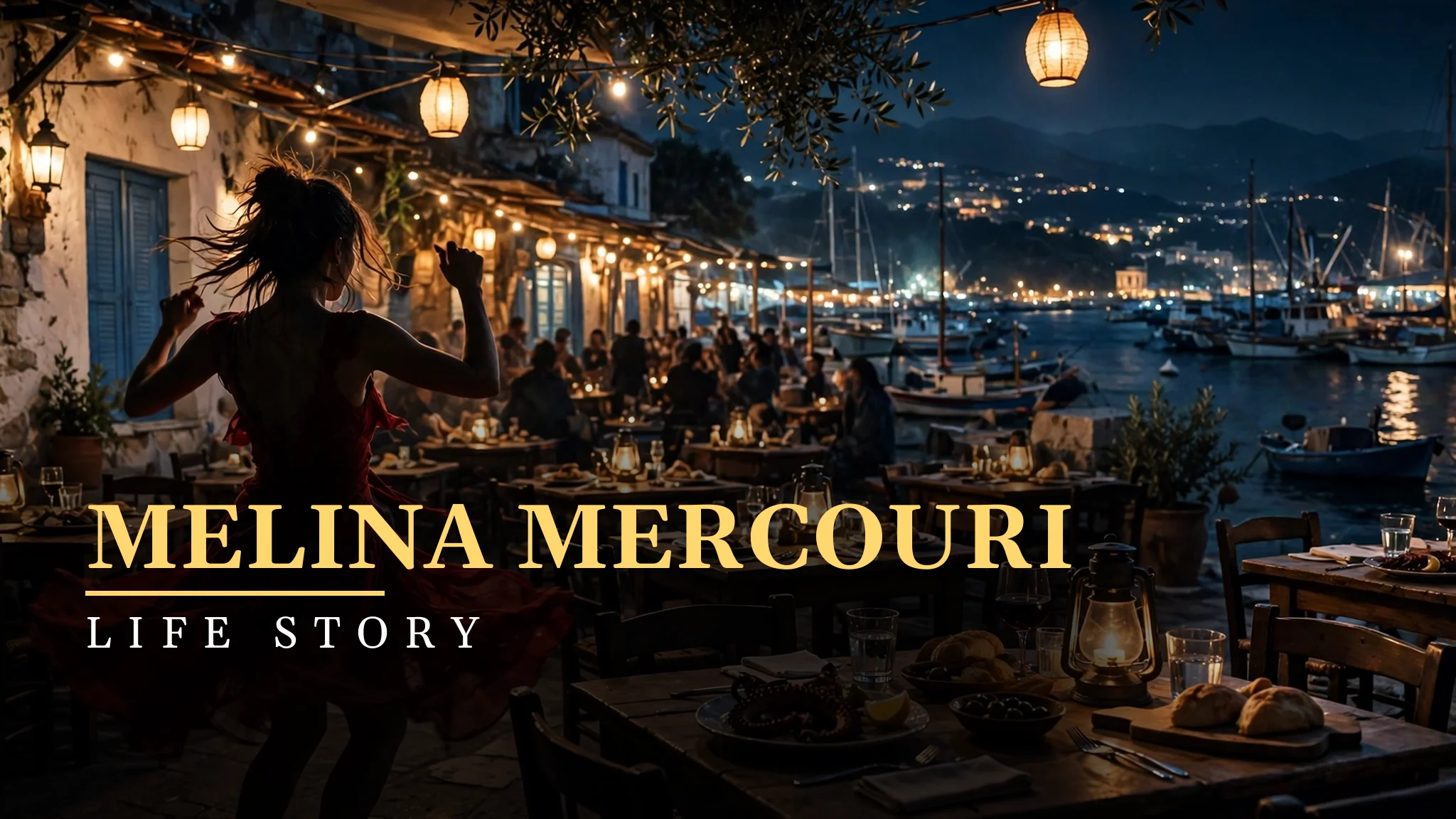
One more thought stays with me, and it is about the image of a woman in a red dress, dancing at a harbourside taverna at night, with lanterns and boats and the sea behind her. That image fits Melina, because she was a woman who danced, who laughed, and who loved the sea and the life of Greece. She was not a distant star. She was a woman of the taverna, of the port, of Piraeus, and of the people. When I think of her, I think of that dance, and of the joy in it, and I am glad that such a woman existed. Her joy is still in her films, in her songs, and in the memory of Greece.
In the end, I think Melina Mercouri teaches us that a life can be both joyful and serious, both artistic and political, and that a woman can be a star and a fighter at the same time. She was born in Athens, she became a star in Never on Sunday, she fought a dictatorship from exile, and she became Greece’s minister of culture, fighting for the Parthenon Marbles. She died in 1994, and she was mourned as a national heroine. I would tell a new viewer to start with Never on Sunday, then to listen to Ta Pediá tou Pireá, and then to learn about her work as a minister. You will find a woman of fire, a woman of joy, and a woman who loved Greece with her whole heart. That is Melina Mercouri, Greece’s fiery star.
I think about Ta Pediá tou Pireá, and about how a song can become an anthem. It is a happy song, a song about the children of a port city, and it is sung with a joy that is infectious. When Melina sang it, the whole world wanted to sing along, and that is a remarkable thing for a song in Greek. I think about that, and I feel glad, because it shows that joy does not need translation. A happy song, sung with feeling, can cross any border, and Melina’s song did. It is still sung today, and it will be sung for a long time, because joy is a universal language.
I also think about Piraeus, and about how Melina’s love for that city shaped her life. She sang about it, she served it as deputy mayor, and she carried it with her wherever she went. That love of a place, a working port, a city of ordinary people, is part of what made her special. She was not a star who lived in a distant world. She was a woman of Piraeus, of Athens, and of Greece, and she loved the ordinary life of her country. That love is in her films, in her songs, and in her politics, and it is why the Greek people loved her back.
I think about her laugh, and about how famous it was. Melina had a laugh that could fill a room, a laugh that was warm, loud, and full of life. In a world where stars are often serious and distant, her laugh was a reminder that joy matters, and that a woman who laughs is a woman who is alive. I think about that laugh, and I smile, because it is a sound that is still in her films, and that still makes audiences happy. A laugh like that is a gift, and Melina shared it with the world.
I think about her marriage to Jules Dassin, and about how their love story made her greatest work possible. Dassin understood her talent, and he gave her roles that used it fully. She understood his vision, and she brought it to life with her warmth and her fire. Their partnership was a meeting of two artists who loved each other and who made each other better. I think that is a beautiful thing, and it is a part of her story that deserves to be remembered. A good partner can change a life, and Dassin changed Melina’s, just as she changed his.
One more thought stays with me, and it is about the fire in her. Melina was a woman of fire, and that fire burned in everything she did: in her acting, in her singing, in her fight against the junta, and in her work as a minister. Fire can destroy, but it can also warm, and Melina’s fire warmed the people around her. It gave them courage, it gave them joy, and it gave them hope. That is a rare kind of fire, and it is one that the world still needs. I am glad that such a woman existed, and I hope her fire continues to inspire others.
I think about the fire in her, and about how it warmed the people around her. Melina’s fire was not a fire that destroyed. It was a fire that gave courage, that gave joy, and that gave hope. When she spoke against the junta, her fire gave hope to Greeks living under dictatorship. When she sang, her fire gave joy to audiences around the world. When she served as minister, her fire gave culture a champion. That is a rare kind of fire, and it is one that the world still needs.
I also think about the young women in Greece who look at Melina and see what is possible. A girl from Athens can become a star, a fighter, and a minister, and she can do it all while laughing and singing. That is a powerful example, and it will inspire others for a long time. Melina did not wait for permission to live a big life. She lived it, loudly and with love, and she showed other women that they could live big lives too.
Frequently Asked Questions
When and where was Melina Mercouri born?
Melina Mercouri was born on 18 October 1920 in Athens, Greece, into a family with a long history in public life. Her grandfather had been mayor of Athens, and her father was a politician, so she grew up in a world where public service mattered.
What is Melina Mercouri best known for in film?
She is best known for Never on Sunday (1960), in which she played Ilya and won the Best Actress award at Cannes and an Academy Award nomination. She also sang its famous song, Ta Pediá tou Pireá, and appeared in Phaedra and Topkapi.
Was Melina Mercouri exiled from Greece?
Yes, after the military junta seized power in 1967, she spoke out against it from abroad, and the junta took away her Greek citizenship. She lived in exile in Paris and travelled the world campaigning against the dictatorship until democracy returned in 1974.
What did Melina Mercouri do as minister of culture?
She served as Greece’s minister of culture from 1981 to 1989 and again from 1993 to 1994, working to protect Greek heritage, support artists, and campaign for the return of the Parthenon Marbles from the British Museum. She also founded the European Capital of Culture programme.
What are the Parthenon Marbles and why did she fight for them?
The Parthenon Marbles are sculptures from the Parthenon in Athens, taken to Britain in the early nineteenth century and held in the British Museum. Melina campaigned passionately for their return to Greece, arguing that they belonged near the Parthenon where they were made.
When did Melina Mercouri die?
She died on 6 March 1994 in New York, at the age of seventy-three, while still serving as minister of culture. She was given a state funeral in Greece and buried in Athens.


