Milton Nascimento: The Life Story Behind Brazil's Gentle Voice
In this post
- A Boy Adopted Into Music in Três Pontas
- Belo Horizonte and the Friends of Clube da Esquina
- Travessia, Maria Maria, and the Songs of a Nation
- The World Stage and the Voice of Minas Gerais
- The Adopted Son Who Sang of Home
- Friends, Faith, and the Music of Minas
- The Legacy of Bituca
- The Farewell Tour and the Love of a Nation
- My Take:
Milton Nascimento sings like a man talking to the hills. His voice is soft, high, and full of light, and it seems to float above the music like a bird over a green valley. In Brazil, people call him Bituca, a nickname from his childhood, and they love him the way you love a person who has always been part of your life. He sang about the mountains of Minas Gerais, about the sea, about mothers and children, about love and about the pain of his country. His songs are gentle, but they carry a deep feeling that stays with you long after the music ends.
He was born in Rio de Janeiro in 1942, but he grew up in the small town of Três Pontas, in the state of Minas Gerais. He was adopted as a small child by a family who loved music, and he learned to play the guitar and the piano in a house full of songs. In the 1960s, he moved to Belo Horizonte, the capital of Minas Gerais, and there he met a group of young musicians who would change Brazilian music. Together they made the album Clube da Esquina, one of the greatest records ever made in Brazil.
His career has lasted more than sixty years. He has won Grammy Awards, he has worked with jazz musicians from around the world, and his songs have been sung in many countries. He gave his farewell tour in 2022, and audiences came to say goodbye to a voice they had loved for a lifetime. This is the story of a boy from the hills of Minas Gerais who became one of the most loved singers in Brazil.
A Boy Adopted Into Music in Três Pontas
Milton Nascimento was born on 26 October 1942 in Rio de Janeiro. His mother was a domestic worker, and when he was still very small, he was adopted by a couple from the state of Minas Gerais: Josino Brito Campos, a bank worker, and Lília Silva Campos, a music teacher. The family moved to the small town of Três Pontas, in the hills of Minas Gerais, and there Milton grew up. His adoptive mother taught music, and the house was full of songs. He heard classical music, popular songs, and the music of the church, and he learned to play the piano and the guitar as a boy.
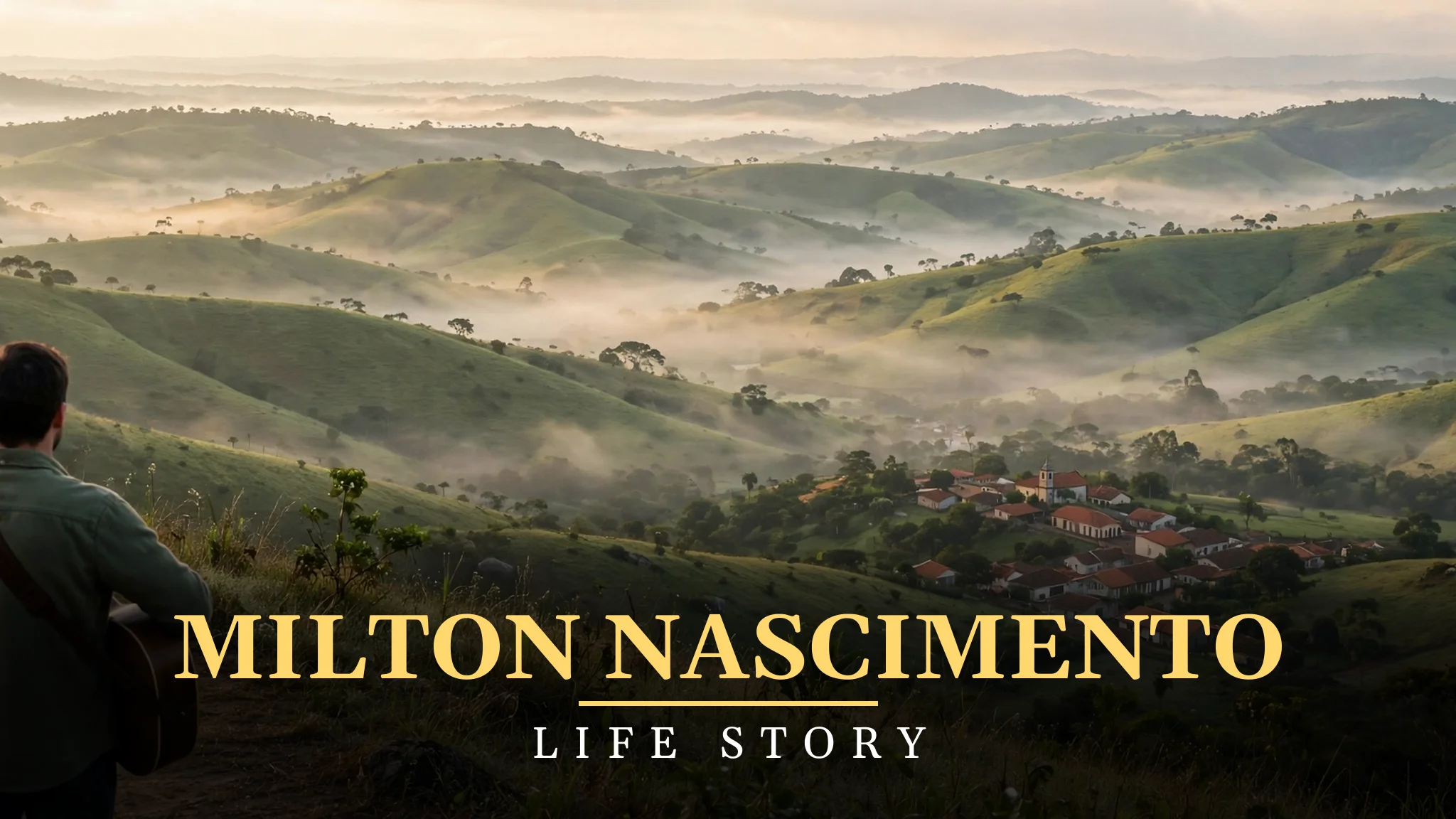
Três Pontas was a quiet place, far from the big cities. The hills were green, the air was clear, and the town moved slowly. The young Milton loved the landscape, and it stayed in his music forever. His songs often speak of mountains, of roads, of the sky, and of the feeling of being a small person in a big, beautiful world. He also loved the radio, and he listened to the samba of Rio, to the jazz of America, and to the songs of the great Brazilian singers of the time. He learned them all by ear, and he began to write songs of his own.
As a teenager, he was known in the town as a talented young musician. People called him Bituca, a nickname that came from his childhood, and the name stayed with him for the rest of his life. He played the guitar at parties, he sang in the church choir, and he dreamed of a bigger life in music. But he was a shy boy, and he did not push himself forward. He let the music speak, and the music spoke quietly, with a voice that was already special: high, clear, and full of feeling.
When he finished school, he moved to Belo Horizonte, the capital of Minas Gerais, to study and to work. The city was larger than Três Pontas, and it was full of young people who loved music. There he met the musicians who would become his closest friends and partners. The hills of Minas Gerais had given him his voice. The city would give him his friends, and together they would make history.
Belo Horizonte and the Friends of Clube da Esquina
In Belo Horizonte in the 1960s, Milton met a group of young musicians who shared his love of music. Among them were the brothers Márcio and Lô Borges, the lyricist Fernando Brant, and the singer and writer Beto Guedes. They spent their days together, playing music, writing songs, and talking about the future of Brazilian music. They met at a corner in the city, on the street, and that corner gave their group its name: Clube da Esquina, the Corner Club. It was not a formal group. It was a circle of friends who made music together.
In 1967, Milton won a prize at a music festival in Rio with his song “Travessia”, a beautiful, sad song about crossing a river and leaving home. The song made his name known across Brazil, and it showed the country a new kind of singer: a man with a high, gentle voice, singing songs that mixed samba, jazz, and the folk music of Minas Gerais. “Travessia” became one of his most loved songs, and it is still sung today. It was the beginning of a great career.
In 1972, the friends of Clube da Esquina made an album together, called Clube da Esquina. Milton and Lô Borges shared the record, and it included songs that became classics of Brazilian music: “Cais”, “Um Girassol da Cor do Seu Cabelo”, “Nada Será Como Antes”, and “Clube da Esquina No. 2”. The album was different from anything else in Brazil at the time. It was soft, it was dreamy, and it was full of the feeling of the hills and the friendships of Minas Gerais. It is now named as one of the greatest Brazilian albums ever made.
The album showed what Milton and his friends could do together. They wrote about love, about friendship, about the roads of Minas Gerais, and about the hopes of young people in a country under a military government. Their music was not loud or angry. It was gentle, but it carried a quiet strength. It spoke about freedom in a time when freedom was hard to find, and young Brazilians loved it for that. The corner in Belo Horizonte had become a legend.
Travessia, Maria Maria, and the Songs of a Nation
In the 1970s, Milton Nascimento became one of the most loved singers in Brazil. He recorded album after album, and each one showed a voice growing deeper and more sure. His song “Maria, Maria”, written with Fernando Brant, became an anthem for the strength of Brazilian women, and it is still sung today. His song “Cais” spoke about the sea and about leaving home, and his song “Nos Bailes da Vida” spoke about the joy of dancing and living. His music was played on the radio, in homes, and in concert halls across the country.
He also became known around the world. Jazz musicians in America loved his voice and his songs, and he worked with some of the finest of them, including the saxophone player Wayne Shorter, the pianist Herbie Hancock, and the guitarist Pat Metheny. His album Nascimento, released in 1997, won a Grammy Award, and his work was praised in many countries. He sang in Portuguese, but listeners who did not speak the language still felt the beauty of his voice. His music crossed borders the way a river crosses land: quietly, and without asking permission.
He was also a singer who cared about his country. Brazil in the 1970s was under a military government, and many artists faced censorship and fear. Milton’s songs spoke about the life of ordinary Brazilians, about the poor, about the workers, about the mothers and children of the country. His song “O Cio da Terra” and his work with the singer Chico Buarque showed a man who loved Brazil and wanted a better life for its people. He did not shout his politics. He sang them softly, in songs about love and about the land, and people understood.
By the end of the 1970s, he was one of the great voices of Brazilian music. He had moved from the small town of Três Pontas to the stages of the world, and he had done it without losing the gentleness that made him special. His voice was still high and clear, his songs were still about the hills and the sea, and his friends from Belo Horizonte were still beside him. The boy from the hills had become a star, and he had stayed himself.
The World Stage and the Voice of Minas Gerais
In the 1980s and 1990s, Milton’s career took him to concert halls around the world. He sang in America, in Europe, and in Japan, and audiences loved his gentle voice and his warm stage presence. He did not perform with loud bands or big shows. He sang with a small group of fine musicians, and he let the songs speak. His concerts were quiet, moving, and full of feeling. People came to hear a voice they had loved for years, and they left feeling as if they had been somewhere beautiful.
He recorded many albums in these years, and he kept working with his old friends from Minas Gerais. He also worked with younger musicians, and he gave his support to new singers who loved his music. He was a generous artist, and he shared his stage with others. His album with the singer Gilberto Gil, and his work with the jazz world, showed a man who was always open to new sounds. He never stopped learning, and he never stopped singing about the things he loved: the hills, the sea, the people of Brazil, and the hope of a better world.
His voice remained special even as he grew older. It was still high, still clear, and still full of light. Singers half his age tried to copy it, and they could not. It was a voice shaped by the hills of Minas Gerais, by the music of his adoptive mother, and by a lifetime of singing with feeling. He sang about his mother, about his friends, about the roads he had travelled, and about the Brazil he loved. His songs were like letters from a friend: personal, warm, and true.
In 2022, he announced his farewell tour, called A Última Sessão de Música, the last music session. He travelled across Brazil and to other countries, singing his greatest songs for audiences who had loved him for decades. The concerts were emotional, and many people cried as they sang along. He was eighty years old, and he had given more than sixty years to music. It was time to rest, but the voice would not be forgotten. The hills of Minas Gerais would keep singing it, in every song he had left behind.
The Adopted Son Who Sang of Home
Milton Nascimento has always spoken with love about his adoptive parents, and their gift to him was music itself. His mother was a music teacher, and she gave him the piano, the guitar, and the habit of listening closely to a song. His father gave him a stable home in a small town where a boy could grow up slowly, close to nature. He has said that he owes his life in music to that family, and his songs often return to the feeling of home: a house, a mother, a road leading back to the hills. That feeling is at the heart of his work.
His adoption also shaped the way he sang about belonging. He was born in Rio, but he grew up in Minas Gerais, and he has always said that Minas is his true home. His songs are full of the landscape of that state: the mountains, the valleys, the small towns, the roads that wind between them. When he sings “Travessia”, about crossing a river and leaving home, you can hear a man who knows what it means to leave a place you love, and to carry it with you wherever you go. That is a feeling many people know, and he sings it better than almost anyone.
He has also spoken about the importance of family in his life, not only the family that raised him, but the family of friends he made in Belo Horizonte. The Clube da Esquina was a family of musicians, and they stayed close for decades. They wrote songs together, they played on each other’s records, and they shared the good years and the hard years. Milton’s music is, above all, music about belonging: to a family, to a place, to a group of friends, and to a country. That is why it touches so many people. Everyone wants to belong, and his songs say that belonging is real.
Friends, Faith, and the Music of Minas
The sound of Milton Nascimento is the sound of Minas Gerais, a state in the hills of Brazil with its own music, its own food, and its own way of life. The people of Minas are known for being quiet, warm, and thoughtful, and Milton’s music carries those qualities. His songs are not fast or loud. They move slowly, like a walk through the hills, and they give the listener time to feel. That slowness is not a weakness. It is a strength, and it comes from the place where he grew up.
His friends were part of that sound. Lô Borges, Márcio Borges, Fernando Brant, Beto Guedes, and the others of the Clube da Esquina each brought something of their own to the music. Together they made a sound that was new: samba mixed with jazz, folk music mixed with rock, the hills of Minas mixed with the sea of Rio. Milton was the voice of that sound, but he was never alone in it. He has always said that his music belongs to his friends as much as to him, and he has kept their names alive in every concert and every interview.
Faith is also part of his music, in a quiet way. He grew up singing in the church, and his songs often carry a sense of wonder at the world: the sky, the sea, the light, the life of ordinary people. He does not preach, and he does not tell people what to believe. He sings about the beauty of the world, and about the hope that life can be better. That hope is the faith in his music, and it has carried his listeners through hard times. In a country that has known much hardship, a song of hope is a precious thing.
The Legacy of Bituca
Today, Milton Nascimento is remembered as one of the greatest singers Brazil has ever had. His voice, high and gentle, is known across the country, and his songs are part of the national memory. “Travessia”, “Maria, Maria”, “Cais”, and “Clube da Esquina” are sung by young people who were not born when the songs were written. That is the mark of great music: it does not belong only to its own time. It belongs to every time, because it speaks about things that do not change: love, home, friendship, and hope.
His influence on other musicians is very large. Singers in Brazil and around the world have learned from his way of singing, from his high, floating voice, and from his gentle way of shaping a melody. Jazz musicians have recorded his songs, and his work with Wayne Shorter, Herbie Hancock, and Pat Metheny brought his music to new audiences. He won Grammy Awards, and he was honoured in Brazil and abroad. But his greatest honour is simpler: the love of the Brazilian people, who call him Bituca, and who sing his songs as if they were their own.
His farewell tour in 2022 was a moment of national feeling. Audiences across Brazil came to hear him one last time, and they sang along to every song. He was eighty years old, and he had given his life to music. The tour was not a sad ending. It was a celebration of a life well sung. The boy from Três Pontas, the adopted son of a music teacher, had become a voice for a whole country. The hills of Minas Gerais will keep his songs, and Brazil will keep singing them.
The Farewell Tour and the Love of a Nation
In 2022, Milton Nascimento announced his farewell tour, called A Última Sessão de Música, the last music session, and Brazil responded with love. He travelled across the country, from the big cities to the smaller towns, singing his greatest songs for audiences who had loved him for decades. The concerts were emotional, and many people cried as they sang along. He was eighty years old, and he had given more than sixty years to music. It was time to rest, but the voice would not be forgotten.
The farewell tour was not a sad ending. It was a celebration of a life well sung. At each concert, the audience sang with him, word for word, song after song, as if they were singing with an old friend. He sang “Travessia”, “Maria, Maria”, “Cais”, and “Clube da Esquina”, and the halls filled with voices. People brought their children, and their grandchildren, to hear the man whose songs had been part of their lives for so long. It was a passing of music from one generation to the next, and it was beautiful to see.
He also took the tour to other countries, and audiences abroad gave him the same love. They had listened to his records for years, and now they could hear him live, one last time. He sang with the same gentleness he had always had, and his voice, though older, was still clear and full of light. He was tired, but he was happy, and he gave every concert everything he had. That is the mark of a great artist: to give your best, even at the end, even when it is hard.
When the tour ended, Brazil thanked him. Newspapers, television, and radio all paid tribute to a singer who had given the country so much. He had not only sung songs. He had given Brazil a sound, a feeling, and a memory that would last. The boy from Três Pontas, the adopted son of a music teacher, had become a voice for a whole country. The farewell was not a goodbye to the music. The music would go on, in every song he had left behind, and in every listener who still sings along.
My Take:
When I think about Milton Nascimento, the first thing I feel is peace. His voice does not rush me or push me. It slows me down, and it makes me want to listen. In a world that is always fast, always loud, always asking for more, his music is a quiet place. I can close my eyes, hear his high, gentle voice, and feel as if I am standing on a hill in Minas Gerais, looking out over green valleys in the morning light. That feeling is a gift, and it is the reason I love his music. He does not try to impress me. He invites me to be still, and to feel.
I admire his voice most of all, because it is so unusual. It is high, it is clear, and it seems to float above the music. Most male singers sing low and strong. Milton sings high and soft, and he makes it sound natural, as if that is simply how a voice should sound. I think that took great courage, because the world often tells men to be loud and strong, and to hide their gentleness. Milton did not hide his. He sang with tenderness, and he made tenderness into strength. That is a brave thing, and it is a lesson for anyone who has been told to be someone they are not. Be yourself, sing in your own voice, and the world will learn to love it.
What moves me most about his story is the family that raised him. He was adopted as a small child by a couple who loved music, and that love shaped his whole life. His mother taught music, and she gave him the piano and the guitar. His father gave him a home in a small town where he could grow up close to nature. I think about that a lot, because it shows how much a loving home matters. A child who is loved and given music can grow up to give music to the whole world. Milton’s story is proof of that. It is also a reminder that family is not only about blood. It is about love, about care, and about the people who choose to raise you. His adoptive parents chose him, and he has spent his life honouring that choice with his songs.
I also think about his friends, the Clube da Esquina, because their story teaches something true about making great work. They were not a company or a business. They were a group of young friends in Belo Horizonte, meeting on a street corner, playing music together, and dreaming of a new sound. They did not have much money, and they did not have a plan. They had friendship, and they had music, and that was enough. The album they made together is now named as one of the greatest in Brazilian history. I think that is a beautiful lesson: great work often comes from friendship, from people who love each other and love what they do. You do not need a big budget or a famous name. You need friends who believe in you, and a corner where you can meet and play.
There is a sadness in his story too, and it is the sadness of a country that has known hard times. Brazil in the 1960s and 1970s was under a military government, and many artists lived in fear. Milton’s songs spoke about that time, but they did not shout. They spoke softly, about the poor, about the workers, about the mothers and children of Brazil. His song “Maria, Maria” is a song about the strength of Brazilian women, and it is still sung today because that strength is still needed. I admire the way he sang about hard things without losing his gentleness. He did not become bitter. He kept singing about hope, and that hope helped people through dark years. That is what great music does: it does not deny the pain, but it does not give up on hope either.
I think about his farewell tour in 2022, and I feel both sadness and gratitude. Sadness, because a great voice was saying goodbye to the stage. Gratitude, because he gave his audiences a chance to say thank you, to sing along one last time, and to celebrate a life of music. Too many artists disappear without a goodbye. Milton gave his listeners a farewell, and they gave him their love in return. The concerts were full of tears and of joy, and that is as it should be. A life of music deserves a good goodbye, and he had one.
If I could speak to a young singer who wants to be like Milton, I would say this: learn to be gentle. The world will tell you to be loud, to be fast, to be impressive. But gentleness is a strength, and it lasts longer than noise. Milton sang softly for sixty years, and people still listen. He did not chase fashion, and he did not change his voice to please the market. He sang about the hills, about home, about his friends, and about hope. That is the honest path, and it is the one that lasts. Sing what you love, sing it truly, and sing it in your own voice.
I also think about what his story says about Brazil. His music is the sound of Minas Gerais, a state in the hills, far from the beaches of Rio. It is a reminder that Brazil is not only one place. It is many places, many sounds, many peoples, and each one has its own music. Milton gave the hills a voice, and the whole country listened. That is a wonderful thing. It means that no place is too small, and no voice is too quiet, to matter. A boy from a small town can sing to the world, if he sings truly.
In the end, what stays with me is the voice itself, high and clear, floating over green hills like a bird in the morning light. It is a voice that makes me feel calm, and hopeful, and close to home, even when I am far away. Milton Nascimento sang for more than sixty years, and he gave Brazil some of its most beautiful songs. I am grateful for them, and I am grateful for the lesson they carry: be gentle, be true, love your home, love your friends, and never give up on hope. That is his story, and it is worth remembering.
I also think about his farewell tour in 2022, and I feel both sadness and gratitude. Sadness, because a great voice was saying goodbye to the stage. Gratitude, because he gave his audiences a chance to say thank you, to sing along one last time, and to celebrate a life of music. Too many artists disappear without a goodbye. Milton gave his listeners a farewell, and they gave him their love in return. The concerts were full of tears and of joy, and that is as it should be. A life of music deserves a good goodbye, and he had one.
I think about the way his voice has stayed with Brazil, too. His songs are played on the radio, in homes, in cars, and in the hearts of people who have listened to them for decades. Young people who were not born when “Travessia” was written still sing it, and they feel the same longing that listeners felt in 1967. That is the mark of great music: it does not belong only to its own time. It belongs to every time, because it speaks about things that do not change: love, home, friendship, and hope. Milton’s songs speak about those things, and they will be sung for years to come.
There is something else I want to say about his gentleness. In a world that often rewards loudness, Milton chose softness, and he made softness into strength. His voice is high, gentle, and full of light, and it carries a feeling that loud music cannot carry. I think that is a brave choice, especially for a man, in a world that often tells men to be loud and strong. He was strong in a different way: strong in feeling, strong in truth, and strong in the courage to be gentle. That is a lesson for anyone who has been told to be someone they are not. Be yourself, sing in your own voice, and the world will learn to love it.
I also think about what his story says about adoption, about family, and about love. He was adopted as a small child by a couple who loved music, and that love shaped his whole life. His mother taught music, and she gave him the piano and the guitar. His father gave him a home in a small town where he could grow up close to nature. I think about that a lot, because it shows how much a loving home matters. A child who is loved and given music can grow up to give music to the whole world. Milton’s story is proof of that. It is also a reminder that family is not only about blood. It is about love, about care, and about the people who choose to raise you.
If I could speak to a young singer who wants to be like Milton, I would say this: learn to be gentle. The world will tell you to be loud, to be fast, to be impressive. But gentleness is a strength, and it lasts longer than noise. Milton sang softly for sixty years, and people still listen. He did not chase fashion, and he did not change his voice to please the market. He sang about the hills, about home, about his friends, and about hope. That is the honest path, and it is the one that lasts. Sing what you love, sing it truly, and sing it in your own voice.
In the end, what stays with me is the voice itself, high and clear, floating over green hills like a bird in the morning light. It is a voice that makes me feel calm, and hopeful, and close to home, even when I am far away. Milton Nascimento sang for more than sixty years, and he gave Brazil some of its most beautiful songs. I am grateful for them, and I am grateful for the lesson they carry: be gentle, be true, love your home, love your friends, and never give up on hope. That is his story, and it is worth remembering.
I also think about the way his songs are used in everyday life in Brazil, because that is a quiet kind of greatness. “Travessia” plays on the radio, in cars, and in homes, and people who hear it feel a longing they cannot quite name. “Maria, Maria” is sung at gatherings, at celebrations, and in moments of pride. Most of the people who sing along do not think about who wrote the songs. They only know the feeling, and the feeling is enough. That is a strange and wonderful fate for a singer: to be everywhere and nowhere at once, to be part of how a whole country feels.
There is one more thing I want to say about him, and it is about the way he treated his friends. He never forgot the Clube da Esquina, the young musicians he met in Belo Horizonte, and he kept their names alive in every concert and every interview. He shared his stage with them, he sang their songs, and he gave them credit. That loyalty is a lesson for anyone who makes art with others: do not forget the people who were with you at the start. Success is sweeter when it is shared, and Milton shared his, for sixty years, with the friends from a street corner in Belo Horizonte.
I also think about the hills of Minas Gerais, and how they live in his songs. A listener who has never been to Brazil can still feel those green valleys, the morning mist, and the quiet of a small town, because Milton put them into his music. That is the work of a true artist: to take the place you love and give it to the world, so that strangers can feel at home in it. His hills are now part of the world’s music, and they will be there for as long as people sing his songs.
Frequently Asked Questions
Why is Milton Nascimento called Bituca?
Bituca is a nickname Milton Nascimento has had since his childhood in Três Pontas, Minas Gerais. It is a name his friends and family used for him when he was a boy, and it has stayed with him throughout his life. In Brazil, many people know him by this nickname as well as by his real name, and it is a sign of the affection Brazilians feel for him.
What is Clube da Esquina?
Clube da Esquina, which means the Corner Club, is the name of a group of young musicians from Belo Horizonte, Minas Gerais, who made music together in the 1960s and 1970s. The group included Milton Nascimento, Lô Borges, Márcio Borges, Fernando Brant, and Beto Guedes. Their 1972 album Clube da Esquina is named as one of the greatest Brazilian albums ever made.
What is Milton Nascimento’s most famous song?
His most famous songs include “Travessia”, which won a prize at a music festival in 1967, “Maria, Maria”, a song about the strength of Brazilian women, and “Cais”. Each of these songs is still sung and played in Brazil today. “Travessia” is often named as the song that made his name known across the country.
Did Milton Nascimento win a Grammy Award?
Yes, Milton Nascimento won a Grammy Award for his album Nascimento, released in 1997. He also worked with famous jazz musicians, including Wayne Shorter, Herbie Hancock, and Pat Metheny, and his music has been praised in many countries. His songs have been recorded by musicians around the world.
Where did Milton Nascimento grow up?
Milton Nascimento was born in Rio de Janeiro in 1942, but he grew up in the small town of Três Pontas, in the state of Minas Gerais. He was adopted as a small child by a couple from Minas Gerais, and his adoptive mother was a music teacher. The hills and the landscape of Minas Gerais have stayed in his music throughout his life.
When did Milton Nascimento give his farewell tour?
Milton Nascimento gave his farewell tour, called A Última Sessão de Música, in 2022, when he was eighty years old. He travelled across Brazil and to other countries, singing his greatest songs for audiences who had loved him for decades. The tour was a celebration of a career that had lasted more than sixty years.


