Mohamed Mounir: The Life Story Behind the King of Nubian Song
In this post
In Egypt, there is a singer whose voice sounds like the Nile itself, wide, warm, and full of history. His name is Mohamed Mounir, and millions of Egyptians call him El King, the King. He is not a king of palaces. He is a king of songs, of the people who sing along in cars, in cafes, and in village squares, of the young who dance to his rhythms and the old who remember the Nubian villages where his music began. His voice carries two worlds at once. It carries Nubia, the old land of the south, with its own language, its own colours, and its own songs. And it carries modern Egypt, with its pop music, its films, and its big city crowds.
Mounir was born in the south, in a Nubian family, and his life was shaped by a great change that came to his people when he was still a boy. The building of the Aswan High Dam flooded old Nubian villages, and families had to move. That move, from the land of his birth to a new home, became the deep story of his life. Many singers sing about home. Mounir sings about a home that was lost, and about a new home that was found, and about the pain and the pride of a people who kept their songs even when they lost their land. That is why his music feels different from other Egyptian pop. It is not only entertainment. It is memory.
What makes his story worth telling is the way he took that memory and turned it into a career that has lasted for nearly fifty years. He did not hide his Nubian roots to fit into Cairo pop. He brought them with him, onto the stage, into the studio, and into the films he acted in, and he made the whole country listen to a sound it had not heard in pop music before. He mixed Nubian rhythms with jazz, with reggae, and with modern Egyptian pop, and he created a style that belonged to no one else. This is the story of how a boy from the south became the King.
A Nubian Childhood on the Banks of the Nile
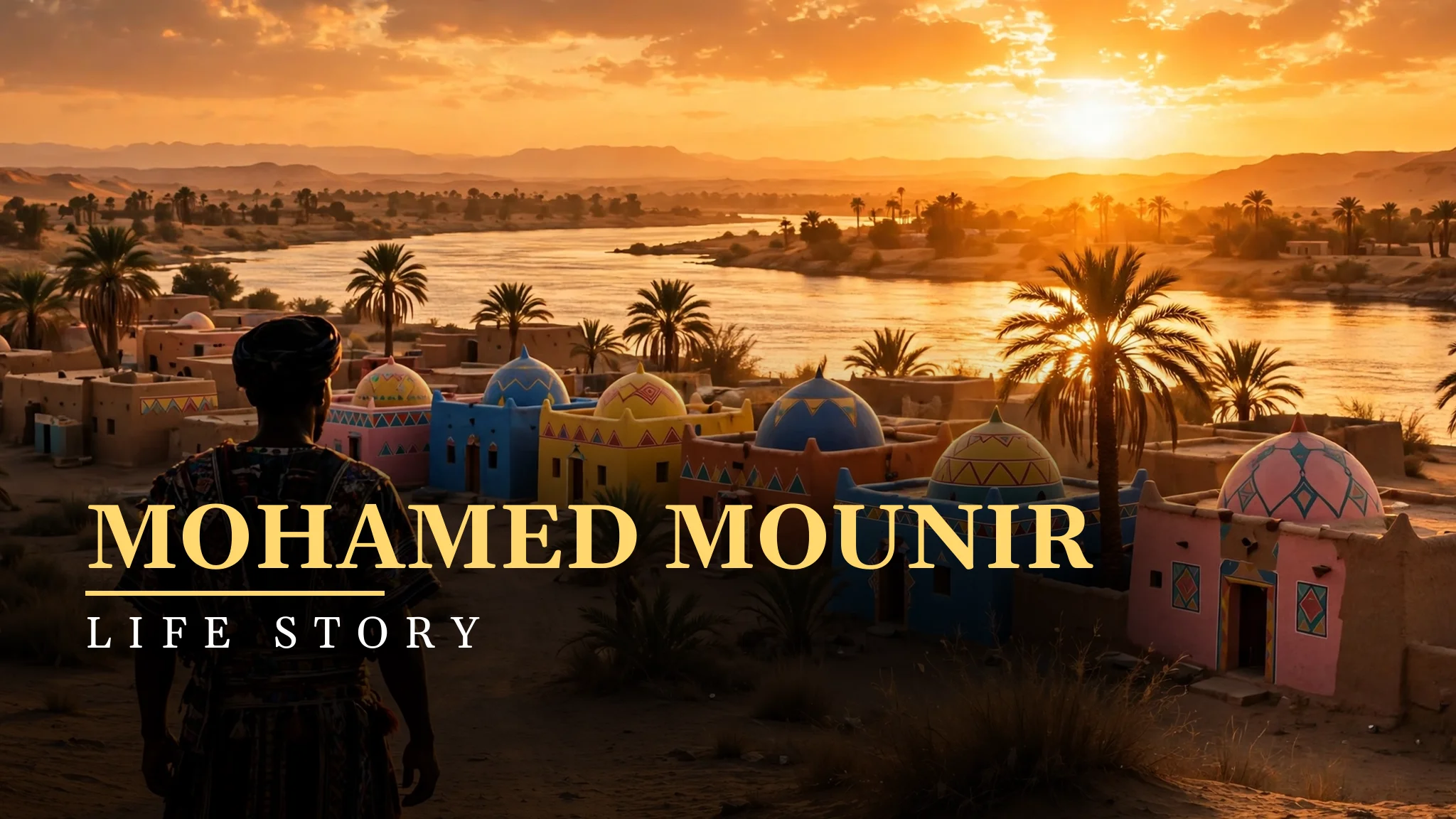
Mohamed Mounir was born on 10 October 1954 in Nubia, in the south of Egypt, near Aswan, in a family that belonged to one of the oldest peoples of the Nile valley. Nubia is a land with its own language, its own music, and its own way of life, older in many ways than the Egypt most people know from the pyramids and the museums. The people of Nubia lived in villages of brightly painted houses, with domed roofs and walls in blue, yellow, and pink, close to the river, close to the palm trees, and close to each other. A child growing up there learned music the way other children learn games, by hearing it at weddings, at festivals, and in the evenings when families gathered and sang.
His childhood was shaped by the river. The Nile in the south is wide and calm, and it gives life to everything around it. The boats, the fishermen, the farmers, and the children who swim in its waters all belong to its rhythm. Mounir grew up inside that rhythm, and it stayed in his music. Even his fastest songs have a flowing quality, as if the river were moving underneath the beat. His voice, warm and a little rough, sounds like a person who has spent his life close to the sun and the water, and that sound is part of why listeners trust him.
When he was still a young boy, his family, like many Nubian families, had to leave their old village because of the building of the Aswan High Dam. The dam was a great project for Egypt, bringing power and water to the whole country, but for the people of Nubia it meant leaving the land where their families had lived for generations. The old villages were flooded, and new villages were built. Mounir’s family moved, and the boy carried the memory of the old home with him. That memory would become the deepest source of his songs. He would sing, for the rest of his life, about a home that was lost and a people who kept their pride.
The move also brought him closer to the wider world. His family settled in a new place, and the young Mounir grew up between two worlds. He spoke the Nubian language at home, and he learned Arabic at school and in the world outside. He heard Nubian songs at family gatherings, and he heard Egyptian radio, and later Western music, in the streets and in the shops. That double hearing gave him an ear that could take in many kinds of music at once. He did not have to choose between Nubia and the modern world. He could carry both, and he did.
From Aswan to Cairo With a Guitar and a Dream
As a young man, Mounir moved to Cairo, the great city where Egyptian music is made, and he began to find his way as a singer. Cairo in the 1970s was a city of change. The old classical singers were still loved, but new sounds were coming in, from the West and from the streets of Egypt itself. Young people wanted music that spoke to their lives, music that was fresh, honest, and different. Mounir arrived with a voice that was different, and with songs that came from a place most Cairo singers had never been. He was not a copy of anyone. He was himself, and that was his strength.
He began performing, and people noticed. His voice was not smooth in the usual pop way. It was warm, deep, and full of feeling, and it carried the rhythms of Nubia in a way that made listeners want to move. He played with musicians who understood his sound, and he began to build a small audience, then a bigger one. A singer’s first years in a big city are hard. There are many singers, many studios, and many people who promise help and then disappear. Mounir kept singing, kept learning, and kept trusting the sound that came from his own roots.
His first album, Alemony Eneeki, came in 1977, and it announced a new voice in Egyptian music. The album was not a copy of the pop of the time. It had Nubian rhythms, modern instruments, and words that spoke of love and of home in a fresh way. Listeners who had never heard Nubian music in a pop album heard it for the first time, and many of them loved it. The album did not make him a star overnight, but it gave him a place. He was now a recording artist, and his name was known to people who followed Egyptian music closely.
In those early years he also learned the craft of the studio. A recording studio is a place where a singer must be precise. A song can be sung many times, and each time the singer must find the feeling again. Mounir learned to do that, and he learned to work with producers and musicians who could help him shape his sound. He also learned that a career is not built on one album. It is built on many, and on the patience to keep going when the first success is small. He had that patience, and it carried him through the years that followed.
Shababik and the Sound No One Else Had
In the years that followed his first album, Mounir released more records, and his sound grew clearer and stronger. He mixed Nubian music with jazz, with reggae, and with the pop sounds of the time, and he created a style that listeners recognised at once. His songs had a rhythm that made people dance, and words that made people think, and a voice that made people feel. That combination is rare, and it is why his audience grew beyond Nubia and beyond the south. People in Cairo, in Alexandria, and in the cities of the Arab world began to listen, and they began to love a sound they had never heard before.
One of the songs that many fans remember is Shababik, a song whose title means windows, and whose music opens like a window onto a wider world. The song has a gentle, flowing feel, and Mounir sings it with a warmth that makes the listener feel as if he is telling a personal story. Songs like that do not need a loud chorus to be remembered. They are remembered because they feel true, and because the singer believes every word. Mounir has many songs of that kind, songs that people play when they are thinking about home, about love, and about the years that have passed.
He also became known for his live performances. A Mounir concert is not a quiet evening. It is a celebration, with drums, with dancing, and with an audience that sings along to every word. He has a way of holding a crowd that comes from years of performing, and from a deep love of the people who come to hear him. He does not stand far from his audience. He reaches out to them, and they reach back, and the concert becomes a shared joy. That live energy is a big part of his fame, and it is why his concerts have stayed full for decades.
During the 1980s, his name grew, and he became one of the most distinctive voices in Egypt. He was not the singer with the most albums, and he was not the singer with the most hits on the radio. But he was the singer with the sound no one else had, and in a crowded music world, that is a precious thing. People who loved his music loved it deeply, and they stayed loyal. They bought his albums, they came to his concerts, and they taught their children his songs. That loyalty, built slowly, became the foundation of a career that would last for nearly fifty years.
The Destiny, Film, and a Wider Stage
Mounir was not only a singer. He was also an actor, and his film work brought him to audiences who might not have followed his music. His most famous film role came in The Destiny, known in Arabic as Al-Massir, directed by the great Egyptian director Youssef Chahine and released in 1997. The film told the story of the philosopher Ibn Rushd, known in the West as Averroes, and it was a grand, serious work about ideas, faith, and the freedom to think. Mounir played a singer in the film, a role that suited him, and he sang in it as well, and his presence gave the film a warmth that matched its serious subject.
Working with Chahine was a great honour, and it was also a great lesson. Chahine was a director who demanded the best from his actors, and who believed that film could change the way people think. Mounir learned from him that art is not only entertainment. It can also be a way of asking hard questions, and of speaking about the world in a serious way. The film was shown at festivals and in cinemas, and it brought Mounir’s name to a wider, more serious audience, people who might not have come to a pop concert but who respected a film by Chahine.
He took other film and television roles over the years, and each one added a different colour to his career. Acting taught him things that singing alone could not teach. An actor must listen, must wait, must react to other people, and must hold a character for weeks of filming. Mounir brought that listening to his music as well. His songs became more like stories, with characters, with feeling, and with a sense of place. The singer who had acted became a better storyteller, and the storyteller became a better singer.
Film also gave him a way to speak about Nubia and about Egypt in a visual way. A song can describe a village. A film can show it. When Mounir appeared on screen, audiences saw a face from the south, a face that looked like the people of Nubia, and that seeing mattered. In a country where the south is often far from the centre, a face from the south on the big screen is a kind of recognition. Mounir gave that recognition to his people, and they were proud of him for it.
The King in the Nineties and the New Century
The 1990s and the early 2000s were strong years for Mounir. He released albums that kept his sound fresh, he performed in Egypt and abroad, and his name became known to Arab audiences far beyond Egypt. He sang for Egyptians living abroad, for people who missed home and who found a piece of home in his voice. For an Egyptian living in Paris, in London, or in the Gulf, a Mounir song could bring back the smell of the Nile, the sound of a wedding, and the memory of a village. That power, to carry home in a song, is one of the greatest things a singer can do, and Mounir did it for millions of people.
He also became a voice for the young. His rhythms were modern, his words were plain, and his concerts were full of energy. Young Egyptians who might not have listened to old classical music found in Mounir a singer who spoke their language, who understood their lives, and who gave them music to dance to. He was not a singer of the past. He was a singer of the present, and his present kept changing, year by year, as Egypt itself changed. That ability to stay present, to stay close to the young, is why his concerts have always had listeners of every age.
The new century brought new challenges. The music business changed, with downloads and streaming, and many older singers found it hard to reach their audiences. Mounir kept reaching them, because his audience was loyal and because his concerts were still full. He also kept recording, and his later albums showed that he had not lost his ear. He worked with younger musicians, he tried new sounds, and he kept the Nubian heart of his music beating. A singer who keeps learning from the young does not grow old in his art. He grows with his art, and Mounir grew.
He was also a public figure in a wider sense. He spoke about Nubia, about the people of the south, and about the need to remember their history. He did not speak as a politician. He spoke as a singer, and as a son of Nubia, and his words carried weight because they came from a life lived close to the people he spoke about. When a famous singer speaks about his home, people listen, and Mounir used that listening well. He reminded Egypt that Nubia is part of its soul, and that the songs of Nubia are part of its music.
Hard Times, Health, and the Will to Keep Singing
A long career is never free of hard times, and Mounir’s life has had its share. The music business has its pressures, the body grows older, and the voice that once came easily can need more care. In later years, Mounir faced health problems, and there were times when he had to step back from performing to rest and to recover. For a singer whose life is the stage, stepping back is hard. The stage is where he feels most alive, and the audience is where he feels most at home. To leave it, even for a while, is a kind of loss.
He faced those hard times with the same steadiness he had shown since his youth. He rested when he needed to rest, he returned when he was ready, and he did not pretend that the hard times had not happened. His fans, who had followed him for decades, understood. They waited for him, and when he returned to the stage, they welcomed him with a warmth that showed how deeply he was loved. A singer who has given so much to his audience receives that love back when he needs it most, and Mounir received it.
There were also the ordinary hard parts of a life in the public eye. Fame brings attention, and attention brings opinions, and a singer who speaks plainly can find himself in the middle of arguments he did not seek. Mounir has spoken at times about his views, about his people, and about his country, and his words have been heard and debated. He has kept his dignity through those debates, and he has kept his focus on his music. A singer’s first job is to sing, and Mounir has never forgotten that.
The passing of time also brought loss. Friends, fellow musicians, and people from his early years have gone, and the world of his youth has changed. The villages of his childhood are not the same, the Cairo of the 1970s is not the same, and the music business is not the same. Mounir has carried those changes in his songs, and he has sung about them with an honesty that younger singers cannot copy, because it comes from a life fully lived. That honesty is one reason his later work feels so true.
What El King Means to Egypt Today
Today, Mohamed Mounir is more than a singer. He is a symbol of Nubia, a symbol of the south, and a symbol of an Egypt that is wider and richer than the capital alone. When people call him El King, they are not only praising his voice. They are praising a life, a history, and a people. They are saying that a boy from Nubia, whose family lost its old village, could become one of the most loved singers in the whole country, and that his songs could carry the memory of his people into every home in Egypt.
His music is taught to young singers, played at weddings, sung in cars, and loved by people who were not born when he released his first album. That is the mark of a true legacy. A song that is only popular for a season is a hit. A song that is still sung fifty years later is a part of a country’s soul. Mounir has many such songs, and they will be sung long after he has left the stage.
He is still performing, still singing, and still carrying the sound of Nubia to new audiences. His story is not finished, and his voice, warm and deep, continues to remind Egypt of its river, its south, and its people. The King is still singing, and as long as he sings, Nubia sings with him.
The title El King, the King, is not a nickname that was given to him by a company. It was given to him by the people, because he sang for them, and because he carried the pride of Nubia in his voice. A king in music is not a man who rules, but a man who serves his people with his art, and Mounir has served Nubia and Egypt with his songs for nearly fifty years, in Cairo, in Aswan, and on stages around the world, and his people have crowned him with a title that no chart can give.
My Take:
When I think about Mohamed Mounir, I do not think first of a pop star. I think of a river. The Nile runs through his whole story, through his childhood in Nubia, through the villages that were lost to the dam, through the songs that carry the sound of the south, and through the voice that has flowed through Egyptian life for nearly fifty years. A river does not hurry, and it does not stop. It keeps moving, year after year, and it gives life to everything it touches. That is how Mounir’s music feels to me. It keeps moving, it keeps giving, and it never loses its source.
What I admire most about him is that he never hid where he came from. Many singers from a small place, from a minority, from a village far from the capital, learn to hide their roots to fit in. They change their accent, they change their songs, and they pretend to be from the centre. Mounir did the opposite. He brought Nubia with him to Cairo, onto the stage, and into the studio, and he made the centre listen to the south. That takes a rare kind of courage, because it means standing in front of a big audience and saying, this is who I am, and this is where my music comes from. He said it, and the audience loved him for it.
I also admire the way he mixes sounds. His music is Nubian, and it is also jazz, and it is also reggae, and it is also modern Egyptian pop, and somehow all of those sounds live together in one song without fighting each other. That mixing is not an accident. It is the work of a musician who has listened widely, who has travelled, and who has learned that music is a language with many dialects. A singer who can mix those dialects without losing his own voice is a true artist, and Mounir is that artist. His songs do not sound like a copy of anyone. They sound like him, and only like him.
His story about the lost villages moves me deeply. I think about a boy who had to leave the land where his family had lived for generations, because a great dam was built for the good of the country, and I think about how that boy carried the memory of that land for the rest of his life. He did not carry it as anger alone. He carried it as music, as pride, and as a reminder to the whole country that Nubia matters. That is a beautiful way to carry a loss. Many people who lose a home become bitter, and they never recover. Mounir turned his loss into songs that millions of people love, and in doing so he kept his home alive. The villages may be under water, but the songs are not. They are still sung, and as long as they are sung, the villages live.
I think about his concerts, and about the joy in them. A Mounir concert is not a quiet, polite evening. It is a celebration, with drums, with dancing, with an audience that knows every word. I have seen clips of his concerts, and I have felt the energy even through a screen. People of every age, young and old, stand together and sing, and for a few hours they are one family. That is a rare gift. A singer who can bring strangers together in joy is doing something that politics and speeches cannot do. He is reminding people that they belong to each other, and that music can hold them together.
His film work, especially in The Destiny, shows another side of him. He was willing to be part of a serious film about ideas, about a philosopher who was punished for thinking freely, and he brought his voice to a story that was bigger than pop music. That tells me that Mounir is not only an entertainer. He is a thinker, a person who cares about ideas, about freedom, and about the right to speak. A singer who can move from a pop concert to a film by Youssef Chahine, and be at home in both, is a singer with a wide soul, and I respect that width.
I also think about the name El King, and about what it means. A king in a palace rules by power. A king in music rules by love. Mounir rules by love. His audience gave him that name, and they gave it freely, because they love his voice, his songs, and his story. That kind of kingship is earned, not inherited, and it is earned over decades, by showing up, by singing well, and by staying true to your people. I think that is a better kind of crown than any palace could give, and I think Mounir wears it with a humility that makes it even more fitting.
If I am honest, I do not love every song he has made. Some of his later work feels less fresh than his early albums, and some of his songs repeat a sound he has used before. That is a normal thing in a career that has lasted for nearly fifty years. No singer can be new in every song. But I do think that his best work, the work from his early years and from his strongest albums, is so good that it carries the whole career. A singer needs a few great songs to be remembered, and Mounir has more than a few. He has a whole body of work that belongs to Egypt, and that is enough.
I also wonder about the hard years, about his health, and about the times when he had to step back from the stage. I feel sympathy for him, because a singer who loves the stage suffers when he cannot be on it. But I also see a strength in the way he returned. He did not pretend that nothing had happened. He came back, he sang, and his audience welcomed him. That return is a lesson for all of us. A setback is not the end of a story. It is a chapter, and the next chapter can still be good, if the person has the will to write it. Mounir wrote that next chapter, and he is still writing it.
What I learn from his life is that roots are not a weight. They are a source of strength. Many people think that to succeed, you must leave your home behind, forget your language, and become like everyone else in the big city. Mounir proves the opposite. He succeeded because he kept his roots, because he sang in the sound of his home, and because he let his home speak through him. A young person from a village, from a small town, from a minority, can learn from that. Your home is not something to be ashamed of. It is the thing that makes your voice different, and your difference is your gift.
I also learn from him that a long career is built on loyalty, on both sides. He was loyal to his audience, and his audience was loyal to him. He did not chase every trend, and he did not abandon his sound when fashion changed. His audience, in return, did not abandon him when new singers arrived. They stayed, they came to his concerts, and they taught their children his songs. That mutual loyalty is the heart of a lasting career, and it is a heart that beats in Mounir’s story.
When I think of Egypt, I think of many things, of the pyramids, of Cairo, of the sea at Alexandria, and of the Nile. But I also think of a voice from the south, warm and deep, singing about windows, about home, and about love, and I think that voice belongs in that list. Mohamed Mounir is part of Egypt’s soul, and his songs are part of the country’s memory. I hope he keeps singing, because as long as he sings, the river keeps flowing, Nubia keeps singing, and Egypt remembers where it came from.
I will carry one image with me from his story, and it is the image of a boy by the Nile, listening to the songs of his village, not knowing that those songs would one day travel across a whole country. That boy listened well, and he learned well, and he gave what he learned back to the world. That is the work of a true singer, and it is the work that Mohamed Mounir has done for nearly fifty years. I am grateful for it, and I think millions of listeners are grateful too.
I also want to say something about the way his music makes me feel about home itself. Home is not only a house or a village. It is a sound, a smell, a rhythm, and a voice that says you belong. Mounir’s songs carry that feeling of home to people who are far from home, to Egyptians living abroad, to Nubians living in new villages, and to anyone who has ever missed a place they loved. When I listen to him, I feel that pull of home, even though I have never lived in Nubia, and I think that is the mark of a great singer. He can make a stranger feel at home in a place he has never been, and he can make a person who has lost a home feel that it is still alive in a song.
There is a lesson in his life about pride that I want to remember. Pride is not about looking down on others. It is about standing tall in who you are, about loving your language, your music, and your people, and about refusing to hide them to please a crowd. Mounir stood tall, and his audience stood taller because of him. Young Nubians who saw him on stage saw a man who looked like them, who sang like them, and who was loved by a whole country, and that seeing changed what they thought was possible for their own lives. That is a gift that goes far beyond music, and it is a gift that will keep giving long after the last note of his last concert has faded.
Finally, I think about time, and about how few singers can hold an audience for fifty years. Most careers are measured in seasons. Mounir’s career is measured in generations. Grandparents, parents, and children have all danced to his songs, and they have all found something different in them, because the songs grow with the listener. A child hears the rhythm. A young person hears the love. An older person hears the memory of home. That is a rare kind of music, and it is why I believe his name will still be sung in Egypt long after he has left the stage. The King earned his crown one song at a time, and he wears it still, warm, deep, and true. When I listen to his voice now, I hear not only a singer, but a whole people, a whole river, and a whole history, and I feel grateful that such a voice was given to Egypt, and to the world. I also feel a quiet hope, because a voice like his does not belong to one season. It belongs to the river itself, which keeps flowing long after any one singer has gone, and which carries every song it has ever heard into the future. Mounir gave his songs to that river, and the river will carry them, and the people who live beside it will keep singing them, in Nubia, in Cairo, and wherever Egyptians make a home. That is the deepest lesson of his life for me. A person who loves his home truly does not lose it when he leaves it. He carries it in his voice, and he gives it to others, and it lives again in every listener who hears it. I think of the Nubian villages, of the painted houses, of the river, and of the songs that were sung there long before Mounir was born, and I feel grateful that one boy listened well enough to carry them to the whole world. His voice is a bridge between the old Nubia and the new Egypt, and as long as that bridge stands, the two worlds will not be apart.
Frequently Asked Questions
When and where was Mohamed Mounir born?
Mohamed Mounir was born on 10 October 1954 in Nubia, in the south of Egypt near Aswan. He grew up in a Nubian family, and his people had to move when the Aswan High Dam flooded old villages.
Why is Mohamed Mounir called El King?
His fans call him El King, meaning the King, because of his long career and his loved place in Egyptian music. The name was given by his audience, and it reflects the deep loyalty he has earned over nearly fifty years.
What was Mohamed Mounir’s first album?
His first album was Alemony Eneeki, released in 1977. It introduced his Nubian sound to Egyptian pop, and it marked the start of a recording career that has lasted for decades.
What is one of Mohamed Mounir’s best-known songs?
Shababik is among his best-known songs, loved for its gentle flow and warm singing. He has many other beloved songs, and his concerts are known for audiences singing along to almost every word.
Did Mohamed Mounir act in films?
Yes, he acted in films, most famously in The Destiny, known in Arabic as Al-Massir, directed by Youssef Chahine and released in 1997. He played a singer in the film, and he also sang in it.
How does Mohamed Mounir’s Nubian background shape his music?
His Nubian roots give his music its rhythms, its colours, and its feeling of home. He mixes Nubian sounds with jazz, reggae, and modern Egyptian pop, creating a style that belongs to no other singer.


