Mohamed Ramadan: The Life Story Behind Egypt's Star
In this post
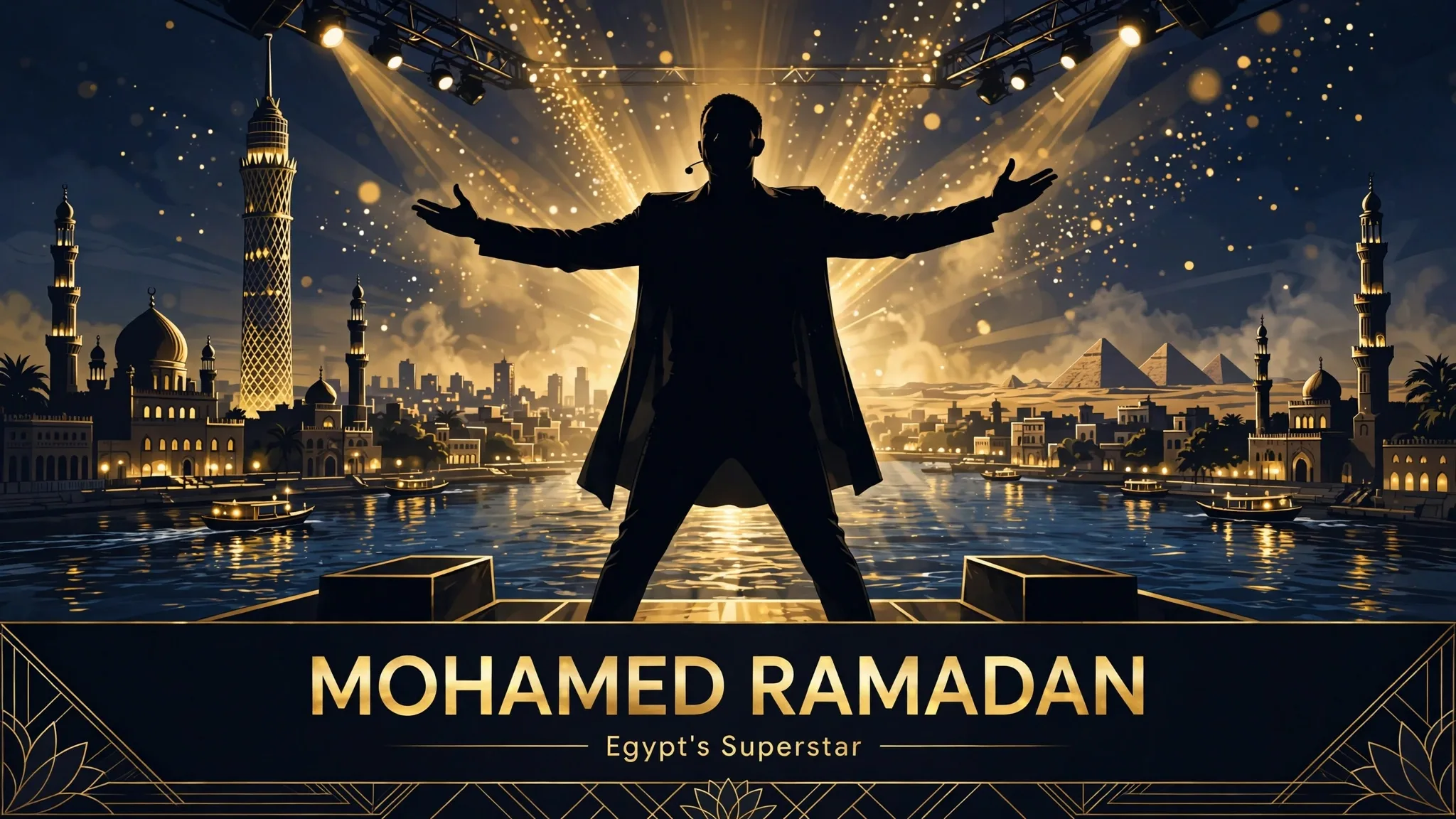
Mohamed Ramadan is the most talked-about entertainer in Egypt, and his story is one of ambition, talent, controversy and an extraordinary rise from a modest background to the top of Arab entertainment. Born on 23 May 1988 in Giza, Egypt, he grew up in a working-class neighbourhood, began acting as a teenager, and became, within a decade, the biggest box-office star in Egyptian cinema, a television phenomenon, and a music sensation whose songs are played across the Arab world. His series El Ostoura became a cultural event, his films broke records, and his music videos, with their bold style and lavish production, made him a social media superstar. What makes his story compelling is not only the scale of his success but the way he achieved it, by playing characters who reflected the lives of ordinary Egyptians, by embracing a larger-than-life persona, and by refusing to apologise for his ambition. He is admired by millions and criticised by many, and that polarisation is part of what makes him fascinating. This is the story of how a boy from Giza became the king of Egyptian entertainment, and what his journey says about fame, ambition and the changing face of Arab stardom.
Growing Up in Giza
Mohamed Ramadan was born on 23 May 1988 in Giza, Egypt, a city that sits across the Nile from Cairo and is home to the pyramids, and he grew up in a working-class neighbourhood where life was shaped by family, community and the everyday struggles of ordinary Egyptians. His family was modest, and his childhood was not one of privilege, but of hard work, of close family ties, and of a determination to make something of himself. He attended school in Giza, where he was a bright and energetic student, and he showed an early interest in acting, performing in school plays and activities that let him express himself. He was drawn to the stage from a young age, and his talent was noticed by teachers and by those around him, who encouraged him to pursue it. His childhood in Giza gave him a deep understanding of the lives of ordinary Egyptians, an understanding that would later shape the characters he played and the stories he told. He knew the streets, the markets, the humour and the hardships of working-class life, and that knowledge gave his performances an authenticity that audiences recognised. He was not a privileged child who became an actor; he was a boy from Giza who dreamed of a bigger life, and who worked to make that dream real. His family supported his ambitions, and his mother in particular encouraged him, believing in his talent even when the path ahead was uncertain. The boy from Giza who loved to perform was on the verge of a career that would take him to the top of Egyptian entertainment.
His early years in the industry were spent in small roles that taught him the craft of acting from the ground up. He began appearing in television series and films as a teenager, taking on supporting roles that gave him experience and taught him how a set operates. He appeared in the series and films of the mid-2000s, learning to work with experienced actors, to take direction, and to handle the demands of a professional production. These were not glamorous jobs, but they were an education, and Ramadan treated them as one, studying the actors around him, learning their techniques, and absorbing the rhythms of Egyptian cinema and television. His talent was evident early, and casting directors began to notice a young actor who could convey emotion, who had a natural screen presence, and who was willing to work hard. He also learned the importance of professionalism, arriving on time, knowing his lines, and treating the crew with respect, qualities that directors remember when they are casting their next project. By the time he reached his early twenties, he was no longer a beginner but a young professional with years of experience, and that experience gave him a confidence that set him apart. His childhood in Giza and his early years in the industry together formed a foundation of authenticity, discipline and ambition, and that foundation is the reason his later success felt earned rather than lucky.
Breaking Through in Egyptian Cinema
Mohamed Ramadan’s breakthrough came in the early 2010s, when he began taking on leading roles in Egyptian films that showcased his talent and his screen presence. He starred in films that dealt with the lives of ordinary Egyptians, playing characters who were tough, ambitious and determined, and his performances resonated with audiences who saw their own lives reflected on screen. His breakthrough film, El Almany in 2012, in which he played a young man from a working-class background who becomes involved in crime, was a box-office success and established him as a leading man. He followed it with films such as Abdo Mota, Qalb El Asad and El Diesel, each one a commercial success that drew large audiences across Egypt and the Arab world. His characters were often men from the streets, tough and resourceful, who fought for a better life, and his portrayal of those characters gave them a dignity and a complexity that audiences loved. He became known as a box-office star, a performer whose name on a poster could bring audiences into cinemas, and his films broke records in Egyptian cinema. His success was not only commercial; it was also cultural, because his films spoke to the experiences of young Egyptians, particularly those from working-class backgrounds, who saw in his characters a reflection of their own struggles and ambitions. The breakthrough years were the foundation of his career, and they proved that a young actor from Giza could become the biggest star in Egyptian cinema.
What made his breakthrough so powerful was the authenticity of his performances. He played characters who came from the same world he did, and he brought to those roles a knowledge of street life, of Egyptian humour, and of the resilience of ordinary people that could not be learned in an acting class. His films were not only entertainment; they were also a form of social commentary, showing the lives of Egyptians who are often overlooked by mainstream cinema, and giving them a hero who looked like them and spoke like them. His success also reflected a change in Egyptian cinema, which was beginning to tell stories about contemporary life, about young people, and about the challenges of a changing society, and Ramadan was at the centre of that change. He became a symbol of a new generation of Egyptian actors, one that was younger, bolder, and more connected to the streets than the stars who had come before. His films were criticised by some for their portrayal of violence, but they were loved by audiences who felt that they told the truth about their lives. The breakthrough was not only about box-office figures; it was about a young actor who gave a voice to a generation, and that voice is the reason his career has endured.
El Ostoura and Television Stardom
The series that made Mohamed Ramadan a television phenomenon was El Ostoura, which aired in 2016, a drama about a young man from a working-class background who becomes a powerful figure in his community. Ramadan played the lead role, and his performance was central to the series’ success, because the character needed to be both tough and sympathetic, both ambitious and vulnerable, and Ramadan found the balance. The series was a massive hit, with audiences across Egypt and the Arab world following it every night, and it became a cultural event, with its dialogue, its characters and its story entering everyday conversation. El Ostoura was not only a ratings success; it was a phenomenon, a series that defined a moment in Egyptian television and that made Ramadan the most famous actor in the Arab world. He followed it with other successful series, including Nesr El Saeed and Zelzal, each one a hit that drew large audiences and that confirmed his status as the king of Egyptian television. His television work showed a different side of his talent from his films, because a series requires a performer to sustain a character over many episodes, to develop a story gradually, and to keep an audience engaged for weeks. Ramadan did that with a skill that won him awards and the admiration of critics, and his series became events that families watched together. The television years were the peak of his fame, and they made him a household name not only in Egypt but across the Arab world, from Saudi Arabia to Morocco, where his series are watched by millions.
What made El Ostoura so powerful was its story, which resonated with the experiences of ordinary Egyptians, and Ramadan’s performance, which gave that story a human face. He played a character who rises from poverty to power, and that journey, with its triumphs and its tragedies, mirrored the aspirations of many viewers. The series dealt with themes of family, loyalty, ambition and justice, and it asked its audience to think about the price of success and the meaning of honour. Ramadan’s portrayal was praised for its intensity, its emotional range, and its ability to convey both strength and vulnerability, and his work in the series earned him awards and the recognition of his peers. The series also showed his growth as an actor, because a leading role in a long-running drama requires a different kind of stamina from a film role, and Ramadan demonstrated that he could carry a series for an entire season. The success of El Ostoura and his later series made him the most bankable television star in Egypt, and it gave him a platform that he has used to build a career that spans film, television and music. The series remains the defining work of his television career, and no other role shows the qualities that made him a star quite so clearly: charisma, authenticity, and a deep connection to the audience.
Music, Social Media and a Superstar Persona
Alongside his acting, Mohamed Ramadan built a career as a music star, releasing songs and music videos that became hits across the Arab world. His music blends Egyptian pop with hip-hop and dance influences, and his songs, with their catchy melodies and bold lyrics, have been streamed hundreds of millions of times. His music videos are lavish productions, featuring luxury cars, private jets, and a lifestyle of wealth and success, and they have made him a social media superstar, with tens of millions of followers across Instagram, YouTube and other platforms. His persona as a music star is larger than life, a celebration of success, ambition and the rewards of hard work, and his fans respond to that persona with enthusiasm. His songs have become anthems for young Arabs who dream of a better life, and his concerts draw large and passionate audiences. The music career is not a side project; it is a central part of his identity as an entertainer, and it has given him a creative outlet that acting does not provide. He has also used his music to express his views, to celebrate his success, and to connect with his audience in a direct and personal way. His social media presence is one of the largest of any Arab celebrity, and his posts, which showcase his lifestyle, his work, and his family, reach millions of people every day. The combination of acting, music and social media has made him a complete entertainer, and it is the reason his fame extends far beyond Egypt.
His superstar persona has also made him a controversial figure, because his celebration of wealth and success has been criticised by some as excessive, and his public statements have sometimes sparked debate. He has been involved in controversies, including disputes with other artists and public figures, and his outspoken nature has made him a polarising figure in Egyptian entertainment. Yet the controversies have not diminished his popularity; if anything, they have increased it, because his fans see in his defiance a reflection of their own frustrations and their own ambitions. He has also used his platform to support causes, to speak about his background, and to inspire young Egyptians who come from modest circumstances. His persona is a deliberate creation, a larger-than-life character that he has built over years, and it is a central part of his brand. The music, the videos, and the social media presence are all part of that brand, and they have made him one of the most recognisable figures in the Arab world. His career is a case study in how a modern star is built, not only through talent but through image, through social media, and through a persona that captures the imagination of an audience. Whether admired or criticised, Mohamed Ramadan is impossible to ignore, and that is a form of success in itself.
Controversy, Criticism and Resilience
Mohamed Ramadan’s career has been marked by controversy as well as success, and that controversy is an important part of his story. He has been criticised for the portrayal of violence in his films, for the extravagance of his lifestyle, and for public statements and disputes that have made headlines in Egyptian media. He has faced legal issues, including a well-publicised case involving a pilot, and he has been the subject of debates about the influence of his work on young people. The criticism has come from many quarters, including other artists, journalists, and public figures, who have questioned whether his films glorify crime and whether his persona sets a bad example. Ramadan has responded to the criticism with defiance, refusing to apologise for his success and insisting that his work reflects the reality of Egyptian life. His resilience in the face of criticism is notable, because many performers would have been damaged by the controversies he has faced, but Ramadan has continued to work, to release music, and to star in films and series that draw large audiences. His fans have remained loyal, seeing in his defiance a strength that they admire, and his box-office success has continued despite the criticism. The controversies have also made him a more interesting figure, because they have forced a conversation about the role of art, about the responsibility of a star, and about the line between entertainment and social influence. His career is a reminder that fame is rarely simple, and that a star who provokes strong reactions, both positive and negative, is a star who matters.
The way he has handled criticism also reveals a resilience that is central to his character. He has not retreated from public life, he has not stopped working, and he has not changed his persona to please his critics. Instead, he has continued to make the work he believes in, to speak his mind, and to trust his audience to judge him. That confidence is a form of strength, and it is one that his fans recognise and reward. He has also shown a willingness to learn from his mistakes, to apologise when necessary, and to move forward, and that maturity has helped him navigate the controversies that have marked his career. The criticism has not defined him; his work has, and his work continues to draw audiences who value his talent and his authenticity. His story is a reminder that a career in entertainment is not only about talent but about resilience, about the ability to withstand criticism and to keep going, and that the performers who last are often the ones who are most resilient. Mohamed Ramadan has shown that resilience, and it is the reason he remains at the top of Egyptian entertainment despite the controversies that have surrounded him.
Legacy, Influence and the Future
Mohamed Ramadan’s legacy is still being written, but it already includes achievements that few performers in Arab entertainment can match. He is the biggest box-office star in Egyptian cinema, the most popular television actor in the Arab world, and a music sensation whose songs are played across the region. His influence extends beyond his own work, because he has shown young Egyptians that it is possible to come from a working-class background and to become a star, and that ambition, talent and hard work can change a life. He has also changed Egyptian entertainment, bringing a new energy, a new style, and a new connection to the streets that has influenced a generation of performers. His films and series have become part of the cultural fabric of Egypt, quoted, discussed, and remembered by audiences who see their own lives in his stories. His music has become the soundtrack of a generation, played at weddings, in cars, and on social media across the Arab world. His legacy is not only about his success; it is about the way he has represented a new Egypt, young, ambitious, and unafraid to dream big. He has become a symbol of that Egypt, and his life shows how talent and determination can carry a person beyond humble beginnings and into the centre of a nation’s culture.
As he moves forward, Mohamed Ramadan’s career continues to evolve, with new films, new series, new music, and a public profile that remains strong. He has shown that a performer can build a career that spans multiple mediums, and that a star who is willing to take risks, to embrace controversy, and to stay true to his audience can last. His future is likely to include more international work, more collaborations, and more opportunities to showcase his talent to a global audience. The challenge for him will be to keep growing as an artist, to take on roles that show different sides of his talent, and to balance the demands of fame with the need for personal growth. He has already shown that he can handle the pressure of being the most famous entertainer in Egypt, and his ambition and his work rate suggest he will keep growing. Ramadan’s future is as unpredictable as his past, and that unpredictability is the core of his appeal. He has moved between film, television and music without ever settling into one lane, and his audience has followed him through every change. What happens next will depend on whether he can turn controversy into craft and fame into work that lasts, and the Egyptian entertainment industry will be watching to see if its biggest star can also become its most enduring one. The boy from Giza who became the king of Egyptian entertainment has written one of the most remarkable stories in Arab show business, and his journey is a reminder that ambition, when it is matched by talent and hard work, can take a person from a modest neighbourhood to the top of the world.
My Take:
When I think about Mohamed Ramadan, the first thing that strikes me is the scale of his ambition. He came from a working-class neighbourhood in Giza, and he became the biggest star in Egyptian entertainment, and he did it by refusing to accept the limits that others tried to place on him. That ambition is not a small thing; it is a force that drives a person to work harder, to take risks, and to keep going when others would stop. I think his story is valuable precisely because it shows that ambition, when it is matched by talent, can change a life, and that a boy from Giza can become a king, if he is willing to work for it.
What impresses me most about his acting is its authenticity. He plays characters who come from the same world he did, and he brings to those roles a knowledge of street life, of Egyptian humour, and of the resilience of ordinary people that cannot be learned in an acting class. His performances feel real because they are rooted in real experience, and audiences recognise that authenticity. I think that is the quality that separates a good actor from a star: a star asks the audience to admire them, but a good actor asks the audience to recognise themselves, and Ramadan has done the second thing throughout his career.
His series El Ostoura is the work that I think about most, because it became a cultural event, a series that families watched together and discussed the next day. That kind of shared experience is rare in television, and it is a testament to the power of a story that speaks to people’s lives. Ramadan’s performance in the series was central to its success, because he played a character who rises from poverty to power, and that journey resonated with viewers who dreamed of a similar rise. I think the series’ success shows that the best television is the kind that reflects the audience’s own hopes and fears, and Ramadan understood that better than almost anyone.
I also think about the controversy that surrounds him, because it is an important part of his story. He has been criticised for his films, for his lifestyle, and for his public statements, and some of that criticism is fair. But I also think that the controversy reflects a deeper tension, between an old Egypt and a new one, between traditional values and the ambitions of a young generation. Ramadan represents the new Egypt, young, bold, and unafraid to show its success, and that representation makes some people uncomfortable. I think his career is a mirror in which Egypt sees itself, and the reactions to him, both positive and negative, say as much about the country as they do about him.
His music career is another aspect of his work that deserves serious attention, because it shows a performer who understands the power of a song to connect with an audience. His music videos are lavish, his songs are catchy, and his persona as a music star is larger than life, and his fans respond to that with enthusiasm. I think his music matters because it gives young Arabs a soundtrack for their ambitions, a set of songs that celebrate success, hard work, and the dream of a better life. That is a valuable thing, even if the style is not to everyone’s taste, because music that inspires people to dream is music that matters.
The way he has handled criticism is also worth noting, because it shows a resilience that is central to his character. He has not retreated, he has not apologised for his success, and he has not changed his persona to please his critics. Instead, he has continued to work, to release music, and to star in films and series that draw large audiences. That confidence is a form of strength, and it is one that his fans recognise and reward. I think his example is important for anyone who faces criticism, because it shows that the best response to criticism is not to hide but to keep working, and to let the work speak for itself.
I also reflect on his influence on young Egyptians, because he has shown them that it is possible to come from a modest background and to become a star. That message is powerful, because it gives hope to young people who might otherwise believe that success is only for the privileged. Ramadan’s story is proof that talent, ambition and hard work can change a life, and that proof matters, even if his persona is controversial. Young people who look up to him see a person who started where they started, and who achieved what they dream of achieving, and that example is more valuable than any lecture.
His social media presence is another part of his career that I find fascinating, because it shows how stardom has changed. He has tens of millions of followers, and his posts reach an audience that spans the Arab world, and he uses that platform to share his work, his lifestyle, and his views. That direct connection with his audience is a new kind of fame, one that does not depend on traditional media, and Ramadan has mastered it. I think his example is important for understanding how entertainment works today, because the stars who succeed are the ones who can connect directly with their fans, and Ramadan does that better than almost anyone in the Arab world.
Looking at his filmography, I am struck by its consistency. He has played similar characters, men from the streets who fight for a better life, and some critics have said that he repeats himself. But I think there is a reason for that consistency: his audience loves those characters, because they see themselves in them, and Ramadan understands that connection. A performer who gives his audience what they want, while also giving them a performance of quality, is doing his job well. I think his films, for all their flaws, have a sincerity that comes from his own experience, and that sincerity is the reason they continue to draw audiences.
His story also makes me think about the changing face of Arab entertainment, because Ramadan represents a new generation of stars who are younger, bolder, and more connected to social media than the stars who came before. His success shows that the Arab entertainment industry is changing, that new voices are emerging, and that the audience is ready for stories that reflect contemporary life. I think his career is a sign of that change, and it is a change that will continue, as more young performers from working-class backgrounds find their way to the screen. Ramadan opened a door, and others will walk through it.
I also want to note the simple pleasure of his performances, because his films and series are entertaining in a way that few others are. They are exciting, they are dramatic, and they make audiences feel something, and that emotional connection is the reason they are so popular. In a world where so much entertainment is cynical or formulaic, a performer who can make an audience cheer, cry, and care is doing something valuable. Ramadan has done that for more than a decade, and his work continues to bring joy to millions of people. That is a gift, and it is one that deserves to be recognised, even by his critics.
Looking ahead, I am curious to see how Ramadan’s career develops, because he is still young, and the most interesting chapters may be ahead of him. He has already proven that he can dominate Egyptian cinema, television and music, and the next phase could include international work, more mature roles, or a new direction entirely. What I hope for him is that he continues to grow as an artist, because the performers who last are the ones who never stop challenging themselves. His story is still being written, and the chapters that come next will show whether he can build on his extraordinary success and become an even more complete artist.
One more thought on Ramadan is about the power of representation. He plays characters who come from the streets, who speak like ordinary Egyptians, and who fight for a better life, and that representation matters, because it gives a voice to people who are often overlooked. His films may be criticised, but they are also loved, because they tell the truth about a part of Egyptian life that mainstream cinema often ignores. I think that representation is the most valuable part of his legacy, because it shows that every life is worth telling, and that every person deserves a hero who looks like them.
His resilience is another quality that I admire, because he has faced criticism, legal issues, and public controversies, and he has continued to work. That ability to keep going, to not let setbacks define you, is a form of strength that is rare and valuable. Too many performers, when faced with criticism, retreat or disappear, but Ramadan has stayed, has worked, and has trusted his audience to judge him. I think that resilience is the reason he remains at the top, and it is a lesson for anyone who faces adversity: keep working, keep believing, and let the work speak for itself.
His influence on Arab music is another aspect of his career that deserves attention, because his songs have become anthems for a generation. They are played at weddings, in cars, and on social media across the Arab world, and they have given young Arabs a soundtrack for their ambitions. I think his music matters because it is joyful, it is bold, and it is unapologetically ambitious, and those qualities resonate with an audience that is also ambitious. A song that makes people feel proud, that makes them want to dance, and that makes them believe in their dreams is a song that has done its job, and Ramadan’s songs have done that for millions of people.
His story also makes me think about the relationship between fame and responsibility. Ramadan is one of the most famous people in the Arab world, and with that fame comes a responsibility to set an example, to use his platform wisely, and to think about the impact of his work. He has sometimes fallen short of that responsibility, and his critics are right to point that out, but he has also used his platform to inspire, to entertain, and to give hope to young people. I think the tension between fame and responsibility is one that every star faces, and Ramadan’s career is a case study in how difficult it is to navigate. His story is a reminder that fame is not only a privilege but a burden, and that the way a star carries that burden defines their legacy.
Finally, I think Mohamed Ramadan’s story is ultimately about ambition, and about the idea that a boy from Giza can become a king, if he is willing to work for it. His journey has not been easy, and it has not always been graceful, but it has been extraordinary, and it has changed Egyptian entertainment. His films, his series, and his music have given millions of people joy, hope, and a sense of recognition, and that is a legacy that will endure. For anyone who comes from a modest background and dreams of something bigger, his life is proof that the dream is achievable, and that the work of achieving it, however difficult, is worth every step.
One more reflection on Ramadan is about the honesty of his ambition. He has never hidden the fact that he wants to be the biggest, the richest, and the most famous, and that openness is refreshing in an industry where many stars pretend to be humble while chasing the same goals. His ambition is not a secret; it is his brand, and his fans love him for it, because they share the same dreams. I think there is a lesson in that honesty: wanting more is not a flaw, and a person who is clear about their ambitions is easier to understand, and easier to root for, than one who hides them.
Frequently Asked Questions
How old is Mohamed Ramadan?
Mohamed Ramadan was born on 23 May 1988, which makes him 38 years old in 2026. He was born in Giza, Egypt.
What is Mohamed Ramadan famous for?
Mohamed Ramadan is famous as Egypt’s biggest box-office star, for the series El Ostoura, and for his music career. His films and series are watched across the Arab world.
What is El Ostoura?
El Ostoura is a 2016 Egyptian television series starring Mohamed Ramadan as a young man from a working-class background who rises to power. It became a cultural phenomenon across Egypt and the Arab world.
Is Mohamed Ramadan a singer as well as an actor?
Yes, Mohamed Ramadan is also a music star, releasing songs and music videos that have been streamed hundreds of millions of times across the Arab world.
Why is Mohamed Ramadan controversial?
Mohamed Ramadan has faced criticism for the portrayal of violence in his films, for his lavish lifestyle, and for public disputes. He has remained popular despite the controversies, with a large and loyal fan base.
What is Mohamed Ramadan’s net worth?
No official figure for Mohamed Ramadan’s net worth has been published, and online estimates vary widely. His income has come from films, television, music and endorsements.


