Mohammad Reza Shajarian: The Life Story Behind Iran's Master of Song
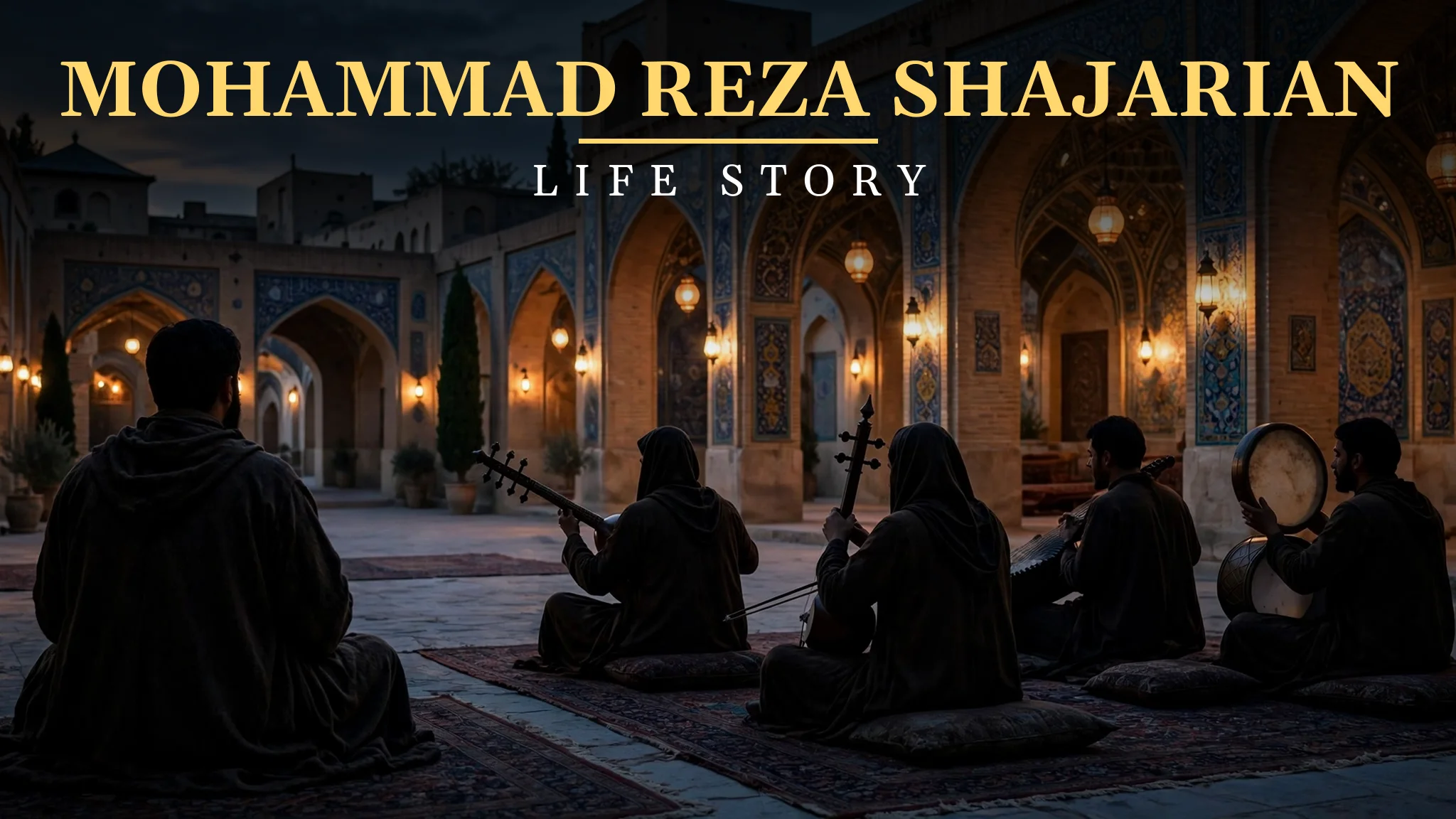
In this post
There are singers who are popular, and there are singers who are masters, and Mohammad Reza Shajarian was a master. He is remembered as the greatest singer in the history of Persian classical music, a man whose voice carried a tradition that is more than a thousand years old, and who gave that tradition to millions of people. His name is spoken in Iran with a respect that few artists ever earn, and his songs are played in homes, in cars, and in concert halls where people want to hear music that is serious, beautiful, and true. He was not a pop star. He was something rarer. He was a keeper of a culture, and his voice was the sound of that culture.
Shajarian was born in Mashhad, in northeastern Iran, on 23 September 1940, and he grew up in a family where the Quran was recited with beauty and with care. His father was a Quran reciter, and the boy learned to recite from him, developing a voice that was clear, strong, and full of feeling. He went on to study the radif, the system of melodies that is the foundation of Persian classical music, with the great masters of his time. He sang on the radio, he performed in concerts, and he became the most respected classical singer in Iran. His prayer, Rabbana, was broadcast during Ramadan for decades, and it became one of the most loved sounds in Iranian life. He died in Tehran on 8 October 2020, at the age of eighty, and his death was mourned by Iranians around the world.
What makes his story so powerful is the depth of his art and the dignity of his life. He did not chase fame, and he did not sing for money. He sang because he believed that Persian music mattered, and that it should be passed on to the next generation. He taught students, he founded an ensemble, and he worked with his son Homayoun, who has become a great singer in his own right. He also stood up for what he believed in, and he paid a price for it. His story is a story of music, but it is also a story of courage, and of a man who refused to let his art be used for purposes he did not believe in.
A Boy in Mashhad Who Learned to Recite
Mashhad, in the northeast of Iran, is a holy city, and Shajarian grew up in a home where religion and music were woven together. His father was a Quran reciter, and he recited the holy book with a voice that was beautiful and moving. The boy listened to his father, and he learned to recite, developing a voice that was clear and strong. He also learned that a voice is a gift, and that it should be used with care and with respect. That lesson stayed with him for his whole life, and it shaped the way he sang. He did not treat his voice as a tool for fame. He treated it as a trust, and he used it to serve the music he loved.
He began to study Persian classical music as a young man, learning the radif, the collection of melodies that is the foundation of the tradition. The radif is not an easy thing to learn. It contains hundreds of melodies, and a singer must memorise them all, and must learn how to move between them with grace. Shajarian studied with the great masters of his time, and he learned the radif deeply. He spent years practising, and he developed a voice that could handle the most difficult melodies with ease. That training was the foundation of everything that followed, and it made him a singer who could do things that few others could do.
His father did not always approve of his son’s interest in music, because in his view, singing was not a proper path for a religious family. Shajarian respected his father, but he could not give up music, and he found a way to follow both. He sang on the radio under the name Siavash Bidkani, a pseudonym that allowed him to perform without his father knowing at first. It was a small deception, but it was a necessary one, and it shows how much he wanted to sing. A young man who is willing to hide his name to sing is a young man who truly loves music, and Shajarian loved it with all his heart. In time, his father came to accept his son’s path, and the two men found a way to respect each other’s beliefs. That reconciliation mattered to Shajarian, because he loved his father, and he wanted his father’s blessing. He got it, in time, and it gave him peace.
He also learned to read and to understand poetry, because Persian classical music is built on the great poems of Iran, from Hafez and Rumi to Saadi and others. A classical singer must understand the poems he sings, and Shajarian studied them deeply. He learned their meanings, their rhythms, and their feelings, and he sang them with a understanding that made the words come alive. That is why his performances were so moving. He was not just singing notes. He was singing poetry, and he was giving the poems a voice. An audience that heard him sing Hafez felt that they were hearing the poem for the first time, even if they had known it for years. That is the gift of a great singer, and Shajarian had it in abundance.
His early years on the radio also taught him about the power of a voice to reach people. A radio singer cannot see his audience, and he must trust that his voice will carry the feeling across the airwaves. Shajarian learned to do that, and his voice became familiar to millions of Iranians who had never seen his face. They knew his voice, and they loved it, and they waited for his programmes. That connection, built through the radio, was the foundation of his fame, and it stayed with him for his whole career. He was a voice before he was a face, and that voice was enough.
The Radif and the Making of a Master
The radif is the heart of Persian classical music, and Shajarian became one of its greatest masters. He studied it for years, learning its melodies, its modes, and its rules, and he developed a deep understanding of how it works. He could sing a melody and then improvise on it, creating new variations that were beautiful and true to the tradition. That skill, called improvisation, is the mark of a great classical singer, and Shajarian was one of the best who ever lived. His concerts were not just performances of songs. They were journeys through the radif, and the audience followed him with wonder.
He also learned to play instruments, and he understood how the tar, the setar, and the other instruments of Persian music worked. He worked with the greatest instrumentalists in Iran, and together they made music that was both traditional and alive. He did not treat the tradition as a museum piece. He treated it as a living thing, and he brought new life to it with every performance. His concerts were long, and they were demanding, but the audience loved them, because they knew they were hearing something extraordinary. A master does not just repeat what he learned. He makes it new, and Shajarian made the radif new every time he sang it.
His voice was remarkable for its range, its power, and its control. He could sing high notes with strength, and he could sing low notes with warmth, and he could move between them without losing his breath. He could hold a note for a long time, and he could shape it so that it rose and fell like a wave. That control came from years of practice, and it showed in every performance. When he sang, the hall fell silent, because the audience knew they were hearing a voice that was doing something rare. He was not just singing. He was speaking to the soul, and the soul listened.
Radio, Concerts, and the Voice of a Nation
Shajarian began to sing on Iranian radio, and the radio gave him an audience across the whole country. Families gathered around the radio in the evening, and a singer who was played on the radio could become famous in a matter of weeks. Shajarian’s voice was perfect for the radio, because it was clear and strong, and it carried feeling even through a small speaker. He sang classical songs, and he sang them with a depth that made listeners stop and pay attention. He was not a pop singer. He was a classical singer, and his audience was made up of people who loved serious music. But his audience grew, because his voice was so beautiful that even people who did not know classical music could love it.
He also performed in concerts, and his concerts became major events. He sang in Tehran and in other Iranian cities, and his performances drew large crowds. He performed with an ensemble of musicians, and together they created evenings of music that were both traditional and moving. He wore simple clothes, he stood with dignity, and he sang with a focus that made the audience feel respected. He did not put on a show. He let the music speak, and the audience answered with applause and with tears. That dignity became part of his image, and his fans loved him for it.
His most loved work was Rabbana, a prayer that he recited and that was broadcast during Ramadan for decades. The prayer was played on television and on the radio at the time of breaking the fast, and it became one of the most familiar sounds in Iranian life. Families heard it every evening during Ramadan, and it became part of their memories of the holy month. Shajarian’s voice on Rabbana was gentle, beautiful, and full of feeling, and it touched people deeply. It was not a song. It was a prayer, and it was sung with a sincerity that made it sacred. For many Iranians, Rabbana is the sound of Ramadan itself, and it is inseparable from Shajarian’s voice.
The Shahnaz Ensemble and Teaching the Next Generation
Shajarian believed that Persian classical music should be passed on, and he worked hard to teach it to the next generation. He founded the Shahnaz Ensemble, a group of musicians who performed with him and who carried on the tradition of Persian music. The ensemble was named after a melody in the radif, and it became one of the most respected groups in Iranian music. He performed with the ensemble in Iran and abroad, and their concerts were praised by critics and by audiences. He was not just a singer. He was a teacher, and he took that role seriously.
He also worked with his son Homayoun, who has become a great singer in his own right. Homayoun learned from his father, and he sang with him in concerts, and the two voices together were a beautiful thing to hear. The father was the master, and the son was the student who became a master himself, and their partnership was a symbol of how tradition is passed on. Shajarian was proud of his son, and he encouraged him to find his own voice, while also teaching him the radif and the discipline it demands. That is the way a tradition survives, from father to son, from teacher to student, and Shajarian made sure that it would survive.
He taught many other students as well, and his influence can be heard in the work of younger classical singers who studied with him or who learned from his recordings. He was generous with his knowledge, and he believed that music should be shared, not hoarded. He gave masterclasses, he recorded albums that showed the radif in its full beauty, and he wrote about music. His recordings are now used as teaching materials, because they show how Persian classical music should be sung. A master who teaches is a master who lives on, and Shajarian lives on in the singers he taught and in the recordings he left behind.
2009, Protest, and the Silencing of Rabbana
In 2009, Iran went through a time of protest, after a disputed election, and Shajarian took a public stand. He spoke out in support of the people who were protesting, and he said that the government should listen to them. He also asked the state broadcaster not to play his Rabbana during Ramadan, because he did not want his prayer to be used by a government he believed was acting unjustly. It was a brave decision, because it meant that his most loved work would no longer be heard on television, and because it put him at odds with the authorities. But he believed that his art should not be used for purposes he did not believe in, and he acted on that belief.
The decision had consequences. His music was no longer played on state television and radio, and he was not invited to perform in the ways he had been before. But his audience did not leave him. They played his recordings at home, they shared them online, and they sang his songs themselves. His voice lived on in the homes of Iranians, even though it was no longer heard on the state broadcaster. That is a powerful thing. A government can ban a singer from the radio, but it cannot ban him from people’s hearts, and Shajarian’s music belonged to the people of Iran, even when it was not played on television.
His stand in 2009 made him a symbol for many Iranians, especially for young people who admired his courage. He was not a politician, and he did not seek power. He was a singer who believed that art and conscience go together, and who was willing to pay a price for that belief. He did not make a show of his protest. He spoke quietly, and he acted with dignity, and that dignity made his stand even more powerful. He showed that a great artist is not just a person who sings beautifully. He is a person who lives by his principles, and who is willing to lose something for them. That is a lesson that goes far beyond music.
The Last Years and a Death That Moved a Nation
Shajarian’s last years were marked by illness, and he spent a long time in hospital in Tehran. He was eighty years old, and his health was failing, but he remained a beloved figure, and Iranians followed news of his condition with love and with worry. When he died in Tehran on 8 October 2020, the news was met with grief across the country and around the world. People gathered outside the hospital, they sang his songs, and they wept. His death was not just the loss of a singer. It was the loss of a master, and of a voice that had been part of Iranian life for more than fifty years.
He was buried at the Tomb of Ferdowsi in Tus, near Mashhad, beside the great poet who wrote the Shahnameh, the epic of Iran. It was a fitting resting place for a man who had given his life to Persian culture, and thousands of people came to pay their respects. His funeral was a moment of national mourning, and it showed how deeply he was loved. He had been a singer, a teacher, and a symbol, and his death left a hole in Iranian music that has not been filled. But his recordings remain, and his students continue to sing, and his son Homayoun carries on his work. A master does not die when his body dies. He lives on in the music he made and in the people he taught.
His legacy is immense. He is remembered as the greatest singer in the history of Persian classical music, and his recordings are studied by students and loved by audiences. His Rabbana is still played during Ramadan, in homes and online, even though it is no longer broadcast on state television. His concerts are remembered as evenings of great beauty, and his teaching lives on in the singers he trained. He gave his life to Persian music, and Persian music will remember him for as long as it is sung. That is a legacy that few artists ever achieve, and it is one that deserves to be celebrated.
A Master Whose Voice Still Sings
Today, Shajarian’s voice is still heard every day in Iran and around the world. His recordings are played on the radio, they are shared on social media, and they are sung by students who are learning the radif. Young singers study his phrasing, his breathing, and his control, and they try to learn from the master. Older listeners keep his albums close, and they play them when they want to hear music that is serious and beautiful. His voice is the sound of Persian classical music, and it is a sound that has never been forgotten. He is gone, but his songs are still here, and they are still loved.
His son Homayoun has become one of the most popular singers in Iran, and he carries on his father’s work with his own voice. He sings classical songs, he performs in concerts, and he is loved by millions. The father and the son are a symbol of how tradition is passed on, and of how a great art can survive from one generation to the next. Shajarian would be proud of his son, and he would be proud that the music he loved is still being sung. That is the true measure of a master. He does not just make beautiful music. He makes sure that the music will go on after him, and Shajarian did that.
His story is still being told, and his fans believe that his voice will be heard for many generations to come. He showed that a singer can be a master, a teacher, and a man of principle, all at the same time. He showed that music is not just entertainment. It is a culture, a history, and a way of life, and it deserves to be treated with respect. Mohammad Reza Shajarian gave his life to that idea, and his life is an example for anyone who loves music and who believes that art matters. He is gone, but his voice remains, and it will remain for as long as Persian music is sung.
His concerts in Iran were also a part of his story, and they were occasions that people remembered for years. He would stand on a stage with his musicians, the tar and the santur beside him, and he would sing the radif with a voice that filled the hall. The audience listened in silence, because they knew they were hearing something rare, and when the last note faded, the hall would erupt. Those evenings were a reminder that classical music can move a crowd as deeply as any pop song, and they are a part of his legacy that his listeners will never forget.
My Take:
Mohammad Reza Shajarian’s story is the most serious story in this group, and I want to be honest about why it moves me so deeply. He was not a pop star. He was a master of Persian classical music, a man who spent his life learning a tradition that is more than a thousand years old, and who gave that tradition to millions of people. His voice was a gift, and he used it with a care and a dignity that few artists ever show. He did not chase fame, and he did not sing for money. He sang because he believed that Persian music mattered, and that it should be passed on. I think that is a beautiful way to live, and it is a way that I respect more than any other kind of fame.
I think about his father, a Quran reciter, and about how the boy learned to recite from him. That image stays with me, because it shows where his voice came from. It came from prayer, from a home where the holy book was recited with beauty, and from a father who taught his son that a voice is a trust. Shajarian carried that lesson for his whole life, and it shaped the way he sang. He did not treat his voice as a tool for fame. He treated it as something sacred, and he used it to serve the music he loved. I think that is a lesson for anyone who has a gift. A gift is not just for you. It is for the people who hear it, and it should be used with care.
His study of the radif impresses me as well, because it shows how seriously he took his craft. The radif contains hundreds of melodies, and a singer must memorise them all, and must learn how to move between them with grace. Shajarian studied it for years, and he became one of its greatest masters. That is not a small achievement. It is the result of decades of practice, of listening, and of learning from the masters who came before him. I think about the patience that takes, and I feel humble. We live in a time when people want everything fast, and Shajarian spent years learning a single tradition. That patience is rare, and it is beautiful, and it is why his music has such depth. A person who learns deeply will always do better work than a person who only learns the surface.
I also think about Rabbana, his prayer, and about what it meant to Iranians. It was played during Ramadan for decades, and it became one of the most familiar sounds in Iranian life. Families heard it every evening, and it became part of their memories of the holy month. When Shajarian asked the state broadcaster not to play it in 2009, he was giving up something precious, because he did not want his prayer to be used by a government he believed was acting unjustly. That is a brave decision, and it is one that I respect deeply. He could have stayed silent, and he could have kept his place on television, but he chose to speak, and he paid a price for it. That is what it means to live by your principles, and it is a lesson that goes far beyond music. I think about the times in my own life when I have stayed silent because speaking would cost me something, and I feel ashamed. Shajarian’s story reminds me that silence has a price too, and that sometimes the price of silence is higher than the price of speaking. He spoke, and he lost his place on television, but he kept his dignity, and his dignity is worth more than any broadcast.
His work as a teacher also moves me, because it shows that he understood something important. A master who does not teach will die with his knowledge, and his art will die with him. A master who teaches will live on in his students, and his art will survive. Shajarian taught, he founded an ensemble, and he worked with his son Homayoun, who has become a great singer in his own right. That is a beautiful thing, and it is the reason his music is still alive today. He did not just make beautiful recordings. He made sure that the tradition would go on, and that is a greater achievement than any single song. I hope young artists learn from that. Your work is not just for you. It is for the people who come after you, and you should teach them well. I think about the teachers in my own life, and about how much I owe them, and I realise that teaching is one of the most generous things a person can do. Shajarian gave his knowledge freely, and his students carry it with them, and they will pass it on to their own students. That chain of teaching is how a culture survives, and Shajarian was a vital link in it.
I think about his death in 2020, and about the grief that Iranians felt. People gathered outside the hospital, they sang his songs, and they wept. His funeral at the Tomb of Ferdowsi was attended by thousands, and it showed how deeply he was loved. He was buried beside the great poet who wrote the Shahnameh, and that is a fitting resting place for a man who gave his life to Persian culture. I was not there, but I can imagine the scene, and I feel sad that such a voice is gone. But I also feel grateful, because his recordings remain, and his students continue to sing, and his son carries on his work. A master does not die when his body dies. He lives on in the music he made and in the people he taught, and Shajarian lives on in both. I have listened to his recordings, and I have felt the beauty in them, and I know that they will be listened to for many years to come. That is a comfort, and it is a reminder that great art does not die. He did not just make beautiful recordings. I hope young artists learn from that. Your work is not just for you.
If I could meet him, I would not ask him about fame or about money. I would ask him about the radif, and about how he learned it. I would ask him about Rabbana, and about what it felt like to hear his prayer played in millions of homes during Ramadan. I would ask him about his son Homayoun, and about what it meant to teach him. I think his answers would be simple and wise, because he was a simple and wise man, and I think they would help a lot of young people who are trying to find their own way. His life says that a voice, a love of music, and the patience to learn are enough to begin, and that the rest comes one step at a time, over many years.
In the end, I believe Shajarian’s story is about a voice that carried a culture. He was a master of Persian classical music, and his voice was the sound of that music for more than fifty years. He taught, he performed, and he lived by his principles, and he left behind a legacy that will last for generations. I hope his voice is heard by people who were not alive when he died, because they deserve to hear it. It is one of the great voices of our time, and it is a voice that carried a thousand years of music in its sound. When I hear him sing, I do not just hear a song. I hear a man who gave his whole life to his art, and that is a gift that cannot be measured. I also hope that young singers who hear him will learn from his example, and that they will study the radif with the same patience and the same love. If they do, his voice will live on not just in recordings, but in the singers who follow him, and Persian music will continue to be sung for another thousand years. When I hear him sing, I do not just hear a song.
I want to say something about listening to Rabbana, because it is an experience that many Iranians share. During Ramadan, at the time of breaking the fast, families would hear his voice on the television, gentle and beautiful, reciting the prayer. It was a sound that meant the day was ending, that food was coming, and that the family was together. That sound is now part of the memory of Ramadan for millions of people, and it is inseparable from Shajarian’s voice. When he asked the broadcaster not to play it in 2009, he was giving up something precious, and he knew it. But he believed that a prayer should not be used for purposes he did not believe in, and he acted on that belief. I think about that decision, and I feel a deep respect for a man who would give up his most loved work for his principles. That is a rare kind of courage, and it is one that I will not forget.
I also think about his son Homayoun, and about what it means to carry on a father’s work. Homayoun learned from his father, he sang with him, and he has become a great singer in his own right. That is a beautiful thing, and it is the reason Shajarian’s music is still alive today. A father who teaches his son well does not just give him a skill. He gives him a tradition, and he trusts him to carry it forward. Shajarian did that, and Homayoun has honoured that trust. When I hear Homayoun sing, I hear his father in his voice, and I hear the radif living on in a new generation. That is how a culture survives, from father to son, from teacher to student, and Shajarian made sure that it would survive. His voice is gone, but his music is still here, and it will be here for as long as Persian music is sung.
I also want to say something about his voice itself, and about the way it moves, because there is a skill in it that is hard to describe. When Shajarian sings, his voice rises and falls in small, quick steps, a technique that Persian singers call tahrir, and it makes the melody shimmer like light on water. It is a difficult skill, and it takes years of practice to learn, and Shajarian learned it so well that it sounded effortless. I think about the young singers who try to copy that sound, and about how they discover that it cannot be copied. It must be learned, slowly, over a lifetime. When I hear it, I feel that I am hearing something ancient and beautiful, a sound that has been passed down through generations. That is the sound of Persian classical music at its finest, and Shajarian was its greatest voice.
His students are another part of his legacy that I want to mention, because Shajarian did not only sing. He taught, and he taught with the same care that he sang with. His students learned the radif from him, they learned the discipline of practice, and they learned that music is a serious art that deserves respect. I think about the classrooms where his students now teach, and about how his voice is still there, in the way they sing and in the way they listen. Those students are now teaching others, and the knowledge is passing from one generation to the next. That is how a tradition survives, not in books, but in the voices of living people, and Shajarian made sure that it would survive. His voice is gone, but his teaching lives on in every student who sings the radif today.
I also think about the silence that follows his songs, because when a Shajarian recording ends, the room often stays quiet for a moment. That silence is a part of the music, and it is a sign of how deeply his voice touches the listener. A singer who can leave a room in silence has done something rare, and Shajarian did it again and again. That is a gift, and it is one that his listeners will remember for the rest of their lives.
Frequently Asked Questions
When and where was Mohammad Reza Shajarian born?
Mohammad Reza Shajarian was born in Mashhad, Iran, on 23 September 1940. He grew up in a family where the Quran was recited, and his father was a Quran reciter. He learned to recite as a boy and went on to study Persian classical music.
What is the radif that Shajarian mastered?
The radif is the collection of melodies that is the foundation of Persian classical music, containing hundreds of melodies that a singer must memorise. Shajarian studied it for years with the great masters and became one of its greatest singers. His concerts were journeys through the radif.
What is Shajarian’s Rabbana?
Rabbana is a prayer recited by Shajarian that was broadcast during Ramadan for decades on Iranian television and radio. Families heard it every evening at the time of breaking the fast, and it became one of the most loved sounds in Iranian life. In 2009 he asked the state broadcaster not to play it.
Who is Homayoun Shajarian?
Homayoun Shajarian is Mohammad Reza Shajarian’s son, and he has become a great singer in his own right. He learned from his father, sang with him in concerts, and now carries on the tradition of Persian classical music. The father and son are a symbol of how tradition is passed on.
When did Mohammad Reza Shajarian die?
He died in Tehran on 8 October 2020, at the age of eighty, after a long illness. His death was mourned by Iranians around the world, and he was buried at the Tomb of Ferdowsi in Tus, near Mashhad. His recordings and his students keep his music alive.
Why is Shajarian called the master of Persian song?
He is called the master of Persian song because of his unmatched knowledge of the radif, the beauty of his voice, and his long career as a classical singer and teacher. He is remembered as the greatest singer in the history of Persian classical music. His influence lives on in the singers he taught.


