Mr. Children: The Life Story Behind Japan's Beloved Band
In this post
- Four Young Men in Tokyo in 1989
- Innocent World and the Breakthrough of 1994
- The Long Middle Years and a Changing Sound
- Hanabi, Sign and the Songs That Stay
- A Band That Japan Trusts
- Reflection, Miss You and the 30th Anniversary
- Mr. Children on Television, in Films and in Everyday Life
- Ap Bank, Giving Back and a Band Beyond the Stage
- Namonaki Uta, Tomorrow Never Knows and the Early Classics
- My Take:
Mr. Children are the band that Japan turns to when it wants a song that says what everyone is feeling. They are not the loudest band, and they are not the strangest, but they are the most trusted. For more than thirty years, their songs have been played at weddings, at graduations, on television, in films, and in the quiet moments when people need to hear that they are not alone. That trust is rare, and it is the reason Mr. Children are loved in a way that few bands ever are.
The band is led by Kazutoshi Sakurai, who sings, plays guitar, and writes the songs. His voice is warm and clear, and his lyrics are direct and honest, about love, about loss, about growing up, and about the hope that tomorrow will be better. Around him are Kenichi Tahara on guitar, Keisuke Nakagawa on bass, and Hideya Suzuki on drums. Together they make a sound that is both rock and pop, both strong and gentle, and it has stayed recognisable for decades.
What makes Mr. Children different is that they have never tried to be cool in the fashionable sense. They have tried to be true. Their songs are about ordinary life, about the people we love, about the mistakes we make, and about the small kindnesses that keep us going. That ordinariness is their strength. Anyone can hear a Mr. Children song and feel that it was written for them, because in a way, it was.
Four Young Men in Tokyo in 1989
Mr. Children formed in Tokyo in 1989, when the members were young men in their late teens and early twenties. Kazutoshi Sakurai, Kenichi Tahara, Keisuke Nakagawa and Hideya Suzuki met through school and through the Tokyo music scene, and they began playing together in small clubs. The late 1980s were a busy time for Japanese rock, with many bands trying to make a name, and Mr. Children were one of many. They were not the most flamboyant, and they were not the loudest, but they had something that set them apart: Sakurai’s songwriting, which was already clear, melodic and emotional.
The band’s name, Mr. Children, is a strange one, and it has puzzled fans for years. It suggests a group of adults who still feel like children, or a group that has never quite grown up, and that idea fits the band’s music, which often looks back at youth with both nostalgia and honesty. The members have kept the name for their whole career, and it has become a familiar part of Japanese pop culture. It is a name that people in Japan recognise instantly, even if they do not follow rock music.
In the early years the band played in small venues, released independent records, and built a following through live shows. They signed with a major label and released their first album, Everything, in 1992. The album did not make them stars overnight, but it showed a band with a clear sound and a songwriter who knew how to write a chorus that people would remember. The band kept touring, kept writing, and kept getting better, and their audience grew with each release.
The early 1990s were a time of change in Japan, with the end of the economic boom and a new mood in the country. Mr. Children sang about that mood, about uncertainty, about hope, and about the feeling of being young in a world that was changing fast. Their songs resonated with listeners who felt the same way, and the band began to build a loyal following, not only of teenagers, but of young adults who saw their own lives in the lyrics.
Innocent World and the Breakthrough of 1994
The breakthrough came in 1994, with the single Innocent World. The song was bright, hopeful and melodic, with a chorus that was easy to sing, and it became a huge hit in Japan. It was used in an advertisement, and millions of people heard it every day, and it introduced Mr. Children to a national audience. The song also won awards, and it became one of the best-selling singles of the year. For a band that had worked for five years to reach that point, Innocent World was a reward, and it was also a beginning.
In the same year the band released Tomorrow Never Knows, another hit single, which was used as the theme song for a popular television drama. The song was more emotional than Innocent World, with lyrics about love, about the future, and about the fear of losing someone. It became another major hit, and it showed that Mr. Children could write both joyful songs and sad songs, and that both could be popular. The two singles together made 1994 the year when Mr. Children became one of the biggest bands in Japan.
The band also released the album Atomic Heart in 1994, which collected the hit singles and showed a band at the height of their early powers. The album sold very well, and it confirmed that Mr. Children were not a one-hit group. They were a band with a full sound, with songs that worked as a collection, and with a songwriter who could write an album, not just a single. The success of Atomic Heart gave the band the confidence to keep growing, and to try new ideas in the years that followed.
The mid-1990s were a golden period for the band. They released more hit singles, including Namonaki Uta, which means a song without a name, and they played in larger venues, including arenas and stadiums. Their concerts became major events, with fans singing every word, and the band became a fixture of Japanese popular music. They were not a fashion band, and they were not a novelty. They were a serious band, with serious songs, and the audience respected them for it.
The Long Middle Years and a Changing Sound
After the breakthrough, Mr. Children did not stop. They released albums throughout the late 1990s and 2000s, including Bolero, Discovery, Q, and It’s a Wonderful World, each of which showed the band trying new sounds while keeping their core identity. Sakurai’s songwriting grew more complex, with lyrics about society, about war, about the environment, and about the responsibility of being alive in a difficult world. The band were no longer only writing love songs. They were writing about life itself, and that made their music richer and more serious.
The band also faced difficult moments in these years. Sakurai took a break from the band for health reasons in the early 2000s, and the band paused their activities while he recovered. The break was a reminder that even a successful band is made of people, and that people need time to rest. When Sakurai returned, the band released the album It’s a Wonderful World, and then Shifuku no Oto, and they showed that they were still strong, still writing, and still able to connect with their audience. The return was welcomed by fans, who had waited patiently for the band to come back.
In the mid-2000s Mr. Children released the song Sign, which was used as the theme for a television drama, and which became another major hit. The song was quiet, emotional and beautifully written, and it showed Sakurai at his best as a songwriter. They also released Hanabi, which means fireworks, a song about summer, about love, and about the fleeting beauty of a moment. Hanabi became one of their most loved songs, and it is still played at concerts, where the audience sing along with a feeling that is both joyful and sad.
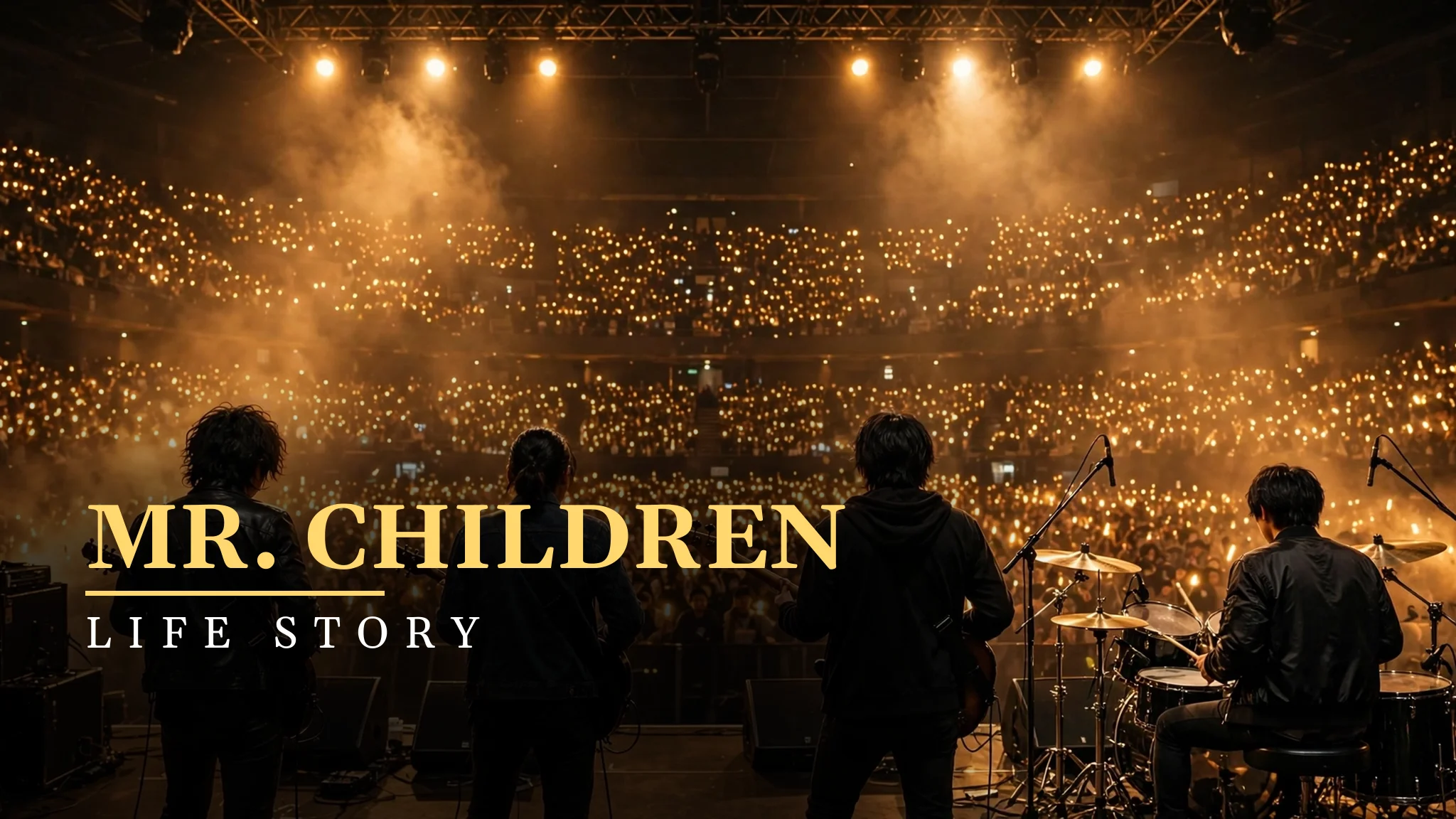
The band also began to play in the largest venues in Japan, including stadiums, and they became known for their live shows, which are long, emotional and carefully planned. A Mr. Children concert is not a short, loud rock show. It is a journey through their career, with old songs and new songs, quiet moments and loud moments, and a sense of shared history between the band and the audience. Fans who have followed the band for decades feel that history, and new fans feel it too, because the songs are strong enough to speak to anyone.
Hanabi, Sign and the Songs That Stay
The songs that people remember most from Mr. Children are the ones that capture a feeling in a simple way. Hanabi is about fireworks, but it is also about the way a beautiful moment passes quickly, and about the sadness and joy of that passing. Sign is about the signs we miss in a relationship, about the small things that tell us someone loves us, or that they are leaving. Innocent World is about hope, about the belief that the world can still be good, even when it feels hard. Each of these songs is simple on the surface, but deep underneath, and that is why they last.
Sakurai’s lyrics are the key to this longevity. He writes in Japanese, in a direct, clear style, and he uses images from everyday life: a train, a sky, a hand, a voice on the phone. Those images are familiar to everyone, and they make the songs feel personal. When Sakurai sings about a train, the listener thinks of their own train journey. When he sings about a phone call, the listener thinks of their own phone call. That is the power of his writing. He takes ordinary things and makes them feel important, because they are important, to the people who live them.
The band’s music has also been used in many films, television dramas and advertisements, and that has introduced their songs to new audiences. A person who has never bought a Mr. Children album may have heard Hanabi in a drama, or Sign on television, or Innocent World in an advertisement, and may have been moved by it without knowing who made it. That wide reach is part of why the band are so loved. Their music is not only for rock fans. It is for everyone, and it is heard everywhere in Japan.
In the 2010s and 2020s Mr. Children continued to release albums, including Sense, Reflection, and Miss You, and they continued to tour in large venues. They marked their 30th anniversary in 2022 with special concerts and releases, looking back at their career while still looking forward. The anniversary was a celebration, but it was also a sign of how long the band have lasted, and how much they mean to their audience. Thirty years is a long time for any band, and Mr. Children have used that time well.
A Band That Japan Trusts
Mr. Children are trusted in Japan in a way that few bands are. They are not a band that chases trends, and they are not a band that makes headlines for the wrong reasons. They are a band that releases music, tours, and lives a quiet, professional life. That quietness is part of their appeal. Fans know that a new Mr. Children album will be well made, that a concert will be well performed, and that the songs will be honest. That trust has been built over decades, and it is not easily broken.
The band have also been involved in charity and social work, including the ap bank project, which was started by Sakurai and others to support environmental and social causes. The project shows a different side of the band, a side that cares about the world beyond music, and that wants to use their success to help others. That work has been praised, and it has shown that Mr. Children are not only musicians, but citizens, who take their responsibility seriously.
Today Mr. Children are one of the best-selling bands in Japanese history, with many number-one albums and singles, and with a career that has lasted for more than thirty-five years. They have done it by writing good songs, by playing them well, and by staying true to themselves. Their story is not about a single moment of fame. It is about a long, steady career, built on trust, on honesty, and on the belief that a song can help people through their lives.
Reflection, Miss You and the 30th Anniversary
Reflection, released in 2015, was an album that showed Mr. Children looking back at their career, and looking forward at the same time. The songs were thoughtful, with lyrics about time, about memory, and about the people who have shaped a life, and they were played with a warmth that came from years of working together. The album was well received, and it proved that the band could still write songs that mattered, even after more than twenty-five years, and that they were still curious about new ideas, new sounds, and new ways to express themselves.
Miss You, released in 2023, was a more recent album, with songs about missing someone, about the feeling of absence, and about the hope that a connection can still be felt, even when a person is far away. The album was quieter in places, more reflective, and it showed Sakurai writing about adult life, about the losses that come with time, and about the small kindnesses that help us through those losses. Miss You was welcomed by fans, who had followed the band for decades, and who heard their own lives in the songs, just as they had heard their teenage lives in Innocent World, and their young adult lives in Hanabi.
In 2022 Mr. Children marked their 30th anniversary, with special concerts, with releases that looked back at their career, and with a celebration that brought together fans of all ages. The anniversary concerts were a major event in Japan, with the band playing songs from across their history, from Everything to Miss You, and with the audience singing along to every word. The shows were a reminder of how long the band have lasted, and how much they mean to their audience, and they were also a sign that the band are still active, still touring, and still writing, even after thirty years. An anniversary is a moment to look back, but for Mr. Children it was also a moment to look forward, to the next album, the next tour, and the next song.
Mr. Children on Television, in Films and in Everyday Life
Mr. Children songs are heard everywhere in Japan, on television, in films, in advertisements, and in everyday life, and that wide reach is part of why they are so loved. Their songs have been used as theme songs for television dramas, including Tomorrow Never Knows and Sign, and those dramas introduced their music to people who might not otherwise listen to rock. A person who watches a drama every week, who hears a Mr. Children song at the end of each episode, will remember that song, will associate it with the story, and will want to hear it again. That is how a band becomes part of daily life, not only part of a record collection.
Their music has also been used in films, in advertisements, and in other media, and each use has introduced their songs to a new audience. A song in an advertisement is heard by millions of people, a song in a film is heard by people who came to see a story, and a song on television is heard by families at home. Mr. Children have used all of these, not by chasing fame, but by writing songs that fit the moment, that fit the story, and that fit the feeling of the scene. That fit is a skill, and it is why their songs are chosen again and again, by directors, by producers, and by advertisers who want a song that will move people.
In everyday life, Mr. Children songs are played at weddings, at graduations, at funerals, and at other moments when people need music to say what they cannot say themselves. A song about hope is played at a graduation, a song about love is played at a wedding, a song about loss is played when someone has died, and the band’s music becomes a part of those moments, a companion through life. That is a great honour for a band, and it is a sign of how much their music means to people in Japan. It is not only entertainment. It is a part of life, and it will be for a long time.
Ap Bank, Giving Back and a Band Beyond the Stage
There is a part of the Mr. Children story that has nothing to do with hit songs, and it is one of the parts I find most worth telling. In 2003, Kazutoshi Sakurai, together with the musician and producer Takeshi Kobayashi, founded an organisation called ap bank, and its purpose was simple and unusual for a pop star. The bank lends money to small projects that help the environment, to people who want to build something good but cannot get a loan from an ordinary bank. The money comes from music, from concerts and from records, and it goes back out into the world as help for farmers, for builders, for people working with clean energy, and for communities trying to live in a better way. It is not a charity that gives money away once and forgets about it. It is a bank, and the money is lent, used, and paid back, so that it can be lent again.
Sakurai and Kobayashi also started a festival called ap bank fes, a large outdoor concert where Mr. Children and other artists play, and where the money raised goes to the same work. The festival is held in nature, often in the countryside, and it has a different feeling from an ordinary rock concert. There are talks about the environment, there is food from local farms, and there is a sense that the audience are part of something larger than a show. Sakurai has said, in his own quiet way, that he wants the festival to be a place where people think about how they live, not only about how they listen. That is a large ambition for a singer, and it would sound empty if he did not follow it with real work, year after year. But he has followed it, and ap bank has now been running for more than twenty years, which is longer than many bands last.
This work matters because it shows what Sakurai thinks a famous band is for. Many bands use their fame only to sell more records, and there is nothing wrong with that, but Mr. Children have used theirs to build something that will last even when the band are no longer playing. A loan that helps a farmer is still helping long after the concert is over. A festival that teaches a young person about the environment can change the way that person lives for the rest of their life. Sakurai does not talk about this work loudly, and he does not use it to make himself look good. He talks about it plainly, as a job that needs doing, and then he goes back to writing songs. That plainness is part of his character, and it is why people trust him.
The same spirit runs through the band’s songs, in a quieter way. Mr. Children songs often ask the listener to look at their own life, to think about what they have done and what they still want to do, and to take responsibility for the choices they make. A song like Sign is about a promise between two people, and a song like Hanabi is about a love that burns brightly and then fades, and both songs treat their listeners as adults who can handle a sad truth. The band do not offer easy answers, and they do not pretend that life is simple. They offer a song, and they trust the listener to take from it what they need. That trust, between a band and its audience, is the same trust that runs ap bank, and it is the reason Mr. Children have lasted so long without losing the respect of the people who listen to them.
It is also worth saying that this work has not made the band rich in the usual sense, and it was never meant to. The money that goes into ap bank is money that could have stayed with the band, and Sakurai has chosen to put it to work for others instead. That is a choice, and it is a choice that tells you more about a person than any award does. Awards are given for a song. A bank that lends to strangers is built on a belief that people are worth helping, even when there is nothing in it for you. Mr. Children have held that belief for more than twenty years, and it is one of the reasons their story feels different from the story of so many other successful bands.
Namonaki Uta, Tomorrow Never Knows and the Early Classics
Namonaki Uta, which means a song without a name, was released in 1996, and it became one of Mr. Children’s most loved songs, with lyrics about a love that has no name, about a feeling that is hard to describe, and about the hope that a song can say what words cannot. The song was long, emotional, and beautifully written, and it showed Sakurai at his best, writing about a feeling that is both personal and universal, in a way that made the listener feel that the song was written for them, even though it was written for everyone. Namonaki Uta is still played at concerts, and the audience sing along, quietly at first, and then loudly, as the chorus rises, and the whole arena feels like one voice, singing about a love that has no name, but that is real, and that matters.
Tomorrow Never Knows, released in 1994, was another early classic, used as the theme for a television drama, and it became a hit because of its melody, its lyrics, and its feeling of hope, of a tomorrow that is unknown, but that is still worth waiting for. The song is about love, about the future, and about the fear of losing someone, and it is a song that many people in Japan associate with a specific time in their lives, with a drama they watched, with a person they loved, and with a feeling they had, when they were young, and when the future felt both exciting and frightening. Tomorrow Never Knows is a song that has lasted, because its feeling has lasted, and because people still feel that way, about tomorrow, about love, and about the unknown.
These early classics, together with Innocent World, form the foundation of Mr. Children’s career, and they are the songs that fans first heard, that made them love the band, and that they still play, still sing, and still remember, decades later. A band that has songs like these, songs that are both popular and meaningful, songs that are both simple and deep, is a band that will last, because the songs will last, even when the band changes, even when the world changes, and even when the audience grows older. Mr. Children have such songs, and they have many of them, and that is why their career has lasted for more than thirty-five years, and why it will last for many more.
The early albums, including Atomic Heart, Bolero, and Discovery, also showed a band that was growing, trying new sounds, and learning how to write an album, not only a single, with songs that worked together, as a collection, and that told a story, about a time, about a feeling, and about a life. Those albums are still listened to, still loved, and still discussed, by fans who remember when they first heard them, and by new fans who discover them, through streaming, through recommendations, and through the band’s concerts, where old songs are played alongside new ones, with the same care, the same energy, and the same honesty, as when they were first written.
My Take:
I think Mr. Children are the band I would play for someone who has never heard Japanese music before, because their songs do not need an explanation. You hear Sakurai’s voice, you hear the melody, and you understand the feeling, even if you do not understand every word. That is a rare gift, and it is why I think they are the most beloved band in Japan. They are not trying to impress you with cleverness, or to shock you with noise. They are trying to tell you something true, in a clear way, and they do it better than almost anyone else.
Innocent World is the song that first made me understand them. It is bright and hopeful, and it sounds like the start of something good, like the first day of summer, or the first day of a new life. I think that hope is important, because the world can feel dark, and a song that believes in the world, even when the world is hard, is a brave thing. Sakurai wrote that song when he was young, and he meant it, and the audience could feel that he meant it. That sincerity is the heart of Mr. Children, and it is why their early songs still work today.
Hanabi is the song I come back to most often. It is about fireworks, but it is really about time, about the way a beautiful moment passes, and about the sadness that comes with that passing. I have watched fireworks, and I have felt that sadness, the feeling that something lovely is gone in a second, and that you cannot hold it. Sakurai captures that feeling perfectly, and he does it without being sentimental. He just describes it, simply and honestly, and lets the listener feel it for themselves. I think that is the best kind of songwriting, the kind that trusts the listener to feel, rather than telling them what to feel.
I also think about Sakurai’s break in the early 2000s, when he had to stop for health reasons. That must have been a frightening time for the band, and for the fans who loved them. A band that has been together for years, that has built a career on touring and recording, suddenly has to stop, and nobody knows when, or if, it will start again. I respect the way they handled it. They did not rush back, they did not pretend nothing had happened, and they gave Sakurai the time he needed to recover. When they returned, with It’s a Wonderful World, the music felt stronger, not weaker, because it had been through a difficult time and had come out the other side. That is a lesson for anyone who has had to stop and rest: stopping is not failure, and returning is possible, if you give yourself time.
What strikes me about Mr. Children is how ordinary their songs are, and how extraordinary that ordinariness is. They sing about trains, about phone calls, about hands, about the sky, about the small things that make up a day. Those are not glamorous subjects, but they are the subjects of real life, and that is why the songs last. A song about a trend will be old in a year. A song about a train journey, about waiting for someone, about missing someone, will still mean something in twenty years, because people will still be taking trains, waiting, and missing. Sakurai understands that, and he writes for the long term, not for the moment.
I do not think Mr. Children are a perfect band, and I think their very steadiness can sometimes feel like a weakness. They rarely surprise me, and they rarely take a wild risk. Their albums are reliable, their concerts are reliable, and their songs are reliable, but reliability can become predictability, and predictability can become boring. I understand why some listeners want more danger, more change, more surprise from a band. I sometimes want that too. But I also think that reliability is a virtue, especially in a world where so much music is made to be forgotten in a week. A band you can rely on, year after year, is a rare and valuable thing, and I would not trade it for a few moments of surprise.
The ap bank project is something I admire, because it shows that the band care about more than music. Sakurai and his colleagues started a project to support environmental and social causes, and they have used their success to help others. That is not something every band does, and it tells me that Mr. Children see their fame as a responsibility, not just as a reward. I think that is a good way to think about success. If you have a voice that millions of people listen to, you can use it for something good, and Mr. Children have tried to do that. I respect that, and I think it makes their music feel more honest, because the people making it are trying to live honestly too.
If a young songwriter asked me what to learn from Mr. Children, I would say this: write about ordinary life, write clearly, and write honestly. Do not try to be clever for its own sake, and do not try to be cool. Try to be true, and trust that the audience will recognise the truth when they hear it. Practise until your songs are strong enough to be sung by thousands of people, and then keep practising, because a long career needs more than one good song. And look after yourself, and each other, because a band is made of people, and people need rest, care and time.
In the end, I think Mr. Children are a band about hope, but a quiet, realistic hope, not a loud, empty one. Their songs do not promise that everything will be fine. They promise that even when things are hard, there is still something worth holding on to: a person, a memory, a song, a tomorrow. That is a hope I can believe in, and it is why I will keep listening to them, and why I think Japan will keep listening to them for many years to come.
I also think about their songs being played at weddings, at graduations, and at funerals, and about what it means for a band to be part of those moments. A wedding is a happy moment, a graduation is a hopeful moment, a funeral is a sad moment, and Mr. Children have songs for all three, because they have written about love, about hope, and about loss, with honesty and with care. To have your music chosen for a moment like that is a great honour, because it means that people trust your songs to say what they cannot say themselves. I think Sakurai would be proud of that trust, and I think he has earned it, by writing honestly, year after year, for more than thirty years.
I think about Reflection and Miss You, and about the way they show a band that is still writing about adult life, about missing someone, about time passing, and about the small things that help us through. It is easy to write about teenage love, because it is intense and simple, but it is harder to write about adult love, about a long marriage, about a friend who is gone, about a parent who is old, and Mr. Children do that, with a maturity that comes from having lived those things themselves. Their fans have grown older with them, and they hear their own adult lives in the later songs, just as they heard their teenage lives in the early songs. That shared growth is rare, and it is why the band’s audience has stayed loyal.
I wonder what the next ten years will look like for Mr. Children, and I hope they will keep writing, keep touring, and keep playing, because Japan needs a band like them, a band that is trusted, that is honest, and that is there, year after year, through good times and bad. There are many bands that are loud, many that are fashionable, and few that are reliable, and Mr. Children are reliable in the best sense: they will be there, they will play well, they will sing honestly, and they will not let you down. That reliability is a comfort, and it is why I will keep listening to them, and why I think Japan will keep listening to them, too.
I also think about the 30th anniversary, and about what it must have been like to stand on a stage, to look out at an audience of people of all ages, and to know that you have been playing for thirty years, that you have been part of people’s lives for thirty years, and that they still want to hear you. That must be a powerful feeling, a mix of pride, of gratitude, and of humility, and I think Sakurai and the other members felt all of that, and more, on that night. I hope they felt it, because they deserve to feel it, after thirty years of hard work, of good songs, and of honest music.
In the end, I come back to the idea of trust, and to the fact that Mr. Children are a band that Japan trusts, not because they are perfect, but because they are honest, because they are consistent, and because they care about their audience. That trust was built slowly, song by song, concert by concert, year by year, and it is a trust that will last, because it is based on something real. I trust them, too, and I will keep listening, because their songs help me through my own life, through its joys and its sorrows, and that is the best thing a band can do for a listener.
I keep thinking about how rare it is for four people to stay together for more than thirty years without a public breakup, without a bitter fight, and without one member leaving to chase a solo career. Most bands break. They break over money, over fame, over who wrote the best song, or over the simple fact that people change and grow apart. Mr. Children have changed, of course, because everyone changes over thirty years, but they have changed together, and they have found a way to keep the band at the centre of their lives. I think that takes a kind of maturity that is easy to praise and hard to practise. It means listening to each other, giving way when you need to, and remembering that the band is larger than any one person in it. I have seen friendships break over far less, and I admire a group that has held on.
I also think about Sakurai’s voice, because it has aged with him, and that ageing is part of the band’s honesty. He does not sound like a young man any more, and he does not try to. His voice is warmer now, a little rougher, a little more tired, and it suits the songs he writes now, which are about looking back, about holding on to what matters, and about letting go of what does not. A singer who pretends to be twenty forever is lying to his audience, and the audience can hear the lie. Sakurai tells the truth, and the truth is that time passes, that people grow older, and that a song can still be beautiful when it is sung by a man who has lived. I find that comforting, because it tells me that getting older is not the end of being useful, or of being loved, or of making something worth hearing.
There is a final thought I want to leave here, about what it means to be steady. Mr. Children are not the most dramatic band in Japan, and they are not the most shocking, and they will never be the band that everyone talks about for a week and then forgets. They are the band that is still there, year after year, writing a new song, playing a new tour, and keeping a promise they made to their listeners long ago. Steadiness is not exciting, and it does not make headlines, but it is what a life is built on. A steady friend, a steady job, a steady band: these are the things that carry us through the hard years. Mr. Children have been steady for more than three decades, and I think that steadiness is their greatest gift, and the reason I will still be listening to them when another ten years have passed.
I also think about Namonaki Uta, and about what it means to love someone, and to not have a name for that love, to feel something that is real, but that is hard to describe, and to need a song to say it for you. That is a feeling I know, and I think many people do, because love is often like that, nameless, wordless, and yet real, and a song that gives it a voice, even without a name, is a valuable song. Sakurai wrote that song in 1996, and it is still sung today, because that feeling has not changed, and because people still need a song to say what they cannot say themselves, and Mr. Children give them that song, with honesty and with care.
I think about Tomorrow Never Knows, and about the future, about the fear of not knowing what tomorrow will bring, and about the hope that, even if we do not know, tomorrow is still worth waiting for. That is a hopeful message, and it is one that I need to hear, especially when the future feels uncertain, when the world feels difficult, and when I am afraid of what might happen next. A song that says, tomorrow never knows, but we will be here tomorrow, is a comforting song, and it is one that Mr. Children have sung for thirty years, in many different ways, with many different songs, but with the same message, that hope is worth holding on to, even when we do not know what will happen.
I wonder what it must be like to be a new fan, discovering Mr. Children through Innocent World, or Hanabi, or Sign, and then going back, listening to Atomic Heart, to Bolero, to Discovery, and realising that there is a whole history behind that one song, a history of thirty-five years, of albums, of tours, and of a band that started in Tokyo, and that is still going. That discovery must be exciting, and I hope those new fans feel welcomed, because Mr. Children’s music is welcoming, even when it is sad, even when it is about loss, and even when it is about the passing of time. Inside that music, there is warmth, there is hope, and there is a sense that it is okay to feel, to love, and to keep going, even when life is hard.
I also think about Sakurai’s voice, and about how it has grown, from a young singer in 1992, to a mature singer in 2023, with a voice that is warmer, deeper, and more controlled, and that carries the weight of the songs he sings, with a feeling that comes from having lived through them. That growth is a result of years of singing, of touring, of recording, and of learning how to use his voice, how to protect it, and how to make it stronger, and it is a sign of a professional, a singer who takes his craft seriously, and who wants to be better, year after year. I respect that, because a voice is a fragile thing, and to keep it strong for thirty-five years, through touring, through recording, and through the pressure of fame, is a remarkable achievement.
In the end, I come back to trust, and to the fact that Mr. Children are a band that Japan trusts, because they have earned that trust, song by song, concert by concert, year by year, for more than thirty-five years, and they have done it by being honest, by being consistent, and by caring about their audience. That trust will last, because it is based on something real, on good songs, on good performances, and on a band that will not let you down. I trust them, too, and I will keep listening, because their songs help me through my own life, through its joys and its sorrows, and that is the best thing a band can do for a listener, and it is why Mr. Children matter so much to me, and to Japan.
Frequently Asked Questions
When did Mr. Children form and who are the members?
Mr. Children formed in Tokyo in 1989, with Kazutoshi Sakurai on vocals and guitar, Kenichi Tahara on guitar, Keisuke Nakagawa on bass, and Hideya Suzuki on drums. The same four members have been together for their whole career. They released their first album, Everything, in 1992, after building a following in small clubs.
What was Mr. Children’s breakthrough song?
Innocent World, released in 1994, was their breakthrough, becoming a huge hit in Japan and one of the best-selling singles of the year. The same year Tomorrow Never Knows, used as a television drama theme, also became a major hit. Together the two songs made 1994 the year Mr. Children became one of Japan’s biggest bands.
What are Mr. Children’s best-known songs?
Their best-known songs include Innocent World, Tomorrow Never Knows, Namonaki Uta, Sign and Hanabi, which means fireworks. Hanabi is about summer, love and the fleeting beauty of a moment, while Sign is about the small signs in a relationship. Each song is known for Sakurai’s clear, honest lyrics and strong melodies.
Did Kazutoshi Sakurai take a break from the band?
Yes, Sakurai took a break in the early 2000s for health reasons, and the band paused their activities while he recovered. When he returned, they released It’s a Wonderful World and continued to tour and record. The break is now seen as a time that made the band stronger, not weaker.
What is the ap bank project connected to Mr. Children?
The ap bank project was started by Sakurai and others to support environmental and social causes, using the band’s success to help others. It is a separate project from the band’s music, but it shows their interest in social responsibility. The project has been praised for its work in Japan.
Are Mr. Children still active today?
Yes, Mr. Children are still active, and they marked their 30th anniversary in 2022 with special concerts and releases. They continue to release albums, including Reflection and Miss You, and to tour in large venues in Japan. They remain one of the best-selling bands in Japanese history.


