MS Dhoni: The Life Story Behind the Cricket Legend
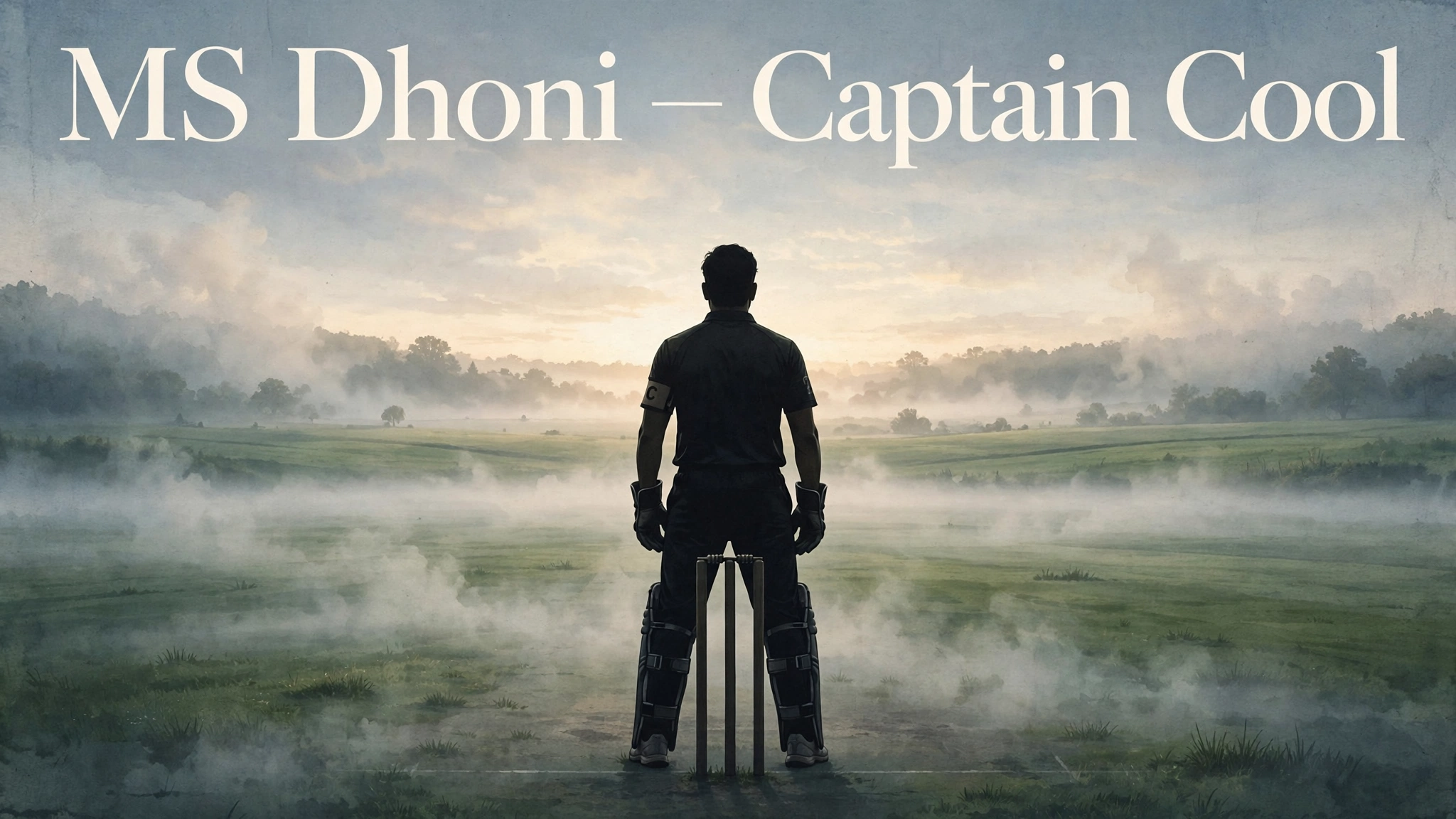
In this post
- A Railway Colony Childhood in Ranchi
- The Goalkeeper Who Learned to Keep Wicket
- The Duck, the 148, and the Helicopter Shot
- The 2007 World Cup and the Youngest Captain
- The 2011 World Cup and the Winning Six
- Captain Cool, the Champions Trophy, and the Test Years
- Chennai Super Kings and the Second Kingdom
- The Private Man, the Family, and the Life After Cricket
- My Take:
Mahendra Singh Dhoni was born on 7 July 1981 in Ranchi, in what was then the state of Bihar and is now Jharkhand, in eastern India, and he became the most successful captain Indian cricket has ever had. He is the only captain in history to have won all three of the International Cricket Council’s major white-ball trophies: the T20 World Cup in 2007, the fifty-over World Cup in 2011, and the Champions Trophy in 2013. He was a wicketkeeper who could change a game with one stumping, a batsman who finished matches with sixes, and a leader whose calm became so famous that it acquired a nickname, Captain Cool. Yet the story begins far from the stadiums, in a railway colony where his father worked for a steel company, where the young Dhoni played football as a goalkeeper, and where nobody expected a boy from Ranchi to captain India at all.
What makes Dhoni’s story different from the usual cricket biography is how late and how unlikely it was. He did not come through a famous Mumbai academy, he was not a child prodigy on television, and he spent three years working as a ticket collector at Kharagpur railway station while his cricket career stalled. When his chance finally came, at twenty-three, he was run out for a duck on debut. Within three years he was captaining India to a World Cup. Within seven he had won everything there was to win. And when he finished, he did it the way he did everything else: quietly, on his own terms, with a short video posted on social media and no farewell press conference. This is the story of how that happened, and why a whole country still talks about him in the present tense.
A Railway Colony Childhood in Ranchi
Ranchi in the 1980s was a quiet industrial town, and the Dhoni family lived in a modest house in a colony belonging to MECON, the steel consultancy where his father, Pan Singh, worked as a junior manager. His mother, Devaki, kept the home, and his older siblings, Jayanti and Narendra, were already teenagers when Mahendra was small. The family was comfortable but not wealthy, and cricket was not the family business: nobody in the house had played professional sport, and the boy’s first love was football. At DAV Jawahar Vidya Mandir school in Shyamali, he was the goalkeeper of the football team, diving at attackers’ feet with a fearlessness that his teachers still remember. He also played badminton, and he was good enough at both that his school coach, Keshav Ranjan Banerjee, had to make a decision about him.
Banerjee’s decision changed Indian cricket. The school cricket team needed a wicketkeeper, and the coach looked at the boy who dived for footballs and thought he would dive for cricket balls too. He asked the young Dhoni to try keeping wicket, and Dhoni, who had barely played serious cricket, agreed. He was good at it immediately: his hands were safe, his footwork was quick, and he had the goalkeeper’s instinct for reading where a ball would go. Within a couple of years he was keeping wicket for the school and batting in the middle order, and the football goalkeeper had become a cricketer. The change was not glamorous — it was a practical decision by a school coach who needed a keeper — but it is the single most important moment in Dhoni’s life, because without it he might have spent his life playing local football and working in an office.
Ranchi itself shaped him. It was a small town by Indian standards, far from the cricket centres of Mumbai, Delhi and Bangalore, and selectors rarely travelled there. A boy from Ranchi had to be not just good but unmissable, because nobody was coming to watch him twice. Dhoni learned to play on uneven grounds, with old equipment and little coaching, and he learned to solve problems on his own, a habit that later became his trademark as a captain. He also learned patience, because the road from Ranchi to the Indian team was long, and every step of it required someone to notice him first.
The Goalkeeper Who Learned to Keep Wicket
Dhoni’s early cricket was played for local clubs in Ranchi, and his reputation grew slowly. He played for the Commando Cricket Club, and in the 1997-98 season he was picked for the Bihar under-16 team in the Vinoo Mankad Trophy. He was not a polished batsman: his technique was unorthodox, his grip was unusual, and coaches who valued textbook batting did not know what to make of him. But he hit the ball very hard, he ran between the wickets fast, and he could keep wicket to fast bowlers and spinners alike. He was selected for the Bihar under-19 team, and in the 1999-2000 season he made his Ranji Trophy debut for Bihar against Assam, scoring runs and keeping tidily. It was a start, but it was not a breakthrough, and the years that followed were the hardest of his life.
The problem was money and time. Dhoni’s family needed him to earn, and cricket in Bihar paid almost nothing. In 2001 he took a job as a travelling ticket examiner with the South Eastern Railway at Kharagpur station in West Bengal, a job that gave him a salary, a railway pass and security, but took him away from serious cricket for long stretches. He worked on trains, checking tickets, and played cricket when he could, for the railway team and for local sides. Teammates from those years remember him as quiet, polite and fiercely competitive, a man who hated losing at anything, including games of table tennis in the railway rest rooms. He has said since that the railway years taught him discipline, because the job had rules, timings and responsibilities, and you could not be late or careless. They also taught him what a normal working life felt like, and that knowledge stayed with him: even at the peak of his fame, he talked about cricket as a job, not as a destiny.
The turning point came in 2003, when he played for East Zone and for India A, and his big hitting finally caught the eye of people who mattered. On an India A tour of Zimbabwe and Kenya in 2004 he scored heavily, including a century against Pakistan A, and the national selectors, who had been ignoring Ranchi for years, could no longer pretend he did not exist. In December 2004, at twenty-three, he was picked for India’s one-day team to play Bangladesh. He was run out for a duck in his first innings, a debut that could hardly have been worse, and many players would have been dropped and forgotten. The selectors kept faith, and four months later Dhoni showed them why.
The Duck, the 148, and the Helicopter Shot
Dhoni’s second chance came in April 2005, in a one-day match against Pakistan at Visakhapatnam. Promoted to number three in the batting order, he smashed 148 runs off 123 balls, with fifteen fours and four sixes, and India won the match. It was one of the most violent innings ever played by an Indian batsman at that time, and it announced a new kind of player: a wicketkeeper who batted like a heavyweight, who hit the ball flat and hard, and who did not seem to feel pressure. Six months later, against Sri Lanka at Jaipur, he did it again, scoring 183 not out off 145 balls, the highest score by a wicketkeeper in one-day history, and finishing the game with a six. The innings included ten sixes, and it made him a star overnight. Crowds began to copy his long hair, his style, his swagger, and the boy from Ranchi was suddenly one of the most famous young men in India.
The most famous shot in his armoury was the helicopter shot, a flick of the wrists that sends a yorker — a ball aimed at the batsman’s toes — soaring over the boundary. He learned it from a childhood friend, Santosh Lal, in Ranchi, who used to play it in tennis-ball cricket, and Dhoni turned it into a weapon against the best bowlers in the world. Bowlers who thought they had him trapped with a perfect yorker watched the ball disappear over mid-wicket, and the shot became a symbol of his whole approach: when the textbook says you cannot score, find a way to score anyway. It is still the shot that crowds wait for, and it is still the shot that young cricketers in Ranchi practise in the street.
He made his Test debut in December 2005 against Sri Lanka in Chennai, and his first Test century came a month later, against Pakistan in Faisalabad. By 2006 he was India’s first-choice wicketkeeper in all formats, and he had gone from a railway ticket collector to an international cricketer in less than two years. The speed of the rise was dizzying, and it set up the next chapter, which would ask him to do something he had never done before: lead.
The 2007 World Cup and the Youngest Captain
In 2007, Indian cricket was in crisis. The team had been knocked out of the fifty-over World Cup in the West Indies in the first round, the coach Greg Chappell had departed amid controversy, and senior players were under pressure. When Rahul Dravid resigned as captain, the selectors made a surprising choice: they gave the job to Dhoni, who was twenty-six and had captained almost nothing, for the first ever T20 World Cup in South Africa. The team he took was young, inexperienced and written off by almost everyone. India had barely played the twenty-over format, and the tournament was expected to be won by Australia or South Africa. Dhoni’s first decision set the tone: he picked a team of fearless young players, backed them publicly, and told them to play without fear.
The tournament became a legend. India beat Pakistan in a bowl-out in the group stage, a tiebreaker in which bowlers aimed at the stumps, and then beat England in a match remembered for Yuvraj Singh hitting six sixes in one over off Stuart Broad. In the semi-final they beat Australia, the favourites, and in the final they met Pakistan again in Johannesburg. The final went to the last over, with Pakistan needing thirteen runs and one wicket left, and Dhoni gave the ball to Joginder Sharma, a medium-pacer with almost no international experience, instead of the senior Harbhajan Singh. Joginder’s second ball was hit for six by Misbah-ul-Haq, and then Misbah scooped the third ball into the hands of Sreesanth at fine leg, and India had won by five runs. Dhoni’s gamble had paid off, and the image of him holding the trophy, smiling quietly while his teammates celebrated wildly around him, became the defining picture of his captaincy: the calm man at the centre of the storm.
The victory changed Indian cricket. The T20 format, which had been a curiosity, became a national obsession, and within a year the Indian Premier League was born. Dhoni, who had been a surprise choice as captain, was now the man who had brought home a world title, and the selectors gave him the one-day captaincy too, and then the Test captaincy in 2008. He was twenty-seven, and he was in charge of the biggest cricket team in the world.
The 2011 World Cup and the Winning Six
If 2007 made Dhoni a captain, 2011 made him immortal. The fifty-over World Cup was held in India, Sri Lanka and Bangladesh, and India had not won it since 1983. The pressure was enormous: a billion people expected victory, and the team carried the hopes of a nation that treats cricket as a religion. India reached the final at the Wankhede Stadium in Mumbai, against Sri Lanka, and the final became the most-watched sporting event in Indian history. Sri Lanka batted first and scored 274, a strong total, and India lost two early wickets in reply, including the great Sachin Tendulkar, who was playing his last World Cup. The stadium went silent.
Dhoni’s response was the bravest decision of his career. With the match in the balance, he promoted himself up the batting order, ahead of the in-form Yuvraj Singh, and walked out to join Gautam Gambhir, who was batting beautifully. He scored 91 not out off 79 balls, playing with a control and a calm that seemed impossible under the circumstances, and with four runs needed he hit the ball over long-on for six. The commentator Ravi Shastri’s words — “Dhoni finishes off in style, a magnificent strike into the crowd, India lift the World Cup after 28 years” — are now part of Indian folklore, and the image of Dhoni’s bat raised, the ball disappearing into the Mumbai night, is the most famous picture in Indian sport. He was named man of the match, and he gave the trophy to his teammates, standing at the back while they lifted it, a gesture that told you everything about how he saw his role.
The victory was not just a sporting achievement. It was a national celebration, with crowds pouring into the streets of every Indian city, and Dhoni, who had been a railway employee seven years earlier, was now the captain who had brought the World Cup home. He had also done something no other captain had done: he had won the T20 World Cup and the fifty-over World Cup, and two years later he would complete the set.
Captain Cool, the Champions Trophy, and the Test Years
In 2013, Dhoni captained India to victory in the Champions Trophy in England, beating the hosts in a rain-shortened final at Edgbaston. The win made him the only captain in history to have won all three ICC white-ball trophies, a record that still stands. He did it with a team in transition, with young bowlers and a new batting order, and he did it by backing his players through bad days and refusing to panic when games turned against India. His captaincy style was the opposite of the shouting, gesturing leaders who came before him. He rarely showed emotion, he rarely criticised players in public, and he made decisions — like giving the last over to an inexperienced bowler, or promoting himself in a World Cup final — that looked strange in the moment and obvious afterwards.
His Test captaincy was more complicated. He led India to the number one ranking in 2009, and India won series at home and abroad under him, but the team also suffered heavy defeats overseas, including whitewashes in England and Australia in 2011 and 2012, and Dhoni’s own Test batting, though solid, never matched his one-day brilliance. He captained India in ninety Tests, winning twenty-seven of them, and he kept wicket in every one, a workload that few players have ever carried. In December 2014, after the third Test against Australia in Melbourne, he announced his retirement from Test cricket with immediate effect, without a farewell match or a press conference. He simply issued a short statement and walked away, leaving Virat Kohli to take over. It was a decision that shocked the cricket world, and it was also entirely in character: Dhoni has never believed in long goodbyes, and he has always preferred to leave a stage while he is still wanted on it.
He continued as one-day and T20 captain until January 2017, when he handed the job to Kohli, and he continued as a player until the 2019 World Cup in England. His last match for India was the semi-final against New Zealand at Old Trafford, a game in which he scored fifty and was run out by a direct hit from Martin Guptill, a dismissal that ended India’s tournament and, as it turned out, his international career. He did not announce anything for more than a year, and then, on 15 August 2020, India’s Independence Day, he posted a video on Instagram set to the song “Main pal do pal ka shayar hoon”, with pictures from his career, and a caption saying that he was retiring. It was the quietest ending to the loudest career in Indian cricket, and it was perfect.
Chennai Super Kings and the Second Kingdom
Dhoni’s second kingdom was the Indian Premier League, where he captained the Chennai Super Kings from the very first season in 2008. CSK bought him for one and a half million dollars, the most expensive player at the first auction, and the investment paid off many times over. Under Dhoni, Chennai became the most consistent team in the league, reaching the final in their first season, winning the title in 2010 and 2011, and winning the Champions League T20 in 2010 and 2014. The team was built in his image: experienced players, calm dressing room, no panic, and a habit of winning close games that other teams lost. Chennai’s fans adopted him as their own, calling him Thalaiva, the leader, and the yellow shirt became as much a part of his identity as the blue of India.
In 2016 and 2017, when Chennai were suspended from the league, Dhoni played for the Rising Pune Supergiant, and the two years away only strengthened his bond with Chennai. When the team returned in 2018, with a squad that critics called too old, Dhoni led them to the title, scoring runs, keeping wicket brilliantly, and winning games with his finishing. He won the title again in 2021 and in 2023, the last of them in a final against Gujarat Titans that went to the final ball, with Ravindra Jadeja hitting the winning runs while Dhoni watched from the other end. He was forty-one years old, his knees were troubling him, and he still found a way to win. He has continued to play for Chennai into his forties, and every season the same question is asked — is this the last one? — and every season he gives the same answer, which is to say nothing and let his bat do the talking.
The Chennai years matter because they show a different side of Dhoni from the international captain. At CSK he was not just a player but a mentor, a builder of young careers, and a man who turned a franchise into a family. Players who have played under him talk about the trust he gives them, the freedom he allows, and the way he takes responsibility for defeats and shares credit for victories. It is the same leadership he showed for India, applied over seventeen seasons to one team, and it is why Chennai’s fans treat him not as an employee but as one of their own.
The Private Man, the Family, and the Life After Cricket
Away from cricket, Dhoni is famously private. He married Sakshi Singh Rawat, a friend from his school days in Ranchi, on 4 July 2010, in a quiet ceremony in Dehradun, and their daughter Ziva was born in February 2015. He does not discuss his family in interviews, he does not post about them often, and he has kept his home life separate from his public life with a discipline that is rare among modern sports stars. He is known for his love of motorcycles and cars, and his collection in Ranchi is famous among his friends, and for his interest in the Indian Army: in 2011 he was made an honorary Lieutenant Colonel in the Territorial Army, and in 2019 he spent time training with a battalion in Kashmir, a decision that made headlines and showed a side of him that cricket fans rarely saw.
His honours include the Rajiv Gandhi Khel Ratna in 2007, the Padma Shri in 2009, and the Padma Bhushan in 2018, some of the highest awards India gives to sportspeople. His life was turned into a film, M.S. Dhoni: The Untold Story, released in 2016, with Sushant Singh Rajput playing him, and the film’s success showed how deeply his story had entered Indian popular culture. He has also built business interests, including sports teams and farming, and he has invested in his home state of Jharkhand, but he has done it quietly, without the self-promotion that usually accompanies such ventures.
What endures about Dhoni is not the statistics, impressive as they are — more than ten thousand one-day runs, nearly three hundred dismissals behind the stumps, three ICC trophies as captain — but the manner. He never raised his voice, never blamed a teammate, never celebrated too loudly, and never made a defeat about himself. He played cricket as if it were a job to be done well, and he did it well for longer than anyone expected, from a railway platform in Kharagpur to the biggest stadiums in the world. The boy who kept wicket because his school needed a keeper became the captain who won everything, and he did it without ever changing the thing that made him: a calm man from Ranchi who trusted his own judgement, and who believed that the best way to lead is to stay still while everyone else is running.
My Take:
When I think about MS Dhoni, I think about silence, because his greatness was never loud. He did not shout, he did not celebrate wildly, and he did not explain himself very often, yet everyone around him knew exactly who was in charge. That kind of leadership is rare, and it is hard to copy, because it comes from a deep confidence that does not need applause. I think his story matters most to people from small places, because he proved that you do not need to be born in a big city to lead a nation, and you do not need to be loud to be heard.
The lesson I take from Dhoni is that calm is a skill, because his stillness in the final overs was not an accident but a habit built over years of practice and self-control. What strikes me most is the patience in this story, because the world wanted everything fast, and this person kept choosing the slower, steadier road instead. I would also point to the courage it took to change, because changing a style, a team or a whole direction in front of millions of watching eyes is far harder than it looks. What I hope readers remember is not a single number or a single date, but the feeling of this life: that hard work, honestly done, can still take a person further than anyone expected. I find myself thinking about the young people reading this story, because the message for them is simple: start where you are, use what you have, and keep going long enough for luck to find you. I admire the way this person treated rivals, because respect for an opponent is often the clearest sign of confidence, and the greatest rivalries in this story made both sides better. There is a quiet kind of courage in starting over after a setback, and this life has that courage in it more than once, which is why it still speaks to people today. This life shows that a dream can be both bigger than the person and still within reach, because the gap between the two is closed one small step at a time. I think we often forget how young these stars were when the pressure began, because a teenager carrying the hopes of a nation is still a teenager, with the same doubts and the same need for kindness as anyone else. The story reminds me that support matters as much as skill, because nobody reaches the top alone, and the people who carried the bags, kept the home and believed early deserve a share of the credit. I think this life also teaches us about grace under pressure, because the cameras are always on, and the way a person behaves on the worst day often says more than the way they behave on the best day. I admire the way the best years of this career were not just about winning, because winning alone is empty, and the joy seemed to come from playing the game well and sharing it with others.
I also learn from him that small towns can produce great leaders, because Ranchi gave him humility and patience, and those qualities served him better than any big-city advantage. What I would tell a young reader is to look past the trophies and study the routines, because the trophies are the result, while the routines are the part anyone can actually copy. I think the deepest lesson is about identity, because when the cheering stops, a person still needs to know who they are without the title, the shirt or the stage. There is a final lesson about letting go, because every career ends, and the people who plan for that ending, and who find new purpose after it, tend to enjoy the years that follow. The part of this story I would underline for parents is the role of encouragement without pressure, because the young star in this tale flourished when support came with freedom, not with fear. I notice that the most loved moments in this career were often the shared ones, because a victory celebrated with a team, a family or a crowd lasts longer in memory than a victory celebrated alone. I notice how often the turning points in this life came from other people: a coach who believed, a parent who sacrificed, a friend who told the truth when flattery would have been easier. What makes this story worth reading again is that it refuses to be only one thing, because it holds triumph and trouble side by side, and that is how real lives actually feel. What I notice most is how much this person had to adapt, because the game, the industry and the audience all changed, and standing still would have meant falling behind. The older I look at this story, the more I see the role of family and close friends, because fame is loud, and a steady private life is what keeps a person standing. I keep thinking about the cost of fame in this life, because the same attention that brings love also brings judgement, and learning to live with both is a skill nobody is born with. I think the legacy here is not only about records, because records are made to be broken, but about the standard that was set for everyone who came after.
His railway years teach me that an ordinary job can be a good teacher, because checking tickets taught him discipline, and discipline later won him World Cups. The most interesting question this story leaves behind is not what was won, but what comes next, because a great career creates a platform, and what a person does with that platform matters just as much. There is a practical lesson here about health and rest, because the body and the mind both have limits, and the stars who respect those limits usually last the longest. I think this story earns its place because it is not only about one person, because it also tells us something about the country, the era and the sport or art that shaped them. Looking at this career from a distance, the pattern is clear: the early years were about learning, the middle years were about proving, and the later years were about giving something back to the game or the art that made it all possible. I think the real lesson here is about patience, because the world loves an overnight success story, yet almost every overnight success took years of quiet mornings to build. I keep returning to the small moments in this story, because the grand finals are easy to remember, while the quiet practice sessions and the kind words are the parts that actually built the career. There is a generosity in this career that is easy to miss, because giving time, money or encouragement to others rarely makes the headlines, yet it shapes how a person is remembered. The final thought I keep returning to is balance, because a great career is only part of a good life, and the people who protect their health, their family and their peace tend to enjoy the journey far more. The legacy of this life will probably be argued about for years, and that is fine, because the argument itself shows how much the work mattered to people. I believe the most useful lesson is about handling pressure, because the pressure never really goes away, and the people who last learn to carry it without letting it crush them. The part of this story that feels most human is the beginning, when nobody knew the name and the dream looked far too big for the life around it.
The 2011 final reminds me that leaders should step forward in the biggest moments, because Dhoni promoted himself when the pressure was highest and finished the job himself. I believe the story also warns us about believing our own headlines, because headlines are written in a hurry, and a wise person reads them lightly and keeps working. One of the most hopeful parts of this story is that the best chapter did not always come first, because some of the finest work arrived after the setbacks, when the person knew themselves better. There is a lesson here about handling the days when nothing works, because every long career has them, and the difference between quitting and continuing is often just one more morning of trying. What stays with me about this life is not the list of honours, because honours fade from memory, but the way a person kept showing up when the work was hard and the applause was far away. The story also shows that talent without humility rarely lasts, because the moment a person believes they have nothing left to learn, the game or the audience moves on without them. What I take away most is that consistency beats intensity, because a person who shows up every day for years will usually outlast the person who burns bright for one season. I find the late chapters of this life especially moving, because they show a person learning to enjoy the work again after years of carrying it like a burden. If there is one thing to copy from this life, it is the habit of preparation, because the great performances that look effortless are almost always the most rehearsed. There is something reassuring about a career that was not perfect, because perfection is a myth, and a real life with mistakes in it is far more useful to the rest of us. If you read this story as a map rather than a museum piece, you can see the choices that mattered: which coach to trust, which risk to take, which offer to refuse, and when to rest. The money and the headlines can distract from the real achievement, which is simply this: a person kept doing difficult work, in public, for many years, and kept finding ways to do it better.
Finally, his quiet retirement shows me that you do not need a grand farewell to be great, because a simple goodbye, honestly given, can be the most dignified ending of all. I keep coming back to the idea of discipline, because talent opens the door, but discipline is what keeps a person in the room year after year. There is something honest about a career that includes failure, because it reminds the rest of us that a bad day, a lost final or a poor season does not have to define a whole life. The older I look at this story, the more I see the role of family and close friends, because fame is loud, and a steady private life is what keeps a person standing. What I notice most is how much this person had to adapt, because the game, the industry and the audience all changed, and standing still would have meant falling behind. I admire the way this person treated rivals, because respect for an opponent is often the clearest sign of confidence, and the greatest rivalries in this story made both sides better. I think we often forget how young these stars were when the pressure began, because a teenager carrying the hopes of a nation is still a teenager, with the same doubts and the same need for kindness as anyone else. I think the legacy here is not only about records, because records are made to be broken, but about the standard that was set for everyone who came after. I keep coming back to the idea of discipline, because talent opens the door, but discipline is what keeps a person in the room year after year. The story reminds me that support matters as much as skill, because nobody reaches the top alone, and the people who carried the bags, kept the home and believed early deserve a share of the credit. There is a quiet kind of courage in starting over after a setback, and this life has that courage in it more than once, which is why it still speaks to people today. There is a generosity in this career that is easy to miss, because giving time, money or encouragement to others rarely makes the headlines, yet it shapes how a person is remembered.
I keep thinking about the cost of fame in this life, because the same attention that brings love also brings judgement, and learning to live with both is a skill nobody is born with. I believe the most useful lesson is about handling pressure, because the pressure never really goes away, and the people who last learn to carry it without letting it crush them. There is a practical lesson here about health and rest, because the body and the mind both have limits, and the stars who respect those limits usually last the longest. There is a lesson here about handling the days when nothing works, because every long career has them, and the difference between quitting and continuing is often just one more morning of trying. There is a final lesson about letting go, because every career ends, and the people who plan for that ending, and who find new purpose after it, tend to enjoy the years that follow. I would also point to the courage it took to change, because changing a style, a team or a whole direction in front of millions of watching eyes is far harder than it looks. I think this story earns its place because it is not only about one person, because it also tells us something about the country, the era and the sport or art that shaped them. The final thought I keep returning to is balance, because a great career is only part of a good life, and the people who protect their health, their family and their peace tend to enjoy the journey far more. I think this life also teaches us about grace under pressure, because the cameras are always on, and the way a person behaves on the worst day often says more than the way they behave on the best day. I believe the story also warns us about believing our own headlines, because headlines are written in a hurry, and a wise person reads them lightly and keeps working. The part of this story that feels most human is the beginning, when nobody knew the name and the dream looked far too big for the life around it. One of the most hopeful parts of this story is that the best chapter did not always come first, because some of the finest work arrived after the setbacks, when the person knew themselves better. What stays with me about this life is not the list of honours, because honours fade from memory, but the way a person kept showing up when the work was hard and the applause was far away. I admire the way the best years of this career were not just about winning, because winning alone is empty, and the joy seemed to come from playing the game well and sharing it with others. I think the deepest lesson is about identity, because when the cheering stops, a person still needs to know who they are without the title, the shirt or the stage. I notice how often the turning points in this life came from other people: a coach who believed, a parent who sacrificed, a friend who told the truth when flattery would have been easier.
Frequently Asked Questions
When was MS Dhoni born?
MS Dhoni was born on 7 July 1981 in Ranchi, Jharkhand, India.
Which ICC trophies did MS Dhoni win as captain?
He won the 2007 T20 World Cup, the 2011 ODI World Cup and the 2013 Champions Trophy, the only captain to win all three.
What is MS Dhoni famous for as a finisher?
He is famous for finishing run chases calmly, including the winning six in the 2011 World Cup final against Sri Lanka.
Which IPL team does MS Dhoni play for?
MS Dhoni is the face of the Chennai Super Kings, leading them to five IPL titles.
When did MS Dhoni retire from international cricket?
He announced his retirement from international cricket on 15 August 2020.


