Muttiah Muralitharan: The Life Story Behind Cricket's Spin Wizard
In this post
- A Tamil Boy from Kandy Who Learned to Spin the Ball
- The Doosra, the Wrist and the Art of Spin
- The Chucking Storm and Being Cleared Again and Again
- 800 Wickets and the Record That May Never Be Broken
- Life After Cricket, Coaching and Giving Back
- The 1996 World Cup and Sri Lanka’s Rise
- Chennai, the IPL and Spin in T20 Cricket
- My Take:
Muttiah Muralitharan took more wickets than any bowler in the history of Test cricket, and he did it with a bowling action that looked like no one else’s. He had a bent elbow, a wrist that could turn the ball sharply, and a smile that never left his face, even when batsmen were trying to hit him out of the ground. He bowled spin, which is a slow kind of bowling, but he made it dangerous, because he could turn the ball a long way, and because he could bowl a ball called the doosra, which turned the other way, and which batsmen found almost impossible to read.
He was born on 17 April 1972 in Kandy, Sri Lanka, and he grew up in a place where cricket is loved, where the hills are green, and where young boys play in the streets and on local grounds. He was a Tamil boy in a country where cricket is a passion, and he learned to bowl spin by playing with a tennis ball and by watching older players. He did not have great coaching as a boy. He learned by doing, by bowling hour after hour, and by trying to make the ball turn.
He took 800 wickets in Test cricket, which is a world record, and he took 534 wickets in one-day internationals, which is also a world record. He played for Sri Lanka for nearly twenty years, and he was the bowler that captains turned to when they needed a wicket, in any condition, against any team. He was also a player who faced controversy about his bowling action, and who was cleared by testing, again and again, which is a part of his story that shows his resilience and his dignity.
This is the story of how a boy from Kandy became the greatest wicket-taker in cricket history, how he learned to spin the ball, how he handled the doubts about his action, and how he retired with 800 wickets, in front of his home crowd in Galle, with a wicket with his last ball. It is a story about spin, about perseverance, and about a bowler who smiled through everything.
A Tamil Boy from Kandy Who Learned to Spin the Ball
Muttiah Muralitharan was born on 17 April 1972 in Kandy, in the Central Province of Sri Lanka. He grew up in a Tamil family, and his father ran a biscuit business, which gave the family a stable life. He played cricket at school, at St Anthony’s College in Kandy, which is a famous school for cricket, and he began to be noticed for his ability to spin the ball. He was a young bowler who could turn the ball sharply, even on pitches that did not help spin, and that made him special.
As a boy, he bowled off-spin, which is a type of spin bowling where the ball turns from off to leg for a right-handed batsman, and he did it with a wrist that was very flexible, which allowed him to turn the ball more than other bowlers. He also had a bent elbow, which was a natural part of his action, and which made his bowling look unusual. Coaches who saw him knew that he had a rare gift, because spin is hard to teach, and Murali had it naturally, with a wrist that could do things other wrists could not.
He made his debut for Central Province, his domestic team, as a teenager, and he began to take wickets in first-class cricket. It was a big step up from school cricket, and he had to learn to bowl to professional batsmen, to bowl long spells, and to handle the pressure of a long season. He did so with a smile, and he enjoyed the game, which is something that stayed with him for the rest of his career. He played cricket because he loved it, and because it gave him a chance to make a better life for himself and his family.
By the time he was twenty, he was in the Sri Lankan Test team, and he was already being talked about as a future star. He made his Test debut in August 1992, against Australia, and he took wickets from the start. He was a player who seemed to have no fear, and who bowled with a joy that made him popular with fans. That joy would become his trademark, and it would stay with him, even when he faced difficult times.
His early years in international cricket were a time of learning. He had to learn to bowl in different countries, to handle fast pitches, and to handle the pressure of playing for Sri Lanka, which was a team that was improving but which was not yet one of the best in the world. He did so with a calm and confident approach, and he made steady progress, year after year, until he became the best spinner in the world.
The Doosra, the Wrist and the Art of Spin
Murali’s bowling was based on spin, and on a wrist that could turn the ball a long way. He bowled off-spin, which turns from off to leg, but he also learned to bowl the doosra, which is a ball that turns the other way, from leg to off, and which is very hard for a batsman to read, because it looks like an off-break but it goes the other way. The doosra became his most famous weapon, and it helped him to take many wickets, because batsmen would play for the off-break, and the ball would go the other way, and they would be bowled or caught.
He also had a topspinner, which is a ball that goes straight on, and a faster ball, which he used as a variation, to keep batsmen guessing. He could bowl all of these balls with the same action, which made it hard for batsmen to tell which one was coming. That is the essence of spin bowling, to deceive the batsman, and Murali was a master of deception, not by cheating, but by skill, by wrist, and by control.
His action was unusual, because his elbow was bent, which made it look as if he was throwing the ball, but testing showed that his action was within the rules, and that his elbow could not straighten fully because of a natural condition. He was cleared by the International Cricket Council, after biomechanical testing, and he was allowed to bowl, but the doubts about his action followed him for many years, and he had to deal with them with dignity and with patience.
He bowled with a smile, and he celebrated wickets with joy, running with his arms out, and hugging his teammates. Fans loved it, because it showed how much he enjoyed taking a wicket, and how much he loved the game. It was a celebration that became famous, and it is still remembered by people who watched him bowl.
His spin was also valuable because it gave Sri Lanka balance. With Murali in the team, Sri Lanka could take wickets on any pitch, even on flat pitches where fast bowlers struggled. He could bowl long spells, and he could keep going, over after over, without losing his accuracy. That durability was a result of his fitness and his professionalism, and it helped him to have a very long career as a spinner, which is a hard job, because it requires a lot of work and a lot of concentration.
The Chucking Storm and Being Cleared Again and Again
Murali’s career was marked by controversy about his bowling action, which is a painful part of his story, but it is also a part that shows his character. In 1995, during a tour of Australia, he was called for throwing by an umpire, which means the umpire thought he was not bowling legally. It was a shocking moment, and it was widely reported, because Murali was a young bowler, and the accusation threatened his career. He was also called again in later years, in 1998 and in other matches, which made the controversy continue.
He did not respond with anger. He responded by going for testing, by working with scientists, and by proving that his action was legal. Biomechanical testing, which measures the movement of the elbow, showed that his elbow did not straighten beyond the allowed limit, and that his action was within the rules. The International Cricket Council cleared him, and he was allowed to continue bowling, but the doubts did not go away completely, and he had to live with them for the rest of his career.
The controversy was hard for him, because he was a proud man, and he knew that he was not cheating. He spoke about it honestly, and he said that it hurt him, but that he would keep bowling, and that he would prove himself with wickets. That is what he did. He kept taking wickets, match after match, year after year, and the wickets spoke for themselves. He did not need to argue. He needed to bowl, and he did, with great skill and with a smile.
The testing also led to a change in the rules, because scientists found that many bowlers, not only Murali, had a small amount of elbow straightening, and the ICC changed the limit to allow for that. That change helped Murali, and it helped other bowlers, and it showed that the science was more complicated than people had thought. Murali was at the centre of that change, and his case helped to make the rules fairer for all bowlers.
His handling of the controversy is a lesson in dignity. He did not shout, he did not blame others, and he did not give up. He went for testing, he proved his case, and he kept playing. That is a model for how to handle a difficult accusation, and it is one of the reasons he is respected, not only as a bowler but as a person who faced a hard time and came through it with his reputation intact.
800 Wickets and the Record That May Never Be Broken
Murali took 800 wickets in Test cricket, which is a world record, and it is a number that may never be broken, because it requires a bowler to play for a very long time, to take wickets consistently, and to stay fit. He reached the milestone in July 2010, in Galle, against India, in his last Test match, and he took the wicket with his last ball in Test cricket, which was a perfect ending. The crowd in Galle, which is his home ground in a way, roared, and his teammates lifted him on their shoulders, and it was a moment of pure joy for Sri Lankan cricket.
He had passed the previous record, held by Shane Warne of Australia, who had taken 708 wickets, in 2007, and he went on to take 800, which is 92 more than Warne. That is a large gap, and it shows how dominant Murali was as a wicket-taker. He took five wickets in an innings 67 times in Test cricket, which is also a world record, and he took ten wickets in a match 22 times, which is also a record. Those numbers tell you how often he took wickets, and how important he was to Sri Lanka.
He also took 534 wickets in one-day internationals, which is a world record, and he played in World Cup finals, in 2007 and 2011, and he retired from Test cricket in 2010, and from one-day cricket in 2011, after the World Cup.
His record is not only about numbers. It is about the way he took wickets, with spin, with skill, and with a smile, and about the fact that he did it for a small country, Sri Lanka, which is not one of the biggest cricket nations, but which became a major force in world cricket, in part because of Murali. He was a hero in Sri Lanka, and he is still a hero there, because he showed that a boy from Kandy could become the greatest wicket-taker in history.
He also played in the Indian Premier League, for Chennai Super Kings and other teams, and he was a popular and successful player in that tournament. He took wickets, he bowled with skill, and he entertained the crowd with his spin. The IPL suited him, because it was a format where his variations were valuable, and where he could take wickets even in T20 cricket, which is a hard format for spinners.
Life After Cricket, Coaching and Giving Back
After retirement, Murali stayed involved in cricket, working as a coach and a mentor, and sharing his knowledge with younger spinners. He worked with Sri Lanka’s spinners, and he worked in the IPL, where he coached Chennai Super Kings and Sunrisers Hyderabad, and he helped young bowlers to learn the art of spin. He spoke about bowling in a clear and passionate way, and young bowlers listened, because they knew he had done it himself, at the highest level, for a long time.
He also became involved in charity work, through the Foundation of Goodness, which helps young people in Sri Lanka, especially in rural areas, to get an education and to play sport. He has spoken about the importance of giving back, and about the need to help children who do not have the opportunities he had. That work is a part of his legacy, and it shows that he cares about more than cricket.
He is a private person, but he is also a public figure in Sri Lanka, and he is respected for his cricket and for his charity work. He lives in Sri Lanka, with his family, and he enjoys the outdoors, and spending time with his children. That quiet life fits the man. He was never a loud player on the field, but he was one of the most respected, and that respect has followed him after retirement.
He also became a commentator and a pundit, where he spoke about spin bowling with great knowledge. He explained the doosra, the topspinner, and the variations in simple terms, and fans appreciated his honesty. He did not try to be controversial. He tried to explain, and he was generous in his praise of other spinners, which made him easy to listen to.
Today, Murali is remembered as the greatest wicket-taker in Test history, and as a player who bowled with a smile and with great skill. He is in the International Cricket Council’s Hall of Fame, and his name is mentioned whenever people talk about the best bowlers of all time. His legacy is not only in wickets, but in the way he handled controversy, in the way he gave back to his country, and in the joy he brought to fans who watched him bowl.
The 1996 World Cup and Sri Lanka’s Rise
Murali was part of the Sri Lankan team that won the Cricket World Cup in 1996, which was a historic moment for Sri Lankan cricket, and for the country as a whole. Sri Lanka were not expected to win, because they were a small team, and because they had never won a major tournament before, but they played with great skill and with great spirit, and they beat Australia in the final in Lahore, which was a famous victory. Murali was a young bowler in that team, and he took wickets, and he played a part in the win, which gave him confidence and which showed him what was possible.
The 1996 win changed Sri Lankan cricket forever. It made cricket even more popular in the country, it gave young boys a hero to look up to, and it showed that a small country could beat the best teams in the world. Murali was at the centre of that change, because he was a young spinner who took wickets, and who became a star, and who would go on to become the greatest wicket-taker in history. The win was a turning point, not only for Murali, but for Sri Lankan cricket as a whole.
He played in other World Cups as well, in 1999, 2003, 2007, and 2011, and he took wickets in all of them, even though Sri Lanka did not win again in the fifty-over format during his career. In 2007, Sri Lanka reached the final, but they lost to Australia, and in 2011, they reached the final again, but they lost to India, which was a disappointment, but also a sign of how consistent Sri Lanka had become, reaching finals regularly, with Murali as a key player.
The 1996 win is still celebrated in Sri Lanka, where fans remember it as a moment of national pride, and where Murali is remembered as one of the heroes of that team. It was a win that brought people together, in a country that was going through a difficult time, with a civil war, and cricket provided a moment of joy and unity, which is a powerful thing, and which shows the importance of sport in Sri Lanka. Murali was a part of that, and he is proud of it, and he speaks about it with great affection.
Chennai, the IPL and Spin in T20 Cricket
Murali played in the Indian Premier League for Chennai Super Kings, where he was a popular and successful player, and where he took wickets with his spin, even in T20 cricket, which is a hard format for spinners, because batsmen try to hit every ball. He played for Chennai from 2008 to 2010, and he helped the team to reach finals, and he became a favourite of fans in Chennai, who loved his smile, his spin, and his celebrations. He later played for Kochi Tuskers and for Royal Challengers Bangalore, and he continued to take wickets, even as he got older.
In T20 cricket, a spinner has to be clever, because batsmen are attacking, and a bad ball can go for six. Murali was clever, because he varied his pace, his flight, and his turn, and he bowled the doosra, which batsmen found hard to read, even in T20. He took wickets, he kept the runs down, and he showed that spin could work in T20, even though many people thought it was a format for fast bowlers. That was a lesson for young spinners, that they could succeed in T20, if they were skilful and if they were brave.
His time in Chennai also showed his popularity in India, where fans loved him, even though he was from Sri Lanka, which is a neighbouring country, and where cricket is also loved. He became a part of Chennai, and he spoke about how much he enjoyed playing there, and how much he loved the fans. That connection with India is a beautiful part of modern cricket, where a player from one country can become a hero in another, and can be welcomed by its people.
He also worked as a coach in the IPL after retirement, with Chennai and with Sunrisers Hyderabad, where he helped young spinners to learn the art of spin. He spoke about bowling in a clear and passionate way, and young bowlers listened, because they knew he had done it himself, at the highest level, for a long time. His coaching in the IPL is a continuation of his playing career, and it shows that he wants to share what he learned, and to help the next generation of spinners to be as good as he was.
My Take:
I think Muttiah Muralitharan is the bowler I would choose if I wanted to show someone that spin bowling can be as exciting as fast bowling, because he took wickets with a smile, with a wrist that could turn the ball sharply, and with a doosra that batsmen could not read. I watch him bowl, and I see a man who is not trying to frighten the batsman with pace. He is trying to deceive him with spin, with flight, and with variation, and that is a beautiful thing to watch. It is a quieter kind of excitement, but it is just as thrilling, because it is about skill and cunning, not only about power.
What I admire most about Murali is his resilience in the face of controversy. He was called for throwing, he was doubted, and he was tested, again and again, and he came through it with dignity. He did not shout, he did not blame others, and he did not give up. He went for testing, he proved his action was legal, and he kept taking wickets. I find that inspiring, because it tells me that when you are accused of something you did not do, the best response is not anger. It is proof, and patience, and continuing to do your job well. Murali did that, and he took 800 wickets, which is the best proof of all.
The 800th wicket is the moment I think about most, because it came with his last ball in Test cricket, in Galle, against India, in front of his home crowd. He took the wicket, his teammates lifted him on their shoulders, and the crowd roared. It was a perfect ending, and it is rare in sport, because most careers end with a whimper, not with a record. Murali ended with a record, and with a wicket, and with a smile. I think he deserved it, because he had worked for nearly twenty years to get there, and he had faced doubts and injuries along the way, and he had kept going.
I also think about his smile, and about how he bowled with joy, even when the pressure was high. He was not a bowler who looked angry or tense. He looked happy, and that happiness spread to his teammates and to the fans. I like that, because it reminds me that cricket is a game, and that it is supposed to be enjoyable, not only serious. He took 800 wickets, and he did it with a smile, which is a wonderful combination, and it is why fans loved him.
If I am honest, there are parts of Murali’s career that I find sad, and I should say so. The controversy about his action must have been painful, and it must have hurt him to be doubted, even after he was cleared. I think about how hard it must have been to keep bowling, knowing that some people would always doubt you, and I respect him for doing it, and for doing it with dignity. That is a kind of strength that is easy to miss, but it is real, and it is a part of his story that should be remembered.
I also think his story is important because it shows the value of spin bowling in a game that often favours fast bowling. In many countries, fast bowlers are seen as the stars, and spinners are seen as supporting players. Murali showed that a spinner can be the star, can take the most wickets, and can win matches on his own. That is a lesson for young spinners, who should look at Murali and see what is possible, and who should work on their spin, their variations, and their control, because those skills can make them great.
There is a lesson in his charity work, too. He works with the Foundation of Goodness, helping young people in Sri Lanka, and he uses his fame to give back. That is a generous choice, and it tells me that he cares about his country, and about children who do not have the opportunities he had. I respect that, because it shows that greatness is not only about what you achieve for yourself. It is also about what you give back.
In the end, when I think of Muttiah Muralitharan, I think of a man bowling with a bent elbow, a flexible wrist, and a smile, taking wicket after wicket, for nearly twenty years. I think of a man who took 800 Test wickets, who was cleared again and again, and who finished with a wicket with his last ball. That is a story I will remember, because it tells me that spin, skill, and resilience, combined with joy, can make a bowler the greatest wicket-taker in history, and can make a career that lasts for a lifetime.
I keep thinking about Kandy, and about how a Tamil boy from a hill town became the greatest wicket-taker in cricket history, and how that journey is a story of hope for young people in Sri Lanka, who might feel that they will never be noticed. Murali was noticed, because his wrist could do things that other wrists could not, and because he bowled with a smile, and with a joy that made people want to watch him. That is a powerful story, and it is one that I think about when I hear people say that talent is limited by where you come from. Murali shows that it is not, if you have a gift and if you work hard.
There is something about the 1996 World Cup win that I find moving, too. Sri Lanka were not expected to win, they were a small team, and they beat Australia in the final, which was a famous victory, and Murali was a young bowler in that team. That win changed Sri Lankan cricket, and it gave the country a moment of joy at a difficult time, with a civil war going on, and cricket provided a moment of unity, which is a powerful thing. I think that is a reminder that sport is not only about runs and wickets. It is also about bringing people together, and about giving a country something to celebrate, even when times are hard.
I think about his charity work, with the Foundation of Goodness, and about how he helps young people in rural Sri Lanka, with education and sport, and how he uses his fame to give back. That is a generous choice, and it tells me that he understands that fame brings responsibility, and that he has tried to live up to it, in a quiet way, without making a show of it. He did not just play cricket. He gave back, and he did so in a practical way, by helping children who do not have the opportunities he had. I respect that, because it shows that greatness is not only about what you achieve for yourself. It is also about what you give to others.
The doosra makes me think about innovation, and about how a bowler can invent a new ball, and how that ball can change the game. Murali learned the doosra, he mastered it, and he used it to take wickets, because batsmen could not read it. That is a lesson for young bowlers, that you should not be afraid to try something new, and that innovation can make you a better player, even if it is hard to learn. He was not afraid to experiment, and that willingness to try new things made him a great bowler.
I also think about his time in Chennai, and about how he became a hero in India, even though he was from Sri Lanka, and how fans in Chennai loved him. That is a beautiful part of modern cricket, where a player from one country can become a hero in another, and can be welcomed by its people. He embraced India, and India embraced him back, and that connection is a part of his story that I like, because it shows that cricket can build bridges, not only rivalries.
When I think about his 800th wicket, I think about how perfect it was, with his last ball, in Galle, in front of his home crowd, and about how rare it is for a career to end so perfectly. He took the wicket, his teammates lifted him, and the crowd roared, and it was a moment of pure joy for Sri Lankan cricket. I think he deserved it, because he had worked for nearly twenty years, he had faced doubts and injuries, and he had kept going, with a smile, and with a love of the game that never faded.
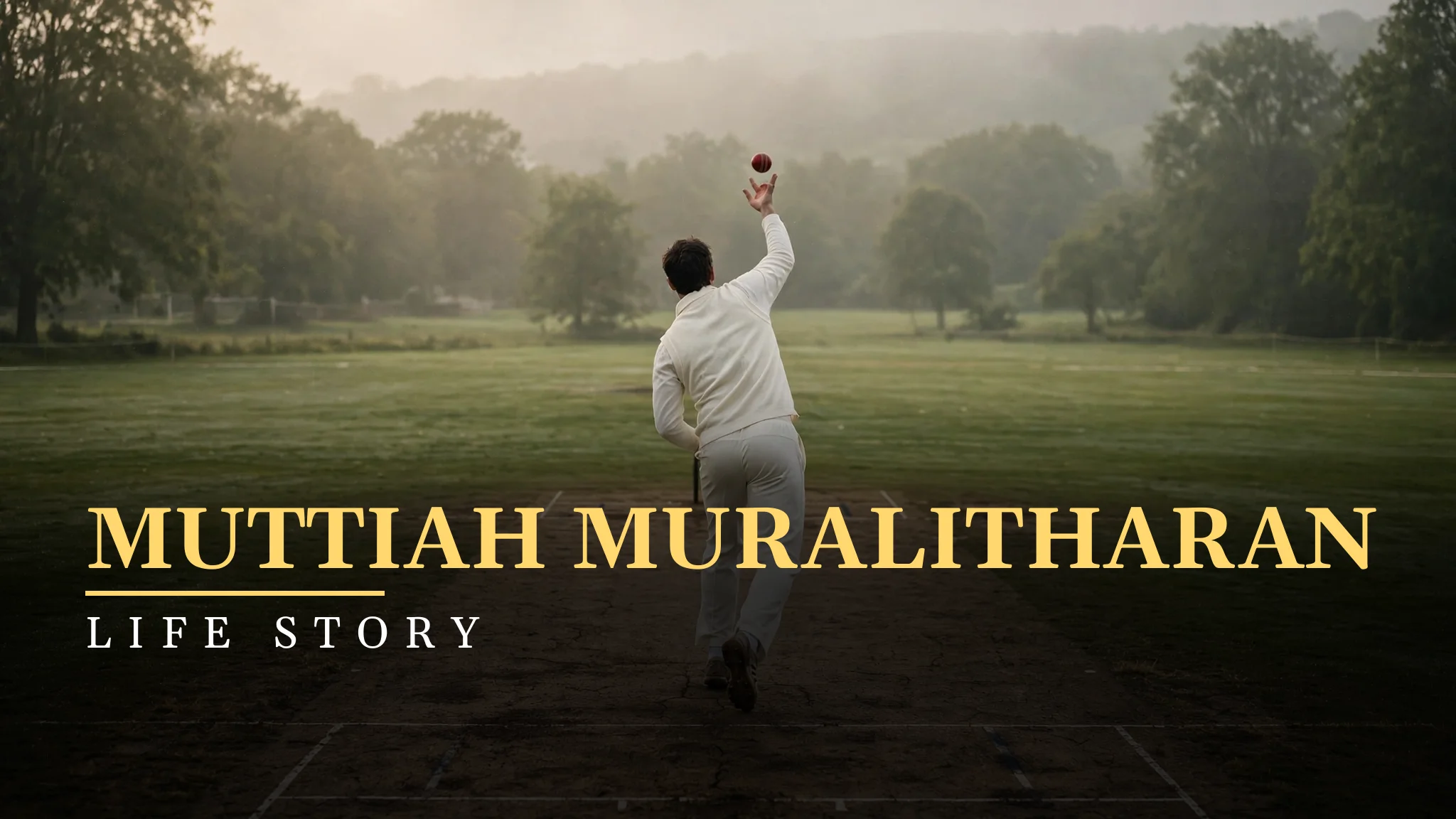
In the end, I keep returning to the image of a man in white, tossing a red ball high into the air on a misty field, with a smile on his face, and of a crowd watching a spinner who took 800 wickets. It is an image of skill, of joy, and of a bowler who made spin bowling exciting. That is a story I will remember, because it tells me that spin, skill, and resilience, combined with joy, can make a bowler the greatest wicket-taker in history, and can make a career that lasts for a lifetime.
I also think about Murali’s early years, when he was a young bowler in the Sri Lankan team, and about how he handled the pressure of being called for throwing, and how he did not let it destroy him. He worked hard, he went for testing, and he kept bowling, which is a sign of a player who understands that talent is not enough. You need resilience, you need patience, and you need to stay grounded, even when people doubt you. Murali did that, and he became a better bowler because of it, and he remained a respected figure, because fans could see that he was not cheating, despite the doubts.
There is something about his love of his family and his biscuit business background that I find interesting, too, because it shows that he comes from a stable, hard-working family, and that he learned the value of work from his father, who ran a business. He brought that work ethic to cricket, bowling hour after hour, and taking wickets, which is a lesson for young players, that hard work matters, even when you have talent, and that a family that supports you can make a big difference.
I think about his work as a coach after retirement, and about how he shares his knowledge with younger spinners, and how they listen, because they know he has done it himself. He does not try to be controversial. He tries to explain, and he is generous in his praise, which makes him a good teacher. That is a fitting next chapter for a man who was always learning, even when he was at the top, and who now wants to help others to learn, too.
In the end, I think Murali’s story is about a man who spun the ball, who took 800 wickets, and who smiled through everything, by bowling with skill, with resilience, and with joy. That is a story worth remembering, and it is one that I will tell to anyone who wants to understand what a great spinner can be.
I also think about the way Murali handled pressure in big matches, and about how he stayed smiling when others were nervous, which is a quality that is hard to teach. He bowled as if the match was just another game, even when it was a World Cup final, and that calmness helped his team, because it showed them that they could trust him, and that they did not need to panic. That is a lesson I will carry with me, that a smile under pressure is a strength, and that a player who stays calm can help a whole team to stay calm, too. I also think about his 800 wickets, and about how that number will stand for a long time, because it requires a bowler to play for nearly twenty years, to take wickets consistently, and to stay fit, which is a rare combination, and one that Murali achieved with skill, with patience, and with joy.
Frequently Asked Questions
How many Test wickets did Muttiah Muralitharan take in his career?
He took 800 wickets in Test cricket, which is a world record, and he also took 534 wickets in one-day internationals, which is also a world record. He played 133 Test matches for Sri Lanka.
What is the doosra and why was it so effective for Muralitharan?
The doosra is a ball that looks like an off-break but turns the other way, from leg to off, which makes it very hard for a batsman to read. Murali mastered it with his flexible wrist, and it helped him to take many wickets because batsmen played for the wrong turn.
Why was Muttiah Muralitharan’s bowling action questioned?
His elbow was naturally bent, which made his action look unusual, and he was called for throwing by umpires in 1995 and in later years. Biomechanical testing showed his elbow did not straighten beyond the allowed limit, and the International Cricket Council cleared him to bowl.
How did Muttiah Muralitharan reach 800 Test wickets?
He reached 800 in July 2010 in Galle against India, in his last Test match, taking the wicket with his last ball in Test cricket. His teammates lifted him on their shoulders as the crowd celebrated the world record.
Where was Muttiah Muralitharan born and which school did he attend?
He was born on 17 April 1972 in Kandy, Sri Lanka, and he attended St Anthony’s College in Kandy, which is famous for cricket. He played domestic cricket for Central Province before making his Test debut in 1992.
What did Muttiah Muralitharan do after he retired from cricket?
He worked as a spin bowling coach and mentor for Sri Lanka and in the IPL, and he became involved in charity work with the Foundation of Goodness, helping young people in Sri Lanka with education and sport.


