Nana Mouskouri: The Life Story Behind Greece's Golden Voice
In this post
- A Girl From Crete Who Loved to Sing
- The White Rose of Athens and a First Great Success
- Only Love and the Years of World Fame
- A Voice for Children and a Life in Public Service
- The Legacy of Greece’s Golden Voice
- Singing in Many Languages for the Whole World
- Farewell Tours, Comebacks, and a Voice That Would Not Stop
- My Take:
Nana Mouskouri is one of the most successful singers the world has ever known. She has sung in many languages, she has sold hundreds of millions of records, and she has performed in concert halls around the globe. Her voice is clear, gentle, and instantly recognisable, and her black-rimmed glasses became as famous as her singing. She is a Greek singer who became a world star, and she did it without shouting, without scandal, and without ever losing the quiet dignity that has marked her whole career. Her story is the story of a girl from Crete who learned to sing, who refused to give up, and who became a voice that the whole world loved.
She was born on 13 October 1934 in Chania, on the island of Crete, and she grew up in a Greece that was going through war and hardship. Her father worked in a cinema, and young Nana grew up listening to music and watching films, and dreaming of a life in song. She studied music in Athens, she learned to sing jazz and classical music, and she began to perform in the late 1950s. Her first great success came with The White Rose of Athens, a song that became a hit in Germany and in many other countries. After that, there was no stopping her. She sang in Greek, French, English, German, Spanish, Italian, and many other languages, and audiences everywhere loved her.
Her career has lasted for more than sixty years, and it has included not only music but also public service. She became a goodwill ambassador for UNICEF, and she served as a member of the European Parliament for Greece. She is a singer who has used her fame to help others, and who has done it with the same quiet grace that marks her singing. This is the story of how a girl from Crete became one of the great voices of the twentieth century.
A Girl From Crete Who Loved to Sing
Ioanna Mouskouri, known to the world as Nana Mouskouri, was born on 13 October 1934 in Chania, on the island of Crete. Crete is a large island in the south of Greece, with mountains, olive groves, and a long history of music and poetry. Nana grew up in a family where music was loved, and her father worked as a projectionist in a cinema, so she spent much of her childhood listening to music and watching films. The cinema was a place of magic for her, a place where songs and stories came alive, and she dreamed of being part of that magic herself.
Her childhood was not easy. Greece was occupied during the Second World War, and the years that followed were hard. But music was a comfort, and Nana found that she had a voice that people wanted to hear. She sang at home, she sang at school, and she began to believe that singing could be her life. Her family moved to Athens, and there she had the chance to study music seriously. She went to the Athens Conservatoire, where she studied classical singing, and she learned the discipline of a trained singer: how to breathe, how to use her voice, and how to sing with control and with feeling.
At the conservatoire, she also discovered jazz, a music that was new and exciting, and that gave her a freedom that classical music did not always allow. She loved the way jazz singers could play with a melody, could sing softly and then strongly, and could make a song their own. She began to sing jazz in clubs in Athens, and she learned how to perform in front of a live audience. Those early years were a time of learning, and they gave her a voice that was both trained and free, a voice that could sing a classical song, a jazz song, or a Greek folk song, and make each one sound natural.
The Athens of the 1950s was a city full of music, and Nana was part of it. She sang in clubs, she worked with other musicians, and she began to build a reputation. She was a young woman with a clear voice, with black-rimmed glasses that would become her trademark, and with a quiet determination to succeed. She did not want to be a star for a season. She wanted to be a singer for a lifetime, and she was willing to work for it. That determination would carry her through the next sixty years.
The White Rose of Athens and a First Great Success
Nana Mouskouri’s first major success came in the early 1960s, with the song The White Rose of Athens. The song was a German version of a Greek song, and it became a huge hit in Germany, selling more than a million copies. For a young Greek singer, this was a remarkable achievement. She had sung a song in a language that was not her own, and audiences in a foreign country had loved it. The song’s success opened the door to a career in Germany, and then to a career around the world. It showed that her voice could cross borders, and that a song sung with feeling could be understood in any language.
She also represented Luxembourg at the Eurovision Song Contest in 1963, singing A Force de Prier, and although she did not win, the contest brought her to the attention of audiences across Europe. Eurovision was, and still is, one of the biggest television events in Europe, and a singer who performs there is seen by millions of people. Nana’s performance was graceful and sincere, and it added to her growing reputation. She was becoming known not only in Greece and Germany, but across the whole of Europe, as a singer of rare clarity and warmth.
In the years that followed, she recorded albums in many languages, and she toured in many countries. She sang in French, and she became especially loved in France, where her gentle voice and her elegant style made her a star. She sang in English, in German, in Spanish, in Italian, and in many other languages, and in each one she sang with the same care and the same feeling. She did not just translate her songs. She learned each language well enough to sing it as if it were her own, and audiences in each country felt that she was singing for them. That ability to sing in many languages is one of the most remarkable parts of her career, and it is why she became a world singer, not only a Greek singer.
By the end of the 1960s, Nana Mouskouri was one of the most popular singers in Europe. She had hits, she had sold millions of records, and she had a loyal audience in many countries. But she was not content to rest. She kept recording, she kept touring, and she kept learning new songs in new languages. Her career was built on hard work, on a beautiful voice, and on a willingness to travel the world and to sing for anyone who wanted to listen.
Only Love and the Years of World Fame
In the 1980s, Nana Mouskouri had one of her biggest successes with the song Only Love, which became a hit in Britain and in many other countries. The song is a gentle, romantic ballad, and it suited her voice perfectly. It reached the top of the charts in Britain, and it introduced her to a new generation of listeners who had not heard her earlier work. The song’s success showed that, even after more than twenty years in music, she could still have a major hit, and that her voice still had the power to move people. It was a remarkable achievement, and it confirmed her place as one of the great singers of her time.
Her concerts in this period were major events. She performed in the great concert halls of the world, including the Royal Albert Hall in London and the Olympia in Paris, and she drew audiences who came to hear her clear, gentle voice. Her concerts were not loud shows. They were quiet, elegant evenings, with Nana singing song after song, in many languages, and with the audience listening in silence and then applauding with warmth. She was a performer who did not need a big production. She needed only her voice, her glasses, and her songs, and that was enough to fill a hall.
She also became known for her recordings of songs by other writers, including the songs of the Greek composer Manos Hadjidakis, with whom she had worked early in her career. Hadjidakis was one of Greece’s greatest composers, and his songs, with their gentle melodies and their poetic words, suited Nana’s voice perfectly. She sang his music throughout her career, and she helped to make it known around the world. Her work with Hadjidakis is one of the most important parts of her legacy, because it links her to the great tradition of Greek song, and it shows her as a singer who honoured her roots even as she became a world star.
By the end of the twentieth century, Nana Mouskouri had sold hundreds of millions of records, and she was one of the best-selling singers in history. The exact number is often debated, but there is no doubt that her sales place her among the most successful recording artists of all time. She had achieved this not by chasing fashion, but by singing beautiful songs, in many languages, with a voice that people trusted. That is a career that few singers can match, and it is one that will be remembered for a long time.
A Voice for Children and a Life in Public Service
Nana Mouskouri’s fame gave her a platform, and she used it to help others. In 1993, she became a goodwill ambassador for UNICEF, the United Nations children’s fund, and she worked to raise awareness of the needs of children around the world. She travelled, she spoke, and she sang for UNICEF, and she used her voice to draw attention to children who were suffering. That work was not a side project. It was a central part of her life, and it showed that she believed a singer’s fame should be used for good, not only for personal success.
She also entered politics, serving as a member of the European Parliament for Greece from 1994 to 1999. It was an unusual step for a singer, but it was a natural one for Nana, who had always been interested in the world and in helping others. In the European Parliament, she worked on cultural issues, and she spoke for the arts and for the needs of children. She did not seek power for its own sake. She sought a way to serve, and she used her time in politics to do that. Her colleagues respected her, and her work there added another dimension to a life that was already remarkable.
Her public service also included work for her own country, Greece, and for the Greek people. She was proud to be Greek, and she carried Greece with her wherever she sang. Her songs in Greek, her work with Greek composers, and her love of her homeland were always part of her identity, even as she sang in many other languages. She was a Greek singer who became a citizen of the world, and she never forgot where she came from. That balance, between the world and home, is one of the most admirable parts of her life.
In her later years, she has continued to sing, to record, and to perform, although she has slowed down. She announced a farewell tour, and then she continued to sing, because her audiences did not want her to stop, and because she did not want to stop either. A singer who has sung for more than sixty years does not stop easily. The voice is a part of her, and the songs are a part of her life. She has given her life to music, and music has given her a life that few people can imagine.
The Legacy of Greece’s Golden Voice
Nana Mouskouri’s legacy is the legacy of a voice that the whole world loved. She sang in many languages, she sold hundreds of millions of records, and she performed in concert halls on every continent. She showed that a singer from a small country, from an island in the Mediterranean, could become a world star, and could do it with grace, with dignity, and with a voice that was gentle rather than loud. That is a legacy that will last, because her recordings will be listened to for generations, and her songs will continue to be sung.
Her legacy is also a legacy of service. She used her fame to help children, to serve in the European Parliament, and to speak for culture and for the arts. She showed that a singer can be more than an entertainer. She can be a citizen, a servant, and a voice for those who have no voice. That is a rare and admirable thing, and it is part of why she is respected not only as a singer, but as a person. Her life is a lesson in how to use fame well, and how to give back to the world that gave you so much.
For young singers, especially young Greek singers, Nana Mouskouri is an example of what is possible. She came from Crete, she studied in Athens, she sang in Paris and London and New York, and she did it all while staying true to herself. She did not change her style to please the market, she did not lose her dignity, and she did not forget her roots. She sang beautiful songs, in many languages, and she let her voice do the work. That is a lesson that will inspire singers for a long time.
Her story is still going on, and her songs are still being heard. The girl from Chania who loved to sing became a woman whose voice is known around the world, and she did it by working hard, by singing with feeling, and by never giving up. That is a full life, and it is a life worth celebrating. Nana Mouskouri is Greece’s golden voice, and the world is richer for having heard it.
Singing in Many Languages for the Whole World
Nana Mouskouri’s ability to sing in many languages is one of the most remarkable parts of her career, and it deserves a closer look. She sang in Greek, French, English, German, Spanish, Italian, Portuguese, and many other languages, and in each one she sang with a care that made the audience feel she was singing for them. Learning a song in a new language is not only about learning the words. It is about learning the sound of the language, its rhythm, and its feeling, and about making it sound natural. Nana did that again and again, for decades, and she did it because she wanted to reach people in their own tongue. That is a generous act, and it is why audiences in so many countries felt that she was their singer.
Her French career was especially important. She became a beloved figure in France, where her gentle voice and her elegant style made her a star. She recorded many albums in French, she performed at the Olympia in Paris, one of the most famous concert halls in the world, and she was loved by French audiences as if she were one of their own. That love was mutual. Nana loved France, its music, and its people, and she gave French audiences some of her finest performances. Her French songs are among her best-known recordings, and they show a singer who could move between cultures with grace.
She also sang in German, where her career had begun with The White Rose of Athens, and in English, where Only Love became a major hit. In each country, she learned the music, she learned the language, and she gave her audience the respect of singing in their own words. That respect is part of why she became a world singer, not only a Greek singer. She did not expect the world to come to her. She went to the world, and she sang to it in its own languages. That is a lesson in humility and in hard work, and it is one reason her career lasted so long and reached so far.
Her multilingual career also showed that music can cross borders that politics cannot. In a Europe divided by languages, Nana’s voice was a bridge. A German listener, a French listener, and a Greek listener could all hear the same voice, and all feel that it was singing for them. That is a powerful thing, and it is a reminder that art can unite people in a way that nothing else can. Nana’s career is proof of that, and it is a legacy that goes beyond record sales. It is a legacy of understanding, of a voice that spoke many languages and that was understood in all of them.
Farewell Tours, Comebacks, and a Voice That Would Not Stop
In her later years, Nana Mouskouri announced farewell tours, and then she continued to sing, because her audiences did not want her to stop, and because she did not want to stop either. A singer who has sung for more than sixty years does not stop easily. The voice is a part of her, and the songs are a part of her life, and to stop singing would be to stop being herself. Her farewell concerts were emotional events, with audiences singing along to the old songs, and with Nana singing them with the same warmth she had always had. Those concerts were celebrations, not endings, because the songs did not end when the tour ended. They lived on, in recordings, in memory, and in the hearts of her fans.
Her comebacks also showed something important about her relationship with her audience. When she returned to the stage after announcing a farewell, her audiences welcomed her back with joy, not with disappointment. They did not feel cheated. They felt glad, because they loved her voice and they wanted to hear it again. That welcome is a sign of how deeply she is loved. An audience that forgives a farewell and welcomes a return is an audience that loves the singer, not only the show, and Nana’s audiences love her in that way.
She has also continued to record in later years, making new albums and revisiting old songs with a voice that has grown richer with age. A voice that has sung for sixty years carries a lifetime of feeling in it, and Nana’s later recordings have a depth that her early ones did not. They are the work of a woman who has lived, who has loved, who has lost, and who has kept singing through it all. That depth is audible, and it is why her later work is worth listening to, even for fans who know her early hits by heart.
In the end, her long career, with its farewells and its comebacks, is a story of a voice that would not stop, and of an audience that would not let it stop. She has sung for more than sixty years, and she has done it with grace, with dignity, and with a love of music that has never faded. The girl from Crete who loved to sing became a woman whose voice is known around the world, and she is still singing, still sharing her songs, and still touching the hearts of people who hear her. That is a remarkable life, and it is one that deserves to be celebrated.
My Take:
When I think about Nana Mouskouri, I think about a voice that is like clear water. It is not loud, it is not showy, and it does not try to impress you. It simply flows, clearly and gently, and it carries the song to you. I think that is a rare kind of singing, because most singers today try to be loud, to show off their power, and to make a big impression. Nana does the opposite. She sings quietly, and she lets the song speak, and the audience leans in to listen. That is a brave way to sing, and it is a way that shows great confidence. She does not need to shout to be heard. Her voice is heard because it is beautiful, and because it is true.
I think about her glasses, and about how they became a part of who she is. A singer’s glasses are not usually famous, but Nana’s black-rimmed glasses are known around the world. They are a sign of her style, a style that is simple, elegant, and a little shy. She did not try to be a glamorous star in the usual way. She was herself, with her glasses, with her long hair, and with her gentle voice, and the world loved her for it. I think that is a lesson: you do not need to change yourself to be loved. You need to be yourself, and to do your work well, and the world will come to you. Nana did that, and the world came.
What I like most about her career is that she sang in so many languages. Greek, French, English, German, Spanish, Italian, and many more, each one sung with care, as if it were her own language. I think about how hard that must have been. Learning a song in a new language is not only about learning the words. It is about learning the feeling of the language, the way it sounds, and the way it moves. Nana did that again and again, for decades, and she did it because she wanted to sing for people in their own language. That is a generous act, and it is why audiences in so many countries felt that she was singing for them. She was, and they knew it.
I think about The White Rose of Athens, and about how a song can change a life. A young Greek singer sings a song in German, and suddenly she is famous in Germany, and then in the world. That must have felt like a miracle, and it was the beginning of a career that would last for sixty years. I think about the courage it took to sing in a foreign language, to trust that the feeling would come through even if the words were new. Nana trusted, and the feeling did come through, and the audience loved it. That is a lesson about taking a chance, and about believing that music can cross any border.
I also think about Only Love, and about how a singer can have a major hit after more than twenty years in music. That is not common. Most singers have their hits when they are young, and then they fade. Nana had a hit in the 1980s that introduced her to a new generation, and it showed that her voice had not lost its power. I think that is because her voice was never about fashion. It was about beauty, and beauty does not go out of fashion. A beautiful voice, singing a beautiful song, will always find listeners, no matter how many years have passed. Nana’s voice is proof of that.
I think about her work for UNICEF, and about how she used her fame to help children. That is a part of her story that I admire deeply. A singer who has sold hundreds of millions of records could easily live a life of comfort and ignore the world. Nana did not. She travelled, she spoke, and she sang for children who needed help, and she did it with the same quiet grace that marks her singing. I think that is the best use of fame: to give it away, to use it for others, and to make the world a little better. She did that, and she did it without making a show of it. That humility is part of who she is.
I think about her time in the European Parliament, and about how unusual it is for a singer to become a politician. It would have been easy for her to stay in the world of music, where she was loved and safe. Instead, she stepped into politics, and she worked for culture and for children. I respect that, because it shows that she cares about more than her own career. She cares about the world, and she was willing to do the hard work of politics to make it better. That is a brave choice, and it is one that few singers would make. She made it, and she did it well.
There is a sadness in her story too, and it is the sadness of a life lived far from home. Nana has spent most of her life travelling, singing in foreign countries, and living away from Greece. That must sometimes feel lonely, to be loved by the world but to be far from the island where you were born. I think about that, and I feel sympathy for her, because a life of travel is a life of goodbyes. But I also think she carried Greece with her, in her songs, in her language, and in her heart, and that home was never truly far away. Her Greek songs were always a part of her, and they kept her close to Crete, no matter where she sang.
I think about young singers who look at Nana and see what is possible. A girl from Crete can become a world star, can sing in many languages, can sell millions of records, and can do it all with dignity and with grace. That is a powerful example, and it is one that will inspire singers for a long time. She did not do it by being loud or by being scandalous. She did it by singing beautifully, by working hard, and by being true to herself. That is a lesson that matters, not only for singers, but for anyone who wants to build a life on talent and on hard work.
If I have a criticism, it is not a criticism of Nana herself. It is a sadness that the world of music today does not always value a voice like hers. Today, singers are often judged by how loud they are, by how many followers they have, and by how much noise they make. A quiet, gentle voice like Nana’s might be overlooked. I think that is a loss, because the world needs quiet voices, voices that sing beautifully and that ask the audience to listen. I hope young listeners discover her, because they will find a voice that is worth hearing, and songs that are worth learning.
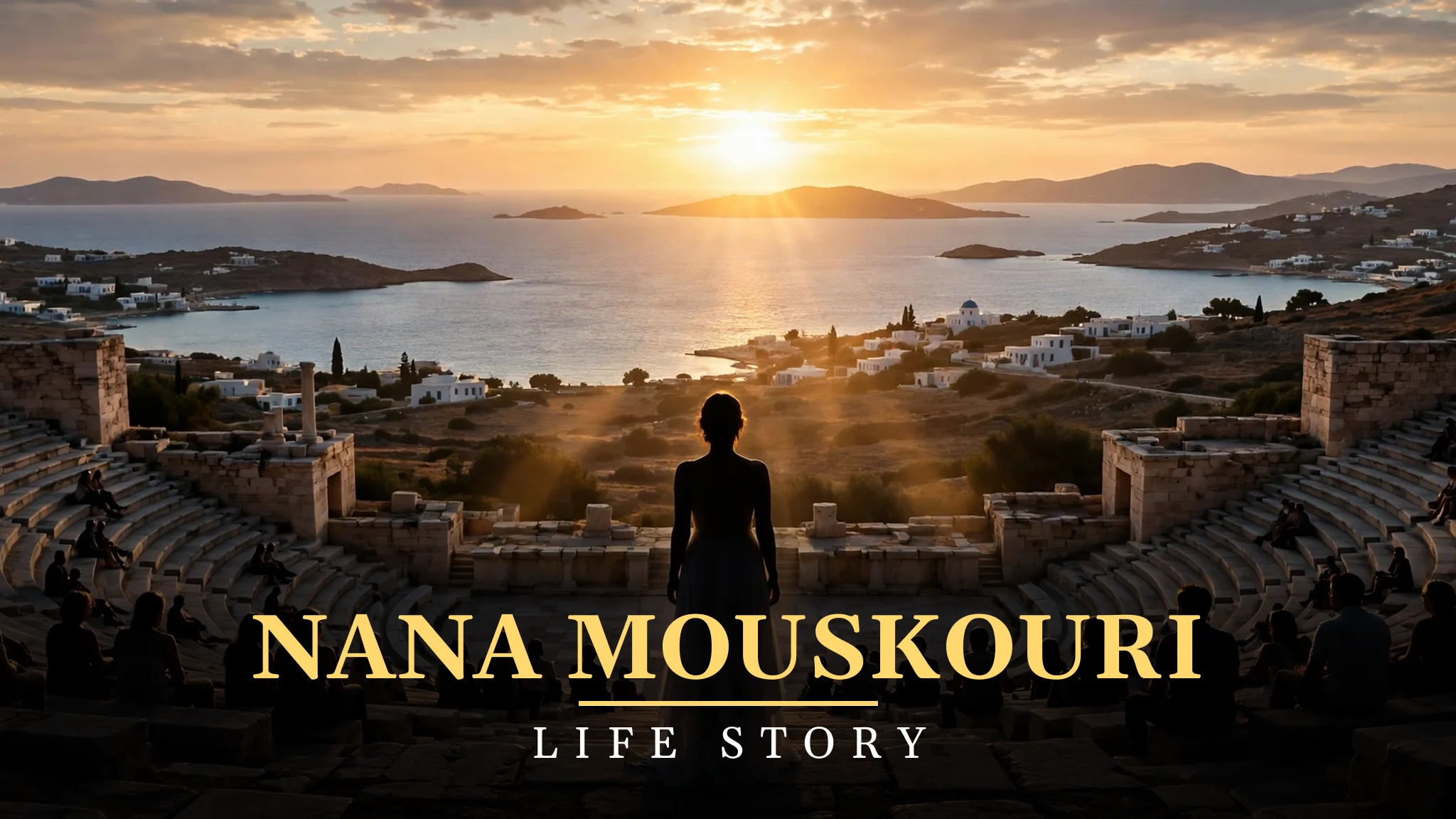
One more thought stays with me, and it is about the image of a woman in a white dress, standing in an ancient amphitheatre at sunset, with the sea behind her. That image fits Nana, because she is a singer who belongs to Greece, to its ancient theatres, to its islands, and to its sea. She is a voice that comes from that place, and that carries it with her wherever she goes. When she sings, you can hear the sea, and the islands, and the long history of Greek song. That is a beautiful thing, and it is why her voice will be remembered long after the charts have forgotten her.
In the end, I think Nana Mouskouri teaches us that a gentle voice can travel the world, and that a singer who is true to herself can be loved in many languages and in many countries. She was a girl from Crete who learned to sing, she sang The White Rose of Athens, she sang Only Love, she helped children through UNICEF, and she served her country in Europe. She did it all with grace, with dignity, and with a voice that is like clear water. I would tell a new listener to start with Only Love, then to listen to The White Rose of Athens, and then to hear her Greek songs, and to listen quietly. You will hear a voice that has sung for more than sixty years, and that still sings with beauty and with truth. That is Nana Mouskouri, Greece’s golden voice.
I think about her farewell tours, and about how hard it must be for a singer to say goodbye to the stage. The stage is a singer’s home, and the audience is her family, and to leave them is to lose a part of yourself. Nana announced farewells, and then she came back, because the stage kept calling her, and because her audiences kept calling her. I think that is a beautiful thing, and it shows that her love of singing is not about fame. It is about the act itself, about standing in front of people and sharing a song. A singer who loves singing that much will never truly stop, and Nana has not stopped.
I also think about the many languages she sang in, and about the respect that shows. To learn a song in a new language is to say to an audience, I care enough about you to sing in your words. Nana said that again and again, in French, in German, in English, and in many other languages, and audiences felt that care. I think that is a lesson for anyone who wants to reach people: speak to them in their own language, and they will listen. Nana did that, and the world listened to her, in many languages, for more than sixty years.
I think about her glasses again, and about how they became a symbol of her style. In a world where singers are often judged by how they look, Nana’s glasses were a quiet statement: I am myself, and I do not need to change to be loved. She wore them, she sang, and the world loved her for it. I think that is a powerful lesson, especially for young people who feel pressure to look a certain way. You do not need to change yourself. You need to be yourself, and to do your work well, and the world will come to you. Nana proved that, with her glasses, her voice, and her songs.
I think about the children she helped through UNICEF, and about how her fame became a tool for good. A singer who has sold hundreds of millions of records could easily live a life of comfort and ignore the world. Nana did not. She travelled, she spoke, and she sang for children who needed help, and she did it with the same quiet grace that marks her singing. I think that is the best use of fame, and it is a part of her story that deserves to be remembered as much as her songs.
One more thought stays with me, and it is about Crete, the island where she was born. Crete is a place of mountains, of olive groves, and of a long history of music, and Nana carried it with her wherever she sang. Her Greek songs are a part of that island, and they keep it alive in the hearts of people who hear them. When I think of her, I think of a girl from Chania, singing in a cinema where her father worked, dreaming of a life in music, and I am glad that her dream came true, and that the world got to hear her voice.
I think about the long arc of her career, from a girl singing in a cinema in Crete to a woman singing in the great halls of the world, and about how that arc was built on hard work, on a beautiful voice, and on a willingness to travel and to learn. It was not built on luck. It was built on decades of singing, of recording, and of performing, and that is a lesson for anyone who dreams of a long career. A long career is made one song at a time, one concert at a time, and Nana made hers that way.
I also think about the listeners who will discover her in the future, young people who have never heard her voice, and about what they will find. They will find a voice that is clear and gentle, songs that are beautiful in many languages, and a singer who gave her life to music and to helping others. I hope they listen, because they will find something worth hearing, and they will understand why the world loved Nana Mouskouri for more than sixty years.
Frequently Asked Questions
When and where was Nana Mouskouri born?
Nana Mouskouri was born on 13 October 1934 in Chania, on the island of Crete, Greece. She grew up in a family where music was loved, and she later moved to Athens to study music at the conservatoire.
What is Nana Mouskouri’s most famous song?
The White Rose of Athens was her first major international hit, and Only Love became a big hit in Britain in the 1980s. Both songs are among her best-known recordings, and she has sung many other songs in many languages.
How many languages has Nana Mouskouri sung in?
She has sung in many languages, including Greek, French, English, German, Spanish, and Italian, among others. Her ability to sing in so many languages helped her to become a world star, loved by audiences in many countries.
Did Nana Mouskouri work for UNICEF?
Yes, she became a goodwill ambassador for UNICEF in 1993, working to raise awareness of the needs of children around the world. She also served as a member of the European Parliament for Greece from 1994 to 1999.
How many records has Nana Mouskouri sold?
She is reported to have sold hundreds of millions of records, making her one of the best-selling singers in history. Her long career and her recordings in many languages helped her to reach audiences around the world.
Is Nana Mouskouri still singing?
She has continued to sing and to perform over a career of more than sixty years, although she has slowed down in later years. Her concerts and her recordings remain loved by audiences in many countries.


