Nanni Moretti: The Life Story Behind Italy's Independent Director
In this post
- Born in the Mountains, Raised in Rome
- A Small Camera, a Big Dream, and Ecce Bombo
- Caro Diario and Riding Through Rome on a Vespa
- The Son’s Room and the Palme d’Or
- Il Caimano, Habemus Papam, and Fighting for His Country
- Mia Madre, Tre Piani, and the Later Films
- The Cinema Owner, the Festival, and a Life of Independence
- Sacher, the Cinema, and the Fight for Italian Film
- My Take:
Nanni Moretti is the most independent filmmaker in Italy, and perhaps one of the most independent in the world. He writes his own films, he directs them, he often stars in them, and he produces them through his own company, so that no one can tell him what to make. For almost fifty years he has made films about his own life, his own city, and his own country, and he has done it in his own way, with a mix of comedy and sadness that no one else can copy. He is not a director who chases fashion. He is a director who tells the truth as he sees it, and then waits to see who agrees.
He was born in the mountains of northern Italy and grew up in Rome, where he learned to love the cinema, the streets, and the game of water polo. As a young man he picked up a small film camera and started to make short films about himself and his friends, with almost no money and no permission from anyone. Those little films became the start of one of the great careers in European cinema, a career that would win the Palme d’Or at Cannes and the love of audiences who recognised their own lives in his work.
Moretti is also a man of strong opinions. He has argued with politicians, with other filmmakers, and with the whole Italian film industry, and he has never been afraid to say what he thinks. He built his own cinema in Rome, he runs his own film festival, and he has kept his freedom in a business that usually takes it away. This is the story of how a stubborn young man from Rome became the conscience of Italian cinema.
Born in the Mountains, Raised in Rome
Giovanni Moretti, known to everyone as Nanni, was born on 19 August 1953 in Brunico, a small town in South Tyrol, in the mountains of northern Italy. His father, Luigi Moretti, was a professor, and his mother was a teacher. The family moved to Rome when Nanni was still a child, and Rome became his real home. He grew up in the city in the 1960s, a time when Italy was changing fast, when young people were asking new questions about politics, about freedom, and about how to live.
As a boy, Moretti loved two things: cinema and water polo. He was a talented water polo player, and he played the sport seriously as a teenager, training in the pool and learning what it meant to be part of a team. Water polo is a hard and physical game, and it taught him discipline and toughness. He has said that the sport shaped him, because it taught him to fight for something and to keep going when he was tired. The pool and the cinema were the two places where he felt most himself.
Rome in those years was full of cinemas, and a young person could see films from all over the world. Moretti watched them all, and he began to dream of making his own. He did not go to film school. He did not have money or connections. He had something else: a strong will, a camera, and a group of friends who were willing to act in his films for nothing. That was enough to start, and starting was the most important thing.
His family supported him, even when his path was unusual. His father was a man of learning, and he taught his son to think for himself and to ask questions. Moretti grew up in a home where ideas mattered, where books were read and argued about, and where a young person was expected to have opinions. That home gave him the confidence to make films that were personal, even when the film world told him that personal films would never find an audience.
A Small Camera, a Big Dream, and Ecce Bombo
In the early 1970s, Moretti began to make short films with a Super 8 camera, a small and cheap camera that many young people used at the time. His first short films were about himself and his friends, about the life of young people in Rome, and about the politics of the time. They were rough and simple, but they had something that professional films often lack: they felt true. The people on screen talked the way real people talk, and they worried about the things real young people worry about.
His first feature film, Io sono un autarchico, I Am Self Sufficient, came out in 1976. Moretti was only twenty-three years old. He wrote it, directed it, and played the main role, a young man who tries to live his life without depending on anyone, and who discovers that independence is harder than it looks. The film was made with almost no money, and it was shown in small cinemas, but people who saw it recognised a new voice. Here was a young director who was not copying anyone, who was filming his own life and his own generation.
Two years later, in 1978, he made Ecce bombo, a film about a group of young people in Rome who talk endlessly about politics, about love, and about the future, but who never seem to do very much. The film was a success, and it made Moretti famous in Italy. Young audiences saw themselves in it, because they too spent their days talking about changing the world and their nights wondering why nothing changed. The film’s title became a phrase that Italians still use, and Moretti became the voice of his generation.
What made these early films special was that Moretti played himself, or a version of himself, in all of them. He was not pretending to be someone else. He was standing in front of the camera and saying: this is who I am, this is how I live, this is what I think. That honesty was new in Italian cinema, and it was brave, because it meant that the audience could judge him as a person, not just as a director.
Caro Diario and Riding Through Rome on a Vespa
Through the 1980s, Moretti made a series of films that mixed comedy and politics, including La messa è finita in 1985, a film about a priest who returns to Rome after years away and finds a city that has changed. He also made films about his own fears, his own family, and his own country, always with the same direct and personal style. He founded his own production company, Sacher Film, so that he could make his films without asking permission from the big studios, and he bought a cinema in Rome, the Nuovo Sacher, where he could show the films he loved.
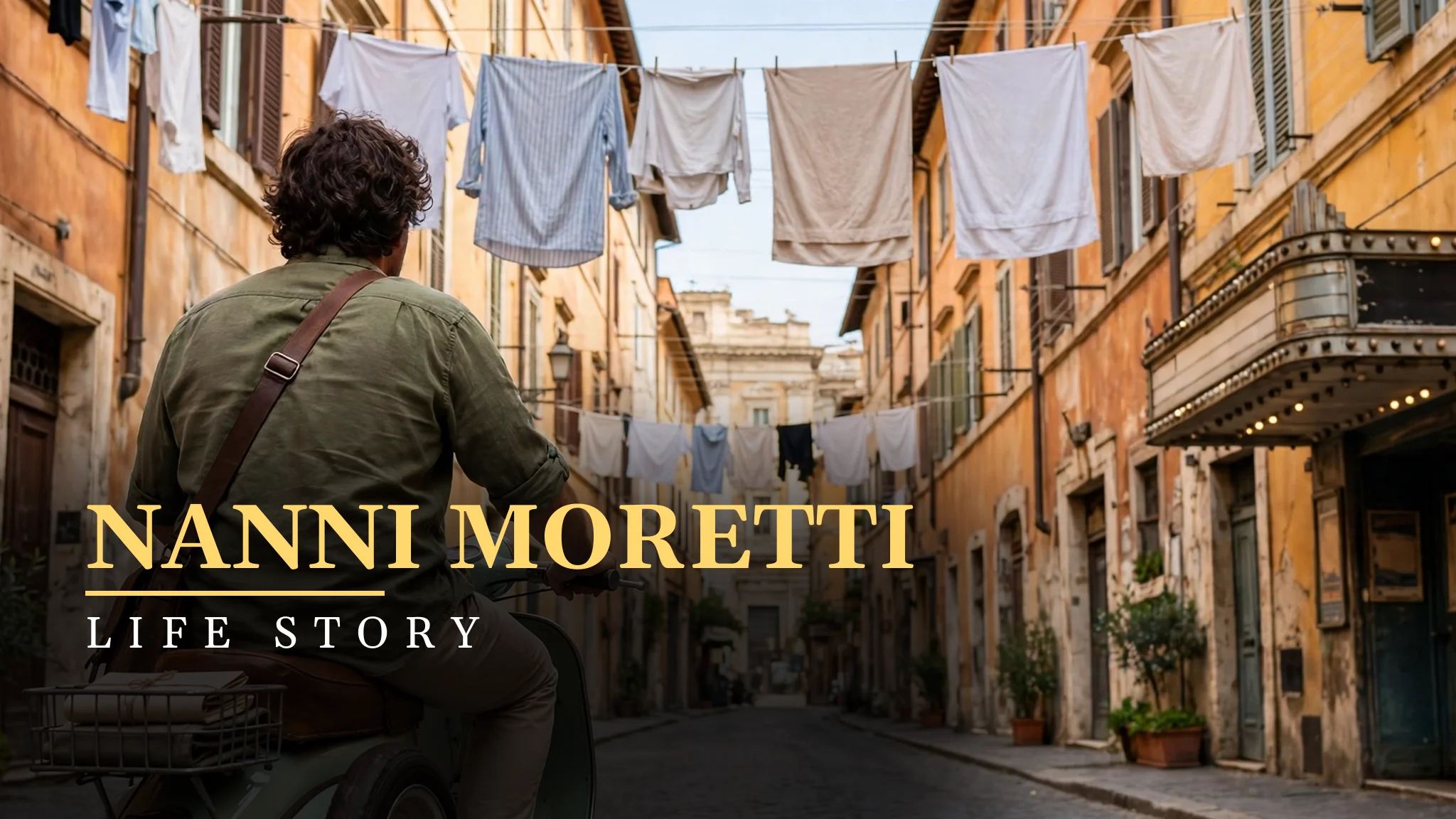
In 1993 he made Caro diario, Dear Diary, the film that many people consider his masterpiece. The film is in three parts. In the first, Moretti rides his Vespa through the streets of Rome in the summer, visiting the places he loves and talking to the camera about his life. In the second, he travels to the Aeolian Islands with a friend, looking for a quiet place to work. In the third, he tells the story of his own illness, when doctors could not find what was wrong with him, and he had to fight to be heard.
Caro diario won the Best Director prize at the Cannes Film Festival, and it made Moretti known around the world. The Vespa ride through Rome became one of the most famous scenes in Italian cinema, because it captured something that every Roman knows: the joy of moving through a beautiful city on a summer day, with the wind in your face and the whole city open in front of you. The film is funny and sad at the same time, and it shows Moretti at his best, talking directly to the audience as if they were old friends.
The third part of the film, about his illness, is the most moving. Moretti had suffered from a skin condition that doctors could not diagnose, and he had to visit many doctors before someone finally listened to him. He turned that painful experience into art, and he used it to say something about how patients are treated, and about how important it is to listen. It was a brave thing to do, and it made the film feel deeply personal, in a way that few films ever do.
The Son’s Room and the Palme d’Or
In 2001, Moretti made La stanza del figlio, The Son’s Room, a film that was very different from his earlier work. It is the story of a family in Ancona, a father who is a psychoanalyst, a mother, and two teenage children. One day, their son Andrea dies in a diving accident, and the family must learn how to live with a loss that cannot be fixed. The film is quiet, slow, and deeply sad, and it shows a family trying to hold together when the centre of their life has gone.
Moretti played the father himself, and his performance is one of the most restrained and moving of his career. He does not cry loudly or make big speeches. He shows a man who does not know what to say, who goes on working, who tries to be strong for his wife and daughter, and who slowly realises that he cannot fix this pain. The film won the Palme d’Or at the Cannes Film Festival, the highest prize in world cinema, and it was a triumph for Moretti and for Italian film.
The Son’s Room showed that Moretti could do more than comedy and politics. He could tell a story about grief with great care and with great respect for the people in it. The film does not offer easy answers. It does not say that time heals all wounds, or that love is enough. It shows a family living with loss, day by day, and it trusts the audience to understand. That trust is one of the things that makes Moretti’s films so powerful.
The film was also a personal one for Moretti, who was by then a father himself. He has a son named Pietro, and he has spoken about how becoming a father changed the way he saw the world. The Son’s Room is, in part, a film about a father’s worst fear, and about what it means to love a child and to know that you cannot always protect him. It is a film that stays with the viewer long after it ends.
Il Caimano, Habemus Papam, and Fighting for His Country
Moretti has never been afraid to make films about Italian politics, and in 2006 he made Il caimano, The Caiman, a film about Silvio Berlusconi, the media tycoon and prime minister who dominated Italian politics for twenty years. The film is about a film producer who tries to make a film about Berlusconi, and it is both funny and angry. Moretti played Berlusconi himself in some scenes, and he used the film to ask how a man like Berlusconi could win power again and again, and what that said about Italy.
The film was controversial, as Moretti knew it would be. Berlusconi’s supporters attacked it, and some people in the film industry said it was too political. Moretti did not care. He believed that a filmmaker has a duty to talk about his country, and that silence is also a choice. Il caimano was a success, and it showed that Moretti was still willing to fight, even when the fight was hard and unpopular.
In 2011 he made Habemus Papam, We Have a Pope, a film about a cardinal who is elected Pope and then panics, because he does not feel worthy of the job. The film is a comedy, but it is also a serious film about power, about faith, and about what it means to be asked to lead. Moretti played a psychoanalyst who is brought in to help the new Pope, and the film is full of gentle humour and quiet sadness. It was shown at Cannes, and it was praised for its originality and its warmth.
These films show the two sides of Moretti: the fighter and the dreamer. He fights for his country, and he dreams about a better one. He makes films about politics because he cares about Italy, and he makes films about ordinary people because he cares about them too. He has never separated the two. For him, politics is not something that happens in Rome. It is something that happens in every home, in every family, and in every life.
Mia Madre, Tre Piani, and the Later Films
In 2015, Moretti made Mia madre, My Mother, a film about a director who is making a film while her mother is dying. The film stars Margherita Buy as the director, and Moretti himself plays her brother. It is a film about work and about death, about trying to finish a job while the most important person in your life is leaving. The film is based on Moretti’s own experience of losing his mother, and it is one of his most personal and most moving works.
Mia madre was praised at Cannes and around the world, and it showed that Moretti was still growing as a filmmaker. He was no longer the young man on the Vespa. He was a man in his sixties, thinking about his parents, about his own age, and about what remains when the people we love are gone. The film is sad, but it is also full of life, because it shows that work and love continue, even in the middle of grief.
In 2021 he made Tre piani, Three Floors, based on the novel by the Israeli writer Eshkol Nevo, a film about three families who live in the same building in Rome and whose lives become tangled together. The film is about secrets, about guilt, and about how the choices we make affect the people who live closest to us. It was a departure for Moretti, because it was based on someone else’s story, but he made it his own, with his usual care for the characters and their inner lives.
In 2023 he made Il sol dell’avvenire, A Brighter Tomorrow, a film about a director who is trying to make a film about Italian communists in the 1950s, while his own life is falling apart. The film is funny and sad, and it is full of Moretti’s love for cinema itself. It is a film about why people make films, and about what cinema can do that nothing else can. It showed that, after almost fifty years, Moretti still loves the work, and still believes in it.
The Cinema Owner, the Festival, and a Life of Independence
Beyond his own films, Moretti has built a small world of his own in Rome. He owns the Nuovo Sacher cinema in the Trastevere district, where he shows films he loves, including the work of young directors who might not find a screen anywhere else. He also runs a film festival, and he has used his production company to help other filmmakers make their films. He has done all of this because he believes that cinema needs places where people can watch films together, in the dark, and talk about them afterwards.
He is also known for his strong opinions about Italian politics and about the state of Italian cinema. He has taken part in public protests, he has spoken out against Berlusconi and against the commercialisation of film, and he has argued with other directors about the future of Italian cinema. Some people find him difficult. Others find him inspiring. No one finds him boring. He has always been willing to say what he thinks, even when it costs him friends or work.
His personal life has been quieter. He was married to Silvia Nono, the daughter of the composer Luigi Nono, and they have a son, Pietro. He has kept his family out of the public eye, and he rarely talks about them. He lives in Rome, he rides his Vespa, he goes to the cinema, and he works on his films. He is, in many ways, the same man he was at twenty-three: stubborn, curious, and determined to do things his own way.
Nanni Moretti’s story is the story of a man who refused to give up his freedom. He could have made bigger films, earned more money, and become more famous, if he had been willing to follow the rules of the film industry. He chose not to. He made his own films, in his own way, about his own life and his own country, and he built a career that no one else could have built. That is a rare achievement, and it is why his name means so much to people who love cinema.
Sacher, the Cinema, and the Fight for Italian Film
Beyond his own films, Nanni Moretti has built a small and stubborn world of his own, a world that exists because he refused to let the film industry decide what cinema should be. In the 1980s, he founded Sacher Film, his own production company, named after the famous Viennese chocolate cake, and he used it to produce his own films and the films of other directors he believed in. He did not want to ask a big studio for money, and then to be told what to change. He wanted to make films his own way, and Sacher Film gave him the freedom to do it.
He also bought a cinema in Rome, the Nuovo Sacher, in the Trastevere district, a neighbourhood of narrow streets, of old houses, and of people who love the cinema. The Nuovo Sacher is not a big multiplex. It is a small and beautiful cinema, with a garden, with a café, and with a programme chosen by Moretti himself. He shows the films he loves there, including the work of young directors who might not find a screen anywhere else, and he talks to the audience, and he listens to what they think. It is a cinema that feels like a home, and it is one of the most loved cinemas in Rome.
Moretti also runs a film festival, and he has used his production company to help other filmmakers, to give them money, advice, and a chance to make their films. He understands that making a film is not enough. You also need a place to show it, and people who believe in it, and a community that cares about cinema. He has built that community, piece by piece, over many years, and he has done it with his own money, his own time, and his own stubbornness.
He is also known for his political engagement. In 2002, he took part in the girotondi, the public protests in which thousands of Italians held hands in a circle around the Palazzo di Giustizia in Rome, to protest against the laws of the Berlusconi government. He has spoken out against the commercialisation of cinema, against the closing of small cinemas, and against a culture that values money more than art. Some people find him difficult, and some find him inspiring, but no one doubts that he believes what he says, and that he is willing to act on it.
His independence has a price. He makes fewer films than other directors, because he works slowly and because he insists on doing things his own way. He does not take money from people who want to control his work, and he does not make films to please an audience. He makes the films he believes in, and he waits to see who agrees. That is a hard way to work, and it is a lonely way, but it is the only way he knows, and it is the reason his films are so honest.
In the end, Moretti’s world, his production company, his cinema, and his festival, is a statement. It says that cinema is not just a business. It is an art, a place, and a community, and it needs people who will protect it, even when it is not profitable, even when it is not fashionable, and even when it is hard. Moretti has protected it for almost fifty years, and that may be as important as any film he has ever made.
My Take:
When I think about Nanni Moretti, I think about a man who never asked for permission. That is a rare thing in life, and it is even rarer in the film business, where so many people spend their whole careers asking for money, asking for approval, and asking for a chance. Moretti started with a small camera and a group of friends, and he just began. He did not wait for someone to tell him he was ready. He decided he was ready, and he proved it by making a film. I admire that more than I can say, because most of us wait too long, and we let the waiting become the whole story.
I think his early films are important because they gave a voice to a generation that had no voice. Young Italians in the 1970s talked a lot about politics, and they dreamed a lot about changing the world, but no one had made a film that showed them as they really were: funny, confused, serious, and a little bit lost. Ecce bombo did that. It did not make fun of those young people, and it did not praise them either. It just showed them, and it let the audience recognise themselves. That is what good art does. It holds up a mirror, and it says, this is you, and it is all right to laugh at yourself, and it is all right to be serious too.
What I love most about Caro diario is the Vespa ride. It is a simple scene, a man riding through Rome on a summer day, and yet it is one of the most joyful scenes I have ever seen in a film. There is no special effect, no big speech, and no drama. There is just a man, a city, and the feeling of being alive. I think that scene works because Moretti loves Rome, and he loves the simple pleasure of moving through it. He does not need to invent a story to make it interesting. He just needs to show what it feels like to be there, and the audience feels it too.
The third part of Caro diario, about his illness, is the part that stays with me longest, because it is about something that happens to so many people. You go to a doctor, and the doctor does not listen. You go to another doctor, and that doctor does not listen either. You know something is wrong, but no one believes you, and you begin to doubt yourself. Moretti turned that experience into a film, and he made it funny and angry and sad all at once. I think that took great courage, because he was talking about his own body, his own fear, and his own anger at a system that did not care. Many people who have been ill have told me that this part of the film made them feel less alone, and that is a wonderful thing for a film to do.
The Son’s Room is a different kind of film, and it is a harder one to watch. It is about the death of a child, and there is no subject more painful than that. What impresses me is how quiet the film is. Moretti does not use music to tell us how to feel. He does not use big scenes of crying. He shows a family eating, working, and trying to go on, and the sadness is in the small things, in the empty chair, in the silence at the table. I think that is the honest way to show grief, because grief is not always loud. Sometimes it is quiet, and it lasts for a long time, and it changes the way a family lives. Moretti understood that, and he trusted the audience to understand it too.
I also think about his political films, and I have mixed feelings about them. On one hand, I admire his courage. Making Il caimano about Berlusconi, when Berlusconi was the most powerful man in Italy, was a brave thing to do. He could have made a safe film instead, and no one would have blamed him. He chose to speak out, and he paid a price for it. On the other hand, I sometimes wish his political films were as good as his personal films. Il caimano is clever and funny, but it does not move me the way The Son’s Room does, because politics is a harder subject to make into art. Still, I respect him for trying, because a filmmaker who cares about his country should talk about it, even when the film is not perfect.
There is something I find inspiring about the way he built his own world. He did not just make films. He bought a cinema, he started a production company, and he helped other filmmakers. He understood that making films is not enough. You also need places to show them, and people to support them, and a community that believes in cinema. That is a practical kind of idealism, and I admire it. Many artists talk about changing the world, but few of them build something real, with walls and seats and a screen, where the change can actually happen.
I also think about his stubbornness, because it is both his greatest strength and his greatest weakness. His stubbornness is what kept him independent, what made him refuse to follow fashion, and what gave his films their honesty. But stubbornness can also make a person difficult to work with, and it can make him refuse to listen when listening would help. I do not know Moretti personally, so I cannot say how stubborn he is in real life. What I can say is that his films show a man who is sure of what he believes, and who is not afraid to say it, and that is a quality I respect, even when I do not always agree with him.
One thing I notice is how much his films are about Rome. Other directors leave their home town and go to Hollywood or to Paris. Moretti stayed in Rome, and he filmed its streets, its piazzas, its cinemas, and its people, again and again. I think that is because Rome is not just a place for him. It is a character in his films, a living thing that changes and stays the same at the same time. He knows the city the way you know a friend, and he films it with love, even when he is angry about what is happening in it. That love of place is something I understand, because we all have a place that shaped us, and we carry it with us wherever we go.
I think his story teaches a simple lesson: do it yourself, and do it your way. You do not need permission. You do not need a big budget. You need an idea, a camera, and the will to begin. Moretti began with almost nothing, and he built a career that won the Palme d’Or. He did it by being honest, by being stubborn, and by refusing to give up his freedom. That is a lesson for anyone who wants to make something, whether it is a film, a book, or a business. Start small, start now, and do not wait for someone else to tell you that you are ready.
In the end, I think Nanni Moretti is one of the most important filmmakers in Europe, not because his films are perfect, but because they are his. No one else could have made them. No one else would have ridden a Vespa through Rome and talked to the camera, or made a film about losing a son with such quiet care, or built a cinema so that other people could show their films. He is a man who made his own way, and who kept his freedom, and that is a rare and precious thing. I will keep watching his films, because I know that each one will be honest, and honesty is the hardest thing to find in cinema, and the most valuable.
There is one more thing I want to say about Moretti, and it is about the Nuovo Sacher cinema. I think about what it means to own a cinema, to choose the films, to open the doors, and to welcome people in, night after night. It is a small thing, and it is a big thing, because a cinema is a place where strangers sit together in the dark and share a story, and that sharing is one of the most human things we do. Moretti understood that, and he built a place for it, and he kept it alive, even when it would have been easier to sell it, or to close it, or to let it become something else. I admire that, because it shows that he cares about cinema not just as an art, but as a place, and as a community.
I also think about his stubbornness, and about how it has shaped his whole life. He is a man who does things his own way, and who does not listen when people tell him to change. That stubbornness has given him his freedom, and it has given his films their honesty, but it has also made him a difficult man, and I am sure he knows that. I think about whether I would want to work with him, and I am not sure. He would be demanding, he would argue, and he would not accept a lazy answer. But I think I would learn a great deal from him, because he cares, and because he does not pretend. I would rather work with a difficult man who cares than with an easy man who does not.
If I could ask him one question, I would ask him about the Vespa, about that ride through Rome in Caro diario, and about whether he knew, when he filmed it, that it would become one of the most famous scenes in Italian cinema. I think he would say no, that he was just riding through the city he loved, on a summer day, and that he wanted to show what it felt like. That is the secret of the scene. It was not planned to be famous. It was planned to be true, and the truth made it famous. That is a lesson for every artist: do not try to be famous. Try to be true, and let the fame come if it comes.
I also think about his son Pietro, and about how becoming a father changed his films. The Son’s Room is a film about a father’s worst fear, and it is a film that only a father could make, a man who knows what it means to love a child, and to know that you cannot always protect him. I think that film is the most personal thing Moretti has ever made, and the most moving, because it comes from a place of love and of fear, and it does not hide either one. I hope his son knows how much that film means, and how much his father loves him.
Another thought that stays with me is about the future of Italian cinema, and about whether there will be another Moretti. I am not sure there will be, because he is a man of a particular time, a time when a young person could pick up a small camera and make a film, and when the world was ready to listen. Today, the film world is different, bigger, faster, and more commercial, and it is harder for a young director to be independent. But I hope there will be young people who learn from Moretti, who start small, who make their own films, and who refuse to give up their freedom. If they do, Italian cinema will survive, and it will be because of him.
I also want to say something about his humour, because people sometimes forget that Moretti is funny. His films are full of jokes, of small and sharp observations about life, about politics, and about himself. He laughs at himself, at his own fears, at his own stubbornness, and that laughter makes his films human. A director who can laugh at himself is a director who can be trusted, because he is not pretending to be perfect. He is showing us who he is, with all his faults, and he is inviting us to laugh with him, and to think with him, at the same time.
Finally, I want to say why I will keep watching his films. It is not because they are perfect, because they are not. It is because they are his, and because no one else could have made them. When I watch a Moretti film, I know that I am watching a man who made his own way, who kept his freedom, and who told the truth as he saw it, even when it was hard, even when it was unpopular. That is a rare and precious thing, and it is worth celebrating, and it is worth remembering, for as long as people watch films and care about honesty.
Frequently Asked Questions
When was Nanni Moretti born and where did he grow up?
Nanni Moretti was born on 19 August 1953 in Brunico, in South Tyrol, Italy. He grew up in Rome, where he fell in love with cinema and played water polo as a young man.
What is Caro diario about?
Caro diario is a 1993 film in three parts: Moretti rides his Vespa through Rome, travels to the Aeolian Islands with a friend, and tells the story of his own illness and his struggle to find a doctor who would listen to him.
Which film won Nanni Moretti the Palme d’Or?
La stanza del figlio, The Son’s Room, won the Palme d’Or at the Cannes Film Festival in 2001. It tells the story of a family whose teenage son dies in a diving accident.
What is the Nuovo Sacher cinema?
The Nuovo Sacher is a cinema in the Trastevere district of Rome that Moretti owns. He shows films he loves there, including the work of young directors, and he also runs his own production company, Sacher Film.
What is Il caimano about?
Il caimano is a 2006 film about Silvio Berlusconi, the media tycoon and prime minister of Italy. It follows a film producer who tries to make a film about Berlusconi, and Moretti plays Berlusconi himself in some scenes.
Did Nanni Moretti start his career with a Super 8 camera?
Yes, he began making short films with a Super 8 camera in the early 1970s, filming himself and his friends in Rome. His first feature film, Io sono un autarchico, came out in 1976 when he was twenty-three.


