Nepal Flash Flood: Budhi Gandaki River Sweeps Away Houses in Gorkha, Five Missing
A flash flood on the Budhi Gandaki river in Nepal's Gorkha district on October 11 swept away around 45 houses and four bridges. Five people are missing, more than 80 were rescued, and officials believe a landslide dam burst caused the sudden surge.
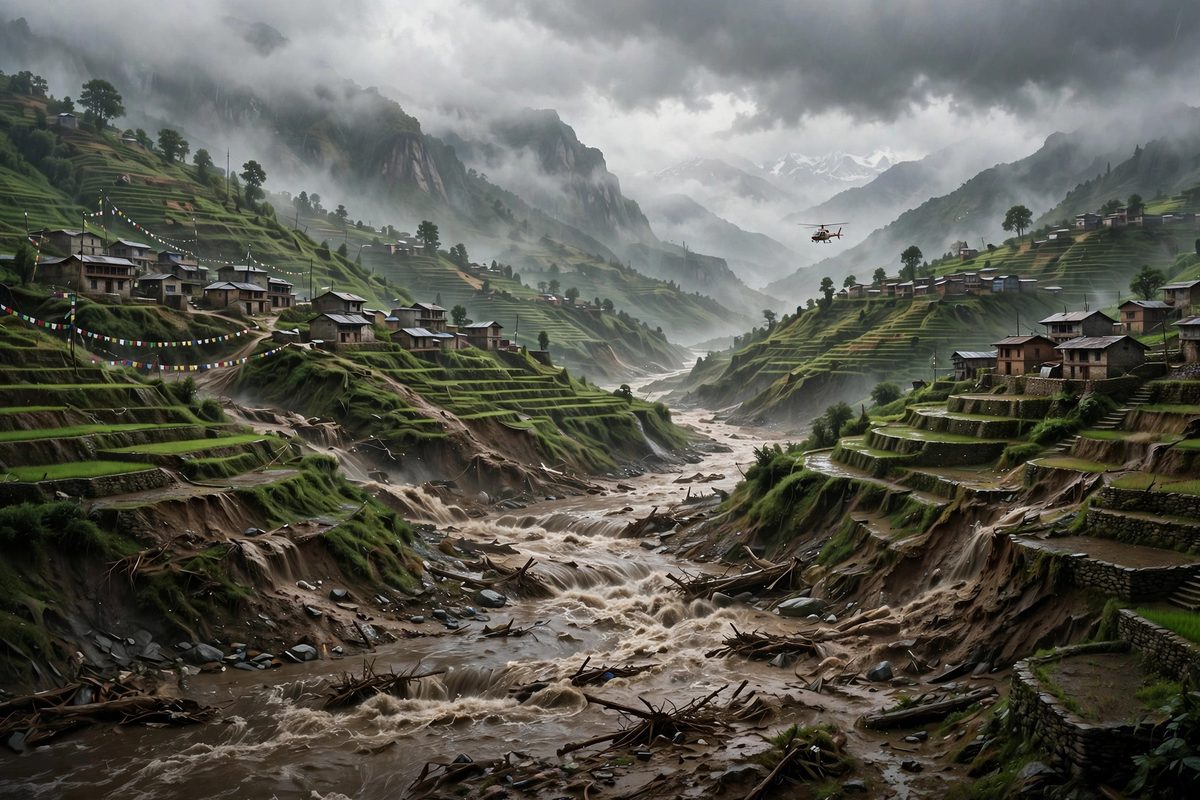
On a normal Sunday morning, the Budhi Gandaki river flows quietly through the steep valleys of Gorkha district in north-central Nepal, passing small bazaars, terraced fields and trailheads leading toward the Manaslu mountains. On October 11, 2026, that quiet ended in minutes. Without any heavy rain falling on the valley, the river suddenly turned black and grey, filled with thick mud, rocks and broken trees, and rose with frightening speed. Within a little over two hours, the water climbed far beyond its danger level, tore through riverside settlements, and swept away around 45 houses. By the end of the day, five people were missing and more than 80 had been rescued.
The short version
A flash flood struck the Budhi Gandaki river in Gorkha district on Sunday, October 11, 2026. Officials believe a dry landslide high in the hills blocked the river and formed a natural dam, and when that dam burst, a sudden wall of muddy water rushed downstream. Around 45 houses were swept away, four bridges were destroyed or damaged and three hydropower projects were hit. Five people — two women and three men — are missing. At least 82 people, including nine foreigners, were rescued, many of them airlifted by Nepal Army helicopters. Remarkably, no deaths have been confirmed so far.
What happened on the Budhi Gandaki
The trouble began in Chumnubri Rural Municipality, in the remote upper reaches of the district. According to Nepal’s disaster agency, the National Disaster Risk Reduction and Management Authority (NDRRMA), a dry landslide slid down between the settlements of Lokpa and Chumling and blocked the river’s path. Behind that wall of earth and rock, water quietly built up, the way water gathers behind a dam. Then the barrier gave way.
When a natural dam like this bursts, the water does not rise gently. It comes all at once — a fast, heavy surge carrying mud, stones, timber and debris. Videos shared online showed exactly that: the Budhi Gandaki, normally a mountain river, transformed into a churning black-grey torrent. Downstream, the wave hit the market settlements of Salleri Bazaar and Jagat Bazaar hard, and continued tearing at whatever stood close to the banks.
How the water rose in minutes
The numbers recorded that morning tell the story of just how fast this disaster moved. At 6:30 AM, the river was measured at 3.66 metres — high, but not yet alarming. By 8:40 AM, barely two hours later, it had reached 8.43 metres, far above the official danger mark of 5 metres. The most terrifying detail is in the final stretch: between 8:30 and 8:40 AM, the water rose by more than 2 metres in just ten minutes.
There was almost no time to react, yet warnings did go out. At about 6:40 AM, Nepal’s flood forecasting section issued an alert telling people to stay away from the river and move to high places, and district authorities urged riverside residents to shift to safer ground. Those warnings almost certainly saved lives. After the surge, however, even measuring the river became impossible — the flood washed away the river measurement centre itself, along with a bridge, so officials lost their eyes on the water when they needed them most.
Houses, bridges and power projects destroyed
The physical damage across the valley was severe. Around 45 houses were swept away entirely, according to the disaster agency figure reported by AFP. For the families inside them, everything — documents, savings, winter stores, livestock shelters — went with the water. “Our house is gone, we have no electricity… but there have been no casualties,” said Laxmi Gurung, a local official of Chumnubri rural municipality, describing the flood as very scary, like a nightmare.
Beyond homes, the flood cut the valley’s lifelines. Four bridges were destroyed or damaged, which in Himalayan terrain means entire villages cut off from the road network. Three hydropower projects — a vital source of income and electricity in this region — were damaged. Electric poles and telephone towers were brought down, leaving affected areas without power and making communication with rescue teams far harder.
The five missing people were staying at a sheep shed in the Ujjilud area of Chumnubri-6 when the flood came. Two are women and three are men. Search efforts have continued, but in fast, debris-filled water, every passing hour makes the work harder.
Rescue: helicopters and hundreds of personnel
The response was large and fast. About 437 security personnel from the Nepal Army, Nepal Police and the Armed Police Force were mobilised across the affected areas. Four helicopters were deployed, and the Nepal Army airlifted dozens of stranded people — around 48 to 49 by Sunday afternoon alone. In total, at least 82 people were rescued, including nine foreigners who were in the region.
Rescuers worked in difficult conditions: broken bridges, no power, damaged communications and a river that could not be trusted to stay calm.
Why did the river suddenly burst?
Many people asked the same question: how can a river flood when it has not rained? The answer lies in the landslide dam. In steep Himalayan valleys, slopes sometimes collapse even without rain — a “dry” landslide of loose rock and earth. If that material falls into a narrow river gorge, it can block the flow completely. Water keeps arriving from upstream, a temporary lake forms behind the blockage, and pressure builds. Sooner or later, the loose dam cannot hold, and it fails suddenly.
Disaster agency chief Dharam Raj Uprety explained it to AFP in simple words: “What we know is that a dry landslide had blocked the river and then it burst to cause the flood.” The NDRRMA has been clear that this flood was not caused by rain, and a detailed technical analysis of the exact cause is still ongoing. Until that work is complete, the landslide-dam explanation remains the officials’ preliminary view — but it fits everything witnesses saw: no rain, a sudden surge, and water loaded with mud and debris.
A country still healing from August
For Nepal, this flood did not arrive on a blank page. The country is still recovering from the devastating floods of August 26, 2026, triggered by a mountain glacial collapse, which killed more than 1,400 people and left over 5,000 missing. Thousands of families are still rebuilding homes, roads and lives from that catastrophe. Against that background, another river disaster — even a smaller one — lands heavily on a nation’s heart.
The timing adds another layer of concern. The flood struck at the very start of the autumn trekking season, the most important months of the year for Nepal’s mountain tourism. On October 8, just three days earlier, the Trekking Agencies’ Association of Nepal had declared most major trekking routes safe, including in the Manaslu region — and Gorkha is the gateway to the Manaslu trek. Nine foreigners were among those rescued on Sunday, a reminder of how closely local safety and visitor safety are tied together in these valleys.
What happens next
The immediate priorities are clear: find the five missing people, reach the settlements cut off by broken bridges, and restore power and communication to the valley. The Budhi Gandaki is part of the wider Trishuli and Gandaki river system, so officials downstream have reason to stay alert as well. The technical analysis will matter too, because understanding exactly where the slope failed is the first step toward watching that spot in the future.
For the families of Salleri Bazaar, Jagat Bazaar and the small settlements along the river, the road back will be long: houses to rebuild, belongings to replace, and a river to learn to trust again. The one mercy in this disaster is that, despite the speed of the water and the scale of the destruction, no deaths have been confirmed so far — a fact that owes much to an early warning sent at dawn, and to rescuers who reached the valley in time.
Frequently Asked Questions
When and where did the Nepal flash flood happen?
The flood struck on Sunday, October 11, 2026, along the Budhi Gandaki river in Gorkha district, north-central Nepal. The worst-hit areas included Salleri Bazaar, Jagat Bazaar and parts of Chumnubri Rural Municipality.
What caused the Budhi Gandaki flood?
Officials’ preliminary view is that a dry landslide between Lokpa and Chumling blocked the river and formed a natural dam, which then burst and sent a sudden surge downstream. The disaster agency says the flood was not caused by rain, and a detailed technical analysis is ongoing.
How many people are missing or were rescued?
Five people — two women and three men staying at a sheep shed in the Ujjilud area — are missing. At least 82 people, including nine foreigners, were rescued, and no deaths have been confirmed so far.
How much damage did the flood cause?
Around 45 houses were swept away, four bridges were destroyed or damaged, three hydropower projects were damaged, and electric poles and telephone towers were brought down, cutting power and communications in the area.
Is the Manaslu trekking region affected?
Yes. Gorkha is the gateway to the Manaslu trek, and the flood came at the start of the autumn trekking season, just days after trekking routes in the region had been declared safe. Travellers should check the latest official updates before heading to the area.
Sources: AFP reports carried by The Hindu and Borneo Bulletin, NDTV, PTI and Nepal’s National Disaster Risk Reduction and Management Authority (NDRRMA), October 11–12, 2026.