New Year Budget Party at Home 2026
In this post
- Set One Total First, Then Let Every Choice Serve It
- Potluck, Appetizers, or Dessert: Choose the Cheapest Format That Fits
- Food and Drinks That Feel Generous Without a Large Bill
- Decorations From Light, Paper, and Things You Already Own
- Games, Music, and a Countdown That Keep Energy Up
- Hosting Well: Space, Safety, and Rides Home
- After Midnight: Leftovers, Thank-Yous, and January
- My Take:
Set One Total First, Then Let Every Choice Serve It
A budget party fails when there is no total, not when there is no money. Without a total, each small purchase feels reasonable on its own, and the sum surprises the host in January. Set one total before buying anything, after January bills are covered, and write it down. Then split it into four parts: food and drinks, decorations, paper goods and ice, and a small reserve for a forgotten item. If food already takes most of the total, the format must change, not the budget. A potluck format, an appetizers-only evening, or a late dessert-and-drinks start each change the food cost sharply, and choosing the format early is the single most effective budget decision.
Guest count is the second decision, because it multiplies every cost. A party for eight needs roughly half the food, seating, and cleanup of a party for sixteen, and it also creates better conversation. A small group can sit together, play games together, and hear each other at midnight. A large group splits into side conversations and needs more food, more space, and more planning. If the budget is tight, invite fewer people and give them a better evening, rather than inviting everyone and giving them a thin evening. Guests remember warmth and attention, not headcount.
Time of party is a budget lever many hosts miss. A party starting at 9 pm with dessert and drinks costs far less than a party starting at 7 pm with a full dinner, because guests will have eaten before arriving if you say so clearly on the invitation. State the format plainly: “Dessert and drinks from 9 pm” or “Potluck from 8 pm, please bring a dish.” Clear invitations prevent the awkward situation where guests arrive hungry for a dinner you never planned, or bring nothing because they assumed you were providing everything. Clarity is free, and it protects both the budget and the guests’ evening.
Potluck, Appetizers, or Dessert: Choose the Cheapest Format That Fits
Potluck is the cheapest reliable format, because each guest brings one dish and the host provides drinks, paper goods, and the space. It also adds variety, because guests bring foods they cook well, and it gives people a role, which makes them feel part of the party rather than just attendees. Potluck needs coordination, not luck. Assign categories, such as one main snack, one side, one dessert, and one drink, so you do not receive eight desserts and no savoury food. Ask about allergies and dietary needs in advance, label dishes at the table, and keep a list of who brings what. A shared note, updated once, prevents duplication and waste.
Appetizers-only is the next format, and it suits a standing, social party where people move, talk, and play games. Choose four or five snacks that can be prepared in advance and served at room temperature or from the oven in batches: nachos, garlic bread, mini pizzas, vegetable sticks with dips, cheese and crackers, and a simple sweet bite. Bite-sized food is cheaper per guest than a plated meal, because portions are smaller and guests serve themselves. It also reduces washing up, because food is eaten from small plates or napkins. Prepare a shopping list with quantities per guest, and buy once, rather than making repeated small trips that add impulse purchases.
Dessert and drinks, with a late start, is the cheapest format of all, and it works well for a midnight countdown party. Guests arrive after dinner, enjoy cakes, biscuits, fruit, and sparkling drinks, and stay for the countdown. The host buys fewer ingredients, spends less time cooking, and still provides a complete evening. The risk is guests who misunderstand the start time and arrive hungry, so the invitation must state the format and the start time clearly. For families with children, a “fake midnight” earlier in the evening, with a countdown, sparkling juice, and noisemakers, lets children celebrate and go to bed, while adults continue to real midnight if they wish.
Food and Drinks That Feel Generous Without a Large Bill
Generous food is about abundance in one place, not expense everywhere. A full table of a few well-chosen items looks more generous than a sparse table of many expensive items. Choose one signature item that guests will remember, such as a slow-cooked dish, a baked dessert, or a special mocktail, and keep the rest simple. A large tray of nachos, a pot of soup, or a big salad with bread can feed many people at low cost, provided quantities are planned. Cook in bulk where possible, because bulk cooking reduces cost per serving and cooking time per guest, and leftovers can be packed for guests the next day rather than wasted.
Drinks need the same discipline. A full bar with many bottles is expensive and wasteful, because most guests drink one or two types. Choose one signature drink, alcoholic or not, plus water, one soft drink, and a sparkling option for midnight. A lemon-mint cooler, a fruit punch, or a simple sparkling juice with fruit garnish feels festive without a bar’s cost. Provide alcohol-free options that are genuinely appealing, not just water, because guests who do not drink should feel included, not sidelined. Buy ice in advance, keep drinks chilled in a large container or bath with ice, and avoid buying drinks on the night at premium prices.
Quantities prevent both shortage and waste. As a planning example only, not a rule, many hosts plan about four to six small appetizer pieces per guest per hour for a standing party, adjusted for duration and for whether guests ate beforehand. Use that kind of estimate to build a shopping list, then adjust for your guests’ appetites and for children, who eat less. Buy staple items you can use in January if left over, such as crackers, nuts, and long-life drinks, rather than perishable items that must be used that night. After the party, pack leftovers promptly, refrigerate them safely, and discard anything left out too long, because food safety matters more than saving a small amount.
Decorations From Light, Paper, and Things You Already Own
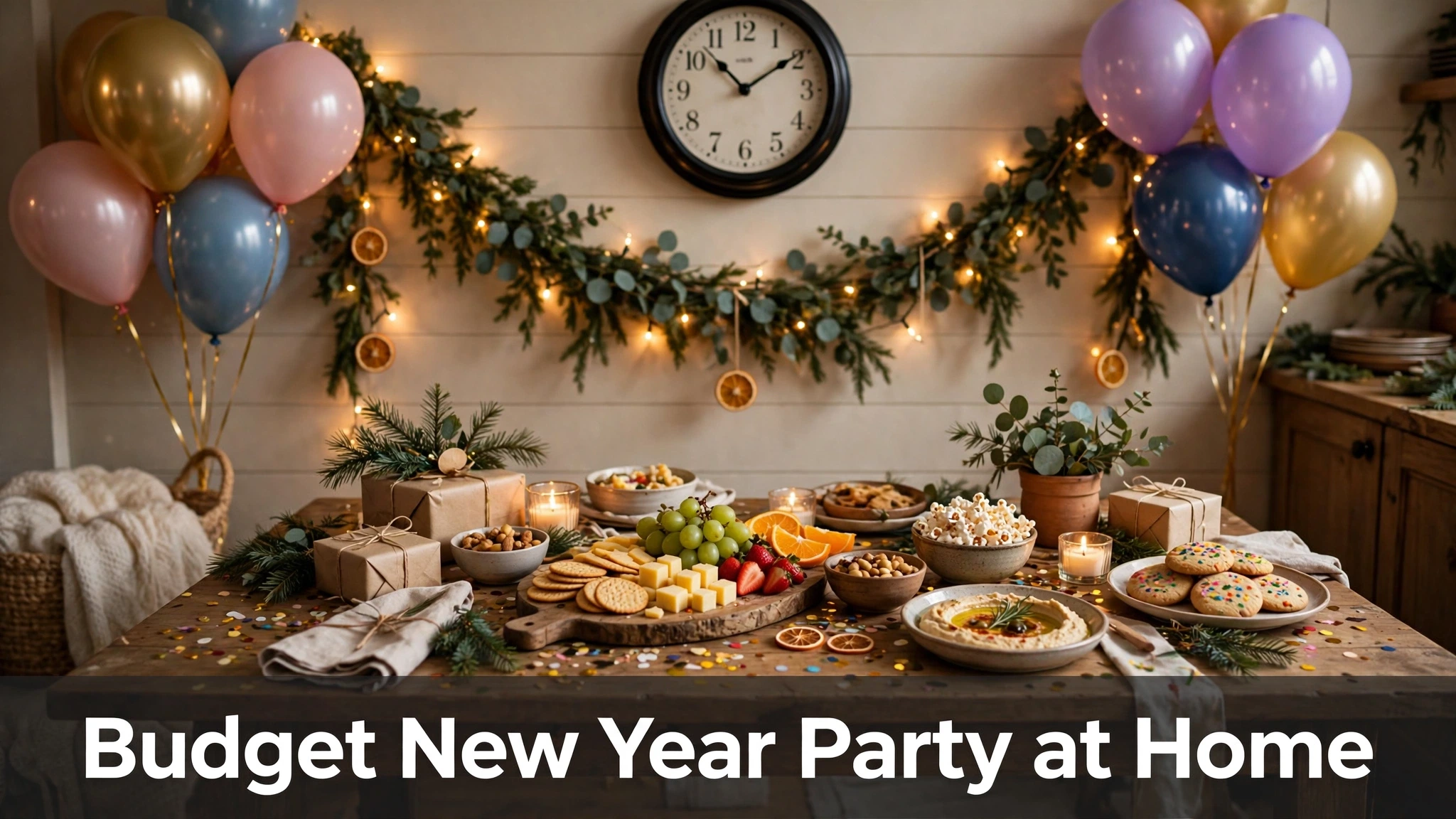
Lighting changes a room more than any other decoration, and it is cheap. Fairy lights, already owned from Christmas, wrapped around curtains, mirrors, jars, or a bookshelf, turn a normal living room into a party room in minutes. Add LED candles for warm light without fire risk, and turn off harsh ceiling lights. A single disco bulb, an example low-cost item depending on store and region, can add movement for a dance corner, but it is optional. The principle is layers: fairy lights for warmth, one brighter spot for food, and a darker corner for conversation. Guests notice light before they notice any single decoration.
Paper decorations add colour at very low cost. A handmade banner with the new year, paper garlands, balloons in gold, silver, and black, and a countdown clock made from paper or card all create a festive focus. Balloons need care: buy a modest number, inflate them on the day, and place them as a wall or arch for photos, rather than scattering them everywhere where they become floor clutter. Reuse decorations from Christmas where they fit, such as gold and silver items, and avoid buying a whole new theme set for one night. A party that reuses well looks intentional, not cheap, because the colour scheme is consistent rather than random.
A photo corner costs almost nothing and gives guests a lasting memory. Use a plain wall, a curtain, or a sheet as a backdrop, add fairy lights, and provide simple props made from card: glasses, hats, speech bubbles with the new year, and numbers. Guests take their own photos, which means the host does not need a photographer or a hired booth. Place the photo corner away from the food table, so queues do not block serving, and keep props in a box so they can be reused. A photo corner also solves a common party problem: it gives shy guests something to do, and it gives the whole group a shared activity without a formal programme.
Games, Music, and a Countdown That Keep Energy Up
Free games are the backbone of a budget party, because they need no equipment beyond paper, pens, and imagination. New Year trivia, charades with New Year words, a quiz about the year just ending, musical chairs for children, and a balloon pop countdown, where one balloon is popped each hour revealing a small challenge, all cost nothing and create laughter. Choose games that suit the group: a trivia game for a talkative group, a movement game for an energetic group, and a quiet card game for a smaller group. Explain rules in one minute, play for a short time, and stop while energy is high, rather than forcing a long game that loses the room.
Music should be planned, not left to chance. Ask guests to add one song each to a shared playlist before the party, so the music reflects the group and the host does not need to pay for a DJ. Start with background music during arrival and food, raise energy later in the evening, and save a special song for midnight. Keep volume at a level where conversation is still possible, because a party where nobody can talk is a concert, not a gathering. If neighbours are close, agree a volume and end time in advance, and tell neighbours about the party as a courtesy. A good relationship with neighbours is worth more than one loud hour.
The countdown itself needs a plan, not just a television. Decide how midnight will be marked: a countdown clock on screen, a phone timer, sparkling drinks poured before midnight, noisemakers or party poppers used safely outdoors or in a clear space, and a moment for resolutions or wishes. Give children a fake midnight if needed, with the same ritual earlier, so they feel included. After midnight, have a clear next step: a slow song, a dessert, or a group photo, so the party does not collapse into awkward standing. A planned midnight, even a simple one, feels like a celebration; an unplanned midnight feels like a television break.
Hosting Well: Space, Safety, and Rides Home
Space planning costs nothing and prevents the most common party discomfort: a room where nobody can move. Clear one gathering lane through the room, push furniture to the walls, and create distinct zones: food in one place, seating in another, games or dancing in a third. Keep the food table against a wall so guests can serve themselves without blocking movement, and place drinks away from food to avoid a single crowded spot. Provide enough seating for about half the guests at once, because at a standing party not everyone sits at the same time, but provide a quiet corner for guests who need to sit, including older guests and parents with children.
Safety is the one line not to cut. Plan rides home before the night, including sober drivers, a place to stay, or rideshare money, and state it on the invitation if alcohol will be served. Keep walkways clear, secure loose rugs and cables from fairy lights, and keep candles, if used, away from curtains and paper decorations, or use LED candles instead. Know where the first aid kit is, keep medicines and valuables out of party areas, and have a phone charger available. A host who plans safety calmly gives guests freedom to relax, because they do not need to worry about the practicalities themselves.
Cleanup planning saves the host’s next day and the budget. Use reusable plates and cups if washing up is manageable, or paper goods if the guest count is large and water or time is limited, and decide before buying. Keep a bin and recycling bag visible during the party, so rubbish does not accumulate on tables. After midnight, do only the essential cleanup: store food safely, clear perishables, and leave the rest for morning. A host who tries to clean everything at 1 am will resent the party, however good it was. A short morning cleanup, with help from a friend or family member arranged in advance, is a kinder ending.
After Midnight: Leftovers, Thank-Yous, and January
A budget party does not end at midnight; its cost and memory continue into January. Pack leftovers promptly into containers guests can take home, label anything that needs eating soon, and refrigerate perishables within a safe time rather than leaving them out overnight. That step turns potential waste into next-day meals, which is a real saving, and it gives guests a small gift to take home. Keep a list of what was popular and what was left untouched, because that list is the shopping guide for next year. A dish nobody ate, however cheap, was wasted money; a dish that disappeared in an hour is the dish to repeat, in larger quantity, next time.
Thank guests promptly, with a short message and, if you took them, one group photo. That message closes the evening warmly and makes a next gathering more likely, which is the real return on a party. Note any borrowed items, return them within a few days, and settle any shared costs immediately, while amounts are fresh, rather than letting a small debt linger into January. A party that ends with clear thanks, returned items, and settled costs leaves no loose ends to sour the memory. January should begin with a good feeling about the night, not with a list of chores and debts that were postponed from it.
My Take:
I think a New Year party at home works best when the host stops trying to copy a venue and starts using what a home does best. A venue sells space, lighting, and a bar. A home offers warmth, familiarity, and the chance for people to actually talk. When a host spends a large amount trying to make a living room look like a club, the result is usually a poor copy of a club, in a room that is too small for it. When a host leans into the home, with fairy lights, a full table of simple food, a playlist made by guests, and a clear midnight moment, the result is something a venue cannot sell: people feeling comfortable enough to be themselves. That comfort is the real luxury of a home party, and it costs very little.
I also believe the budget party reveals something important about friendship. A potluck party, where each guest brings a dish, is not a sign that the host cannot afford to feed people. It is a sign that the host trusts guests to contribute, and that guests are willing to do so. That trust changes the feeling of the evening. Guests are not consumers waiting to be served; they are participants who helped create the night. I have seen potluck evenings where the food conversation itself became entertainment, as people explained recipes, shared family dishes, and tasted something new. A catered party rarely creates that conversation, because the food arrives without a story. A potluck dish always has one.
There is a pressure at New Year that deserves honest naming: the pressure to start the year with a display of success. Expensive drinks, a large guest list, a house full of new decorations, all photographed for social media, can feel like proof that the year ahead will be good. I do not believe a display creates a good year. A good year is created by the relationships that survive January, by the friends who will still answer the phone in February, and by the host who does not start January in debt for one night. A budget party that ends with guests helping to clear plates, laughing, and planning the next meeting has done more for the new year than an expensive party that ends with a bill and exhaustion. The new year begins the next morning, not at midnight, and it begins better without financial regret.
My practical judgement is therefore to spend on the few things that change feeling, and to save on everything else. Spend on light, because light changes a room instantly. Spend on one signature food or drink, because one memorable taste anchors the evening. Spend on time, by starting at a clear hour, by planning midnight, and by protecting the host’s energy with a morning cleanup plan. Save on a full bar, on a new decoration set, on a large guest list, and on a dinner that nobody needed. Those savings are not sacrifices. They are choices that leave room for what matters: conversation, laughter, and a midnight moment shared with people who genuinely wanted to be there.
Finally, I think a home New Year party is a good test of what celebration means. If celebration requires spending beyond one’s means, then only the wealthy can celebrate properly, which is a cruel definition. If celebration means gathering people you care about, feeding them simply and generously, playing games, sharing music, and marking midnight together, then anyone with a home, a few lights, and a few friends can celebrate fully. I prefer the second definition, and I think most guests do too, even if they do not say it. A budget party at home, done with care and clarity, is not a lesser party. It is a party that understands what a new year actually is: not a purchase, but a shared moment of hope, in a warm room, with people who matter.
Another consideration is inclusion. A budget party can easily exclude people without intending to, if food ignores allergies, if drinks ignore non-drinkers, if games ignore shy guests, or if the space ignores older guests who need seating. Inclusion costs nothing extra when planned early: label dishes, provide a genuinely good alcohol-free drink, offer a quiet game alongside a loud one, and keep a comfortable seat available. A guest who feels considered will enjoy the party far more than a guest who is served expensive food but feels overlooked. The host’s attention to difference, not the budget, determines whether everyone belongs, and belonging is what makes a party feel successful the next day.
Children and neighbours also deserve a deliberate place in the plan. A party that works for adults but leaves children bored, tired, or unsafe will end early and stressfully, however good the adult evening was. A children’s corner with simple activities, a fake midnight, and a clear bedtime plan lets parents relax, because their children are cared for within the party, not in spite of it. Similarly, telling neighbours in advance, agreeing an end time, and keeping noise reasonable protects the host’s life after the party. A single complaint, or a damaged relationship with a neighbour, costs far more than any saving from a louder, later party. Good hosting looks beyond the night itself, to the morning after and the weeks after.
Finally, the host’s own enjoyment must be protected, or the party becomes a performance. A host who spends the whole evening cooking, serving, and cleaning, without sitting, talking, or celebrating midnight, has hosted a service, not a party. The budget format helps here: potluck shares cooking, appetizers reduce serving, and a morning cleanup plan shares the aftermath. Delegate one task to a trusted friend, such as music, photos, or midnight drinks, so the host is not the only person working. A host who enjoys the party gives guests permission to enjoy it too. A host who is exhausted and resentful, however generous the food, teaches guests that celebration is a burden. The best budget party is one where the host, at midnight, is laughing with guests, not alone in the kitchen.
A final note on January itself: a party that leaves the host rested, with leftovers used, costs settled, and guests thanked, starts the year with goodwill rather than recovery. That goodwill is the real product of a budget party. It shows in messages the next day, in offers to host next time, and in friendships that feel easier, not strained, after a celebration. Money spent wisely does not just save pounds or dollars; it protects the relationships the party was meant to celebrate.
Frequently Asked Questions
How much should a New Year budget party at home 2026 cost? Set one total after January bills are covered, then split it into food and drinks, decorations, paper goods and ice, and a small reserve. The format decides the cost most: potluck is cheapest, appetizers-only is next, and dessert and drinks with a late start is cheapest for the host, provided the invitation states the format clearly.
What food should I serve at a New Year budget party at home 2026? Choose four or five appetizers that can be prepared in advance, such as nachos, garlic bread, mini pizzas, vegetable sticks with dips, and cheese and crackers, plus one signature item guests will remember. Bite-sized food is cheaper per guest than a plated dinner and reduces washing up.
How do I organise a potluck New Year budget party at home 2026 without getting eight desserts? Assign categories in advance, such as one main snack, one side, one dessert, and one drink, keep a shared list of who brings what, ask about allergies and dietary needs, and label dishes at the table. Coordination, not luck, prevents duplication and waste.
What cheap decorations work best for a New Year budget party at home 2026? Lighting matters most: fairy lights from Christmas, LED candles, and a consistent colour scheme of gold, silver, and black. Add a handmade banner, paper garlands, and a modest balloon wall for photos, and reuse Christmas gold and silver items where they fit, rather than buying a whole new theme set.
How do I plan midnight at a New Year budget party at home 2026? Pour sparkling drinks before midnight, use a countdown clock or phone timer, mark the moment with safe noisemakers or party poppers in a clear space, and plan a next step after midnight, such as a slow song, dessert, or group photo. For children, a fake midnight earlier in the evening lets them celebrate and go to bed.
How do I keep guests safe at a New Year budget party at home 2026? Plan rides home before the night, including sober drivers, a place to stay, or rideshare money, keep walkways clear of cables and loose rugs, use LED candles near paper decorations, and provide appealing alcohol-free drinks so guests who do not drink feel included rather than sidelined.