Ni Ni: The Life Story Behind China's Stylish Star
In this post
- Growing Up in Nanjing, the Old Capital
- The Flowers of War and a Debut Nobody Forgets
- Learning to Act After the Big Debut
- The Rise of Phoenixes and a Leading Lady
- Style, Fame, and the Burden of Beauty
- Still Elegant, Still Working, Still Growing
- What Elegance Really Means
- Fashion, Photographs, and the Image She Built
- My Take:
Ni Ni is an actress who looks like she belongs in a painting. She is tall, elegant, and poised, with a face that the camera loves and a walk that turns heads on every red carpet she attends. Chinese audiences know her as Yu Mo from The Flowers of War, the film that made her famous, and as the stylish, confident woman of The Rise of Phoenixes and many other dramas and films. She is one of the most fashionable actresses in China, and her photographs are shared by millions. But behind the elegance, there is a story of hard work, of a girl from Nanjing who was chosen by a great director, and who had to prove that she was more than a beautiful face.
She was born in 1988 in Nanjing, the old capital of China, a city of history, of rivers, and of graceful old streets. She studied broadcasting at the Communication University of China in Nanjing, and she had no plans to become a film star. Then Zhang Yimou, the most famous director in the country, chose her to play the lead female role in The Flowers of War, a big and serious film about the Nanjing Massacre. She was twenty-three years old, and she had never acted in a film before. The film made her famous overnight, and it gave her a name that the whole country knew.
This is the story of how a student from Nanjing became one of China’s most elegant stars, and of what she did after the fame arrived. It is a story about beauty and about the burden of beauty, about learning to act when the world only wants to look at you, and about building a career that lasts longer than a single famous film. It is also a story about a woman who has kept her dignity in a world that often treats beautiful women as decorations, and who has insisted, again and again, that she is an actress first.
Growing Up in Nanjing, the Old Capital
Nanjing is one of the oldest and most beautiful cities in China. It was once the capital of the country, and its streets are full of history: old walls, quiet lakes, and trees that have stood for hundreds of years. Ni Ni was born there on 8 August 1988. She grew up in a city that values grace and culture, and she grew up as a girl who loved to read, to dance, and to perform in small ways. She was tall for her age, and she had a natural elegance that people noticed early. She did not try to be elegant. She simply was, in the way she stood, in the way she walked, and in the way she spoke.
Her family was ordinary, and her childhood was the childhood of a girl in a big Chinese city in the 1990s: school, friends, and a growing interest in the arts. She was a good student, and she was interested in language and in performance. She decided to study broadcasting at the Communication University of China in Nanjing, a school known for training presenters, journalists, and performers. It was a practical choice, and a sensible one. She wanted a career in media, but she did not dream of becoming a film star. She dreamed of a steady job, of speaking well, and of being respected for her work.
At university, she studied voice, presentation, and the skills of a broadcaster. She learned to speak clearly, to stand in front of a camera, and to hold an audience’s attention. Those skills would later help her as an actress, because an actress also needs to speak clearly and to hold an audience. But at the time, she was simply a student, learning her craft, and looking forward to a normal career in television or radio. She had no idea that a great director was about to change her life completely.
The change came when Zhang Yimou began to look for an actress to play Yu Mo in The Flowers of War. The film was based on a novel about the Nanjing Massacre, one of the darkest events in Chinese history. Yu Mo was a complex character, a woman who worked in a place of ill repute, who was beautiful, clever, and brave, and who risked her life to save others. Zhang Yimou needed an actress who could play that complexity, and who had never been seen on screen before. He looked at thousands of young women, and he chose Ni Ni. She was twenty-three years old, a student, and she had never acted in a film. It was an extraordinary piece of luck, and it was also a test. She would have to learn to act, in a big film, in front of the whole country.
The Flowers of War and a Debut Nobody Forgets
The Flowers of War, released in 2011, was one of the most expensive and most serious films ever made in China. It told the story of the Nanjing Massacre in 1937, when Japanese soldiers attacked the city, and of a group of schoolgirls and women who hid in a church, protected by an American mortician played by Christian Bale. Ni Ni played Yu Mo, the leader of the women, a woman who is beautiful and worldly, and who makes a terrible sacrifice to save the schoolgirls. It was a huge role for a first-time actress, and it asked her to show courage, sadness, and dignity, all at the same time.
She played it with a grace that surprised everyone. Yu Mo is not a simple character. She is a woman who has lived a hard life, who knows the world, and who chooses to do a brave thing. Ni Ni played her without overacting, without trying too hard, and with a quiet strength that made the character feel real. Audiences wept for Yu Mo, and they remembered Ni Ni’s face long after the film ended. The film was a great success in China, and it was shown around the world. Ni Ni became famous overnight, and she became known as a “Mou girl”, the name given to the young actresses discovered by Zhang Yimou.
Being a Mou girl is both a blessing and a burden. It is a blessing because it means that the most famous director in China chose you, and that the whole country knows your name. It is a burden because people will always compare you to the other Mou girls, and they will always ask if you are as good as the director who discovered you. Ni Ni faced that burden from the start. She was praised for her beauty, and she was praised for her debut, but people also asked if she could act, or if she was only a beautiful face that Zhang Yimou had found. She would spend the next years answering that question, one role at a time.
The film also gave her a connection to Nanjing that was deeper than her birthplace. The Flowers of War is about her home city, about its darkest hour, and about the people who suffered there. Ni Ni, as a girl from Nanjing, carried that history with her into the role. She understood what the city meant, and what the story meant, in a way that an actress from another place might not have. That understanding showed in her performance, and it is one of the reasons the film felt so real to audiences in Nanjing and across China.
Learning to Act After the Big Debut
After The Flowers of War, Ni Ni had to learn how to be an actress, not only a famous face. She took roles in films and in television, playing a range of women, from modern girls in love to historical figures. She appeared in films such as The Warriors Gate, a fantasy adventure, and in dramas about love and about history. She worked hard, and she improved with each role, but she also faced a problem that many beautiful actresses face: people talked about her looks more than they talked about her acting.
She was known for her fashion, for her red carpet appearances, and for her photographs. She was one of the most stylish women in Chinese entertainment, and her pictures were shared by millions. That fame was useful, but it was also a trap. When people see a woman as a fashion icon, they can forget that she is also an actress. Ni Ni had to work harder than other actresses to be taken seriously, because she had to overcome the idea that she was only beautiful. She did it by choosing roles that asked her to act, not only to look good, and by working with directors who cared about performance.
One of her most important later roles was in The Rise of Phoenixes, a television drama released in 2018. In it, she played Feng Zhiwei, a clever and determined woman who rises from a low position to a place of power in a world of politics and war. It was a long drama, with dozens of episodes, and it asked her to show intelligence, ambition, and pain, over a long story. She played it with a seriousness that impressed audiences and critics. The drama was popular, and it showed that Ni Ni could carry a major television series as the leading lady, not only as a beautiful supporting actress.
She also appeared in films such as Shock Wave 2, an action film, and in other productions that showed her range. She played women who were strong, women who were in love, and women who were fighting for their lives. Each role taught her something new, and each role helped her to build a career that was based on work, not only on a single famous debut. She was no longer only the girl from The Flowers of War. She was an actress with a body of work, and with a name that stood on its own.
The Rise of Phoenixes and a Leading Lady
The Rise of Phoenixes deserves a closer look, because it was the drama that proved Ni Ni could lead a long and serious television series. The story was set in a fictional ancient kingdom, and it followed Feng Zhiwei, a woman born into a difficult life, who uses her intelligence to survive in a court full of danger. She is not a warrior. She is a thinker, a planner, and a woman who learns to play the game of power in order to protect the people she loves. Ni Ni played her with a calm and a focus that made the character believable over many episodes.
The drama was long, and it demanded a great deal from its lead actress. She had to show Feng Zhiwei changing over time, from a young woman with little power to a woman who holds the fate of a kingdom in her hands. She had to show love, loss, and ambition, sometimes in the same scene. Ni Ni did it with a steadiness that audiences respected. She did not overplay the emotions. She let them build slowly, and she let the audience feel them grow. That is the mark of an actress who has learned her craft, not one who is still relying on her looks.
The Rise of Phoenixes was watched by millions, and it made Ni Ni a television star as well as a film star. It also showed that she could work in the long form of television, where a character must be sustained over dozens of hours, not only in the short form of a film. That is a different skill, and it is one that many film actresses find hard. Ni Ni found it, and she made it look natural. She had become, by 2018, a complete actress, able to work in film and in television, in history and in the modern world, in love stories and in stories of power.
After the drama, she continued to work in both film and television, taking roles that suited her growing maturity. She played women in their thirties, women with careers, women with families, and women with difficult choices to make. She was no longer the young girl of The Flowers of War. She was a woman, and she was playing women, and her performances had a depth that came from her own life. She had grown up in public, and her acting had grown with her.
Style, Fame, and the Burden of Beauty
Ni Ni’s style is famous in China. She is known for her elegant dresses, her poised photographs, and her calm presence on the red carpet. She is one of the most photographed actresses in the country, and her fashion choices are discussed by millions. That fame is real, and it has brought her work, including endorsements and invitations to fashion events around the world. But it has also brought a question that follows her everywhere: is she an actress, or is she a model?
She has answered that question by continuing to act, and by choosing roles that demand more than beauty. She has played in action films, where she had to run, fight, and show physical courage. She has played in dramas where she had to cry, to argue, and to show pain. She has played women who are not beautiful in the story, women who are tired, afraid, or broken. Each of those roles was a small answer to the question, a proof that she is more than her face.
The burden of beauty is a real one, and it is worth talking about honestly. A beautiful actress is often judged more harshly than a plain one, because people assume that her success came from her looks, not from her work. A beautiful actress has to work twice as hard to be taken seriously, and she has to endure comments about her body that a plain actress never hears. Ni Ni has lived with that burden for more than a decade, and she has handled it with dignity. She has not complained in public. She has not tried to look less beautiful. She has simply kept working, and she has let her work speak for her.
Her private life has been kept mostly out of the public eye, although she has had relationships that were talked about, including a well-known relationship with actor Jing Boran. She has handled those stories with privacy and with grace, neither hiding completely nor sharing everything. She seems to understand that a famous person’s private life is not public property, and that keeping something for oneself is a form of strength. That understanding has helped her to survive in an industry that often tries to take everything from its stars.
Still Elegant, Still Working, Still Growing
Today, Ni Ni remains one of the most respected and most admired actresses in China. She is in her late thirties, and she continues to work in film and television, taking roles that suit her age and her experience. She is known for her elegance, for her professionalism, and for her ability to carry a serious role with grace. She is also known as a woman who has built a career that lasts, not on a single film, but on many years of careful work.
What will people remember about her? They will remember Yu Mo, the brave woman in The Flowers of War, who gave her life to save others. They will remember Feng Zhiwei, the clever woman in The Rise of Phoenixes, who rose from nothing to a place of power. They will remember the red carpet photographs, the elegant dresses, and the calm smile. And they will remember, if they have watched her work closely, an actress who learned to act in public, who grew from a student into a star, and who did it with a dignity that never wavered.
Her story is still being written. She has many years ahead of her, and many roles still to play. If she continues as she has begun, she will be remembered as more than a beautiful face. She will be remembered as an actress who took a lucky break and turned it into a real career, who faced the burden of beauty with grace, and who proved, again and again, that she was more than the world first thought she was. That is a legacy worth having, and it is one that Ni Ni is building, one role at a time, with the same elegance she brings to everything she does.
What Elegance Really Means
It is worth asking what elegance means in Ni Ni’s story, because it is easy to think that elegance is only about clothes. In her case, elegance is also about behaviour. It is about the way she speaks, the way she treats people, and the way she handles pressure. She does not shout. She does not make a scene. She does not answer every rumour. She carries herself with a calm that is rare in the world of fame, and that calm is a kind of strength.
That strength has helped her to survive in an industry that is often unkind to women, especially to beautiful women. She has been judged, photographed, and talked about, and she has kept her dignity through all of it. She has not let the attention change who she is. She is still the girl from Nanjing, still the student who studied broadcasting, still the actress who wants to be judged by her work. That steadiness is the real elegance in her story, and it is the reason her career has lasted.
For young women who admire her, that is the most important lesson. Elegance is not a dress. It is a way of living, a way of treating yourself and others with respect, and a way of holding on to your dignity when the world is watching. Ni Ni has shown that elegance, and she has shown it for more than a decade. That is a rare achievement, and it is one that deserves to be remembered, long after the photographs have faded.
Fashion, Photographs, and the Image She Built
Ni Ni’s fashion sense is famous in China, and it is worth looking at closely, because it is not only about clothes. It is about how a person presents themselves to the world. Ni Ni presents herself with elegance, with calm, and with a confidence that does not need to shout. Her dresses are often simple, in dark colours, with clean lines. Her photographs are often quiet, with a soft light, and a thoughtful expression. She does not pose like a model showing off. She stands like a person who is comfortable in her own skin, and the camera responds to that comfort.
That image has brought her a great deal of work outside acting. She has been invited to fashion shows in Paris, in Milan, and in other cities, and she has worked with major brands. She is seen as a style icon, a woman whose taste is trusted by millions. That trust is valuable, and it is not given lightly. It comes from years of choosing well, of dressing with care, and of never looking cheap or careless. Ni Ni has built her image slowly, one photograph at a time, and she has protected it, by not taking every endorsement, and by not appearing in every magazine. She chooses carefully, and that care shows.
Her fashion work has also helped her acting career, in a way that is easy to miss. When an actress is known for her style, directors and producers see her as a star, as a person who can carry a film, and who can attract an audience. Ni Ni’s style has made her a star in the eyes of the industry, and it has brought her roles that she might not otherwise have been offered. It has also made her a familiar face to audiences who do not watch her films, but who see her photographs. That familiarity matters, because it means that when she does appear in a film, people already know her, and they are curious to see what she will do.
But fashion is also a trap, as I have said before, because it can make people forget that an actress is more than her clothes. Ni Ni has worked hard to avoid that trap, by taking roles that demand acting, not only looking good. She has played in action films, where she had to run and fight, in dramas where she had to cry, and in stories where she had to show pain. Each of those roles was a reminder that she is an actress first, and a fashion icon second. That order matters to her, and she has protected it, even when fashion offered her more money and more attention. She is an actress, and she wants to be judged as one, and her fashion is only a part of who she is, not the whole of it.
My Take:
I think Ni Ni’s story is really a story about being seen, and about what it costs to be seen for the wrong reason. She was chosen by Zhang Yimou because she was beautiful, and she became famous because she was beautiful, and then she spent the next decade trying to prove that she was more than beautiful. I find that both sad and inspiring. It is sad because no one should have to prove that they are more than their face. It is inspiring because she did prove it, again and again, with hard work, with good roles, and with a dignity that never wavered. She did not complain. She did not try to look less beautiful. She simply worked, and she let the work speak. I respect that more than I can say.
What I admire most about her is the calm she brings to everything. She does not shout. She does not make a scene. She does not fight with people online. She walks onto a red carpet, she poses for the cameras, and she goes home. She goes to a film set, she does her work, and she goes home. That calm is a kind of strength, and it is a strength that many famous people do not have. Fame makes many people loud, because they are afraid of being forgotten. Ni Ni is not loud, because she does not need to be. She knows that her work will be remembered, and that is enough. I think that is a lesson for all of us. We do not need to shout to be heard. We need to do good work, and to do it with calm, and the right people will hear us.
I also think about her debut, and about what it must have been like to play Yu Mo at twenty-three, in a film about the Nanjing Massacre, in her own home city. That is an enormous weight for a young woman to carry. She was not only playing a character. She was playing a woman from the darkest hour of her city’s history, a woman who gives her life to save schoolgirls. She played it with grace, and she played it without overacting, and audiences wept. I think that performance deserves more respect than it sometimes gets, because people talk about her beauty and forget how hard the role was. It was hard. It asked her to show courage, sadness, and dignity, all at the same time, in her first film. She did it, and she did it well. That is not luck. That is talent, and it is courage.
There is a part of her story that makes me think about the way we treat beautiful women, and I want to be honest about it. When a woman is beautiful, people often assume that her success came from her looks. They do not see the work behind it. They do not see the hours of rehearsal, the lines learned, the scenes shot again and again. They see a beautiful face, and they think that is the whole story. Ni Ni has lived with that assumption for more than a decade. She has been judged by her photographs more than by her performances. I think that is unfair, and I think it is a problem that affects women in many kinds of work, not only in acting. A beautiful woman in an office, in a school, or in a hospital can face the same assumption: that she got her job because of her looks, not because of her skill. Ni Ni’s life shows how hard it is to overcome that assumption, and how much work it takes. I hope that people who read her story will think about that, and will judge women by their work, not by their faces.
I want to say something about The Rise of Phoenixes, because I think it is her most important work after her debut. Feng Zhiwei is not a woman who wins by being beautiful. She wins by being clever, by thinking, by planning, and by surviving in a dangerous world. Ni Ni played her with a calm and a focus that made the character believable over dozens of episodes. That is a different kind of acting from a film, where a character is built in two hours. In a long drama, a character must be built over weeks, and the actress must hold the character steady through many scenes, many days, and many changes. Ni Ni did that, and she proved that she could carry a major series. I think that matters, because it shows that she is not only a film actress. She is a complete actress, able to work in any form, and that is a rare thing.
The lesson I take from Ni Ni is about dignity, and about how to keep it when the world is watching. Dignity is not about being perfect. It is about treating yourself with respect, and treating others with respect, even when you are under pressure. Ni Ni has done that for more than a decade. She has been photographed, judged, and talked about, and she has kept her dignity. She has not let the attention make her bitter. She has not let it make her loud. She has simply kept working, and kept being herself. I think that is a powerful example, especially for young women who are learning how to live in a world that watches them all the time. You do not need to shout back. You do not need to explain yourself to everyone. You need to do good work, to be kind, and to keep your dignity. The rest will follow.
Finally, I want to say that her story makes me think about Nanjing, and about history, and about the weight of the past. The Flowers of War is about a terrible event in Nanjing’s history, and Ni Ni, as a girl from Nanjing, carried that history into her performance. She understood what the city had suffered, and she honoured it with her acting. I think that is a beautiful thing, and it is a reminder that where we come from matters. Our home town is not only a place on a map. It is a part of who we are, and it shapes the way we see the world. Ni Ni’s Nanjing shaped her elegance, her calm, and her respect for history. She carried those things into her work, and her work is better for it. I hope that after reading her story, you will think about your own home town, and about what it has given you, and I hope you will carry it with the same grace that Ni Ni carries hers.
I also think about the way Ni Ni’s walk works, because it is such a large part of her elegance. She walks slowly, with her back straight, and her head up, as if she has all the time in the world. That walk is not something you learn in a day. It comes from confidence, from training, and from a sense of who you are. When she walks onto a red carpet, people stop and watch, not because she is shouting for attention, but because she is calm, and that calm is magnetic. I think that is a lesson for all of us. We do not need to rush to be noticed. We need to walk slowly, with our heads up, and with confidence in who we are. People will notice, not because we demanded it, but because we earned it, by being steady, and by being ourselves. Ni Ni walks like that, and it is one of the reasons she is so admired.
I want to think, too, about what it means to be from Nanjing, and how that shapes a person. Nanjing is an old city, a city of history, of quiet lakes, and of graceful streets. It is not a loud city, like Shanghai, or a fast city, like Shenzhen. It is a city that values culture, patience, and grace. Ni Ni grew up in that city, and she carries its grace with her. She is not loud. She is not fast. She is calm, thoughtful, and elegant, like the city she came from. I think that is a beautiful thing, and it is a reminder that where we come from matters. Our home town shapes us, in ways we do not always see, and it gives us gifts that we carry for the rest of our lives. Ni Ni’s gift from Nanjing is grace, and she has used it well, in her acting, in her fashion, and in her life.
There is another part of her story that I find important, and it is the way she has handled being compared to other Mou girls. Zhang Yimou has discovered many young actresses, and each one is compared to the others. People ask, who is the best Mou girl? Who is the most beautiful? Who is the most talented? Those comparisons are unfair, because each actress is different, and each one has her own strengths. Ni Ni has faced those comparisons for more than a decade, and she has handled them with dignity. She has not tried to be better than the others. She has tried to be herself, and to do her own work well. I think that is the right answer to any comparison. You cannot win a comparison by trying to be someone else. You can only win by being yourself, and by doing your work as well as you can. Ni Ni has done that, and she has built a career that stands on its own, not on a comparison with anyone else.
I want to be honest about something else as well. Ni Ni’s acting, while good, has not yet reached the level of her elegance. She is a fine actress, but she has not yet had the one great dramatic role that would make people say, she is one of the best actresses of her generation. She has had good roles, and she has done them well, but she has not yet had the role that changes everything. I think that role may still come. She is thirty-eight, and she has many years ahead of her. I hope she finds it, because I think she has more to show us than we have seen so far. She needs a script that asks her to be more than elegant, more than beautiful, more than calm. She needs a script that asks her to be messy, to be angry, to be broken, and to show the audience a side of herself that they have never seen. If she finds that script, and if she gives it everything she has, I think she could surprise a lot of people. I do not say this to criticise her. I say it because I believe in her talent, and I want to see all of it.
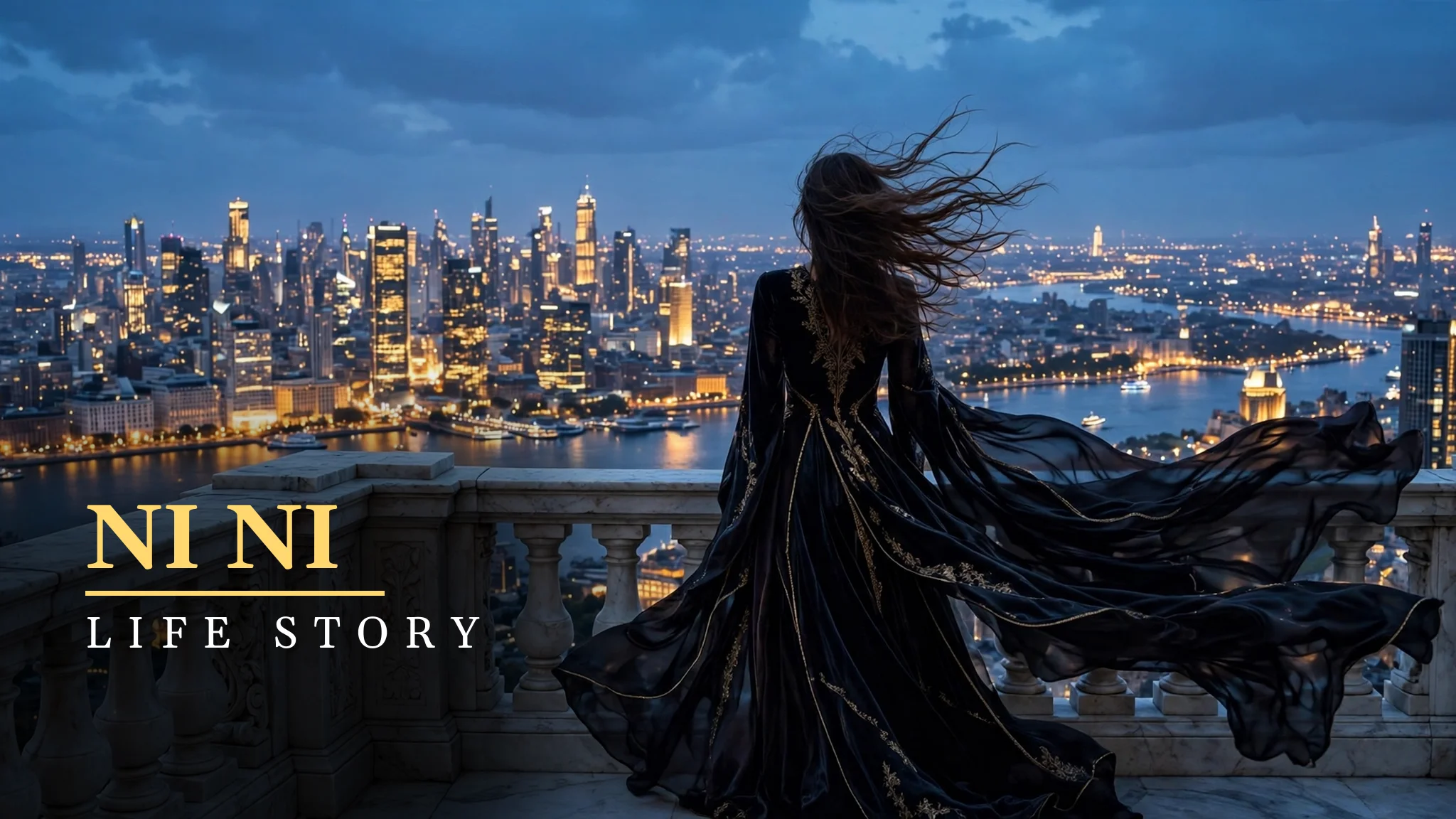
Finally, I want to return to the image of the woman in the black gown, standing on a terrace above a glittering city at dusk, which is the image on her cover. That image fits Ni Ni perfectly, because it shows a woman who is alone, above the city, in a beautiful dress, with her hair blowing in the wind, looking out over a world of lights. She is not part of the crowd below. She is above it, quiet, elegant, and a little bit distant. That is Ni Ni, as I understand her. She is above the noise, above the rush, and above the gossip, standing quietly, looking out over the city, and letting the lights shine below her. I think that is a beautiful image, and it is a hopeful one. It says that a person can be above the noise, and still be part of the world, and still be loved, without shouting, without rushing, and without losing their grace. Ni Ni has done that, for more than a decade, and I believe she will keep doing it, for many years to come.
I also want to say something about the way Ni Ni prepares for a role, because preparation is the hidden part of every good performance. People see the finished film, and they think the actress simply walked onto the set and became the character. They do not see the reading, the thinking, the rehearsing, and the quiet work that happens before the cameras roll. Ni Ni prepares carefully, she studies her character, and she thinks about how that woman would walk, speak, and feel. That preparation is the reason her performances feel complete, even in small roles. A performance that looks effortless is usually the result of a great deal of effort, done in private, and Ni Ni’s work is a good example of that. I respect the preparation, because it shows that she takes her craft seriously, and that she does not rely on beauty alone.
Frequently Asked Questions
Who is Ni Ni and what is she best known for?
Ni Ni is a Chinese actress born in 1988 in Nanjing, Jiangsu. She is best known for her debut as Yu Mo in The Flowers of War in 2011, a film directed by Zhang Yimou, and for playing Feng Zhiwei in the television drama The Rise of Phoenixes in 2018.
Where did Ni Ni study?
She studied broadcasting at the Communication University of China in Nanjing. She had never acted in a film before Zhang Yimou chose her for The Flowers of War when she was twenty-three years old.
What is The Flowers of War about?
The Flowers of War is a film about the Nanjing Massacre in 1937. Ni Ni plays Yu Mo, a brave woman who risks her life to save a group of schoolgirls hiding in a church, in a story that is set in her own home city of Nanjing.
What is The Rise of Phoenixes about?
The Rise of Phoenixes is a long television drama about Feng Zhiwei, a clever woman who rises from a low position to a place of power in a fictional ancient kingdom. Ni Ni played the lead role, showing intelligence, ambition, and pain over dozens of episodes.
How old is Ni Ni?
Ni Ni was born on 8 August 1988, so she was thirty-eight years old in 2026. She became famous at twenty-three and has worked steadily in film and television for more than a decade.
Why is Ni Ni known for her style?
She is known as one of the most elegant and fashionable actresses in China, famous for her red carpet dresses and photographs. Her style is widely discussed, though she has worked hard to be recognised as a serious actress as well as a fashion icon.
What does it mean to be a Mou girl?
A Mou girl is a young actress discovered by the director Zhang Yimou, whose name is Zhang Yimou in Chinese, with Mou as a short form. Ni Ni became a Mou girl when he chose her for The Flowers of War, a title that brought her fame and high expectations.


