Nick Cave: The Life Story Behind the Dark Poet of Rock
In this post
Nick Cave is one of the most unusual and most respected figures in rock music. He is a singer, a songwriter, a novelist, and a poet, a man who writes songs about murder, about love, about God, and about grief, in words that are dark, beautiful, and unforgettable. He began with a wild punk band called The Birthday Party, he built a long career with Nick Cave and the Bad Seeds, and he has made albums that are loved by people around the world, from Red Right Hand to Into My Arms to Ghosteen.
He grew up in a small town in Victoria, in a family that loved books and music, and he became a performer who is known for his tall, thin figure, his black clothes, and his intense way of singing, as if every word matters, and every song is a story that must be told. He has faced great loss in his life, including the death of two of his sons, and he has turned that grief into music, into writing, and into a conversation with his fans that is open, honest, and deeply moving.
This is the story of how a boy from Warracknabeal became a dark poet of rock, a man who has spent more than forty-five years making music that is unlike anyone else’s, and who has done it with courage, with imagination, and with a deep love of words.
A Small Town Boy in Warracknabeal
Nick Cave was born Nicholas Edward Cave on 22 September 1957 in Warracknabeal, a small town in Victoria, Australia, to a family that loved books, music, and art. His father, Colin Cave, was a teacher of English and mathematics, and his mother, Dawn, was a librarian, and the house was full of books, of records, and of talk about stories, about poetry, and about the world. Warracknabeal in the 1950s and 1960s was a small farming town, with wide streets, with wheat fields, and with a strong sense of community, and Cave grew up inside that world, learning to read, to write, and to imagine.
As a boy, Cave was bright, curious, and a little bit wild. He loved to read, he loved to listen to music, and he loved to make up stories. He was not a quiet child who sat at the back of the room. He was a lively boy who wanted to perform, to be noticed, and to make people feel something. He sang in the school choir, he played in school plays, and he began to write songs and poems, first as a teenager, when he was still at school in Wangaratta, where his family had moved.
He went to school at Wangaratta High School, and he was a good student, but he was more interested in music and in art than in other subjects. He listened to rock music, to blues, to country, and to the songs of Leonard Cohen and Johnny Cash, and he began to see that a song could be a story, a poem, and a prayer, all at the same time. He also learned about the Bible, about the Old Testament, and about the dark stories of murder, of love, and of redemption, stories that would later shape his songwriting in a profound way.
When he was a teenager, Cave’s father died in a car accident, when Nick was only nineteen years old. The loss was a terrible one for the family, and it shaped Cave’s life in a deep way. He became more serious, more aware of death, and more interested in the questions that have no easy answer: why do people die, what happens after death, and how do we live with loss? Those questions are at the heart of many of his songs, and they have stayed with him for the rest of his life.
Cave’s years with The Birthday Party taught him a lesson that stayed with him for his whole career: that a performance must first be felt, before it can be understood, and that a singer who is willing to be wild, to be frightening, and to be honest on stage, can make an audience feel something that a safe performer never could. He learned to use his body, his voice, and his words to create a world on stage, a world that was dark, loud, and full of danger, and he learned that an audience will follow a performer who is brave, even when they do not understand everything he is doing. Those lessons, learned in pubs and clubs in Melbourne, London, and Berlin, became the foundation of his style, a style that is intense, poetic, and deeply personal, and that allows him to sing about murder, about love, and about God, in a way that feels true, because it comes from a man who has lived, who has lost, and who has kept going.
The Birthday Party and a Wild Start
In the late 1970s, Cave formed a band with friends from school, including Mick Harvey, Phill Calvert, and Tracy Pew, and the band was first called The Boys Next Door, and later The Birthday Party. The band played punk rock, loud, fast, and wild, with Cave as lead singer, shouting, screaming, and performing on stage in a way that was both frightening and exciting. They played in Melbourne, in pubs and clubs, and they built a reputation as one of the most intense live bands in Australia.
The Birthday Party released albums including Prayers on Fire in 1981 and Junkyard in 1982, with songs that were dark, violent, and poetic, about murder, about love, and about the end of the world. The band moved to London, and then to Berlin, where they lived in a world of art, of music, and of drugs, and where Cave began to write songs that were more complex, more literary, and more personal. The band was not a commercial success, but it was loved by critics and by other musicians, who saw in Cave a rare talent, a singer who could write like a poet and perform like a wild man.
In 1983, The Birthday Party broke up, after years of touring, of arguments, and of drug problems. The breakup was sad, but it was also a new beginning for Cave, who was ready to make music in a different way, with a new band, and with a new sound. He had learned a great deal from The Birthday Party: how to perform, how to write, and how to be brave on stage. He was ready for the next chapter, and that chapter would last for more than forty years.
He formed a new band, Nick Cave and the Bad Seeds, with Mick Harvey and other musicians, and he began to make albums that were darker, slower, and more beautiful than the punk rock of The Birthday Party. The new band would become one of the most respected bands in the world, and Cave would become one of the most important songwriters of his generation.
The Bad Seeds and a Long Career
Nick Cave and the Bad Seeds released their first album, From Her to Eternity, in 1984, and they followed it with many other albums, including The Firstborn Is Dead in 1985, Your Funeral… My Trial in 1986, Tender Prey in 1988, The Good Son in 1990, Henry’s Dream in 1992, Let Love In in 1994, and Murder Ballads in 1996. Each album was different, but each one shared Cave’s gift for storytelling, for finding a dark and beautiful image, and for singing it with great feeling.
One of his most famous songs is The Mercy Seat, from Tender Prey, about a man on death row who is waiting to die, and who sings about his guilt, his fear, and his hope. Another is Red Right Hand, from Let Love In, a song about a mysterious man who appears in a small town, and who brings both help and danger. The song became famous when it was used as the theme for the television series Peaky Blinders, and it is now one of Cave’s best known songs, even among people who do not know his other work.
In 1996, Cave released Murder Ballads, an album of songs about murder, including Where the Wild Roses Grow, a duet with Kylie Minogue, which became a hit in Australia and in other countries. The song was a beautiful and sad ballad about a man who kills the woman he loves, and it showed that Cave could write a pop song, a song that could be played on the radio, without losing his dark and poetic style. The album won awards, and it made Cave famous to a wider audience, including people who had never heard The Birthday Party.
Cave also wrote songs for films, including The Proposition in 2005, a western written by Cave and directed by his friend John Hillcoat, and The Assassination of Jesse James by the Coward Robert Ford in 2007, for which he wrote the music with Warren Ellis. He also wrote novels, including And the Ass Saw the Angel in 1989, and The Death of Bunny Munro in 2009, both of which were praised for their dark and poetic writing. He was not only a singer. He was a writer, in the fullest sense of the word.
Into My Arms, the Boatman’s Call, and a Softer Sound
In 1997, Cave released The Boatman’s Call, an album that was quieter, softer, and more personal than his earlier work. The album included the song Into My Arms, a beautiful love song that has become one of his most loved songs, played at weddings, at funerals, and at moments when people need to hear a song about love that is simple and true. The album was written after a breakup, and it showed a new side of Cave: a man who could write about love, about loss, and about faith, with great tenderness and with great honesty.
The Boatman’s Call was a turning point, because it showed that Cave was not only a singer of dark and violent songs. He was also a singer of love songs, of hymns, and of prayers, and he could write about the human heart in a way that was both dark and light at the same time. The album was praised by critics, and it is now seen as one of his best works, a record that many people return to again and again, when they need comfort, or when they need to feel understood.
He followed it with other albums, including No More Shall We Part in 2001, Nocturama in 2003, Abattoir Blues / The Lyre of Orpheus in 2004, and Dig, Lazarus, Dig!!! in 2008, which won awards and which showed Cave returning to a louder, more rock and roll sound. He also formed a side project, Grinderman, with members of the Bad Seeds, which made raw and funny rock music, and which showed that Cave still had a wild side, even in his fifties.
During these years, Cave lived in many places, including London, Berlin, and Brighton in England, where he settled with his wife, Susie Bick, a fashion designer, whom he married in 1999. They had twin sons, Arthur and Earl, born in 2000, and they built a family life in Brighton, by the sea, where Cave could write, record, and tour, while also being a father and a husband. He was a man who had lived a wild life, and who was now trying to build a quieter, more stable life, with the people he loved.
Loss, Ghosteen, and the Red Hand Files
In 2015, Cave faced the greatest loss of his life, when his son Arthur, then fifteen years old, died after falling from a cliff near Brighton. The death was a terrible shock, and it changed Cave’s life in a profound way. He and his wife Susie grieved, and they tried to find a way to live with a loss that no parent should have to face. Cave turned to music, to writing, and to his fans, and he made an album called Skeleton Tree in 2016, which was recorded during the time of Arthur’s death, and which is a raw and painful portrait of grief.
Skeleton Tree was followed by Ghosteen in 2019, a double album about loss, about love, and about the hope that a parent can still feel after a child has died. The album was praised as one of Cave’s greatest works, a record that is both sad and beautiful, and that shows a man who is trying to find meaning in a world that has been broken. The songs are quiet, slow, and full of images of the sea, of the sky, and of a boy who is gone but not forgotten. Ghosteen is a difficult album to listen to, but it is also a comforting one, because it shows that grief can be shared, and that music can help people to feel less alone.
In 2022, Cave faced another loss, when his son Jethro, from an earlier relationship, died at the age of thirty-one. The death was another terrible blow, and Cave spoke about it with great honesty, in interviews and in his writing, showing that grief does not end, and that a parent can face loss more than once, and still keep going. He has been open about his pain, and that openness has helped many fans who have faced their own losses to feel understood.
Cave also began a project called The Red Hand Files, a website where fans can write to him with questions about life, about love, about death, and about music, and where he answers them with long, thoughtful, and honest letters. The project has become very popular, because Cave writes with great care, with humour, and with a deep sense of compassion, and he treats each question as if it matters, because to the person who asked it, it does matter. The Red Hand Files shows a new side of Cave: a man who is not only a dark poet, but also a kind and thoughtful person who wants to help others.
Later Work and a Life of Words
In 2024, Cave released Wild God, a new album with the Bad Seeds, which was praised as a joyful and hopeful record, a return to a brighter sound after the sadness of Skeleton Tree and Ghosteen. The album showed that Cave, now in his sixties, could still make music that was full of life, of energy, and of hope, even after facing great loss. He toured the album around the world, performing in large venues, with a band that played with great power, and with an audience that sang along to every word.
Cave has also continued to write, to make films, and to work on other projects, including a book called Faith, Hope and Carnage, based on conversations with the journalist Sean O’Hagan, in which he talks about his life, his music, his grief, and his faith. The book was praised for its honesty, and it showed Cave as a thinker, a man who is trying to understand the world, and who is willing to share what he has learned with others.
He lives in Brighton, with his wife Susie, and he continues to tour, to record, and to write. He is one of the most respected musicians in the world, a man who has made music for more than forty-five years, and who has never stopped growing, learning, and changing. He is a dark poet, a rock singer, a novelist, and a father, and he is still telling stories, still singing songs, and still trying to find meaning in a world that is both beautiful and painful.
A Writer, a Filmmaker, and a Man of Many Arts
Nick Cave has never been only a singer, and that is one of the most interesting parts of his story, because he has worked as a novelist, as a film writer, as a composer for films, and as a performer in many different forms, always bringing the same dark and poetic vision to each new project. He wrote the novels And the Ass Saw the Angel in 1989 and The Death of Bunny Munro in 2009, both praised for their language, for their darkness, and for their humour, and both showing that Cave is a writer in the fullest sense, not only a songwriter who writes lyrics, but a novelist who can build a whole world in prose. He also wrote the screenplay for The Proposition in 2005, a western directed by his friend John Hillcoat, and he wrote the music for that film, and for The Assassination of Jesse James by the Coward Robert Ford in 2007, with Warren Ellis, showing that his music can tell a story on screen, as well as on stage.
He has also worked as an actor, appearing in films and in television, and he has performed in many different settings, from large rock festivals to small, quiet concerts where he sits at a piano and sings alone, with only a few lights and a hushed audience. That range, from loud rock to quiet piano, from a novel to a film score, shows a man who is not afraid to try new things, and who believes that art is not about one form, but about telling a story, in whatever form fits it best. He moves between forms with ease, learning from each one, and bringing what he has learned back to the next project, whether it is a song, a book, or a film.
Cave has also become known for The Red Hand Files, a website where he answers questions from fans with long, thoughtful, and honest letters, and that project has become one of the most important parts of his recent work, because it shows a new side of him: a kind, thoughtful, and generous man who wants to help others, who listens to their questions, and who treats each one as if it matters. He writes about grief, about love, about faith, and about how to keep going when life is hard, and he does it with great care, with humour, and with a deep sense of compassion. That work, quiet and often unseen by people who only know his music, is a legacy that will last, because it helps people in a direct and personal way, one letter at a time.
He continues to tour, to record, and to write, even in his late sixties, because he believes that a creative life does not end at sixty, and that a person can keep learning, keep growing, and keep telling stories for as long as they have something to say. That belief is a hopeful message for anyone who wants a long life in the arts, and it is a message that Cave has lived, song by song, book by book, and film by film, with patience, with courage, and with a deep love of words.
My Take:
When I think about Nick Cave, the first thing I feel is awe, because his words are like no one else’s words. He writes songs about murder, about love, about God, and about grief, in language that is dark, beautiful, and unforgettable. When he sings Red Right Hand, you can see the man in the song, tall and shadowy, appearing in a small town, and you can feel the danger he brings. When he sings Into My Arms, you can feel the love in the song, simple and true, and you want to hear it again and again. That is a rare gift, and it is why people around the world love his music, even when it is dark, even when it is sad, and even when it is hard to listen to.
I also admire the way he has been honest about his grief. When his son Arthur died in 2015, Cave did not hide. He made an album, Skeleton Tree, that is raw and painful, and he shared it with the world. When his son Jethro died in 2022, he spoke about it openly, in interviews and in his writing. That honesty is brave, because grief is a private thing, and many people would keep it hidden. Cave chose to share it, and by sharing it, he helped many other people who were grieving to feel less alone. That is a powerful thing for an artist to do, and it is one of the reasons I respect him so deeply.
What I find most moving in his story is The Red Hand Files, because it shows a side of Cave that many people do not expect. He is known as a dark poet, a wild rock singer, a man in black clothes who sings about murder. But in The Red Hand Files, he answers questions from fans with kindness, with humour, and with great thought, writing long letters about life, about love, about death, and about how to keep going when life is hard. That shows me that Cave is not only a dark poet. He is also a kind man, a thoughtful man, and a man who cares about the people who listen to his music. That kindness is a beautiful surprise, and it makes his work even more powerful.
I think about his early life, and about the loss of his father when he was nineteen, and about how that loss shaped his songs. Many of his songs are about death, about fathers, about sons, and about the questions that have no easy answer. That feeling comes from his own life, and it makes his songs feel honest, because he is not writing about death in general. He is writing about a death he knows, a loss he has lived with, and that honesty is what makes his songs so powerful. A songwriter who has known loss can write about it in a way that a person who has not known it cannot.
I feel sad about the losses he has faced, about Arthur and about Jethro, and about the pain that no parent should have to face. Yet I also feel hopeful, because he has kept going, he has kept making music, and he has kept writing, even after those losses. Ghosteen is a sad album, but it is also a hopeful one, because it shows that love does not end when a person dies, and that a parent can still feel hope, even in grief. That is a message that many people need to hear, and Cave delivers it with great beauty and with great courage.
I also think about his partnership with Warren Ellis, and with the Bad Seeds, because it shows the value of working with people you trust. Cave has worked with the same musicians for many years, and together they have made music that is dark, beautiful, and true. They listen to each other, they push each other, and they make each other’s work better. That is a lesson for any young musician: find people who share your vision, work with them, and trust them, and you will make better music than you could make alone.
For a young reader who wants to write songs, I think the lesson of Nick Cave is to read, to listen, and to be brave with words. Read poetry, read the Bible, read novels, and listen to the way people really speak. Then write songs that are true to what you feel, even if what you feel is dark, even if it is sad, and even if people tell you not to. Cave writes about murder, about love, and about God, and he does it with words that are beautiful and unforgettable. That is because he is not afraid to be honest, and he is not afraid to be different. Be honest, be different, and your songs will last.
I also think his story teaches us about the value of a long and patient career. Cave has been making music for more than forty-five years, and he is still learning, still growing, and still changing. He started with punk rock, he moved to slower and more beautiful music, he wrote novels, he made films, and he started a website where he answers questions from fans. He did not stay in one place. He kept moving, kept learning, and kept trying new things. That is a hopeful message for anyone who wants a long life in the arts. You do not need to do everything at once. You need to keep going, keep learning, and keep telling stories.
When I look at the whole of his career, I see a man who has told stories about murder, about love, about faith, and about grief, for more than forty-five years. He has made more than twenty albums, he has written novels, he has made films, and he has inspired many other musicians and writers. That is a large and generous body of work, and it is one that deserves to be celebrated. He is a dark poet, a rock singer, and a storyteller, and his work will be remembered for a long time to come.
I will remember him as a boy from Warracknabeal who loved books and music, who became a wild punk singer, who became a poet of rock, and who faced great loss with courage and with honesty. He sang Red Right Hand, he sang Into My Arms, and he sang Ghosteen, and he did it with all his heart. That is the best kind of life, and it is why people around the world love him, and why they will keep loving him for a long time to come.
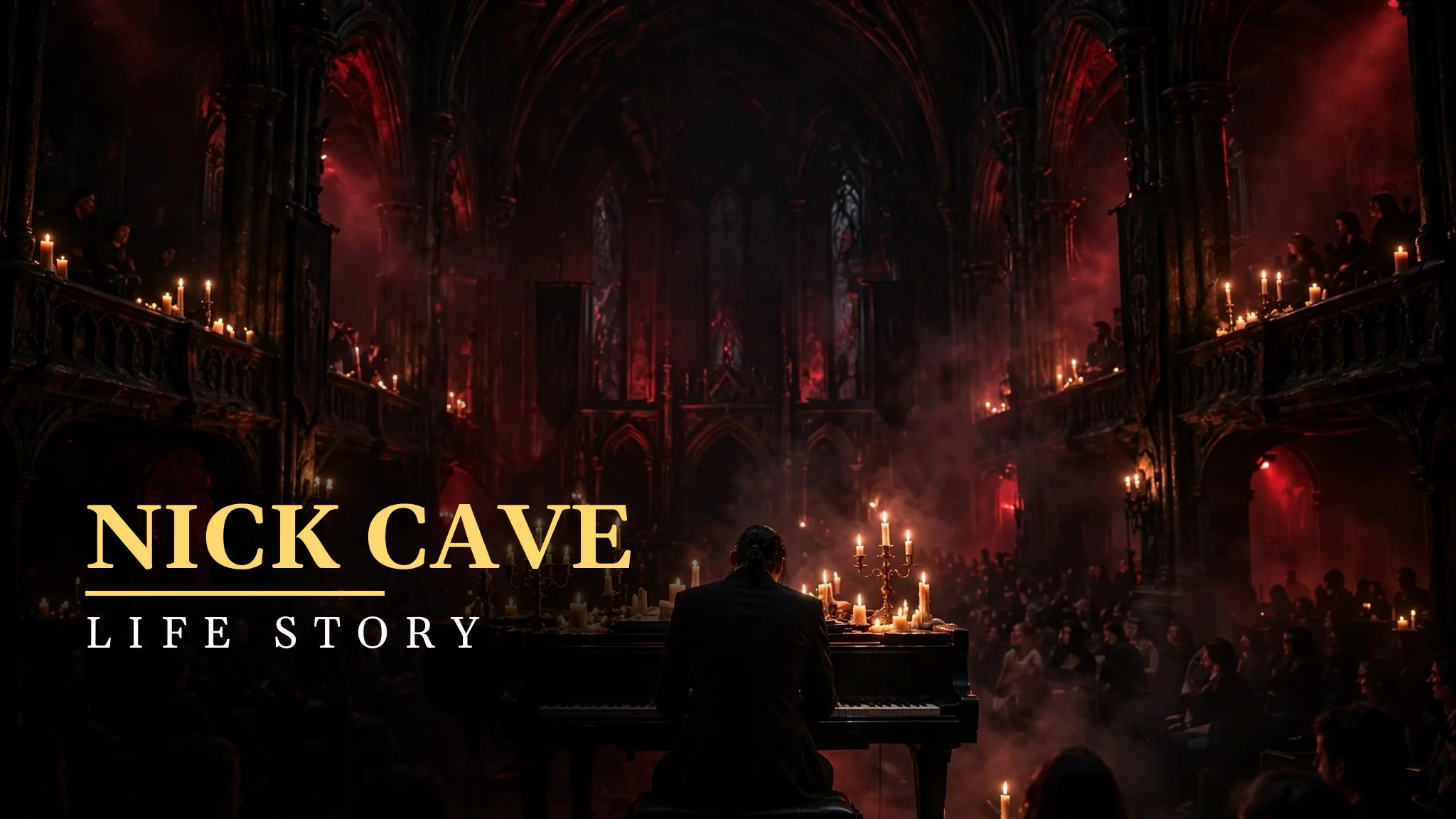
I keep thinking about the piano in the image, about a man sitting at a piano in a dark hall, lit by candles, playing for a quiet audience. That is Nick Cave: a man at a piano, in the dark, playing a song that is both sad and beautiful, and making the audience feel that they are not alone. That is a powerful image, and it is a true one, because his music does that for people, night after night, year after year.
In the end, I believe Nick Cave teaches us that a song can be dark and still be beautiful, and that a life can be painful and still be full of hope. Be honest, read widely, listen carefully, and tell the story that is true to you. If you do that, your work will last, and the people who hear it will remember it. Cave has done that, and his songs will be remembered for a long time, as the work of a dark poet who found light in the darkest places, and who shared that light with the world.
I think about the way Cave writes, because his words are like no one else’s words, and they are the key to his whole career. He writes about murder, about love, about God, and about grief, in language that is dark, beautiful, and unforgettable, using images from the Bible, from old songs, and from the Australian landscape, to tell stories that feel both ancient and modern at the same time. When he sings Red Right Hand, you can see the man in the song, tall and shadowy, appearing in a small town, and you can feel the danger he brings. When he sings Into My Arms, you can feel the love in the song, simple and true, and you want to hear it again and again. That is a rare gift, and it is why people around the world love his music, even when it is dark, even when it is sad, and even when it is hard to listen to.
I also think about The Red Hand Files, because it shows a side of Cave that many people do not expect, a kind, thoughtful, and generous man who answers questions from fans with long letters, about life, about love, about death, and about how to keep going when life is hard. He is known as a dark poet, a wild rock singer, a man in black clothes who sings about murder, but in The Red Hand Files, he writes with kindness, with humour, and with great care, treating each question as if it matters, because to the person who asked it, it does matter. That kindness is a beautiful surprise, and it makes his work even more powerful, because it shows that a person can be dark and kind at the same time, and that art can be both frightening and comforting.
I wonder about his grief, and about how he has turned it into music, because when his son Arthur died in 2015, Cave did not hide. He made Skeleton Tree, an album that is raw and painful, and he shared it with the world, and when his son Jethro died in 2022, he spoke about it openly, in interviews and in his writing. That honesty is brave, because grief is a private thing, and many people would keep it hidden, but Cave chose to share it, and by sharing it, he helped many other people who were grieving to feel less alone. That is a powerful thing for an artist to do, and it is one of the reasons I respect him so deeply, and why his music matters to so many people who have faced loss.
I think about his early life, and about the loss of his father when he was nineteen, and about how that loss shaped his songs, because many of his songs are about death, about fathers, about sons, and about the questions that have no easy answer. That feeling comes from his own life, and it makes his songs feel honest, because he is not writing about death in general. He is writing about a death he knows, a loss he has lived with, and that honesty is what makes his songs so powerful. A songwriter who has known loss can write about it in a way that a person who has not known it cannot, and Cave has known it, and he has turned it into art that helps others.
I also think about his partnership with Warren Ellis, and with the Bad Seeds, because it shows the value of working with people you trust, for many years, through good times and hard times. Cave has worked with the same musicians for a long time, and together they have made music that is dark, beautiful, and true, listening to each other, pushing each other, and making each other’s work better. That is a lesson for any young musician: find people who share your vision, work with them again and again, and trust them, even when the work is hard, and even when other people do not understand it. That partnership will make your work stronger, and it will help you to keep going when the work is difficult.
I think about his novels, and about why they matter, because they show that Cave is not only a songwriter, but a writer in the fullest sense, a man who can build a whole world in prose, with characters, with dialogue, and with a sense of place that is as dark and beautiful as his songs. And the Ass Saw the Angel and The Death of Bunny Munro are not easy books to read, because they are dark, violent, and strange, but they are also funny, poetic, and deeply human, and they show a writer who is willing to take risks, to be strange, and to tell a story that no one else would tell. That is a brave way to write, and it is one that I admire, because it shows that art should not be safe. It should be true, even when the truth is hard to hear.
In the end, I believe Nick Cave will be remembered as a dark poet of rock, a singer, a novelist, and a man who faced great loss with courage and with honesty, and who turned that loss into music, into writing, and into a conversation with his fans that is open, kind, and deeply moving. His songs will be sung for a long time, his books will be read for a long time, and his letters in The Red Hand Files will be remembered, because they show a man who is not only a performer, but also a person who cares, who listens, and who wants to help others. That is a legacy to be proud of, and it is one that will live on in the music he made, and in the people he inspired.
Frequently Asked Questions
How did Nick Cave first become famous with The Birthday Party?
Nick Cave first became famous as the lead singer of The Birthday Party, a punk band formed in Melbourne in the late 1970s, with Mick Harvey and others. The band was known for its loud, wild live shows, and for albums like Prayers on Fire and Junkyard, before breaking up in 1983.
What is Red Right Hand about and why is it so famous?
Red Right Hand, from the album Let Love In in 1994, is about a mysterious man who appears in a small town, bringing both help and danger. The song became famous when it was used as the theme for the television series Peaky Blinders, and it is now one of Cave’s best known songs around the world.
What is the song Into My Arms about?
Into My Arms, from the album The Boatman’s Call in 1997, is a beautiful love song, written after a breakup, about a love that is simple, honest, and true. The song is played at weddings, funerals, and other important moments, and it is one of Cave’s most loved songs.
Did Nick Cave write books as well as songs?
Yes, Cave wrote the novels And the Ass Saw the Angel in 1989 and The Death of Bunny Munro in 2009, both praised for their dark and poetic writing. He also wrote the book Faith, Hope and Carnage, based on conversations about his life, music, grief, and faith.
What happened to Nick Cave’s sons Arthur and Jethro?
Cave’s son Arthur, then fifteen, died in 2015 after falling from a cliff near Brighton, and his son Jethro died in 2022 at the age of thirty-one. Cave has spoken openly about both losses, and he turned his grief into the albums Skeleton Tree in 2016 and Ghosteen in 2019.
What is The Red Hand Files?
The Red Hand Files is a website where fans can write to Nick Cave with questions about life, love, death, and music, and where he answers them with long, thoughtful, and honest letters. The project has become very popular, because Cave writes with kindness, humour, and great care for each question.
Is Nick Cave still making music with the Bad Seeds today?
Yes, Cave released Wild God with Nick Cave and the Bad Seeds in 2024, a joyful and hopeful album, and he toured it around the world. He lives in Brighton, England, with his wife Susie Bick, and he continues to record, tour, and write, more than forty-five years after he started.


