Nicki Nicole: The Life Story Behind Argentina's Rap Queen
In this post
- Rosario, Santa Fe and the City of Messi
- Instagram Freestyles and the Discovery
- Wapo Traketero and the Viral Hit
- Bizarrap Session #13 and the Global Stage
- Recuerdos, Parte de Mí and the Albums
- Mamichula, Trueno and the Duet
- Colocao, YaMeFui and the Hits
- Dispara, Milo J and the New Generation
- The Voice, the Style and the Rap Queen
- Lollapalooza, the Live Show and the Stage
- The Future and the Star from Rosario
- My Take:
Nicole Denise Cucco was born on 25 August 2000 in Rosario, a city in the province of Santa Fe, Argentina, and she grew up in a place that is famous for producing talent. Rosario is the city of Lionel Messi, of Che Guevara, and of a musical culture that is proud, defiant, and deeply Argentine, and Nicki Nicole, as she is known, grew up inside that culture, listening to rap, to trap, and to the freestyle battles that were taking over Argentina in the late 2010s. She did not come from a musical family, and she did not have connections in Buenos Aires, but she had a voice, a phone, and an Instagram account, and she used them to post freestyles that caught the attention of producers, of other rappers, and of millions of listeners. She became Nicki Nicole, one of the most popular young artists in Latin America, known as Argentina’s rap queen, with a career that has taken her from Rosario to the biggest stages in the Spanish-speaking world.
Her best-known work tells the story of that journey. She released Wapo Traketero in 2019, a song that went viral, and she recorded the Bizarrap Music Session #13 the same year, a performance that introduced her to a global audience. She released the albums Recuerdos in 2019, Parte de Mí in 2021, and Alma in 2023, and she has had hits including Mamichula with Trueno, Colocao, YaMeFui with Duki, and Dispara with Milo J. She has performed at Lollapalooza Argentina, she has collaborated with artists from Argentina, Spain, and Puerto Rico, and she has become a voice for a generation of young Latin women who see themselves in her music. This is the story of a girl from Rosario who became a star, and of the songs that carried her there.
Rosario, Santa Fe and the City of Messi
Rosario is the third-largest city in Argentina, a port on the Paraná river, and a place with a strong sense of its own identity. It is the city of Lionel Messi, who was born there, of Che Guevara, who spent his childhood there, and of a cultural life that is proud, creative, and a little bit defiant towards Buenos Aires. Nicki Nicole was born there in 2000, into a working-class family, and she grew up in a city where music, football, and street culture are part of daily life. She did not grow up in a scene. She grew up in Rosario, and the city’s character, its directness, its humour, and its refusal to be intimidated, is part of what makes her music distinctive.
Growing up in Rosario also meant growing up far from the centres of the Argentine music industry, in Buenos Aires, and that distance shaped her career. She did not have access to studios, to producers, or to the networks that Buenos Aires artists take for granted. She had Instagram, and she had a phone, and she used them to share her freestyles, to build an audience, and to get noticed. That do-it-yourself beginning is characteristic of her generation, a generation of Argentine artists who built their careers on social media, without waiting for permission from the industry. Rosario gave her her identity, and Instagram gave her her audience, and the combination took her further than either one alone could have.
Instagram Freestyles and the Discovery
Nicki Nicole began her career by posting freestyle videos on Instagram, rapping over beats, improvising verses, and sharing them with whoever would listen. The videos were simple, filmed at home, with no production and no polish, but they showed a voice that was distinctive, a flow that was confident, and a presence that was impossible to ignore. She was a teenager, rapping in Spanish, with a Rosario accent, and her videos began to spread, first among friends, then across Rosario, and then across Argentina. Producers noticed, other rappers noticed, and the audience grew, video by video, until she was no longer a girl posting freestyles. She was an artist, with a following, and with a future.
The Instagram years were also the years in which she learned her craft. Freestyle is a demanding form, requiring speed, wit, and the ability to think in rhyme, and Nicki Nicole practised it daily, in front of a camera, with an audience that would judge her immediately. That training gave her a sharpness, a precision, and a confidence that are still audible in her recorded work. She did not learn to rap in a studio. She learned it in public, on Instagram, and that public education is part of why her music feels direct, honest, and unfiltered. She is not a manufactured pop star. She is a rapper who built her career one video at a time, and the videos are the foundation of everything that followed.
Wapo Traketero and the Viral Hit
In 2019, Nicki Nicole released Wapo Traketero, her debut single, and it became a viral hit, streamed millions of times and shared across social media in Argentina and beyond. The song is a trap track, with a catchy hook, a confident vocal, and lyrics about style, about attitude, and about being a woman in a male-dominated scene, and it announced a new voice in Argentine urban music. Wapo Traketero was not a polished pop song. It was raw, direct, and full of personality, and that rawness was part of its appeal. Young listeners, especially young women, responded to a song that was unapologetic, that claimed space, and that did so with humour and with style. The song made Nicki Nicole a name, and it did so almost overnight.
The success of Wapo Traketero was both a blessing and a challenge. It gave her fame, it gave her a record deal, and it gave her an audience, but it also created an expectation: that she would repeat the hit, again and again, and that she would be defined by it. Many young artists who have a viral hit never escape it, and the industry is full of one-hit wonders. Nicki Nicole escaped that fate by understanding that a hit is a beginning, not an end, and by working to build a career, album by album, collaboration by collaboration, rather than by chasing the same formula. Wapo Traketero remains her signature song, and she still performs it, but it is now one song among many in a catalogue that has grown steadily since 2019.
Bizarrap Session #13 and the Global Stage
Also in 2019, Nicki Nicole recorded the Bizarrap Music Session #13, a performance that introduced her to a global audience and that remains one of the most popular in the series. The session format, in which the producer Bizarrap builds a beat around an artist’s voice, was becoming the shop window of Argentine urban music, and Nicki Nicole’s entry showed a rapper who could hold a listener’s attention with nothing but flow and words. Her verses were sharp, her delivery was confident, and her presence was magnetic, and the session was viewed millions of times, in Argentina, in Spain, and across Latin America. It was a turning point, because it took her from a viral artist to a serious rapper, recognised by the most important producer in the Argentine scene.
The session also showed her ability to work with a producer, to trust a beat, and to deliver a performance that was both improvised in spirit and polished in execution. Bizarrap’s sessions are a test, because the artist has nowhere to hide, no chorus to lean on, and no production to mask a weak verse, and Nicki Nicole passed the test. Her session is still cited as one of the best in the series, and it is a reminder that her talent is not only about hits. It is about rapping, about flow, and about the craft of the form. She is a rapper first, and a pop star second, and the Bizarrap session is the proof.
Recuerdos, Parte de Mí and the Albums
Nicki Nicole has released three studio albums, each one showing her growth as an artist. Recuerdos, released in 2019, was her debut, a collection of songs that introduced her voice, her style, and her world, with tracks that mixed trap, R&B, and pop. Parte de Mí, released in 2021, was a more mature record, with collaborations, with a wider range of sounds, and with lyrics that dealt with love, with fame, and with the experience of growing up in public. Alma, released in 2023, was her most personal album, a record about identity, about soul, as the title says, and about the journey from Rosario to the world. Each album is a step, and together they show an artist who is growing, album by album, from a teenage rapper to a mature singer-songwriter.
The albums also show her range as a vocalist. She can rap, she can sing, and she can move between the two, often in the same song, and that versatility is what makes her albums interesting. She is not limited to trap, and she is not limited to pop. She is a musician who draws on both, and on R&B, on reggaeton, and on the sounds of Latin America, and who makes them her own. The albums are the core of her career, and they are the reason she is regarded as one of the most important young artists in Latin music. A rapper with one hit is a moment. A rapper with three albums is a career, and Nicki Nicole has a career.
Mamichula, Trueno and the Duet
In 2020, Nicki Nicole collaborated with Trueno, another young star from Argentina, on Mamichula, a song that became one of the defining Argentine urban tracks of the year. The song, produced by Bizarrap, paired Nicki Nicole’s melodic hook with Trueno’s sharp verses, and it was a hit across Latin America and Spain, played on radio, at parties, and in clubs. Mamichula was a genuine duet, not a rapper with a singer added on top, and the two voices needed each other, with Nicki Nicole’s chorus giving the song its melody and Trueno’s verses giving it its edge. The collaboration was also a personal one, because Nicki Nicole and Trueno were in a relationship at the time, and the song’s chemistry was real, in a way that a purely professional collaboration could not replicate.
The success of Mamichula changed the scale of Nicki Nicole’s career. She was no longer only a rapper with a viral hit. She was a chart artist, a collaborator, and a star, with a song that was known across the Spanish-speaking world. The collaboration also showed her ability to work with other artists, to share a song, and to make it better by sharing it. That generosity is a hallmark of her career, and it is part of why other artists enjoy working with her. Mamichula remains one of her best-known songs, and it is the track that most people outside Argentina associate with her first. It is a reminder that the best collaborations are built on real connection, and that Nicki Nicole and Trueno had it, in music and in life.
Colocao, YaMeFui and the Hits
Among Nicki Nicole’s many hits, Colocao deserves special attention, because it is a song that showcases her voice at its best, with a melodic, catchy chorus and a confident, playful vocal. The track became a hit in Argentina and beyond, and it is one of the songs that fans sing along to at her concerts. YaMeFui, a collaboration with Duki and Bizarrap, is another major track, a song that brought together three of the biggest young stars in Argentina, and that became a hit across Latin America. Together, Colocao and YaMeFui show the two sides of Nicki Nicole: the melodic pop singer and the sharp rapper, both present in the same artist, and both convincing.
Her other hits, including Dispara with Milo J in 2023, a collaboration that paired her with one of the youngest stars in Argentine music, and Toa la vida with Mora, show the same pattern: a singer who is generous with her collaborators, who gives them space, and who makes the song better by sharing it. That generosity is rare, and it is part of why other artists enjoy working with her. She does not need to dominate a song. She is happy to share it, and the song is better for it. Her hits are not only a list of chart positions. They are a record of collaborations, of friendships, and of a scene that works together, and Nicki Nicole is at the centre of it.
Dispara, Milo J and the New Generation
In 2023, Nicki Nicole collaborated with Milo J, one of the youngest and most exciting artists in Argentine music, on Dispara, a song that became a major hit and that showed her ability to work with the next generation. Milo J was a teenager, a rapper from Buenos Aires, and the collaboration was a meeting of two generations: Nicki Nicole, who had broken through in 2019, and Milo J, who was breaking through in 2023. The song worked, because both artists brought something real to it, and it became a hit, played on radio and streamed millions of times. It was also a sign that Nicki Nicole was not only a star of her own generation. She was a mentor, a collaborator, and a bridge to the next one.
The collaboration with Milo J is also a reminder that the Argentine urban scene is a community, in which established artists support younger ones, and in which success is shared rather than hoarded. Nicki Nicole has always been part of that community, from her early freestyles to her Bizarrap session to her collaborations with Trueno, Duki, and Milo J, and Dispara is the latest example. She is not a star who guards her position. She is an artist who shares it, and that generosity is one reason she is so well liked within the scene. Dispara is a hit, but it is also a statement, about the future of Argentine music, and Nicki Nicole’s place in it.
The Voice, the Style and the Rap Queen
Nicki Nicole’s voice is one of her greatest assets, and it deserves to be described. It is clear, melodic, and expressive, with a tone that is immediately recognisable, and a range that allows her to rap, to sing, and to move between the two with ease. She can deliver a fast, technical verse, and she can sing a soft, melodic chorus, and both performances are convincing. Her voice is also distinctive, with a Rosario accent that gives her rapping a particular colour, and that distinctiveness is what makes her stand out in a crowded field of Latin rappers. She does not sound like anyone else, and that is a significant advantage in a genre where many voices blur together.
Her style, as a performer and as a public figure, is also part of her appeal. She is known for her fashion, for her videos, and for a visual identity that is confident, feminine, and distinctly her own. She is a rap queen, a title she has earned, not by claiming it but by proving it, song after song, collaboration after collaboration. That title is significant, because the Argentine rap scene, like rap everywhere, has been dominated by men, and Nicki Nicole’s success is a challenge to that dominance. She is not a female rapper. She is a rapper, and she is one of the best in Argentina, and that is a statement that matters, for her and for the young women who follow her.
Lollapalooza, the Live Show and the Stage
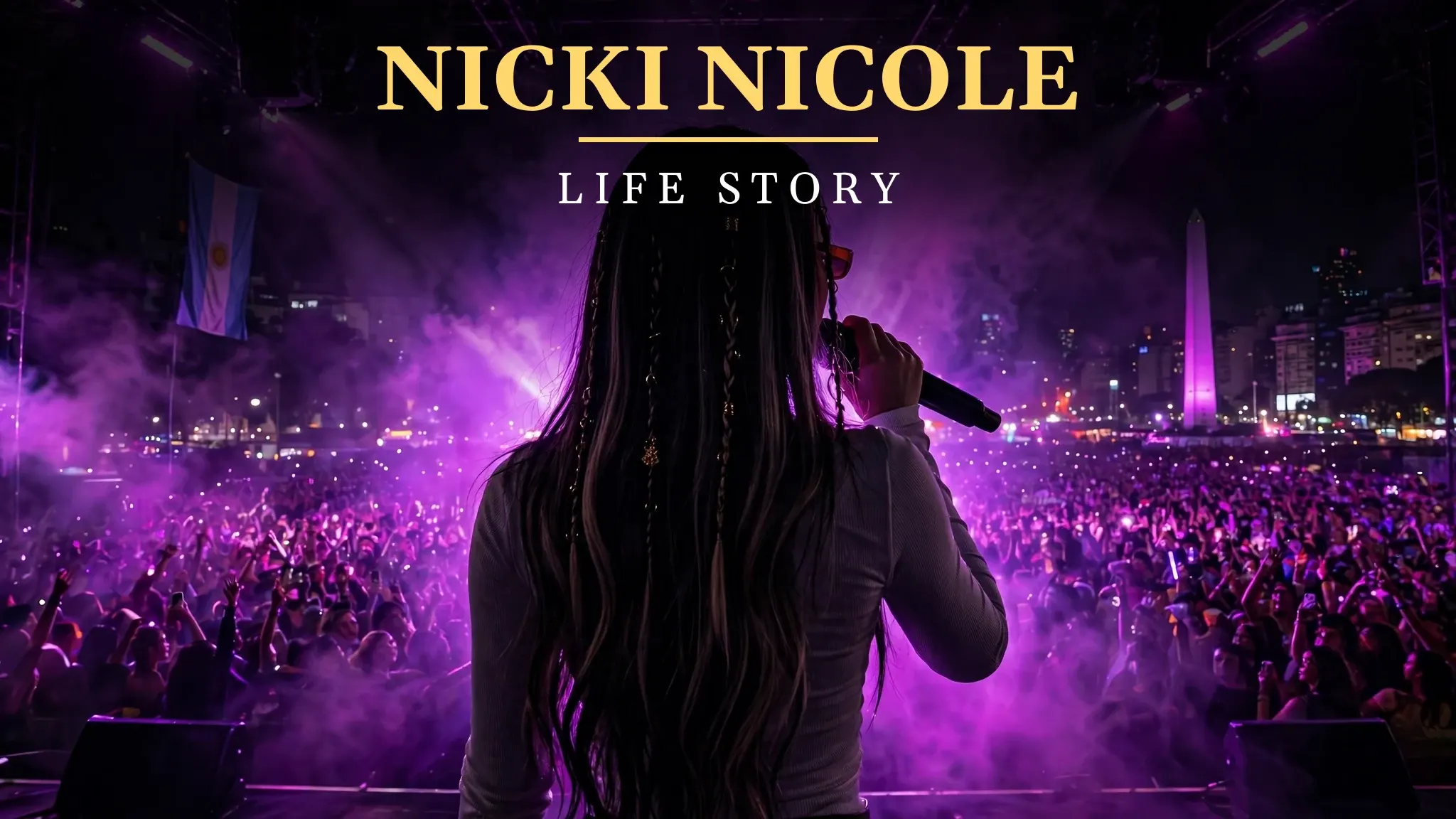
Nicki Nicole’s live shows are a central part of her reputation, and they are known for their energy, their production, and the connection she makes with her audience. She has performed at Lollapalooza Argentina, one of the largest festivals in Latin America, and her sets there have been highlights, with crowds singing along to every word. She performs with a band, with dancers, and with a stage show that is polished and professional, and she sings and raps with a power and a confidence that fill large venues. Her concerts draw young audiences, many of whom have grown up with her music, and the atmosphere is joyful, celebratory, and loud, with fans singing along to Mamichula, to Colocao, and to Wapo Traketero.
The relationship with her fans is also important. She is active on social media, she interacts with her followers, and she treats them as a community rather than as an audience. That accessibility is part of why she is so popular with young listeners, who expect their stars to be reachable, and who reward the ones who are. Nicki Nicole is reachable, she is responsive, and she is grateful, and her fans respond to that gratitude with loyalty. The live show is where that loyalty is most visible, in a room full of people singing her songs back to her, and it is a reminder that music, at its best, is a shared experience, not a solitary one.
The Future and the Star from Rosario
Nicki Nicole’s career is still young, and its future is open. She has three albums, a string of hits, and a place at the centre of Argentine urban music, all achieved before her twenty-fourth birthday, and the combination is already remarkable. The question now is what she will do next, and the answer is likely to be as varied as everything that came before. She could make another album, she could explore new sounds, she could collaborate with artists from other countries, and any of those choices would be consistent with the artist she has become. She is not tied to a single sound or a single role, and that freedom is the most valuable thing a pop star can have.
Her place in the history of Argentine music is already secure. She is the girl from Rosario who became a star, the rapper who posted freestyles on Instagram and built a career, the artist who made Mamichula, and the collaborator who helped define a generation. But her legacy will be more than a list of hits. It will be the example she sets: of a young woman from a small city who believed in herself, who worked hard, and who made music that millions of people love. That example is worth following, and it is why Nicki Nicole matters, not only to her fans, but to anyone who cares about what Latin music can be.
My Take:
When I think about Nicki Nicole, the first thing that comes to mind is the voice, because it is a remarkable instrument for someone so young. She can rap, she can sing, and she can move between the two, often in the same song, and that versatility is rare in Latin urban music. Her delivery is confident, her flow is sharp, and her choruses are melodic and memorable, and that combination is what makes her songs so effective. She is not only a rapper. She is a singer, and she is a songwriter, and she does all three with a skill that belies her age. That is the foundation of her career, and it is why she has lasted, while many viral artists have faded.
The second thing is the journey, from Rosario to the world, and it is a journey that is hard to believe until you hear her tell it. She posted freestyles on Instagram, she released Wapo Traketero, she recorded a Bizarrap session, and she became a star, all before she was twenty. That speed is remarkable, and it is a sign of both her talent and the power of social media to launch a career. She did not wait for a record deal. She built an audience herself, video by video, and the industry came to her. That is the new way to become a star, and Nicki Nicole is one of its best examples. She is a reminder that talent, when combined with a phone and a determination, can reach the world.
Wapo Traketero is the song that started everything, and it deserves to be remembered, because it is a perfect debut hit. It is raw, direct, and full of personality, and it announced a new voice in Argentine urban music. The song’s success was not a fluke. It was the result of a good song, well performed, and well timed, and it has lasted, still played and still sung, years after its release. That longevity is rare for a viral hit, and it is a sign that the song captured something real: a young woman claiming space in a male-dominated scene, with humour, with style, and with confidence. Nicki Nicole filled a gap, and the audience rewarded her for it.
The Bizarrap session #13 is the performance that proves she is a rapper, and it deserves to be discussed, because it is a test that many artists fail. The session format gives the artist nowhere to hide, no chorus to lean on, and no production to mask a weak verse, and Nicki Nicole passed it, with sharp verses, confident delivery, and a presence that held the listener’s attention. Her session is still cited as one of the best in the series, and it is a reminder that her talent is not only about hits. It is about rapping, about flow, and about the craft of the form. She is a rapper first, and a pop star second, and the session is the proof.
Mamichula is the collaboration that best shows her ability to work with others. The song, with Trueno and Bizarrap, is a genuine duet, with Nicki Nicole’s melodic hook and Trueno’s sharp verses complementing each other, and it became one of the defining Argentine urban tracks of 2020. The collaboration was also personal, because the two were in a relationship at the time, and the song’s chemistry was real. That chemistry is audible, in the way the two voices interact, and it is part of why the song was so successful. Mamichula remains one of her best-known songs, and it is the track that most people outside Argentina associate with her first. It is a reminder that the best collaborations are built on real connection.
Her albums, Recuerdos, Parte de Mí, and Alma, are the body of work that holds the hits together, and they deserve to be listened to as albums, not only as collections of singles. Recuerdos was a debut, a statement of identity. Parte de Mí was a more mature record, with a wider range of sounds. Alma was her most personal album, about identity and soul. Together, the three albums show an artist growing, album by album, from a teenage rapper to a mature singer-songwriter. That growth is the most important thing about her career, because it shows that she is not a one-hit wonder. She is a musician, building a body of work, and the work is getting better.
Dispara, with Milo J, is the collaboration that shows her generosity, because it paired her with one of the youngest artists in Argentine music, and it became a hit. She did not need to work with a teenager. She chose to, because she believed in him, and because she wanted to support the next generation. That generosity is a hallmark of her career, and it is part of why other artists enjoy working with her. She is not a star who guards her position. She is an artist who shares it, and that sharing is one reason she is so well liked within the scene. Dispara is a hit, but it is also a statement, about the future of Argentine music, and Nicki Nicole’s place in it.
Her role as a woman in Argentine rap is another thing worth discussing, because the scene, like rap everywhere, has been dominated by men, and Nicki Nicole’s success is a challenge to that dominance. She is not a female rapper. She is a rapper, and she is one of the best in Argentina, and that distinction matters. Young women in Argentina see themselves in her music, in her confidence, and in her refusal to be limited by gender, and that representation is significant. She is a role model, not because she set out to be one, but because her success shows what is possible. That is a powerful legacy, and it is one that will last beyond her own career.
For a new listener, I would suggest a simple path. Start with Wapo Traketero, then listen to the Bizarrap session #13, then listen to Mamichula, then listen to the Alma album from start to finish, and then watch a live performance. That order takes you from the first hit to the session to the duet to the album, and it shows the full arc of a career that is still growing. If you only have time for one song, make it Mamichula, because it is the most popular, and if you only have time for one album, make it Alma, because it is the most personal.
One more thought: Nicki Nicole’s career is a useful answer to anyone who thinks that social media fame is not real fame. Her fame began on Instagram, but it is real, because it is built on talent, on songs, and on performances, not only on videos. She used social media as a tool, not as a substitute for work, and the work is what has sustained her. That is a lesson for every young artist: the platform can launch you, but only the work can keep you, and Nicki Nicole’s work has kept her, album after album, hit after hit.
Finally, I would say this: Nicki Nicole matters not only for what she has sung but for what she represents. She represents Rosario, its pride, its defiance, and its talent, and she represents a generation of young Latin women who are claiming space in music, in rap, and in public life. She is a reminder that a girl from a small city can become a star, that a rapper can be a singer, and that a viral hit can be the beginning of a real career. That is a hopeful story, and it is a true one, and it is why, at twenty-four, she is already one of the most important young artists in Latin America.
There is a last detail that stays with me, which is the way she talks about Rosario. She does not talk about it as a place she left. She talks about it as home, as the source of her identity, and as the place she returns to, in her mind, whenever she needs to remember who she is. That loyalty to home is the thread that runs through her whole career, from Wapo Traketero to Alma, and it is why her music feels authentic. She did not become famous by leaving Rosario behind. She became famous by carrying it with her, and the world came to listen.
Her live shows deserve a final word, because they are where her energy, her voice, and her connection with her fans come together. She has performed at Lollapalooza Argentina, at festivals across Latin America, and her sets are known for their joy, their power, and the way the crowd sings along to every word. A live show is a test, and Nicki Nicole passes it, night after night, with a performance that is as compelling as her records. That is a sign of a real artist, one who can deliver on stage as well as in the studio.
One more practical note: if you want to understand Argentine urban music in the 2020s, listen to Nicki Nicole. Her music is the sound of a generation, a mixture of trap, R&B, pop and reggaeton, sung in Spanish, with a confidence and a directness that are characteristic of the scene. She is not only a singer. She is a portrait of a moment, and that moment is still happening, in Rosario, in Buenos Aires, and across Latin America. Listening to her is the best way to hear it.
Looking ahead, the question is what she will do next, and the answer is likely to be as varied as everything that came before. She could make another album, she could explore new sounds, or she could collaborate with artists from other countries, and any of those choices would be consistent with the artist she has become. She is not tied to a single sound, and that freedom is the most valuable thing a pop star can have. The next chapter is unwritten, but the chapters so far suggest that it will be worth following.
Her relationship with Trueno, and later with Peso Pluma, is a subject that the press has often focused on, but it is worth saying plainly that her career is not defined by her relationships. She is an artist in her own right, with her own songs, her own albums, and her own audience, and the relationships are a part of her life, not the whole of it. That distinction matters, because female artists are too often defined by the men in their lives, and Nicki Nicole deserves to be defined by her work. Her work is the story, and it is a remarkable one, on its own terms.
One more thought on her albums: Alma, from 2023, is the most personal, and it is the one I return to most, because it shows an artist who is thinking about identity, about soul, and about what it means to grow up in public. The album is more reflective than her earlier work, and it shows a maturity that is impressive for someone so young. It is a reminder that Nicki Nicole is not only a hitmaker. She is a songwriter, and a thoughtful one, and Alma is the proof.
One more thought on her songwriting: her lyrics are direct, funny, and honest, and they show a writer who knows her own voice. She writes about love, about confidence, and about life in Rosario, and she does so without pretence. That directness is part of why her songs connect, especially with young women who hear their own lives in her words.
One last thing about the crowds at her shows: they are young, loud, and they know every word, and watching them sing Wapo Traketero back at her is a reminder of how music travels now. It starts on a phone in Rosario, and it ends in a stadium full of strangers who feel like friends. That journey, from a screen to a stage, is the story of her generation, and Nicki Nicole is one of its best examples.
Frequently Asked Questions
When was Nicki Nicole born?
Nicki Nicole, whose real name is Nicole Denise Cucco, was born on 25 August 2000 in Rosario, Santa Fe, Argentina.
What was Nicki Nicole’s breakthrough song?
Her breakthrough was Wapo Traketero, released in 2019, a trap track that went viral and made her a name in Argentine urban music.
What is Nicki Nicole’s Bizarrap session?
She recorded the Bizarrap Music Session #13 in 2019, a performance that introduced her to a global audience and remains one of the most popular in the series.
What is Mamichula?
Mamichula is a 2020 song by Trueno featuring Nicki Nicole, produced by Bizarrap. It became one of the defining Argentine urban tracks of the year.
What albums has Nicki Nicole released?
She has released three albums: Recuerdos in 2019, Parte de Mí in 2021 and Alma in 2023.
What is Dispara?
Dispara is a 2023 song by Nicki Nicole with Milo J, one of the youngest stars in Argentine music. It became a major hit and showed her support for the next generation.


