Oh Jung-se: The Life Story Behind Korea's Beloved Actor
In this post
- Growing Up in Uijeongbu and the First Love of Theatre
- Small Film Roles and Learning the Camera
- The Long Wait and the Steady Professional
- When the Camellia Blooms and the First Big Prizes
- It’s Okay to Not Be Okay and the Brother the World Loved
- Jirisan, Uncle Samsik, and the Years After Fame
- The Neighbour We All Know and His Place in Korean Drama
- The Theatre Roots and the Art of Listening
- My Take:
Oh Jung-se is the actor every Korean drama fan knows, even if they do not always remember his name at first. He is the kind, funny, sad, or strange man on the edge of the story, the one who makes the leading actors look better and who often steals the scene without trying. For more than twenty-five years he worked in theatre and in small screen roles, patient and professional, until one role, as the gentle older brother in It’s Okay to Not Be Okay, made the whole world love him. Suddenly people knew his name, and they realised that he had been there all along, doing excellent work in drama after drama.
What makes his story special is that he did not become famous young, and he did not become famous by playing heroes. He became famous by playing real people: neighbours, brothers, friends, small-town men with big hearts and ordinary troubles. He is a character actor in the best sense, a man who disappears into a role so completely that you forget you are watching an actor. And when fame finally came, in his forties, he was ready for it, because he had spent decades learning how to be good.
This is the story of a patient man from Uijeongbu who loved the theatre, who waited for his moment, and who, when it came, used it to show the world that the most important person in a story is not always the hero. Sometimes it is the brother, the friend, or the neighbour, played with honesty and with heart.
Growing Up in Uijeongbu and the First Love of Theatre
Oh Jung-se was born on 26 February 1977 in Uijeongbu, a city just north of Seoul in Gyeonggi Province. Uijeongbu is a busy, ordinary Korean city, close enough to the capital to feel its energy, but with its own slower rhythm and its own neighbourhoods. Oh grew up there, and the warmth and directness of ordinary Korean life stayed with him. He did not grow up in glamour. He grew up in a place where people work hard, look after their families, and know their neighbours, and that background shows in the characters he plays.
As a young man, he fell in love with theatre. Theatre is a hard love to follow in Korea, because it does not pay well and it does not make a person famous, but it teaches an actor everything that matters: how to speak so that a whole room can hear you, how to keep a character alive for two hours, and how to work as part of a team. Oh began acting on stage in the late 1990s, and he stayed with theatre for many years, learning his craft night after night in front of small audiences who came because they loved plays, not because they loved stars.
He studied at Sun Moon University, and he built his life around the stage. In theatre, there is no camera to make you look good, and there is no editing to save a weak moment. You must be present, you must be honest, and you must earn the audience’s attention every minute. Oh learned those lessons, and they gave him a strength that screen actors who never do theatre often lack. His voice, his timing, and his ability to be funny and sad in the same scene all come from those years.
He also learned patience. A theatre actor can work for years without being noticed by television or film, and many give up. Oh did not give up. He believed that good work would lead to more good work, even if it took a long time. That belief, held quietly for more than a decade, is the foundation of everything that followed.
Small Film Roles and Learning the Camera
Oh Jung-se began appearing in films in the late 1990s and early 2000s, taking small roles and learning how different screen acting is from stage acting. On film, the camera is close, and a small look can say more than a loud speech. Oh learned to be smaller, to trust the camera, and to let his face do the work. He appeared in a number of films in supporting roles, and directors began to notice that he was reliable, professional, and always interesting, even in a short scene.
Television came more slowly. Korean dramas in the 2000s were dominated by young stars and romantic leads, and there was little room for a character actor in his thirties who looked like an ordinary man. But Oh kept working, and he kept building a reputation. People who worked with him talked about his kindness, his humour, and his willingness to help a scene work, even if it meant stepping back so another actor could shine. That generosity is rare, and it is one reason directors kept calling him back.
He played many kinds of men in those years: policemen, neighbours, office workers, friends, and villains. He did not care about the size of the role. He cared about whether the character felt real, and whether he could find something true in the part. That attitude kept his work fresh, and it meant that when a bigger role finally came, he was ready for it in a way that a less patient actor would not have been.
The years of small roles also taught him about people. A character actor must watch people closely, because he must play people who are not heroes, people who are ordinary, and ordinary people are the hardest to play well. Oh watched how people walk, how they laugh when they are nervous, and how they hide their sadness behind a joke. When his big roles came, all that watching paid off.
The Long Wait and the Steady Professional
By the 2010s, Oh Jung-se was a familiar face in Korean film and television, but he was still not a star. He was the actor you recognised and liked, the one whose name you could not quite remember, and that is a strange place to be. It is a place of respect without fame, of good work without reward, and it tests a person’s character. Some actors in that place become bitter. Oh seems to have become grateful instead, grateful for the work, for the colleagues, and for the chance to act at all.
He appeared in films such as Swing Kids in 2018, a film about a tap-dancing North Korean soldier, where he played a man caught in a difficult time. The film was praised, and his performance was noted, but it did not make him a star. He also appeared in many dramas, playing supporting roles that made the stories better. He was, in the best sense, a working actor, and he took pride in that.
He also continued to work in theatre when he could, because theatre was his first love and because it kept his skills sharp. A screen actor who stops doing theatre can lose the habit of being present, of listening, and of trusting the moment. Oh did not lose those habits. He kept them alive, and they showed in his screen work, where he always seemed to be listening, even when he was not speaking.
In those years, he also thought about what kind of actor he wanted to be. He did not want to be a star for a year. He wanted to be an actor for a lifetime, and that meant choosing good work over easy fame, and being patient when fame did not come. That patience would be rewarded, but not in the way he expected, and not until he was in his forties.
When the Camellia Blooms and the First Big Prizes
In 2019, Oh Jung-se starred in When the Camellia Blooms, a drama about a single mother who runs a bar in a small town, and the people around her. He played No Kyu-tae, a kind but weak man, the husband of a woman who loves him and is frustrated by him in equal measure. The role was comic and sad at the same time, and Oh played it with a warmth that made audiences love the character even when he made mistakes. The drama was a huge hit, and it won him the Best Supporting Actor prize at the Baeksang Arts Awards.
That prize mattered, because it was the first time the wider public had recognised what directors and fellow actors had known for years: that Oh Jung-se was one of the best character actors in Korea. He was in his early forties, and he had waited more than twenty years for that recognition. When it came, he accepted it with grace, and he thanked the people who had worked with him along the way. He did not act like a man who had finally arrived. He acted like a man who was grateful to be noticed.
The drama also showed his gift for comedy. He could be funny without being silly, and he could make a joke land while also showing the sadness underneath it. That is a hard balance, and very few actors can hold it. Oh held it, and the audience loved him for it. He had shown that he could be a leading supporting actor, a man who could carry a story even when he was not the hero.
After Camellia Blooms, more offers came, and he chose them carefully. He did not want to repeat the same character. He wanted to keep growing, and he wanted to find roles that challenged him. The next role he chose would become the most famous of his life, and it would change everything.
It’s Okay to Not Be Okay and the Brother the World Loved
In 2020, Oh Jung-se took on the role of Moon Sang-tae in It’s Okay to Not Be Okay, a drama about a man who cares for his older brother, who is on the autism spectrum, and who falls in love with a children’s book writer. Oh played the older brother, a man who loves dinosaurs, who is afraid of butterflies, and who sees the world in a way that is direct and honest. It was a difficult and sensitive role, and it could easily have gone wrong. Oh played it with care, with humour, and with deep respect, and the result was one of the most loved performances in Korean drama history.
Audiences around the world fell in love with Sang-tae. They loved his honesty, his love for his brother, and the way he grew and changed over the course of the drama. They also loved the relationship between the two brothers, which felt real and tender rather than forced. Oh’s performance won him the Best Supporting Actor prize at the Baeksang Arts Awards for a second year in a row, and it made him a star, not only in Korea but around the world.
The role mattered for another reason. It showed a person with autism as a full human being, with dreams, fears, humour, and a life of his own, not as a symbol or a problem to be solved. Oh worked hard to play the character truthfully, and he listened to advice from people who understood autism. That care showed on screen, and it earned him praise from viewers and from disability advocates. He had taken a risk, and he had done it with respect.
After the drama, Oh Jung-se was no longer a familiar face without a name. He was a beloved actor, and people waited to see what he would do next. He had waited more than twenty years for that moment, and when it came, he handled it with the same calm and kindness that had marked his whole career.
Jirisan, Uncle Samsik, and the Years After Fame
After It’s Okay to Not Be Okay, Oh Jung-se continued to work steadily, choosing roles that showed different sides of him. In 2021 he appeared in Jirisan, a drama about rangers on Korea’s highest mountain, playing a kind and steady ranger who helps others. The drama was a large production, and his presence gave it warmth and grounding. He played a man who knows the mountain, who respects it, and who looks after the people who visit it, and the role suited his calm, reliable screen presence.
In 2024 he appeared in Uncle Samsik, a drama set in the 1960s about a fixer who helps a young politician, and he played a character who was more complex and more political than his earlier roles. The drama showed that he could work in a serious historical story as well as in a warm family drama, and that his range was wider than audiences had thought. He was not only the kind brother. He was a complete actor, able to play many kinds of men.
He also continued to appear in films, and he remained in demand as a supporting actor who could make any story better. Directors wanted him because he was reliable, because he made other actors better, and because audiences trusted him. When Oh Jung-se appears in a drama, viewers feel safe, because they know that his character will be played with honesty and with heart.
He has also become a mentor figure for younger actors, a man who has lived the long, patient career and who can show others how to do it. He speaks about acting with humility, and he talks about the theatre as the place where he learned everything. Young actors listen to him, because he has earned the right to be heard, not by being famous young, but by being good for a long time.
The Neighbour We All Know and His Place in Korean Drama
Oh Jung-se’s career tells a story that is different from most star stories. Most stars are found young, and they spend their careers trying to stay young. Oh was found late, and he spends his career being exactly who he is: a warm, funny, honest man in his forties and fifties who plays people we recognise from our own lives. That is why audiences love him. He does not look like a star from another world. He looks like a neighbour, a brother, a friend, and that familiarity is his power.
He is known for being kind on set, for making people laugh, and for treating everyone with respect, from the leading actor to the youngest staff member. That kindness is not a performance. It is who he is, and it shows in his work. When he plays a kind man, you believe it, because he is a kind man. When he plays a sad man, you believe it too, because he understands sadness and does not hide from it.
His story also tells us something about Korean drama itself. Korean dramas are loved around the world because they tell human stories, and human stories need actors who can play ordinary people with truth. Oh Jung-se is one of those actors, and he is essential to the dramas he appears in. Without him, the stories would be less warm, less funny, and less real. With him, they feel like life.
Today, Oh Jung-se remains one of Korea’s most beloved actors. He works less often than he once did, and he chooses more carefully, but when he appears, people pay attention and they smile. He has shown that fame can come late, and that late fame can be sweeter than early fame, because it is built on years of good work rather than on a single lucky moment. He is still growing, and his best work may still be ahead of him.
The Theatre Roots and the Art of Listening
One of the most important parts of Oh Jung-se’s story is his theatre background, and it deserves to be told in full, because it explains almost everything about the way he acts on screen. He began on stage in the late 1990s, in small productions in front of small audiences, and he stayed with theatre for many years, learning a craft that cannot be learned any other way. In theatre, an actor must be heard by the back row, must remember long passages of text, and must keep a character alive for two hours without a break. There is no second take, no close-up to save you, and no editing to hide a weak moment. You must be present, you must be honest, and you must earn the audience’s attention every minute. Oh learned those lessons, and they gave him a strength that screen actors who never do theatre often lack.
Listening is the skill that theatre teaches best, and Oh is one of the finest listeners in Korean acting. When you watch him in a scene, you can see him listening to the other actor, really listening, not waiting for his turn to speak. His face changes as he listens, his eyes move, and his breathing changes, and the audience feels that he is truly hearing what is being said. That is a rare gift, and it is one that makes other actors better, because when you act with someone who listens, you act better yourself. Directors have spoken about this, about the way a scene comes alive when Oh is in it, not because he does something big, but because he listens so well that the whole scene becomes more real.
Theatre also taught him about comedy, and about the difference between being funny and trying to be funny. On stage, a joke that is forced falls flat at once, and the audience’s silence tells you so immediately. Oh learned to find humour in a character, in a situation, and in a small human weakness, rather than in a joke pasted on top. When he plays a funny man, the humour comes from the person, from the way he walks, from the way he misunderstands something, or from the way he tries too hard. That is why his comedy feels warm rather than silly, and why audiences laugh with his characters rather than at them. It is a generous kind of comedy, and it is one that comes from years on stage, where the audience is close enough to see whether you mean it.
There is also a physical side to his theatre training that shows on screen. He uses his whole body to act, not only his face, and he knows how to stand, how to sit, and how to move in a way that tells you who his character is before he speaks. When he plays Sang-tae, his body is open and eager, his hands move when he talks about dinosaurs, and his whole being leans toward the person he loves. When he plays a tired man in a small town, his shoulders drop, his walk slows, and his body tells you that he is carrying a weight. That physical honesty is a theatre skill, and it is one that makes his screen performances feel complete, as if the character exists from head to toe, not only from the neck up.
Finally, theatre taught him humility, and humility is the most important lesson of all. In theatre, you are part of a company, and the play matters more than any single actor. You learn to serve the story, to help your colleagues, and to accept that your role may be small. Oh carried that humility into television and film, and it is one reason he is loved by everyone who works with him. He does not try to be the star of every scene. He tries to make the scene work, and if that means stepping back, he steps back gladly. That generosity is rare, and it is the reason his career has lasted so long, because directors and actors want to work with a person who makes the work better for everyone.
My Take:
I think Oh Jung-se is one of the most hopeful stories in Korean acting, and I have thought about why that is while writing his life. He waited more than twenty years to be famous, and he did not become bitter. He kept working, he kept learning, and he kept being kind to the people around him. I think that is a rare and beautiful thing. In a world that tells us to be famous by twenty-five or to give up, Oh Jung-se is proof that the world is wrong. He became famous at forty-three, and he became famous by playing a brother, not a hero, and that is a lesson I want everyone to hear. Your time may come late, and it may come in a form you did not expect, but if you keep working, it can still come.
What moves me most is his performance as Moon Sang-tae. I have seen many actors play characters with disabilities, and too often the performance feels like an imitation, or like a way to win an award. Oh’s performance felt different. It felt like a person, not a performance. He played Sang-tae as a man who loves dinosaurs, who is afraid of butterflies, who is angry when he is treated badly, and who is loyal to his brother with his whole heart. I think the reason it worked is that Oh did not try to be inspiring. He tried to be true, and truth is always more inspiring than inspiration. I believe that performance helped many people see autism differently, and that it helped families feel seen. That is a real thing that art can do, and I do not say it lightly.
I also admire his work in When the Camellia Blooms, because it showed his gift for playing an ordinary man who is both funny and sad. No Kyu-tae is not a hero. He is a man who makes mistakes, who is weak, and who is loved anyway. I think many of us are like that, and it is a comfort to see such a man on screen, played with love rather than with judgement. Oh did not make the character into a fool. He made him into a person, and that is a harder and kinder thing to do. I think that is why audiences loved him in that drama, and why they trusted him in the next one.
There is a lesson here about supporting actors, and I think it is an important one. We live in a world that celebrates the hero, the star, the person in the centre of the poster. But stories do not work without the people on the edges, the brothers, the friends, the neighbours, who make the world feel real. Oh Jung-se is one of those people, and his career proves that the edge of the story can be the most important place to be. If you are a person who supports others, who makes others look good, who does the quiet work that no one notices, I want you to know that your work matters. Oh Jung-se proves it.
I think about his theatre years a lot, because I believe they are the reason his acting feels so alive. In theatre, you cannot hide. You must be present, you must listen, and you must earn the audience’s attention every minute. Oh learned that, and he carried it into television, where many actors forget to listen. When I watch him, I see a man who is always listening, even when he is not speaking, and that listening makes the scene work. I wish more actors learned to listen like that. I wish more people in life learned to listen like that, too. Listening is a small thing, but it changes everything.
His kindness on set also matters to me. I have read many times that he is warm, funny, and respectful to everyone, from the star to the youngest staff member. I think that is not a small detail. A film set is a hard place, with long hours and high pressure, and a kind person makes the whole place better. I believe that Oh’s kindness is part of why directors want to work with him again, and why other actors speak well of him. Talent gets you the first job. Character gets you the tenth, and the twentieth, and the fiftieth. Oh Jung-se has had a long career because he has both.
If I could meet him, I would thank him for Sang-tae, and I would ask him how he prepared for the role. I suspect his answer would be simple, and that the simplicity would be the lesson. He would probably say that he listened, that he watched, and that he tried to understand the person, not the label. I think that is enough. If we all tried to understand the person, not the label, the world would be a kinder place, and Oh’s performance is a reminder of that.
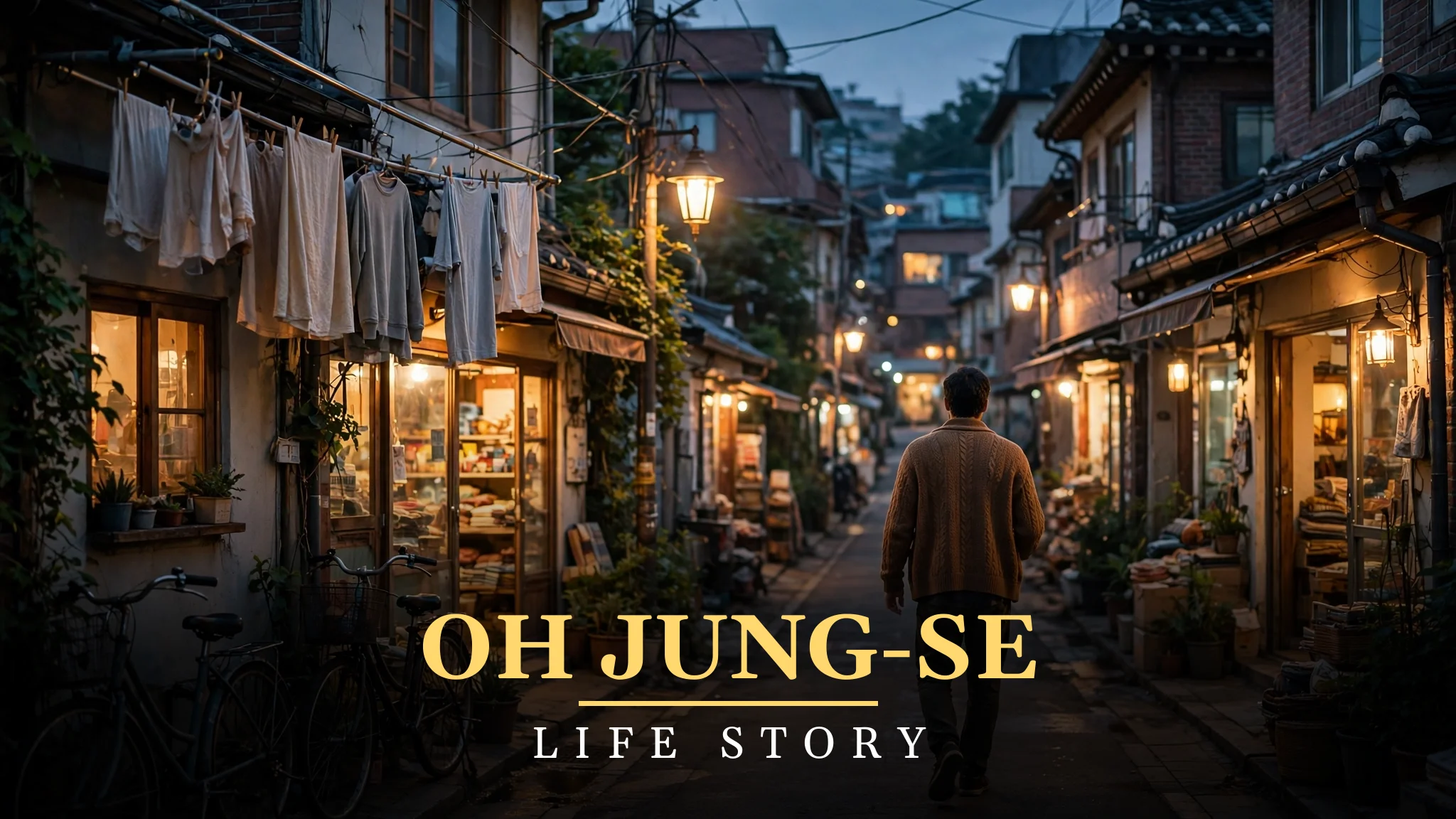
In the end, I come back to the image of him walking down a narrow old alley at dusk, a man in a brown sweater, going home past small shops and bicycles. That image fits him, because he has always seemed like a man walking home, not a man walking a red carpet. He is ordinary, and he is extraordinary, and he is both at the same time. I hope he keeps working for many years, and I hope his next roles are as warm and as honest as the ones that came before. I think Korean drama is better because he is in it, and I think anyone who has waited a long time for their moment will find hope in his story.
One last thought stays with me. Oh Jung-se’s career shows that you do not need to be the hero to matter. You can be the brother, the friend, the neighbour, and you can matter more than the hero, because you are the person who makes the hero’s story real. I think that is a lesson for all of us, in work and in life. Be the person who makes the story work, and the story will remember you. Oh Jung-se will be remembered, not only for Sang-tae, but for all the small, honest people he played along the way, and for the kindness he brought to every one of them.
I also keep thinking about his listening, because it is such a rare and beautiful skill, and because it is one that I wish more people had. When Oh Jung-se listens on screen, you can see him truly hearing the other person, and that hearing makes the scene feel real. In life, too many of us wait for our turn to speak, and we do not really hear what the other person is saying. Oh hears, and his hearing is a form of kindness, a way of saying that the other person matters. I think that is a lesson for all of us. Listen, really listen, and the people around you will feel it, and the work you do together will be better.
There is another thought that stays with me, about the way he handles fame. He became famous late, and he handles it with a calm that is rare. He does not act like a man who has finally arrived, and he does not act like a man who is afraid of losing what he has found. He acts like a man who is grateful, and who knows that fame is a borrowed thing. I think that gratitude is a form of wisdom, and it is one reason people love him. He does not take his fame for granted, and he does not use it to make himself bigger. He uses it to do good work, and to help others, and that is the best use of fame there is.
I also think about the mothers and brothers who watch his performance as Sang-tae, and about what it means to them. For a family living with autism, to see a character played with such care, such humour, and such respect is a gift. It says that their loved one is a whole person, not a problem, and that their family is worthy of a beautiful story. I believe that performance has helped many families feel seen, and that it has helped many people understand autism a little better. That is a real thing that art can do, and I am grateful that Oh Jung-se did it with such love.
If I could watch only one of his performances again, it would be Sang-tae, because it is the role in which all his gifts come together: listening, humour, warmth, and honesty, held in a single character. I would watch it and be reminded that the most important person in a story is not always the hero, and that a brother, played with love, can be the heart of everything. That is a beautiful lesson, and I hope Oh Jung-se keeps teaching it for many years to come.
I also keep thinking about his work in Jirisan, because it showed his calm, steady presence in a large drama, and because it reminded me that he can play a man who knows a mountain, who respects it, and who looks after the people who visit it. That is a quiet kind of heroism, the heroism of a person who does a difficult job well, day after day, without praise, and I think Oh understands that heroism deeply, because he has lived it himself, as an actor who worked for twenty years before fame found him. He knows what it means to do good work without applause, and he plays that knowledge with great heart.
There is another thought that stays with me, about the way he makes other actors better. When you act with someone who listens, you act better yourself, and Oh is one of the finest listeners in Korean acting. His face changes as he listens, his eyes move, and his breathing changes, and the audience feels that he is truly hearing what is being said. I think that is a lesson for all of us, in work and in life. Listen, really listen, and the people around you will feel it, and the work you do together will be better. That is a simple lesson, and it is one that Oh Jung-se teaches, scene after scene, without ever saying a word about it.
I also think about the families who watch his performance as Sang-tae, and about what it means to them. For a family living with autism, to see a character played with such care, such humour, and such respect is a gift. It says that their loved one is a whole person, not a problem, and that their family is worthy of a beautiful story. I believe that performance has helped many families feel seen, and that it has helped many people understand autism a little better. That is a real thing that art can do, and I am grateful that Oh Jung-se did it with such love.
If I could watch only one of his performances again, it would be Sang-tae, because it is the role in which all his gifts come together, and because it is the role that reminds me that the most important person in a story is not always the hero. Sometimes it is the brother, played with love, and that brother can be the heart of everything. That is a beautiful lesson, and I hope Oh Jung-se keeps teaching it for many years to come.
One more thought stays with me, and it is about gratitude. Oh Jung-se waited more than twenty years to be famous, and he accepted that fame with gratitude, not with pride, and that gratitude makes people love him even more. I hope we all learn from that, and I hope we all remember to be grateful for the good work we are given, even when it comes late, and even when it comes in a form we did not expect.
Frequently Asked Questions
Who did Oh Jung-se play in It’s Okay to Not Be Okay?
He played Moon Sang-tae, the older brother of the male lead, a man on the autism spectrum who loves dinosaurs and is afraid of butterflies. His warm, honest performance made the character one of the most loved in Korean drama history. He won the Best Supporting Actor prize at the Baeksang Arts Awards for the role.
When did Oh Jung-se become famous?
He worked in theatre and in small film and television roles for more than twenty years before becoming widely famous. His breakthrough came with When the Camellia Blooms in 2019, followed by It’s Okay to Not Be Okay in 2020. He was in his early forties when fame arrived, which makes his story unusual and inspiring.
What is Oh Jung-se best known for?
He is best known for playing Moon Sang-tae in It’s Okay to Not Be Okay and No Kyu-tae in When the Camellia Blooms. He is also known for Jirisan and Uncle Samsik, and for his long career as a respected character actor in Korean film and television. Fans love him for his warmth, humour, and honesty.
Did Oh Jung-se start in theatre?
Yes, he began acting on stage in the late 1990s and spent many years working in theatre before moving into film and television. His theatre training gave him a strong voice, good timing, and the discipline of live performance. He still speaks of theatre as the place where he learned everything.
Has Oh Jung-se won Baeksang Awards?
Yes, he won Best Supporting Actor at the Baeksang Arts Awards for When the Camellia Blooms and again for It’s Okay to Not Be Okay. Those back-to-back wins recognised more than twenty years of excellent work. He is now regarded as one of Korea’s finest supporting actors.
Which Oh Jung-se performance should a newcomer watch before anything else?
A new fan should start with It’s Okay to Not Be Okay for his most famous performance, then watch When the Camellia Blooms for his comic and warm side. Jirisan shows his calm, steady presence in a large drama, and his earlier films show the range he built over many years.


