Ólafur Arnalds: The Life Story Behind Iceland's Gentle Composer
In this post
Some musicians make a lot of noise, and some make music so quiet that you have to lean in to hear it. Ólafur Arnalds belongs to the second group. His piano music is soft, gentle, and full of feeling, like snow falling on a quiet street in Iceland. He plays a few notes, and then he waits, and the silence between the notes is as important as the notes themselves. People listen to his music when they want to think, when they want to rest, and when they want to feel calm in a busy world.
Ólafur was born in Iceland, and he began his musical life not at a piano, but behind a drum kit in loud metal bands. That start may sound strange, but it shaped everything that came later. A drummer learns rhythm, learns how to listen to other players, and learns how to hold a band together, and Ólafur carried those lessons with him when he moved to the piano. His music is gentle, but it is built on a strong sense of rhythm, and that strength comes from his years as a drummer.
This is the story of Ólafur Arnalds, from a young drummer in Mosfellsbær to one of the best known composers in the world. It is a story about a boy who loved music in many forms, about a first album that was made with little money and much heart, about the television music that made him famous, and about a composer who keeps finding new ways to make the piano sing. It is also a story about Iceland, and about how a small island can produce music that speaks to the whole world.
What makes Ólafur special is not only his music. It is his way of sharing it. He has recorded songs in his living room and given them away for free, he has travelled around Iceland recording with local musicians, and he has built a community of listeners who feel like friends. His music is not only something to hear. It is something to share, and that sharing is at the heart of his story.
There is also something hopeful in the story of Ólafur, because it shows that a musician does not have to choose one kind of music and stay with it forever. He moved from metal to classical, from drums to piano, from loud to quiet, and each move made his music richer. That willingness to change is a gift, and it is one reason his listeners have stayed with him for so many years.
A Drummer in Mosfellsbær
Ólafur Arnalds was born on 3 November 1986 in Mosfellsbær, a town near Reykjavík in Iceland. Mosfellsbær is a quiet place, with mountains nearby and the sea not far away, and Ólafur grew up in that calm and open landscape. As a boy, he loved music, and he began to play drums, which is a loud and physical instrument, very different from the piano he would later become known for. He played in local bands, and he learned the joy of playing with other people, of keeping time, and of making a loud sound together.
As a teenager, Ólafur played drums in hardcore and metal bands, including a band called Fighting Shit, and he toured with other Icelandic bands. The metal scene in Iceland was small but strong, and the young drummer learned a great deal from it. He learned how to play fast, how to play with power, and how to listen to the other players in a loud band. Those lessons stayed with him, even after he left metal behind, because a good musician carries every kind of music they have ever played inside them.
Ólafur also began to write his own music during these years, and he found that he loved the piano as much as the drums. The piano gave him a different kind of freedom, because he could play a melody and a harmony at the same time, and he could write songs that were soft and sad. He began to compose small pieces for piano and strings, and he found that the music he wrote was gentle, even though the music he played as a drummer was loud. That contrast became the heart of his work.
He studied music, and he worked hard at his craft, practising the piano, learning about composition, and listening to many kinds of music. He loved classical music, he loved electronic music, and he loved the folk music of Iceland, and he began to join those loves into his own sound. He did not rush to release an album. He took his time, and he waited until he had music that felt true to him. That patience would become a habit for the rest of his career.
The years as a drummer also taught Ólafur something important about making music with others. A drummer is the heart of a band, and a good drummer listens more than they play. Ólafur learned to listen, and when he became a composer, he listened to the piano, to the strings, and to the silence between the notes. That listening is one reason his music feels so calm and so careful. It is music made by a person who knows how to hear.
Eulogy for Evolution and the First Album
Ólafur released his first solo album, Eulogy for Evolution, in 2007, when he was only twenty years old. The album was a set of piano pieces with strings, and it was quiet, sad, and beautiful. The album was about life, about growing up, and about the changes that come with time, and it showed a young composer who already knew how to write music that touched people deeply. The album was not a big commercial success, but it was praised by listeners who heard it, and it gave Ólafur his first real audience.
The album was made with little money, and it was recorded simply, with the piano and the strings close to the listener. That simple sound became a part of Ólafur’s style, because he wanted the listener to feel as if they were sitting in the same room as the piano. He did not want the music to sound distant or grand. He wanted it to sound close and human, like a friend playing in your living room. That closeness is still in his music today.
After the first album, Ólafur began to tour, playing his piano pieces in small halls and in churches, where the quiet sound could be heard clearly. He played in Iceland, in Europe, and in America, and his audience grew slowly, one listener at a time. People who heard him play often told their friends, and the friends came to the next show. That slow growth was healthy, because it meant that the audience truly loved the music, and they were not there only because of a hit song.
Ólafur also began to work with other musicians during these years, and he learned how to write for strings, for electronics, and for voices. He was curious, and he wanted to try new things, but he always kept the piano at the centre of his music. The piano was his home, and every new idea came back to it. That steadiness gave his music a clear identity, even as he tried new sounds around it.
By the end of his first years as a solo artist, Ólafur had made a name for himself as a composer who could write beautiful and honest music. He was still young, but he had already found his voice, and he had an audience that believed in him. The next years would bring bigger chances, and he was ready for them, because he had built his work on patience and on truth.
Living Room Songs and Sharing Music
In 2011, Ólafur did something unusual and generous. He recorded a set of songs in his living room, one song each day for a week, and he gave them away for free on the internet. The project was called Living Room Songs, and it was a gift to his listeners. The songs were recorded simply, with the piano and a few strings, and the sound of the room was part of the music. Listeners could hear the warmth of the home, and they felt as if they were sitting with Ólafur while he played.
The project was a success, because it showed that music did not need a big studio to be beautiful. A living room, a piano, and a few friends could make music that touched people all over the world. The songs were shared widely, and new listeners found Ólafur through them. The project also showed Ólafur’s belief that music should be shared, not only sold, and that belief has stayed with him throughout his career.
Living Room Songs also taught Ólafur something about his own music. When he played in his home, without the pressure of a studio, the music felt more free and more honest. He learned to trust that feeling, and he carried it into his later albums. The best music, he found, is often the simplest, made in a quiet place with time to listen. That lesson is one of the most important in his story.
The project brought Ólafur closer to his listeners, because it felt personal, like a letter from a friend. Fans wrote to him, they shared the songs, and they felt as if they knew him. That closeness is rare in the music world, where artists often seem distant, and it is one reason Ólafur’s fans have stayed loyal. They do not only love the music. They feel a connection with the person who made it, and that connection matters.
After Living Room Songs, Ólafur continued to share his music in open and generous ways. He made videos of his recording sessions, he talked to his fans online, and he built a community around his work. That community, which he later called OPIA, became a place where listeners could share music, art, and ideas. Ólafur did not only make music. He made a home for people who loved music, and that home is still growing.
Broadchurch and Music for Television
Ólafur’s music reached a much larger audience when he was asked to write the score for the British television series Broadchurch, which began in 2013. The series was a crime drama set in a small coastal town, and it needed music that was sad, gentle, and full of feeling. Ólafur’s piano music was perfect for it, because it could express grief and hope without words. The music became one of the most loved parts of the show, and people who had never heard of Ólafur began to ask who had written it.
The Broadchurch score won Ólafur a BAFTA award in 2014 for Best Original Music, which is one of the highest honours in British television. The award brought him to the attention of many more people, and it opened doors to other work in film and television. He went on to write music for the series Defending Jacob and for the film and television projects that followed, and his music became known to millions of viewers around the world.
Writing music for television is different from writing an album, because the music has to fit the story on the screen, and it has to serve the actors and the mood of each scene. Ólafur learned to do this well, because he listened to the story, and he wrote music that supported it without taking over. His music for Broadchurch was quiet, but it was powerful, and it helped the audience to feel the sadness of the story. That skill is rare, and it made him one of the most sought-after composers for television.
The success of Broadchurch also changed Ólafur’s life, because it gave him a larger audience and more chances to work. But he did not change his music to fit the fame. He kept writing in the same gentle and honest way, and he kept the piano at the centre of his work. The fame did not make him louder. It made him more careful, because he knew that more people were listening, and he wanted to give them his best.
Ólafur continued to write for television in the years that followed, and his music for shows like Defending Jacob and Surface showed that he could write for many kinds of stories. Each project was different, but the music always sounded like him, soft, honest, and full of feeling. That steadiness is a sign of a composer who knows who he is, and who does not lose himself when the work grows larger.
Island Songs and a Journey Around Iceland
In 2016, Ólafur began a project called Island Songs, in which he travelled around Iceland and recorded a song each week with a different local artist. The project was a journey through his home country, and it showed the many kinds of music that Iceland holds. He recorded with singers, with choirs, and with folk musicians, and each song was made in the place where the artist lived, whether it was a small town, a farm, or a city. The project was a love letter to Iceland, and to its people.
Island Songs was shared as videos and as recordings, and listeners could follow Ólafur on his journey, week by week, as he met new people and made new music. The project was open and generous, like Living Room Songs, and it brought Ólafur closer to his listeners. People watched the videos, they heard the songs, and they saw the beauty of Iceland through Ólafur’s eyes. The project was a success, and it showed that music could be a way to travel, to meet people, and to learn.
The project also taught Ólafur a great deal, because each artist he worked with had a different way of making music, and he had to listen and to learn. He recorded with a choir in a church, with a singer in a small house, and with a folk musician in a field, and each recording was different. That variety made the project rich, and it showed Ólafur’s curiosity and his respect for other musicians. He did not go to teach. He went to learn, and to share what he learned.
Island Songs also showed the world how much music Iceland holds, beyond the famous names. There are singers, choirs, and players in every town, and Ólafur gave them a chance to be heard. That generosity is a part of who he is, and it is one reason his fans love him. He does not only make his own music. He helps other musicians to be heard, and he celebrates the music of his home.
By the end of Island Songs, Ólafur had travelled the whole of Iceland, and he had made seven songs with seven different artists. The project was finished, but the friendships he made during it stayed with him, and the music stayed with his listeners. It was one of the most beautiful projects of his career, and it showed that a journey can be a kind of music in itself.
re:member, Stratus, and New Inventions
In 2018, Ólafur released the album re:member, which was one of his most creative works. For this album, he invented a new way to play the piano, using software called Stratus, which controlled two self-playing pianos. When Ólafur played a note on his piano, the Stratus pianos played notes of their own, creating a sound that was larger and more surprising than one piano alone. The idea was a mix of human playing and machine playing, and it gave the album a fresh and exciting sound.
The album was a success, and it showed that Ólafur was still curious and still willing to try new things after more than ten years as a composer. He could have kept making the same kind of album again and again, but he chose to invent something new. The Stratus pianos were not a trick. They were a tool that let him hear new ideas, and the music on re:member was full of those ideas. The album was praised by critics, and it brought Ólafur a new audience of listeners who loved electronic music as well as classical music.
Ólafur toured behind re:member, playing the album live with the Stratus pianos on stage. The live shows were a wonder, because the audience could see the pianos playing by themselves, and they could hear the music grow in ways that no one could predict. The shows were a mix of a concert and a science experiment, and the audience loved them. Ólafur had found a way to make a piano concert feel new again, and that is a rare achievement.
The album also showed Ólafur’s love of working with others, because he recorded with a string quartet and with other musicians, and the music was built on collaboration. He did not make the album alone. He made it with friends, and the friendship showed in the music. That spirit of working together is at the heart of all of Ólafur’s work, from his early days as a drummer to his later albums as a composer.
After re:member, Ólafur released some kind of peace in 2020, an album that was written during a time when the world was quiet and people were staying at home. The album was soft and hopeful, and it spoke to listeners who needed calm in a hard time. The album showed that Ólafur’s music could comfort people, and that is a powerful thing for music to do. The album was loved by his fans, and it remains one of his most personal works.
What Ólafur’s Music Gives the World
Ólafur Arnalds has given the world music that helps people to feel calm, to think, and to rest. In a busy world, where noise is everywhere, his piano music is a quiet place where a listener can sit for a while. That gift is larger than it seems, because many people need quiet, and they do not know where to find it. Ólafur’s music gives them a place to find it, and it does so without asking for anything in return.
His music has also helped many people through hard times. Listeners write to him to say that his music helped them when they were sad, when they were ill, or when they had lost someone they loved. That is a powerful thing for a composer to hear, and it shows that music can be a kind of medicine. Ólafur does not write his music to be medicine, but it has become medicine for many people, and that is a beautiful accident.
For Iceland, Ólafur is one of the most loved musicians the country has produced, and he has carried the name of Iceland to the whole world. He has shown that a small country can produce music that is gentle and deep, and that a composer from a small town can be heard in every country. Young Icelandic musicians look to him as an example, and they learn from his patience, his curiosity, and his generosity.
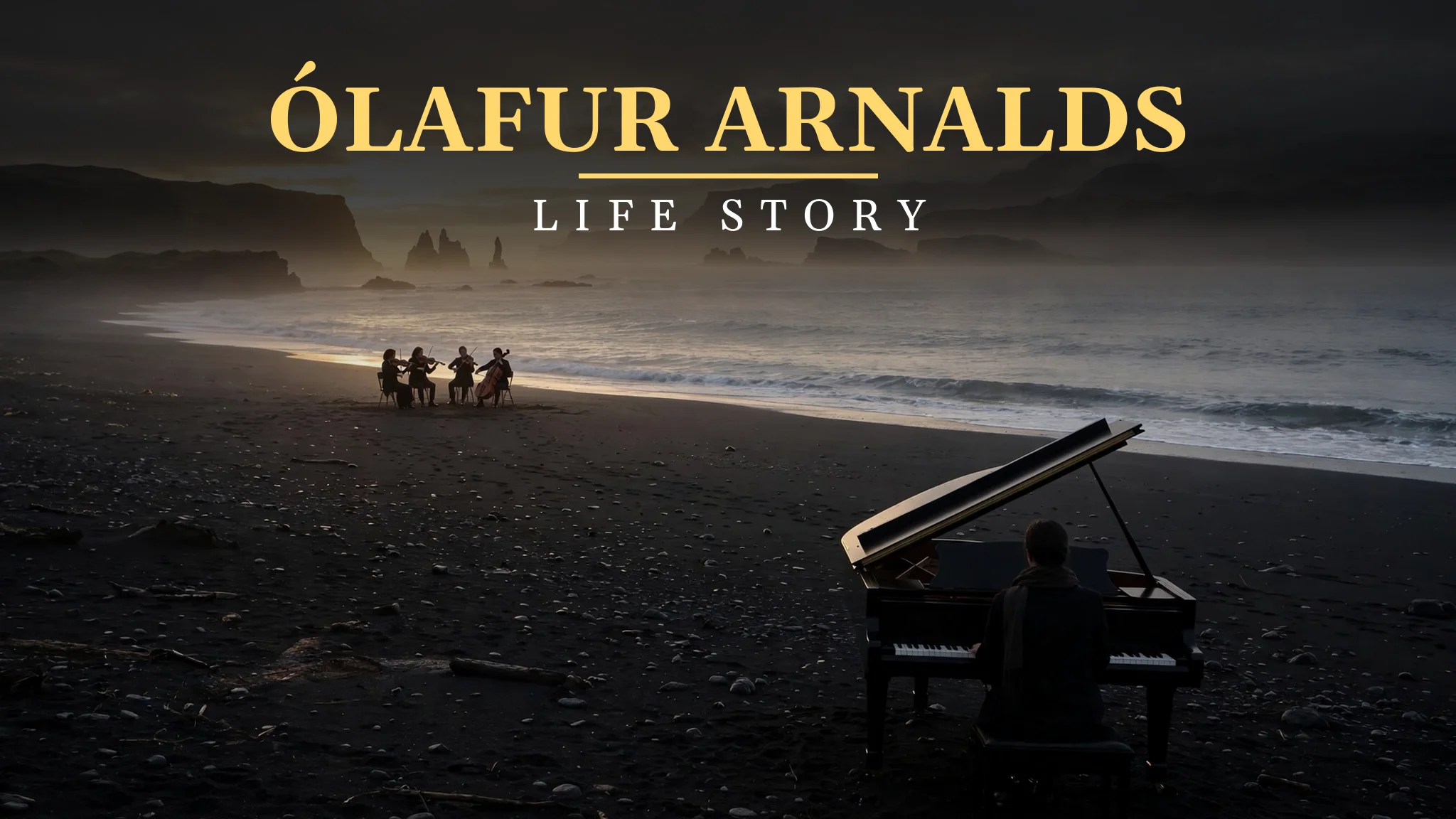
Ólafur has also changed the way people think about the piano. Before his music, many people thought of the piano as an instrument for formal concerts, played by people in suits in large halls. Ólafur plays the piano in living rooms, on beaches, and in small churches, and he shows that the piano can be a friend, not only a formal instrument. That change has brought new listeners to piano music, and it has made the piano feel closer to everyday life.
Today, Ólafur continues to compose, to record, and to tour, and his music continues to reach new listeners. His albums are played in homes, in hospitals, and in cars, and his music for television is watched by millions. He is still young, and he has many more albums to make. The story of Ólafur Arnalds is still being written, and the next chapter is yet to come.
My Take:
When I think about Ólafur Arnalds, the first thing I feel is calm, because his music slows me down in a good way. I listen to his piano, and the noise of the day fades, and I feel as if I am sitting in a quiet room with a friend who is playing just for me. I admire that calm, because much of the music in the world today is loud and fast, and it asks for attention by shouting. Ólafur asks for attention by whispering, and the whisper is more powerful than the shout.
I think it is remarkable that he began as a drummer in metal bands, because that start seems so far from the piano music he makes now. But when I think about it more, I understand. A drummer learns to listen, learns to keep time, and learns to hold a group together, and those lessons are in every piano piece Ólafur writes. His music is gentle, but it is never weak, because the rhythm underneath it is strong. That strength comes from his years behind the drums, and it is one reason his quiet music feels so solid.
What I love most about Ólafur is his generosity. He recorded Living Room Songs in his home and gave them away for free, and he travelled around Iceland for Island Songs and shared the music of other artists with the world. That generosity is rare, because most artists keep their music behind a price, and they do not share the work of others. Ólafur shares, and he does it with joy. I think that sharing is a part of who he is, and it is one reason his fans love him so deeply.
I also admire his curiosity, because he never stops trying new things. He invented the Stratus pianos for re:member, he worked with electronic sounds, and he wrote music for television, and each new step made his music richer. Many artists find one sound and stay with it forever, because they are afraid to change. Ólafur changes, and he does it with confidence, because he trusts his own ear. That trust is a sign of a true artist, and it is one I respect greatly.
I think about Broadchurch, and I am glad that so many people found Ólafur through that show. The music for Broadchurch was sad and beautiful, and it helped the audience to feel the grief of the story. A composer who can write music that helps a story without taking over the story has a rare skill, and Ólafur has it. I also think it is good that the show won him a BAFTA, because an award like that tells the world that quiet music matters, and that a composer from Iceland can stand with the best in the world.
I feel a little sad when I think about how hard it must be to make music this quiet, because a quiet piece has nowhere to hide. Every note is heard, every pause matters, and the listener can hear a mistake at once. Ólafur has made quiet music for many years, and he has done it with great skill and with great courage. I respect that courage, because it would be easier to make loud music, where mistakes can hide. He chose the hard road, and he walked it beautifully.
I think about the piano, and about how Ólafur has changed the way people see it. The piano is often seen as a formal instrument, played in concert halls by people in suits, but Ólafur plays it in living rooms, on beaches, and in small churches, and he shows that the piano can be a friend. That change matters, because it brings new listeners to the piano, and it makes classical music feel closer to everyday life. I am glad for that change, because the piano deserves to be loved by everyone, not only by a few.
There is a lesson here for young musicians, and it is a simple one. You do not have to stay in one kind of music forever. You can start in metal and end at the piano, you can start with drums and end with strings, and each step will make your music richer. Ólafur did not throw away his past. He carried it with him, and his piano music is stronger because of the drums he played as a boy. That is a hopeful lesson, because it means that no part of our past is wasted, if we are willing to learn from it.
I also think about Iceland, and I feel grateful for the music that comes from that small island. Iceland has given the world so much music, and Ólafur is one of its finest gifts. His music carries the feeling of the land, with its quiet, its space, and its light, and it reminds me that a small place can have a large heart. I have never been to Iceland, but when I listen to Ólafur, I feel as if I have seen it, and that is a powerful thing for music to do.
If I have one regret, it is that Ólafur’s music is sometimes seen as background music, played quietly while people do other things. His music deserves more than that. It deserves to be listened to with full attention, because it is full of detail, of feeling, and of care. I hope listeners will give it that attention, because they will be rewarded with music that is deeper than it first seems. A quiet song can hold a whole world inside it, and Ólafur’s songs do.
For a reader who has never heard Ólafur, I would say this. Find a quiet evening, sit down, and listen to one of his piano pieces from start to finish, without doing anything else. Listen to the notes, listen to the silence between them, and ask yourself how the music makes you feel. If you feel calm, if you feel sad, or if you feel hopeful, then you have found a composer who speaks to you. That is how I found him, and I am glad I did.
In the end, I think Ólafur Arnalds teaches us that quiet is not empty. Quiet is full of meaning, and it is a place where we can hear ourselves think. In a world that is full of noise, a composer who makes quiet music is giving us a gift, because he is giving us a place to rest. That gift is precious, and it is one I do not take lightly. I hope Ólafur keeps making music for many years, and I hope his listeners keep finding the quiet he offers.
I keep thinking about the living room where he recorded those free songs, and I smile, because it is such a simple image. A piano, a few strings, and a man playing in his own home, sharing the music with strangers around the world. That image is the heart of Ólafur’s story. He did not need a big studio or a big stage. He needed a piano, a quiet room, and a willingness to share. That is a beautiful way to make music, and it is a way that more artists should try.
One more thought stays with me, and it is about the Stratus pianos. When Ólafur invented a way for pianos to play by themselves, he was not trying to replace the human player. He was trying to hear new ideas, to let the machine surprise him, and to make music that he could not make alone. That is a wise way to use technology, because it treats the machine as a partner, not as a master. I think that attitude is important, and I hope other musicians learn from it.
I also want to say that I respect Ólafur for building a community around his music. The OPIA community is a place where listeners can share music, art, and ideas, and it shows that Ólafur cares about his audience as people, not only as buyers. A musician who builds a community is building something larger than a career. He is building a home, and that home will last longer than any single album. I admire that, and I think it is one of the best things about his work.
I think about the future of Ólafur’s music, and I feel hopeful. He is still young, and he has many more albums to make, many more journeys to take, and many more ideas to try. The world needs more music like his, music that is quiet, honest, and kind, and I believe he will keep making it. I will be listening, and I think many other people will be listening too, because his music has a way of finding the people who need it.
Finally, I want to say that this story makes me think about my own life, and about the value of quiet. I spend much of my day in noise, and I often forget to stop and to listen. Ólafur’s music reminds me to stop, to breathe, and to hear the silence between the notes. That reminder is a gift, and it is one I will carry with me. I hope every reader of this story finds a quiet moment to listen to his music, and I hope they find the same peace in it that I have found.
I will end with a simple wish. I hope Ólafur keeps playing the piano, I hope he keeps travelling around Iceland, and I hope he keeps sharing his music with the world. The world is a noisy place, and it needs more quiet music, more gentle composers, and more artists who share their work with joy. Ólafur is one of those artists, and I am glad he exists. His music is a light in a dark room, and I will keep listening to it for many years to come.
When I finish thinking about Ólafur, I feel calm, and I feel grateful, and I feel hopeful. Calm, because his music slows me down. Grateful, because he shares his work so generously. Hopeful, because his story shows that a quiet person from a small town can reach the whole world with a piano and a few honest notes. That is a beautiful story, and it is one I will remember for a long time.
I also think his story has a message for people who feel that their dreams are too small. Ólafur did not dream of being the loudest musician in the world. He dreamed of making honest music, and he followed that dream one note at a time. That is a modest dream, and it is a beautiful one, because it does not ask for fame. It asks only to be true. I think more of us should dream that way, and I think the world would be a better place if we did.
I want to say one more thing about the way Ólafur listens, because listening is the heart of his music. A drummer listens to the band, a composer listens to the piano, and a good musician listens to the silence. Ólafur does all three, and his music shows it. When I listen to his albums, I feel as if I am being listened to as well, as if the music is paying attention to me. That feeling is rare, and it is one reason I return to his music again and again, whenever I need to think or to rest.
There is also something I admire about the way he has stayed close to Iceland, even as his fame has grown. He could have moved to London or to Los Angeles, and he could have worked in big studios far from home, but he has kept his roots in Iceland, and his music still carries the feeling of that place. That loyalty tells me that he knows where his music comes from, and that he does not want to lose it. A tree that forgets its roots will fall, and Ólafur has kept his roots strong.
Frequently Asked Questions
When was Ólafur Arnalds born and where is he from?
Ólafur Arnalds was born on 3 November 1986 in Mosfellsbær, Iceland, a town near Reykjavík. He began his musical life as a drummer in metal and hardcore bands, and he later became known as a composer and pianist who mixes classical music with electronic sounds.
What is Ólafur Arnalds’s most famous work?
His music for the British television series Broadchurch, which began in 2013, is his most famous work, and it won him a BAFTA award in 2014 for Best Original Music. His albums, including re:member from 2018 and some kind of peace from 2020, are also well known to his listeners.
What are Ólafur Arnalds’s most important albums?
His most important albums are Eulogy for Evolution from 2007, …And They Have Escaped the Weight of Darkness from 2010, For Now I Am Winter from 2013, re:member from 2018, and some kind of peace from 2020. He also made the free Living Room Songs project in 2011 and the Island Songs project in 2016.
What is the Stratus piano system?
Stratus is software created by Ólafur Arnalds that controls two self-playing pianos, which play notes of their own in response to the notes he plays on his piano. He used the system on the album re:member in 2018, and it gave the album a fresh and surprising sound that mixed human playing with machine playing.
What was the Island Songs project?
Island Songs was a project from 2016 in which Ólafur Arnalds travelled around Iceland and recorded a song each week with a different local artist, in the place where that artist lived. The project was shared as videos and recordings, and it celebrated the many kinds of music found in Iceland.
Is Ólafur Arnalds still making music?
Yes, Ólafur Arnalds is still active, composing, recording, and touring, and he continues to write music for film and television as well as for his own albums. His work includes scores for Broadchurch, Defending Jacob, and Surface, and he has built a community of listeners around his music.


