Oleksandr Usyk: The Life Story Behind Ukraine's Boxing King
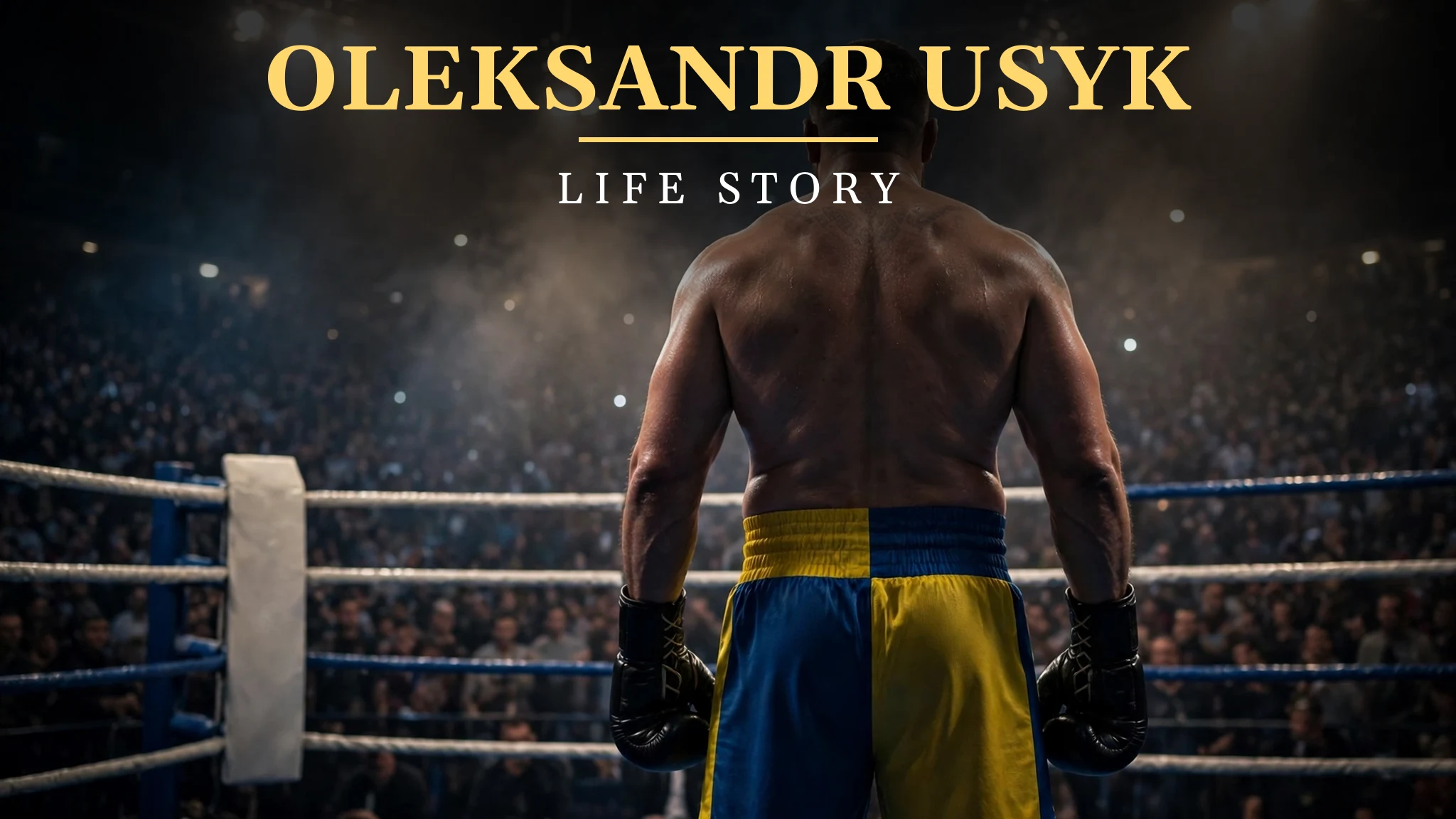
In this post
Oleksandr Usyk does not look like a heavyweight champion. He is not the biggest man in the division, he does not have the loudest personality, and he does not knock people out with a single punch. He is a quiet, smiling Ukrainian who dances, who jokes, who talks about God and his family, and who happens to be one of the greatest boxers of his generation. He won Olympic gold in London in 2012, he became the undisputed cruiserweight champion in 2018, and then he moved up to heavyweight and did something that had not been done in a generation: he became the undisputed heavyweight champion, twice, beating Anthony Joshua twice and Tyson Fury twice along the way.
He was born on 17 January 1987 in Simferopol, in Crimea, in what was then the Ukrainian Soviet Socialist Republic, and he grew up in a modest family where sport was a way of life. He played football as a boy and did not start boxing until he was 15, which is late for a future champion, but he learned quickly and he loved the sport from the start. His amateur career was long and successful, with hundreds of fights, and it gave him a technical foundation that few professional boxers ever achieve. By the time he turned professional in 2013, he was already one of the most skilled amateurs in the world.
What makes Usyk special is not one thing but many: his footwork, his intelligence, his stamina, and his ability to adapt in the middle of a fight. He is a southpaw, which means he fights left-handed, and his movement confuses opponents who are used to fighting orthodox boxers. He does not rely on power, although he can punch, and he wins by being better than his opponent in every department: faster, cleverer, fitter, and more disciplined. In an era of huge, powerful heavyweights, he is proof that skill can still beat size, and that the sweet science is still a science.
His story is also a Ukrainian story, and it has become more poignant since the Russian invasion of Ukraine in 2022. Usyk joined the territorial defence forces when the war began, he has spoken about his country with deep love, and he has carried the Ukrainian flag into the ring in every big fight since. His victories have meant more than sporting success to millions of Ukrainians, because they have been moments of pride and hope in a terrible time. This is the full life story of Oleksandr Usyk, the boxer who became a symbol of his country.
Growing Up in Simferopol
Oleksandr Oleksandrovych Usyk was born on 17 January 1987 in Simferopol, the capital of Crimea, in what was then part of the Soviet Union and is now Ukraine. His father was a soldier and his mother worked in construction, and the family lived modestly. Usyk has spoken about a childhood that was happy but not easy, and about a father who taught him discipline and respect. He played football as a boy and was good at it, and for a time it seemed as if football might be his future. But at the age of 15, he tried boxing, and everything changed.
He did not take to boxing immediately, and his early years in the sport were not easy. He lost fights, he struggled with the discipline of training, and he had to learn a completely new set of skills. But he was a quick learner, and he had a natural athleticism that coaches noticed. He was tall, he was fast, and he had a good eye for distance, and as he trained more, he began to win. By his late teens, he was one of the best young boxers in Ukraine, and he was selected for the national team, a step that put him on the path to the Olympics.
His father died when Usyk was still young, a loss that affected him deeply and that he has spoken about with great emotion. He has said that his father wanted him to become a champion, and that he carries that wish with him into every fight. The loss made him more serious about his career, and it gave him a sense of purpose that went beyond sport. He was no longer boxing only for himself. He was boxing for his father, for his family, and for the country that had given him his chance.
Amateur Glory and Olympic Gold
Usyk’s amateur career was one of the finest of his generation. He fought more than 300 amateur bouts, winning the vast majority of them, and he represented Ukraine at the highest level for years. He won the European championship in 2008, the world championship in 2011, and then, at the London Olympic Games in 2012, he won the gold medal in the heavyweight division, beating the Italian Clemente Russo in the final. The gold medal was the crowning achievement of his amateur career, and it made him a hero in Ukraine.
The Olympic victory was special for another reason: it came in London, in front of a huge crowd, and it was watched by millions of people in Ukraine. Usyk celebrated with a traditional Ukrainian dance, the hopak, a moment that became famous and that showed the world his personality: joyful, proud, and unafraid to be himself. He was not a dour, serious champion. He was a man who loved to dance, to joke, and to enjoy his success, and that joy has stayed with him throughout his career.
After the Olympics, Usyk had a choice. He could stay amateur and aim for another Games, or he could turn professional and try to become a world champion. He chose the professional route, signing with the Klitschko brothers’ promotion company, K2 Promotions, and turning professional in late 2013. He was 26 years old, which is old for a boxer turning pro, but his amateur experience meant that he was far more advanced than most young professionals. He did not need to learn how to box. He needed only to learn how to box for money, over twelve rounds, against men who were trying to hurt him.
Undisputed Cruiserweight Champion
Usyk’s professional career began in the cruiserweight division, the weight class below heavyweight, and he moved through it with remarkable speed. He won his first world title, the WBO cruiserweight belt, in only his tenth professional fight, beating the Polish champion Krzysztof Glowacki in Gdansk in 2016. It was a fast rise, but it was not a surprise to anyone who had followed his amateur career, because he was already one of the best boxers in the world, and the professional ranks were simply the next stage.
In 2018, he entered the World Boxing Super Series, a tournament that brought together the best cruiserweights in the world, and he won it in style. He beat Mairis Briedis in the semi-final and Murat Gassiev in the final, in Moscow, to become the undisputed cruiserweight champion, holding all four major belts. The victory over Gassiev was a masterclass, a twelve-round display of footwork, speed, and intelligence that left no doubt about who was the best cruiserweight on the planet. He had achieved in 15 professional fights what most boxers never achieve in a lifetime.
The cruiserweight triumph also raised a question: what next? Usyk had cleaned out his division, and there was nothing left for him to prove at cruiserweight. The answer was obvious, and it was also the hardest one: move up to heavyweight, the glamour division of boxing, and try to do what only a handful of cruiserweights have ever done, which is to become the heavyweight champion of the world. It was a risk, because he would be giving away size and power to every opponent, but Usyk has never been afraid of a risk.
The Move to Heavyweight
Usyk’s move to heavyweight began in 2019, and it was not easy. His first fight in the division, against Chazz Witherspoon, was a comfortable win, but his second, against Derek Chisora in 2020, was a hard, physical fight that tested him in new ways. Chisora was bigger, stronger, and more aggressive, and he pushed Usyk for twelve rounds, but Usyk won a clear decision, and he showed that he could handle the size and the pressure of the heavyweight division. It was a crucial win, because it proved that his skills translated to the bigger men.
The heavyweight division at that time was ruled by Anthony Joshua and Tyson Fury, two huge, powerful champions who held all the belts between them. Usyk was smaller than both of them, and many people doubted whether he could beat either one. But Usyk and his team believed, and they worked on a plan: use his footwork to stay out of range, use his speed to land punches and get out, and use his stamina to outwork bigger men over twelve rounds. It was a plan that required perfect execution, and Usyk is a man who executes plans perfectly.
In 2021, he got his chance. He challenged Anthony Joshua for the WBA, IBF and WBO heavyweight titles at Tottenham Hotspur Stadium in London, and he won a clear decision, outboxing the bigger man for twelve rounds. It was a stunning performance, and it made him the heavyweight champion of the world. He had done what Evander Holyfield had done a generation before: moved up from cruiserweight and beaten the heavyweight champion, and he had done it with a display of skill that left the boxing world in awe.
Beating Joshua Twice
The rematch with Joshua, in August 2022 in Jeddah, Saudi Arabia, was harder than the first fight. Joshua had changed trainers, he had changed his approach, and he fought with more aggression and more urgency. For much of the fight, it was close, and Joshua had moments of success, particularly in the ninth round, when he hurt Usyk badly. But Usyk recovered, he took control in the championship rounds, and he won a split decision to retain his titles. It was a fight that showed his heart as well as his skill, because he had to survive a bad round and come back to win.
Joshua’s emotional reaction after the fight, when he threw Usyk’s belts out of the ring and gave an impassioned speech, showed how much the defeat had meant to him, and it also showed the respect that Usyk commanded. Usyk, for his part, was gracious and calm, as he always is, and he did not gloat. He had beaten one of the best heavyweights in the world twice, and he had done it with dignity, and that dignity is part of why he is so respected in the sport.
The two Joshua wins also made Usyk a star. He was no longer just a brilliant technician known to boxing fans. He was the heavyweight champion who had beaten the biggest name in British boxing twice, and he was the man standing between Tyson Fury and the undisputed championship. The stage was set for the biggest fight of his career, and of the era, against Fury, and the whole boxing world waited to see whether the smaller man could beat the bigger one again.
Undisputed Against Fury
On 18 May 2024, Usyk faced Tyson Fury in Riyadh, Saudi Arabia, for the undisputed heavyweight championship, the first time all four major titles had been contested in the four-belt era. It was a close, high-quality fight, and Usyk won by split decision, knocking Fury down in the ninth round and finishing strongly to take the decision. The victory made him the first undisputed heavyweight champion since Lennox Lewis in 1999, and it was the crowning achievement of his career. He had beaten the two best heavyweights of his generation, and he had done it as the smaller man.
The rematch, on 21 December 2024, again in Riyadh, was more one-sided. Usyk won by unanimous decision, with all three judges scoring the fight clearly in his favour, and he showed that the first win had not been a fluke. He outworked Fury, he outlanded him, and he controlled the fight from the middle rounds onwards. It was a performance of remarkable consistency and discipline, and it left no doubt about who was the best heavyweight in the world. Fury was gracious in defeat, and Usyk was, as always, humble in victory.
In July 2025, Usyk completed his collection by beating Daniel Dubois at Wembley Stadium to become the undisputed heavyweight champion for a second time, stopping Dubois in the fifth round. It was a fitting end to a remarkable run, and it confirmed what many had already believed: that Oleksandr Usyk is one of the greatest boxers of his generation, and one of the finest technicians the heavyweight division has ever seen. He had beaten everyone put in front of him, and he had done it with skill, courage, and grace.
A Style Built on Feet and Brain
Usyk’s style is built on two things: his feet and his brain. His footwork is the best in the heavyweight division, and it allows him to move in and out of range, to create angles, and to avoid punches that would hurt a less mobile fighter. He is constantly moving, constantly feinting, and constantly changing the distance, and that movement makes him very hard to hit cleanly. Opponents who try to chase him find themselves punching air, and opponents who wait for him find themselves being outworked.
His boxing brain is equally impressive. He reads fights as they happen, he adjusts his tactics between rounds, and he finds weaknesses in his opponents that others cannot see. Against Joshua, he saw that the bigger man was slow to react to feints, and he exploited it. Against Fury, he saw that the bigger man tired in the later rounds, and he increased his work rate. That ability to think in the ring, to solve problems under pressure, is what separates great boxers from good ones, and Usyk is a great one.
He is also a southpaw, which gives him an advantage against orthodox fighters who are not used to facing left-handed boxers. His jab, his straight left, and his movement all come from angles that his opponents find uncomfortable, and he uses that discomfort to control fights. He does not have the one-punch power of a Wilder or a Joshua, but he does not need it, because he wins by landing more punches, by being harder to hit, and by being fitter and smarter than the man across the ring. It is a complete style, and it has proved unbeatable.
Ukraine, Family, and Faith
Usyk’s story cannot be told without Ukraine. When Russia invaded his country in February 2022, he was in London, and he returned home immediately to join the territorial defence forces. He has spoken about the war with deep emotion, and about the friends and family members who have suffered. He has used his fame to raise awareness of Ukraine’s plight, and he has carried the Ukrainian flag into the ring in every major fight since the invasion began. His victories have been moments of joy for a country at war, and he knows it.
He is also a family man, married to his wife Yekaterina, with whom he has four children, and he speaks about his family as the centre of his life. He is a devout Orthodox Christian, and his faith is important to him, shaping the way he talks about winning and losing. He is known for his humour, his love of dancing, and his habit of joking with journalists, and he is one of the most likeable champions in the sport. He does not trash-talk, he does not boast, and he treats his opponents with respect.
Today, Oleksandr Usyk stands as the undisputed heavyweight champion, a two-time undisputed champion in two weight classes, and one of the greatest boxers of his generation. He is also a symbol of Ukraine, a man who has carried his country’s hopes into the ring and has not let them down. Whatever happens next in his career, his place in boxing history is secure, and his story is one of skill, courage, and grace under the hardest pressure imaginable.
Usyk Among the All-Time Greats
When the history of boxing is written, Oleksandr Usyk will be remembered as one of the finest technicians the heavyweight division has ever seen, a man who won the undisputed championship in two weight classes and who beat every great fighter of his era. He is one of only a handful of boxers to become undisputed in two divisions, and the only one to do it at cruiserweight and heavyweight in the four-belt era. That is a record that places him alongside the all-time greats, and it is a record that will be very hard for anyone to match.
His victories over Joshua and Fury are the foundation of his legacy, because those were the two best heavyweights of his generation, and he beat them both twice. He beat Joshua in London and in Jeddah, and he beat Fury in Riyadh twice, and he did it as the smaller man in every fight. Those wins were not lucky, and they were not controversial. They were clear, deserved, and complete, and they left no doubt about who was the best heavyweight in the world. That is the kind of dominance that defines a great champion.
What sets him apart from other great heavyweights is the way he wins. He does not rely on power, and he does not rely on size. He relies on skill, on footwork, on intelligence, and on preparation, and he wins by being better than his opponent in every department. That is a style that will be studied by young boxers for generations, because it proves that boxing is still a thinking sport, and that the smartest fighter in the ring is often the one who wins. Usyk is the smartest heavyweight of his era, and his record proves it.
Beyond boxing, his legacy is tied to Ukraine, and to the war that has shaped his country’s recent history. He has carried the Ukrainian flag into the ring, he has spoken for his people, and he has given them moments of pride and hope in a terrible time. That is a responsibility that few athletes ever carry, and he has carried it with grace and with courage. Whatever happens next, Oleksandr Usyk will be remembered not only as a great boxer but as a great Ukrainian, and that is a legacy that no defeat can ever take away.
My Take:
What I admire most about Oleksandr Usyk is that he wins with skill rather than size. In an era when heavyweights are getting bigger and bigger, he is a man who proves that boxing is still a thinking sport. He does not win by being the strongest or the hardest puncher. He wins by being the smartest, the quickest, and the best prepared, and that is a beautiful thing to watch. It reminds me that in any field, the person who thinks best often beats the person who is simply biggest, and that is a lesson that goes far beyond the ring.
His footwork is the thing I enjoy watching most, because it is like watching a dancer who happens to be in a fight. He glides, he pivots, he steps in and out, and he makes his opponents look clumsy by comparison. I think that footwork is the foundation of everything he does, because it allows him to be in the right place at the right time, and to avoid being in the wrong place when a punch is coming. It is a skill that takes years to develop, and Usyk has developed it to a level that few heavyweights have ever reached.
The Olympic gold medal is where his story really begins for me, because it shows the depth of his amateur education. He fought more than 300 amateur bouts, and that experience is what makes him so complete as a professional. He has seen every style, he has fought in every kind of situation, and he is never surprised by anything that happens in a ring. That is why he looks so calm under pressure, because he has been under pressure hundreds of times before, and he knows how to handle it.
I think his move from cruiserweight to heavyweight is one of the bravest decisions in modern boxing. He had nothing left to prove at cruiserweight, and he could have stayed there, defended his titles, and earned good money for years. Instead, he moved up to face men who were much bigger and stronger than him, and he beat them all. That takes a special kind of courage, because it means risking everything you have built for the chance to achieve something greater. Most people would not take that risk. Usyk did, and it made him a legend.
The first Joshua fight is the performance I keep returning to, because it was a masterclass in how to beat a bigger man. Usyk did not try to match Joshua’s power. He used his speed, his movement, and his intelligence to make Joshua miss, and he punished him for every mistake. It was a twelve-round lesson in boxing, and it was watched by millions of people who had never seen anything like it. That fight changed the way people think about heavyweight boxing, and it proved that skill can still triumph over size.
The rematch with Joshua showed me something different, which is his heart. He was hurt badly in the ninth round, and for a moment it looked as if he might lose. But he recovered, he took control, and he won the championship rounds to take the decision. That is the mark of a great champion: not that he never gets hurt, but that he knows what to do when he is hurt. He stayed calm, he stuck to his plan, and he found a way to win. That is a quality that cannot be taught, and Usyk has it in abundance.
His fights with Fury are the ones that will define his legacy, because Fury was the biggest and most awkward heavyweight of the era, and Usyk beat him twice. The first fight was close, and the ninth-round knockdown was the moment that turned it, but the second fight was clearer, and it showed that the first win was no accident. I think those two fights proved that Usyk is not just a great cruiserweight who moved up. He is a great heavyweight, full stop, and one of the best of his generation.
What moves me most about Usyk is his connection to Ukraine, and the way he has carried his country through the war. When the invasion began, he went home and joined the defence forces, and he could have stayed there. Instead, he returned to boxing, because he understood that his victories could give his people hope. Every time he walks into the ring with the Ukrainian flag, he is fighting for something bigger than himself, and that gives his fights a meaning that most sporting events never have.
I also admire his personality, because he is joyful in a sport that is often grim. He dances, he jokes, he smiles, and he seems to genuinely enjoy what he does. That joy is not a weakness. It is a strength, because it means he is not fighting out of anger or fear, but out of love for the sport. I think that is why he stays calm under pressure, because he is not afraid of losing. He is enjoying the fight, and a man who is enjoying himself is a dangerous man to face.
His southpaw stance is a technical detail that I find fascinating, because it gives him an edge that his opponents struggle to deal with. Most boxers spend their careers fighting orthodox opponents, and when they face a southpaw as good as Usyk, they are out of their comfort zone. His jab comes from a different angle, his left hand comes from a different angle, and his movement is different. That discomfort is worth rounds in a fight, and Usyk exploits it brilliantly. It is a reminder that being different can be an advantage, if you know how to use it.
The Dubois win in July 2025, which made him a two-time undisputed heavyweight champion, is the perfect ending to his story so far, because it showed that he is still getting better. He stopped Dubois in five rounds, in front of a huge crowd at Wembley, and he did it with the same calm and precision that has defined his whole career. It was not a lucky win. It was a dominant one, and it left no doubt about who is the best heavyweight in the world. I think history will remember that night as the moment his greatness became undeniable.
I think about his father a lot when I read his story, because Usyk has spoken about how his father’s death shaped him. He boxes for his father, and that gives his career a purpose that goes beyond belts and money. It is a reminder that the people we lose stay with us, and that their hopes for us can carry us through the hardest moments. Usyk’s father wanted him to be a champion, and he became one, not once but twice, in two weight classes. That is a beautiful tribute, and it is one that I find deeply moving.
His faith is another part of his story that I respect, because it is sincere and it is central to who he is. He is a devout Christian, and he talks about God in a way that is humble rather than showy. He thanks God for his victories, he prays for his opponents, and he treats his faith as a source of strength rather than a slogan. In a sport that is often cynical, that sincerity stands out, and it is part of why so many people admire him, including people who do not share his beliefs.
The lesson I take from Usyk is that preparation beats size. He is smaller than the men he beats, but he is better prepared, better trained, and better educated in the sport than they are. He has fought hundreds of amateur bouts, he has studied his opponents, and he has a plan for every fight. That preparation is not glamorous, and it is not exciting to watch, but it is what wins fights. If you are smaller than your competition, whether in sport or in life, the answer is not to wish you were bigger. It is to be better prepared.
I also think his story has a lesson about humility. He is the undisputed heavyweight champion of the world, and he behaves like a man who is grateful for the chance to box, not like a man who believes the world owes him something. He does not boast, he does not trash-talk, and he does not demand attention. He lets his fighting speak for him, and his fighting speaks very loudly. That humility is rare in modern sport, and it is one of the reasons I respect him as much as I do.
His dancing, his jokes, and his joy are the parts of his personality that I enjoy most, because they show that a champion can be a happy person. Too many great athletes seem miserable, driven by fear or anger, and their success comes at a terrible cost. Usyk seems to genuinely love what he does, and that love is visible in the way he fights and in the way he celebrates. I think that is a healthier way to be great, and it is a model that other athletes could learn from.
The war in Ukraine gives his story a weight that no other boxer of his generation carries, and I think it is important to say that plainly. He is not just fighting for belts. He is fighting for a country that is under attack, and every victory is a moment of pride for millions of people who are suffering. That is an enormous responsibility, and he carries it with grace. I do not know how he does it, but I admire him for it, and I think history will remember him as much for what he meant to Ukraine as for what he achieved in the ring.
Finally, I believe Oleksandr Usyk is one of the greatest boxers of all time, and I do not say that lightly. He is a two-time undisputed champion in two weight classes, an Olympic gold medallist, and a man who has beaten every opponent put in front of him. He has done it with skill, with courage, and with grace, and he has done it as the smaller man in almost every big fight. That is a record that places him among the all-time greats, and I think future generations will look back on his career with the same awe that we feel for the legends of the past.
One more thing I want to say about Usyk is that his story is not finished. He is still fighting, still winning, and still carrying the hopes of his country. I do not know what comes next for him, but I know that whatever it is, he will face it with the same calm, the same preparation, and the same joy that have defined his career. That is the mark of a true champion, and it is why I will keep watching him for as long as he fights.
When I think about what his career means, I come back to a simple idea: that skill, properly learned and properly applied, can overcome almost any physical disadvantage. Usyk is not the biggest, not the strongest, and not the hardest puncher, yet he is the best heavyweight in the world. That is a hopeful message for anyone who has ever felt too small, too weak, or too different to succeed. Usyk proves that the size of your heart and the quality of your preparation matter more than the size of your body, and that is a lesson worth remembering.
I will end by saying that watching Usyk box is a pleasure that I never take for granted, because fighters like him do not come along often. He is a man who has mastered his craft, who respects his opponents, who loves his country, and who fights with joy rather than anger. That combination is rare, and it is beautiful, and it is the reason I believe he will be remembered as one of the greats. The heavyweight division has had many champions, but it has had very few like Oleksandr Usyk, and I am grateful to have watched him fight.
There is one more lesson in his story that I want to carry with me, and it is about patience. Usyk did not rush his career. He spent years as an amateur, he moved up in weight slowly, and he waited for the right fights at the right time. That patience is the reason he is still winning at the highest level, and it is a reminder that the slow road is often the best road. In a world that celebrates speed, Usyk celebrates preparation, and preparation has made him the best heavyweight in the world.
Frequently Asked Questions
When was Oleksandr Usyk born?
Oleksandr Usyk was born on 17 January 1987 in Simferopol, Crimea, in what was then the Ukrainian Soviet Socialist Republic. He grew up in Ukraine and started boxing at the age of 15.
How did Oleksandr Usyk become undisputed heavyweight champion?
He beat Tyson Fury by split decision in May 2024 to become the first undisputed heavyweight champion of the four-belt era, then beat Fury again in December 2024, and beat Daniel Dubois in July 2025 to become undisputed for a second time.
Did Oleksandr Usyk win Olympic gold?
Yes. He won the heavyweight gold medal at the London 2012 Olympic Games, beating the Italian Clemente Russo in the final, and he celebrated with a traditional Ukrainian hopak dance.
Was Oleksandr Usyk undisputed at cruiserweight too?
Yes. In 2018 he won the World Boxing Super Series, beating Murat Gassiev in the final in Moscow to become the undisputed cruiserweight champion, holding all four major belts.
What is Oleksandr Usyk’s fighting style?
He is a southpaw with outstanding footwork, speed, stamina, and ring intelligence. He wins by outboxing opponents, landing more punches, and being harder to hit, rather than by one-punch power.
Did Oleksandr Usyk serve in the Ukraine war?
When Russia invaded Ukraine in February 2022, Usyk returned home and joined the territorial defence forces. He has since carried the Ukrainian flag into the ring and spoken publicly in support of his country.


