Oliver Mtukudzi: The Life Story Behind Zimbabwe's Music Legend
In this post
- Highfield: A Township Boy with a Guitar
- The Black Spirits and the Sound Called Tuku
- Neria: A Song for the Widows of Zimbabwe
- Todii, Wasakara, and the Peak Years
- Loss, Family, and the Later Years
- Tuku Music and the Voice of a Nation
- The Voice, the Guitar, and the Mbira
- A National Treasure and the Honours He Earned
- My Take:
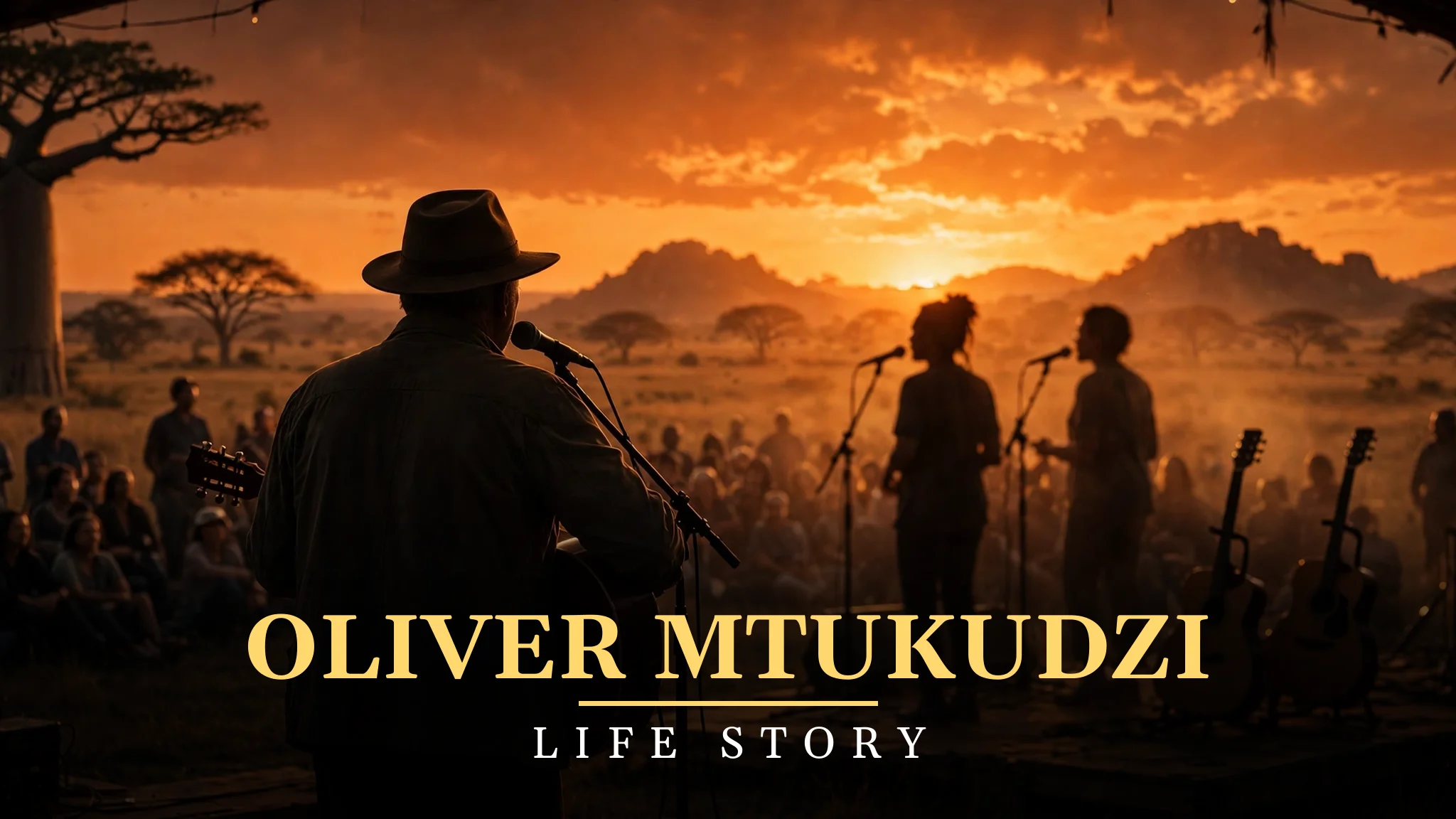
In Zimbabwe, there is a word for the music of Oliver Mtukudzi, and the word is his own name: Tuku music. It is a sound that mixes the traditional rhythms of the Shona people with modern pop, jazz, and soul, and it is sung in a husky, warm voice that is instantly recognisable. For more than forty years, that voice was the sound of Zimbabwe, and the man behind it was one of the most loved musicians in Africa.
He was born on 22 September 1952 in Highfield, a township of Harare, then called Salisbury, in what was then Rhodesia. He grew up in a working-class neighbourhood, in a family that loved music, and he learned to sing and play in the streets and churches of Highfield. He formed his band, the Black Spirits, and he went on to record more than sixty albums, to sing about the lives of ordinary Zimbabweans, and to become a national hero.
This is the story of that life: a boy from Highfield who became Tuku, the voice of a nation, and whose songs about love, loss, and hope are still sung in Zimbabwe today. It is a story about a country, a voice, and a man who never stopped singing for his people.
Highfield: A Township Boy with a Guitar
Oliver Mtukudzi was born on 22 September 1952 in Highfield, Harare, in what was then Southern Rhodesia. Highfield was one of the oldest townships of the capital, a place of small houses, crowded streets, and strong community ties. It was a working-class area, and the people who lived there were traders, workers, and families who had come to the city from the countryside. A child in Highfield grew up close to his neighbours, and he grew up hearing music everywhere: in the churches, in the shebeens, and in the streets where people sang as they worked.
His family was musical, and Oliver learned to sing at home and in church. He was drawn to the guitar, and he began to play as a boy, learning the rhythms of Shona music and the melodies of the mbira, the thumb piano that is the heart of traditional Zimbabwean music. The mbira’s sound, with its repeating patterns and its gentle, ringing tones, would later become a central part of Tuku music. Oliver did not learn it from a book. He learned it from the world around him, from the songs he heard and from the musicians he watched.
Highfield also taught him about the life of ordinary people in Rhodesia. The country was ruled by a white minority government, and Black Zimbabweans faced discrimination, poverty, and a lack of opportunity. A boy in Highfield saw that injustice every day, and he heard it in the songs of his community. Music in Rhodesia was not only entertainment. It was a way of speaking about a life that was hard, and of keeping hope alive. Oliver’s songs would later carry that same spirit: honest, warm, and full of the life of ordinary people.
As a young man, he began to perform in Harare, singing in bands and at local events. He was not an overnight star. He worked, he learned, and he built a following in the townships and in the city. He learned how to hold a crowd, how to write a song that people would remember, and how to make music that spoke to the lives of his listeners. Those early years in Highfield and Harare were his school, and the lessons he learned there stayed with him for the rest of his career.
By the late 1970s, he was ready to form his own band, and to take the next step. He had a voice, he had a guitar, and he had a sound that was beginning to be his own. The boy from Highfield was about to become Tuku, and the journey was just beginning.
The Black Spirits and the Sound Called Tuku
In 1977, Oliver Mtukudzi formed his band, the Black Spirits, and the group became the vehicle for his music for the rest of his life. The Black Spirits were a band of talented musicians who shared Oliver’s vision: to make music that was rooted in Zimbabwean tradition and that could also be heard around the world. The band’s sound was built around Oliver’s guitar and voice, and around the rhythms of the mbira, the drums, and the bass. It was a sound that was both old and new, and it was soon known as Tuku music, after Oliver’s nickname, Tuku.
The band’s early records were released in Rhodesia, and then in the newly independent Zimbabwe after 1980. Independence changed the country, and it changed its music. Zimbabwean artists were now free to sing in their own languages, to celebrate their own culture, and to speak about their own lives without fear. Oliver’s music fitted that new freedom perfectly. He sang in Shona, in Ndebele, and in English, and his songs spoke about love, about family, about work, and about the hope of a new nation. His audience grew, and his name became known across Zimbabwe.
The Black Spirits toured Zimbabwe, performing in towns and villages, and their concerts became famous for their warmth and their energy. Oliver was a generous performer, and he gave his audiences long, joyful shows. He sang, he danced, and he talked to the crowd, and the crowd sang back to him. A Tuku concert was not a formal event. It was a celebration, and it was a celebration that belonged to everyone in the room. That live reputation kept the band working for decades, and it made Oliver one of the most popular performers in the country.
He also began to record prolifically, releasing album after album, and his catalogue grew to more than sixty albums over the course of his career. That output is extraordinary, and it is a sign of his discipline and his creativity. He did not release an album every few years. He released them constantly, and each one added new songs to his repertoire. His fans knew that there would always be a new Tuku record to look forward to, and they looked forward to each one.
The Black Spirits were not only a backing band. They were a family, and many of the musicians played with Oliver for years. That loyalty is a sign of the respect he commanded, and of the joy of playing in his band. A musician who stays with a leader for decades does so because the music is good, and because the leader treats his band well. Oliver did both, and the Black Spirits became one of the great bands of African music.
Neria: A Song for the Widows of Zimbabwe
In 1993, Oliver Mtukudzi wrote and performed the song Neria, and it became one of the most important songs in Zimbabwean music. Neria was the title song of a film of the same name, a film about a widow in Zimbabwe who loses her husband and then loses her home and her possessions to her husband’s family. The film told a story that many Zimbabwean women knew from real life: a widow who is treated unfairly after her husband’s death, and who must fight for her rights and for her children. Oliver’s song gave that story a voice, and it became an anthem for widows and for women across Zimbabwe.
The song’s melody is gentle and haunting, and its lyrics, sung in Shona, speak about loss, about dignity, and about the strength of a woman who refuses to give up. It is a song that moves listeners to tears, and it is a song that has been sung at funerals, at weddings, and at gatherings across Zimbabwe for more than thirty years. Neria is not only a hit song. It is a part of the country’s culture, and it is one of the reasons Oliver is remembered as more than a musician. He is remembered as a voice for the people who have no voice.
The success of Neria also showed Oliver’s skill as a songwriter. He could write a song that was both beautiful and meaningful, and he could do it in a way that spoke to the lives of ordinary people. He did not write about abstract ideas. He wrote about a widow, about a family, and about a home, and his listeners recognised their own lives in those details. That concreteness is what makes his songs so powerful, and it is what makes Neria a classic.
The film and the song also brought Oliver to a wider audience. Neria was seen in Zimbabwe and beyond, and the song was heard by people who had never listened to Tuku music before. It introduced his voice to a new generation, and it showed that his music could carry a serious message without losing its beauty. A song about a widow’s struggle is not an easy song to write, and it is not an easy song to sing, but Oliver wrote it and sang it with a grace that made it unforgettable.
Today, Neria is still one of Oliver’s best-known songs, and it is still sung in Zimbabwe. It is a reminder that music can speak for people who are ignored, and that a singer can use his voice to change the way a society thinks. Oliver did that with Neria, and he did it with many other songs as well. His music was not only entertainment. It was a form of care for his people.
Todii, Wasakara, and the Peak Years
In the late 1990s, Oliver Mtukudzi released some of his most famous songs, and his career reached a new peak. Todii, released in 1998, became one of his best-known works. The song’s title means what shall we do, and its lyrics speak about the HIV and AIDS crisis that was devastating Zimbabwe and southern Africa at the time. The song asked a question that many people were asking in private: what shall we do, in the face of a disease that was taking so many lives? Oliver sang that question in public, and his song gave a voice to the grief and the fear of a whole nation.
Todii was a brave song, because it spoke about a subject that many people found difficult to discuss. It was also a beautiful song, with a melody that stayed in the head and a rhythm that made it both danceable and moving. The song was played across Zimbabwe, and it became an anthem for a generation that was living through the AIDS crisis. It showed that Oliver was not afraid to sing about the hardest subjects, and that he could do so with honesty and with compassion. That is the mark of a great artist, and Todii is one of the reasons Oliver is so respected.
Wasakara, another of his best-known songs, is a joyful, danceable track that became a favourite at parties and celebrations. Its title is a Shona expression, and its rhythm is infectious. The song shows the other side of Oliver’s music: the side that makes people dance, that celebrates life, and that brings joy to a room. A singer who can write both Todii and Wasakara is a singer with range, and Oliver had that range. He could make you cry, and he could make you dance, and both felt true in his voice.
The peak years also brought him recognition beyond Zimbabwe. He performed at festivals around the world, he was honoured by cultural institutions, and he became a UNICEF goodwill ambassador, a role that reflected his commitment to children and to his country. He used his fame to speak about the issues that mattered to him, including the welfare of children, the rights of women, and the health of his nation. That work was an extension of his music, and it showed that he understood the responsibility that comes with fame.
Through the 2000s, Oliver continued to record and to tour, and his audience remained loyal. He released albums, he performed with the Black Spirits, and he became an elder statesman of Zimbabwean music. His voice, husky and warm, was still strong, and his songs were still loved. He had become a national treasure, and his name was known to every Zimbabwean, young and old.
Loss, Family, and the Later Years
Oliver Mtukudzi’s later years were marked by both success and loss. In 2010, his son Sam Mtukudzi, who was also a musician, died in a car accident, at the age of 21. The loss was a devastating blow to Oliver and to his family, and it was felt across Zimbabwe, where Sam had been seen as a young talent who would carry his father’s music forward. Oliver mourned his son, and he continued to perform, but the loss stayed with him. It is a reminder that even a national hero is a father first, and that a father’s grief is a private pain that fame cannot heal.
His family also included his daughter Selmor Mtukudzi, who became a singer in her own right, and his other children, who grew up in a home where music was a part of daily life. Oliver was a family man, and his home in Harare was a place where music, family, and community came together. He was known for his generosity, for his kindness to young musicians, and for his willingness to help others. Those qualities are part of his legacy, and they are remembered by the people who knew him.
In his later years, he continued to record and to perform, releasing albums and playing concerts in Zimbabwe and abroad. His health began to decline, and he performed less often, but his voice remained, and his songs remained. He was honoured by his country, by his fans, and by the music world, and he was recognised as one of the great musicians of Africa. He had built a career that lasted for more than forty years, and he had done it with a consistency and a quality that few artists achieve.
Oliver Mtukudzi died on 23 January 2019 in Harare, at the age of 66. His death was mourned across Zimbabwe and around the world, because he had been a central figure in the country’s music and in its life. His funeral was a national event, attended by thousands of people, and it showed how deeply he was loved. The mourning was not only for a musician. It was for a man who had sung the story of Zimbabwe for more than forty years, and whose voice had been a companion to generations of listeners.
Tuku Music and the Voice of a Nation
Oliver Mtukudzi’s legacy is Tuku music, a sound that he created and that continues to be played in Zimbabwe today. His influence can be heard in the work of younger Zimbabwean musicians, who play in his style and who sing about the same subjects: love, family, work, and the life of ordinary people. It can also be heard in the way Zimbabweans think about their own music. Tuku showed that Zimbabwean music could be both traditional and modern, both local and global, and that it could be loved by everyone.
His songs are still played in Zimbabwe, at weddings, at funerals, at parties, and on the radio. Neria is still sung, Todii is still remembered, and Wasakara is still danced to. His albums are still listened to, and his voice is still recognised by young people who were not born when he first became famous. That is the mark of a great artist: his music outlives him, and it continues to speak to new generations.
He is also remembered as a man who used his music for good. His work as a UNICEF goodwill ambassador, his songs about widows and about AIDS, and his commitment to his country all show that he understood music as a responsibility. He did not sing only for himself. He sang for his people, and his people heard him. That is why his name is still spoken with respect in Zimbabwe, and why his story is told to young musicians as an example of what a life in music can be.
Today, Oliver Mtukudzi is regarded as one of the greatest musicians in African history, and his place in the history of Zimbabwean music is secure. He is Tuku, the voice of a nation, and his voice is still heard. The boy from Highfield who learned to play the guitar in a township has become a legend, and his legend is carried in his songs, which are still sung in the streets of Harare and in the villages of Zimbabwe.
The Voice, the Guitar, and the Mbira
Oliver Mtukudzi’s sound was built on three things: his husky voice, his guitar, and the mbira, the thumb piano that is the heart of Shona music. The mbira’s gentle, repeating patterns gave his songs their hypnotic quality, and his guitar gave them their warmth. His voice, rough and tender at the same time, carried the melody over the top, and the combination was unmistakable. A listener who heard the first notes of a Tuku song knew at once who was singing, even before the voice began. That is the mark of a great sound, and Oliver’s sound was one of the great sounds of African music. He did not copy the mbira. He brought it into a modern band, and he showed that it belonged there, alongside electric guitars and drums. That is a lesson for musicians everywhere: your tradition is not a museum piece. It is a living sound, and it can live in modern music if you know how to use it.
A National Treasure and the Honours He Earned
In his later years, Oliver Mtukudzi was recognised as a national treasure in Zimbabwe, and he received honours that reflected his standing. He was celebrated by his country, by cultural institutions, and by the music world, and his name became synonymous with Zimbabwean music itself. Those honours mattered, because they showed that his work was valued not only by his fans, but by his nation. A singer who is honoured by his country is a singer who has served it, and Oliver served Zimbabwe with his voice for more than forty years. He did not seek honours, but he earned them, through his songs, his concerts, and his commitment to his people. His honours are a reminder that a life in music, lived with honesty and with love, is a life that a country will remember.
Highfield itself deserves a final word in Oliver’s story, because it was more than a township. It was a community of families, of churches, of shebeens, and of musicians, and it gave Oliver everything he needed: a voice, a guitar, and an audience that understood his songs. A township is often described by outsiders in terms of its problems, but Oliver described it in terms of its life, and his songs carried that life to the world. Highfield made Tuku, and Tuku made Highfield famous, and that exchange, between a place and its singer, is the heart of his story. The boy from Highfield became the voice of Zimbabwe, and his voice is still heard there today.
My Take:
I think Oliver Mtukudzi is one of the most important singers I have ever written about, and I say that because his music was not only music. It was the sound of a country, and it was the sound of a people. When I listen to Tuku music, I do not only hear a guitar and a voice. I hear Zimbabwe: its streets, its villages, its churches, and its people. That is a rare achievement for a musician, and it is one that Oliver earned over forty years of singing for his country. I respect him for it more than I respect any single album, because it shows that a singer can be a voice for a nation, and that a nation can hear itself in a song.
What moves me most about his story is Neria. It is a song about a widow, about a woman who loses her husband and then loses her home, and it is a song that gave a voice to women who had no voice. I think about the widows in Zimbabwe who heard that song for the first time, and about what it must have felt like to hear their own pain in a song that was played on the radio. That feeling is a gift, and Oliver gave it to thousands of women. He did not write Neria to be a hit. He wrote it because the story needed to be told, and because the women in that story deserved to be heard. That is the kind of songwriting I admire most: songwriting that serves people, not only the charts.
Todii is another song I think about often, because it spoke about AIDS at a time when many people were afraid to speak about it. The song asks a simple question: what shall we do? That question is honest, and it is one that many people were asking in private. Oliver asked it in public, in a song, and he made it possible for others to ask it too. That is a brave thing to do, and it is a necessary thing. A singer who can speak about a crisis in a way that brings people together, rather than dividing them, is a singer who understands his responsibility. Oliver understood it, and Todii is the proof.
I also admire the sheer scale of his work. More than sixty albums is an extraordinary output, and it is a sign of a man who never stopped working. He did not release an album every few years and then rest. He released them constantly, and each one added something new to his catalogue. That discipline is rare, and it is one I respect. It shows that he took his work seriously, and that he believed his audience deserved new songs. Young artists who want a long career should study that discipline. A long career is not built on one album. It is built on many albums, on many concerts, and on many years of showing up for your audience.
His voice is another thing I think about. It was husky, warm, and instantly recognisable, and it carried a feeling that was both joyful and sad. I like voices like that, because they sound human. They do not sound perfect. They sound real, and realness is more moving than perfection. When Oliver sang, I believed him, because his voice carried the weight of a life lived in Zimbabwe, with all its joys and its difficulties. That is a quality that cannot be taught. It comes from living, and Oliver lived a life that gave his voice its depth.
The loss of his son Sam is a part of his story that I think about with real sadness. A father who loses a son carries a pain that does not go away, and Oliver carried it while continuing to perform. I respect him for that, because it takes strength to keep singing when your heart is broken. His music after that loss had a depth that came from his grief, and his audiences understood it. They did not only hear a singer. They heard a father, and they heard a man who knew loss. That understanding made his music more powerful, and it made his story more human.
I will be honest about something: I do not think every Oliver Mtukudzi album is as strong as Neria or Todii. Some of his records are good, but they do not have the same impact as the best ones. That is normal for a career that produced more than sixty albums. No artist can be at his peak for every record. What matters is the whole body of work, and Oliver’s body of work is extraordinary. It is a library of Zimbabwean life, and it will be listened to for generations. That is the achievement, not any single album.
What I learn from his life is that a singer can be a historian. Oliver’s songs are a history of Zimbabwe, from the townships of Harare to the villages of the countryside, from independence to the AIDS crisis, from joy to grief. A listener who hears his songs hears the story of a country, told by a man who lived it. That is a valuable thing, and it is one that few singers achieve. I hope young Zimbabwean musicians learn from that, and that they write songs about their own lives with the same honesty. Their country needs its historians, and its singers can be among them.
In the end, I think Oliver Mtukudzi’s story is a story about a voice that belonged to a people. He was born in Highfield, he sang for Zimbabwe, and he died in Harare, and his voice is still heard in all three places. I hope his songs keep playing, and I hope new listeners keep discovering them, because the world needs voices that tell the truth about ordinary life, and that do it with warmth, with humour, and with love. Tuku did that for more than forty years, and his music will keep doing it for many more.
I also think about his daughter Selmor, and about what it means to grow up as the child of a legend. Selmor became a singer in her own right, and she carries her father’s music forward in her own voice. That is a difficult thing to do, because a child of a great singer is always compared to the parent, and the comparison is rarely fair. Selmor has handled it with grace, and she has built her own career while honouring her father’s legacy. I respect that, because it shows that talent can be passed from one generation to the next, and that a father’s music can live on in his daughter’s voice. I hope she keeps singing, because Zimbabwe needs her voice, and because her father’s songs deserve to be heard in a new generation.
His work as a UNICEF goodwill ambassador is another part of his story that deserves more attention. It is one thing to sing about children. It is another thing to be asked by the United Nations to speak for them, and to accept that responsibility. Oliver accepted it, and he used his fame to bring attention to the welfare of children in Zimbabwe. That work was an extension of his music, and it showed that he understood the responsibility that comes with fame. A singer who is loved by millions has a duty to use that love for good, and Oliver used it. I respect that deeply, because it shows that his commitment to his people was not only in his songs. It was also in his actions.
I think about the townships of Harare today, and about what Tuku music means to the young people there. They hear Neria, they hear Todii, and they hear the sound of their own history in those songs. That is a gift, and Oliver gave it to them. He did not sing about a distant world. He sang about Highfield, about Harare, and about the lives of ordinary Zimbabweans, and his songs became a history of his country. A young person who listens to his albums hears the story of Zimbabwe, told by a man who lived it. That is a rare achievement, and it is one that few artists ever reach. I hope young Zimbabwean musicians learn from that, and that they write songs about their own lives with the same honesty.
Wasakara is another song I keep coming back to, because it shows the joyful side of Oliver’s music. It is a dance song, a party song, and it is full of energy and humour. I like that he could write both Todii and Wasakara, a song about AIDS and a song about dancing, and that both sounded true in his voice. That range is rare, and it is the mark of a great artist. A singer who can only make you cry is a singer with one note. A singer who can make you cry and make you dance is a singer with a full range, and Oliver had it. His audience loved him for both, and they still love him for both today.
I also think about the sheer number of his albums, more than sixty, and about what that output means. It means that he never stopped working, never stopped writing, and never stopped believing that his audience deserved new songs. That discipline is rare, and it is one I respect. A long career is not built on one album. It is built on many albums, on many concerts, and on many years of showing up for your audience. Oliver showed up, again and again, for more than forty years, and his audience showed up for him. That mutual loyalty is the heart of his story, and it is one that young artists should study.
In the end, I keep coming back to the same thought: Oliver Mtukudzi’s voice belonged to a people, and it still does. He was born in Highfield, he sang for Zimbabwe, and he died in Harare, and his voice is still heard in all three places. I hope his songs keep playing, and I hope new listeners keep discovering them, because the world needs voices that tell the truth about ordinary life, and that do it with warmth, with humour, and with love. Tuku did that for more than forty years, and his music will keep doing it for many more.
I also think about the churches of Highfield, and about the role they played in his music. Oliver learned to sing in church, and the feeling of church singing — its warmth, its community, and its honesty — stayed in his voice for the rest of his life. A singer who learns in church learns that music is not only for the stage. It is for the people, and it is for God, and it is sung with a sincerity that cannot be faked. Oliver’s voice carried that sincerity, and it is one reason his songs moved so many people. I respect that, because it shows that his music came from a real place, and that it was never only about fame.
There is one more thing I want to say about his legacy. Oliver’s songs are now a history of Zimbabwe, and they will be listened to by people who were not born when he first became famous. Those listeners will hear the story of their country in his voice, and they will learn about their own history from his songs. That is an extraordinary gift, and it is one that few artists ever give. A singer who becomes a historian is a singer who has done more than entertain. He has preserved a nation’s memory, and that preservation is a gift that lasts. I hope his songs keep being played, because Zimbabwe needs its historians, and Tuku was one of its finest.
I also think about the Black Spirits, and about the musicians who played with Oliver for so many years. A band that stays together for decades is a family, and keeping a family together is hard work. Oliver kept his band together, and the musicians who played with him learned from him, and they carried his sound forward. That loyalty is a sign of the respect he commanded, and of the joy of playing his music. A musician who stays with a leader for decades does so because the music is good, and because the leader treats his band well. Oliver did both, and the Black Spirits became one of the great bands of African music because of it.
Frequently Asked Questions
Where was Oliver Mtukudzi born?
Oliver Mtukudzi was born on 22 September 1952 in Highfield, Harare, in what was then Southern Rhodesia. He grew up in the township and learned music in its churches and streets.
What is Tuku music?
Tuku music is the style created by Oliver Mtukudzi, named after his nickname Tuku. It mixes traditional Shona rhythms, including the mbira, with modern pop, jazz, and soul.
What is the song Neria about?
Neria, from 1993, is the title song of a film about a widow in Zimbabwe who loses her home to her husband’s family after his death. The song became an anthem for widows and for women across Zimbabwe.
What is Todii about?
Todii, released in 1998, speaks about the HIV and AIDS crisis in Zimbabwe. Its title means what shall we do, and it gave a voice to the grief and fear felt by many people at the time.
How many albums did Oliver Mtukudzi record?
He recorded more than sixty albums over a career of more than forty years, with his band the Black Spirits, formed in 1977.
When did Oliver Mtukudzi die?
He died on 23 January 2019 in Harare, Zimbabwe, at the age of 66. His death was mourned across Zimbabwe and around the world.
Was Oliver Mtukudzi a UNICEF ambassador?
Yes, he served as a UNICEF goodwill ambassador, using his fame to speak about the welfare of children and about the issues facing Zimbabwe.


