Pappo: The Life Story Behind Argentina's Guitar Hero
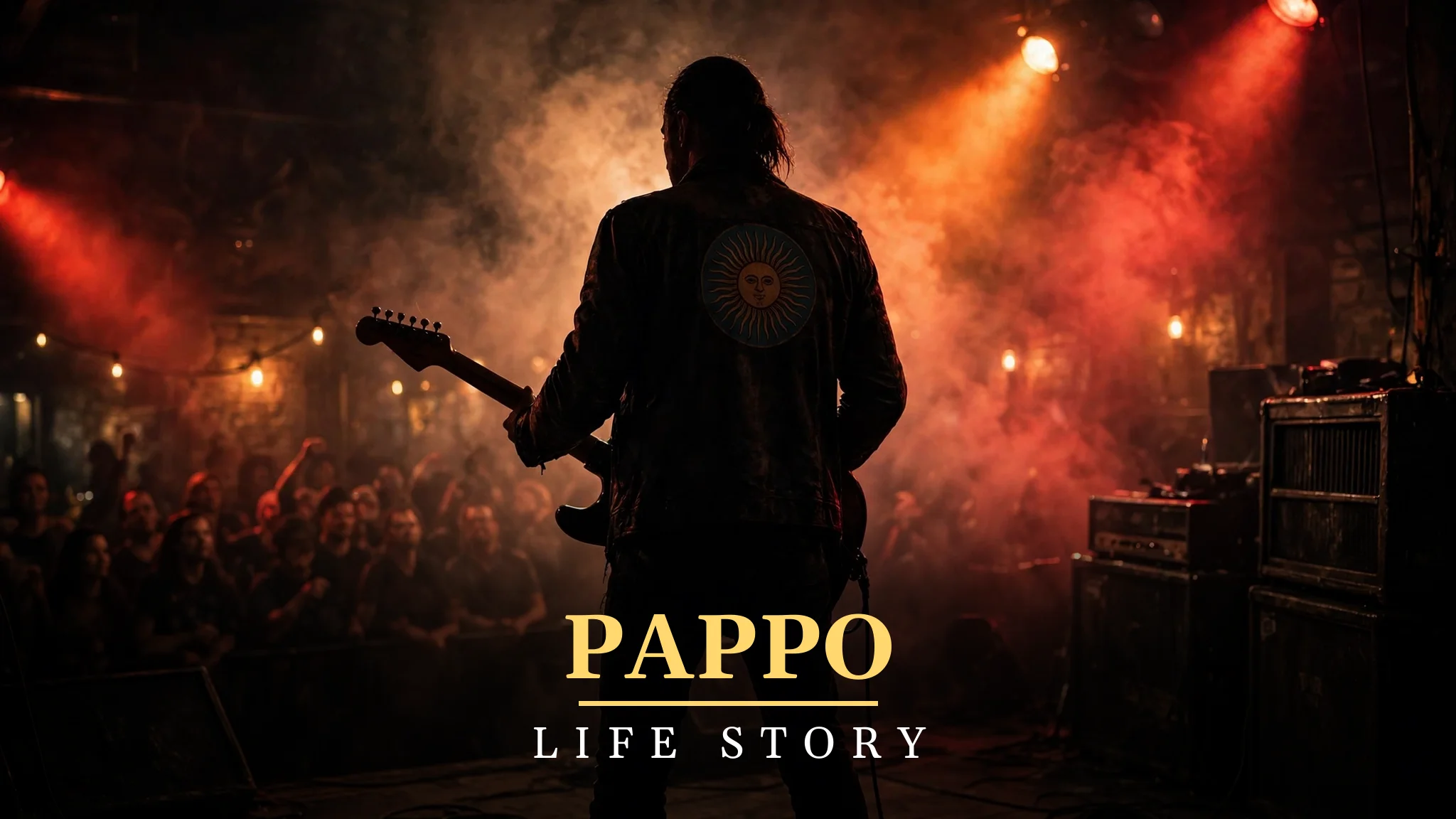
In this post
- A Boy from La Paternal Who Found the Blues
- First Bands and the Birth of Pappo’s Blues
- Riff and the Heavy Sound of the Eighties
- Juntos a la Par and the Song Everyone Knows
- The Guitarist’s Guitarist and the Road Years
- A Sudden Death and a Lasting Legend
- Years Abroad and the Search for the Real Blues
- Friends, Collaborations, and the Respect of His Peers
- The Sound That Never Faded
- My Take:
Pappo was the kind of musician other musicians talked about with respect. He was not the most famous singer in Argentina, and he was not the most polished performer. He was a guitarist, and that was enough. When he played, people listened to the guitar, and the guitar told them everything they needed to know. He played the blues the way it was meant to be played, with feeling, with power, and with a sound that was entirely his own. In Argentine rock, his name became a byword for the real thing.
He was born Norberto Aníbal Napolitano, but almost nobody called him that. To the world, he was Pappo, and later El Carpo, a nickname that came from a play on his name. He grew up in the Buenos Aires neighbourhood of La Paternal, and he learned the guitar as a young man. He did not come from a musical family, and he did not have an easy path. He taught himself, he listened to records, and he practised until his hands knew what his heart wanted to say. That is how he became the greatest blues guitarist Argentina ever produced.
His life was not long. He died in 2005, at the age of 54, in a motorcycle accident, and the news shocked the whole country. But in the years he had, he built a body of work that still stands. He formed Pappo’s Blues, he formed Riff, he played with many of the great names of Argentine rock, and he left behind songs that are still played on the radio and in bars across the country. This is the story of a man who lived for the guitar, and who never put it down.
A Boy from La Paternal Who Found the Blues
Norberto Aníbal Napolitano was born on 10 March 1950 in Buenos Aires, and he grew up in La Paternal, a working-class neighbourhood of the city. La Paternal was an ordinary place, full of families, small shops, and football, and young Norberto was an ordinary boy in most ways. He went to school, he played in the street, and he listened to the music that was around him. But somewhere along the way, he heard the blues, and it changed him. The blues was a music from far away, from the United States, but it spoke to him in a way that nothing else did.
He began to play the guitar as a teenager, and he threw himself into it with a passion that surprised everyone around him. He listened to the great American blues players, and he studied their records note by note. He also listened to the British rock bands who had taken the blues and turned it into something louder and harder. He practised for hours, and he learned to bend the strings, to make the guitar cry, and to make it shout. He was not interested in playing pretty music. He wanted to play music that felt true.
As a young man, he began to play with other musicians in Buenos Aires. The city in the late 1960s had a growing rock scene, and young players were forming bands, playing in small clubs, and trying to find their own sound. Pappo was already different. He played with a confidence and a feel that other guitarists envied, and people began to notice him. He was tall, strong, and quiet, and he let the guitar do the talking. That became his way for the rest of his life.
He also developed a love of motorcycles in those years, and it would stay with him forever. He was a man who liked machines, speed, and the open road, and his motorcycles became as much a part of his image as his guitar. He was not a man of many words, but he was a man of strong tastes, and the guitar and the motorcycle were the two things he loved most. Both of them would be with him until the end of his life.
First Bands and the Birth of Pappo’s Blues
Pappo’s first steps in professional music came when he joined the bands of the early Argentine rock scene. He played with Los Abuelos de la Nada in their early days, and he also spent time with Los Gatos, one of the founding bands of Argentine rock. These were important experiences, because they taught him how a band worked, how to play on stage, and how to record. But Pappo was not a man who liked to stay in the background for long. He had his own ideas about music, and he wanted a band of his own.
In 1970, he formed Pappo’s Blues, and it became the vehicle for his music for the rest of his life. The band went through many changes of line-up over the years, but the centre was always Pappo and his guitar. Pappo’s Blues played hard, honest blues rock, with long guitar solos and songs about life on the street, about work, about love, and about being true to yourself. The band’s first albums established Pappo as a serious force in Argentine rock, and they gave him a loyal audience that never left him.
One of the early songs, “El hombre suburbano”, became a classic, a portrait of a working man from the suburbs that many listeners recognised as their own life. Pappo sang about the world he knew, and he sang it in plain words. He did not write clever poetry, and he did not hide behind strange images. He wrote about the street, about the night, and about the feeling of being an outsider. His audience understood him, because they lived in the same world.
Pappo’s Blues also gave Pappo a home. He returned to the band again and again throughout his career, between other projects, and the name became a promise to his fans. When they saw Pappo’s Blues on a poster, they knew what they would get: loud guitars, long solos, and a night of honest rock and roll. That promise was kept for more than thirty years, and it is why the band’s name still means something in Argentina today.
Riff and the Heavy Sound of the Eighties
In 1980, Pappo formed a new band, Riff, and it took his music in a harder direction. Riff played heavy rock, loud and fast, with a sound that owed something to the British and American hard rock bands of the time. The band’s early albums, including “Ruedas de metal” and “Macadam 3…2…1…0…”, became landmarks of Argentine heavy rock, and their songs were played at full volume by young fans across the country. Pappo’s guitar was at the centre of it all, heavier and more aggressive than before, but still rooted in the blues.
Riff was also a band with a strong image. The members wore leather, they looked tough, and they played as if they meant every note. Pappo was the leader, and he was in his element. He had always been a man who liked power, whether it was the power of a motorcycle or the power of a loud amplifier, and Riff gave him both. The band’s concerts were wild, loud, and unforgettable, and they built a new generation of fans who had not been born when Pappo’s Blues began.
But Riff was not an easy band to keep together. Like many rock bands, it had its share of arguments and changes, and it broke up and reformed several times over the years. Pappo kept coming back to it, because he believed in the music, and because his fans kept asking for it. The band’s songs, including “No detenga su motor” and “Susy Cadillac”, became anthems of Argentine rock, and they are still played today.
The 1980s were also a time when Pappo spent long periods outside Argentina, living in the United States and in England. He played with musicians there, he learned new things, and he deepened his understanding of the blues. He was always looking for the real thing, and he was willing to travel to find it. When he came home, he brought that knowledge with him, and his playing was richer for it.
Juntos a la Par and the Song Everyone Knows
If there is one Pappo song that everyone in Argentina knows, it is “Juntos a la par”. The song is a simple, beautiful piece about friendship and loyalty, about walking side by side with someone through life. It was released in the early 1990s, and it became one of the most loved songs in Argentine rock. It was different from Pappo’s harder music, because it was gentle and open, and it showed a side of him that many people had not seen before.
The song became so well known that it was used in films and on television, and it was sung by people who did not know anything else about Pappo. It is the kind of song that plays at gatherings, at farewells, and at moments when friends want to say something true. For a man who was known as a hard rocker, it was a surprising gift, and it showed that Pappo’s heart was as big as his sound. He could play loud, but he could also play with tenderness.
“Juntos a la par” also gave Pappo a new audience. Younger listeners who had not followed his career discovered him through the song, and they went back to listen to Pappo’s Blues and Riff. Older listeners heard it and remembered the young guitarist they had first seen in the 1970s. The song became a bridge between generations, and it remains his most famous work.
In the 1990s, Pappo continued to record and to tour, and he remained a central figure in Argentine rock. He played at festivals, he played in small clubs, and he played with younger musicians who had grown up listening to him. He was generous with his time, and he was willing to share a stage with anyone who loved the music as much as he did. That generosity was part of who he was, and it is one of the reasons he is still loved.
The Guitarist’s Guitarist and the Road Years
Pappo was known among musicians as a guitarist’s guitarist, a player whom other players admired. He did not play fast for the sake of playing fast. He played with feeling, and every note had weight. He understood the blues deeply, and he could make a single note say more than many players could say with a hundred. He was influenced by the great American bluesmen, and he was also influenced by British rock guitarists, but his sound was his own. When you heard Pappo play, you knew it was Pappo.
He was also a man of strong opinions, and he did not hide them. He believed that rock music should be honest, and he had little patience for music that he thought was fake. He said what he thought, and he did what he thought was right. That directness won him respect, and it also won him arguments. He was not an easy man, but he was an honest one, and the people who knew him best valued that honesty above all.
His love of motorcycles was part of his legend. He owned many bikes over the years, and he rode them everywhere. He was a member of the motorcycle world, and he spent time with other riders, at gatherings and on the road. The motorcycle was not a fashion statement for him. It was a way of life, a way of being free, and a way of feeling alive. He rode with the same passion that he played with, and he never slowed down.
In his later years, Pappo continued to tour and to record, and his concerts were still full of energy. He played with the same fire he had played with as a young man, and his audiences were still there, singing along to the old songs and cheering the solos. He was in his fifties, but he had not lost his love of the music, and he had not lost his audience. He seemed like a man who would play forever.
A Sudden Death and a Lasting Legend
On 25 February 2005, Pappo died in a motorcycle accident near the city of Luján, in the province of Buenos Aires. He was 54 years old. The news spread quickly, and it shocked Argentina. Radio stations played his songs all day, and fans gathered to mourn him. He had died doing one of the two things he loved most, riding his motorcycle, and that made the loss both more painful and more fitting. He had lived fast, and he had died fast, and it was hard for people to accept that he was gone.
His funeral was attended by thousands of people, including musicians, fans, and friends. The tributes came from every part of Argentine music, from the oldest rockers to the youngest players. Everyone had a story about Pappo, about a concert, about a conversation, or about a solo that had changed the way they thought about the guitar. He had touched more lives than most people realised, and his death made that clear.
In the years since his death, Pappo’s legend has only grown. His songs are still played, his albums are still listened to, and new generations of guitarists still learn from his playing. Tribute concerts are held in his name, and his image, with his guitar and his motorcycle, has become an icon of Argentine rock. He is remembered not only as a great player but as a man who lived by his own rules and who never compromised on the music.
The neighbourhood of La Paternal, where he grew up, honours him, and the city of Buenos Aires has remembered him in different ways. But his real monument is his music. As long as people in Argentina play the blues, and as long as they pick up a guitar and try to make it sing, Pappo will be there. He was the guitarist who showed a whole country what the blues could sound like in Spanish, on a street in Buenos Aires, played loud and played true.
Years Abroad and the Search for the Real Blues
Pappo spent long periods of his life outside Argentina, and those years shaped his playing in ways that are easy to hear. He lived in the United States and in England, and he played with musicians who had grown up with the blues. He listened to the old records in the places where they were made, and he sat in clubs where the music was played the way it had always been played. He was not a tourist in those places. He was a student, and he was a player, and he earned the respect of the musicians he met.
Those years abroad taught him that the blues was not only a style. It was a way of life, a way of telling the truth about hard times, and a way of turning pain into something beautiful. He brought that understanding back to Argentina, and it made his playing deeper. When he played a slow blues in Buenos Aires, it carried the weight of everything he had learned abroad, but it also carried the streets of La Paternal. That combination, the American blues and the Argentine street, was what made his sound unique.
Living abroad also showed him how small the Argentine rock scene was, and how much work it still had to do. In the United States and England, rock was a huge industry, with big studios, big tours, and big audiences. In Argentina, rock was still young, and it was still fighting for respect. Pappo came home with a determination to make Argentine rock stronger, and he did it by playing, by recording, and by showing younger musicians what was possible. He did not talk about it much. He simply played, and the playing spoke for him.
Friends, Collaborations, and the Respect of His Peers
Pappo played with almost everyone who mattered in Argentine rock, and his collaborations are part of his story. He worked with Luis Alberto Spinetta, with Charly García, and with many other musicians who shaped the music of the country. These were not always easy relationships, because strong musicians often have strong opinions, but they were built on mutual respect. Other musicians knew that Pappo could play, and they wanted him on their records and on their stages.
He was also generous to younger players. He shared stages with musicians who were just starting, and he gave them a chance to play beside him. He did not guard his place or push others away. He believed that the music was bigger than any one person, and that the best way to keep it alive was to pass it on. Many guitarists who are famous today have said that playing with Pappo changed the way they thought about the guitar, and that is a legacy that no record can capture.
His friendships in the music world were real, and they lasted. Musicians who played with him in the 1970s were still playing with him in the 2000s, and they still speak about him with warmth. They remember his humour, his directness, and his love of the music. They also remember his loyalty. Pappo was a man who stood by his friends, and who expected the same in return. That loyalty is part of why his death was felt so deeply. He was not only a great guitarist. He was a friend to many, and a brother to the whole world of Argentine rock.
The Sound That Never Faded
Pappo’s sound has never faded, even though he has been gone for twenty years. His records are still played, his solos are still studied, and his songs are still sung. New guitarists still learn “El hombre suburbano” and “Juntos a la par”, and they still try to understand how he made the guitar sound the way he did. That is the mark of a great player. The sound does not belong only to its time. It belongs to anyone who picks up a guitar and wants to play with feeling.
Tribute concerts are held in his name, and they bring together musicians from different generations. Older players come to honour a friend, and younger players come to honour a master. The concerts are loud, they are long, and they are full of the music Pappo loved. They are also a reminder that a musician’s work does not end when he dies. It continues in the hands of the people who learned from him, and in the ears of the people who still listen.
His image has also become part of Argentine culture. The long hair, the leather jacket, the guitar, and the motorcycle are all part of the picture of Pappo that people carry in their minds. But the image is only the surface. Underneath it was a man who practised for hours, who listened to the old blues records until he knew them by heart, and who gave everything to the music. That is the part of him that matters most, and it is the part that will last.
My Take:
I think Pappo is the kind of artist who is easy to admire and hard to fully explain. I have listened to his music, and I have read about his life, and what stays with me is not a single song or a single concert. It is the feeling that here was a man who knew exactly what he loved, and who spent his whole life doing it, without apology and without compromise. That is rare, and I think it is worth thinking about.
What I admire most about Pappo is his honesty. He played the blues, and the blues is a music about telling the truth. It is about hard times, about love that goes wrong, about work, about the road, and about the feeling of being alone in a crowd. Pappo understood that, and he did not try to make the blues into something it was not. He played it loud, he played it with feeling, and he played it in his own language, in his own city, for his own people. That is what made him great. He did not copy the Americans. He learned from them, and then he made the music his own.
I also think about his guitar playing, and I find it moving in a way that is hard to describe. A great guitarist does not only play notes. He makes the guitar speak, and Pappo could do that. When I hear his solos, I hear a man who is not showing off. I hear a man who is saying something he cannot say in words. That is why other guitarists admired him so much. They knew how hard it is to play with that kind of feeling, and they knew that Pappo had it in a way that few people do. I think that is a gift, and I think it is a gift that cannot be learned from a book.
There is also something I respect about the way he lived. He was not a man who chased fame in the usual way. He did not try to be a pop star, and he did not try to please everyone. He played the music he loved, he rode the motorcycles he loved, and he said what he thought. That kind of life has a cost, because it means you will not always be popular, and you will not always be rich. But it also has a reward, because you get to be yourself. Pappo was himself, all the time, and I think that is why people trusted him.
I also think about his years abroad, and I find them important in a way that is easy to miss. Many musicians stay at home and play what they know. Pappo went to the source. He went to the United States and England, he listened, he played, and he learned. That takes humility, because it means admitting that there is more to learn, even when you are already good. I think that humility is part of what made him great. He never thought he knew everything, and he never stopped listening. That is a lesson for anyone who wants to be good at anything: go to the source, listen, and learn.
There is also something I respect about the way other musicians treated him. When the best players in a country want to play with you, that means something. It means they trust your hands, your ears, and your heart. Pappo earned that trust over decades, not by talking about himself, but by playing. Every time he picked up the guitar, he proved himself again. That is a hard way to live, because you are always being judged, but it is also an honest way to live. Your work speaks for you, every night, on every stage.
I also think about the young guitarists who learned from him, and I feel hopeful. Pappo did not keep his knowledge to himself. He shared stages, he shared advice, and he shared his love of the music. That kind of generosity keeps a tradition alive. The blues did not survive because one man played it well. It survived because players passed it on, from one generation to the next. Pappo was one of the links in that chain in Argentina, and the chain is still strong because of him.
I do not want to pretend that his life was perfect. He was a difficult man at times, and he had his share of arguments and problems. He was stubborn, and he did not always make things easy for the people around him. But I think that stubbornness was part of what made him great. A musician who gives in to every fashion and every trend will not last. A musician who stands his ground will last, even if it costs him something. Pappo stood his ground, and he lasted.
The song “Juntos a la par” means a lot to me, because it shows a side of Pappo that the hard image hid. It is a song about friendship, about walking together, about being there for someone. It is gentle, and it is open, and it is honest. I think it tells us that the tough guitarist was also a man who valued loyalty, and who knew that life is better when you walk it with someone else. That is a beautiful thing to learn from a man who was known for being hard. It reminds me that people are never only one thing.
I also think about his death, and I feel a real sadness. He died at 54, which is too young, and he died on a motorcycle, which was the thing he loved. There is something fitting about that, but it does not make it less sad. He had more music in him, and he had more years to play it. The fact that he is gone does not change what he left behind, but it does make me wish he had stayed longer. I think many people in Argentina feel the same way.
If I had to choose one lesson from Pappo’s life, it would be about doing one thing well. He did not try to do everything. He did not try to be a singer, an actor, a politician, and a guitarist. He was a guitarist, and he gave his whole life to the guitar. That focus is what made him great. In a world where everyone is told to do many things at once, Pappo’s life is a reminder that depth matters more than breadth. If you love one thing, and you give it everything, you can change the world in your own way.
I also think young musicians should listen to Pappo, not only because his playing is great, but because his attitude is great. He practised, he listened, he learned from the masters, and he never stopped working on his sound. He did not expect success to come easily, and he did not complain when it did not come. He played, and he played, and he played, and in the end, the music spoke for him. That is a lesson for anyone who wants to be good at anything.
When I think about Pappo now, I do not think first about the leather jacket or the motorcycle. I think about a man in a small club, late at night, playing a slow blues while the room goes quiet. That is the image that stays with me, and it is the image I would keep if I could keep only one.
What strikes me most is that his music never needed a big stage to be great. A small club, a single amplifier, and a guitar were enough, because the feeling was already there. He did not need lights or costumes or a show. He needed six strings and a room full of people who were willing to listen. That simplicity is something I keep coming back to, because it tells me that great art does not need much. It needs honesty, and it needs someone who cares.
I also think about his sound, and how it has never faded. Twenty years after his death, his records are still played, and young guitarists still try to copy his solos. That does not happen by accident. It happens because the sound was real, and because real things last. A fashionable sound fades when the fashion changes. A real sound stays, because it speaks to something that does not change. Pappo’s sound speaks to the feeling of the blues, and that feeling is always there.
I think about the tribute concerts held in his name, and I find them moving. Musicians from different generations come together to play his songs, and they do it because they loved him and because they learned from him. A tribute concert is not only a memorial. It is a classroom, where younger players learn from older ones, and where the music is passed on. Pappo would have liked that, I think, because he believed in passing the music on.
There is also something I want to say about his image, the leather jacket, the motorcycle, and the long hair. Some people might see that image and think it was only for show. I do not think so. I think it was who he was. He loved motorcycles the way he loved guitars, and he wore leather because he liked it, not because someone told him to. In a world where many stars are dressed by other people, Pappo dressed himself. That small honesty matters, because it shows that he was the same man on stage and off it.
I also think about the blues itself, and about what Pappo gave to Argentina. Before him, the blues was a foreign music, something from far away. After him, it was an Argentine music too, played in Spanish, on the streets of Buenos Aires, by a man from La Paternal. That is a real gift. He took a music that belonged to another country and made it belong to his own, without losing what made it true. That is what great musicians do. They do not copy. They translate, and they make something new.
I wonder sometimes what Pappo would think of Argentine rock today. I think he would be pleased that young guitarists still play the blues, and I think he would be impatient with anything he thought was fake. He had little patience for pretence, and he said so. That impatience was part of his character, and it kept the music honest. A scene needs people like that, people who will say when something is not good enough, even if it is unpopular to say so.
I also think about his friends, and about how they remember him. Musicians who played with him speak about his loyalty, his humour, and his generosity. They do not only talk about his guitar. They talk about the man, about the friend who stood by them, and about the nights they spent playing together. That tells me that Pappo was not only a great player. He was a good friend, and a good friend is remembered just as long as a great player.
If I could hear him play one more time, I would ask for a slow blues, the kind where every note has space around it, and where the guitar seems to be talking. That was Pappo at his best, not when he was playing fast, but when he was playing slow, and when every note mattered. I think that is the Pappo I will remember: a man alone with his guitar, playing the truth, one note at a time.
In the end, I think Pappo deserves his place as a legend of Argentine rock, not because he was the most famous, and not because he sold the most records, but because he was the most real. He played the blues the way it should be played, he lived the life he wanted to live, and he left behind songs that still matter. When I hear his guitar, I hear a man who was true to himself, and that is the highest praise I can give any artist.
Frequently Asked Questions
What was Pappo’s real name?
Pappo’s real name was Norberto Aníbal Napolitano. He was born on 10 March 1950 in Buenos Aires and grew up in the neighbourhood of La Paternal, where he first learned to play the guitar.
Why was Pappo called El Carpo?
El Carpo was a nickname that grew out of his name Napolitano, and it became a friendly way for fans and fellow musicians to refer to him. Most people simply called him Pappo, and both names are still used by his fans today.
What bands did Pappo form?
He formed Pappo’s Blues in 1970, a blues rock band that he returned to throughout his career, and Riff in 1980, a harder heavy rock band. He also played with Los Abuelos de la Nada and Los Gatos in the early days of Argentine rock.
What is Pappo’s most famous song?
His most famous song is “Juntos a la par”, a gentle song about friendship and loyalty from the early 1990s. It became one of the most loved songs in Argentine rock and is still sung at gatherings and farewells.
How did Pappo die?
Pappo died on 25 February 2005 in a motorcycle accident near the city of Luján in the province of Buenos Aires. He was 54 years old, and his death was mourned across Argentina by fans and fellow musicians.
What kind of guitar music did Pappo play?
He played blues rock and hard rock, with a deep love of the American blues. He was known for powerful, feeling guitar solos, and other guitarists admired him as one of the finest players Argentina ever produced.


