Paul Newman: The Life Story Behind Hollywood's Cool Star
In this post
- An Ohio Boy Who Loved the Stage
- The Hustler, Hud, and the Making of a Serious Actor
- Cool Hand Luke and the Man Who Would Not Bend
- The Racetrack and the Second Life at Speed
- Newman’s Own and the Giving That Changed Everything
- The Oscar, the Last Years, and a Life Well Lived
- The Verdict, Nobody’s Fool, and the Wisdom of Age
- My Take:
Paul Newman had the bluest eyes in Hollywood, and for fifty years, the camera loved them. But the eyes were only the start. Behind them was a man who was far more interesting than a handsome face: a serious actor who wanted hard parts, a racing driver who risked his life at speed, a businessman who gave all of his profits to charity, and a husband who stayed married to the same woman for fifty years. He was a star who did not seem to want to be a star, and that was part of why people loved him. He worked, he raced, he gave, and he kept his private life private, in a business that rewards noise.
He was born Paul Leonard Newman on 26 January 1925, in Shaker Heights, Ohio, a suburb of Cleveland. His father ran a sporting goods store, and his mother was a homemaker who loved the theatre, and the family lived a comfortable, middle-class life. Paul was the younger of two sons, and he was a bright, restless boy who loved to act in school plays and who dreamed of a life on the stage. He was not a wild child, and he was not a troubled one. He was a thoughtful boy who liked to watch people, to listen, and to imagine what it would be like to be someone else. That habit, of watching and imagining, would become his whole career.
What makes Newman’s story special is how many lives he lived in one lifetime. Most actors are happy to be actors. Newman was an actor, and also a racing driver, and also a food businessman, and also a giver of hundreds of millions of dollars to charity, and also a husband and father who kept his family at the centre of everything. He did not do these things one after another. He did them all at once, for decades, and he did them well. This is the story of a man who had everything Hollywood could offer, and who decided that it was not enough.
An Ohio Boy Who Loved the Stage
Paul Newman grew up in Shaker Heights, a quiet, tree-lined suburb of Cleveland, Ohio. His father, Arthur, ran a sporting goods store with his brother, and his mother, Theresa, was a woman who loved books and the theatre and who took her sons to plays when she could. The Newman home was a warm one, and Paul was a happy child, though he was also a shy one. He found his voice on the stage, in school plays, where he discovered that he could be someone else for an hour or two, and that the audience would listen. It was a feeling he never forgot, and it shaped the rest of his life.
At school, he was a good student, but he was not a brilliant one, and he was more interested in acting and in sport than in his lessons. He played football, he acted in plays, and he began to think seriously about a career in the theatre. He went to Kenyon College in Ohio, where he studied and acted, but his studies were interrupted by the Second World War. In 1943, he joined the United States Navy, and he served as a radio operator and gunner on a torpedo bomber in the Pacific. The war was a hard time, and he lost friends, and he came home with a deeper sense of life and death than most young men his age. It was an experience that stayed with him, and it gave his later acting a weight that younger actors could not fake.
After the war, he went back to college, and then he went to New York to study acting. He joined the Actors Studio, the famous school where Marlon Brando and James Dean had studied, and he learned a style of acting that was new and honest: an acting that came from real feeling, not from posing. He also acted on Broadway, where he played in plays that tested him and taught him. He was not yet famous, and he was not yet rich, but he was learning his craft, and he was working with some of the best actors and teachers in America. He was also, by then, a young man with a face that the camera would love, though he did not yet know it.
In those early years, he married his first wife, Jackie Witte, and they had three children together. The marriage would not last, and it ended in divorce in 1958, but the children remained a central part of his life. He also met the actress Joanne Woodward, who would become his second wife and the love of his life. They met in New York, in the theatre world, and they were drawn to each other at once. They married in 1958, in Las Vegas, and they stayed together until his death fifty years later. It was one of the great marriages in Hollywood, and it was built on respect, on humour, and on a shared love of acting and of a quiet life away from the cameras.
The Hustler, Hud, and the Making of a Serious Actor
Newman’s first great film success came in 1956, when he played the boxer Rocky Graziano in Somebody Up There Likes Me. It was a hard, physical part, and he played it with a hunger that audiences recognised at once. He was not yet a star, but he was on his way, and the film showed that he could carry a picture on his own. Two years later, he made Cat on a Hot Tin Roof, based on the play by Tennessee Williams, where he played Brick, a man who is drowning in drink and grief, opposite Elizabeth Taylor. The film was a great success, and it earned him his first Academy Award nomination for Best Actor. He was, by then, one of the most promising young actors in Hollywood.
In 1961, he made The Hustler, a film about a pool player named Fast Eddie Felson, a man who wants to be the best and who learns that being the best costs more than he thought. It is one of the great films about ambition, and Newman’s performance is at the centre of it. He played Eddie as a man who is charming, reckless, and self-destructive, and who has to learn, painfully, what it means to be a man. The film earned him another Oscar nomination, and it is still watched today as a masterclass in acting. He would return to the part twenty-five years later, in The Color of Money, and he would win his Oscar for it, but the first film is the one that made his name as a serious actor.
Two years after The Hustler, he made Hud, in 1963, where he played a cold, selfish rancher in Texas, a man who cares for no one but himself. It was a dark part, and Newman played it without softening the edges. Hud is not a likeable man, and Newman did not try to make him likeable. He played him as he was: handsome, charming, and rotten inside. The film earned him another Oscar nomination, and it showed that Newman was not afraid to play men the audience would hate. He was not interested in being loved. He was interested in being true, and Hud is one of the truest performances of his career.
In those years, he also began to work with the director he trusted most, and with the actors he loved best. He made films with Robert Redford, with Joanne Woodward, and with the great directors of the time, and he built a reputation as a man who arrived on time, knew his lines, and gave his best to every film. He was not a difficult star. He was a working actor, and he took his work seriously. That seriousness, and the blue eyes, and the smile, made him one of the most loved actors in the world.
Cool Hand Luke and the Man Who Would Not Bend
In 1967, Newman made the film that many people remember him for above all others. Cool Hand Luke was the story of a prisoner in a Southern chain gang, a man who refuses to be broken by the system, no matter how hard the guards punish him. Newman played Luke, a cheerful, stubborn man who eats fifty eggs on a bet, who escapes again and again, and who will not say that he is beaten. The film is about freedom, about dignity, and about a man who would rather die than give in, and Newman played it with a lightness and a humour that made Luke feel real, not like a symbol. It earned him another Oscar nomination, and it gave the world one of the most famous lines in film history, about a failure to communicate.
Luke was a part that suited Newman perfectly, because Newman himself was a man who did not bend easily. He had his own views, he had his own way of working, and he did not let the studios push him around. He chose his own films, he worked with the directors he trusted, and he said no when he did not believe in a project. That independence was rare in Hollywood, and it was part of why his career lasted so long. He was not a man who did what he was told. He was a man who did what he believed was right, and the audience could feel that independence in every part he played.
Two years after Cool Hand Luke, he made Butch Cassidy and the Sundance Kid, in 1969, with Robert Redford. It was a western, but it was not like the westerns of John Wayne. It was funny, it was sad, and it was about two outlaws who know that their time is ending and who ride on anyway. Newman played Butch, the talker, the dreamer, the man who always has a plan, and Redford played Sundance, the quiet gunman. The two men were a perfect pair, and the film was one of the biggest hits of its year. It also gave Newman one of his most loved roles, a man who is charming and doomed at the same time, and who faces the end with a smile.
He and Redford worked together again in 1973, in The Sting, a film about two con men who set out to cheat a gangster. It was a clever, joyful film, full of twists and tricks, and it won the Academy Award for Best Picture. Newman played Henry Gondorff, an older con man who teaches Redford’s young character how to run a great con, and the two men were as good together as they had been in Butch Cassidy. The Sting is still loved today, not only for its story, but for the pleasure of watching two great actors enjoy each other’s company on screen. It was a reminder that Newman could be light and funny as well as serious, and that his range was wider than many people gave him credit for.
The Racetrack and the Second Life at Speed
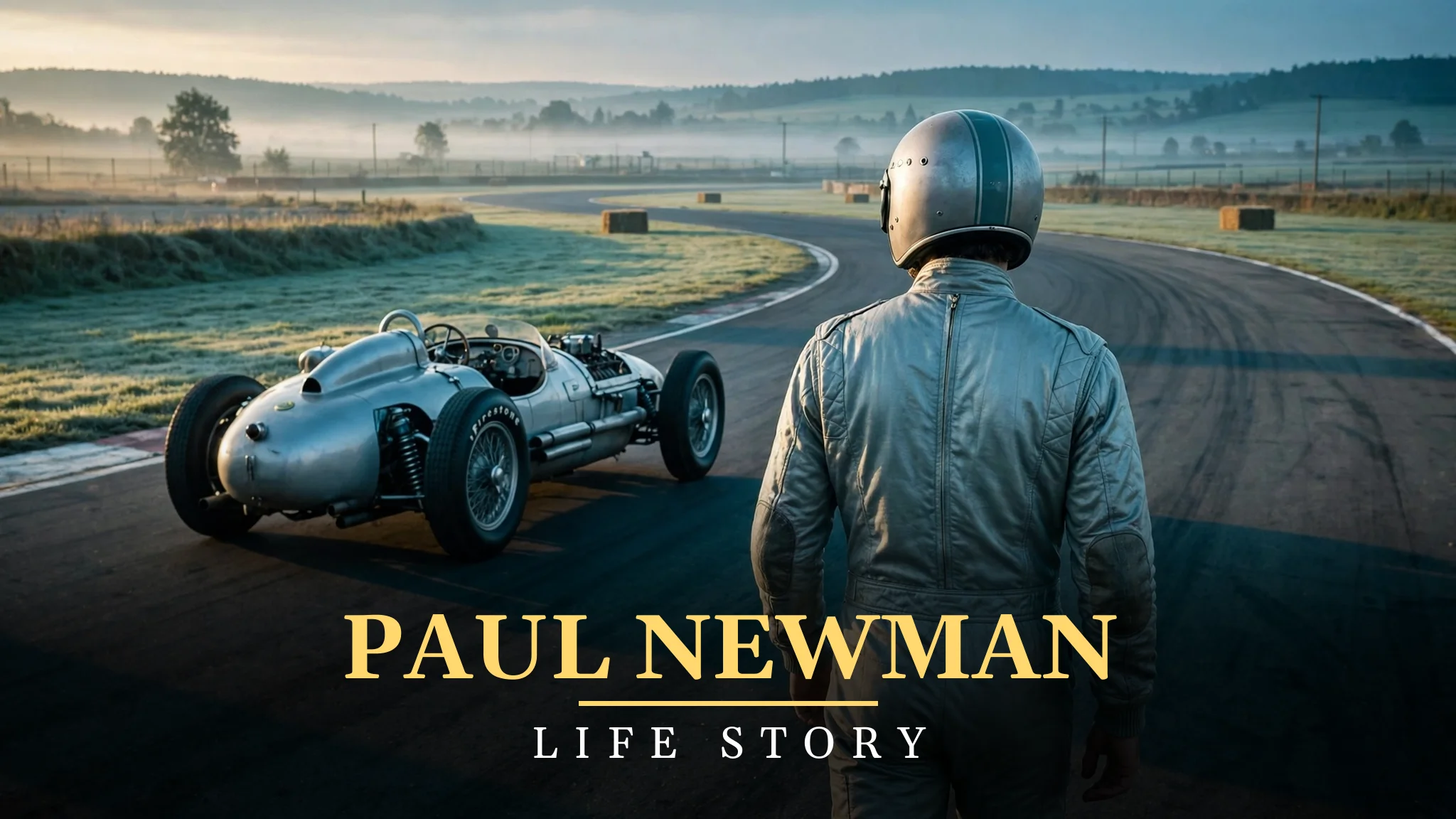
While he was making films, Newman was also building a second career, one that few actors have ever matched. He had fallen in love with motor racing while making a film called Winning in 1969, where he played a racing driver, and he discovered that he loved the speed, the danger, and the discipline of the track. He began to race seriously, and he became very good at it. He won races, he drove in the famous 24 Hours of Le Mans in France, where he finished second in his class, and he kept racing into his seventies and eighties, long after other men had retired. It was not a hobby. It was a second profession, and he took it as seriously as he took acting.
Racing gave him something that Hollywood could not: a place where his fame did not matter. On the track, no one cared that he was a film star. They cared only about how fast he could drive, and how well he could handle a car. Newman loved that honesty. He loved the fact that the track did not lie, and that a slow driver could not pretend to be fast. He drove with the same focus he brought to his acting, and he earned the respect of professional drivers, who did not give respect easily to an actor. He also owned a racing team, and he helped young drivers, and he stayed involved in the sport for the rest of his life.
The racing life also showed a side of Newman that the films had hidden: a man who liked danger, who liked speed, and who was willing to risk his life for the thrill of it. It was a surprising side for a man who was also known as a gentle husband and a generous giver, but it was part of who he was. He was not a man who sat still. He needed to move, to compete, to test himself, and the racetrack gave him a place to do that. He raced until he was in his eighties, and he won his last race at the age of eighty-one, a fact that still amazes the people who knew him.
Newman’s Own and the Giving That Changed Everything
In 1982, Newman started a food company almost by accident. He had made salad dressing at home for his family and friends, and people loved it so much that he and his friend A. E. Hotchner decided to sell it. They called the company Newman’s Own, and they put Newman’s face on the label, and they made a promise: all of the profits would go to charity. It was a simple idea, and it was a radical one, because no one had ever built a food company on the idea of giving everything away. The dressing sold well, and the company grew, adding pasta sauce, popcorn, and many other foods, and the money it gave away grew with it.
By the time of his death, Newman’s Own had given away hundreds of millions of dollars to charity, and it has given away even more since. The money went to many causes, but the one Newman cared about most was the Hole in the Wall Gang Camp, a summer camp he founded for children with serious illnesses. The camp gave sick children a chance to be children, to play, to fish, to laugh, and to forget their illness for a week or two. Newman visited the camp often, and he loved it deeply, and he spoke about it with a pride that he never showed about his films. It was, by his own account, the best thing he had ever done, better than any film, better than any race, better than any award.
He also gave money to many other causes, to schools, to hospitals, to the arts, and to the environment, and he did so quietly, without seeking praise. He did not put his name on buildings, and he did not hold press conferences to announce his giving. He simply gave, year after year, and he let the work speak for itself. It was a remarkable way to use fame, and it set an example that few other stars have matched. He showed that a famous man could do more than entertain. He could feed children, he could heal them, and he could give them a summer they would never forget.
The Oscar, the Last Years, and a Life Well Lived
Newman was nominated for the Academy Award for Best Actor many times, and for many years, he did not win. He was nominated for Cat on a Hot Tin Roof, for The Hustler, for Hud, for Cool Hand Luke, for Absence of Malice, and for The Verdict, a film about a lawyer who takes one last case to redeem himself. Each time, the award went to someone else, and Newman took it with grace, though it must have hurt. Then, in 1986, he made The Color of Money, in which he returned to the part of Fast Eddie Felson, now an older man who teaches a young pool player. He won the Academy Award for Best Actor, his first and only competitive Oscar for acting, and the audience in the hall stood for him. It was a long time coming, and it was a fitting honour for a man who had given so much to the cinema.
He also received an honorary Oscar in 1994, for his charity work, and another for his long career, and he accepted them with the same modesty he had always shown. He did not make a fuss about awards, and he did not believe that they were the measure of a life. He believed that the work was the measure, and that the giving was the measure, and that the family was the measure. He kept working into his eighties, making films and doing voice work, and he kept racing, and he kept giving, until his health began to fail.
He was diagnosed with lung cancer, and he died on 26 September 2008, at his home in Connecticut, at the age of 83. He was surrounded by his family, including Joanne Woodward, his wife of fifty years, and his children. Tributes came from around the world, from actors, from racing drivers, from the children of his camps, and from ordinary people who had loved his films and his food. He left behind a company that still gives its profits to charity, a camp that still welcomes sick children, and a body of work that remains one of the finest in American film. He was, by any measure, a man who used his fame well, and who left the world better than he found it.
The Verdict, Nobody’s Fool, and the Wisdom of Age
In 1982, Newman made The Verdict, a film about Frank Galvin, a lawyer who has lost everything: his practice, his reputation, and his self-respect, and who takes one last case, a medical malpractice suit, to redeem himself. It was a sad, powerful film, and Newman played Galvin with a weariness and a hope that audiences recognised at once. He was not a young hero in this film. He was an old man, tired and broken, who finds, in the course of the case, a reason to believe in himself again. The film earned him another Oscar nomination, and it is now seen as one of his finest performances, because it showed a man who had lived, who had failed, and who still had the courage to try again. It was a part that suited a man in his late fifties, a man who knew what it was to lose, and to keep going.
Twelve years later, in 1994, he made Nobody’s Fool, a film about Sully, an old man in a small town in New York, who is stubborn, funny, and lonely, and who tries, in his own clumsy way, to be a better father and a better man. It was a gentle, warm film, and Newman played Sully with a humour and a tenderness that moved audiences and critics alike. He was nominated for another Oscar, and the film showed that he could still carry a picture, even in his late sixties, and that his gift had not faded with age. It had deepened, and it had become wiser, and it showed a man who understood life better than he had when he was young.
He also did voice work in his later years, playing Doc Hudson in the animated film Cars in 2006, a role that introduced him to a new generation of children who had never seen his films. It was a fitting final role, because Doc Hudson is an old racing car, a former champion who has retired to a small town, and who teaches a young car how to race and how to live. Newman, who had been a racing driver himself, understood that part deeply, and he gave it a warmth and a wisdom that made it one of the most loved characters in the film. It was a quiet, beautiful farewell to the screen, and it was a fitting end to a career that had lasted for more than fifty years.
My Take:
I think Paul Newman is the star I would most want to have been, if I had to choose one, and I say that not because of the blue eyes or the fame, but because of the way he used his life. Most famous people spend their lives taking: taking money, taking praise, taking attention. Newman spent his life giving, and he gave in a way that was quiet, steady, and real. He gave money to sick children, he gave his time to a camp, he gave his fame to a food company that existed only to help others. That is a rare thing, and I think it is the most important part of his story, more important than any film, more important than any race, more important than any award.
What I admire most is the charity, because it was not a performance. Many stars give to charity, and they do it with cameras watching, and they put their names on the gift. Newman did the opposite. He built a company that gave away all of its profits, and he did it year after year, without fuss, without self-praise, and without ever suggesting that he was a saint. He was not a saint. He was a man who had been given a great deal, and who believed that a great deal was expected in return. I think that belief is one of the best things a person can hold, and I wish more people who have much would hold it too. The Hole in the Wall Gang Camp is still open today, and children who were born after Newman died still go there, and still laugh, and still forget their illness for a week. That is a legacy that no film can match.
I also admire the racing, because it shows a side of Newman that is easy to miss. Here was a man who was rich, famous, and loved, and who could have spent his life in comfort, and instead he chose to drive a car at two hundred miles an hour, in the rain, with other cars inches away from him. That takes a kind of courage that is not about fame. It is about wanting to know what you are made of, and wanting to test yourself in a place where no one can help you. I think Newman needed that test, because acting, for all its difficulty, is a safe place compared to a racetrack. On a track, there is no script, and there is no second take, and a mistake can kill you. Newman loved that honesty, and I respect it, because it tells me that he was not a man who was content to be comfortable. He wanted to be alive, and racing made him feel alive.
Cool Hand Luke is the film I think about most when I think about Newman, because it is a film about a man who will not be broken. Luke is beaten, starved, and locked in a box, and he still smiles, and he still refuses to give in. I think that is a powerful image, and I think it is one that many people carry with them when life is hard. We all have times when we feel like Luke, when the world is pressing down on us, and when giving in would be easier than standing up. Newman’s Luke reminds us that we can stand up, that we can smile, and that we can keep going, even when the odds are against us. That is not a small gift for a film to give, and it is one of the reasons Cool Hand Luke is still loved today.
I also think about his marriage to Joanne Woodward, because it is one of the few Hollywood marriages that lasted, and it lasted because both of them worked at it. They were both actors, they were both famous, and they both knew the temptations of Hollywood, but they stayed together for fifty years, and they raised a family, and they built a life away from the cameras in Connecticut. Newman once said, when asked about fidelity, that he had steak at home and did not need hamburger on the road, a line that is often quoted because it is funny and because it is true. I like that line, not only because it is funny, but because it tells me that he valued what he had, and that he did not need to look elsewhere. That is a simple kind of wisdom, and it is one that many people forget.
If I had to choose one Newman film to show to someone who had never seen him, I would choose The Hustler, because it shows everything he could do as an actor. It has the charm, the ambition, the self-destruction, and the painful learning, and it has a final scene that is quiet and honest, in which Eddie finally understands what it means to be a man. But I would also ask that person to watch The Verdict, a later film in which Newman plays a lawyer who has lost everything and who takes one last case to save himself. It is a sad film, and a beautiful one, and it shows Newman as an older man, tired and hopeful at the same time, and it is one of his finest performances. Together, those two films show a man who grew, who learned, and who never stopped trying to be better.
I also think about the son he lost, because it is the saddest part of his story, and because it shows that even a man who had everything could suffer a loss that no money could fix. His son Scott died in 1978, at the age of twenty-eight, after a struggle with drink and drugs, and Newman grieved for him for the rest of his life. He did not talk about it much in public, but he carried it with him, and he later gave money to help young people with addiction. I find that deeply human, because it shows that fame does not protect a person from grief, and that a father who loses a son carries that loss forever. It also shows that Newman turned his grief into something useful, by helping others who were struggling in the same way. That is a brave and generous thing to do.
In the end, I think Paul Newman’s story teaches me that a life is not measured by what you take, but by what you give. He took a great deal from Hollywood: money, fame, applause, and the love of millions. And he gave back more than he took: he gave money to sick children, he gave his time to a camp, he gave his name to a company that feeds the hungry, and he gave his best to every film he made. That is a life well lived, and it is a life that makes me want to be better, not only as a worker, but as a person. He had the bluest eyes in Hollywood, but it is not the eyes I remember. It is the giving, and the racing, and the quiet way he lived, that I will remember, and that I hope others will remember too.
I also think about The Verdict, because it is a film about a man who has lost everything and who finds a reason to try again. Frank Galvin is a lawyer who drinks, who has no clients, and who has no hope, and he takes one last case, and he finds, in that case, a reason to believe in himself. I think many people know that feeling, of having lost their way, and of wondering if it is too late to find it again. Newman’s Galvin shows them that it is not too late, that a man can be broken and still be brave, and that a single case, a single act of honesty, can redeem a life. That is a powerful message, and it is one that Newman played with a truth that came from his own life, from his own knowledge of what it is to fail and to keep going.
I also think about Nobody’s Fool, because it is a film about an old man who is stubborn and funny, and who tries to be a better father. Sully is not a hero. He is a man who has made mistakes, who has hurt people, and who is trying, late in life, to make things right. Newman played him with a warmth and a humour that made the audience love him, even though he was flawed. I think that is a good lesson: that it is never too late to try to be better, and that a man in his sixties can still learn, still grow, and still love. Newman was in his late sixties when he made that film, and he played Sully as a man who was still learning, still hoping, and still alive. That is a beautiful thing, and it is one that I hope to remember when I am old.
I also think about his voice work in Cars, because it is a fitting end to his career. He played Doc Hudson, an old racing car who teaches a young car how to race, and he gave the part a warmth and a wisdom that made it one of the most loved characters in the film. Children who had never seen Cool Hand Luke or Butch Cassidy knew Doc Hudson, and they loved him, and they learned from him. That is a wonderful legacy: that a man who was a racing driver in real life should end his career playing a racing car, teaching a young one how to live. It is a perfect circle, and it is a fitting farewell to a man who had lived so many lives in one lifetime.
In the end, I keep coming back to the camp, to the Hole in the Wall Gang Camp, where sick children go to play, to fish, and to forget their illness for a week. That camp is still open today, and children who were born after Newman died still go there, and still laugh, and still come home with memories that will last them a lifetime. That is a legacy that no film can match, and it is the reason I will remember Paul Newman, not only as a great actor, but as a great man, who used his fame to do good, and who left the world better than he found it. He had the bluest eyes in Hollywood, but it is not the eyes I remember. It is the giving, and the racing, and the quiet way he lived, that I will remember, and that I hope others will remember too.
I also think about his daughter, because it is a part of his story that is easy to forget. Newman had three children from his first marriage, and three more with Joanne Woodward, and he loved them all, and he was a devoted father, even though his life was busy, and even though he was often away, racing or filming. His children have spoken about him with love, and about the quiet way he lived at home, in Connecticut, away from the cameras, and about the man who was not a star at home, but a father, who cooked, who played, and who listened. I like knowing that, because it tells me that the giving was not only public. It was private, too, and it began at home, with the people he loved most.
I also want to say something about the salad dressing, because it is a small detail that tells a big story. Newman started Newman’s Own almost by accident, making dressing at home for his family and friends, and people loved it so much that he decided to sell it, and to give all the profits away. That is a remarkable idea, and it is one that no one had ever tried before, because most people who start a company want to keep the money. Newman did the opposite, and he built a company that has given away hundreds of millions of dollars, and that still gives today, long after his death. That is a legacy that no film can match, and it is the reason I will remember Paul Newman, not only as a great actor, but as a great man.
Frequently Asked Questions
Where did Paul Newman grow up?
He was born on 26 January 1925 in Shaker Heights, Ohio, a suburb of Cleveland. His father ran a sporting goods store, and his mother loved the theatre and took him to plays as a boy.
What was Paul Newman’s most famous film role?
Many people name Cool Hand Luke from 1967, where he played a prisoner who refuses to be broken, or Butch Cassidy and the Sundance Kid from 1969. The Hustler from 1961 is also among his most praised performances.
How did Paul Newman win his Academy Award?
He won the Academy Award for Best Actor for The Color of Money in 1986, where he returned to the part of Fast Eddie Felson from The Hustler, now an older man teaching a young player. It was his only competitive Oscar win for acting.
Was Paul Newman really a racing driver?
Yes, he raced seriously for decades, drove at Le Mans in France, won many races, and kept racing into his eighties. He also owned a racing team and won his last race at the age of eighty-one.
What is Newman’s Own and where does its money go?
Newman’s Own is a food company he started in 1982 with salad dressing, and it gives all of its profits to charity. It has given away hundreds of millions of dollars, much of it to the Hole in the Wall Gang Camp for seriously ill children.
How long was Paul Newman married to Joanne Woodward?
They married in 1958 and stayed together for fifty years until his death on 26 September 2008. It was one of the longest and most admired marriages in Hollywood.


