Paulette Goddard: The Life Story Behind Hollywood's Glamorous Star
In this post
Paulette Goddard was glamour with a sharp mind behind it. She was beautiful, she was witty, and she was independent in a Hollywood that expected women to be quiet and obedient. She began as a Ziegfeld girl, she became Charlie Chaplin’s leading lady, and she built a career that lasted for decades, in films, on stage, and in a life that took her from New York to Hollywood to Switzerland. She was not a star who waited for permission. She made her own choices, and she lived with them.
She starred in Modern Times, one of the greatest films ever made, and in The Great Dictator, a brave film that mocked Hitler at a time when many people were afraid to speak out. She was nominated for an Academy Award, she worked with some of the best directors in Hollywood, and she became known as one of the most glamorous women in the world. She was also a smart businesswoman, a collector of art, and a woman who loved to travel, to read, and to live well.
Her private life was as colourful as her films. She married Charlie Chaplin, she married Burgess Meredith, and she married the writer Erich Maria Remarque, and each marriage taught her something about love, about work, and about herself. She died in Switzerland at seventy-nine, a long way from the New York girl who had danced in a chorus line. This is the story of a woman who was glamorous, smart, and free, and who lived her life on her own terms.
A New York Girl in the Ziegfeld Follies
Paulette Goddard was born Marion Levy on 3 June 1910 in Whitestone, New York, a neighbourhood in Queens. Her parents separated when she was young, and she was raised by her mother, who worked hard to support them. Paulette was a lively girl, she was pretty, and she liked to perform. She took dance lessons, she sang, and she dreamed of a life on stage. She was still a teenager when she began to work as a model, and then as a dancer in the Ziegfeld Follies, one of the most famous stage shows in America.
The Ziegfeld Follies were a glamorous world, full of beautiful girls, elaborate costumes, music, and dance. Paulette was one of the Ziegfeld girls, and she learned how to perform in front of a large audience, how to move with grace, and how to make an impression. She was young, she was beautiful, and she was ambitious, and she wanted more than a chorus line. She wanted to act, she wanted to be a star, and she was willing to work for it.
She also worked as a model, and she appeared in advertisements and in magazines. She learned how to pose for a camera, how to smile, and how to make a photograph work. Those lessons would help her later in Hollywood, where a photograph could make a career. She was not a girl who had been handed success. She was a girl who had worked in the chorus, who had modelled, and who had learned her trade, one job at a time.
She married her first husband, Edgar James, a lumber heir, when she was still a teenager, and the marriage ended in divorce. She was young, and she had married too soon, and she learned from the experience. She moved to Hollywood in the early 1930s, hoping to become a film actress, and she began to look for work. She was in her early twenties, and she was about to meet the man who would change her life.
Meeting Chaplin and Modern Times
In Hollywood, Paulette Goddard met Charlie Chaplin, one of the most famous men in the world. Chaplin was a genius of silent film, and he was looking for a leading lady for his new film, Modern Times. He saw Paulette, and he knew that she was right for the part. She was beautiful, she was lively, and she had a natural, unpolished quality that suited the role of the Gamin, a young woman who lives on the streets, who steals food to survive, and who finds love with Chaplin’s Tramp. She was cast in the film, and it changed her life.
Modern Times, released in 1936, is one of the greatest films ever made. It is a comedy about the modern world, about factories, about machines, and about a little man who tries to survive in a world that is too big for him. Paulette played the Gamin with warmth, with humour, and with a toughness that made her feel real. She was not a glamorous star in the film. She was a poor girl, in ragged clothes, with dirt on her face, and she was beautiful because she was alive, because she was brave, and because she loved. The film was a hit, and it made Paulette a star.
She worked closely with Chaplin, and she learned from him. He was a perfectionist, he filmed scenes again and again, and he expected the best from everyone he worked with. Paulette gave him her best, and he respected her for it. She learned how to act for the camera, how to use her face, her eyes, and her body to tell a story without words, and how to make a character feel real. Those lessons would stay with her for the rest of her career.
She and Chaplin lived together, and they were married, according to many accounts, in 1936, although the exact details of their marriage were kept private for many years. They were a famous couple, and they were loved by the public, but their relationship was complicated. Chaplin was older, he was a genius, and he was a difficult man to live with. Paulette was young, she was independent, and she wanted her own career. The marriage would later end, but the films they made together would last forever.
The Great Dictator and a Brave Film
In 1940, Paulette Goddard starred with Chaplin again, in The Great Dictator, a film that mocked Adolf Hitler at a time when Hitler was at the height of his power, and when many people in Hollywood were afraid to speak out. Chaplin played a Jewish barber who looks like Hitler, and also played Hitler himself, in a brilliant, brave, and funny performance. Paulette played Hannah, the barber’s friend, a strong, brave, and loving woman who stands by him through danger and hardship. The film was a bold statement, and it was a risk, because it made fun of a dictator who was starting a war.
Paulette played Hannah with warmth and with courage, and she was a perfect partner for Chaplin. She was not a helpless heroine. She was a woman who fought back, who spoke her mind, and who loved deeply. The film was a hit, and it is now regarded as one of the greatest films ever made, and as one of the bravest. Paulette’s performance in it is one of her best, and it shows that she could do more than be glamorous. She could be brave, and she could be part of a film that mattered.
The film also showed that Paulette was willing to take a risk. She could have played safe, glamorous roles, and she could have avoided controversy, but she chose to be in a film that mocked Hitler, at a time when that was dangerous. That choice tells us a lot about her character. She was not afraid to speak out, and she was not afraid to be part of something important. She was a woman with courage, and she used it.
After The Great Dictator, Paulette and Chaplin separated, and they divorced in 1942. The marriage had lasted for several years, and it had produced two great films, but it had also been difficult. Paulette was ready to build her own career, without Chaplin, and she did it with the same energy and independence that had marked her life. She was no longer only Chaplin’s leading lady. She was Paulette Goddard, a star in her own right.
A Star in Her Own Right
After leaving Chaplin, Paulette Goddard built a successful film career on her own. She starred in Reap the Wild Wind in 1942, a colourful adventure film directed by Cecil B. DeMille, and in So Proudly We Hail! in 1943, a film about nurses in the Second World War, for which she was nominated for an Academy Award for Best Supporting Actress. She played a nurse who is brave, funny, and strong, and she showed that she could carry a serious, dramatic role. The nomination was a well-deserved honour, and it showed that Hollywood respected her as an actress, not only as a beautiful face.
She also starred in other films in the 1940s, including Kitty in 1945, and The Diary of a Chambermaid in 1946, in which she played a maid who is clever, ambitious, and determined to improve her life. She was versatile, she was skilled, and she was beautiful, and she made each film better by being in it. She was at the peak of her career, and she was one of the most popular actresses in Hollywood.
She married the actor Burgess Meredith in 1944, and the marriage lasted until 1949. Meredith was a talented actor, and the two of them were a famous couple, but the marriage ended in divorce. Paulette was independent, and she wanted a career, and a life, that was her own. She did not let a marriage define her, and she did not let a divorce stop her. She kept working, she kept travelling, and she kept living her life on her own terms.
She also worked on stage, and she appeared in plays in New York and in London. She loved the theatre, and she enjoyed the direct contact with a live audience. She was a performer, and she liked to perform, whether the audience was in a cinema or in a theatre. She was a star, and she knew it, but she was also a worker, and she did her job with skill and with care.
Remarque, Switzerland, and a Life Abroad
In 1958, Paulette Goddard married the writer Erich Maria Remarque, the author of All Quiet on the Western Front, one of the most famous novels about the First World War. Remarque was a thoughtful, intelligent man, and Paulette loved him deeply. They lived in Switzerland, in a beautiful home overlooking Lake Maggiore, and they built a life together that was centred on reading, on art, on travel, and on conversation. The marriage lasted until Remarque’s death in 1970, and it was a long and happy partnership.
Life in Switzerland gave Paulette a new kind of freedom. She was no longer in Hollywood, she was no longer under the eye of the studios, and she could live as she wanted. She collected art, she read widely, she travelled, and she enjoyed the company of writers, artists, and interesting people. She was a smart woman, and she loved to learn, and Switzerland gave her the time and the space to do that. She was happy there, and she stayed there for the rest of her life.
She worked less in films in her later years, but she did not stop. She appeared in a few films and on television, and she was welcomed as a star from Hollywood’s golden age. She was proud of her career, and she was grateful for the loyalty of her fans. She was also a woman who had lived a full life, and who had seen the world change many times. She had been a Ziegfeld girl, a Chaplin star, a Hollywood leading lady, and a writer’s wife in Switzerland, and she had done all of those things with grace and with independence.
Her life abroad matters because it shows that Paulette Goddard was more than a Hollywood star. She was a woman who loved art, who loved books, who loved travel, and who wanted to live a full and interesting life. She did not need Hollywood to be happy. She needed a good book, a beautiful view, and a person she loved, and she found all three in Switzerland. That is a fitting end to a life that began in New York, and that took her around the world.
A Glamorous Goodbye in Switzerland
Paulette Goddard died on 23 April 1990 in Ronco, Switzerland, at the age of seventy-nine. She had lived a long life, and she had seen Hollywood change many times. She had been a Ziegfeld girl, a Chaplin star, an Oscar nominee, and a writer’s wife, and she had done all of those things with glamour and with independence. Her death was mourned by her family, by her friends, and by fans who remembered her films. She was buried in Switzerland, in the country she had come to love.
Her legacy is tied to Modern Times and The Great Dictator, two of the greatest films ever made, and to her work as a glamorous, independent star. She showed the world that a woman could be beautiful and smart, glamorous and brave, and that she could live her life on her own terms. Her films are still shown today, and they still give pleasure to people who like the great films of the 1930s and 1940s. She is remembered as one of the most glamorous stars in Hollywood history, and as a woman who worked hard for every step she took.
She is also remembered for her art collection, for her love of books, and for her life in Switzerland. She was not only a film star. She was a collector, a reader, a traveller, and a woman who loved life. That is a legacy worth remembering, and it is a legacy that still matters. She lived a full life, and she lived it well, and that is the most important thing of all.
What Glamour Means When It Is Real
Glamour is often thought of as a matter of clothes, of jewellery, or of a beautiful face. Paulette Goddard showed that glamour is more than that. Glamour is a way of living, a way of carrying yourself, and a way of facing the world with confidence and with joy. She was glamorous in her films, she was glamorous in Switzerland, and she was glamorous in her private life, because she lived with style, with intelligence, and with independence. That is true glamour, and it is rarer than beautiful clothes.
She also showed that glamour can be a form of strength. She was beautiful, and she used her beauty, but she did not let it define her. She was smart, she was brave, and she was independent, and she used those qualities to build a life that was her own. She did not wait for a man to give her a career, or a studio to give her a role. She made her own choices, and she lived with them. That is a powerful message, and it is one that still matters today, when women are still fighting to be seen as more than their looks.
Her life also shows that glamour does not mean a perfect life. She married three times, she faced divorce, she faced the end of her film career, and she lived far from the country where she was born. She was not perfect, and her life was not perfect, but she faced it with style and with courage. That is the most important part of her story, and it is the part that should be remembered. Glamour is not about being perfect. It is about living well, even when life is imperfect.
An Art Collector With a Sharp Eye
Paulette Goddard was not only a film star. She was also an art collector, with a sharp eye for beautiful things, and a love of painting, sculpture, and design. In Switzerland, she collected works by famous artists, she visited galleries, she talked to dealers, and she built a collection that reflected her taste, her intelligence, and her love of beauty. She was not a star who bought art to show off. She bought art because she loved it, because it moved her, and because it made her home a more beautiful place to live.
Her collection was a part of her life in Switzerland, and it was a part of her identity as a woman who loved culture. She read widely, she travelled, and she learned about art, about history, and about the world. She was a smart woman, and she loved to learn, and art gave her a way to keep learning, even after her film career had ended. She was not a woman who sat back and lived on her memories. She was a woman who kept exploring, kept discovering, and kept growing.
She also understood that art, like film, can tell a story, can move people, and can make life richer. She collected art because it gave her joy, and because it gave her a connection to the artists who had made it, and to the cultures that had produced it. That joy is a beautiful thing, and it tells me a lot about Paulette. She was not only interested in fame. She was interested in beauty, in ideas, and in the world, and she used her money and her time to explore those interests.
Her art collection is a lasting legacy, and it shows that Paulette Goddard was more than a Hollywood star. She was a collector, a reader, a traveller, and a woman who loved life. That is a legacy worth remembering, and it is a legacy that still matters, because it shows that a star can have a rich, interesting life after Hollywood, and that fame is not the only thing that defines a person.
She also worked with the director Mitchell Leisen and with other talented filmmakers, and she learned how to work with different styles, different scripts, and different co-stars. She was a professional, and she adapted to each new film, each new director, and each new role, with the same energy and independence that had marked her life. That adaptability helped her to build a long career, and it showed that she was more than a single image, or a single kind of star. She was a versatile actress, and she proved it, film after film.
My Take:
When I think about Paulette Goddard, I think first about independence, and about how rare true independence is. She was a woman who made her own choices, who lived her own life, and who did not wait for permission. She began as a Ziegfeld girl, she became Chaplin’s leading lady, she built her own career, she married three times, and she lived in Switzerland, collecting art and reading books. She did all of that on her own terms, and I admire that deeply, because independence is hard to keep, especially in a world that often tells women to be quiet, to be obedient, and to wait for a man to decide.
I admire her courage most of all. She starred in The Great Dictator, a film that mocked Hitler at a time when Hitler was at the height of his power, and when many people were afraid to speak out. That was a brave choice, and it was a choice that could have cost her her career. She made it anyway, because she believed in the film, and because she believed that it was right to mock a dictator. That courage is a beautiful thing, and it is a thing I want to remember. She was not only glamorous. She was brave, and she used her bravery for something important.
What makes me sad about her story is the way her marriages ended, and the way her life in Hollywood faded. She married Chaplin, and the marriage ended. She married Burgess Meredith, and the marriage ended. She married Remarque, and she was happy, but he died, and she was left alone. She loved, and she lost, and she kept going, but the losses must have been hard. I feel sad for her, and I admire the way she kept living, kept travelling, kept reading, and kept collecting art, even after loss. That is a quiet kind of strength, and it is a strength that deserves respect.
I also feel sad about the way Hollywood sometimes saw her only as a glamorous face. She was beautiful, and she was glamorous, but she was also smart, funny, and brave. She could act, she could sing, she could dance, and she could carry a serious film. Hollywood did give her good roles, and it did nominate her for an Oscar, but it also typecast her as a glamorous star, and it did not always give her the credit she deserved for her intelligence. I wish she had been given more chances to show her full range, and more respect for her mind, not only for her looks.
I think about her work in Modern Times, and I smile when I remember it. She played the Gamin, a poor girl who lives on the streets, who steals food to survive, and who finds love with Chaplin’s Tramp. She played her with warmth, with humour, and with toughness, and she made her feel real. She was not a glamorous star in that film. She was a poor girl, in ragged clothes, with dirt on her face, and she was beautiful because she was alive, because she was brave, and because she loved. That is a powerful performance, and it is one that still moves people today. I think about the young people who watch that film and see the Gamin, and who learn that beauty is not only about clothes, but about spirit, and about love.
I think about her life in Switzerland, and I admire it too. She lived in a beautiful home, she collected art, she read books, she travelled, and she enjoyed the company of interesting people. That is a good life, and it is a life that she built for herself, after Hollywood. She did not need Hollywood to be happy. She needed a good book, a beautiful view, and a person she loved, and she found all three. That is a lesson for all of us, because fame fades, but a good life, built on reading, on art, and on love, can last.
Her marriage to Remarque is the part of her story that makes me feel happy. Remarque was a thoughtful, intelligent writer, and Paulette loved him deeply. They lived together in Switzerland, they read, they talked, and they built a life that was centred on ideas, not only on fame. That is a beautiful partnership, and it tells me a lot about Paulette. She was not only interested in glamour. She was interested in books, in art, and in ideas. She was a smart woman, and she found a smart man, and they were happy together. That is a wonderful thing, and it is a thing worth celebrating.
If I could ask her one question, I would ask her how she kept her independence when Hollywood tried to control her. She was a young woman in a studio system that controlled its stars, she was married to a genius who was difficult to live with, and she was beautiful in a world that wanted to use her beauty. How did she keep her own mind, her own choices, and her own life? I think she would laugh, and she would say that she never let anyone else decide for her, and that she always trusted herself. That is good advice, and it is advice that comes from a life lived with courage.
In the end, I feel both admiration and sadness when I think about Paulette Goddard. Admiration for her independence, her courage, her glamour, and her love of art and books. Sadness for the marriages that ended, for the way Hollywood sometimes overlooked her intelligence, and for a life that, like all lives, had its share of loss. Both feelings are true, and both belong in her story. She was not only a glamorous star on screen. She was a woman who worked hard, loved deeply, and lived her life on her own terms. That is the Paulette Goddard I want to remember.
I also learn from her that glamour can be real, when it comes from within. She was glamorous because she was confident, because she was smart, and because she lived well. She did not need expensive clothes to be glamorous, although she wore them beautifully. She needed a strong mind, a brave heart, and a love of life. That is a lesson for all of us, because glamour is not about what we wear. It is about how we live, and how we face the world. Paulette shows us how to live with style, with courage, and with joy.
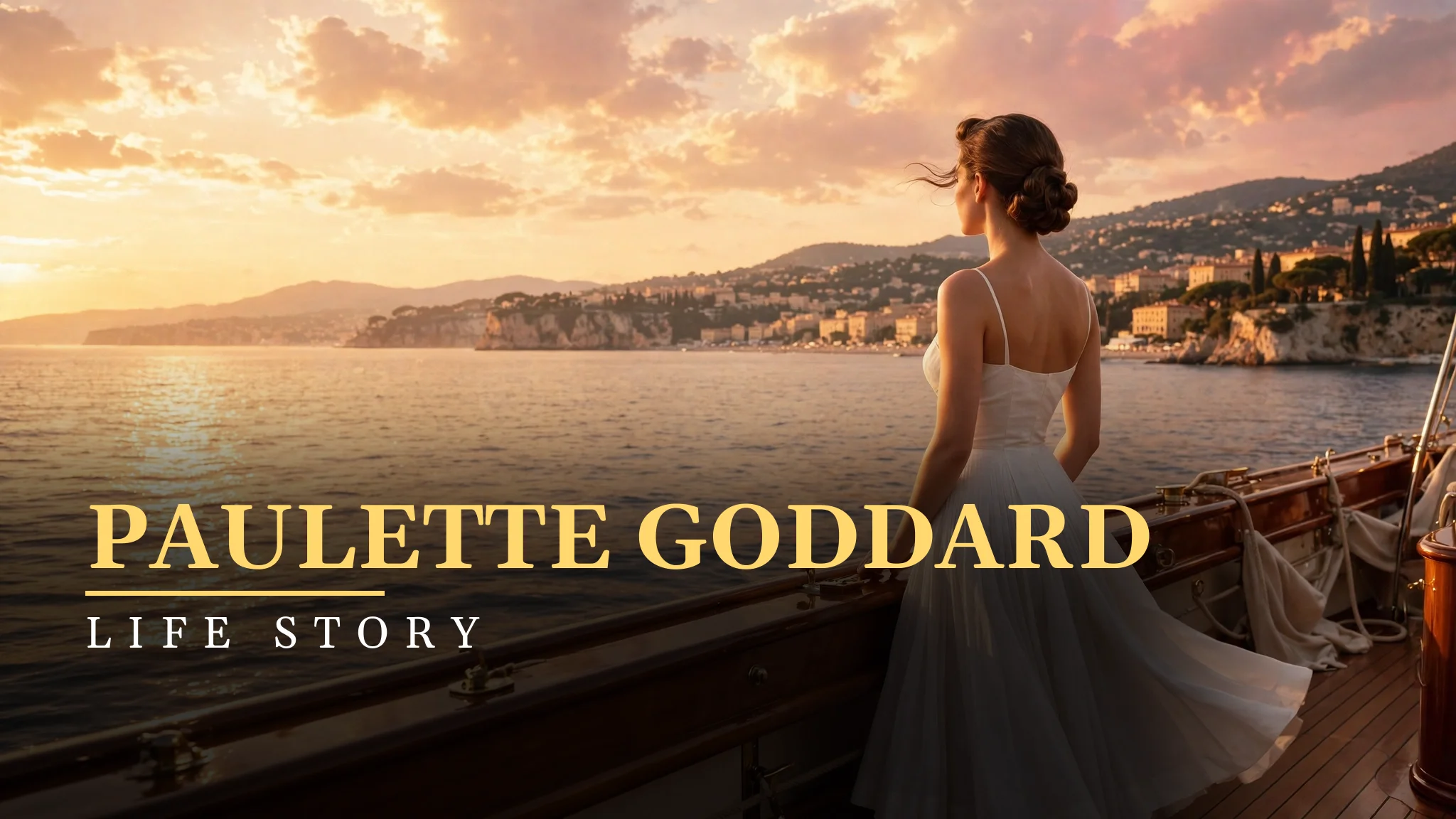
I think her legacy is a good one, and I think it is worth remembering. She showed the world that a woman could be beautiful and smart, glamorous and brave, and that she could live her life on her own terms. Her films are still shown today, and they still give pleasure to people who like the great films of the 1930s and 1940s. She gave joy to millions of people, and she did it with grace. That is a life worth celebrating, and it is a life worth telling. When I think of Paulette Goddard, I think of a woman in a white dress on a yacht, looking out over a golden sea, free, beautiful, and happy, and I smile, because that image is beautiful, and it will last.
I also think about the young women today who dream of a life that is their own, who want to be independent, to travel, to read, and to live well. Paulette Goddard proves that it is possible, and that hard work, courage, and independence can change a life. She proves that you do not need to wait for permission to live your life. You need to make your own choices, to trust yourself, and to keep going. That is a message of hope, and it is a message that still matters. I hope that young women who read about Paulette Goddard will feel that hope, and will believe in themselves, as she believed in herself.
I keep thinking about the way she played the Gamin in Modern Times, because that role captures everything I admire about Paulette. She was a poor girl in worn clothes, with a smudged face, and she shone because she was full of life, full of courage, and full of love. She was not a glamorous star in that film. She was a real person, trying to survive, and trying to love, in a hard world. That is a powerful performance, and it is one that still moves people today. I think about the young people who watch that film and see the Gamin, and who learn that beauty is not only about clothes, but about spirit, and about love.
I also think about her life in Switzerland, and about how it gave her a new kind of freedom. She lived in a beautiful home, she collected art, she read books, she travelled, and she enjoyed the company of interesting people. She was no longer in Hollywood, she was no longer under the eye of the studios, and she could live as she wanted. That freedom must have felt good after years of following a studio plan, and after years of being a public figure. She was a smart woman, and she loved to learn, and Switzerland gave her the time and the space to do that. She was happy there, and she stayed there for the rest of her life.
There is another part of her story that stays with me, and it is her marriage to Erich Maria Remarque. Remarque was a thoughtful, intelligent writer, and Paulette loved him deeply. They lived together in Switzerland, they read, they talked, and they built a life that was centred on ideas, not only on fame. That is a beautiful partnership, and it tells me a lot about Paulette. She was not only interested in glamour. She was interested in books, in art, and in ideas. She was a smart woman, and she found a smart man, and they were happy together. That is a wonderful thing, and it is a thing worth celebrating.
I wonder what she would say to a young woman today who wants to be independent, to travel, to read, and to live well. I think she would laugh, and she would say, make your own choices, trust yourself, and do not wait for permission. I think she would tell that young woman to work hard, to learn, and to live her life on her own terms. That is good advice, and it is advice that comes from a life lived with courage, glamour, and independence.
I also think about the way she worked with Cecil B. DeMille in Reap the Wild Wind, because DeMille was a director who loved spectacle, and Paulette loved to be part of a big, colourful film. She played a strong, adventurous woman, and she held her own in a film full of action, romance, and drama. That versatility is a sign of a great actress, and it is a sign of a woman who was not afraid to try new things. She could play a poor girl in Modern Times, a nurse in So Proudly We Hail!, and an adventurer in Reap the Wild Wind, and she could make each one feel real. That range is rare, and it deserves to be celebrated.
Finally, I think about her as a woman who loved life, and who lived it fully, from a Ziegfeld girl in New York to a star in Hollywood to a collector in Switzerland. She travelled, she read, she collected art, she loved, and she worked, and she did all of it with style and with courage. She did not let fame define her, and she did not let loss stop her. She kept living, kept learning, and kept loving, even after difficult times. That is a lesson for all of us, because life is short, and we should live it fully, with curiosity, with love, and with courage, as Paulette did.
Frequently Asked Questions
What was Paulette Goddard’s most famous film with Charlie Chaplin?
She starred with Chaplin in Modern Times in 1936 as the Gamin, and in The Great Dictator in 1940 as Hannah, and both films are now regarded as among the greatest ever made.
Was Paulette Goddard married to Charlie Chaplin?
Yes, she was married to Chaplin, according to many accounts in 1936, and the marriage ended in divorce in 1942, after they made two great films together.
Did Paulette Goddard win an Academy Award?
No, she was nominated for Best Supporting Actress for So Proudly We Hail! in 1943, but she never won an Oscar, although her work in Modern Times and The Great Dictator is widely admired.
Who was Paulette Goddard’s last husband?
She married the writer Erich Maria Remarque in 1958, and they lived together in Switzerland until his death in 1970, in a long and happy marriage centred on books, art, and travel.
Where did Paulette Goddard live in her later years?
She lived in Switzerland, in a home overlooking Lake Maggiore, where she collected art, read widely, travelled, and enjoyed a quieter life away from Hollywood.
When did Paulette Goddard die?
She died on 23 April 1990 in Ronco, Switzerland, at the age of seventy-nine, after a long career in films, on stage, and in a life lived on her own terms.


