Pedro Costa: The Life Story Behind Portugal's Bold Director
In this post
- Growing Up in Lisbon and Learning to See
- O Sangue and a First Film That Stood Out
- Fontainhas and the People Who Became His Cinema
- Colossal Youth, Horse Money, and a Growing Reputation
- Vitalina Varela and the Golden Leopard
- The Legacy of a Director Who Looked Closely
- A Way of Working: Small Crews, Long Time, Deep Trust
- My Take:
Pedro Costa makes films that most directors would never dare to make. He films in the poorest neighbourhoods of Lisbon, he works with people who are not actors, he shoots slowly, and he asks the audience to look at lives that the world usually ignores. His films are dark, quiet, and beautiful, and they have won him some of the highest honours in world cinema. He is not a famous director in the usual sense. He does not make films for large audiences, and he does not chase the box office. He makes films because he believes that the people he films deserve to be seen, and that their lives deserve to be treated with the same seriousness as any great story.
He was born on 3 March 1959 in Lisbon, and he grew up in a Portugal that was changing fast. He studied film, he worked as an assistant to other directors, and he made his first feature film, O Sangue, in 1989. That film was a dark, beautiful work about two brothers, and it showed that Costa was a director with a clear and original vision. In the years that followed, he made films that took him deeper into the world of Lisbon’s poorest communities, especially the Cape Verdean community in the neighbourhood of Fontainhas. Films like Ossos, In Vanda’s Room, Colossal Youth, Horse Money, and Vitalina Varela are now regarded as some of the most important films of modern European cinema.
His story is the story of a director who chose a hard path, and who stayed on it. He chose to work with small crews, with little money, and with people who had never acted before. He chose to film in places that other filmmakers avoided, and to tell stories that other filmmakers ignored. That choice cost him a large audience, but it gave him something better: a body of work that is honest, that is original, and that is respected around the world. This is how that work was made.
Growing Up in Lisbon and Learning to See
Pedro Costa was born on 3 March 1959 in Lisbon, in a city that was still under a dictatorship. He was a boy when the Carnation Revolution of 1974 changed Portugal, and he grew up in the new democracy that followed, a country that was learning to be free and to look at itself honestly. That time of change shaped him. He became interested in film as a young man, and he studied it seriously, learning how films were made and how they could show the truth about people’s lives. He was not interested in making films that were only entertainment. He was interested in films that looked closely at the world.
He studied at the Lisbon Theatre and Film School, and he began to work in the Portuguese film industry, learning from other directors and from the practical work of making films. He worked as an assistant director, and he learned how a set works, how a crew works, and how a director must lead. Those early years were a time of learning, and they taught him that filmmaking is not only about ideas. It is about patience, about working with people, and about being willing to spend a long time on a single shot until it is right. He carried those lessons into his own films, and they became the foundation of his style.
Costa was also influenced by the great directors of world cinema, by the films of Manoel de Oliveira, by the Japanese director Yasujirō Ozu, and by other filmmakers who believed in slow, careful, and honest cinema. He learned from them that a film does not need to be fast to be powerful, and that a single face, filmed with care, can say more than a hundred scenes of action. That belief became the centre of his work. He would film faces, rooms, and streets with a patience that few directors possess, and he would let the audience look, and look again, until they saw what he saw.
Lisbon itself was his great subject. The city is beautiful, but it is also a city of poverty, of old neighbourhoods, of people who live on the edge. Costa was drawn to those edges, to the places that tourists do not visit, and to the people who live there. He believed that those places and those people deserved to be filmed with the same care as any palace or any hero. That belief would take him to Fontainhas, a neighbourhood that would become the centre of his work, and to the people who would become his collaborators and his friends.
O Sangue and a First Film That Stood Out
Pedro Costa’s first feature film, O Sangue, was released in 1989, and it announced a major new talent in Portuguese cinema. The film tells the story of two brothers, Vicente and Nino, whose father has died, and who must face a world that is dark and dangerous. It is a film shot in black and white, with long, still shots, and with a mood that is both beautiful and sad. The film does not explain everything. It lets the audience watch, and feel, and draw their own conclusions. That restraint was unusual for a first film, and it showed that Costa was a director who trusted his audience.
O Sangue was shown at film festivals, and it won praise from critics who saw in it a new voice in European cinema. The film’s darkness was not only a style. It was a way of looking at the world, a way of saying that life is often dark, and that cinema should not pretend otherwise. Costa’s characters live in a world of shadows, of empty rooms, and of long nights, and the film’s black-and-white images capture that world with a stark beauty. It was a film that stayed with people after they had seen it, and it marked Costa as a director to watch.
The film also showed Costa’s way of working with actors. He gave them time, he let them be still, and he filmed them with a respect that made their performances feel real. He was not interested in big, showy acting. He was interested in the small details: a look, a pause, a hand on a table. Those details, filmed with care, became the heart of his cinema. O Sangue was a beginning, but it was a beginning that already contained the whole of Costa’s later work: the darkness, the patience, the faces, and the belief that a film can be both beautiful and true.
After O Sangue, Costa could have tried to make more commercial films, and to build a career in the usual way. He did not. He chose a harder path, and that path led him to a neighbourhood in Lisbon that would change his life and his cinema. The next chapter of his story is the story of Fontainhas, and of the people he met there.
Fontainhas and the People Who Became His Cinema
In the 1990s, Pedro Costa began to work in Fontainhas, a poor neighbourhood on the edge of Lisbon, home to many immigrants from Cape Verde. The neighbourhood was made of small, crowded houses, narrow streets, and a community that lived with poverty, with illness, and with the threat of demolition. The Portuguese government planned to tear Fontainhas down, and its people were to be moved to new housing blocks. Costa went there to make a film, and he stayed. He spent years in the neighbourhood, getting to know its people, listening to their stories, and filming their lives with a small camera and a small crew.
His film Ossos, released in 1997, was set in Fontainhas, and it told the story of a young father, a baby, and a community living on the edge. The film was shot with non-professional actors, people from the neighbourhood itself, and it had a raw, honest quality that came from filming real people in real places. The film was shown at the Venice Film Festival, and it brought Costa international attention. But it also began a relationship that would last for decades, a relationship between a director and a community, and between a camera and the people it filmed.
The most famous film from this period is In Vanda’s Room, released in 2000. The film is set almost entirely in a single small room in Fontainhas, where a young woman named Vanda lives, talks, and struggles with her life. The film is long, slow, and made with a small digital camera, and it is one of the most radical films ever made. Costa spent months filming in Vanda’s room, with only a few people, and he let the film grow out of the life he saw there. The result is a film that feels like a portrait, a painting of a life, made with patience and with love. It is a film that changed how many people thought about what cinema could be.
Costa’s work in Fontainhas was not only filmmaking. It was a way of living, and a way of being with people. He did not come to the neighbourhood as a visitor. He came as a collaborator, and he stayed, and he kept filming, and he kept listening. The people of Fontainhas trusted him, and that trust is visible in his films. The faces on the screen are not acting. They are living, and Costa’s camera respects that life. That respect is the heart of his cinema, and it is why his films are so powerful.
Colossal Youth, Horse Money, and a Growing Reputation
After In Vanda’s Room, Costa continued to film the people of Fontainhas, and his reputation grew. His film Colossal Youth, released in 2006, follows Ventura, an elderly Cape Verdean man who walks through the ruins of Fontainhas and through the new housing blocks where its people have been moved. The film is slow, dark, and beautiful, and it is a portrait of a man who has lost his home and who is trying to find his place in a new world. It was shown at the Cannes Film Festival, and it confirmed Costa as one of the most important directors in world cinema.
His next major film, Horse Money, released in 2014, returned to Ventura, now older and in a hospital, remembering his life and his past. The film is even darker and more dreamlike than the ones before it, and it is a meditation on memory, on age, and on the history of Portugal and Cape Verde. It was praised by critics, and it showed that Costa was still growing as a filmmaker, still finding new ways to tell the stories of the people he had filmed for so long. His films were becoming more personal, more poetic, and more profound with each new work.
Costa’s reputation also grew in film schools and among young directors, who saw in his work a new way of making films. He showed that a film could be made with a small crew, with little money, and with non-professional actors, and that it could still be shown at the great festivals and discussed around the world. He showed that a director did not need a big budget to make a great film. He needed patience, respect, and a willingness to spend time with the people he filmed. That lesson has influenced a whole generation of filmmakers, in Portugal and beyond.
During these years, Costa also became known for his way of working: slowly, carefully, and with a deep commitment to the people he films. He does not rush a film. He takes years to make one, and he lets it grow out of the life he is filming. That slowness is part of his art, and it is part of why his films feel so true. They are not made in a hurry. They are made with time, and time is visible in every shot.
Vitalina Varela and the Golden Leopard
Pedro Costa’s film Vitalina Varela, released in 2019, is one of his most acclaimed works. The film tells the story of a Cape Verdean woman who arrives in Lisbon after the death of her husband, and who must face a new country, a new home, and a life of grief and survival. Vitalina Varela, the woman herself, plays the central role, and her performance is one of the most powerful in modern cinema. She is not a professional actress. She is a woman playing a version of her own life, and her face, filmed by Costa with great care, carries the whole film. The film won the Golden Leopard, the top prize, at the Locarno Film Festival, and it brought Costa his widest recognition yet.
The film is dark, slow, and beautiful, like all of Costa’s work, but it is also a story of a woman’s strength. Vitalina arrives in a strange country, she finds her husband dead, she finds a house that is falling apart, and she stays. She cleans, she works, she remembers, and she survives. Costa films her with a respect that makes her survival feel heroic, not pitiful. The film is a portrait of a woman who has lost almost everything and who still stands, and it is one of the most moving films of recent years.
The success of Vitalina Varela showed that Costa’s cinema, once seen as too slow and too difficult for a wide audience, could win the highest honours and reach new viewers. The film was shown at festivals around the world, and it was discussed by critics who saw in it a masterwork. It also showed that Costa’s long relationship with the Cape Verdean community in Lisbon had produced something extraordinary: a body of films that told the story of a people, over decades, with a depth and an honesty that no other filmmaker had achieved.
Costa continues to work, and his films continue to be awaited by audiences who care about serious cinema. He is a director who has never compromised, who has never chased a large audience, and who has never stopped listening to the people he films. His work is a reminder that cinema can be an act of attention, and that paying attention to people who are usually ignored is one of the most important things an artist can do.
The Legacy of a Director Who Looked Closely
Pedro Costa’s legacy is the legacy of a director who looked closely at lives that others ignored, and who filmed them with a care and a beauty that made them unforgettable. His films about Fontainhas and about the Cape Verdean community in Lisbon are now a vital part of Portuguese and world cinema. They are a record of a place that no longer exists in the same form, and of people whose lives might otherwise have been forgotten. That record is a gift to history, and it is a gift that only Costa could have made, because only he spent the time, and earned the trust, to make it.
His legacy is also a lesson in how to make films. He showed that a film does not need a big budget, a big crew, or famous actors. It needs a clear vision, a willingness to spend time, and a respect for the people in front of the camera. That lesson has influenced filmmakers around the world, and it has helped to create a new kind of cinema, a cinema that is slower, more patient, and more honest. Costa is one of the leaders of that cinema, and his influence will be felt for a long time.
In Portugal, he is one of the most respected directors of his generation, alongside Manoel de Oliveira, whom he admired and learned from. He has shown that Portuguese cinema can be bold, original, and world-class, and that it can tell stories that no other country’s cinema can tell. His films are Portuguese films, but they are also universal films, because they are about people, about home, about loss, and about survival, and those are themes that belong to everyone.
His story is still going on. He continues to make films, and his next work is always awaited by those who love serious cinema. He is a director who has chosen a hard path, and who has stayed on it, and his work is the proof that the hard path can lead to something great. The boy from Lisbon who learned to see became a man who taught the world to see, and his films will keep teaching that lesson for as long as they are watched.
A Way of Working: Small Crews, Long Time, Deep Trust
Pedro Costa’s way of making films is as important as the films themselves, because it is a way that few other directors have dared to follow. He works with a very small crew, often only a handful of people, and with a small digital camera, and he spends months, sometimes years, filming in one place. He does not rush. He watches, he waits, and he lets the film grow out of the life he is filming. That patience is not a luxury. It is the heart of his method, because the people he films need time to trust him, and the trust is what makes the films true.
He also works with non-professional actors, people from the neighbourhoods he films, who play versions of their own lives. That choice asks a great deal of the director, because he must earn their trust, must listen to them, and must let them shape the film. Costa does that, and the result is a kind of cinema that feels like a collaboration, not like a director imposing a story on people. The people in his films are not being used. They are being honoured, and they know it, and that knowledge is visible on screen. Their faces are open, their voices are calm, and their lives are treated with dignity.
His use of digital video was also a bold choice. When he made In Vanda’s Room, digital cameras were new, and many filmmakers looked down on them as cheap and ugly. Costa saw that a small digital camera could go where a large film camera could not, into a small room, into a dark street, into a life that was intimate and private. He used that smallness as a strength, and he made films that were beautiful in a new way, a way that was dark, close, and deeply human. Other filmmakers learned from him, and digital cinema became a serious art form, in part because Costa showed what it could do.
This way of working has also made his films possible with very little money. He does not need a large budget, a large crew, or a studio. He needs time, patience, and trust, and those are things that money cannot buy. That independence has given him a freedom that few directors enjoy: the freedom to make exactly the film he wants to make, in exactly the way he wants to make it, without answering to producers or to the market. That freedom is visible in his films, which are uncompromising, original, and deeply personal. It is a freedom that he has earned, and it is one that young filmmakers admire and envy.
My Take:
When I think about Pedro Costa, I think about attention, because his whole cinema is an act of paying attention. He looks at people who are usually ignored, he looks at them for a long time, and he films them with a care that says, you matter, your life matters, and I am going to show it properly. I think that is a rare and beautiful thing in a world that is always looking away. Most films look at rich people, at beautiful people, at people with power. Costa looks at poor people, at old people, at immigrants, and he shows them with the same dignity. I admire that, because it takes a special kind of courage to point a camera at a life that the world has forgotten, and to say, look, this is a life worth filming.
I think about Fontainhas, and about how Costa spent years there, not as a visitor, but as a collaborator and a friend. That is not how most directors work. Most directors arrive, they film for a few weeks, and they leave. Costa stayed. He stayed for years, he got to know the people, he listened to their stories, and he let the films grow out of that knowing. I think that is the right way to make a film about a community. You do not take from a community and leave. You stay, you listen, and you give something back. Costa gave back films that honour the people he filmed, and that is a generous act.
What I like most about his films is their slowness. In Vanda’s Room is a film that takes its time, and it asks the audience to take their time too. That is a brave choice in a world where films are getting faster and louder. Costa’s films say, sit still, look at this face, listen to this voice, and you will see something true. I think that slowness is a form of respect. It respects the audience, by trusting them to pay attention, and it respects the people on screen, by giving them time to be themselves. I wish more filmmakers had that patience, because the world needs more films that look closely, not fewer.
I think about Vitalina Varela, and about the face of a woman who has lost almost everything and who still stands. That face, filmed by Costa in the dark, is one of the most powerful images in modern cinema. It is a face that carries grief, strength, and dignity, all at once. I think about what it must have taken for Vitalina to stand in front of a camera and to play her own life, and I think about what it must have taken for Costa to film her with such care. That meeting, between a director and a woman who trusted him, is the heart of his cinema. It is a meeting built on trust, and trust is the hardest thing to earn in filmmaking.
I also think about the darkness in his films, and about how it is not only a style. It is a truth. The lives he films are often dark, because poverty is dark, because old houses are dark, and because grief is dark. Costa does not hide that darkness. He films it, and he finds beauty in it, not by making it pretty, but by showing it honestly. I think that is a lesson about art. Art does not have to make everything bright. It can show the dark, and it can find a kind of beauty there, a beauty that comes from truth. Costa’s films are beautiful because they are true, not because they are pretty.
There is a sadness in his story too, and it is the sadness of the neighbourhoods he filmed. Fontainhas was torn down, and its people were moved to new blocks, and a whole way of life was lost. Costa’s films are a record of that loss, and they carry a grief for a place that no longer exists. I think about that, and I feel sad, because a community is a fragile thing, and when it is broken, it cannot easily be put back together. But I also feel grateful that Costa filmed it before it was gone, because his films keep it alive. A place that is filmed with love does not fully disappear. It lives on in the images, and in the memories of the people who watch them.
I think about the young filmmakers who learn from Costa, and about what they learn. They learn that you do not need a big budget to make a great film. You need a clear idea, a willingness to spend time, and a respect for the people you film. That is a hopeful lesson, because it means that filmmaking is not only for the rich. It is for anyone who is willing to look closely and to work patiently. Costa’s career is proof of that, and it is an inspiration for young directors who do not have money but who do have eyes and patience.
If I have a criticism, it is not a criticism of Costa himself. It is a sadness that his films are seen by so few people. They are slow, they are dark, and they ask a great deal of the audience, and many people will never watch them. I think that is a loss, because his films have something important to say about how we live, about who we ignore, and about what it means to pay attention. But I also think Costa would not change his films to reach more people. He makes the films he believes in, and he trusts that the right audience will find them. That trust has been rewarded, because his films are shown at festivals, studied in schools, and loved by those who have seen them.
I also think about Lisbon, and about how Costa’s films show a side of the city that tourists never see. The Lisbon of his films is not the Lisbon of postcards. It is the Lisbon of small rooms, of dark streets, and of people who work hard and who struggle. That is a real Lisbon, and it deserves to be seen. Costa shows it, and he shows it with love, not with pity. He does not look down on the people he films. He looks at them as equals, and that equality is the heart of his work. I think that is a lesson for anyone who wants to tell stories about other people’s lives: look at them as equals, and your work will be honest.
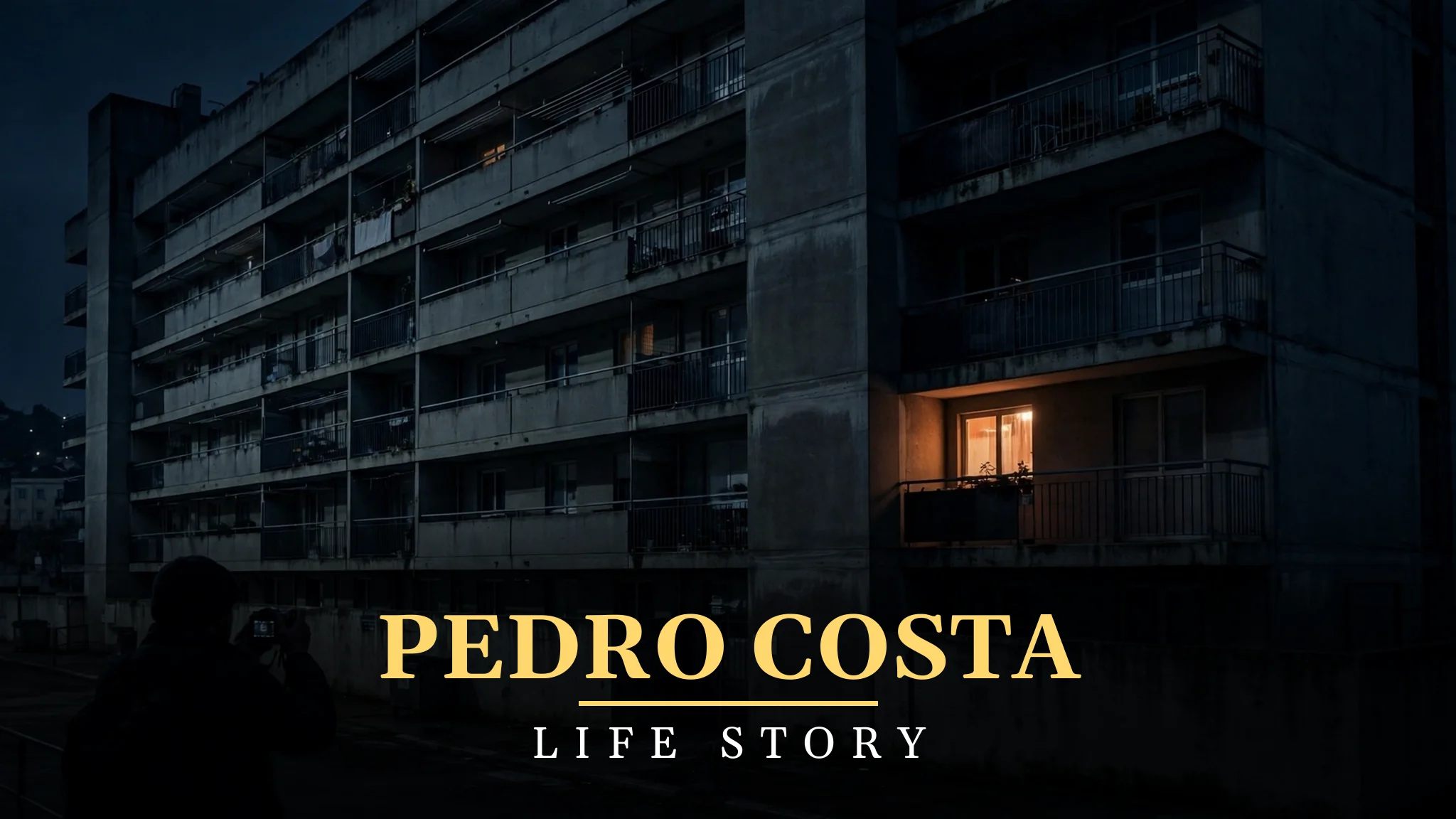
One more thought stays with me, and it is about the image of a man with a camera, photographing a dark building at night, with one warm window glowing. That image fits Costa, because he is a director who looks for the one warm window in a dark building, the one sign of life in a place that seems empty. He finds it, he films it, and he shows it to the world. That is what his cinema does, again and again. It finds the light in the dark, and it shows us that the light was there all along, if only we had looked closely enough.
In the end, I think Pedro Costa teaches us that paying attention is an act of love, and that cinema can be a way of paying attention. He looked at Fontainhas, he looked at Vanda, at Ventura, at Vitalina, and he saw lives that mattered. He filmed them slowly, carefully, and with respect, and he made films that will last. I would tell a new viewer to start with Vitalina Varela, then to watch In Vanda’s Room, and to be patient. Do not watch them in a hurry. Watch them slowly, and let the faces and the rooms come to you. That is how Costa’s films work, and that is how they teach us to see.
I think about his way of working, and about how it is a lesson for anyone who wants to make something with little money. Costa shows that you do not need a big budget to make a great film. You need time, you need patience, and you need respect for the people you are filming. That is a hopeful message, because it means that filmmaking is not only for the rich. It is for anyone who is willing to look closely and to work slowly. Young filmmakers who have no money but who have eyes and patience can learn from Costa, and many of them have.
I also think about trust, and about how hard it is to earn. The people of Fontainhas trusted Costa with their lives, with their rooms, and with their stories, and that trust was not given lightly. It was earned over years, by staying, by listening, and by showing respect. I think about that, and I feel admiration for him, because trust is the hardest thing to earn in any work, and the easiest thing to lose. Costa earned it, and he kept it, and his films are the proof. A film made with trust looks different from a film made without it, and you can see the difference in every shot he makes.
I think about the darkness in his films again, and about how it is a kind of honesty. The world is not always bright, and the lives he films are often dark, because poverty is dark, because old houses are dark, and because grief is dark. Costa does not pretend otherwise. He films the dark, and he finds a beauty in it, not by making it pretty, but by showing it truly. I think that is a lesson about art: you do not have to make the world look better than it is. You have to show it as it is, with care, and the beauty will come from the truth, not from decoration.
I think about Ventura, the old man who walks through Colossal Youth and Horse Money, and about how his face carries a whole history. Ventura is an immigrant, a worker, a man who has lost his home and who is trying to find his place. His face, filmed by Costa, tells that history without words. I think about that face, and I think about how many faces like it exist in the world, faces that carry histories no one has bothered to hear. Costa bothered to hear them, and he filmed them, and he gave them a place in cinema. That is a generous act, and it is one that matters.
I also think about the future of his cinema, and about whether young directors will follow his path. His path is hard: it asks for years of work, for little money, and for a patience that few people possess. But it also offers something rare: the chance to make films that are truly your own, that are honest, and that will last. I hope young directors take that path, because the world needs more films that look closely at lives that are usually ignored. Costa has shown that such films can win prizes, can be shown at festivals, and can change how people see the world. That is a powerful example.
One more thought stays with me, and it is about the one warm window in a dark building. That image, from his film’s cover, is a perfect picture of his cinema: a dark world, and one small light, and a director who finds it and films it. I think that is what Costa does, again and again. He finds the light in the dark, the life in a forgotten place, and the dignity in a person the world has ignored. He shows us that the light was there all along, if only we had looked. That is a lesson for all of us, not only for filmmakers: look closely, and you will find light where you did not expect it.
I think about the patience his films demand, and about how that patience is a gift to the audience. In a world that wants everything fast, Costa asks us to slow down, to look, and to listen, and that slowing down changes how we see. When we watch his films, we learn to pay attention, and that attention stays with us after the film ends. We look at the world a little more closely, and we see a little more of it. That is a powerful thing for a film to do, and it is why his work matters.
I also think about the future of his cinema, and about the filmmakers who will follow his path. His path is hard, but it is honest, and it shows that a film can be made with little money, with a small crew, and with a deep respect for the people in front of the camera. Young directors who have no budget but who have eyes and patience can learn from him, and many of them will. That is a legacy that will grow, film by film, as new directors take up his example and make their own quiet, honest films.
Frequently Asked Questions
When and where was Pedro Costa born?
Pedro Costa was born on 3 March 1959 in Lisbon, Portugal. He studied film in Lisbon and worked as an assistant director before making his first feature film, O Sangue, in 1989.
What is Pedro Costa best known for?
He is best known for his films about the Fontainhas neighbourhood in Lisbon and its Cape Verdean community, including Ossos, In Vanda’s Room, Colossal Youth, Horse Money, and Vitalina Varela. His slow, dark, and patient style has made him one of the most respected directors in world cinema.
What is In Vanda’s Room about?
In Vanda’s Room, released in 2000, is set almost entirely in a small room in Fontainhas, where a young woman named Vanda lives and talks about her life. It was filmed over months with a small digital camera and non-professional actors, and it is one of Costa’s most radical films.
Did Pedro Costa win a major festival prize?
Yes, his film Vitalina Varela won the Golden Leopard, the top prize, at the Locarno Film Festival in 2019. His films have also been shown at Cannes, Venice, and other major festivals around the world.
Who is Vitalina Varela in Pedro Costa’s work?
Vitalina Varela is a Cape Verdean woman who plays the central role in Costa’s 2019 film of the same name, telling a version of her own story of arriving in Lisbon after her husband’s death. Her powerful performance is at the heart of the film.
Is Pedro Costa still making films?
Yes, he continues to work, and his films are awaited by audiences who care about serious cinema. His career has been built on patience, small crews, and a deep commitment to the people and places he films.


