Peter Fonda: The Life Story Behind the Easy Rider Star
In this post
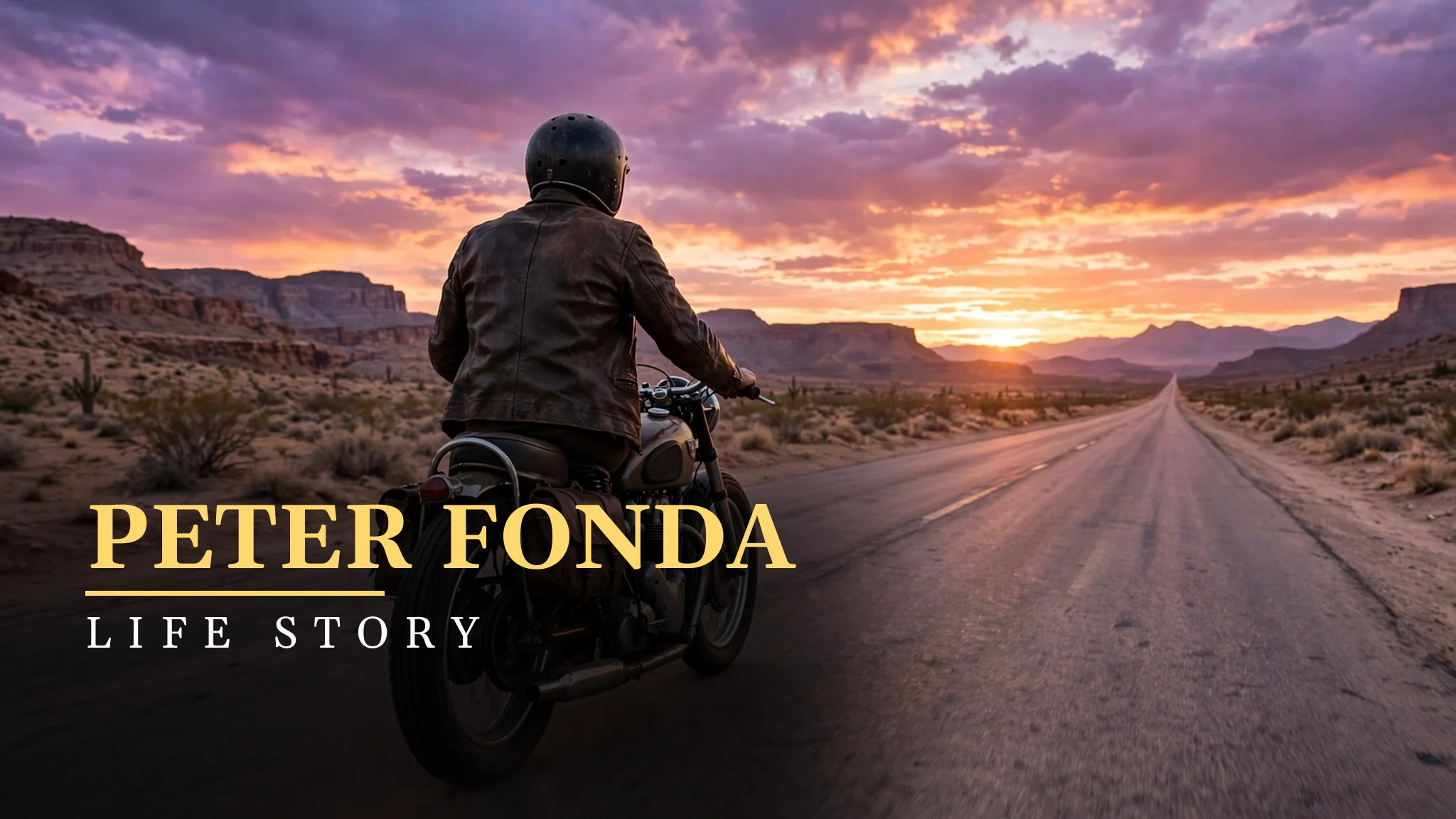
Peter Fonda was a rebel with a famous name. He was the son of Henry Fonda, one of the great actors in American film, and the brother of Jane Fonda, another great star. He grew up in the shadow of a famous family, and he spent his life trying to find his own road. He found it on a motorcycle, in a film called Easy Rider, which became a symbol of freedom for a whole generation. He played Wyatt, known as Captain America, and he rode across America with his friend Dennis Hopper, looking for a life that was free and true.
He was not only an actor. He wrote, he produced, and he directed, and he made films that were different from the Hollywood of his father’s time. He was part of the new Hollywood of the late 1960s, a time when young filmmakers were changing the rules. He later won praise for Ulee’s Gold, a quiet film about a beekeeper in Florida, which earned him an Academy Award nomination and a Golden Globe. His life was a journey from a famous family to his own voice, and it is a story about freedom, family, and finding your own way.
He died in 2019, at the age of seventy-nine, and he is remembered as a man who lived on his own terms, who loved motorcycles, who loved film, and who never stopped searching for something real.
A Famous Family and a Troubled Childhood
Peter Henry Fonda was born on 23 February 1940 in New York City. His father was Henry Fonda, one of the most respected actors in American film, known for films such as The Grapes of Wrath and 12 Angry Men. His mother was Frances Ford Seymour, and his older sister was Jane Fonda, who would also become a famous actress. The family was famous, but it was not a happy family in the usual sense. Henry Fonda was a distant father, and he was often away working. The children grew up in a world of fame, but also in a world of distance.
When Peter was ten years old, his mother died. It was a terrible loss, and it changed him deeply. He was a boy who had already felt distant from his father, and now he had lost his mother. He later spoke about how hard those years were, and how the loss shaped his life. He was sent to boarding schools, and he grew up with a sense of being alone, even in a famous family. That loneliness would stay with him, and it would shape the films he made.
As a teenager, he began to act, and he studied at the University of Nebraska and at acting schools in New York. He was a young man with a famous name, and people expected a great deal from him. He wanted to be an actor, but he also wanted to be himself, not only Henry Fonda’s son. That was a hard thing to do, because his father’s shadow was long. He worked in theatre, he worked in small films, and he waited for his chance. He was learning his craft, and he was learning who he was.
By the early 1960s, he was working in Hollywood, and he was making a name for himself. He appeared in films such as Tammy and the Doctor and The Young Lovers, and he was seen as a promising young actor. But he was not yet a star, and he was not yet free. The road to freedom was coming, and it would be on a motorcycle, in a film that would change his life and change American cinema.
The Wild Angels, The Trip, and the Counterculture
In the mid-1960s, Peter Fonda began to make films that were different from the Hollywood of his father’s time. In 1966, he starred in The Wild Angels, a film about a motorcycle gang. He played Heavenly Blues, the leader of the gang, and the film was a success with young audiences. It showed a world of motorcycles, freedom, and rebellion, and it spoke to a generation that was questioning the old rules. Peter was not playing a clean-cut hero. He was playing a rebel, and he played him with honesty.
In 1967, he starred in The Trip, a film about a man who takes LSD and has a strange and colourful experience. The film was written by Jack Nicholson, and it was a product of its time, when many young people were exploring new ideas about drugs, music, and freedom. The film was controversial, and it was also a success. It showed that Peter was willing to take risks, and that he was part of a new kind of Hollywood, one that was young, bold, and unafraid.
These films were part of the counterculture, the movement of young people in the 1960s who wanted a different kind of life. They wanted freedom, they wanted peace, and they wanted to question the war in Vietnam and the rules of their parents’ generation. Peter Fonda was a part of that movement, not only as an actor, but as a person. He rode motorcycles, he lived freely, and he spoke his mind. He was a rebel, and he was proud of it.
He also began to think about making his own films. He wanted to tell stories that Hollywood would not tell, and he wanted to do it his own way. He had the name, he had the talent, and he had the courage. The next step would be the film that defined his life: Easy Rider, a film about two men on motorcycles, riding across America in search of freedom.
Easy Rider and Captain America
In 1969, Peter Fonda co-wrote, produced, and starred in Easy Rider, with Dennis Hopper as his co-star and director. He played Wyatt, known as Captain America, a biker who wears a helmet with the American flag and rides a motorcycle across the country with his friend Billy. The two men are looking for freedom, and they travel through the American West, meeting people, facing danger, and searching for a life that is true. The film was made for very little money, and it became one of the biggest successes of the year.
Easy Rider became a symbol of its time. It spoke to young people who felt that America had lost its way, and who wanted a freer life. The film’s music, its landscapes, and its mood captured the spirit of the late 1960s, and it is still seen as one of the great films of American cinema. Peter’s performance as Wyatt was quiet and thoughtful, and it showed a man who was searching for something he could not quite find. The film was nominated for an Academy Award for Best Original Screenplay, and it made Peter a star in his own right, not only as Henry Fonda’s son.
The film’s ending is sad and shocking, and it is still talked about today. Without giving too much away, the two bikers meet a violent end, and the film suggests that freedom is hard to find in a world that fears it. The ending made audiences think, and it made the film more than a simple road movie. It was a film about America, about freedom, and about the cost of being different. Peter had made a film that mattered, and he had done it his own way.
Easy Rider also changed Hollywood. It showed that a small, independent film could make a great deal of money, and it opened the door for a new generation of filmmakers. Young directors, young writers, and young actors were given a chance, and American cinema changed. Peter Fonda was a central part of that change, and his name is still linked with it today. He had found his own road, and it was a road that many others followed.
The Hired Hand, the Quiet Years, and a New Direction
After Easy Rider, Peter Fonda directed The Hired Hand in 1971, a western about a man who returns to his wife after years away. He starred in the film, and he directed it with a quiet and thoughtful style. The film was not a great success at first, but it is now seen as a beautiful and honest western, and it showed that Peter could direct as well as act. He was not only a rebel. He was an artist who wanted to tell stories about real people.
In the 1970s and 1980s, he worked in many films, but the great success of Easy Rider was hard to repeat. He played in action films, in westerns, and in dramas, and he worked steadily. He was a known actor, but he was not a major star, and the film world had changed again. The new Hollywood of the 1970s gave way to the blockbuster films of the 1980s, and Peter’s kind of film became less common. He kept working, but the big roles became fewer.
His personal life also had its changes. He was married three times, first to Susan Brewer, then to Portia Rebecca Crockett, and then to Margaret DeVogelaere. His first marriage lasted from 1961 to 1974, and they had two children, Bridget and Justin, who both became actors. His family was a central part of his life, and he loved his children. He was a father, a husband, and an actor, and he tried to balance those roles as best he could.
He also became a grandfather, and he enjoyed his family life in later years. He lived in California, and he kept his love of motorcycles. He was a man who had lived a wild youth, and who had grown into a thoughtful and kind older man. The rebel had not disappeared, but he had grown wiser, and he had found a quieter kind of freedom.
Ulee’s Gold, a Late Triumph, and the Final Ride
In 1997, Peter Fonda gave one of the finest performances of his career in Ulee’s Gold. He played Ulee Jackson, a beekeeper in Florida who raises his granddaughters and tries to keep his family together. The film is quiet, slow, and full of heart, and Peter played Ulee with great warmth and honesty. He was nominated for the Academy Award for Best Actor, and he won the Golden Globe for Best Actor. It was a late triumph, and it showed that he was still a great actor, nearly thirty years after Easy Rider.
The film was a surprise to many people, because Peter had not been a major star for many years. But his performance was so strong that it could not be ignored. He played a man who is tough, loving, and tired, a man who works with bees and who works to keep his family safe. The role was close to his own life in some ways: a man who had lived a wild youth and who had grown into a responsible and caring older man. The film is still praised today, and it is one of his best works.
He continued to work in films and television after Ulee’s Gold, appearing in films such as Ghost Rider in 2007, where he played the villain Mephistopheles. He was in his sixties, and he was still working, still acting, and still enjoying his craft. He appeared in television shows, he gave interviews, and he shared stories about his life and his family. He was an old man now, but he was still a rebel at heart, and he still loved the road.
He died on 16 August 2019, at the age of 79, in Los Angeles. The cause was lung cancer, and he died with his family near. The news was met with sadness around the world. Tributes came from actors, directors, and fans who had loved Easy Rider and Ulee’s Gold. His sister Jane spoke of him with love, and his children spoke of him as a kind and generous father. He was buried in California, and his legacy as a rebel, an artist, and a free spirit was secure.
A Rebel Who Found His Own Road
Peter Fonda’s legacy is the road. Easy Rider is still watched today, and it is still a symbol of freedom for young people who want to live their own lives. The image of two men on motorcycles, riding through the American desert, is one of the most famous images in film history, and it belongs to Peter Fonda and Dennis Hopper. He showed that a film could be small, honest, and powerful, and that it could change the way people think.
His later work, especially Ulee’s Gold, showed that he was more than a rebel. He was a serious actor who could play a quiet and loving man with great depth. His career was long, and it had many chapters: the famous son, the rebel, the filmmaker, and the wise old beekeeper. Each chapter was different, and each one was true. He lived on his own terms, and he left behind films that will be watched for many years to come.
The Family Man and the Later Films
Peter Fonda’s later films showed a different side of him, a quieter and more thoughtful side. After the wild years of the 1960s, he grew into a man who loved his family and who wanted to tell stories about real people. He appeared in films such as The Limey in 1999, where he played a record producer, and he worked with directors who valued his experience. He was no longer the young rebel on a motorcycle. He was an older actor with a lifetime of stories, and he brought that depth to every role. His performances in his later years were calm, honest, and full of feeling, and they showed that he had grown as an artist.
His children, Bridget and Justin, both became actors, and he was proud of them. Bridget became a well-known actress in films, and Justin also worked in film. Peter loved his children, and he supported their work. He was a father who knew the hard parts of show business, and he wanted his children to find their own way, just as he had. He did not push them to be like him. He let them be themselves, and he was glad when they succeeded. That is a good kind of fatherhood, and it is one that he learned the hard way, from a father who had been distant with him.
He also became a grandfather, and he enjoyed his family life in his later years. He lived in California, and he spent time with his family, his friends, and his motorcycles. He was a man who had lived a wild youth, and who had grown into a thoughtful and kind older man. The rebel had not disappeared, but he had grown wiser, and he had found a quieter kind of freedom. He still loved the road, but he also loved home, and he had learned to balance the two.
He gave interviews in his later years, and he spoke openly about his life, his family, and his films. He talked about his father, about his sister Jane, and about the loss of his mother when he was a boy. He was honest about the hard parts, and he did not hide them. He said that his childhood had been lonely, and that he had spent his life trying to find his own way. That honesty helped people understand him, and it made his story feel real. He was not a perfect man, and he did not pretend to be. He was a man who had lived, learned, and grown, and he shared what he had learned.
His love of motorcycles never faded. He rode for most of his life, and he was known as a man who loved the open road. He rode with friends, he rode alone, and he rode because it made him feel free. A motorcycle is a symbol of freedom, of the open road, and of a life lived on your own terms, and Peter lived that way. He was a rebel, a son, a father, and a beekeeper in his films, and he was true to himself in each role. That is a good life, and a good story, and it is why his films are still watched today.
He also worked with his sister Jane on a film, and their relationship as siblings is a part of his story that deserves mention. Jane became a famous actress in her own right, and she and Peter shared the experience of growing up in a famous and distant family. They loved each other, and they supported each other through the years. When Peter died, Jane spoke of him with love, and she said that he had been a wonderful brother. Their bond was a comfort to both of them, and it is a reminder that even in a hard family, siblings can be a source of love and strength. Peter and Jane shared a childhood, a name, and a gift, and they shared a love that lasted until the end of his life.
His work as a producer is also worth remembering, because Easy Rider was not only an acting role for him. He produced the film, he co-wrote it, and he fought to make it his own way. Producing is hard work, and it takes courage to put your own money and your own name behind a film that Hollywood does not understand. Peter did it, and the film became a great success. That courage is a part of his legacy, and it is a lesson for anyone who wants to make something new: do not wait for permission. Make it yourself, and trust that the audience will find it. Peter trusted that, and he was right.
He also appeared in the film The Limey in 1999, playing a record producer, and he worked with directors who valued his experience. He was no longer the young rebel on a motorcycle, but he was an older actor with a lifetime of stories, and he brought that depth to every role. His performances in his later years were calm, honest, and full of feeling, and they showed that he had grown as an artist. He was a man who had lived a full life, and his work showed it. He did not need to shout or to show off. He needed only to be honest, and the audience felt it.
His love of the American West is also a part of his story. He loved the desert, the mountains, and the open road, and those landscapes are central to his films. Easy Rider is a film about the West, about the desert highways and the small towns, and it shows a love of the land that is deep and real. The Hired Hand is also a western, and it shows the same love. Peter was a man who loved the land, and who found freedom in it. That love is part of his legacy, and it is why his films still feel fresh today, when audiences watch them and see the beauty of the American West through his eyes.
My Take:
When I think about Peter Fonda, I think about a man who spent his life looking for his own road. He was born into a famous family, and that is both a gift and a burden. People knew his name before they knew him, and they expected him to be like his father. He was not like his father, and he did not want to be. He wanted to be himself, and that is a hard thing to do when your father is Henry Fonda. I admire him for trying, and for finding his own way, on a motorcycle, in a film that changed American cinema.
I admire Easy Rider, because it is a film about freedom, and freedom is a real and important thing. The film is not perfect, and I do not want to pretend that it is. It is slow in places, it is sad, and its ending is shocking. But it is honest, and it speaks to a feeling that many young people have: the feeling that the world is not quite right, and that there must be a freer way to live. Peter and Dennis Hopper captured that feeling, and they put it on screen in a way that no one had done before. That is a great achievement, and it is why the film is still watched today.
I feel sad when I think about his childhood, because he lost his mother when he was ten years old, and his father was distant. That is a hard start for any child, and it shaped him. He grew up feeling alone, even in a famous family, and that loneliness stayed with him. I think his films are about that loneliness, in a way. Wyatt in Easy Rider is a man who is searching for something, and Ulee Jackson is a man who is trying to keep his family together. Both are men who know what loss feels like, and both are trying to find a home. Peter knew that feeling, and he brought it to his work. That is why his performances feel true.
His relationship with his father is a painful part of his story. Henry Fonda was a great actor, but he was not a warm father, and Peter felt that distance. I do not want to judge Henry harshly, because I do not know the full story, and families are private places. But I think it is worth saying that fame does not make a family happy, and that a famous father can be a hard father to live with. Peter spent his life trying to step out of his father’s shadow, and I think he did it, in his own way, with Easy Rider and with Ulee’s Gold. That is a brave thing to do, and I respect him for it.
His sister Jane is another part of his story. She also became a famous actress, and she also struggled with their father’s distance. The two of them shared that experience, and they loved each other. When Peter died, Jane spoke of him with love, and that moved me. Siblings who share a hard childhood often have a special bond, and Peter and Jane had that bond. I am glad they had each other, and I am glad they loved each other to the end.
Ulee’s Gold is the part of his career that moves me most. It is a quiet film, about a beekeeper who raises his granddaughters, and Peter played him with great warmth. He was fifty-seven years old, and he gave a performance that earned him an Oscar nomination and a Golden Globe. That is a late triumph, and it shows that talent does not fade with age. It grows, if the actor is willing to learn. Peter had lived a wild youth, and he had grown into a thoughtful man, and Ulee Jackson was the perfect role for that man. I think it is his best performance, and I am glad the world recognised it.
I also think about his love of motorcycles. It was not only a role in a film. He really loved to ride, and he rode for most of his life. A motorcycle is a symbol of freedom, of the open road, and of a life lived on your own terms. Peter lived that way, and he rode that way. I think that is a good image for his life: a man on a road, looking for freedom, and finding it in the ride itself, not only in the destination. That is a lesson for all of us. The journey matters as much as the arrival, and sometimes it matters more.
If I have a criticism, it is that some of his films in the 1970s and 1980s were weak. He made many action films and westerns that are forgettable, and he did not always get the roles he deserved. That is not a serious fault. A man who works for fifty years will make some weak films, and Peter’s weak films are still fun to watch. His best work, Easy Rider, The Hired Hand, and Ulee’s Gold, is strong enough to carry his reputation, and it is those films that people will remember.
What I take from his story is the value of finding your own road. Peter was born into a famous family, and he could have lived in his father’s shadow for his whole life. Instead, he found his own road, on a motorcycle, in a film he wrote and produced himself. He did not wait for Hollywood to give him a chance. He made his own chance, and he made a film that changed cinema. I think that is a lesson for anyone who feels trapped by their family, their name, or their past. You can find your own road, and you can ride it, even if it is hard. Peter did it, and his films show us how.
I also take from his story the importance of growing wiser with age. The rebel of Easy Rider became the beekeeper of Ulee’s Gold, a man who cares for his family and works with his hands. That is not a loss of freedom. It is a different kind of freedom, the freedom of a man who knows who he is and what matters to him. Peter grew into that man, and his later work shows it. I am glad he lived long enough to show us that side of himself, and I am glad his films still exist. He was a rebel, a son, a father, and a beekeeper, and he was true to himself in each role. That is a good life, and a good story.
I also think about his children, Bridget and Justin, because they show a different side of him. He was a father who knew the hard parts of show business, and he wanted his children to find their own way, just as he had. He did not push them to be like him. He let them be themselves, and he was glad when they succeeded. That is a good kind of fatherhood, and it is one that he learned the hard way, from a father who had been distant with him. I think that is a hopeful story: a man who did not have a warm father can still become a warm father himself, if he learns from the past and chooses to do better. Peter did that, and his children loved him for it.
His later films are another part of his story that I admire, because they show a man who grew wiser with age. The rebel of Easy Rider became the beekeeper of Ulee’s Gold, a man who cares for his family and works with his hands. That is not a loss of freedom. It is a different kind of freedom, the freedom of a man who knows who he is and what matters to him. Peter grew into that man, and his later work shows it. I am glad he lived long enough to show us that side of himself, and I am glad his films still exist. A rebel who grows wise is a rare and beautiful thing.
I think about his honesty in interviews, too, because it takes courage to speak openly about a hard childhood. He talked about losing his mother when he was ten, about his father’s distance, and about feeling alone in a famous family. He did not hide those things, and he did not use them to win sympathy. He shared them because they were true, and because they helped people understand his films. That honesty is a gift, and it is one that many famous people do not give. Peter gave it, and his story feels more real because of it.
There is also a lesson in his love of motorcycles. He rode for most of his life, and he loved the open road. A motorcycle is a symbol of freedom, and Peter lived that way. But he also learned that freedom is not only about riding away. It is also about coming home, about caring for your family, and about doing work that matters. He learned that lesson slowly, over many years, and his later films show it. The road is still there, and it is still beautiful, but home matters too, and Peter found his way back to it.
Finally, I think about what his life means for anyone who feels trapped by their family or their name. Peter was born into a famous family, and he could have lived in his father’s shadow for his whole life. Instead, he found his own road, on a motorcycle, in a film he wrote and produced himself. He did not wait for Hollywood to give him a chance. He made his own chance, and he made a film that changed cinema. I think that is a lesson for anyone who feels trapped: you can find your own road, and you can ride it, even if it is hard. Peter did it, and his films show us how. He was a rebel, a son, a father, and a beekeeper, and he was true to himself in each role. That is a good life, and a good story.
I also think about his sister Jane, because their bond is a beautiful part of his story. They shared a hard childhood, a famous name, and a gift for acting, and they loved each other through it all. When Peter died, Jane spoke of him with love, and that moved me. Siblings who share a hard childhood often have a special bond, and Peter and Jane had that bond. I am glad they had each other, and I am glad they loved each other to the end. A brother and a sister who understand each other in a way that no one else can is a rare and precious thing, and Peter had that with Jane.
And I think about his courage as a producer, because Easy Rider was not only an acting role for him. He produced the film, he co-wrote it, and he fought to make it his own way. That takes courage, because Hollywood did not understand the film, and many people thought it would fail. Peter trusted his own vision, and he was right. That is a lesson for anyone who wants to make something new: do not wait for permission. Make it yourself, and trust that the audience will find it. Peter did that, and his film changed cinema, and his name will always be linked with that change.
And I think about his love of the American West, because it is central to his films. He loved the desert, the mountains, and the open road, and Easy Rider shows that love in every frame. The film is about the West, about desert highways and small towns, and it shows a love of the land that is deep and real. Peter was a man who loved the land, and who found freedom in it. That love is part of his legacy, and it is why his films still feel fresh today, and I am glad we still remember him.
Frequently Asked Questions
What is Easy Rider about?
Easy Rider, released in 1969, is a film co-written, produced, and starring Peter Fonda as Wyatt, known as Captain America, who rides a motorcycle across America with his friend Billy, played by Dennis Hopper. The two men search for freedom, meet different people, and face danger on the road. The film became a symbol of the late 1960s and was nominated for an Academy Award for Best Original Screenplay.
Who were Peter Fonda’s famous family members?
Peter Fonda was the son of the great actor Henry Fonda and the younger brother of the actress Jane Fonda. He was born into one of the most famous acting families in America. His children, Bridget and Justin Fonda, also became actors. He spent much of his life trying to find his own voice apart from his famous family.
What is Ulee’s Gold about?
Ulee’s Gold, released in 1997, stars Peter Fonda as Ulee Jackson, a beekeeper in Florida who raises his granddaughters and tries to keep his family together. The film is quiet and full of heart, and Peter’s performance earned him an Academy Award nomination for Best Actor and a Golden Globe win. It is seen as one of his finest performances.
Did Peter Fonda direct films?
Yes, Peter Fonda directed The Hired Hand in 1971, a western about a man who returns to his wife after years away. He starred in the film and directed it with a quiet and thoughtful style. The film was not a great success at first, but it is now seen as a beautiful and honest western.
When did Peter Fonda die?
Peter Fonda died on 16 August 2019 in Los Angeles at the age of 79. The cause was lung cancer, and he died with his family near. He was remembered as a rebel, an artist, and a free spirit, and his films Easy Rider and Ulee’s Gold are still watched and loved today.
What motorcycle did Peter Fonda ride in Easy Rider?
In Easy Rider, Peter Fonda played Wyatt, known as Captain America, and rode a customised motorcycle with an American flag design. The image of him riding through the American desert became one of the most famous images in film history and a symbol of freedom for a whole generation.


