Pierre Niney: The Life Story Behind France's Versatile Leading Man
In this post
- A Young Man with a Dream of the Stage
- The Comédie-Française and the Youngest Member
- Yves Saint Laurent: The Role That Made Him a Star
- Frantz, La Boîte noire, and a Growing Range
- The Count of Monte-Cristo: A Triumph
- A Private Life and a Serious Artist
- A Writer and a Man of Many Talents
- The Young Star Who Takes His Time
- OSS 117 and the Gift of Comedy
- La Boîte noire: Obsession and the Search for Truth
- My Take:
Pierre Niney is the youngest star of his generation in France, and one of the most talented. He joined the Comédie-Française, the most famous theatre in France, when he was only twenty-one, the youngest actor ever to do so. He played Yves Saint Laurent, the great fashion designer, and he won the César for Best Actor. He played a French soldier in Frantz, a man in a black box in La Boîte noire, and Edmond Dantès in The Count of Monte-Cristo, one of the biggest French films of recent years. He is a man who can play anyone, and who does it with a quiet, serious grace.
He is not a loud star. He does not seek gossip, and he does not live his life in public. He works, he studies his roles, and he lets his performances speak for him. He is a theatre actor who became a film star, a young man who became a leading man, and a serious artist who is still growing. His story is about talent, about hard work, and about a young man who took the oldest stage in France and made it his own.
He is still young, and his best years may still be ahead of him. But he has already given France some of its most memorable performances, and he has already shown that he is one of the great actors of his generation.
A Young Man with a Dream of the Stage
Pierre Niney was born on 13 March 1989 in Boulogne-Billancourt, just outside Paris. He grew up in a family that loved film and theatre, and his father was a film professor. He was a boy who loved to watch films, to act, and to dream about the stage. He was not from a family of actors, but he was from a family that understood the arts, and that gave him a love of performance from an early age. He studied at the Lycée Claude Monet in Paris, and he began to act in school plays and in small productions.
As a teenager, he decided that he wanted to be an actor, and he worked hard to make it happen. He auditioned for the Conservatoire national supérieur d’art dramatique in Paris, one of the most famous drama schools in France, and he was accepted. The Conservatoire is a hard school, with many talented students competing for a small number of places, and Niney was one of the best. He studied acting, voice, and movement, and he learned the craft of the theatre from some of the best teachers in France.
He was a serious student, and he was determined to succeed. He did not want to be a star by accident. He wanted to be an actor by training, by hard work, and by talent. He took his studies seriously, and he graduated with a strong reputation. He was ready for the theatre, and the theatre was ready for him. He was still very young, but he had already shown that he had the discipline and the talent to go far.
In 2010, when he was only twenty-one, he joined the Comédie-Française, the national theatre of France, founded in the seventeenth century. He was the youngest actor ever to become a member of the company, and it was a great honour. The Comédie-Française is the home of French classical theatre, and to join it is to be recognised as one of the best young actors in the country. Niney had done it, and he had done it at an age when most actors are still students.
The Comédie-Française and the Youngest Member
The Comédie-Française is a theatre with a long history, and it is a place where actors learn to play the great roles of French literature: Molière, Racine, Corneille, and many others. Niney played in many productions there, learning from older actors, and building his craft on the stage. He played young lovers, soldiers, and kings, and he learned how to hold a large theatre, how to speak classical French, and how to make an old play feel alive for a modern audience.
His time at the Comédie-Française taught him discipline, patience, and respect for the text. He learned that acting is not only about emotion. It is also about technique, about voice, about movement, and about understanding the words you speak. He was a young man in an old institution, and he took it seriously. He did not try to be modern for the sake of being modern. He tried to be true to the plays, and to the audience, and that honesty made him a strong stage actor.
He also began to work in films while he was at the Comédie-Française, taking on small roles and learning the difference between stage acting and film acting. On stage, you must be big, you must reach the back row. On film, you must be small, you must let the camera come to you. Niney learned to do both, and that double skill made him a complete actor. He was building a career on stage and on screen, and he was doing it with the same seriousness he had shown as a student.
He left the Comédie-Française in 2015, after five years, to focus on his film career. It was a brave decision, because the Comédie-Française is a safe and respected home for an actor. But Niney wanted to grow, to take on new challenges, and to make films. He had learned what the theatre could teach him, and he was ready for the next stage of his life. He left with the respect of his colleagues, and with a reputation as one of the finest young actors in France.
Yves Saint Laurent: The Role That Made Him a Star
In 2014, Niney starred in Yves Saint Laurent, a film about the life of the great French fashion designer. He played Saint Laurent from his early years at Dior to his rise as a designer in his own right, and he gave a performance that was both delicate and powerful. He showed the designer’s genius, his shyness, his love, and his struggles, and he made the audience feel that they were watching a real man, not a legend. The film was a success, and Niney won the César Award for Best Actor, the highest honour for an actor in France. He was twenty-five years old, and he was a star.
The role was a difficult one, because Saint Laurent was a real person, known to millions, and Niney had to play him without imitating him. He studied the designer’s life, his voice, his manner, and his work, and he found a way to make the character his own. He did not play a caricature. He played a man who was brilliant and fragile at the same time, a man who created beauty and who suffered for it. The performance was praised by critics, and it showed that Niney could carry a major film on his own.
Winning the César at twenty-five was a great moment, but it was also a challenge. He was now a star, and the world expected great things from him. He chose his next roles carefully, looking for films that would challenge him, and for directors who would help him grow. He did not want to play the same role again and again. He wanted to be different in each film, and to show that he could play many kinds of men.
Yves Saint Laurent remains one of his most important films, because it proved that he was not only a theatre actor. He was a film star, and he was one of the best of his generation. The film is still watched today, and Niney’s performance is still praised as one of the finest of recent French cinema.
Frantz, La Boîte noire, and a Growing Range
After Yves Saint Laurent, Niney took on a series of roles that showed his range. In 2016, he starred in Frantz, directed by François Ozon, a film about a young French soldier who visits the family of a German soldier he killed during the First World War. Niney played Adrien, a man carrying guilt and grief, and he gave a quiet, moving performance in black and white. The film was beautiful, sad, and full of questions about war, forgiveness, and love, and Niney’s performance was at its heart.
He also starred in La Boîte noire in 2021, a thriller about a man who investigates a plane crash by listening to the black box recordings. Niney played Mathieu, a sound expert who becomes obsessed with the truth, and he carried the film with intensity and focus. The film was a success, and it showed that he could play a modern, technical role as well as a historical one. He was an actor who could do anything, and who did it well.
He appeared in comedies as well, showing that he was not only a serious actor. He played in OSS 117: Alerte rouge en Afrique noire in 2021, a spy comedy, and he showed that he could be funny, light, and charming. He was not afraid to laugh at himself, and he was not afraid to take on roles that were different from his serious work. That willingness to try new things is part of what makes him a great actor.
Through these years, Niney built a reputation as a serious, hardworking actor, a man who chooses his roles carefully, and who gives his best to each one. He was not a star who made films for money. He was an artist who made films because he believed in them, and that belief showed in his work. He was growing, film by film, and he was becoming one of the most respected actors in France.
The Count of Monte-Cristo: A Triumph
In 2024, Niney starred in Le Comte de Monte-Cristo, a new film version of the famous novel by Alexandre Dumas. He played Edmond Dantès, a young sailor who is betrayed, sent to prison, escapes, and returns as the Count of Monte-Cristo to take revenge on those who wronged him. It was a huge production, with a big budget, a long running time, and a cast of great French actors. Niney carried the film, playing Dantès from youth to age, from innocence to anger, and from revenge to a kind of peace. The film was a massive success in France, one of the biggest hits of the year, and it was praised by audiences and by critics.
The role was a perfect one for Niney, because it asked for everything he had learned: the classical training from the Comédie-Française, the film craft from Yves Saint Laurent and Frantz, and the intensity from La Boîte noire. He played Dantès as a man who is broken and rebuilt, and he made the audience feel every step of that journey. The film showed that he was now a leading man of the first rank, an actor who could carry a great epic, and who could make a classic story feel new.
The success of The Count of Monte-Cristo confirmed Niney’s place as one of the biggest stars in French cinema. He was no longer only a promising young actor. He was a star who could open a film, who could bring millions of people into cinemas, and who could give a performance that would be remembered for years. He had come from the Comédie-Française to the biggest film in France, and he had done it by working hard, by choosing well, and by giving his best.
He continues to work, taking on new roles, and he is still young. His story is not finished, and his best films may still be ahead of him. But he has already given France some of its finest performances, and he has already shown that he is an actor of rare talent and rare seriousness.
A Private Life and a Serious Artist
Niney has kept his personal life mostly private. He is in a relationship with the actress Natasha Andrews, and they have two daughters together. He has spoken about his family with love, and about the importance of balancing work and home. He is not a star who lives for gossip. He is a working actor, a father, and a partner, and he has kept those parts of his life in balance. That steadiness is part of what has allowed him to have such a strong career at a young age.
He is known as a serious artist, a man who prepares carefully for his roles, who studies, who rehearses, and who gives his best on set. Directors who have worked with him say that he is professional, focused, and generous with his colleagues. He is not a star who demands attention. He is an actor who does the work, and who lets the work speak for itself. That humility is rare, and it is part of why he is respected by his peers.
He has also worked as a writer, co-writing a comic book and other projects, showing that his creativity goes beyond acting. He is a man with many interests, and he is not afraid to try new things. He is a young artist who is still growing, still learning, and still surprising his audiences. French cinema is lucky to have him, and his story is one that will be told for many years to come.
A Writer and a Man of Many Talents
Niney is not only an actor. He is also a writer, and he has co-written a comic book and worked on other creative projects. He loves stories, in all their forms, and he is not afraid to try new ways of telling them. He has written, he has acted, and he has directed his energy into many different kinds of work. That creativity, beyond acting, shows a young man who is curious, who loves art, and who wants to make things, not only to perform them. He is a complete artist, and his writing is a part of that.
He is also known for his love of fashion, of design, and of the visual world. His role as Yves Saint Laurent gave him a deep understanding of fashion, and he has carried that understanding with him. He is a man who pays attention to how things look, to the clothes, the sets, and the images in a film. That attention to detail makes his performances richer, because he understands that acting is not only about words. It is also about how you look, how you move, and how you fill a frame. He is an actor who sees the whole picture, and that makes him a better performer.
His many talents are a sign of a young artist who is still growing. He is not content to do one thing. He wants to act, to write, and to create, and he does it all with the same seriousness he brought to the Comédie-Française. He is a man who is still learning, still trying, and still surprising his audiences, and that is a happy thing for French cinema, and for anyone who loves good acting.
The Young Star Who Takes His Time
Niney is known for taking his time with his roles. He does not rush from film to film, and he does not take on every offer. He chooses carefully, he prepares thoroughly, and he gives his best to each role. He studies the character, he reads about the person, and he rehearses until he feels ready. That patience is rare in a young star, and it is part of why his performances are so strong. He does not want to be famous for being famous. He wants to be good, and he is willing to wait for the right role.
He has also spoken about the pressure of being a young star, about the expectations that come with a César, and about the need to stay humble. He knows that fame can be a trap, and that it can make a young actor arrogant or afraid. He has chosen a different path: to work hard, to learn, and to let his films speak for him. That humility is a sign of maturity, and it is a sign of a man who understands that a career is a long journey, not a single moment of success.
He continues to work, taking on new roles, and he is still young. His best films may still be ahead of him, and his story is still being written. But he has already shown that he is an actor of rare talent, rare seriousness, and rare patience. He is a young star who takes his time, and that time has made him great.
OSS 117 and the Gift of Comedy
In 2021, Niney starred in OSS 117: Alerte rouge en Afrique noire, a spy comedy in which he played a young agent working with the bumbling spy OSS 117, played by Jean Dujardin. The film was funny, colourful, and full of the charm of the series, and Niney played his role with a lightness that surprised audiences who knew him from serious dramas. He showed that he could be funny, that he could play a comic role, and that he was not afraid to laugh at himself. It was a different kind of film from Frantz or La Boîte noire, and it showed his range as an actor.
The film was a success, and it showed that Niney was not only a serious actor. He was a complete actor, capable of comedy, of drama, and of everything in between. He worked with Jean Dujardin, one of the great comic actors in France, and he held his own, bringing a fresh, young energy to the film. He was a student of comedy as well as of drama, and he learned from the best. That willingness to try comedy, after winning a César for a serious role, is a sign of confidence, and of a man who wants to grow in every direction.
OSS 117 also showed his loyalty to French popular cinema. He did not only make serious art films. He made a popular comedy, for a wide audience, and he did it with joy. He believes that comedy is important, that it should be for everyone, and that a good laugh can bring people together. That belief is part of his story, and it is part of why he is so loved in France. He is a serious actor who is not afraid to be funny, and that is a rare and wonderful combination.
La Boîte noire: Obsession and the Search for Truth
In 2021, Niney starred in La Boîte noire, a thriller about a man who investigates a plane crash by listening to the black box recordings. He played Mathieu, a sound expert who becomes obsessed with the truth, who listens again and again to the recordings, and who will not give up until he knows what really happened. The film was tense, intelligent, and full of suspense, and Niney carried it with intensity and focus. He was on screen for most of the film, and he held the audience’s attention with a quiet, determined performance. It was a role that asked for stamina, for concentration, and for a deep understanding of obsession, and Niney gave it all.
The film was a success, and it showed that Niney could play a modern, technical role as well as a historical one. He was an actor who could do anything, and who did it well. He studied the work of sound experts, he learned how they listen, and he brought that knowledge to his performance. He was a young actor who took his craft seriously, and who prepared carefully for each role. La Boîte noire remains one of his most interesting films, because it is about a man who searches for the truth, and who will not stop until he finds it, and that search is one that Niney plays with honesty and with heart.
My Take:
When I think about Pierre Niney, I think about youth and seriousness together. He was twenty-one when he joined the Comédie-Française, the youngest ever, and that is a remarkable thing. Most young people at twenty-one are still finding their way. Niney had already found his, and he had already been recognised as one of the best. I admire that, because it shows a young man who knew what he wanted, and who worked hard to get it. He did not wait for life to happen to him. He went to the Conservatoire, he studied, he auditioned, and he earned his place. That is a lesson for any young person: if you know what you want, work for it, and do not wait for someone to give it to you.
I admire his performance in Yves Saint Laurent, because it is a performance about a real person, and real people are hard to play. Saint Laurent was a genius, but he was also a shy, fragile man, and Niney played both sides without making him into a caricature. He showed the beauty of the clothes, and the pain of the man who made them. I think about the pressure of playing a legend, and about the courage it takes to do it well. Niney was twenty-five, and he was playing one of the most famous Frenchmen of the twentieth century. He did not shrink from it. He gave a performance that won him the César, and that is still remembered today. That is a great achievement for a young actor.
What moves me most is The Count of Monte-Cristo, because it is a story about betrayal, prison, and revenge, and about a man who has to decide whether revenge will save him or destroy him. Niney plays Edmond Dantès from youth to age, from innocence to anger, and he makes the audience feel every step. I think about the weight of that role, and about the stamina it takes to carry a film that long, with that much emotion. Niney does it, and he does it with grace. The film is a triumph, and it shows that he is now a leading man of the first rank. I think that is a beautiful thing to watch: a young actor growing into a great one, film by film, role by role.
I think about his time at the Comédie-Française, and about what it means to learn classical theatre. He learned to speak Molière, to play kings and lovers, and to hold a large theatre with his voice. That training is in every film he makes, even when he is playing a modern man in a thriller. He has a discipline, a clarity, and a respect for the text that comes from the theatre, and it makes his film acting stronger. I think about the actors who have no training, and who rely only on instinct. Instinct is good, but training makes it better. Niney has both, and that is why he is so strong.
There is something I respect about the way he keeps his private life private. He is a star, he has a partner, he has two daughters, and he does not put his family on display. He talks about his work, not about his gossip. That is a healthy way to live, and it is rare in a world where famous people share everything. Niney has chosen to protect his family, and to let his films speak for him. I respect that choice, because it shows that he knows what matters: the work, the family, and the life away from the cameras.
I also think about his youth, and about the pressure of being called a great actor at twenty-five. That is a heavy thing to carry, and it could make a young man arrogant, or afraid. Niney has carried it with humility, and he has kept working, kept learning, and kept choosing roles that challenge him. He did not rest on his César. He went on to Frantz, to La Boîte noire, and to The Count of Monte-Cristo, each time trying something new. That is a good way to handle success: do not believe your own praise, keep working, and keep growing. Niney has done that, and it is why his career is still rising.
For a young reader, I think the lesson of Niney’s life is to study, to work, and to be patient. He did not become a star by accident. He went to school, he joined the theatre, he learned his craft, and he built his career step by step. He was patient, and he was serious, and he let his talent grow. That is a lesson for anyone who wants to do something well: do not rush, do not look for shortcuts, and do not try to be famous before you are ready. Study, work, and let the work speak for itself. Niney did that, and it has made him one of the great actors of his generation.
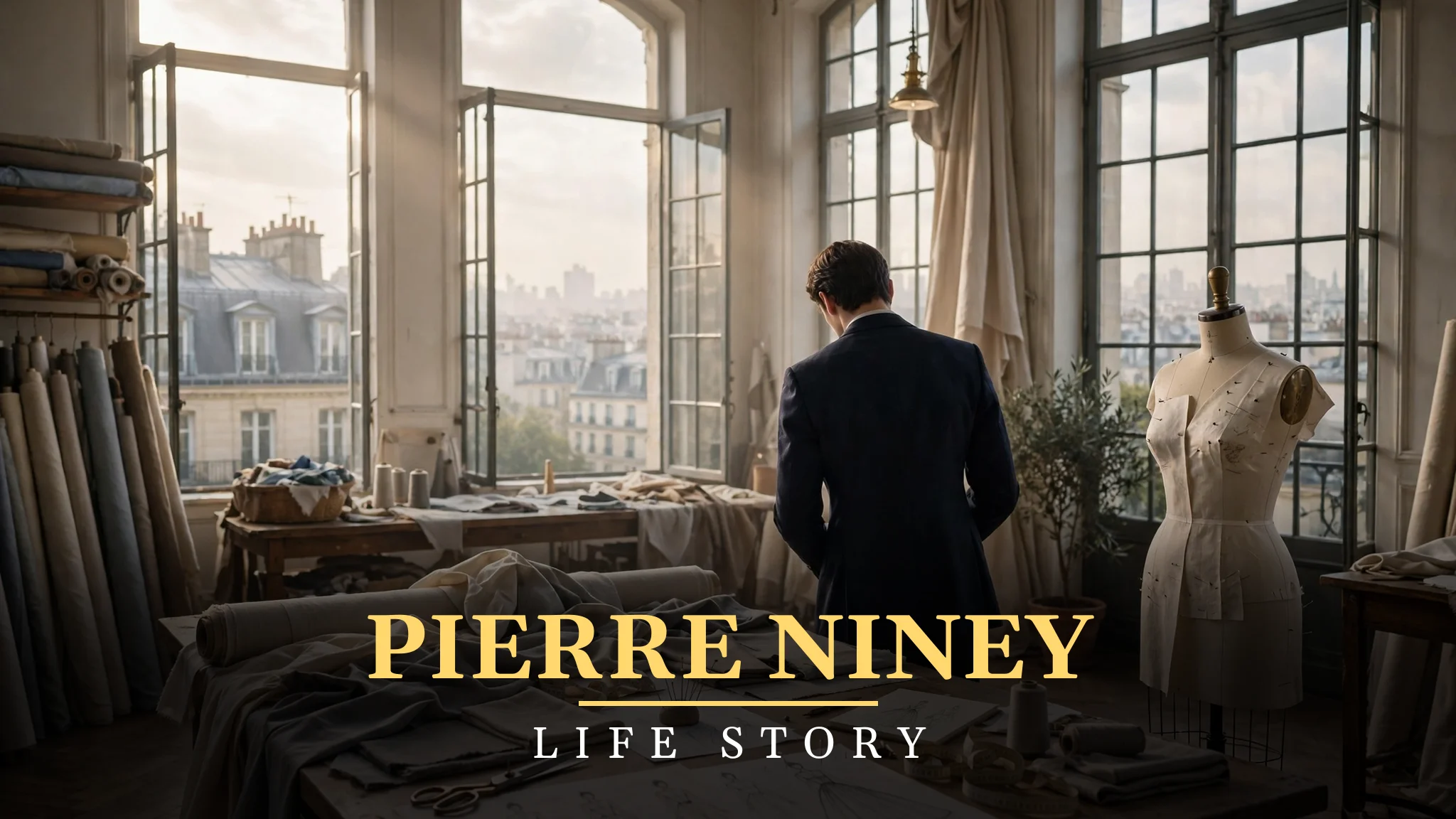
I keep thinking about the fashion atelier, the fabric, the mannequin, and the sketches on the table. It is a picture of creation, of a man making something beautiful from cloth and thread. That is Niney for me: an actor who creates, who studies, and who makes something beautiful from a role, a text, and a character. He is not a star who only shows his face. He is an artist who makes something, and who gives it to us. In the end, I think that is his gift: he creates, with care and with seriousness, and he invites us to watch. That is a gift worth remembering.
I also think about his youth, and about the pressure of being called a great actor at twenty-five. That is a heavy thing to carry, and it could make a young man arrogant, or afraid. Niney has carried it with humility, and he has kept working, kept learning, and kept choosing roles that challenge him. He did not rest on his César. He went on to Frantz, to La Boîte noire, and to The Count of Monte-Cristo, each time trying something new. That is a good way to handle success: do not believe your own praise, keep working, and keep growing. Niney has done that, and it is why his career is still rising, and why audiences still trust him.
I think about Frantz, and about the black-and-white film, the guilt, and the forgiveness. It is a film about war, about a French soldier who visits the family of a German soldier he killed, and about the pain of carrying that guilt. Niney plays Adrien with a quiet, moving sadness, and he makes the audience feel the weight of war. I think about the wars in the world today, and about the soldiers who carry guilt, and I see them in Adrien. Niney does not play a hero. He plays a man who is sorry, who is trying to make amends, and who does not know if he can. That honesty is rare, and it is a sign of a great actor. He shows that war does not end when the fighting stops. It lives on in the people who fought, and in the families who lost someone.
I also think about La Boîte noire, and about the man who listens to a black box, trying to find the truth about a plane crash. It is a film about obsession, about a man who cannot let go, and about the need to know what really happened. Niney plays Mathieu with intensity and focus, and he carries the film on his own. I think about the people who search for the truth, who will not give up, even when it is painful. Niney shows that search with honesty, and he makes the audience feel the urgency of it. He is an actor who can carry a film alone, and that is a rare talent.
There is something I respect about the way he keeps his private life private. He is a star, he has a partner, he has two daughters, and he does not put his family on display. He talks about his work, not about his gossip. That is a healthy way to live, and it is rare in a world where famous people share everything. Niney has chosen to protect his family, and to let his films speak for him. I respect that choice, because it shows that he knows what matters: the work, the family, and the life away from the cameras. He is a young man with old wisdom, and that wisdom shows in his choices.
Finally, I think about the fashion atelier, the fabric, the mannequin, and the sketches on the table. He is not a star who only shows his face. He is an artist who makes something, and who gives it to us. He creates, with care and with seriousness, and he invites us to watch, and that is a gift worth remembering for a long time.
I also think about OSS 117, and about the comedy that showed a different side of Niney. He had won a César for a serious role, and he could have stayed in serious films for the rest of his career. He did not. He took on a spy comedy, he played a young agent, and he made audiences laugh. That is a brave choice, because it is easy to stay in the box that success puts you in. Niney did not stay in the box. He tried comedy, and he did it well, and he showed that he is a complete actor, not only a serious one. I think about the boxes we put ourselves in, and the boxes others put us in, and I see that Niney refuses to stay in any of them. He is free, and that freedom makes his work better.
I think about his preparation for roles, and about the care he takes. He studies, he rehearses, and he gives his best to each character, whether it is a fashion designer, a soldier, or a spy. That preparation is invisible to the audience, but it is there, in every scene, in every look, and in every word. I think about the work I do, and about the preparation that no one sees, and I see the same truth: good work takes time, and it takes care. Niney takes that time, and he takes that care, and that is why his performances are so strong. He does not rush, and he does not cut corners, and that is a lesson for anyone who wants to do something well.
Finally, I think about the fashion atelier, the fabric, the mannequin, and the sketches on the table. He is not a star who only shows his face. He is an artist who makes something, and who gives it to us, with care and with seriousness, and that is a gift worth remembering.
I also think about La Boîte noire, and about the man who listens to a black box, trying to find the truth about a plane crash. It is a film about obsession, about a man who cannot let go, and about the need to know what really happened. Niney plays Mathieu with intensity and focus, and he carries the film on his own. I think about the people who search for the truth, who will not give up, even when it is painful, and I see them in Mathieu. He shows that the search for truth is not easy, and that it takes courage to keep listening, even when the truth is hard to hear. That is a powerful performance, and it is one that stays with me.
I also think about his patience, and about the way he chooses his roles. He does not rush, he does not take every offer, and he waits for the right film. That patience is rare in a young star, and it is part of why his performances are so strong. He studies, he prepares, and he gives his best to each character, whether it is a fashion designer, a soldier, or a spy. I think about the work I do, and about the preparation that no one sees, and I see the same truth: good work takes time, and Niney takes that time, and that is why he is one of the finest actors of his generation.
Frequently Asked Questions
When and where was Pierre Niney born?
Pierre Niney was born on 13 March 1989 in Boulogne-Billancourt, just outside Paris, France. His father was a film professor, and he grew up in a family that loved film and theatre.
How did Pierre Niney join the Comédie-Française so young?
He studied at the Conservatoire national supérieur d’art dramatique in Paris, and in 2010, at the age of twenty-one, he joined the Comédie-Française, becoming the youngest actor ever to become a member of the company. He played classical roles there for five years before leaving in 2015 to focus on film.
What role won Pierre Niney the César for Best Actor?
He won the César Award for Best Actor for playing the fashion designer Yves Saint Laurent in the film Yves Saint Laurent, released in 2014. He was twenty-five years old, and the performance made him a star in French cinema.
What is Frantz about?
Frantz, released in 2016 and directed by François Ozon, is a film about a young French soldier who visits the family of a German soldier he killed during the First World War. Niney played Adrien, a man carrying guilt and grief, in a beautiful black-and-white drama about war and forgiveness.
What is The Count of Monte-Cristo, and how successful was it?
Le Comte de Monte-Cristo, released in 2024, is a film version of the novel by Alexandre Dumas, in which Niney plays Edmond Dantès, a sailor betrayed and imprisoned who returns to take revenge. The film was one of the biggest French hits of the year, and Niney’s performance was widely praised.
Is Pierre Niney still working today?
Yes, he is still active in French film and theatre, and he continues to take on leading roles. He is in a relationship with the actress Natasha Andrews, and they have two daughters together, while he keeps his private life mostly out of the public eye.


