Pilou Asbæk: The Life Story Behind the Game of Thrones Star
In this post
Pilou Asbæk is an actor who can make you feel uneasy with a single look. He has played a charming political fixer, a soldier torn by war, a pirate king who smiles while he threatens, and many other men who are hard to trust and hard to forget. His face is strong, his voice is deep, and his acting is direct. He does not hide behind tricks. He steps into a character and he lets the audience see the danger and the charm at the same time.
He was born Johan Philip Asbæk in Copenhagen, Denmark, and he grew up in a family where art and culture were part of everyday life. His father ran a gallery, his mother worked in a gallery, and the house was full of paintings, books, and conversations about art. Pilou did not plan to be an actor at first. He wanted to be a soldier, and he tried to join the army. When that did not work out, he found acting, and acting found him. That change of direction shaped his whole life.
What makes his story interesting is the range in it. He started in Danish film and television, he became famous in Denmark for Borgen, and then he stepped onto the world stage in Game of Thrones, where millions of viewers learned his name as Euron Greyjoy. This is the story of a Danish actor who went from a gallery in Copenhagen to the biggest television show in the world, without losing his direct and honest way of acting.
A Childhood Among Paintings in Copenhagen
Johan Philip Asbæk, known as Pilou Asbæk, was born on 2 March 1982 in Copenhagen, Denmark. His father, Jacob Asbæk, ran an art gallery, and his mother, Maria Patricia Asbæk, worked in a gallery too. The family lived in a world of paintings, sculptures, and artists, and Pilou grew up surrounded by art. He was the youngest of three children, and he grew up with a sense of creativity and a love of stories. His parents encouraged him to explore, to ask questions, and to find his own path in life.
As a boy, Pilou was energetic and restless. He liked to be outside, he liked to play, and he liked to test himself. He was not a quiet child who sat and read all day. He was a child who wanted to move, to run, to climb, and to see what he could do. He was also interested in the army, and as a teenager he dreamed of becoming a soldier. He liked the idea of discipline, of teamwork, and of serving his country. That dream stayed with him for a long time, and it shaped the way he thought about himself.
When he was a teenager, he tried to join the Danish army, but he was rejected because of a medical issue with his knees. It was a disappointment, and it forced him to think about what else he could do with his life. He had always been interested in acting, in a quiet way, but he had not taken it seriously. Now, with the army door closed, he began to look at acting more closely. He took part in school plays, he watched films, and he started to think that acting might be a way to use his energy and his curiosity.
His family supported him, and they encouraged him to try. They did not push him to become famous. They simply wanted him to find something he loved, and to work hard at it. He applied to the Danish National School of Performing Arts in Copenhagen, and he was accepted. He studied there, and he graduated in 2008, at the age of twenty-six. He was older than many of his classmates, but he was also more focused, because he had already learned what it felt like to lose a dream and to find a new one.
Theatre School and the First Roles
Pilou studied at the Danish National School of Performing Arts, one of the most respected theatre schools in Denmark. He learned about acting, about voice, about movement, and about the craft of telling a story on a stage. He was a serious student, and he worked hard. He was not the most polished student, but he was one of the most determined. He wanted to learn, and he wanted to be good. His teachers noticed his energy, his directness, and his ability to play characters who were strong and complex.
After he graduated in 2008, he began to work in Danish theatre and film. His first major role was in the film R, released in 2010, a film about a young man in prison, about the violence and the fear of life behind bars. Pilou played a prisoner named Rune, and his performance was praised for its power and its honesty. The film was a success in Denmark, and it brought him to the attention of directors and audiences. He had arrived, and he had arrived with a role that showed he was not afraid of dark and difficult subjects.
In the same year, he appeared in other Danish films, and he began to build a reputation as an actor who could play tough men, but who could also show their soft side. He was not just a strong face. He was an actor who could show fear, doubt, and pain, and who could make the audience care about a character even when that character did bad things. That ability would become one of the hallmarks of his career, and it is why directors kept casting him in complex roles.
He also worked in theatre, and he continued to take on stage roles that challenged him. Theatre was important to him, because it was where he had learned his craft, and it was where he could test himself in front of a live audience. He played in productions in Copenhagen, and he was praised for his energy and his commitment. He was a working actor, and he was building a career one role at a time.
Borgen and Kasper Juul
In 2010, Pilou Asbæk was cast as Kasper Juul in the Danish television series Borgen. Kasper was a political spin doctor, a man who worked behind the scenes for the prime minister, Birgitte Nyborg, played by Sidse Babett Knudsen. He was clever, charming, and damaged, a man who had been hurt as a child and who carried that hurt with him into his adult life. Pilou played him with a mix of charm and pain, and audiences loved him for it. Kasper became one of the most popular characters in the series.
Borgen was a huge success in Denmark, and it soon became a success in other countries too. It was shown in Britain, where it was praised by critics, and it was shown in many other countries around the world. People who had never watched Danish television before fell in love with Borgen, and they fell in love with Kasper Juul. Pilou’s performance was at the heart of that success. He made Kasper feel real, not like a cartoon villain, but like a man who was trying his best in a difficult world.
The series ran for three seasons, from 2010 to 2013, and Pilou appeared in all of them. He won awards for his performance, and he became a household name in Denmark and in Britain. He was invited to appear on television, to give interviews, and to talk about Borgen and about Danish politics. He did so with warmth and with humour, and he became a kind of ambassador for Danish television. He had spent years building his career, and now, in his late twenties, he was famous.
Kasper Juul was a role that stayed with him. He returned to the character in the fourth season of Borgen, Borgen: Power and Glory, in 2022, and he played Kasper again with the same power and the same honesty. It was a rare thing, for an actor to return to a role after almost ten years and to make it feel fresh again, but Pilou did it. He showed that Kasper had grown, and that he had grown too.
A War, The Hijacking and Danish Film
While he was working on Borgen, Pilou also appeared in Danish films that showed his range as an actor. In 2012, he appeared in The Hijacking, a film about a Danish cargo ship that is taken by pirates off the coast of Somalia. He played a crew member, and his performance was praised for its realism and its tension. The film was a success, and it showed that Pilou could play a normal man in an extraordinary situation, and make the audience feel the fear and the hope of that man.
In 2015, he appeared in A War, a film about a Danish soldier in Afghanistan, about the choices a commander has to make in war, and about the price those choices carry. Pilou played a soldier named Claus, and his performance was praised for its power and its humanity. The film was nominated for an Academy Award for Best Foreign Language Film, and it brought Pilou to the attention of a wider audience. He had shown that he could play a soldier, a man in uniform, with the same honesty that he brought to Kasper Juul.
He also appeared in other Danish films, including The Absent One, and in other productions that showed his range. He could play comedy, he could play drama, and he could play characters who were strong and vulnerable at the same time. He was becoming one of Denmark’s best-known actors, and he was respected by directors and by other actors for his talent and his professionalism. He did not choose easy parts. He chose parts that challenged him, and that made him grow.
During this time, he also began to work in international productions. He appeared in the film Lucy in 2014, with Scarlett Johansson, and he began to be noticed by directors in Hollywood. He was no longer just a Danish actor. He was an actor who could work in English, in Danish, and in other languages, and who could bring the same energy to each role. That ability would soon take him to the biggest television show in the world.
Game of Thrones and Euron Greyjoy
In 2016, Pilou Asbæk joined the cast of Game of Thrones, the HBO series that was, at the time, the biggest television show in the world. He played Euron Greyjoy, a pirate king from the Iron Islands, a man who was charming, cruel, and dangerous. Euron was a character who had been in the books, but who had not yet appeared on screen, and fans were waiting to see who would play him. Pilou was chosen, and he made the role his own.
Euron Greyjoy was a very different character from Kasper Juul. Kasper was a man who was hurt and who tried to do good. Euron was a man who enjoyed power, who smiled while he threatened, and who did not care about anyone but himself. Pilou played him with a big, bold energy, with a smile that was both charming and frightening. He made Euron a character that audiences loved to hate, and he became one of the most talked-about characters in the later seasons of the show.
Game of Thrones was watched by millions of people around the world, and Pilou’s performance brought him to a global audience. He was recognised on the street, he was interviewed by journalists from many countries, and he became a star in a way he had never been before. He appeared in seasons six, seven, and eight of the show, from 2016 to 2019, and his character played a key part in the story, fighting for the Iron Throne and clashing with other powerful characters.
The role was not without its challenges. Euron was a controversial character, and some fans did not like the way he was written. But Pilou’s performance was praised, and he brought a sense of fun and danger to the role that made it memorable. He has said in interviews that he enjoyed playing Euron, because it was a chance to play a character who was completely free, who did what he wanted, and who did not care about the rules. That freedom was fun for an actor, and it showed in his performance.
Ghost in the Shell, Aquaman and Hollywood
After Game of Thrones, Pilou continued to work in international film and television. In 2017, he appeared in Ghost in the Shell, a science fiction film with Scarlett Johansson, playing a character named Batou. The film was a big Hollywood production, and it brought him to a wider audience. He also appeared in the film Overlord in 2018, a horror film set during the Second World War, and in other productions that showed his range.
In 2023, he appeared in Aquaman and the Lost Kingdom, the sequel to the successful Aquaman film, playing a character in the underwater world of the film. He has also appeared in the series Foundation, and in other international productions. He is now a familiar face in Hollywood, but he still lives in Denmark, and he still works in Danish film and television. That balance is important to him, because it keeps him grounded, and it keeps him close to the culture that shaped him.
He has also continued to work in Denmark, appearing in Danish films and in Borgen: Power and Glory, and in other productions that have brought him back to his roots. He does not want to leave Denmark behind. He wants to work in both worlds, in Danish and in English, in small films and in big productions, and to keep learning. That willingness to move between worlds is one of the reasons his career has lasted, and one of the reasons directors keep casting him.
In recent years, he has also spoken about his family, about his wife, Anna Bro, who is a playwright, and about their children. He is a father, and he talks about the importance of family, of being present, and of balancing work with home. He is a man who has achieved a great deal, but who still values the simple things, like time with his family, like a quiet life in Copenhagen, like the art that surrounded him as a child.
A Direct Actor With a Big Heart
Pilou Asbæk’s story is, in the end, a story about directness. He acts directly, he speaks directly, and he lives directly. He does not hide behind tricks, and he does not pretend to be someone he is not. He is a man who tried to join the army, who found acting instead, and who brought the discipline and the energy of a soldier to his work as an actor. That directness is what makes his performances so powerful, and it is what makes him stand out in a world of polished and careful actors.
He has won awards in Denmark, including the Bodil Award and the Robert Award, and he has been recognised as one of the best actors of his generation. But he does not talk much about awards. He talks about the work, about the characters, about the directors, and about the joy of telling a story well. That focus on the work, rather than on the prizes, is a big part of who he is, and it is why directors love working with him.
His influence on Danish acting is large. He was part of Borgen, which changed the way the world saw Danish drama, and he was part of Game of Thrones, which changed the way the world saw him. He has shown that a Danish actor can work in the biggest productions in the world, without losing his Danish roots, and without changing who he is. He is proud of Denmark, and he often talks about it, about its culture, and about the way it shaped him.
As he moves into his forties, Pilou is still a working actor, still choosing roles, still learning. His story is not finished, and his fans wait with hope for whatever he does next. He is an actor, a father, and a man who found his path after losing his first dream, and his story is one of the most inspiring in European acting. He shows that when one door closes, another one can open, and that the new door can lead to a life you never imagined.
The Man Behind the Villains
Pilou Asbæk is known for playing villains, but the villains he plays are never simple. Euron Greyjoy is cruel, but he is also funny, and he enjoys his power in a way that makes the audience laugh even as they fear him. Kasper Juul is charming, but he is also hurt, and his charm is a shield for a pain he carries from childhood. The soldier in A War is a good man who makes a terrible choice, and the audience must decide whether to forgive him. Pilou does not play villains as monsters. He plays them as people, with reasons, with feelings, and with a history that explains, though it does not excuse, what they do.
That approach comes from the way Pilou thinks about acting. He has said in interviews that he looks for the humanity in every character, even the darkest ones, because a character without humanity is boring. He wants the audience to understand why a man does what he does, even if they do not agree with it. That is a mature way to act, and it is why his villains are memorable. They are not just bad. They are human, and that makes them frightening, because it reminds the audience that real people, not monsters, do terrible things.
He has also played heroes, and he brings the same complexity to them. In A War, he plays a commander who must decide whether to fire on a compound where civilians may be present, and he plays the decision with a weight that makes the audience feel the burden of command. In The Hijacking, he plays an ordinary crew member, a man who is afraid, who wants to go home, and who must survive a terrifying ordeal. Those roles show that Pilou is not just a villain actor. He is an actor who can play any kind of man, and make him feel real.
His range is one of the reasons directors keep casting him. He can be funny, he can be frightening, he can be tender, and he can be cruel, sometimes in the same scene. He is a big man with a big presence, but he is also a sensitive actor, and he listens to the other actors, and he responds to them. That listening is at the heart of his work, and it is why his performances feel so alive. He is not performing alone. He is in a scene with other people, and he is reacting to them, just as a real person would.
My Take:
When I think about Pilou Asbæk, the first thing I feel is energy. He is not a quiet actor. He is a direct actor, a bold actor, and when he steps onto a screen, you notice him. I like that, because many actors today are too careful, too polished, too afraid to be big. Pilou is not afraid to be big. When he plays Euron Greyjoy, he smiles, he threatens, he laughs, and he makes you feel uneasy and entertained at the same time. That is a hard thing to do, and he does it well. I admire that kind of boldness, because it takes courage to be big in a world that often asks you to be small.
I admire his story most of all, because it starts with a disappointment. He wanted to be a soldier, and he was rejected because of his knees. That must have hurt. He had a dream, and the dream was taken away, not because he was not good enough, but because of something he could not control. Many people would have given up after that. They would have felt sorry for themselves, and they would have stopped trying. Pilou did not do that. He found a new dream, in acting, and he worked hard at it. That is a lesson for all of us. When one door closes, look for another door. It may lead to a better place than the first one ever could.
What moves me about his performance as Kasper Juul is the pain behind the charm. Kasper is a man who smiles, who jokes, who is clever and funny, but underneath that smile there is a hurt child, a boy who was abused and who never fully healed. Pilou plays that pain with such honesty that I feel it. I have never been Kasper, but I have felt hurt, and I have tried to hide it behind a smile. Watching Kasper, I felt understood. That is what great acting does. It takes a character who is very different from me and makes me feel that his pain is my pain too. I respect Pilou for playing that pain so openly, without hiding it.
I also think about his time in Game of Thrones, and how strange it must have been to go from Danish television to the biggest show in the world. One day you are acting in Copenhagen, the next day you are on a set with hundreds of people, with cameras everywhere, with millions of viewers waiting to see what you will do. That is a huge jump, and it could make a person lose themselves. Pilou did not lose himself. He stayed Pilou, he stayed direct, he stayed Danish, and he brought his own energy to Euron. He did not try to be like the other actors. He was himself, and that was enough. I admire that, because fame can change people, and Pilou did not let it change him.
I love the way he talks about his family. He is married to Anna Bro, a playwright, and they have children together. He talks about being a father, about the importance of being present, and about balancing work with home. That is a side of him that many people do not see, because they only see Euron, the pirate king, or Kasper, the spin doctor. But the real Pilou is a father, a husband, and a man who values his family. I think that is important, because it shows that a man can play dark characters on screen and still be a kind and caring person in real life. Acting is a job, and Pilou knows the difference between the job and the life.
I also think about his childhood among paintings, and how that shaped him. He grew up in a gallery, surrounded by art, and he learned to look at the world with an artist’s eye. That must have helped him as an actor, because acting is about looking, about noticing, about seeing the small details of a person’s behaviour. Pilou learned to look as a child, and he still looks now. That is why his characters feel so real. He has watched people, he has listened to them, and he has understood them. That is a gift, and it is one that he uses well.
If I have a sadness in his story, it is that Euron Greyjoy was not always written well. Some fans felt that the character was wasted, that he could have been more, that the story did not do him justice. I understand that feeling, because I liked Euron too, and I wanted more from him. But that is not Pilou’s fault. He did the best he could with the material he was given, and he made Euron memorable even when the writing was not perfect. That is the mark of a good actor. He takes what he is given and he makes it better. I respect him for that, and I think the fans do too.
I also learn from him that energy is not the same as noise. Pilou is energetic, but he is not noisy for the sake of being noisy. His energy has a purpose. It shows the character’s feelings, it moves the story forward, and it makes the audience pay attention. When he is quiet, as Kasper often is, his quietness is also energetic, because you can feel the thoughts behind it. That is a lesson for life. You do not need to shout to be heard. You need to mean what you say, and to say it with conviction. Pilou does that, and I want to learn from him.
For a young reader, I think the lesson from Pilou is simple: when life closes a door, do not sit in front of it and cry. Look for another door, and walk through it with all your energy. He wanted to be a soldier, and he became an actor. He wanted to serve his country, and he ended up serving stories, serving audiences, and serving the art of acting. That is not a lesser life. It is a different life, and it is a wonderful life. I hope young people who read his story remember that. Your first dream may not come true, but your second dream might be even better.
In the end, I think Pilou Asbæk is a reminder that directness is a kind of honesty. He does not hide, he does not pretend, and he does not apologise for being who he is. He is a big man with a big voice and a big heart, and he brings all of that to his work. I am grateful for him, and I hope he keeps acting for many years to come. The world needs more actors like him, actors who are bold, honest, and true. When I watch him, I do not just see a character. I see a man who loves his work, and who does it with all his heart.
I also think about the way he plays with his voice. Pilou has a deep voice, and he uses it well, sometimes soft, sometimes loud, sometimes with a laugh that makes you uneasy. In Game of Thrones, Euron’s voice is playful and menacing at the same time, and that combination is what makes the character so memorable. In Borgen, Kasper’s voice is quicker, more nervous, more like a man who is always thinking three steps ahead. Pilou changes his voice for each character, and he does it in a way that feels natural, not forced. That is a skill, and it is one that many actors do not have. He listens to the character, and he lets the character speak through him, in a voice that is right for that person.
There is another side to him that I want to mention, and that is his humour. When I watch his interviews, I see a man who laughs easily, who makes jokes, and who does not take himself too seriously. That is a rare quality in an actor who plays dark characters. He can play a pirate king who murders people, and then he can laugh about it in an interview, and both feel true. That humour makes his performances even better, because you know that the person playing the villain is a real person, with a real sense of fun. He is not a dark person. He is a funny person who plays dark characters, and that distinction matters.
I also think about his work in A War, and how it shows a different kind of courage. The film is about a soldier who must make a terrible decision, and Pilou plays that decision with a weight that I felt in my chest. He does not play the soldier as a hero. He plays him as a man, a man who is tired, who is afraid, and who wants to protect his men, and who makes a choice that he will have to live with for the rest of his life. That is a powerful performance, and it is one that stayed with me long after the film ended. It taught me that war is not about heroes and villains. It is about ordinary people making impossible choices, and living with the consequences.
I think about the young actors who look at Pilou and see a role model. They see a man who lost his first dream, who found a second one, who worked hard, and who became a star in Denmark and in the world. That story tells them that it is all right to change direction, that a closed door is not the end, and that a new dream can be even better than the old one. I hope those young actors remember that, and I hope they keep going when they face a disappointment. Pilou did, and his story proves that it is possible.
I also want to say something about his physical presence. He is a big man, and he uses his size well, sometimes to intimidate, sometimes to protect, sometimes to comfort. In Game of Thrones, his size makes Euron feel dangerous. In Borgen, his size makes Kasper feel like a man who is trying to be bigger than his pain. In A War, his size makes the soldier feel like a man who carries the weight of his men on his shoulders. That is a gift, to use your body as part of your acting, and Pilou does it with skill. He does not just act with his face and his voice. He acts with his whole body, and that makes his performances feel complete.
I also think about the way he prepares for a role. He does not just read the script and show up. He thinks about the character’s past, about what the man has been through, and about how that past shows in the way he walks, talks, and looks at people. For Kasper, he thought about a boy who was hurt and who learned to hide it behind charm. For Euron, he thought about a man who had never been loved and who decided to take what he wanted. That preparation is invisible on screen, but it is there in every scene, in the small choices he makes, in the way he pauses, in the way he smiles. I respect that kind of preparation, because it shows that acting is not just talent. It is work, and Pilou does the work.
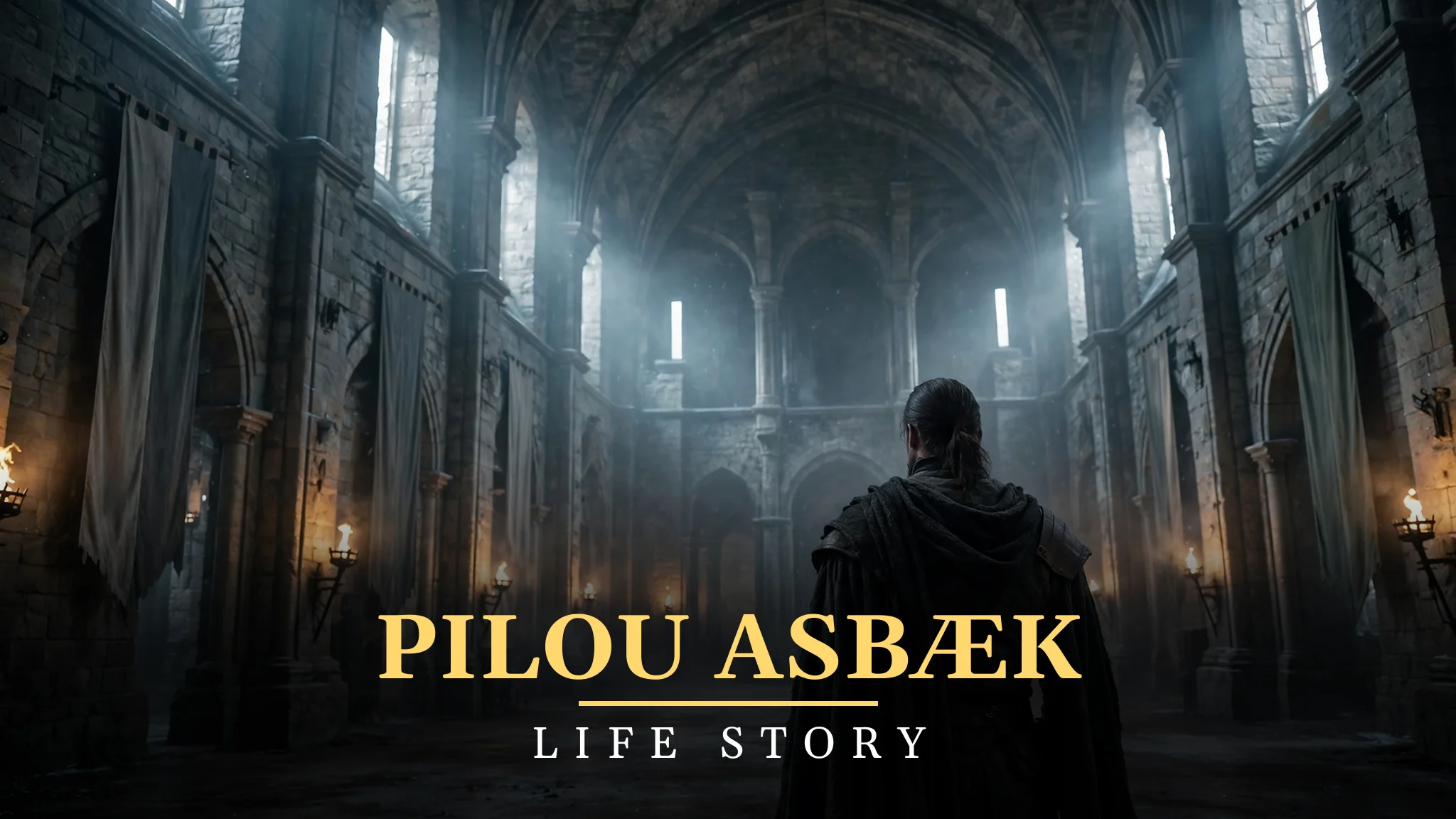
One more thought stays with me. I think about the castle hall in the image, with its stone walls and its torchlight, and how it fits Pilou. He is like that hall: strong, old, full of history, and a little bit dangerous. But he is also warm, like the torchlight, and he makes you want to step inside and see what is there. I hope he keeps stepping into new roles, keeps surprising us, and keeps showing us what a direct and honest actor can do. He is a star, but he is a star who never forgot where he came from, and that is the best kind of star.
Frequently Asked Questions
Where was Pilou Asbaek born and how old is he?
Pilou Asbaek was born Johan Philip Asbaek on 2 March 1982 in Copenhagen, Denmark, which makes him 44 years old in 2026. He grew up in Copenhagen, where his father ran an art gallery, and he graduated from the Danish National School of Performing Arts in 2008.
What is Pilou Asbaek most famous for?
He is most famous for playing Kasper Juul in Borgen and Euron Greyjoy in Game of Thrones. Kasper made him a star in Denmark and Britain, while Euron brought him to a global audience in the biggest television show in the world.
Who did Pilou Asbaek play in Game of Thrones?
He played Euron Greyjoy, a pirate king from the Iron Islands, in seasons six, seven, and eight of Game of Thrones, from 2016 to 2019. Euron was charming, cruel, and dangerous, and Pilou played him with a big, bold energy.
Why did Pilou Asbaek not become a soldier?
As a teenager, Pilou wanted to join the Danish army, but he was rejected because of a medical issue with his knees. The disappointment led him to acting instead, and he later graduated from the Danish National School of Performing Arts.
What films has Pilou Asbaek been in?
His films include R in 2010, The Hijacking in 2012, A War in 2015, Ghost in the Shell in 2017, Overlord in 2018, and Aquaman and the Lost Kingdom in 2023. He has worked in Danish and international productions.
Who is Pilou Asbaek married to?
He is married to Anna Bro, a Danish playwright, and they have children together. He talks about the importance of family and of balancing his work as an actor with his life at home in Copenhagen.
What was Pilou Asbaek’s first major film role?
His first major film role was as Rune in R, released in 2010, a film about a young man in prison. His performance was praised for its power and honesty, and it brought him to the attention of directors and audiences in Denmark.


