Post Malone: The Life Story Behind the Unlikely Star
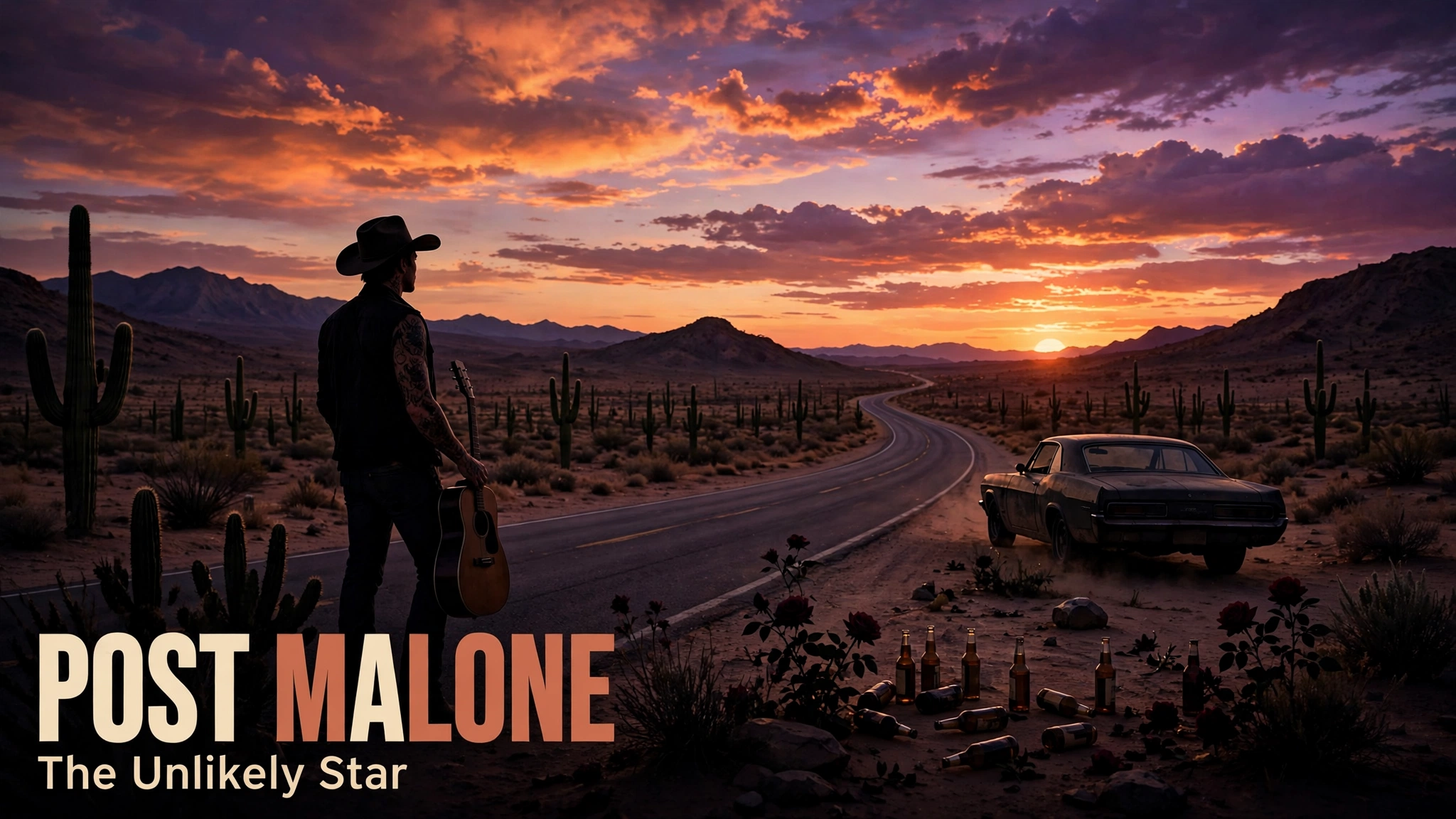
In this post
Growing Up in Syracuse and Grapevine
Austin Richard Post was born on July 4, 1995, in Syracuse, New York, and was raised in Grapevine, Texas, a suburb of Dallas, after his father, Rich Post, got a job as the concessions manager for the Dallas Cowboys, and moved the family south when Austin was nine years old. His father had been a DJ in his youth, and he introduced Austin to a wide range of music, from hip-hop to country to rock, and the house was always full of records, of guitars, and of sounds that would shape Austin’s taste. His mother, Jodie, worked in the school system, and the family was middle-class, loving, and supportive, and Austin grew up in a household where music was a part of everyday life, where he was encouraged to play, to sing, and to be himself. He was a boy who loved video games, who loved music, and who was, by his own account, not particularly popular at school, a kid who was a little bit different, a little bit odd, and who found his place in music rather than in the social world of high school.
He attended Grapevine High School, where he was a good student but also a musician, playing guitar in a heavy metal band, Crown the Empire, for a time, and performing with friends, and where he began to think seriously about a career in music. He has spoken about his teenage years as a time of exploration, of listening to everything, from Bob Dylan to Johnny Cash to 50 Cent, and of trying to figure out what kind of musician he wanted to be. He was not a typical rapper, and he was not a typical rock star; he was a kid from Texas who loved all kinds of music, and who wanted to make music that reflected that, that was a mix of genres, of sounds, and of influences. He graduated from high school in 2013, and he moved to Los Angeles with his friend Jason Probst, a fellow musician, to pursue a career in music, with little money, and with a dream that was bigger than his circumstances.
The move to Los Angeles was a turning point, because it was there that Austin, who had begun calling himself Post Malone, a name that came from his last name, Post, and from a rap name generator that suggested Malone, began to record music, to post it online, and to build a following. He was a young man with a guitar, with a laptop, and with a voice that was both melodic and raw, and he was making music in a bedroom, in a style that was unlike anything else on the radio. He has spoken about those early years in Los Angeles as a time of struggle, of living in a small apartment, of working odd jobs, and of wondering whether the dream would ever come true, but also as a time of freedom, of creativity, and of the excitement of being young and making music with friends. The dream did come true, and it came true faster than anyone expected, with a single song that changed everything.
White Iverson and the Overnight Sensation
In February 2015, Post Malone released White Iverson, a song that was a tribute to the basketball player Allen Iverson, and that became an overnight sensation, first on SoundCloud, then on the radio, and then on the charts. The song, with its laid-back beat, its melodic flow, and its confident lyrics, was unlike anything else in hip-hop at the time, a song that was both a rap song and a pop song, that was smooth and catchy, and that introduced the world to a new kind of star: a white rapper from Texas, with face tattoos, with long hair, with a beer in his hand, and with a voice that was both soulful and strange. The song reached the top twenty on the Billboard Hot 100, it was certified diamond, and it made Post Malone famous, almost overnight, a young man who had been making music in his bedroom, and who was suddenly one of the most talked-about artists in America.
The success of White Iverson led to a record deal with Republic Records, and to the release of his debut album, Stoney, in 2016, featuring the hits Congratulations, featuring Quavo, and Go Flex, and the album was a commercial success, selling millions of copies and establishing Post Malone as a major artist. He followed Stoney with Beerbongs and Bentleys in 2018, an album that debuted at number one, that broke streaming records, and that featured the hits Rockstar, featuring 21 Savage, Psycho, featuring Ty Dolla Sign, and Better Now, and that became one of the biggest albums of the year. Rockstar, in particular, spent eight weeks at the top of the Hot 100, and it made Post Malone one of the biggest stars in the world, a rapper who could top the charts, who could fill arenas, and who could do it with a sound that was entirely his own, a mix of hip-hop, pop, rock, and country, that defied categorisation.
His rise was meteoric, and it was also, in many ways, unlikely, because Post Malone did not look like a typical rap star, did not sound like one, and did not come from the places that rap stars usually come from. He was a kid from Grapevine, Texas, who loved heavy metal and country, who had face tattoos, and who made music that was a mix of everything he loved, and audiences responded to that authenticity, to the fact that he was not trying to be someone else, but was being himself, fully and unapologetically. He has spoken about the surprise of his own success, about the feeling that it happened too fast, and about the pressure of being famous, but he has also spoken about the gratitude, about the love of his fans, and about the joy of making music that people love. White Iverson was the beginning, and it was a beginning that no one, including Post Malone himself, could have predicted.
Beerbongs, Hollywood’s Bleeding, and Superstardom
Beerbongs and Bentleys, released in 2018, was a landmark album, not just for Post Malone, but for the music industry, because it broke the record for the most streams in a single week, with more than 400 million streams, and it proved that streaming had become the dominant way people listened to music. The album, with its mix of trap, pop, and rock, featured collaborations with 21 Savage, Ty Dolla Sign, Swae Lee, and Nicki Minaj, and it was a commercial phenomenon, debuting at number one, staying there for weeks, and earning Post Malone a Grammy nomination for Album of the Year. He followed it with Hollywood’s Bleeding in 2019, an album that was even more successful, debuting at number one, featuring the hits Circles, Sunflower, with Swae Lee, from the Spider-Man: Into the Spider-Verse soundtrack, and Goodbyes, featuring Young Thug, and that became one of the best-selling albums of the year. Circles, in particular, became one of his biggest hits, a melodic, introspective song that spent weeks at number one, and that showed a different side of Post Malone, a songwriter who could make a pop song that was both catchy and emotional.
Sunflower, his collaboration with Swae Lee for the animated film Spider-Man: Into the Spider-Verse, became one of the most successful songs of his career, reaching number one, winning awards, and becoming a favourite with audiences of all ages, a song that was sunny, sweet, and utterly charming. The song’s success showed that Post Malone could make music for films, for families, and for a wider audience, and that his appeal was not limited to hip-hop fans, but extended to anyone who loved a good melody. He has spoken about Sunflower as one of his proudest achievements, about the joy of making a song for a film that he loved, and about the way the song connected with children, with families, and with people who had never heard his music before. It was a reminder that his talent was not just about rap, but about songwriting, about melody, and about the ability to make music that touches people.
During this period, Post Malone also became known for his live performances, for his energy, for his ability to connect with an audience, and for his willingness to be himself on stage, with a beer in his hand, with his tattoos on display, and with a smile that was infectious. He toured the world, performing in arenas and stadiums, and his concerts became known for their atmosphere, for the sing-alongs, and for the sense that the audience was part of a community, a group of people who loved his music and who felt as though they knew him. He was a superstar, one of the biggest in the world, and he was doing it on his own terms, with a sound that was his, a style that was his, and a personality that was unmistakably his own.
Twelve Carat Toothache, Austin, and the Country Turn
In 2022, Post Malone released Twelve Carat Toothache, an album that was more introspective, more personal, and more experimental, featuring the hits I Like You (A Happier Song), featuring Doja Cat, and Cooped Up, featuring Roddy Ricch, and that debuted at number two on the Billboard 200. The album was a departure, a work that dealt with themes of fame, of loneliness, of the pressures of success, and that showed Post Malone as an artist growing reflective, thinking hard about his life thinking deeply about his life, and who was willing to be vulnerable in his music. He followed it with Austin, in 2023, an album named after his real first name, and that was a more guitar-driven, more rock-influenced work, featuring the hit Chemical, and that showed his love of rock, of country, and of the music he had grown up with. The album was a commercial success, and it was praised for its honesty, its musicianship, and its willingness to take risks.
In 2024, Post Malone made a full turn toward country music, releasing F-1 Trillion, a country album featuring collaborations with country stars like Morgan Wallen, Luke Combs, Blake Shelton, and Dolly Parton, and featuring the hit I Had Some Help, with Morgan Wallen, which reached the top spot on the Hot 100 and became one of the year’s most-streamed songs. The album was a commercial and critical success, debuting at number one, and it proved that Post Malone could not only make country music, but could make it well, with a respect for the genre, for its traditions, and for its artists. He has spoken about his love of country music, about growing up listening to it in Texas, about the influence of Johnny Cash, Willie Nelson, and Dolly Parton, and about the joy of working with the artists he admired. The country turn was not a gimmick; it was a homecoming, a return to the music he had loved since he was a child, and it was embraced by country fans, by critics, and by the artists themselves, who welcomed him into the genre.
The country album also led to a stadium tour, the F-1 Trillion Tour, and to performances at country festivals, including Stagecoach, where he performed with country legends, and where he proved that he belonged, not as a visitor, but as a peer. He has said that country music is where he feels most at home, that it is the music of his childhood, and that he plans to continue making it, alongside his other work. The turn to country is one of the most interesting moves in recent pop music, a star who was at the top of hip-hop, who decided to make a country album, and who succeeded, because he did it with respect, with talent, and with a love for the genre that was evident in every song. It is a reminder that Post Malone is not just a rapper, but a musician, a person who loves music in all its forms, and who is not afraid to follow that love wherever it leads.
Tattoos, Beer, and the Public Image
Post Malone is known as much for his image as for his music, with face tattoos, including the words Always Tired under his eyes, a barbed wire across his forehead, and many others, that have become a part of his identity, a visual signature that is unmistakable. He has spoken about his tattoos as a form of self-expression, about the stories behind them, and about the way they reflect who he is, a person who is not afraid to be himself, to look different, and to stand out. He has also spoken about the tattoos as a way to deal with insecurity, about the feeling that he was not handsome enough, and about the decision to cover his face as a form of armour, a way to be seen for his music rather than for his looks. The tattoos have become iconic, and they are a part of his brand, a visual representation of a star who is unlike anyone else in music.
He is also known for his love of beer, particularly Bud Light, with whom he has a partnership, and for his laid-back, friendly personality, a person who is known in the industry as kind, generous, and down-to-earth. He has spoken about his love of Bud Light with humour, about the memes, about the commercials, and about the way the partnership reflects who he is, a regular guy who likes a beer, who likes to have fun, and who does not take himself too seriously. He is also known for his generosity, for tipping waiters thousands of dollars, for giving money to fans, and for supporting causes he cares about, and that generosity is a part of his public image, a person who is not just a star but a good guy, a friend, and a human being who has not forgotten where he came from.
His personal life has remained largely private, though he became a father in 2022, with the birth of his daughter, whose name he has not publicly shared, and he has spoken about fatherhood with love, about the joy of being a father, and about the way it has changed his priorities, his music, and his life. He was previously in a relationship with Ashlen Diaz, and he has been linked to others, but he keeps his personal life out of the public eye, preferring to let his music speak for itself. He is a star who is famous for his work, not for his personal life, and he has worked hard to keep it that way, a choice that is increasingly rare and increasingly admirable in an industry that rewards oversharing.
Business, the Voice, and Life Beyond Music
Beyond music, Post Malone has built a business empire, including a wine brand, Maison No. 9, a French rosé that he launched in 2020, which sold out within days of its release, and which has become a successful product, reflecting his taste, his interest in wine, and his understanding of branding. He has also launched a clothing line, and he has collaborated with brands like Crocs, on a series of shoes, and with many others, making him one of the most sought-after collaborators in the world. His business ventures reflect his personality, his interests, and his understanding that a career in music is also a business, and that the best way to build a lasting career is to diversify, to invest, and to create products that people love. He is not just a singer; he is an entrepreneur, a person who understands the value of his name, and who has built a business that leverages that value in a creative way.
He has also supported causes he cares about, including donations to food banks and disaster relief, and he has done it the way he does most things, without making a fuss about it. He has spoken about his own struggles with mental health, about the pressures of fame, about the loneliness that can come with success, and about the importance of talking about these issues, of seeking help, and of supporting each other. His openness about mental health is a part of his story that is often overlooked, but it is important, because it shows a star who is willing to be vulnerable, to admit that he struggles, and to encourage others to do the same. That honesty is a gift, and it is one that has helped many of his fans.
In recent years, Post Malone has continued to make music, to tour, and to perform, with new projects in development, including more country music, more collaborations, and more work that reflects his diverse tastes. He remains one of the most popular and successful artists in the world, a star who has sold millions of records, who has topped the charts, and who has done it with a sound that is entirely his own. He is a musician who is still growing, still learning, and still finding new ways to make music, and his fans are eagerly awaiting what comes next.His story, of a kid from Texas who became a star without ever fitting the mould, is still being written, and it keeps surprising people.
Legacy: The Unlikely Superstar
Post Malone’s legacy is that of the unlikely superstar, a kid from Texas who did not look or sound like a rap star and became one anyway, on his own terms. He is one of the best-selling artists of his generation, with multiple diamond-certified singles, with billions of streams, and with fans who are among the most loyal in music.Younger artists point to him as proof that genre is only a starting point, and that a song can be anything if it is honest.
Post’s influence is in the way genre stopped mattering: after him, a rapper could make a country song, a pop star could wear a cowboy hat, and nobody blinked, because he had already done it first. He is a genre-bending artist, a person who refuses to be labelled, and that refusal is a part of his appeal, a sign of a musician who loves music in all its forms, and who is not afraid to explore. His country album, F-1 Trillion, is the latest example of that, a work that proved he could make country music, and that he could do it with respect, with talent, and with a love for the genre that was evident in every song. That versatility is rare, and it is what makes him one of the most interesting artists of his generation.
Post Malone’s next chapter will probably surprise people, just as the last ones did. He has already moved from SoundCloud rap to country stages, from face tattoos to family life, and each move has felt honest rather than calculated, because he follows what he loves. What his career proves is that the internet era rewards artists who are themselves, loudly and without apology, and that a genre is a starting point, not a cage. He is a reminder that the most unlikely stars are often the ones who last, because they never belonged to a trend in the first place. The kid who recorded White Iverson in his bedroom became a headliner, a father, and a genre of one, and the music will keep coming as long as he keeps loving it.
My Take:
White Iverson and the Song That Came From Nowhere
When I think about Post Malone, I think about White Iverson, not just as a song, but as a moment, a time in 2015 when a song appeared on SoundCloud, by an artist no one had heard of, with face tattoos, with long hair, and with a sound that was unlike anything else, and within months, it was everywhere, on the radio, on the charts, and in the conversation. I remember hearing it for the first time, and thinking, who is this, and what is this, because it did not sound like hip-hop, it did not sound like pop, it sounded like something new, something that was both laid-back and confident, both melodic and strange. That is the power of a great debut: it announces an artist, it defines a sound, and it makes the world pay attention, and White Iverson did all of that, with a song that was a tribute to Allen Iverson, a basketball player, and that became, in itself, a kind of tribute to being an outsider, to being different, and to being yourself.
What impresses me most about the song is its confidence. Post Malone was twenty years old, he had no record deal, he had no fame, and he made a song that sounded like he already knew he was a star, like he was not asking for permission, but telling the world who he was. That confidence is not arrogance; it is talent, it is the knowledge that you have something to say, and that you are going to say it, whether the world is ready or not. The song’s success, its diamond certification, its place on the charts, was a validation of that confidence, a proof that audiences respond to authenticity, to a person who is being himself, and who is not trying to fit into a mould. White Iverson is a song about a basketball player, but it is also a song about Post Malone himself, about a young man from Texas who was an outsider, who was different, and who was going to make it anyway.
I also think about the name, Post Malone, a name that came from his last name and from a rap name generator, a name that is both ordinary and strange, and that has become one of the most recognisable names in music. The name is a perfect representation of the artist: a regular guy, Austin Post, who became a star, Post Malone, and who did it by being himself, by making music that was a mix of everything he loved, and by refusing to be categorised. That refusal, to be put in a box, is a central part of his story, and it is why his music is so hard to define, why it is hip-hop and pop and rock and country, all at once, and why it appeals to such a wide audience. He is not a rapper, or a pop star, or a country singer; he is Post Malone, and that is enough, and that is a remarkable achievement for any artist.
One more thing about White Iverson stays with me, and it is the video, a simple, low-budget video, with Post Malone and his friends, in a desert, with a white Rolls-Royce, and with a sense of fun, of freedom, and of youth. The video is not polished, it is not expensive, and it is not trying to be something it is not; it is a group of friends, making a video, having fun, and that authenticity is part of why the song worked. It was not a corporate product; it was a bedroom recording that became a hit, and that story, of a kid from Texas making a song in his room and becoming a star, is a story that inspires young musicians everywhere, a reminder that you do not need a big budget, or a big label, or a big name, to make great music, you just need a song, and a belief in yourself.
Circles, Sunflower, and the Songwriter Behind the Tattoos
Post Malone is often talked about for his image, for his tattoos, for his beer, for his style, but I think the most important thing about him is his songwriting, and the songs that prove it are Circles and Sunflower, two tracks that are, in my opinion, among the best pop songs of the last decade. Circles, released in 2019, is a melancholic, introspective song about a relationship that is going in circles, about the pain of repeating the same mistakes, and it is a song that is both catchy and emotional, with a melody that is unforgettable, and with lyrics that are honest and vulnerable. The song spent weeks at number one, it was one of the biggest hits of the year, and it showed a different side of Post Malone, a songwriter who could make a pop song that was not just about partying, but about feeling, about heartbreak, and about the complexities of love. That depth is what makes him more than a rapper; it makes him a songwriter, a person who understands how to write a song that touches people.
Sunflower, his collaboration with Swae Lee for Spider-Man: Into the Spider-Verse, is another example, a song that is sunny, sweet, and utterly charming, a song that became a favourite with audiences of all ages, and that showed Post Malone’s ability to make music for a film, for families, and for a wider audience. The song is not a rap song; it is a pop song, a love song, and it is a perfect example of his versatility, of his ability to write a melody, to sing it beautifully, and to make a song that feels both modern and timeless. The song’s success, its diamond certification, and its place in popular culture, are a testament to his talent as a songwriter, a talent that is often overlooked because of his image, but that is the foundation of his career. He is not just a performer; he is a writer, and his songs are the reason he has lasted, the reason audiences keep coming back, and the reason he will be remembered.
I also think about the way he writes, about the process, about the fact that he writes from experience, from his own life, from his own feelings, and that he does it with a honesty that is rare in pop music. He does not write songs that are generic; he writes songs that are personal, that are about his relationships, his struggles, and his joys, and that honesty is what makes his music resonate. Circles is about a relationship that is failing, Sunflower is about a love that is hopeful, and both songs are true, both are felt, and both are sung with a voice that is both melodic and raw, a voice that is unmistakably his. That voice, that songwriting, is the heart of his art, and it is why I believe he will be remembered not just as a star, but as a songwriter, a musician who wrote songs that mattered, and that will last.
The Country Turn and the Courage to Change
Post Malone’s decision to make a country album, F-1 Trillion, in 2024, is in my opinion one of the bravest and most interesting moves in recent pop music, because he was at the top of hip-hop, he was one of the biggest stars in the world, and he decided to make a country album, a genre that is, in many ways, the opposite of hip-hop, with different traditions, different audiences, and different expectations. He did it not as a gimmick, but as a homecoming, as a return to the music he had grown up with in Texas, to Johnny Cash, to Willie Nelson, to Dolly Parton, and he did it with respect, with talent, and with a love for the genre that was evident in every song. The album featured collaborations with Morgan Wallen, Luke Combs, Blake Shelton, and Dolly Parton herself, and it debuted at number one, with I Had Some Help becoming one of the biggest songs of the year. That success was not guaranteed; it was a risk, and it paid off, because audiences, and country artists, recognised that Post Malone was not a tourist, but a genuine lover of the genre, a musician who belonged.
What I admire most about the country turn is the authenticity behind it. Post Malone did not make a country album because it was trendy, or because he wanted to chase a new audience; he made it because he loves country music, because it is the music of his childhood, and because he wanted to honour it. He has spoken about growing up in Texas, about listening to country on the radio, about the influence of the genre on his songwriting, and about the joy of working with the artists he admired. That love is audible in the album, in the way he sings, in the way he writes, and in the way he collaborates, and it is why the album was embraced by country fans, who are famously protective of their genre, and who do not welcome outsiders lightly. The fact that they welcomed him is a testament to his sincerity, to his talent, and to the respect he showed for the music.
I also think about the tour, the F-1 Trillion Tour, and about the performances at country festivals, including Stagecoach, where he performed with country legends, and where he proved that he belonged, not as a visitor, but as a peer. He did not just record a country album; he lived it, he toured it, he performed it, and he did it with a commitment that showed he was serious, that this was not a one-off, but a new chapter in his career. That commitment is admirable, and it is a sign of an artist who is not afraid to change, to grow, and to follow his muse, even when it leads him to a place that is unexpected. The country turn is a reminder that the best artists are the ones who are not afraid to reinvent themselves, who are willing to take risks, and who trust their own taste, even when the world does not understand it yet. Post Malone did that, and the result is one of the most interesting albums of his career.
What I Take Away From His Story
When I look at Post Malone’s whole career, from a kid in Grapevine with a guitar to a global superstar who has topped the charts in hip-hop, pop, and country, what stays with me is the authenticity, the fact that he did not become famous by trying to be someone else, but by being himself, fully and unapologetically, with face tattoos, with a beer, with a love of all kinds of music, and with a personality that is warm, funny, and genuine. He is a star who is not afraid to be different, to look different, to sound different, and that difference is his strength, it is what makes him stand out in a world of pop stars who often look and sound the same. He is a reminder that the best way to succeed is to be yourself, to trust your own taste, and to make the music you love, even if it does not fit into a category, even if people do not understand it at first, because in the end, authenticity is what audiences respond to, and it is what lasts.
I also think his story is a reminder that success does not have to look a certain way, that a star can come from Grapevine, Texas, can have face tattoos, can love heavy metal and country, and can still become one of the biggest artists in the world. He broke the mould, not by trying to, but by being himself, and that is a powerful message for young artists who do not fit the usual image of a star, who are told that they need to look a certain way, sound a certain way, or come from a certain place. Post Malone proves that none of that matters, that talent, hard work, and authenticity are enough, and that the audience, in the end, cares more about the music than about the image. That is a lesson worth learning, and it is one that his career teaches beautifully.
Finally, I want to say that I am excited about what comes next for him, because he is an artist who is still growing, still learning, and still finding new ways to make music. His country album, his collaborations, and his willingness to take risks suggest a musician who is not content to rest on his past successes, but who is looking forward, to the next song, the next album, the next genre, and who is doing it with a curiosity and a joy that are infectious. His story is one of the great stories in modern music, a story about a kid from Texas who became an unlikely superstar, and it is a story that is still being written. I will be listening, because if his past is any guide, the next chapters will be as surprising, as musical, and as compelling as the ones that came before, and that is a promise worth holding on to.
One last thought stays with me, and it is about the beer, the tattoos, and the image, and about the fact that behind that image is a kind, generous, hardworking person, a man who tips waiters thousands of dollars, who gives money to fans, who supports causes he cares about, and who has not forgotten where he came from. That kindness, that generosity, is the most human part of his story, and it is a reminder that fame does not have to change a person, that it is possible to be a star and to be a good guy, and that the two are not incompatible. Post Malone is proof of that, and his story is a celebration of what happens when talent meets kindness, when authenticity meets hard work, and when a kid from Grapevine becomes a star without losing himself.
Frequently Asked Questions
How did Post Malone become famous?
Post Malone became famous with his debut single White Iverson in 2015, which went viral on SoundCloud and reached the top twenty on the Billboard Hot 100. His debut album Stoney followed in 2016.
Where is Post Malone from?
Post Malone was born Austin Richard Post in Syracuse, New York, on July 4, 1995, and was raised in Grapevine, Texas. He moved to Los Angeles after high school to pursue music.
What is Post Malone’s biggest song?
His biggest songs include White Iverson, Congratulations, Rockstar featuring 21 Savage, Circles, Sunflower with Swae Lee, and I Had Some Help with Morgan Wallen, which topped the charts in 2024.
Did Post Malone make a country album?
Yes, Post Malone released the country album F-1 Trillion in 2024, featuring collaborations with Morgan Wallen, Luke Combs, Blake Shelton, and Dolly Parton. It debuted at number one on the Billboard 200.
Is Post Malone married?
Post Malone keeps his personal life private. He became a father in 2022 with the birth of his daughter, whose name he has not publicly shared.
What are Post Malone’s best albums?
His best albums include Stoney, Beerbongs and Bentleys, Hollywood’s Bleeding, Twelve Carat Toothache, Austin, and the country album F-1 Trillion.


