Primal Scream: The Life Story Behind the Screamadelica Band
In this post
- Glasgow Roots and a Drummer Who Wanted to Sing
- The Acid House Turn
- Screamadelica and the Mercury Prize
- Country Rock, Give Out, and a New Direction
- Vanishing Point, XTRMNTR, and the Hard Edge
- Later Albums and the Long Career
- What Primal Scream Mean Today
- Primal Scream on Stage
- Friends, Guests and Collaborators
- Primal Scream and the Mercury Prize
- My Take:
Some bands find one sound and stay with it for their whole career. Primal Scream did the opposite. They changed their sound again and again, from jangly guitar pop to acid house dance music, from country rock to hard electronic noise, and back again. Each time, some fans were shocked, and each time, the band found a new way to be themselves. That restless spirit is the heart of their story.
The band came from Glasgow, Scotland, and it was led by Bobby Gillespie, a singer with a thin voice, a sharp sense of style, and a deep love of music in all its forms. Gillespie had started out as a drummer in another famous band, and he brought that sense of rhythm with him when he stepped forward to sing. Around him, the band gathered musicians who shared his taste for risk, and together they made some of the most surprising records in British music.
Their greatest moment came in 1991 with Screamadelica, an album that mixed rock guitars with dance beats and became one of the defining records of its time. It won the first Mercury Prize, and it is still talked about as a landmark. But Screamadelica was only one chapter. Primal Scream kept changing for more than thirty years after it, and that long career of reinvention is what makes them worth writing about.
Glasgow Roots and a Drummer Who Wanted to Sing
Primal Scream formed in Glasgow in 1982. Bobby Gillespie and Jim Beattie were at the centre of the early band. Gillespie had grown up in Glasgow loving music, and he had a job in a record shop, which meant he spent his days surrounded by records. He also played drums for The Jesus and Mary Chain, a band that made loud, noisy pop, and that experience taught him a great deal about how a band works on stage and in the studio.
The early Primal Scream played guitar pop in the style of the time, with bright melodies and ringing guitars. Their first singles and their first album, Sonic Flower Groove, released in 1987, showed a young band still finding its feet. The songs were pleasant and tuneful, but they did not yet have the fire that would later define the band. Gillespie was still learning how to be a frontman, how to hold a crowd, and how to write songs that meant something to him.
Glasgow in the eighties was a tough city, and its music scene was full of energy. Bands rehearsed in cheap rooms, played in small clubs, and supported each other. Primal Scream were part of that world. They toured, they recorded, and they slowly built a following. They were signed to Creation Records, a small label run by Alan McGee, who believed in them and gave them the freedom to experiment.
By the end of the eighties, the band was at a turning point. The guitar pop of their first album had not made them stars, and Gillespie was listening to new sounds. Dance music was growing in Britain, and the clubs of Manchester and London were full of people dancing all night to house music. Gillespie heard something in that music that he wanted to bring into his own band, and that decision would change everything.
The Acid House Turn
The change began with a single. In 1990, Primal Scream released Loaded, a song built around a sample of a film actor talking about freedom, set to a rolling dance beat. It was unlike anything the band had done before. The guitars were still there, but they were wrapped around a groove that came from the dance floor. Loaded became a hit, and it showed that a rock band could make dance music without losing its soul.
The band worked with the DJ and producer Andrew Weatherall, who understood both rock and dance music. Weatherall took the band’s songs apart and rebuilt them as long, swirling dance tracks. He did not simply add a beat to a rock song. He reimagined the songs from the ground up, keeping the melodies and the feeling, but giving them a new shape. The partnership between the band and Weatherall was one of the most creative in British music at the time.
This was a brave move. Many rock fans did not like dance music, and many dance fans did not like rock bands. Primal Scream risked losing both audiences. But the gamble worked, because the music was good. The songs had the energy of a club at two in the morning, and they also had the heart of a rock band. People who had never danced to a guitar band before found themselves moving, and people who had never listened to dance music found themselves listening.
The turn toward dance music was also a sign of Gillespie’s character. He was not afraid to change direction, even when the change was risky. He listened to what was happening around him, and he trusted his own taste. That willingness to change would become the defining quality of Primal Scream, and it would carry them through many more changes in the years that followed.
Screamadelica and the Mercury Prize
In 1991, Primal Scream released Screamadelica. It was an album unlike any other in British music. It mixed dance beats, gospel singers, dub bass, rock guitars, and Gillespie’s soft voice into a sound that felt warm, free, and joyful. Songs such as Movin’ on Up, Come Together, and Loaded became anthems, played in clubs and on the radio for years.
The album was a success with both critics and listeners. It captured the feeling of the time, when dance culture and rock culture were coming together in Britain. Young people who went to clubs at the weekend and listened to rock bands during the week heard both parts of their life in one record. Screamadelica spoke to that moment, and it became one of the most loved albums of the decade.
In 1992, Screamadelica won the first ever Mercury Prize, a new award for the best British album of the year. The win confirmed the band’s place in music history. They were no longer a small indie band from Glasgow. They were a band that had made a landmark record, and their name would be remembered.
The success of Screamadelica also brought the band a bigger audience. They toured the world, playing festivals and large venues. They worked with gospel singers, with DJs, and with musicians from many different backgrounds. The album had shown that a band could be open to many kinds of music at once, and that openness became part of the band’s identity. But success also brought pressure, and the band would soon have to decide what to do next.
Country Rock, Give Out, and a New Direction
After Screamadelica, many people expected Primal Scream to make another dance album. Instead, they made Give Out But Don’t Give Up, released in 1994, an album of country and soul influenced rock. It was recorded in part in America, with musicians who had played with some of the great names of rock and soul. The album included the song Rocks, which became a hit, and it showed a completely different side of the band.
The change surprised many fans and critics. Some loved the new sound, and some felt the band had turned away from what made them special. The album sold well, but it did not have the same impact as Screamadelica. It was a good record, but it was not a landmark. The band had shown that they could play country rock, but they had also shown that changing direction had a cost.
During this period, the band’s lineup changed. The bassist Mani, who had been in The Stone Roses, joined Primal Scream in 1996, and his playing gave the band a new drive. The band also began to work with new producers and new collaborators, always looking for a fresh sound. They were not a band that could sit still, and they were not interested in repeating themselves.
The years after Screamadelica were a search. The band knew they had made a great record, and they knew they could not simply make it again. They tried new sounds, they worked with new people, and they kept touring. It was a period of experiment, and it laid the ground for the next great change in their sound.
Vanishing Point, XTRMNTR, and the Hard Edge
In 1997, Primal Scream released Vanishing Point, an album that mixed dub, dance, and rock into a dark and tense sound. It was inspired in part by films and by the feeling of life in a big city at night. The album included the song Kowalski, and it showed a band that was interested in atmosphere and in noise as much as in melody. It was well received, and it proved that the band still had new ideas.
Three years later, in 2000, they released XTRMNTR, a much harder and angrier record. The music was loud, electronic, and confrontational, with lyrics about politics, power, and the state of the world. Songs such as Swastika Eyes and Kill All Hippies were fierce and direct. The album divided listeners, but it was praised by critics as one of the band’s boldest works. It showed that Primal Scream could still shock people, nearly twenty years after they had formed.
These two albums showed the range of the band. Vanishing Point was moody and cinematic, while XTRMNTR was sharp and furious. Both were made by the same group of musicians, and both sounded like Primal Scream. That was the band’s gift. They could change their sound completely, and yet the songs still had Gillespie’s voice, his sense of melody, and his love of rhythm at their centre.
The band toured these albums hard, playing festivals and clubs around the world. They were no longer the biggest band in Britain, but they were one of the most respected. Other musicians admired them for their courage, and fans admired them for never standing still. They had become a band that other bands looked to for inspiration.
Later Albums and the Long Career
Primal Scream continued to release albums through the two thousands and beyond. Evil Heat came out in 2002, Riot City Blues in 2006, Beautiful Future in 2008, More Light in 2013, and Chaosmosis in 2016. Each album had its own character. Some leaned toward rock, some toward dance, and some toward pop. None of them repeated Screamadelica, and none of them tried to.
During these years, the band’s lineup continued to change, with new guitarists and keyboard players joining. Andrew Innes, who had been with the band since the early days, remained a key figure, writing and playing alongside Gillespie. The band also lost friends and collaborators along the way, and those losses were felt deeply. In 2023, the bassist Mani left the band, and in 2025 the band released new music with a new lineup, showing that the story was still going on.
The band also faced the loss of Andrew Weatherall, who died in 2020. Weatherall had been a central figure in the making of Screamadelica, and his death was mourned by the band and by many others in British music. Gillespie spoke warmly about him, remembering the creativity and the humour that had gone into their work together.
Through all of this, Primal Scream kept touring. They played festivals, they played anniversary shows for Screamadelica, and they played new songs for audiences who had followed them for decades. They were a working band, not a band that lived only on past glory. That work ethic, that refusal to stop, is a large part of why they are still respected today.
What Primal Scream Mean Today
Today, Primal Scream are remembered first for Screamadelica, and rightly so. It is one of the great British albums, and it still sounds fresh. But their story is bigger than one album. It is the story of a band that refused to be pinned down, that changed its sound whenever it felt like changing, and that survived for more than forty years by following its own taste.
The band’s influence can be heard in many younger acts who mix rock and dance, who work with DJs and producers, and who refuse to stay in one genre. Primal Scream showed that a rock band could learn from dance music, and that a dance record could have the heart of a rock band. That lesson has shaped British music ever since.
Gillespie remains the face of the band, a singer who has spent his life listening to music and trying to make something new from what he hears. He is not a singer with a huge voice, and he has never pretended to be one. His strength is his taste, his sense of rhythm, and his willingness to take a risk. Those qualities have carried the band through every change.
Primal Scream’s story is not a story of steady success. It is a story of peaks and troughs, of great albums and of records that divided opinion, of lineups that changed and of friendships that lasted. It is the story of a band that kept moving, and that is why it is still worth telling.
Primal Scream on Stage
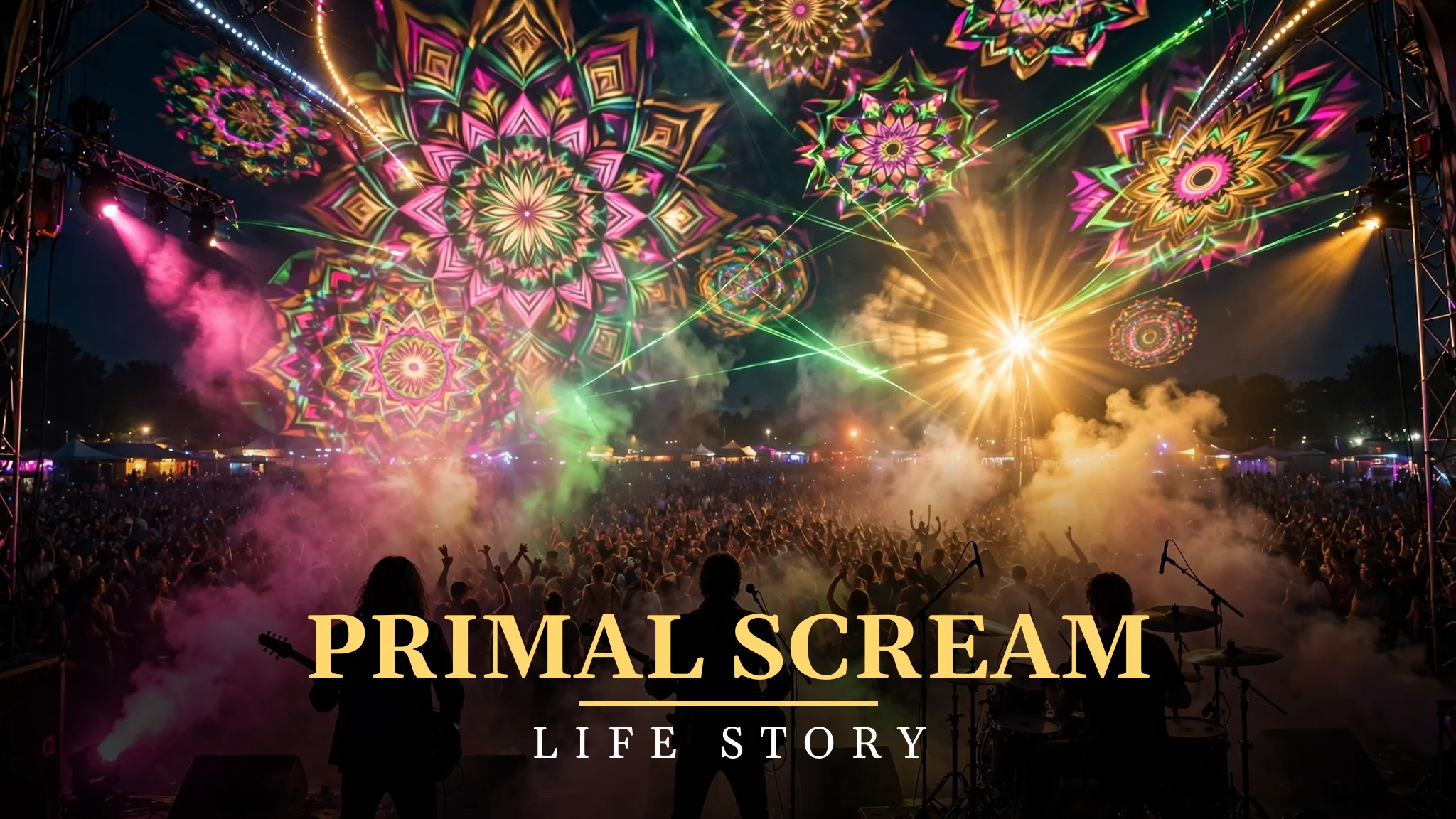
Primal Scream have always been a live band, and their shows have been a large part of their story. On stage, the band’s changing sound made sense in a way that it sometimes did not on record. A dance song, a rock song, and a soul song could sit side by side in the same set, because the band played them all with the same energy, and because Gillespie held the show together with his presence. The audience did not need the songs to be in one style. They needed them to be played with feeling, and Primal Scream always played with feeling.
The band’s best live moments came when they played the Screamadelica songs, because those songs were made for a crowd. Movin’ on Up, with its gospel voices and its driving beat, could lift a festival crowd in a way that few songs can. Loaded, with its rolling groove, could make thousands of people dance. The band knew this, and they built their sets around those moments, saving the biggest songs for the times when the crowd needed them most. That is the skill of a band that has played hundreds of shows.
Festivals were a natural home for Primal Scream, because festivals are places where different kinds of music meet. A rock fan, a dance fan, and a soul fan can all be in the same field, and Primal Scream could speak to all of them. The band played Glastonbury, they played festivals in Europe and in America, and they were welcomed everywhere. Their shows were not always perfect, and they were sometimes messy, but they were always alive, and that aliveness is what people remember.
The band’s live lineup often included extra musicians, including gospel singers and keyboard players, who added colour to the sound. Those guests were part of the show, and they showed the band’s openness to other voices. Primal Scream were never a closed group. They were a band that welcomed other musicians onto the stage, and that generosity made their shows feel like a celebration rather than a performance. That is a rare quality, and it is one of the reasons their live reputation has lasted.
Friends, Guests and Collaborators
Primal Scream’s story is full of collaborations, and those collaborations are a large part of why their music sounds so varied. The band worked with Andrew Weatherall on Screamadelica, and his ear for dance music shaped the record. They worked with gospel singers, whose voices gave Movin’ on Up and Come Together their warmth and their lift. They worked with producers and with DJs, and each one brought something new to the band’s sound.
Mani, who joined the band in 1996 after The Stone Roses split up, brought a new drive to the bass. His playing was melodic and strong, and it gave the band a foundation that they had not had before. He stayed with the band for many years, and he became a key part of their sound on Vanishing Point, XTRMNTR, and the albums that followed. His presence showed that Primal Scream were a band that other great musicians wanted to join.
The band also worked with guest singers, including Kate Moss, who sang on Some Velvet Morning, a song from Evil Heat. That collaboration was unusual, and it showed the band’s willingness to try something unexpected. They also worked with the guitarist Kevin Shields, whose noisy and beautiful playing added a new layer to their sound. Each collaboration was a risk, and each one taught the band something new.
These friendships and partnerships matter, because they show that Primal Scream were never a band that worked alone. They listened to other people, they learned from them, and they let those people change their music. That openness is the reason their records sound so different from each other, and it is the reason their career has lasted so long. A band that only listens to itself will eventually run out of ideas. A band that listens to others will always have something new to try.
Primal Scream and the Mercury Prize
The Mercury Prize win in 1992 was a turning point for Primal Scream, and it is worth thinking about, because it changed how the band were seen. The prize was new, and Screamadelica was its first winner, which gave the album a special place in British music history. The band were not the biggest sellers of the year, and they were not the most famous act on the list. They were a band from Glasgow who had made a strange and beautiful record, and the judges chose it because it was original. That choice said something important about British music. It said that originality mattered, and that a record could be both experimental and popular.
The win brought the band a wider audience, and it brought them respect from other musicians. It also brought them pressure, because a prize can be a burden as well as a reward. People expected the next album to be just as good, and the band knew that they could not simply repeat Screamadelica. They tried new sounds, and some of those sounds were less successful, but the prize had given them the confidence to try. That confidence is a large part of why their career lasted so long.
The Mercury Prize has since become one of the most important awards in British music, and Screamadelica’s win is still talked about as one of its great moments. The band were nominated again in later years, but they never won a second time. That does not matter. The first win was enough. It marked them as a band that mattered, and it gave their music a place in history. Today, when people talk about the Mercury Prize, they still talk about Screamadelica, and that is a lasting tribute to the band.
The prize also matters because it showed that a band from Glasgow, making dance music with guitars, could be recognised as the best in Britain. That was a hopeful message for other bands from outside London, and it encouraged them to trust their own sound. Primal Scream did not win because they sounded like everyone else. They won because they sounded like themselves, and that is a lesson that has lasted far beyond 1992.
My Take:
When I think about Primal Scream, the first word that comes to my mind is brave. Most bands find a sound that works, and then they stay with it, because staying with it is safe. It pays the bills, it keeps the fans happy, and it keeps the record company happy. Primal Scream never did that. They found a sound, they enjoyed it, and then they walked away from it to try something else. That takes courage, and it also takes a kind of faith in your own taste. You have to believe that the next thing you make will be worth hearing, even if no one has asked for it yet.
I admire Bobby Gillespie for that courage, and I admire him for something else too. He is not a singer with a great voice in the usual sense. His voice is thin, it is soft, and it sometimes sounds as if it might break. But he uses it well. He sings as if he is talking to you, not as if he is showing off. When he sings Movin’ on Up, I hear a man who is trying to lift himself up, not a man who is already on top of the world. That honesty is what makes the song work. A bigger voice might have made it sound like a boast. Gillespie’s voice makes it sound like hope.
Screamadelica is an album I keep coming back to, because it does something that very few albums do. It makes me feel free. The beats roll, the gospel voices rise, the guitars shimmer, and for an hour I feel as if the world is a kinder place than it usually is. That is a rare gift for a record to have. Many albums are clever, many are loud, many are sad. Few are joyful in the way Screamadelica is joyful. It is not a naive joy. It is the joy of people who have been through hard times and have decided to dance anyway.
What I find most interesting about the band is the way they handled the years after Screamadelica. It would have been easy to make Screamadelica again, with the same producers and the same sound, and to sell a lot of records. They refused. They made a country rock album, then a dark dub album, then a furious electronic album. Some of those records sold less, and some of them confused people. But each one was honest. Each one was the sound of a band following its own curiosity. I respect that more than I respect a band that plays it safe for thirty years.
I also think about the cost of that honesty. When a band changes its sound, it loses some fans. People who loved the dance sound did not always love the country rock sound. People who loved the country rock sound did not always love the electronic sound. Primal Scream accepted that cost. They chose artistic freedom over a steady audience, and that choice meant they were never as rich or as famous as they might have been. But it also meant they were never bored, and they were never fake. I think that is a fair trade.
The partnership with Andrew Weatherall is one of the great stories in British music. Weatherall took the band’s songs and rebuilt them, and in doing so he helped to create a new kind of record. I think about how much trust that must have taken. A band has to trust a producer to take their work apart and put it back together in a new shape. Gillespie trusted Weatherall, and the result was Screamadelica. When Weatherall died in 2020, it felt like the end of an era, not just for Primal Scream, but for a whole generation of British music. I am glad that Gillespie spoke about him with such warmth, because it showed how much that partnership had meant.
I have mixed feelings about XTRMNTR. It is a fierce album, and it is angry about the world, and I admire that anger. But I also think it is a hard album to love. It is loud, it is harsh, and it does not offer the warmth of Screamadelica. That is the point, of course. The band wanted to make a record that felt like the world at the turn of the century, and the world did not feel warm. I respect the album, even when I do not always enjoy listening to it. It is a record that says something, and that matters more than being easy to listen to.
One thing I notice about Primal Scream is how long they have lasted. More than forty years is a very long time for a band, especially a band that has changed its sound so many times. Most bands break up after ten years. Primal Scream kept going, through changes in the music business, through changes in fashion, through the loss of friends and collaborators. That longevity tells me something about Gillespie and Innes. They love music, they love making it, and they are not ready to stop. That love is the engine of the band, and it has kept them going when other bands have given up.
For a young musician, I think the lesson of Primal Scream is to listen widely. Gillespie listened to rock, to soul, to country, to house music, to dub, to punk, and he let all of it into his band. He did not say that one kind of music was better than another. He said that good music is good music, wherever it comes from. That openness is the reason Screamadelica sounds the way it does. It is a record made by people who loved many kinds of music, and who were not afraid to put them together.
I also think the band teaches a lesson about failure. Not every Primal Scream album was a success. Some of them sold poorly, some were criticised, and some are barely remembered today. But the band did not let those failures stop them. They made the next record, and then the next one. That is how a long career is built. It is not built on one great album. It is built on the willingness to keep working after a disappointment, to trust that the next idea might be the good one.
In the end, I think Primal Scream matter because they showed that a band can be free. Free to change, free to experiment, free to fail, and free to try again. Screamadelica will always be their most famous record, and it deserves to be. But the full story is the story of a band that refused to stand still, and that refusal is, for me, the most admirable thing about them. I would rather listen to a band that takes risks and sometimes fails than to a band that plays the same safe songs for forty years.
When I think about Primal Scream, I think about a band that refused to be boring, and that refusal is the thing I admire most. Most bands find a sound that works, and then they repeat it, because repeating it is safe. Primal Scream never did that. They made a dance album, then a country album, then a dark dub album, then a furious electronic album. Each time, they risked losing their audience, and each time, they trusted their own taste. That takes a kind of courage that is rare in music, and it is the reason I keep coming back to their records.
I think about Bobby Gillespie’s voice, because it is not a voice that should work, and yet it does. It is thin, it is soft, and it sometimes sounds as if it might break. But he uses it with great care, and he sings as if he is talking to you, not as if he is performing for you. When he sings Movin’ on Up, I hear a man who is trying to lift himself up, not a man who is already on top. That honesty is what makes the song work, and it is what makes Gillespie a special singer.
I keep returning to Screamadelica, because it is an album that makes me feel free. The beats roll, the gospel voices rise, and for an hour, the world feels kinder than it usually is. That is a rare gift for a record to have. Many albums are clever, many are loud, and many are sad. Few are joyful in the way that Screamadelica is joyful. It is not a naive joy. It is the joy of people who have been through hard times and have decided to dance anyway, and that decision is a brave one.
The partnership with Andrew Weatherall is one of the great stories in British music, and it makes me think about trust. A band has to trust a producer to take their songs apart and to put them back together in a new shape. Gillespie trusted Weatherall, and the result was a landmark record. When Weatherall died in 2020, it felt like the end of an era, not just for Primal Scream, but for a whole generation of British music. I am glad that Gillespie spoke about him with such warmth, because it showed how much that partnership had meant to him.
I think about the years after Screamadelica, and I respect the band for not trying to make it again. It would have been easy to hire the same producer, to use the same sound, and to sell a lot of records. They refused, and they made a country rock album instead. Some fans were confused, and some critics were harsh, but the band were honest. Each record was the sound of a band following its own curiosity, and that honesty matters more than sales. A band that chases sales will eventually lose its soul. A band that follows its curiosity will keep its soul, even if it sells fewer records.
The cost of that honesty is real, and I do not want to pretend otherwise. When a band changes its sound, it loses some fans. People who loved the dance sound did not always love the country sound, and people who loved the country sound did not always love the electronic sound. Primal Scream accepted that cost, and they chose artistic freedom over a steady audience. I think that is a fair trade, but it is also a hard one, and it is one that not every band is willing to make.
I have mixed feelings about XTRMNTR, because it is a fierce and angry album, and it is not always easy to love. It is loud, it is harsh, and it does not offer the warmth of Screamadelica. But I respect it, because it says something about the world, and it says it directly. The band wanted to make a record that felt like the world at the turn of the century, and the world did not feel warm. A record that tells the truth, even when the truth is uncomfortable, is worth more than a record that is merely pleasant.
I think about how long Primal Scream have lasted, and I find it remarkable. More than forty years is a very long time for a band, especially a band that has changed its sound so many times. Most bands break up after ten years. Primal Scream kept going, through changes in the music business, through changes in fashion, and through the loss of friends. That longevity tells me something about Gillespie and Innes. They love music, they love making it, and they are not ready to stop. That love is the engine of the band, and it has kept them going when other bands have given up.
For a young musician, I think the lesson of Primal Scream is to listen widely. Gillespie listened to rock, to soul, to country, to house music, to dub, and to punk, and he let all of it into his band. He did not say that one kind of music was better than another. He said that good music is good music, wherever it comes from. That openness is the reason Screamadelica sounds the way it does. It is a record made by people who loved many kinds of music, and who were not afraid to put them together.
I also think the band teaches a lesson about failure. Not every Primal Scream album was a success. Some of them sold poorly, some were criticised, and some are barely remembered today. But the band did not let those failures stop them. They made the next record, and then the next one. That is how a long career is built. It is not built on one great album. It is built on the willingness to keep working after a disappointment, and to trust that the next idea might be the good one.
In the end, I think Primal Scream matter because they showed that a band can be free. Free to change, free to experiment, free to fail, and free to try again. Screamadelica will always be their most famous record, and it deserves to be. But the full story is the story of a band that refused to stand still, and that refusal is, for me, the most admirable thing about them. I would rather listen to a band that takes risks and sometimes fails than to a band that plays the same safe songs for forty years.
One more thought stays with me, and it is about Glasgow. Primal Scream came from a tough city, and their music has a toughness to it, even when it is joyful. That toughness comes from growing up in a place where life is not easy, and where music is a way of surviving. I think that is true for many great bands. They come from places that are hard, and they make music that is honest about that hardness, and that honesty is what makes their songs last.
Frequently Asked Questions
What is Primal Scream’s best known album?
Screamadelica, released in 1991, is Primal Scream’s best known album. It mixed rock and dance music, won the first Mercury Prize in 1992, and includes Loaded, Movin’ on Up, and Come Together.
Where is Primal Scream from?
Primal Scream formed in Glasgow, Scotland, in 1982. The band was led by singer Bobby Gillespie, who had previously played drums for The Jesus and Mary Chain.
Who produced Screamadelica with Primal Scream?
The DJ and producer Andrew Weatherall played a central role in shaping Screamadelica, rebuilding the band’s songs as long dance tracks. His work on the album is widely credited as a key part of its sound.
Why did Primal Scream change their sound so often?
Bobby Gillespie and the band listened widely to rock, soul, country, house, dub, and punk, and they followed their own taste rather than repeating one style. Each album explored a new sound, from dance to country rock to hard electronic music.
What was Primal Scream’s first album?
Their first album was Sonic Flower Groove, released in 1987. It was a guitar pop record, very different from the dance sound they became famous for with Screamadelica four years later.
Is Primal Scream still making music?
Yes, Primal Scream have continued to record and tour for more than forty years, releasing albums including More Light in 2013 and Chaosmosis in 2016, and new music in 2025 with a changed lineup.


