Prince: The Life Story Behind the Purple Star
In this post
Prince Rogers Nelson was born on 7 June 1958 in Minneapolis, Minnesota, to John L. Nelson, a jazz pianist, and Mattie Della Shaw, a jazz singer, and he grew up in a musical household where the piano was always being played. His parents separated when he was young, and he lived for a time with his father, then with his mother’s new family, and then, after running away, with the family of a school friend, Andre Anderson. He was a small, shy boy who was bullied at school, but he could play the piano, the guitar and the drums before he was a teenager, and music was the place where he felt safe.
By the time he was eighteen, Prince had signed a record deal with Warner Bros., and in 1978 he released his first album, For You, on which he played all twenty-seven instruments himself. The album did not sell well, but it showed what he could do, and his second album, Prince, released in 1979, produced his first hit, I Wanna Be Your Lover, which reached the top twenty. He was nineteen, and he was already writing, producing and playing everything himself, a one-man band who answered to no one.
His breakthrough came in the early 1980s, with the albums Dirty Mind, Controversy and 1999, and then, in 1984, with Purple Rain, an album and a film that made him one of the biggest stars in the world. Purple Rain sold more than twenty million copies, won an Academy Award for its music, and produced three hit singles, including When Doves Cry, which reached number one. Prince was twenty-six, and he was at the centre of popular music, writing songs for other artists, producing records, and performing concerts that were famous for their energy and their length.
Prince died on 21 April 2016 in Chanhassen, Minnesota, at the age of 57, of an accidental overdose of the painkiller fentanyl. He had recorded more than thirty albums, written hundreds of songs, and become one of the most influential musicians of his generation. This is his life story, from a piano in Minneapolis to the stage of the Super Bowl.
Minneapolis and the Childhood
Prince Rogers Nelson was born on 7 June 1958 in Minneapolis, Minnesota, and he was named after his father’s stage name, Prince Rogers, which John Nelson used when he performed with his jazz group, the Prince Rogers Trio. His mother, Mattie Della Shaw, sang in the group as well, and the young Prince grew up listening to his parents rehearse in the living room, absorbing the sounds of jazz, blues and gospel. His parents separated when he was seven, and he lived first with his father, who was strict, and then with his mother and her new husband, with whom he did not get along.
When he was twelve, Prince ran away from home after a fight with his stepfather, and he went to live with the family of his school friend Andre Anderson, whose mother took him in and treated him as one of her own children. The Anderson home had a piano, and Prince spent hours playing it, teaching himself songs by ear and writing his own. He also learned the guitar and the drums, and by the time he was in high school he was playing in a band with Andre, called Grand Central, which performed at school dances and local clubs. The band later changed its name to Champagne, and it was Prince’s first experience of leading a group.
At Minneapolis Central High School, Prince was a quiet student who kept to himself, but his talent was obvious to anyone who heard him play. He recorded a demo tape with the help of a local engineer, Chris Moon, who was impressed by the young musician’s ability to play every instrument and to write songs in several styles. Moon introduced him to Owen Husney, a manager, who took the demo to Warner Bros. Records in Los Angeles. The label signed Prince in 1977, when he was nineteen, to a three-album deal that gave him an unusual amount of creative control for a new artist.
For You and the First Albums
Prince’s first album, For You, was released in April 1978, and it was a remarkable debut, because Prince played all twenty-seven instruments on it himself, including piano, guitar, bass, drums and synthesizer, and he produced it as well. The album was a mix of disco, funk and rock, and it included the single Soft and Wet, which reached the top twenty on the rhythm and blues chart. The record did not sell well, but it established Prince as a musician of unusual ability, and it gave him the confidence to push further on his next album.
His second album, Prince, released in October 1979, was a breakthrough, producing two hit singles, I Wanna Be Your Lover, which reached number eleven on the pop chart, and Why You Wanna Treat Me So Bad? The album sold more than a million copies, and Prince toured for the first time, opening for Rick James, a funk star who was then at his peak. The tour was a difficult experience, because James’s audiences were hostile to the young opening act, and Prince was pelted with food and booed off stage on several nights, but he learned from it, and he returned with a harder, more aggressive sound.
Dirty Mind, released in 1980, was the album that made Prince a critical favourite. It was recorded in his home studio in Minneapolis, and it mixed new wave, punk, funk and rock in a way no one had done before, with lyrics about sex and desire that were frank even by the standards of the time. The album’s cover showed Prince in a black trench coat, briefs and a scarf, an image that shocked the record company and delighted his growing audience. Controversy followed in 1981, with a title song that asked whether Prince was Black or white, straight or gay, and refused to answer, a stance that became central to his public image.
1999 and the Breakthrough
1999, released in October 1982, was the album that made Prince a star. It was a double album, the first of his career, and it mixed funk, rock, pop and electronic music into a sound that was entirely his own. The title song, 1999, was a dance anthem about partying at the end of the world, and it reached the top twenty, while Little Red Corvette, a song about a fast woman and a fast car, became his first top ten hit, reaching number six. Delirious, the third single, also reached the top ten, and the album sold more than four million copies.
The album’s success was helped by the rise of MTV, which played Prince’s videos constantly, and by his touring, which included a long run of shows that showcased his band, the Revolution, a multiracial, mixed-gender group that reflected his vision of music without boundaries. The band included Wendy Melvoin on guitar and Lisa Coleman on keyboards, two musicians who became central to his sound, and their harmonies and arrangements gave the music a richness that his solo records had lacked. The 1999 tour made Prince a major live act, and it set the stage for what came next.
Prince was also writing songs for other artists during this period, including Manic Monday, which became a hit for the Bangles in 1986, and he was producing records for his side projects, including the Time, a funk band led by Morris Day, and Sheila E., a percussionist and singer. The side projects showed his range as a writer and producer, and they kept him working at a pace that few musicians could match. He was writing songs every day, recording them in his home studio, and storing them in a vault that would later become famous for the sheer volume of unreleased material it contained.
Purple Rain and the Peak
Purple Rain was released in June 1984, as both an album and a film, and it became one of the biggest successes in the history of popular music. The album spent twenty-four weeks at number one on the Billboard chart, sold more than twenty million copies worldwide, and won the Academy Award for Best Original Song Score. The singles included When Doves Cry, which reached number one and stayed there for five weeks, Let’s Go Crazy, which also reached number one, and the title song, Purple Rain, a power ballad that became one of his most beloved recordings.
The film, directed by Albert Magnoli, was a semi-autobiographical story about a young musician in Minneapolis, played by Prince himself, struggling with his father’s alcoholism and his own ambition. The film was a box-office hit, earning more than sixty million dollars, and it made Prince a movie star as well as a music star. The concert scenes, filmed at the First Avenue club in Minneapolis, showed his band at its peak, and the film’s success made First Avenue one of the most famous clubs in America, a place that fans still visit today.
Purple Rain also made Prince one of the most powerful figures in the music business. He was writing, producing and performing at a level no one else matched, and he was doing it on his own terms, in Minneapolis, far from the centres of the industry in Los Angeles and New York. The album’s success gave him the freedom to do whatever he wanted, and he used it to record a series of albums that were more experimental and less commercial, including Around the World in a Day in 1985 and Parade in 1986, both of which were successful but did not match Purple Rain’s sales.
The Symbol and the Name Change
In 1993 Prince changed his name to an unpronounceable symbol, a combination of the male and female signs, which he called the Love Symbol, and he became known in the press as the Artist Formerly Known as Prince. The change was a protest against his record company, Warner Bros., which he felt owned his name and his recordings, and which he accused of limiting his output. He wrote the word slave on his cheek during public appearances, and he fought a long and bitter battle with the label, which lasted for years and cost him money and momentum.
The dispute centred on ownership. Prince believed that an artist should own his master recordings, and Warner Bros. owned his, under the terms of his contract. He asked to be released, and the label refused, so he began recording albums at a furious pace, delivering them to the label to fulfil his contract as quickly as possible, while releasing other music independently. The strategy worked, in the sense that he was eventually freed, in 1996, but it damaged his commercial standing, and his albums in the mid-1990s sold far less than his earlier work.
In 2000, when his contract with Warner Bros. expired, Prince resumed using his name, and he began releasing music independently, through his website and through his own label, NPG Records. He also signed a new deal with Columbia Records, and he returned to the charts with Musicology in 2004, an album that sold well and won him two Grammy Awards. The name change remains one of the most famous episodes in the history of popular music, a reminder of how fiercely Prince guarded his independence, and of how much it cost him.
The Vault and the Work Ethic
Prince was famous for his work ethic, and he recorded constantly, often finishing a song in a single day and moving on to the next. His home studio, Paisley Park, which he built in Chanhassen, Minnesota, in the 1980s, was a complex of recording studios, rehearsal rooms and a soundstage, where he worked at all hours, sometimes through the night. He kept the recordings in a vault, a climate-controlled room in the basement, and by the time of his death the vault contained thousands of unreleased songs, enough, by some estimates, to fill a hundred albums.
The vault became legendary, and fans and journalists speculated about its contents for years. After his death, his estate began releasing material from it, including the album Piano and a Microphone 1983 in 2018, a solo recording that showed Prince at his most intimate, and Originals in 2019, a collection of his demo versions of songs he had written for other artists. The releases have been well received, and they have added to his reputation, showing that even his unreleased work was of a high standard.
His work ethic was also visible in his concerts, which were famous for their length and their energy. He would play for three hours or more, moving between guitar, piano and bass, and he would often return for multiple encores, playing until the venue forced him to stop. His band, which changed over the years, was always made up of superb musicians, and his rehearsals were demanding, with Prince insisting on perfection from every player. The concerts were the centre of his art, and he took them as seriously as his recordings.
The Super Bowl and the Final Years
In February 2007 Prince performed at the Super Bowl halftime show in Miami, in a rainstorm, and the performance is now regarded as the greatest in the history of the event. He played a set that included Let’s Go Crazy, 1999 and Purple Rain, and he finished with a version of Purple Rain played on a guitar shaped like his Love Symbol, in the pouring rain, with the stadium lights turning the rain purple. The performance was watched by more than a hundred million people, and it reminded the world of what Prince could do on a stage, even after twenty years at the top.
His final years were productive, and he released several albums, including Art Official Age in 2014 and Hit n Run in 2015, and he toured with a new band, 3rdeyegirl, an all-female rock trio. He also gave a series of intimate Piano and a Microphone shows in 2016, in which he performed alone at the piano, telling stories and taking requests from the audience. The shows were a departure from his usual spectacle, and they showed a different side of him, reflective and funny, and they were among the best-received performances of his later career.
In April 2016 Prince was found unresponsive in an elevator at Paisley Park, and he was pronounced dead at the age of 57. The cause was an accidental overdose of fentanyl, a powerful painkiller that he had been taking for hip pain, which had troubled him for years after decades of performing in high heels. His death shocked the music world, and tributes came from every corner, including a performance by Madonna at the Billboard Music Awards and a lighting of landmarks in purple around the world. He was cremated, and his ashes were placed in a custom urn in the shape of Paisley Park.
The Music and the Influence
Prince’s music mixed funk, rock, pop, R&B and jazz in a way no one had done before, and his influence is heard in almost every corner of popular music. He wrote songs that were covered by artists from the Bangles to Sinead O’Connor, whose version of Nothing Compares 2 U became a worldwide hit in 1990, and he produced records for a generation of Minneapolis musicians who became known as the Minneapolis Sound. His guitar playing, which was often overlooked in favour of his singing and his showmanship, was ranked among the greatest in rock, and his solo on While My Guitar Gently Weeps at the Rock and Roll Hall of Fame in 2004 is still watched by millions online.
He was also a pioneer in the business of music, fighting for artists’ rights and for control of his own work, and his battles with Warner Bros. helped to change the way the industry thought about ownership. He was one of the first major artists to sell music directly to fans over the internet, and his NPG Music Club, launched in 2001, was an early experiment in direct-to-fan distribution. The model he pioneered is now standard in the music business, and his insistence on owning his work is cited by younger artists as an inspiration.
His influence extends beyond music, into fashion, film and visual art. His style, a mix of ruffles, high heels, purple and eyeliner, was imitated around the world, and his films, including Purple Rain and Under the Cherry Moon, are studied as examples of how a musician can work in cinema. He was a complete artist, in the sense that he controlled every part of his presentation, from the music to the clothes to the stage design, and he did it with a confidence that few others have matched.
The Legacy of Prince
Prince’s estate has released a steady stream of music from his vault since his death, and his recordings continue to sell in large numbers. His albums have been reissued in deluxe editions, and his films have been restored and re-released. Paisley Park has been opened as a museum, and fans visit from around the world to see the studios where he worked and the stage where he performed. The museum is a testament to the scale of his ambition, a complex that was part studio, part home and part temple.
He won seven Grammy Awards in his lifetime, and he was inducted into the Rock and Roll Hall of Fame in 2004, in his first year of eligibility, with a speech by Outkast and Alicia Keys that praised his range and his independence. His songs have been inducted into the Grammy Hall of Fame, and Purple Rain was added to the National Recording Registry by the Library of Congress in 2011, a recognition of its cultural importance. The honours reflect a career that was both popular and serious, and that changed the sound of American music.
Today Prince is remembered as one of the great musicians of his generation, and his influence is heard in the work of artists from Beyoncé to Bruno Mars, who cite him as a model of independence and of craft. He was a singer, a songwriter, a guitarist, a producer and a performer, and he did all of it at the highest level, in a career that lasted almost forty years. He was born in Minneapolis, he worked in Minneapolis, and he died in Minneapolis, and his music remains the sound of a man who refused to be anything but himself.
My Take:
What I admire about Prince is that he was a genius, and he was a genius in a way that few musicians ever are, a man who could play 27 instruments, who could write a song, and record it, entirely by himself, in a studio, and who did it, again and again, for more than thirty years. That is a rare thing, because many musicians need a band, and Prince did not, and he did it all, by himself, and that is why he is the Purple Genius, and why his music is still studied today, by musicians who want to learn how to play, and who listen to Prince, and who try to understand his genius, and who know they never will, because it was unique, and it was Prince’s, and it was a gift, and that gift is still here, in recordings that are more than forty years old.
Purple Rain is the album I think about most, because it is one of the greatest albums ever made, and Prince’s performance is at its heart. He made a film and an album, that became a huge success, and that won an Academy Award, and that made him a superstar, and it included songs like When Doves Cry, Let’s Go Crazy, and Purple Rain, songs that are still played today, as classics, and that show Prince at his best, as a singer, as a musician, and as a showman, who could make an audience feel, and who could make it dance, and who could make it cry, and that is a gift that few musicians possess, the gift of making an audience feel, in every way, and Prince had it, and he used it, in Purple Rain, and in every album he made.
When Doves Cry is a song I love, because it has no bass line, a remarkable choice, for a funk song, and that shows Prince’s genius, and his willingness to take risks, and to break the rules, and that is a part of his genius, a genius that was not just about playing an instrument, but about inventing, about creating, and about changing the way music is made, and heard, and that is why When Doves Cry is still studied today, by musicians who want to learn how to make a hit, and who listen to Prince, and who try to understand his genius, and who know they never will, because it was unique, and it was Prince’s, and it was a gift, and that gift is still here, in a recording that is more than forty years old, and that is still powerful, still moving, and still relevant, today.
His name change is a part of his story that fascinates me, because he changed his name, to an unpronounceable symbol, as a protest, against his record company, who, he felt, owned his name, and his music, and he became known as The Artist Formerly Known as Prince, a change that was both strange and inspiring, because it shows a man who was willing to give up his name, to fight for his freedom, and who did it, with a symbol, that became famous, around the world, and that is a testament to his determination, and to his belief in himself, and to his willingness to fight, for what he believed in, even when it seemed crazy, and that is a form of courage, and a form of art, that is worth remembering, and worth honouring.
The lesson I take from Prince is that doing it yourself matters. He played every instrument, he wrote every song, and he produced every album, by himself, and that is a lesson for anyone who dreams of being a musician, because Prince shows that you can do it all, if you have the talent, and the determination, and that is a powerful message, for anyone who feels dependent on others, because Prince did it himself, and he did it better than anyone, and that is a beautiful thing, and it is a part of why his story is inspiring, and why it will always be inspiring, and it is a reminder that talent, and hard work, can make a musician into a legend, and Prince did that, and he did it with a purple guitar, and with a voice, and with a talent that was extraordinary.
I also think about his shyness, because he was a shy, small boy, who was bullied at school, and who found his way, through music, and who became a legend, and that is a hopeful message, for anyone who feels shy, or bullied, or different, because Prince shows that you can be shy, and you can still be great, and you can use music, to find your way, and to become a legend, and that is a lesson worth remembering, for every shy person out there, and for every person who has been bullied, because Prince was bullied, and he became a genius, and that is a beautiful thing, and it is a part of his story that is both touching and inspiring.
His 27 instruments are something I admire, because he could play the guitar, the piano, the drums, and the bass, and many more, and he did it, with a mastery that was extraordinary, and that made him a musician, in the fullest sense of the word, a man who understood music, in all its forms, and who could make it, in any form, and that is a rare gift, and it is a part of why his music is so rich, and so varied, and so influential, because he drew on funk, on rock, on pop, and on R&B, and he fused them, into a sound that was entirely his own, a sound that was purple, and that changed music forever, and that is a legacy that will never fade, and a life that will always be remembered, as one of the greatest in the history of popular music.
Finally, I believe Prince was one of the greatest musicians who ever lived, and his albums are classics that will be played for as long as music is played. He was the Purple Genius, he was the man who made Purple Rain, and he was a legend, and his story is one of talent, determination, and a life lived with a purple guitar. He will always be remembered as the man who played 27 instruments, and who did it, entirely by himself, in a studio, in Paisley Park, and who made music that was a gift, and that will never fade.
One more thing I want to say is that his Paisley Park is still a pilgrimage site, for fans, who visit it, to see where Prince lived, and where he made his music, and to feel, for a moment, that they are close to him, and to his genius, and that is a beautiful thing, and it is a part of his legacy that will never fade, and a life that will always be remembered, as one of the greatest in the history of popular music, a man who created his own world, and who lived in it, and who made music in it, and that is a gift that few musicians possess, the gift of creating a world, and Prince had it, and he used it, in Paisley Park, and in every album he made.
When I think about Minneapolis, his birthplace, I think about how far he travelled, from a shy boy in Minnesota to the most famous musician in the world, and how much he achieved. He was a boy who was bullied, and who found his way, through music, and who became a legend, and that is a story that inspires anyone who has been bullied, because it shows that you can survive bullying, and you can become great, and you can turn your pain into art, and that is a hopeful message, and one that Prince embodied, in every song he sang, and in every concert he gave.
I will end by saying that listening to Prince play was a privilege, and I am grateful to have heard his guitar. He was a master, he was a genius, and he was a legend, and those three things together make a great musician. He is the Purple Genius, he is the man who made Purple Rain, and he is Prince, and he will always be remembered as such, as a legend, and as a guitar that will never be forgotten.
There is a final thought I want to leave with, and it is about the line from Purple Rain, where he sings, I never meant to cause you any sorrow, I never meant to cause you any pain, I only wanted to one time to see you laughing, a line that has stayed with me, because it is a lesson about love, about regret, and about being human. Prince sang that line with a warmth that has stayed with me, because it is a lesson about life, about love, and about being human. That is the power of his singing: it teaches us how to live, and it makes us better people, by showing us that love matters, and that regret is a part of life, and that is a lesson I will carry with me, always.
And if you have never heard Purple Rain, listen to it, because it is one of the great albums of all time, and Prince’s performance is at its heart. Listen to it for the story, for the guitar, and for the voice, and for the man who sang it with a conviction that is unforgettable. That is the Prince I will remember: not just the musician, but the man, who was a genius, and who will never be forgotten.
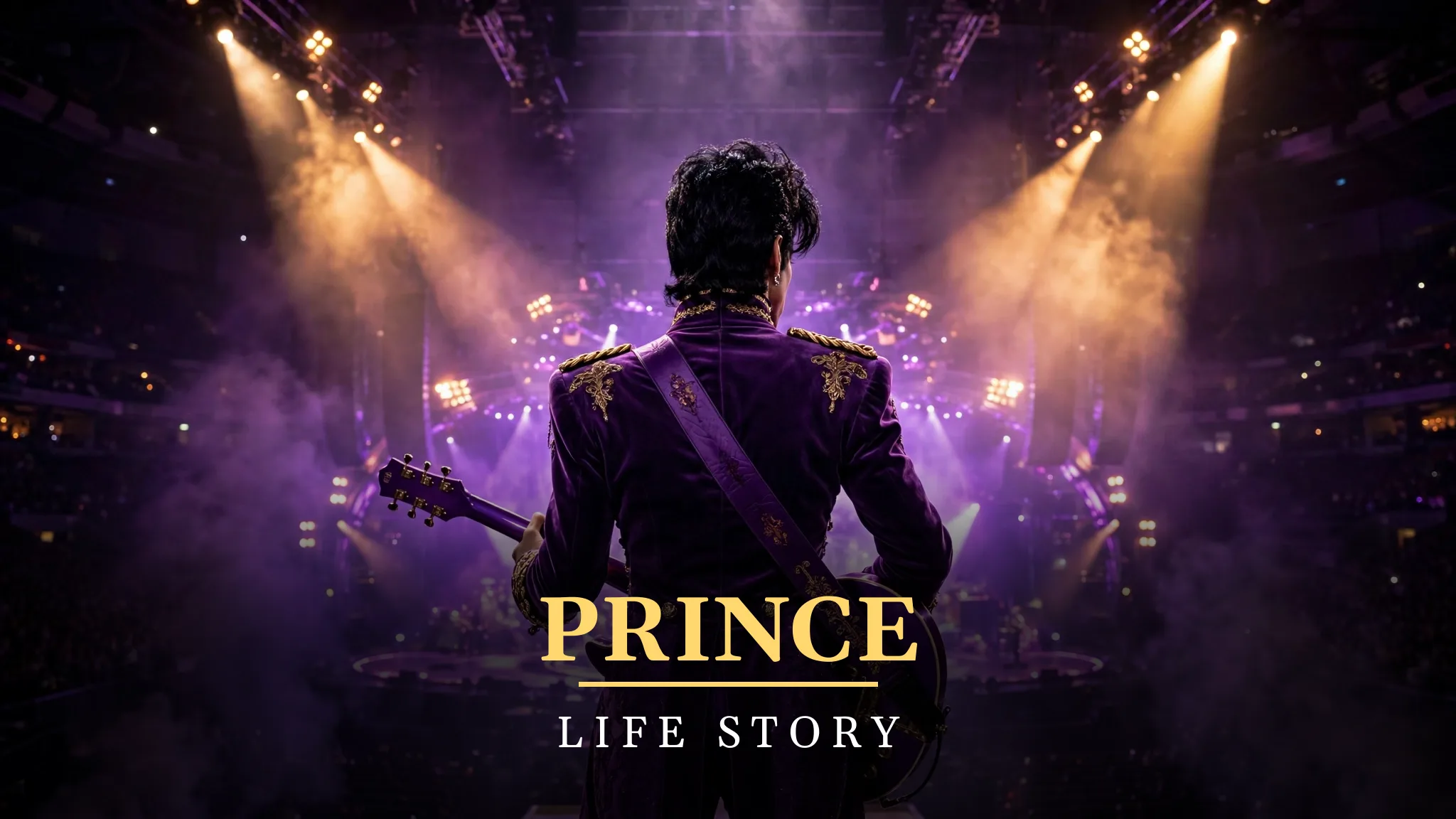
One last memory: the image of him in a purple suit, playing a purple guitar, on a stage bathed in purple light, with a smile that is both cool and warm, and that is unforgettable. That image is iconic, and it is beautiful, and it is the image that will define him forever. He was the Purple Genius, and he was Prince, and he was the man who made Purple Rain.
His legacy will live on through his albums, through his guitar, and through the generations of musicians he inspired, who heard his guitar and wanted to play the way he played. That is a fitting legacy for a man who defined purple, and who did it with a guitar and a voice that will never be forgotten. He is gone, but his music remains, and his name will be remembered as one of the greats.
Finally, I want to say thank you, Prince, for Purple Rain, for 1999, and for a life lived with a purple guitar. You were a great musician, and you were a great man, and the world is a better place because you were in it. Your music is still here, your legacy is still here, and your example is still here, and that is a life that mattered, and a life that will never be forgotten.
And one more thing: if you are a musician, play like Prince, because he is the musician every musician deserves to be, a musician who plays with his heart, and who makes an audience feel. Play like Prince, the way Prince played, and the world will be a better place for it, because the world needs more musicians like him, who play with talent, with passion, and with humanity.
There is a last lesson in his life that I carry with me, and it is this: do it yourself, even when it is hard, because doing it yourself is a choice, and Prince chose it, every day, in every album, and in every part of his life. That is a lesson worth remembering, and it is one I will carry with me, always, because the world needs more people like Prince, who do it themselves, and who do it better than anyone.
One final thought: his Academy Award for Purple Rain, won in 1985, is a testament to his talent as a musician, because he won it for Best Original Song Score, for a film and an album that became a huge success, and that is a record that speaks for itself. He was great, as a musician, and he was great as a filmmaker, and that is a range that few musicians possess, and it is a reminder that Prince was not just a singer, he was an artist, and a great one, and that is a legacy that will never be forgotten.
And if you ever doubt that one person can make a difference, remember Prince, because he did, as a musician, and as an artist, and his difference is still felt today, in every pop song, in every funk song, and in every person who loves music, and that is a legacy that will last, long after his guitar is heard, because his music is still here, and his influence is still here, and that is a gift that will never fade.
There is one more thing I want to say, and it is about his vault, because he recorded hundreds of songs, that were never released, and that are still in his vault, at Paisley Park, and that is a beautiful thing, and it is a part of his story that shows him as a musician, not just as a star, and that is a legacy that matters, in its own way, alongside his albums and his guitar, because his vault is his greatest legacy, and it will be released, for generations, and it will keep his music alive, long after his death, and that is a gift that will never fade.
His story also reminds me that a shy boy from Minneapolis can become a legend, if he has talent, determination, and a purple guitar, and that is a hopeful message for anyone who feels shy, or bullied, or different. Prince was shy, and he was bullied, and he became one of the greatest musicians in history, because he embraced who he was, and he used his talent to become great. That is a lesson worth remembering, for every shy person out there, and for every person who dreams of being a musician.
I also want to mention his father, John, because he was a jazz musician, and he taught Prince about music, and about life, and he was, in many ways, the driving force behind his early life, and that is a reminder that a father’s love can change a life, and that Prince was lucky to have a father who loved music, and who shared it with him, and that is a beautiful thing, and it is a part of his story that shows the power of a father’s love, and of a family that cares, even when it is difficult.
And finally, I think about the fact that he died at 57, and that he had so much more to give, and that is a reminder that life is short, and that we should make the most of it, the way Prince did, playing with a purple guitar, and living a life that was both beautiful and tragic, and that is a life worth living, and a life worth remembering, and I am grateful to have learned about it, and to have shared it with you.
Frequently Asked Questions
When was Prince born?
Prince was born on 7 June 1958 in Minneapolis, Minnesota, USA, as Prince Rogers Nelson. His father was a jazz musician and his mother a singer, and he taught himself many instruments as a child.
What is Prince most famous for?
He is most famous for Purple Rain (1984), a film and album that won an Oscar, and for 1999, Sign o’ the Times, When Doves Cry, and playing 27 instruments on his recordings.
How many instruments could Prince play?
He was credited with playing 27 instruments, and on his debut album For You (1978) he played every instrument himself, a feat he repeated throughout his career.
Why did Prince change his name to a symbol?
In 1993 he changed his name to an unpronounceable symbol in protest against Warner Bros., who he felt owned his name and music. He was known as The Artist Formerly Known as Prince until 2000.
When did Prince die?
He died on 21 April 2016 in Chanhassen, Minnesota, at the age of 57, of an accidental overdose of fentanyl, at his Paisley Park studio complex.
What is Paisley Park?
Paisley Park is the studio complex Prince built in Chanhassen, Minnesota, in 1987, where he lived, recorded, and performed. It is now a museum and pilgrimage site for fans.


