Qin Hao: The Life Story Behind China's Art Film Star
In this post
- Growing Up in Shenyang, a City of Factories
- The Art Film Years and Spring Fever
- The Bad Kids and a Whole Country Notices
- The Long Season and a Taxi Driver’s Sad Life
- Marriage, Family, and a Quieter Private Life
- Choosing Scripts With Care After Fame
- Why His Story Stands Out
- The Festival Years and What They Taught Him
- My Take:
Qin Hao is an actor who spent most of his career being admired by a small number of people, and then suddenly became famous with almost everyone. For years, he was the favourite actor of art-house directors, the man they called when they wanted a film that would play at festivals in Cannes and Berlin. Ordinary television viewers did not know his name. Then, in 2020, he played a quiet mathematics teacher with a dark secret in the drama The Bad Kids, and millions of people who had never watched an art film began to talk about him. Two years later, he played a broken taxi driver in The Long Season, and the talk grew even louder. He was forty-two years old when the whole country finally noticed him.
He was born in 1978 in Shenyang, the capital of Liaoning province in north-east China. Shenyang is a big industrial city, known for its cold winters and its factories. Qin Hao grew up there, far from the film world, and he found his way to the Central Academy of Drama in Beijing. He was a serious student, and a serious actor, and he chose the hardest path in Chinese cinema: the path of the art film, where the money is small, the audiences are small, and the work is demanding. He walked that path for almost twenty years before the mainstream caught up with him.
His story is a story about staying true to a difficult choice. Many actors start in art films and then move to commercial work as soon as they can, because that is where the money is. Qin Hao stayed. He stayed because he believed in the films, and because he believed that a good performance in a small film was worth more than a careless performance in a big one. When fame finally came, it came to a man who was ready for it, and who had nothing to be ashamed of in the work behind him.
Growing Up in Shenyang, a City of Factories
Shenyang sits in the north-east of China, a city built on heavy industry, with long winters and a practical, down-to-earth character. Qin Hao was born there on 20 December 1978. His childhood was ordinary in the best sense of the word. He went to school, he played with friends, and he lived in a city where people worked hard and did not make a show of it. There was nothing in his early life that suggested he would become a film actor, and certainly nothing that suggested he would one day be known at film festivals around the world.
He was a quiet boy, and a thoughtful one. He liked to watch people, and he liked stories. As he grew older, he began to think about performance, about what it would be like to stand in front of people and become someone else for a while. It was a strange dream for a boy from Shenyang, but it was a strong one. He worked towards it in the way that Chinese students work towards a hard goal: he studied, he prepared, and he took the entrance exams for the best drama schools in the country.
The Central Academy of Drama in Beijing accepted him, and the move south changed his life. Beijing was bigger, busier, and full of people who wanted to be actors. Qin Hao arrived as a young man from the north-east, with a calm manner and a serious face. He was not the loudest student, and he was not the most handsome. He was the one who listened, who thought before he spoke, and who took the work seriously. His teachers noticed that. They saw a young man who understood that acting is not about showing off. It is about understanding a person from the inside.
At drama school, he trained in voice, movement, and stage work, like all his classmates. But he also began to form his own taste in films. He was drawn to the serious, slow films of directors who cared more about truth than about entertainment. He watched films from China and from other countries, and he learned that a film could be quiet and still be powerful. That taste would shape his whole career, for better and for worse. It would give him great roles in great films, and it would also keep him away from fame for a very long time.
The Art Film Years and Spring Fever
After graduation, Qin Hao did not chase television fame. He went into art films, working with directors who made small, personal, and often difficult films. These films did not make much money. They played at festivals, they won prizes, and they were watched by a small audience of people who loved serious cinema. Qin Hao was at home in that world. He liked the slow pace, the long takes, and the space to build a character in detail. He liked working with directors who would spend a whole day on one scene to get it right.
His most important early film was Spring Fever, directed by Lou Ye and released in 2009. The film told a story of love and longing in modern China, and it was shown in competition at the Cannes Film Festival, one of the most important film festivals in the world. Qin Hao played one of the central characters, a man caught in a complicated and painful love affair. The film was bold, and it was controversial, and it asked a great deal of its actors. Qin Hao gave it everything he had, and his performance was praised by critics who saw it.
Spring Fever did not make him famous in China. Art films rarely do. But it made him known to directors and to festival audiences around the world. He became the kind of actor that serious directors wanted to work with, because they knew he would not ask for an easier part, and he would not complain about a long shoot or a difficult scene. He worked with Lou Ye again, and with other directors of the same kind, building a list of films that were respected, even if they were not widely seen.
Those years were hard in a practical sense. Art films pay little, and an actor who works only in art films does not earn much money. Qin Hao lived simply, and he kept working. He believed that the films mattered, and that belief carried him through the years when his friends from drama school were becoming television stars and earning far more than he was. He did not envy them, at least not in public. He had chosen his path, and he was willing to walk it, even when it was lonely.
The Bad Kids and a Whole Country Notices
The change came in 2020, with the television drama The Bad Kids. The series was a crime story about three children who witness a murder, and the man who tries to cover it up. Qin Hao played Zhang Dongsheng, a mathematics teacher who seems quiet and kind at first, and who turns out to be capable of terrible things. It was a part that needed an actor who could be gentle and frightening at the same time, and Qin Hao was perfect for it.
The drama became a huge hit. People watched it at home, they talked about it online, and they argued about Zhang Dongsheng. Was he a bad man, or a sad man? Was he a victim of his own life, or a villain who chose to do wrong? Qin Hao played him in a way that made both readings possible. He did not play a monster. He played a man who was polite, who smiled, who taught mathematics, and who hid a dark secret behind that polite smile. That made him far more frightening than a loud villain would have been.
Suddenly, Qin Hao was famous. People who had never heard of Spring Fever knew his face. They knew the way he climbed a mountain in the drama, a scene that became famous on its own. They quoted his lines. They made jokes about him online. He was forty-one years old, and he had become a star overnight, after twenty years of work. It was a strange feeling, and he handled it with the same calm that he brought to his acting. He did not act like a man who had been waiting for fame. He acted like a man who was surprised by it, and a little bit amused.
The success of The Bad Kids also changed the way the industry saw him. Directors who had once thought of him as only an art-film actor now saw that he could carry a popular drama. Television companies wanted him for their biggest projects. He had crossed over from the small world of festivals to the big world of mass television, without giving up the seriousness that had made him good in the first place. That is a rare crossing, and very few actors manage it.
The Long Season and a Taxi Driver’s Sad Life
If The Bad Kids made Qin Hao famous, then The Long Season, released in 2023, made him beloved. In the drama, he played Gong Biao, a taxi driver in a small city in the north-east, a man whose life has fallen apart in slow and painful ways. Gong Biao was once a promising young man. He lost his job, he lost his health, and he lost his place in the world. He drives his taxi through the streets of a city that is also falling apart, and he tries to hold on to a little bit of dignity.
The role asked Qin Hao to gain weight, to look older, and to play a man who is tired in every part of his body. He did it without complaint, and the result was one of the most praised performances in recent Chinese television. Audiences wept for Gong Biao, even though he was not a hero. He was an ordinary man who had been beaten down by life, and who kept going anyway. People in the north-east recognised him at once. They had seen men like Gong Biao in their own streets, in their own families. Qin Hao had played a man they knew.
The Long Season was also a story about time. It moved backwards and forwards through the years, showing how a group of friends had changed, how a city had changed, and how promises made in youth had faded. Qin Hao was at the centre of that story, and he carried it with a quiet sadness that never turned into self-pity. He let the audience feel the weight of the years, without telling them how to feel. That restraint is the mark of a great actor. A lesser actor would have cried in every scene. Qin Hao cried rarely, and when he did, it mattered more.
The drama won praise from critics and from audiences, and it won awards. It also confirmed that Qin Hao’s fame was not a one-time accident. He had followed The Bad Kids with a performance that was just as strong, in a completely different kind of role. Zhang Dongsheng was a cold and frightening man. Gong Biao was a warm and broken man. Qin Hao played both with the same honesty, and he showed that his range was far wider than anyone had guessed. He was no longer only an art-film actor. He was one of the best actors in China, in any kind of work.
Marriage, Family, and a Quieter Private Life
Qin Hao’s private life has been more public than that of some actors, because his wife is also a well-known person. He married Yi Nengjing, a singer and actress from Taiwan, in 2015. She is older than he is, and their marriage was talked about a great deal when it began. People wondered if it would last. It has lasted, and they have a daughter together. Qin Hao has spoken about his family with warmth, and he has said that becoming a father changed the way he thinks about his work and his life.
He has also spoken, in a careful way, about the pressures of his career. He has said that the years of art films were hard, and that he sometimes wondered if he had made the wrong choice. He has said that fame, when it finally came, was both welcome and strange. He did not become a different person when he became famous. He stayed the same calm, serious man he had always been. That steadiness has helped him to handle the attention without losing himself.
His wife’s career has also been part of his story. Yi Nengjing is a strong and outspoken person, and she has supported him through the long years when his work was not widely known. Their marriage is a partnership of two people who understand the film and music worlds, and who have both known success and disappointment. That understanding matters, because it means they do not have to explain their work to each other. They already know what it costs.
In recent years, Qin Hao has also become known as a father who is involved in his daughter’s life. He has shared small moments of family life in public, without turning his family into a show. He seems to have found a balance that many famous people never find: he works hard, he is famous, and he still has a private life that belongs to him and his family. That balance is not easy to hold, and it is worth respecting.
Choosing Scripts With Care After Fame
Fame brings a new problem: too many offers. After The Bad Kids and The Long Season, Qin Hao was offered a great many scripts, and not all of them were good. He has been careful about which ones he takes. He has said that he looks for a script that feels true, a character that feels like a real person, and a director who cares about the work. He does not take a part only because it pays well, and he does not take a part only because it will keep him famous. That care is the same care he showed in his art-film years, and it is the reason his recent work has stayed strong.
He has continued to work in both television and film, taking roles that stretch him in different directions. He has played policemen, fathers, and men caught in difficult moral choices. He has also returned to the kind of serious, slow work that made his name in the first place. He has not forgotten the art films, even now that he is famous. He has kept one foot in that world, because it is the world that taught him how to act.
The risk for an actor in his position is that fame will make him safe. When a person becomes famous, they can start to protect their image, taking only the roles that will please the audience. Qin Hao has tried not to do that. He has taken roles that are uncomfortable, roles that show a man at his worst, roles that might make some viewers dislike him. That willingness to be disliked is a sign of a serious actor. It means he cares more about the truth of the character than about his own popularity.
His career is now at a strong point, and it is likely to stay strong for many years. He has the respect of directors, the love of audiences, and a list of great roles behind him. He has also kept the thing that made him special in the first place: a belief that acting is about truth, not about fame. That belief carried him through twenty quiet years, and it is carrying him now through the loud years. It is the thread that runs through his whole story, from Shenyang to Cannes, from Spring Fever to The Long Season.
Why His Story Stands Out
Qin Hao’s story stands out because it is a story of two careers in one life. The first career was in art films, admired by few, unknown to most. The second career is in popular television, watched by millions. Most actors have only one of those careers. Qin Hao has had both, and he has done both well. That is rare, and it is worth thinking about. It means that he did not have to give up his seriousness to become popular. He became popular by being serious, and by trusting that audiences would recognise good work when they saw it.
It also stands out because of the time it took. He was forty-one when The Bad Kids made him famous. By that age, many actors have already had their best years, or have given up. Qin Hao was just getting started in the eyes of the public, even though he had been working for twenty years. His story says that a person’s best work can come late, and that the years of waiting are not wasted years. They are the years when the skill is built, when the patience is learned, and when the actor becomes ready for the part that will change everything.
For young actors, his story is both a warning and a hope. It is a warning that choosing art films is a hard path, with little money and little fame. It is a hope that the hard path can still lead somewhere, and that the work itself is worth doing, even when nobody is watching. Qin Hao’s life is proof that honest work is not wasted, even if the reward comes twenty years late. The reward came, and it came to a man who deserved it, because he had earned it many times over, in small cinemas and at faraway festivals, long before the whole country knew his name.
The Festival Years and What They Taught Him
Before he was famous on television, Qin Hao spent many years travelling to film festivals around the world. He went to Cannes, to Berlin, and to other festivals, with films that were small, serious, and often difficult. Those festivals are a different world from Chinese television. The audiences are smaller, the films are slower, and the talk is about art, not about ratings. Qin Hao lived in that world for almost twenty years, and it shaped him in ways that still show in his work today.
At a festival, an actor learns to talk about a film in a serious way. Reporters ask about the meaning of a scene, about the director’s ideas, and about the choices an actor made. They do not ask about gossip, or about ratings, or about who is dating whom. They ask about the work, and Qin Hao learned to answer those questions with care. He learned to think about his characters deeply, to understand why they do what they do, and to explain his choices in a thoughtful way. That habit of thinking deeply about a character is one of the reasons his performances are so rich. He does not play a part on the surface. He thinks about it, from the inside, until he understands it fully.
Festivals also taught him patience. A film that plays at Cannes may not be seen by a large audience for months, or for years. An actor who works in festivals must learn to wait, to trust that the work will find its audience in time, even if it takes a long time. Qin Hao learned that patience, and he carried it into his television career. When The Bad Kids became a hit, he did not act surprised. He had waited for twenty years, and he knew that good work finds its audience, sooner or later. That patience is rare, and it is one of the most valuable things he learned in the festival years.
He also learned something about the world from travelling to festivals. He met directors, actors, and audiences from many countries, and he saw how films are made in different places. He learned that a good story is a good story everywhere, and that a quiet, honest performance can move people in any language. That knowledge gave him confidence, and it gave him a wider view of acting than many Chinese television actors have. He was not only a Chinese actor. He was a world actor, in a small way, and that worldliness shows in the calm and the depth of his performances today.
My Take:
I think Qin Hao’s story is one of the most hopeful stories in Chinese acting, and the reason is simple: he waited twenty years, and the wait was worth it. I say that carefully, because I know that not every wait is worth it. Some people wait and wait, and nothing comes. But Qin Hao’s wait was not empty. He was not sitting at home doing nothing. He was working, in small films, at festivals, in roles that taught him his craft. When I think about his life, I do not think of a man who was unlucky for twenty years and then lucky for one year. I think of a man who was building something for twenty years, and then the world finally saw what he had built. That is a different way of looking at it, and I think it is the truer way.
What I admire most is that he did not give up his taste to become famous. He liked serious, slow, art films. Those films did not make him rich. They did not make him famous. A lot of people would have looked at that and said, this is not working, I need to change. Qin Hao did not change. He kept making the films he believed in, and he trusted that his taste was right. I think that takes a kind of courage that is easy to praise and hard to practise. It is easy to say, be true to yourself. It is hard to be true to yourself when the rent is due and your friends are earning ten times more than you. Qin Hao did it, and I respect him for it, because it shows that he was not acting for money or for fame. He was acting because he believed in the work.
I also think about the two roles that made him famous, and what they say about him. Zhang Dongsheng in The Bad Kids is a frightening man, a man who smiles and teaches mathematics and hides a terrible secret. Gong Biao in The Long Season is a broken man, a taxi driver who has lost almost everything and keeps going anyway. Those two men could not be more different. One is cold. One is warm. One is dangerous. One is sad. Qin Hao played both, and he played both with complete honesty. I think that tells us something important about his talent. He is not a one-note actor. He does not play the same man in every film. He finds the truth of each man, even when the men are opposites. That is the mark of a real actor, and it is why I believe his fame will last. An actor who can only play one kind of person will fade when fashion changes. An actor who can play many kinds of people will always have work.
There is a sad part to his story too, and I want to name it honestly. The sad part is the twenty years when almost nobody knew his name. He was doing great work, and the great work was seen by a few hundred people at a festival, while a careless television drama was seen by millions. That is not fair, and it is not a good way for a country to treat its artists. I think about all the other actors like him, the ones who are still waiting, the ones who are still making serious work that nobody sees. Some of them will never get their Bad Kids moment. Some of them will work all their lives without fame. I do not want to pretend that Qin Hao’s story proves that everyone who works hard will be rewarded. It does not prove that. It proves that one man who worked hard was rewarded, and that is a good thing, but it is not a promise. I think we should be honest about that, because false hope is not kind. The honest hope is different. It is that the work itself is worth doing, even if the reward never comes, because the work makes you better, and it makes the world a little bit richer, even if only a few people see it.
I think about his private life as well, and about his marriage to Yi Nengjing. People talked about their age difference, and about whether the marriage would last. I do not think that talk was fair, and I do not think it was kind. Two adults can love each other, and their ages are their own business. What matters is that they have stayed together, and that they have raised a daughter together, and that they have supported each other through hard years. I admire that, because a marriage in the public eye is hard to keep. Everyone has an opinion. Everyone is watching. Qin Hao and his wife have kept their marriage alive in spite of that, and I think that takes the same patience that his career took. Patience is not only a professional skill. It is a personal one too.
I want to say something about the north-east, because Qin Hao is from Shenyang, and The Long Season is set in the north-east, and I think that matters. The north-east of China was once the industrial heart of the country, and in recent decades it has gone through hard times. Factories closed. Jobs were lost. Cities became quieter. Gong Biao, the taxi driver, is a man from that world. He is a man who had a good job once, and then lost it, and then tried to make a new life. Qin Hao played him with a deep understanding, because he grew up in that world. He knew the cold, the factories, and the feeling of a place that was once proud and is now struggling. I think that is why the performance felt so true. It was not an actor pretending to be from the north-east. It was a man from the north-east playing a man from the north-east, and the truth showed.
The lesson I take from Qin Hao is about the value of a slow career. We live in a time when everyone wants to be famous fast. Young people want a million followers in a month. They want a viral video, a quick success, a shortcut. Qin Hao’s life says that there is another way, a slower way, and that the slower way can lead to something deeper. He did not go viral. He did not become famous in a month. He worked for twenty years, and then he became famous, and the fame was built on real skill, not on a trick. I think that is a better kind of fame, because it cannot be taken away by a change in fashion. Skill stays. Tricks fade. If I could give one piece of advice to a young person who wants to be an actor, or a writer, or a singer, or anything else, it would be this: learn your craft properly, do the hard work when nobody is watching, and do not measure your life by how fast others are moving. Measure it by how good your work is getting. Qin Hao measured his life that way, and in the end, the world caught up with him.
Finally, I want to say that his story makes me feel hopeful, not only for actors, but for everyone who feels invisible. If you are doing good work and nobody notices, it is easy to feel that the work does not matter. Qin Hao’s story says that it does matter, and that the world may notice later than you hope, but that the work itself is never wasted. I do not know if that is always true. I know that it was true for him. And I know that the work he did in those quiet years made him the actor he is now. Without Spring Fever, there would be no Zhang Dongsheng. Without twenty years of practice, there would be no Gong Biao. The quiet years were not a waste. They were the foundation. And that, more than anything else, is why I will remember Qin Hao’s story, and why I think you should remember it too.
I also think about the way Qin Hao’s face changes between his two most famous roles, because it tells us something important about his talent. As Zhang Dongsheng in The Bad Kids, his face is calm, polite, and a little bit cold. He smiles, but the smile does not reach his eyes. As Gong Biao in The Long Season, his face is tired, soft, and a little bit broken. He smiles rarely, and when he does, it is a sad smile. Those two faces could not be more different, and they belong to the same man. That is the mark of a great actor. He does not bring the same face to every role. He finds a new face for each character, a new way of holding himself, a new way of looking at the world. I think that is a rare gift, and it is one that takes a great deal of work. It is easy to play yourself, again and again, in different clothes. It is hard to become a different person, each time, and to make the audience believe it. Qin Hao does that, and he does it without showing off. He simply becomes the man, and the audience forgets that they are watching an actor. That is the highest praise I can give, and it is praise that Qin Hao has earned many times over.
I want to think, too, about what his story says about the north-east of China, because it matters more than people think. Qin Hao is from Shenyang, and The Long Season is set in the north-east, in a small city that is falling apart, like many cities in the region. The north-east was once the industrial heart of China, full of factories, jobs, and pride. In recent decades, many of those factories have closed, many jobs have been lost, and many cities have become quieter. Gong Biao is a man from that world. He had a good job once, and then he lost it, and then he tried to make a new life as a taxi driver. Qin Hao played him with a deep understanding, because he grew up in that world. He knew the cold, the factories, and the feeling of a place that was once proud and is now struggling. I think that understanding is why the performance felt so true. It was not an actor pretending to be from the north-east. It was a man from the north-east, playing a man from the north-east, and the truth showed. That is a reminder that where we come from matters, and that our home can be our greatest strength as an artist, if we let it be.
There is another part of his story that I find moving, and it is the way he talks about his wife and his daughter. He has spoken about becoming a father, and about how it changed the way he thinks about his work. A man who has a child understands things that a young man cannot understand. He knows what it feels like to worry about a small person at night, to be proud of a small achievement, and to feel helpless when a child is sad. Those feelings have found their way into his later roles, especially the fathers and the tired men he has played. When he plays a man who is trying to protect his family, he is not guessing. He is drawing on his own life, and audiences can tell the difference. I think that is a beautiful thing, and it is a reminder that life itself is the best teacher an actor can have. The more you live, the more you have to draw on, and the better your work becomes. Qin Hao has lived, and his work is better for it.
I want to be honest about something else as well. Qin Hao’s fame came late, and it came suddenly, and that suddenness can be dangerous. When a person becomes famous overnight, after twenty years of quiet work, the attention can be overwhelming. People want interviews, photographs, and appearances. They want the star to be everywhere, all the time. Qin Hao has handled that attention with calm, but I wonder what it cost him. I wonder if he ever wished for the quiet years back, for the small cinemas and the festivals, where the work mattered more than the fame. I hope he has found a way to keep some of that quiet in his life, even now that he is famous. A person needs quiet, even a famous person, and especially a person whose work depends on thinking deeply about characters. I hope Qin Hao has protected his quiet, because it is the source of his best work, and without it, the work would suffer.
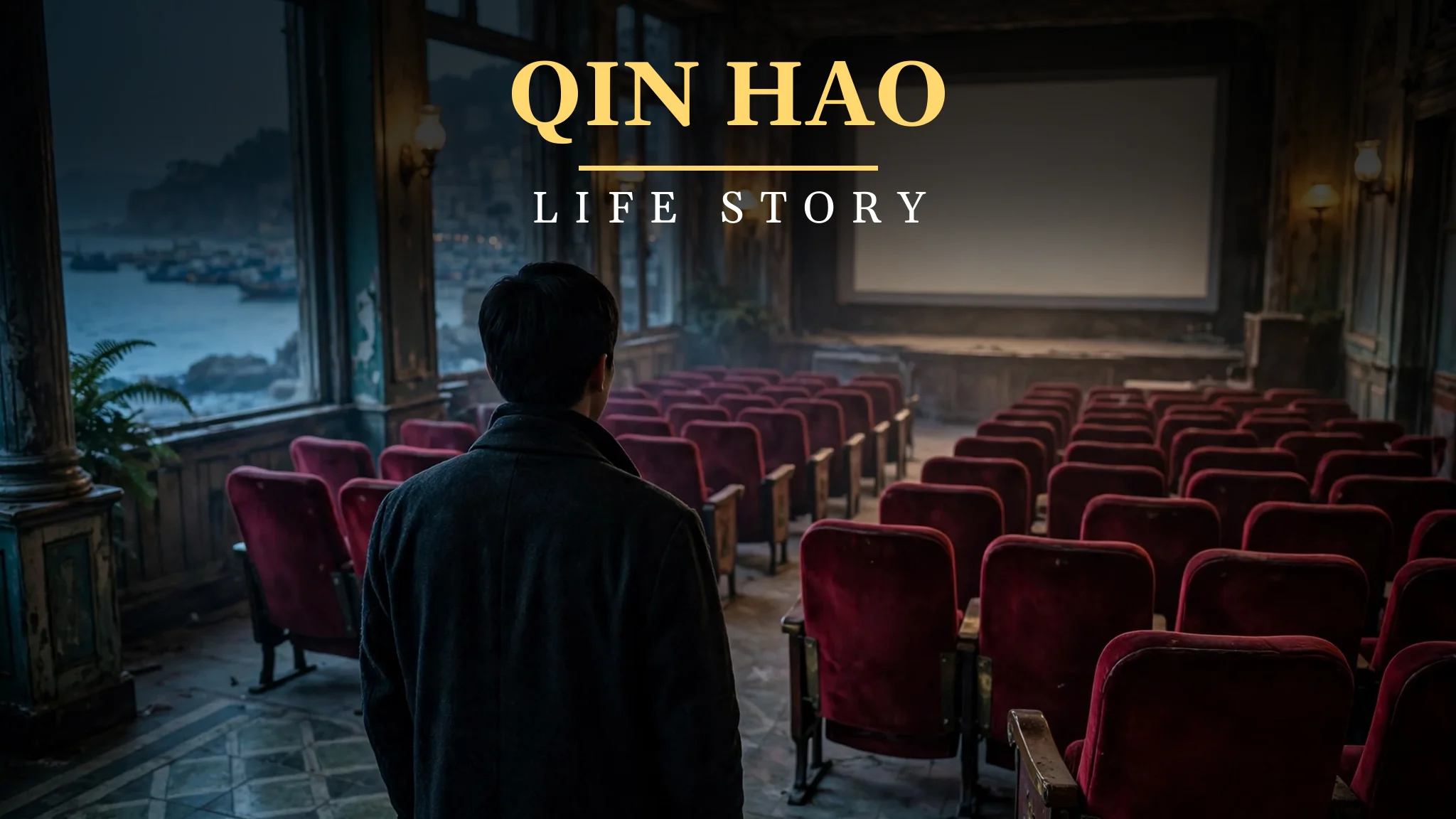
Finally, I want to return to the image of the man in the empty cinema, standing before a blank screen, which is the image on his cover. That image fits Qin Hao well, because it shows a man who is alone in a place built for stories, looking at a screen that is empty, waiting for a story to begin. For twenty years, Qin Hao waited in that empty cinema, doing the work, learning his craft, and trusting that a story would come. Then the story came, in the form of The Bad Kids, and then The Long Season, and the screen was no longer empty. It was full of his face, his voice, and his talent. I think that is a beautiful image, and it is a hopeful one. It says that waiting is not wasted, that an empty screen is not a failure, and that a story will come, if you are ready for it. Qin Hao was ready, and his story came, and it is still being told. That is why I will remember him, and why I think you should remember him too.
Frequently Asked Questions
Who is Qin Hao and what made him famous?
Qin Hao is a Chinese actor born in 1978 in Shenyang, Liaoning. He was known for years as an art-film actor, then became famous across China as Zhang Dongsheng in The Bad Kids in 2020, and as Gong Biao in The Long Season in 2023.
Where did Qin Hao study acting?
He studied at the Central Academy of Drama in Beijing. After graduation he chose to work mainly in art films, including Spring Fever, which played in competition at the Cannes Film Festival in 2009.
What is The Bad Kids about and who does Qin Hao play?
The Bad Kids is a crime drama about three children who witness a murder. Qin Hao plays Zhang Dongsheng, a quiet mathematics teacher who seems kind at first and is hiding a dark secret, a role that became one of the most talked-about in Chinese television.
Who is Qin Hao in The Long Season?
In The Long Season, Qin Hao plays Gong Biao, a taxi driver in a small north-eastern city whose life has fallen apart over the years. The performance was widely praised for its sadness, honesty, and realistic portrayal of an ordinary man.
Who is Qin Hao married to?
He married singer and actress Yi Nengjing in 2015. They have a daughter together, and their marriage has been much discussed in public because Yi Nengjing is older than Qin Hao, though the couple have stayed together for many years.
How old is Qin Hao?
Qin Hao was born on 20 December 1978, so he was forty-seven years old in 2026. He became widely famous in his early forties, after almost twenty years of work in art films and smaller productions.
What kind of films did Qin Hao make before he became famous?
Before his television fame, he worked mainly in art films with directors such as Lou Ye, including Spring Fever in 2009. Those films played at international festivals and won critical praise, but they reached only small audiences in China.


