Rabeh Saqer: The Life Story Behind Saudi Arabia's Music Star
In this post
- Al-Ahsa: Palms, Water, and the First Songs
- The Falcon Takes Flight
- Cassettes, Radio, and a Kingdom That Sang Along
- Riyadh, Jeddah, and the Big Stages
- A Voice That Bridges the Old and the New
- Forty Years On: Still Filling Stadiums
- The Eastern Province Sound He Carries Everywhere
- Weddings, Families, and Songs That Belong to Everyone
- My Take:
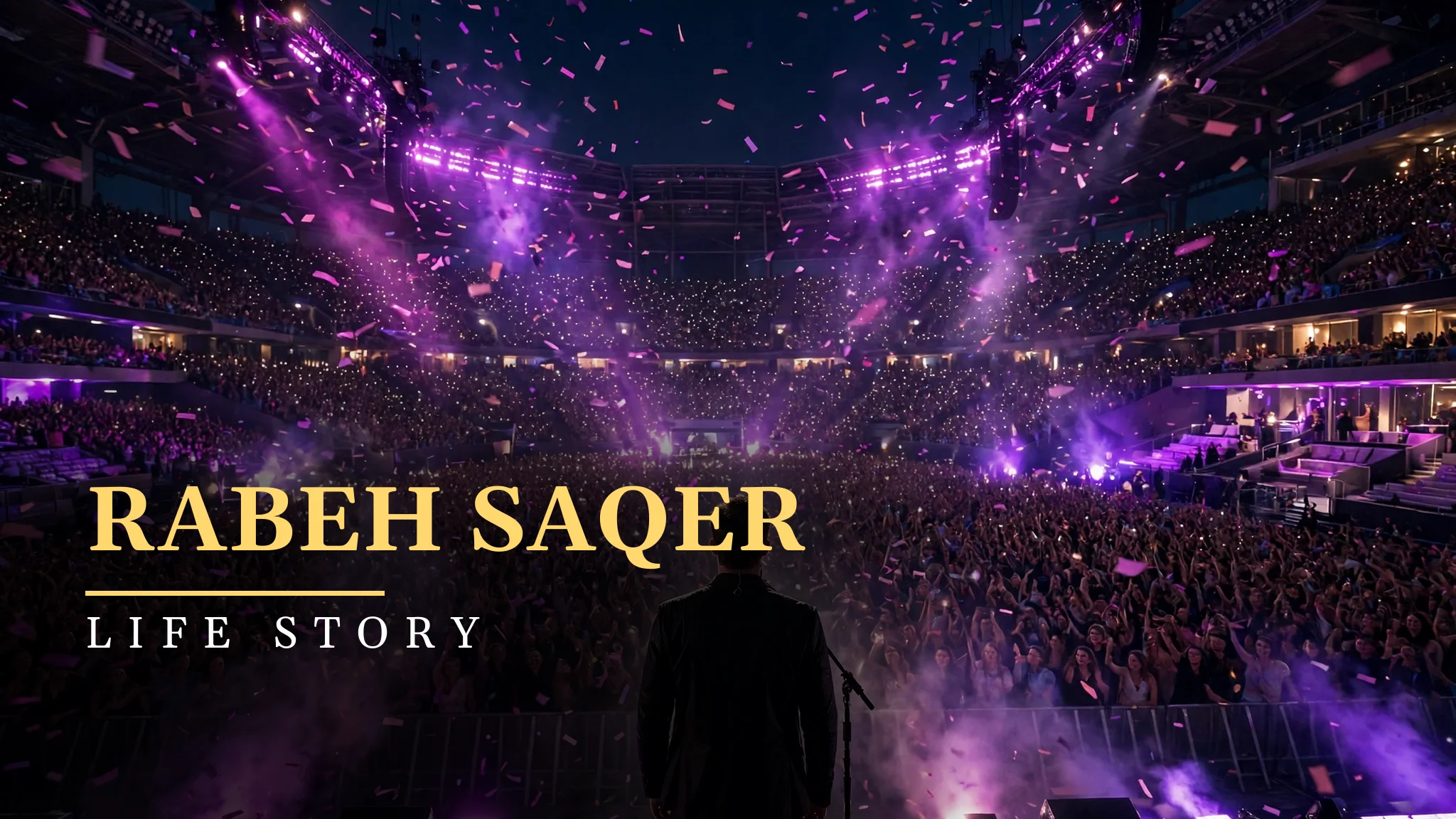
Stand in a Riyadh stadium at night, when the lights go purple and the confetti starts to fall, and you will see forty thousand people on their feet, singing along to a man in a black suit who has his back to the camera and his face to the crowd. That man is Rabeh Saqer, and the crowd is singing because they know every word. They know the words because his songs have been with them for forty years, on cassettes in cars, on radio in the morning, on television at festivals, and now on phones. A singer who is still filling stadiums after four decades has done something rare, and Rabeh Saqer’s story is the story of how that happened, and of how a boy from the oases of Al-Ahsa became the falcon of Saudi pop.
His surname means falcon, and it fits him. A falcon is fast, it is sharp-eyed, and it does not miss. Rabeh Saqer’s career has been like that: quick to catch a new sound, sharp in knowing what an audience wants, and never missing a chance to grow. He has sung for kings and for crowds, for festivals and for weddings, and his voice has become one of the most recognisable sounds in the Gulf. This is how that voice was made, and how it has stayed in the air for so long.
Al-Ahsa: Palms, Water, and the First Songs
Al-Ahsa is not the first place people think of when they think of Saudi music, but it should be. It is an oasis in the Eastern Province, a green place of palm groves and springs in a country that is mostly desert, and it has a music of its own, with rhythms from the sea, from the pearl boats, and from the villages that have stood there for centuries. Rabeh Saqer came into the world there on 21 June 1964, and the sounds of Al-Ahsa went into his ears before he could read or write. He heard drums at weddings, he heard singers in the palm groves, and he heard the melodies that fishermen and farmers had sung for generations. Those sounds stayed in him, and they can still be heard, underneath the modern production, in the songs he sings today.
Growing up in an oasis taught him something that a boy in a big city might never learn: that music belongs to a place, and that a place can be heard in a voice. The Eastern Province has always been different from the rest of Saudi Arabia, closer to the sea, closer to Bahrain and the Gulf, and its music reflects that difference. It is warmer, it is more rhythmic, and it moves with a sway that comes from the water. Rabeh learned that sway as a child, not from lessons, but from living in it, from hearing it every day, from breathing it in with the air of the oasis.
He was a teenager when he began to sing seriously, in the early 1980s, when Saudi music was changing. Cassettes were everywhere, radio was powerful, and a young singer could be heard across the Kingdom without ever leaving his town. Rabeh made his first recordings as a young man, and people noticed that his voice was different: it was strong, it was clear, and it had a confidence that most young singers did not have. He did not sound like he was copying anyone. He sounded like himself, a young man from Al-Ahsa with a voice that could carry a melody across a stadium.
Those first years were a test. The Kingdom had many singers, and the competition was fierce. A new voice had to prove itself again and again, at weddings, at festivals, and on radio, before anyone would remember its name. Rabeh proved himself by singing, night after night, and by choosing songs that people wanted to hear again. He did not try to be clever. He tried to be true, and he tried to be good, and those two things, done night after night, are what turned a boy from an oasis into a name that the whole Gulf would know.
The Falcon Takes Flight
People in the Gulf call him Saqer, the falcon, and the name is not a nickname that a manager invented. It is his own name, and it is a name that describes the way he works. A falcon does not wait for its prey to come to it. It sees from far away, it moves fast, and it strikes with precision. Rabeh has worked that way through his whole career: he has seen changes in music coming before others saw them, he has moved quickly to try new sounds, and he has done it with a precision that has kept his songs on the radio for decades.
In the 1980s and 1990s, Saudi pop was changing fast. New instruments were arriving, new production was making songs sound bigger, and audiences were growing younger. Rabeh did not resist those changes. He welcomed them. He began to make songs that took the rhythms of the Gulf and dressed them in the sounds of modern pop: drums that hit harder, keyboards that sparkled, and arrangements that filled a stadium. His voice, strong and clear, sat on top of those arrangements like a falcon riding a wind, and the combination worked. Young listeners loved it, and older listeners recognised the Gulf in it, even under the new sounds.
He also learned to perform for large crowds, which is a different skill from singing in a studio. A stadium is a huge, noisy place, and a singer has to fill it with his voice and his presence. Rabeh learned to walk a stage, to talk to a crowd, and to make forty thousand people feel that he was singing to each one of them. That is a rare gift, and it is why his concerts are remembered. People do not only remember the songs. They remember the feeling of being there, of standing in a crowd that was singing together, and of a man in a black suit holding the whole night in his hands.
Through the 1990s and into the 2000s, his name grew. He became a regular at the biggest festivals in Saudi Arabia, in Riyadh and Jeddah, and his songs were played at weddings, in cars, and on the radio across the Gulf. He was no longer a young singer from Al-Ahsa trying to be heard. He was Rabeh Saqer, a star, and his voice was one of the sounds of Saudi Arabia itself.
Cassettes, Radio, and a Kingdom That Sang Along
To understand Rabeh Saqer’s rise, you have to remember a time before streaming, when a song travelled on a cassette tape. A cassette was a small plastic box, and it could be copied, shared, and played in a car, and a good cassette could travel across a whole country in a few weeks. Rabeh’s early albums travelled that way, from Al-Ahsa to Riyadh, from Jeddah to Dammam, and then across the Gulf to Bahrain, Kuwait, Qatar, and the Emirates. A listener in Bahrain could hear a song that a boy from Al-Ahsa had recorded, and sing it the next day, and that is how a regional star was made, one cassette at a time.
Radio helped too. In the 1980s and 1990s, Saudi radio was a powerful force, and a song that radio played became a song that everyone knew. Rabeh’s songs were made for radio: they were melodic, they were memorable, and they had choruses that a listener could sing after hearing them once. Radio presenters played them in the morning, when people were driving to work, and in the evening, when families were at home, and his voice became a familiar part of daily life. A voice that is heard every day becomes a voice that people trust, and Rabeh’s voice became a trusted voice in Saudi homes.
Television festivals were the third part of his rise. The Kingdom’s great festivals, in Riyadh and Jeddah, were televised, and a singer who performed well at a festival would be seen by millions. Rabeh performed at those festivals year after year, and each performance added to his reputation. He was not a singer who appeared once and disappeared. He appeared, again and again, and each time he was a little better, a little more confident, and a little more loved. That consistency, that willingness to show up and sing, is what separates a star who lasts from a star who fades.
By the turn of the century, his songs were part of the fabric of Saudi life. They were played at weddings, where couples danced to them, and at national celebrations, where they were sung with pride. A singer whose songs are played at a wedding has entered a family’s life, and Rabeh’s songs entered thousands of families. That is a kind of success that no chart can measure, and it is the kind of success that lasts, because it is woven into people’s happiest memories.
Riyadh, Jeddah, and the Big Stages
If Al-Ahsa gave Rabeh his voice, Riyadh and Jeddah gave him his stages. Riyadh, the capital, is where the Kingdom’s biggest festivals happen, where the largest crowds gather, and where a singer is judged by the toughest audiences. Rabeh has sung in Riyadh more times than he can count, in halls and stadiums that hold tens of thousands of people, and he has learned how to command a room that large. He walks onto a stage in Riyadh with the confidence of a man who has done it a hundred times, and the crowd responds to that confidence with a roar.
Jeddah is different. It is a port city, open to the sea and to the world, and its audiences are warmer, looser, and more ready to dance. Rabeh’s concerts in Jeddah have a different feeling from his concerts in Riyadh: they are more joyful, more relaxed, and more like a celebration. He loves performing in Jeddah, because the city loves music, and because its people have always welcomed him. The two cities, Riyadh and Jeddah, have shaped him in different ways, and he has given each of them something back: a voice that belongs to both, and to the whole Kingdom.
His festival performances have become landmarks. When Rabeh Saqer is on the programme, people know that the night will be special, and they come from across the Kingdom to see him. He has performed at the great national festivals, at the events that mark the Kingdom’s history, and at the celebrations that bring the country together. To be invited to those events, again and again, is a sign of trust, and Rabeh has earned that trust by never disappointing an audience. He shows up, he sings, and he gives everything he has, and the audience gives it back to him.
In recent years, the Kingdom’s entertainment scene has grown enormously, with new seasons of concerts, new venues, and new audiences. Rabeh has been a part of that growth, performing at the great new seasons in Riyadh, where the biggest stars in the world now come to sing. He has stood on those stages as a Saudi star, among international names, and he has held his own, because his voice and his songs belong to that stage as much as any singer’s do. That is a measure of how far he has come, from an oasis in the East to the biggest stages in the capital.
A Voice That Bridges the Old and the New
Listen to a Rabeh Saqer song, and you will hear two things at once. One is the Gulf, with its rhythms and its melodies, the sound of the sea and the desert that has been sung for generations. The other is the present day, with its modern instruments, its big production, and its energy. Rabeh does not keep those two things apart. He lets them live together in his songs, and the result is a sound that is both familiar and new. An older listener hears the Gulf and feels at home. A younger listener hears the energy and feels excited. Both are hearing the same song, and both are right.
That balance is hard to keep, and it is why Rabeh’s career has lasted so long. Many singers choose one side: they stay traditional and are forgotten by the young, or they go fully modern and lose the older listeners. Rabeh has refused to choose. He has kept the Gulf in his songs and the present in his production, and he has done it for forty years, adjusting the balance a little with each new album, but never abandoning either side. That is a skill, and it is a discipline, and it is one of the reasons his name is still on festival programmes today.
His voice itself is the key. It is strong, it is clear, and it has a warmth that makes even a big stadium feel intimate. When he sings a slow song, his voice holds a note and lets the feeling in it be heard. When he sings a fast song, his voice rides the rhythm and lifts the crowd. He does not need tricks. He needs only his voice, a microphone, and a stage, and the rest takes care of itself. That simplicity is the mark of a great singer, and it is what has kept him working for so long.
He has also been a generous singer, in the sense that he has given his songs to other people, to other singers, and to the Kingdom’s music as a whole. His songs are sung by others, his melodies are remembered by musicians, and his style has influenced a generation of Gulf singers who grew up listening to him. A singer who influences others has done more than make hits. He has shaped a tradition, and Rabeh Saqer has shaped the tradition of modern Gulf pop in a way that few others have.
Forty Years On: Still Filling Stadiums
It is one thing to be famous for a year. It is another thing to be famous for forty years, and to still be filling stadiums when many of the singers who started with you have stopped. Rabeh Saqer has done the second thing, and it is worth asking how. The answer is not a secret. He kept singing, he kept learning, and he kept showing up. He did not retire, he did not fade away, and he did not let the changes in music leave him behind. When streaming arrived, he was there. When new festivals began, he was there. When the Kingdom’s entertainment scene grew, he grew with it.
His longevity is also a matter of trust. Audiences trust a singer who has never let them down, and Rabeh has built that trust over decades, one performance at a time. A family that danced to his songs at a wedding in the 1990s now brings their children to his concerts, and those children grow up hearing his voice, and the cycle continues. That is how a singer becomes a part of a country’s life, not only its charts, and it is how a name becomes a household word.
He is now in his sixties, and he sings with the authority of a man who has spent a lifetime on stage. His voice has matured, his presence has deepened, and his concerts have a weight that a young singer’s concerts do not have. He does not need to prove himself anymore. He needs only to sing, and the audience knows what they are hearing: a master, a man who has given his life to music, and who has given music to his country in return.
What comes next for him is still being written, but his place is secure. He will be remembered as one of the great voices of Saudi Arabia, as the falcon of the Gulf, and as a singer who took the music of Al-Ahsa and carried it to stadiums across the Arab world. That is a legacy that no one can take away, because it is built on forty years of singing, and on the trust of millions of listeners who have carried his songs in their hearts.
The Eastern Province Sound He Carries Everywhere
There is a sound that belongs to the Eastern Province, and Rabeh Saqer carries it with him wherever he sings. It is the sound of the sea meeting the desert, of fishermen’s songs and pearl divers’ rhythms, of drums that were played in villages long before there were concert halls. That sound is warmer and more rhythmic than the music of the centre of the Kingdom, and it has a sway that comes from the water. Rabeh learned it as a boy in Al-Ahsa, and he has never lost it, even when he sings in a stadium in Riyadh with a full orchestra behind him. Listen closely to one of his songs, and you will hear that sway underneath the modern production, like a current running under a wave.
That regional sound is part of why his music is loved across the Gulf, not only in Saudi Arabia. The Eastern Province faces Bahrain, and its music has always travelled across the water, to the island and back again. Rabeh’s songs have travelled the same way, and they are loved in Bahrain, in Kuwait, in Qatar, and in the Emirates, because they speak a musical language that the whole Gulf understands. A song from Al-Ahsa can be a song for the whole Gulf, and Rabeh has proved that again and again.
He has also been a bridge between the generations of Gulf music. Older singers taught him the rhythms of the sea, and younger singers have learned from him how to take those rhythms and make them modern. He stands in the middle of that bridge, looking both ways, and his songs are the proof that a tradition does not have to die to be new. It can live, it can grow, and it can fill a stadium, all at the same time. That is what Rabeh has shown, and it is one of his greatest gifts to the music of his region.
Weddings, Families, and Songs That Belong to Everyone
A singer knows he has truly succeeded when his songs are no longer his own, when they belong to the people who sing them at weddings, at celebrations, and in their cars on the way home. Rabeh Saqer’s songs belong to the people in that way. They are played at weddings across Saudi Arabia, where couples dance to them on the happiest night of their lives, and they are sung by families at gatherings, where a grandmother and a grandchild can sing the same chorus together. A song that can be sung by two generations at once is a rare thing, and Rabeh has many such songs.
That is because his songs are about feelings that everyone knows: love, longing, pride, and home. He does not sing about things that only a few people understand. He sings about the things that everyone feels, and he sings them in a way that is direct and honest. A wedding guest does not need to know anything about music to sing along to a Rabeh Saqer chorus. He needs only to have loved someone, and to have felt what the song is saying. That is why his songs are sung by people who are not singers, in places that are not concert halls, and why they will go on being sung long after the concerts are over.
His songs have also become a part of Saudi identity, in the sense that they are played when the country celebrates itself. At national festivals, at the events that bring the Kingdom together, his voice is one of the voices that people expect to hear. That is an honour that is given slowly, over many years, and it is given only to singers who have proved that they belong to the nation, not only to the charts. Rabeh has proved it, by singing for forty years, by never leaving his audience, and by giving his songs to the people who love them.
My Take:
When I think about Rabeh Saqer, the first thing I think about is his name, Saqer, which means falcon, and how well it fits him. A falcon is a bird that flies high, that sees far, and that does not stay in one place. Rabeh has flown high for more than forty years, he has seen far, and he has never stayed in one place. He has mixed the old and the new, he has tried new sounds, and he has kept flying. I admire that, because it takes courage to keep changing, and to keep looking for new horizons, when it would be easier to stay where you are.
What I admire most about him is his energy. His concerts are not quiet evenings. They are celebrations, with lights, with sound, and with an audience that sings along. He performs with a joy that is infectious, and that joy is part of why people love him. He does not sing as if it is a chore. He sings as if it is a pleasure, and that pleasure spreads to his audience. I think that is a gift, and it is a gift that cannot be learned. It comes from loving what you do, and Rabeh loves what he does, even after forty years.
I also think about Al-Ahsa, and about how a place can shape a singer. Al-Ahsa is an oasis, a place of palms and springs, and Rabeh’s music has the warmth of that place in it. He did not come from Riyadh or Jeddah, and he did not have the advantages of a singer from a big city. He came from an oasis, and he made his name with his voice alone. That is a hopeful story for any young person from a small place. It says that where you start does not decide where you finish, if you have a gift and you work hard.
His modern Gulf pop sound is another part of his work that I admire, because it shows that tradition and change can live together. He did not abandon the Gulf rhythms, and he did not reject modern pop. He brought them together, and he made something that was both. That is a hard thing to do, because it is easy to lose the tradition when you add the new, and easy to sound old-fashioned when you keep the old. Rabeh found the balance, and he kept it for decades. That balance is his art, and it is why his music has lasted.
I think about his teenage debut, and I wonder what it must have been like to start a career so young. Most teenagers are thinking about school, about friends, and about growing up. Rabeh was already recording, already performing, and already being judged by an audience. That is a lot of pressure for a boy, and it could have broken him. Instead, it made him stronger. He learned early how to work, how to choose songs, and how to handle fame. Those lessons stayed with him, and they are part of why he has lasted so long. He grew up in public, and he grew up well.
If I am honest, I also think about the limits of his music. He is a pop singer, and his songs are made to be enjoyed, to be danced to, and to be sung along with. Some people might say that his music is not as deep as the music of a tarab singer, and that it does not move the heart in the same way. I understand that view, but I do not agree with it completely. His music moves people in a different way: it makes them happy, it makes them celebrate, and it makes them feel alive. That is also a valuable thing, and it is a thing that should not be dismissed. Not all music has to be sad to be good.
I think about the new Saudi Arabia, and about how Rabeh has been a part of its change. The country has opened up to large concerts, to festivals, and to new entertainment, and Rabeh has performed at those events, helping to show the world that Saudi music is alive. He is not only a singer of the past. He is a singer of the present, and his presence at those events shows that he is respected as a pioneer. I think that is a proud place to be, and I hope he knows how much it matters to his country.
What I learn from his life is that a career is built on change, as well as on tradition. He did not stay the same for forty years. He changed, gently, album by album, and he kept his audience with him. That is a lesson for any young person who wants a career in music: do not be afraid to change, but do not change so much that you lose yourself. Find the balance, and keep it, as Rabeh has done. That balance is the secret of a long career, and it is a secret that is worth learning.
I also think about his fans, and about the loyalty they have shown him. A fan who has listened to a singer for forty years is not a casual listener. That fan has grown up with the singer, has celebrated to his songs, and has grown old with his songs. That kind of loyalty is precious, and it is earned, not bought. Rabeh earned it by being there, by singing well, and by respecting his audience. I hope he knows how much that loyalty means, because it is the greatest reward a singer can receive.
His energy on stage also teaches me something about the value of joy. Music is not only about sadness, or about love, or about longing. It is also about joy, about celebration, and about feeling alive. Rabeh’s concerts are joyful, and that joy is a gift to his audience. In a world where there is so much sadness, a singer who can make people happy is doing something important. I think we should celebrate that, and we should not treat joy as a lesser feeling than sadness. Both matter, and Rabeh’s music reminds us of that.
I also think about the cassettes that carried his early songs, and about how music travelled in the Gulf in the 1980s. There was no streaming, no social media, and no easy way to find a new singer. A song travelled because a person played a cassette for a friend, or because a radio station played it, or because it was heard at a wedding. Rabeh’s songs travelled in that slow, human way, and they earned their fame one listener at a time. That kind of fame is stronger than the fame that comes from a single viral video, because it is built on people choosing to listen again and again.
Another thing I respect is that he did not let his success change his singing. A man who performs in stadiums could easily become distant, or proud, or careless, but Rabeh has stayed close to his audience. He still sings with the same energy, the same joy, and the same respect for his fans. That tells me that singing is not only his job. It is his love, and he would sing even if he did not need the money. That love is what his audience hears, and it is why they stay loyal to him after so many years.
I think about the young singers who look up to him, and I hope they learn the right lessons. They should learn that a voice is a gift, but that a career is built on change, on hard work, and on respecting the audience. They should learn that tradition and modernity can live together, and that a singer can be both. Rabeh’s life is a lesson in all of those things, and it is a lesson that is worth studying. He did not take shortcuts, and he did not cheat. He worked, and he earned his place.
If I had to choose one word to describe him, I would choose “falcon”. He is a falcon, a bird that flies high, that sees far, and that does not stay in one place. He has flown for more than forty years, and he is still flying. That is a beautiful image, and it is a true one. I hope he keeps flying, and I hope his music is heard for many more years, because the Gulf needs its falcon, and it has found it in him.
I also think about the future, and about what his legacy will be. His records will remain, his concerts will be remembered, and his modern Gulf pop sound will be studied by young musicians. But his greatest legacy may be the example he set: that a boy from Al-Ahsa, starting as a teenager, can become one of the most important singers in the Arab world, not by luck, but by work, by talent, and by respect for his audience. That example will inspire young singers for a long time, and it will remind them that a long career is possible, if they are willing to work for it.
In the end, I think Rabeh Saqer’s life is a reminder that music should make people happy, as well as make them feel. His songs make people celebrate, they make them dance, and they make them sing along. That is a life’s work, and it is a work to be proud of. I hope he keeps singing, and I hope his voice is heard on the biggest stages for many more years, because Saudi Arabia needs its falcon, and it has found it in him.
I also think about the Eastern Province, and about how it is present in his music. The palms, the springs, the sea, and the old towns of Al-Ahsa are all in his songs, even when they are dressed in modern arrangements. A singer who carries his home with him sings with a confidence that cannot be faked, and Rabeh carries Al-Ahsa with him onto every stage. That is a beautiful thing, and it is a reminder that where we come from never leaves us, even when we travel far.
Another lesson I take from his life is about the value of a strong voice. His voice is powerful, it is clear, and it can fill a stadium. That power is a gift, but it is also a responsibility, because a powerful voice must be used with care. Rabeh uses his voice with care, singing songs that are worth singing, and performing with an energy that respects his audience. I think young singers should learn from that: a strong voice is not an excuse to shout. It is a gift that should be used to move people, and Rabeh uses it well.
I think about his collaborations, and about how working with others has kept his music fresh. A singer who works alone can become isolated, but a singer who works with young composers, with poets, and with other artists learns new things. Rabeh has always been willing to learn, and that willingness is part of why he has lasted for forty years. I hope young singers learn from that, and understand that collaboration is not a weakness. It is a strength, and it is a way to grow.
His story also reminds me that joy is a serious thing. His concerts are joyful, and that joy is not a light thing. It is a gift to people who work hard, who live far from home, and who need a night of celebration. A singer who can give that joy is doing something important, and Rabeh has given it for decades. I think we should celebrate singers who make people happy, just as we celebrate singers who make people cry. Both are needed, and both matter.
Finally, I want to say that I hope his music is taught to young musicians in the Eastern Province, so that they can hear the sound of their own home in his songs. A region’s music is part of its identity, and Rabeh’s music is part of the identity of Al-Ahsa. If young people learn his songs, they will carry their region’s music into the future, and Rabeh’s voice will live on in them. That is the best way to honour a singer: to teach his songs to the next generation.
I will remember him as a singer who began as a boy in Al-Ahsa and became a star, not by chasing fame, but by singing well, year after year, and by mixing the old with the new. His voice is the sound of the Gulf at its most joyful, and it is a sound that has moved millions of people. That is a legacy to be proud of, and it is a story worth telling in full.
Frequently Asked Questions
When and where was Rabeh Saqer born?
Rabeh Saqer was born on 21 June 1964 in Al-Ahsa, a historic oasis region in the Eastern Province of Saudi Arabia, and he began his professional career in the early 1980s.
What does the name Saqer mean?
Saqer means “falcon” in Arabic, and Rabeh Saqer is known as the falcon of Gulf music for his high-flying career and his strong, soaring voice.
What kind of music does Rabeh Saqer sing?
He sings modern Gulf pop, mixing traditional Gulf rhythms and melodies with modern pop sounds, new instruments, and energetic arrangements.
When did Rabeh Saqer start his career?
He began as a teenager in the early 1980s, recording his first songs and building his reputation through radio, cassettes, and live performances.
Where has Rabeh Saqer performed in concert?
He has performed across Saudi Arabia, the Gulf, and the Arab world, and in recent years he has headlined major festivals and concerts in Riyadh and Jeddah.
How has Rabeh Saqer stayed popular for forty years?
He has stayed popular by balancing tradition with modernity, working with young composers, and respecting his audience, changing gently album by album without losing his sound.
Is Rabeh Saqer still performing today?
Yes, he is still active, performing at large festivals and concerts in Saudi Arabia after more than forty years in music.


