Rade Šerbedžija: The Life Story Behind Croatia's Veteran Star
In this post
- A Village Childhood in Lika
- Zagreb, the Academy, and a Rising Star
- War, Exile, and Starting Again in London
- Hollywood Calls: Snatch, Eyes Wide Shut, and More
- Poetry, Music, and the Ulysses Theatre
- Family, Return, and a Life Between Worlds
- A Veteran Still on Stage
- Songs, Poems, and the Stage at Brijuni
- My Take:
Rade Šerbedžija has been acting for more than fifty years, and he has played almost every kind of man you can imagine, a soldier, a poet, a criminal, a father, a spy, and a king of the underworld. He has worked in Yugoslav films, in London theatre, and in Hollywood, and he has done it with a voice that sounds like gravel and honey at the same time, and with eyes that seem to have seen a great deal of life.
He was born in a small village in Croatia, in a family that did not have much money, and he grew up in a world of fields, forests, and hard work. From there he went to Zagreb to study acting, and he became one of the most respected actors in Yugoslavia. Then war came, and he had to leave his home and start again in another country, in another language, at an age when most actors are already settled.
What makes his story worth telling is that he did not give up, and he did not become bitter. He learned to act in English, he took small roles in big films, and he slowly became a familiar face to audiences around the world, in films like Snatch, Eyes Wide Shut, and Harry Potter and the Deathly Hallows. He also became a poet, a singer, and the founder of a theatre on the Brijuni islands, where he still performs under the summer sky.
This is the story of a village boy who became a star, lost his country to war, and rebuilt his life on stages in three countries, a man whose voice and whose presence have carried him through more than half a century of acting.
A Village Childhood in Lika
Rade Šerbedžija was born on 27 July 1946 in Bunić, a small village in the Lika region of Croatia, which was then part of Yugoslavia. Lika is a land of forests, mountains, and cold winters, and life there was hard. His family was Serbian by background, and they lived a simple rural life, working the land and living close to nature. A boy growing up there learned early what hard work meant, and what it meant to live with little and to make do.
As a child, he was drawn to stories, to songs, and to the sound of words. He listened to older people talking, he learned poems, and he found that he liked to perform, to recite, and to make people listen. He was not a boy who wanted to stay in the village forever. He wanted to see the world, and he wanted to learn, and that hunger for learning took him away from Lika and toward the city.
School was important to him, and he worked hard at it, because he knew that education was the way out of a hard rural life. He read widely, he learned about theatre and literature, and he began to dream of becoming an actor. It was a bold dream for a boy from a small village, because acting seemed like a world far away, a world of cities, stages, and lights. But he held on to it, and he worked toward it step by step.
The village stayed with him, though. Even when he became famous, he often spoke of Lika with warmth, and his poetry and his songs carry the feeling of that place, its forests, its cold air, and its people. He never pretended to be a city man who had always lived in comfort. He was a village boy who had made his way, and he was proud of it.
Zagreb, the Academy, and a Rising Star
Šerbedžija went to Zagreb to study at the Academy of Dramatic Art, one of the best acting schools in Yugoslavia. There he learned the craft of acting in a serious way, studying the great plays, learning how to use his voice, and working with teachers who demanded discipline. He was a talented student, and he soon began to work in the theatre, where he played a wide range of roles and earned a reputation as an actor who could be trusted with hard parts.
In the 1970s and 1980s, he became one of the leading actors in Yugoslavia. He worked with the best directors, he appeared in films that were shown around the country, and he became a familiar face on television. He was known for his deep voice, his strong presence, and his ability to play men who were tough on the outside and tender on the inside. Audiences liked him, and critics respected him.
He also began to write poetry and to sing, and he became known as an artist who did more than act. His poems were about love, about his home, and about the world he had grown up in, and his songs were performed in concerts that drew large audiences. He was not just an actor. He was a man of the arts, a person who wanted to express himself in many ways, and that breadth made him stand out.
By the late 1980s, he was at the top of his profession in Yugoslavia. He had a family, he had a career, and he had the respect of his peers. He was a star in his own country, and he could have stayed there and had a comfortable life. But the country itself was about to break apart, and his life was about to change in a way he had not expected.
War, Exile, and Starting Again in London
When war came to Yugoslavia in the early 1990s, Šerbedžija found himself in a painful position. He was a Serb living in Croatia, and the war made life dangerous and difficult for many people in his position. He was attacked in the press, and he felt that he could no longer live safely in Zagreb. He left Croatia with his family and moved first to Serbia, and then to London, where he had to start his career again from nothing.
Starting again in London was hard. He was in his forties, he was famous in Yugoslavia but unknown in England, and he had to act in a language that was not his own. He took small roles in the theatre, he worked hard to improve his English, and he lived a life far from the comfort he had known. Many actors would have given up at that point, or would have become bitter. He kept working, and he kept learning.
London theatre gave him a new start. He worked with respected companies, he played roles in plays by Chekhov and other great writers, and he earned the respect of British actors and directors. His voice, his presence, and his experience made him stand out, even in a city full of talented actors. He was not a young man trying to be noticed. He was a veteran actor who had already lived a full life, and that depth showed in his work.
The years of exile were painful, but they also made him stronger as an artist. He learned what it meant to lose a home, to live in a foreign city, and to build a life again from the beginning. That experience gave his later performances a weight and a sadness that younger actors could not fake, and it made him a more interesting actor than he had been before.
Hollywood Calls: Snatch, Eyes Wide Shut, and More
In the late 1990s, Hollywood began to notice him. He was cast in The Saint in 1997, and then in Eyes Wide Shut in 1999, the last film of the great director Stanley Kubrick, in which he played a small but memorable role. Working with Kubrick was a mark of respect, because Kubrick was known for choosing his actors with great care. Šerbedžija did not waste the chance, and his performance was noticed.
Then came Snatch in 2000, the crime comedy by Guy Ritchie, in which he played Boris the Blade, a Russian arms dealer. The role was funny and frightening at the same time, and it made him famous with a new generation of film fans. People who had never seen a Yugoslav film knew him now as the man with the deep voice and the dangerous smile, and they quoted his lines. It was a small role, but it was a perfect one, and it opened many doors.
He went on to appear in many Hollywood and international films, including The Promise, X-Men: First Class, in which he played a Russian general, and Harry Potter and the Deathly Hallows, in which he played Gregorovitch, the wandmaker. These were not leading roles, but they were important ones, and they showed that directors trusted him to bring weight and character to a film, even in a short scene. He became one of those actors whose face audiences recognised, even if they did not always know his name.
What made him valuable to Hollywood was his ability to play men from many different countries, with many different accents, and to make each one feel real. He could be Russian, Serbian, Croatian, or a man from nowhere, and the audience believed him. That skill came from his life, from having lived in many places and from having learned to listen to the way people speak. He was not acting a foreigner. He was a man who had lived as a foreigner, and he knew how it felt.
Poetry, Music, and the Ulysses Theatre
Alongside his film work, Šerbedžija never stopped writing poetry and making music. He published books of poems, he recorded albums of songs, and he performed concerts in which he recited his poems and sang, often with a guitar. His poetry is simple and direct, about love, about home, about loss, and about the passing of time, and it has earned him a loyal audience in the countries of the former Yugoslavia, where people know his poems by heart.
He also became a theatre director and a founder. With his wife, Lenka Udovički, a theatre director, he helped to create the Ulysses Theatre on the Brijuni islands, off the coast of Croatia. The theatre performs plays in the open air, in a beautiful setting by the sea, and it has become one of the most loved summer theatres in the region. Audiences come by boat, they sit under the stars, and they watch plays performed by actors from many countries.
The Ulysses Theatre was a way for Šerbedžija to come home, in a sense, without forgetting what he had learned in exile. It was a place where people from different backgrounds could work together, where a play could be performed in a beautiful place, and where the audience could feel that theatre was a shared joy, not a luxury. He has performed there himself, in plays by Shakespeare and others, and he has watched young actors learn their craft on that stage.
His work as a poet and a singer is not a side project. It is a central part of who he is. He is an artist who needs many ways to speak, and he has used them all, film, theatre, poetry, and song, to say what he feels about life, about home, and about the world. That breadth is rare, and it is one of the reasons his career has lasted so long.
Family, Return, and a Life Between Worlds
Šerbedžija has been married to Lenka Udovički, and he has children, including a daughter, Lucija, who is also an actress, and a son, Danilo. His family life has been a steady part of his story, through the years in Zagreb, the years of exile in London, and the years of travelling for films. He has kept his family close, and he has worked with his wife on theatre projects, which is a rare and happy thing for an artist.
In time, he was able to return to Croatia and to work there again, and he now lives a life between Croatia, Serbia, and the wider world. He is no longer an exile in the same way, but he is still a man who belongs to more than one place. He has homes and work in different countries, and he moves between them with the ease of a man who has learned that home is not only a place on a map, but also the people you love and the work you do.
He has received many honours in his career, including awards for his acting and for his contribution to culture, and he is regarded as one of the greatest actors to come from the former Yugoslavia. But he does not act like a man who has finished his work. He still performs, he still writes, and he still takes on new roles, because acting is not a job he can retire from. It is a way of life.
For people in Croatia and Serbia, he is a reminder of a time when Yugoslav cinema was respected around the world, and of a generation of actors who were trained in the theatre and who could do anything. For people elsewhere, he is the man with the deep voice from Snatch and Harry Potter. Both are true, and both are part of a life that has crossed many borders.
A Veteran Still on Stage
Today, in his late seventies, Rade Šerbedžija is still working. He still acts in films, he still performs on stage, he still recites his poetry, and he still sings. He has been acting for more than fifty years, and he has played more roles than most actors ever will. His career is a long one, and it is a career that survived war, exile, and the loss of a country, which is a remarkable thing.
His legacy is not only in the films he made, but in the theatre he helped to build, in the poems he wrote, and in the example he set for younger actors. He showed that an actor can lose everything and start again, that a man can learn a new language in his forties and still be respected, and that a voice and a presence, used with honesty, can carry a person through a whole life.
Young actors in Croatia and Serbia look up to him, not only because he is famous, but because he is still working, still learning, and still willing to take on a hard role. He did not become a star and then stop. He kept going, and he kept growing, and that is a lesson that lasts longer than any single film.
He remains a man from a small village in Lika who became a star, lost his home, and found a new home on stages around the world. His story is a reminder that a life in art is not a straight line. It is a road with turns, with losses, and with new beginnings, and the people who keep walking that road, even when it is hard, are the ones whose stories are worth telling.
Songs, Poems, and the Stage at Brijuni
Šerbedžija’s poetry is not a hobby, and it is not a side project, because he has published books of poems that are read widely in Croatia, Serbia, and Bosnia, and that are known by heart by many readers, who quote his lines about love, about home, and about getting older, as if they were songs. His poems are simple, direct, and honest, written in a language that everyone can understand, and they carry the feeling of his village in Lika, its forests, its cold winters, and its people, and that simplicity is their strength, because it makes them accessible, and it makes them last.
He has also recorded albums of songs, in which he sings his poems, and other songs, with a guitar, with a deep voice, and with a warmth that makes a concert feel like a gathering of friends, rather than a formal performance, and his concerts draw large audiences, of people who come to hear him recite, to hear him sing, and to feel close to a man whose voice they have known for decades, through film, through theatre, and through music.
The Ulysses Theatre on the Brijuni islands deserves a closer look, because it is not an ordinary theatre, but an open-air stage by the sea, where audiences arrive by boat, sit under the stars, and watch plays performed by actors from many countries, in a setting that is one of the most beautiful in Europe, with the sea behind the stage, and the sky above, and with a feeling that theatre is a shared joy, not a luxury for a few.
He has performed there himself, in plays by Shakespeare, by Chekhov, and by other great writers, and he has watched young actors learn their craft on that stage, in the open air, with the sound of the sea, and with an audience that is close, and attentive, and that experience, of performing under the stars, is one that he treasures, and that he has said is among the happiest of his life, because it brings together everything he loves, theatre, nature, and people.
His wife, Lenka Udovički, is a theatre director, and together they have built the Ulysses Theatre into a place where people from different backgrounds can work together, where a play can be performed in a beautiful place, and where the audience can feel that art belongs to everyone, not only to the rich, or to the educated, and that vision, of a theatre for all, is a generous one, and it is a legacy that will last longer than any single performance.
He has also directed theatre himself, and he has taught young actors, sharing what he learned at the academy in Zagreb, in London, and on film sets around the world, and his teaching is practical, honest, and based on experience, not on theory, because he believes that an actor learns by doing, by rehearsing, by failing, and by trying again, and that is a lesson that young actors need to hear, in a world where many want fame without work.
Today, the Ulysses Theatre continues, with summer seasons, with new plays, and with audiences who return year after year, and Šerbedžija remains its heart, a man in his late seventies, still performing, still reciting, still singing, and still believing that theatre, poetry, and music can bring people together, across borders, across languages, and across the divisions that war created, and that belief is a hopeful one, and it is a fitting end to a long career.
He has also appeared in many European films, in French, German, and Italian productions, working with directors from many countries, and showing that he is not only a Yugoslav actor, or a Hollywood actor, but a European actor, with a career that crosses borders, and with a skill that works in many different kinds of stories, and that breadth has kept his career interesting, and has given him a wider range of roles than a purely national actor might have, and it is a sign of a person who is willing to learn, and to grow, throughout his life.
My Take:
I think the first thing I feel about Rade Šerbedžija is respect for his staying power. He has been acting for more than fifty years, and he has done it through war, through exile, and through starting again in a foreign language in his forties. Most people would have stopped. He did not stop. He learned English, he took small roles, he worked in the theatre in London, and he slowly built a new career. That is not luck. That is stubbornness, and it is a kind of courage that I admire a great deal.
I admire his voice most of all, because it is one of the great voices in cinema. It is deep, it is warm, and it carries a weight that makes you listen. When he speaks, you feel that the man has lived, that he has seen things, and that he is not pretending. In Snatch, he does not need to shout to be frightening. He speaks quietly, and that quiet is more frightening than shouting. In his poetry, the same voice makes simple words sound important. A voice like that cannot be learned in a class. It comes from a life.
What moves me about his story is the exile, the years when he had to leave Zagreb and start again in London. I try to imagine what that felt like, to be a famous actor in your own country, to have a home and a career, and then to be a stranger in a new city, taking small parts and learning a new language. It must have been humbling, and it must have been painful. But he did it, and he did it without becoming bitter in public. He turned that pain into work, and that is a brave choice.
I also think about his poetry, because it tells me something about the man behind the actor. An actor who only acts is one thing. An actor who also writes poems about love and home is another. His poems are simple, and that simplicity is their strength. They do not try to impress. They try to say something true, about a village, about a woman, about a night, about getting older. I like that, because it shows that he is not only a performer. He is a person who thinks and feels, and who wants to share that with others.
The Ulysses Theatre matters to me too, because it is a place he built with his wife, on the Brijuni islands, where people come by boat to watch plays under the stars. That is a beautiful idea, and it is a generous one. He could have kept his money and his fame for himself. Instead, he helped to build a theatre where young actors can learn, where audiences can enjoy a summer night, and where people from different countries can work together. That is a legacy that will last longer than any single film role.
I have to be honest about the sad part of his story, which is the war that broke up Yugoslavia. He was a Serb living in Croatia, and the war made his life impossible there. He lost his home, he lost his place, and he had to leave. That loss is not something a person gets over quickly, and I think it stayed with him. His later work carries a sadness that was not there before, and I believe that sadness comes from that loss. It is a reminder that war does not only kill people. It also scatters families, breaks careers, and takes homes away from people who did nothing wrong.
For a young actor, I think the lesson is to learn the craft properly, in the theatre, before chasing fame. Šerbedžija studied at the academy, he worked on stage for years, and he learned how to use his voice, his body, and his mind. When he had to start again in London, that training saved him, because he had real skill to offer, not just a famous face. Talent without training is fragile. Training makes a person strong enough to survive a hard time, and his story proves it.
I also learn from him that it is never too late to start again. He was in his forties when he moved to London, an age when many actors are already settled and are afraid of change. He changed everything, his city, his language, his audience, and he made it work. That tells me that a person should not be afraid of a new beginning, even when it is hard, because a new beginning can lead to a whole second career, and to a life that is richer than the one that was lost.
There is something else I admire, which is his willingness to play small roles well. In Harry Potter, he is on screen for a short time. In Eyes Wide Shut, he is on screen for a short time. But he makes those moments count. He does not act as if a small role is beneath him. He gives it everything, and the audience remembers him. That is a professional attitude, and it is a humble one, and I think it is one of the reasons directors kept calling him. They knew he would not waste a scene.
In the end, I think Rade Šerbedžija teaches us that a life in art is a long road, and that the people who last are the ones who keep working, keep learning, and keep being honest. He is not a star who burned brightly and faded. He is a man who has worked for more than fifty years, through good times and bad, and who is still on stage, still writing, still singing. That is a life I respect, and a story I am glad to have learned.
I keep thinking about his poetry, because it tells me something about the man behind the actor, and about how a person who plays criminals and spies on screen can also write a simple poem about love, about a village, and about getting older, and that contrast is beautiful, because it shows that a person is not only one thing, and that an actor who plays hard men can also be a tender poet, and that tenderness is a part of his strength, not a weakness.
I also think about the Ulysses Theatre, and about what it means to build a theatre on an island, where audiences arrive by boat, and watch plays under the stars, because that is a romantic idea, and a generous one, and it shows that Šerbedžija did not just want to act, he wanted to create a place, a home for theatre, where young actors could learn, and where audiences could enjoy a summer night, and that place, built with his wife, is a legacy that will outlast any film role.
His songs also matter to me, because a concert where a man in his seventies sings his own poems, with a guitar, to an audience that knows the words, is a different kind of performance from a film, and it is a more intimate one, because there is no camera, no director, and no second take, just a man, a voice, and a crowd, and that intimacy is a gift, and it is a sign of an artist who is not afraid to be close to his audience, and to be vulnerable in front of them.
I think about his age, and about the fact that he is still working in his late seventies, still performing, still writing, and still singing, and I realise that this is a lesson in itself, because many people retire, and stop, and fade, but he keeps going, and he keeps growing, and that refusal to stop is a form of courage, and a reminder that a life in art does not have an end date, unless the artist chooses one, and he has not chosen one.
Another thought that stays with me is about his voice, and about how it has aged, becoming deeper, rougher, and more full of life, and how that ageing voice is perfect for poetry, for songs, and for the stage, because it carries the weight of a life lived, of a war survived, and of a home lost and found, and audiences hear that weight, and they trust it, because it is real, and it cannot be faked by a younger actor, no matter how talented.
I also reflect on his family, and on his daughter Lucija, who is also an actress, and on what it means for a father to watch his daughter follow him into the same profession, with the same risks, and the same rewards, and I think it must be both proud and frightening, and I admire the way he has supported her, without pushing her, and without trying to make her into a copy of himself, because that is a generous way to be a father, and a colleague.
There is a lesson here about starting again, and it is a lesson I want to remember, because Šerbedžija started again in London in his forties, in a new language, in a new city, and he made it work, and then he started again, as a poet, as a singer, and as a theatre founder, and each new beginning made his life richer, and that tells me that a person should not be afraid of a new chapter, even when it is hard, because a new chapter can lead to a whole new life.
I think about Lika, his home region, and about how its forests, its mountains, and its cold winters shaped him, and how that shaping is visible in his poetry, in his songs, and in his acting, because he carries the place with him, in his voice, in his manner, and in his stories, and that is a reminder that a small village, in a remote region, can produce a great artist, if the artist is willing to work, to learn, and to leave, and then to return, in his art, again and again.
His work in Harry Potter and in other Hollywood films also teaches me something, which is that a small role, played well, can be remembered for a long time, and that an actor does not need to be the star to matter, because Gregorovitch is on screen for a short time, yet audiences remember him, and that is because Šerbedžija gave the role everything, and did not treat it as beneath him, and that humility is a professional attitude that young actors should learn.
I also think about the war, and about the pain of exile, and about how he turned that pain into art, into poetry, into theatre, and into a life that is still creative, and I realise that this is the most important lesson of his story, that a person can lose a home, and still build a new one, on a stage, in a poem, in a song, and on an island, and that building is a form of healing, and a form of hope, for himself, and for others.
In the end, I think the extra chapter of his life, the poetry, the songs, and the theatre on Brijuni, makes his story complete, because it shows a man who is not only an actor, but a complete artist, with many ways to speak, and with a life that is still growing, still learning, and still giving, and that completeness is what makes his career last, and what makes it worth telling, for a long time to come.
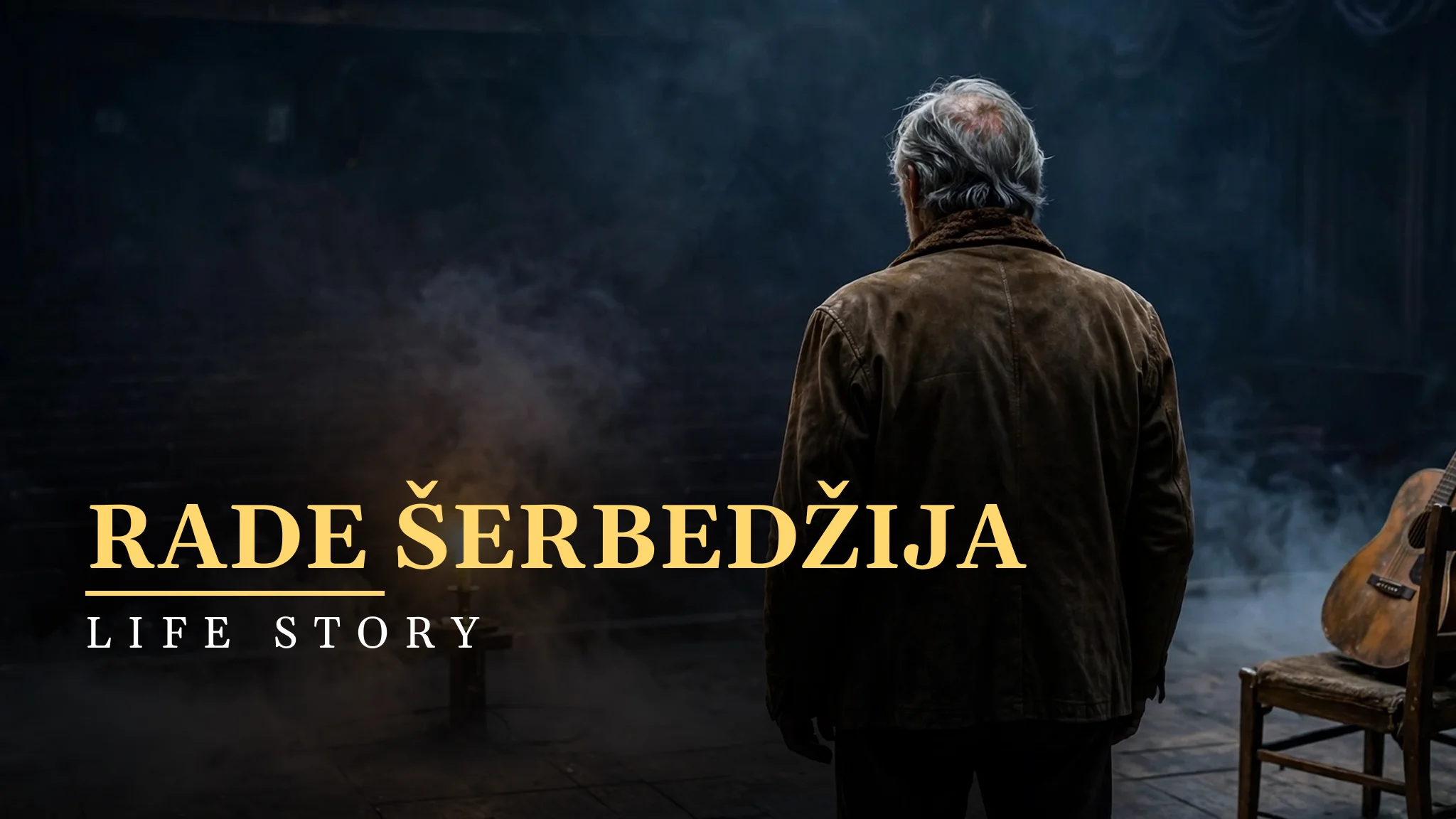
Finally, I return to the image of the stage, dark, smoky, with a single candle and a guitar on a chair, because that image captures his story, a man alone on a stage, with a light, with a guitar, and with a lifetime of work behind him, and I hope that image stays with readers, as a picture of a veteran actor, who has been through war, through exile, and through fame, and who is still standing, still performing, and still singing, under the lights.
I also think about the simple pleasure of hearing him recite a poem, in a concert hall, or on an island, under the stars, because his voice, deep and warm, makes even simple words sound important, and that is a gift that cannot be taught, only earned, through a life lived, and through a voice used, for fifty years, on stage, on screen, and in song, and I hope young actors listen to that voice, and learn from it, that a voice is an instrument, and it must be cared for, and used with honesty.
And I think about the island of Brijuni, at night, with the sea, and the stars, and an audience arriving by boat, to watch a play, because that image, of theatre as a journey, as a shared adventure, is a beautiful one, and it shows that Šerbedžija did not just want to act, he wanted to create a place where theatre could live, in nature, under the sky, and that place, built with his wife, is a gift to Croatia, and to everyone who loves theatre, and it will outlast any single performance, or any single film.
Frequently Asked Questions
When and where was Rade Šerbedžija born?
Rade Šerbedžija was born on 27 July 1946 in Bunić, a small village in the Lika region of Croatia, which was then part of Yugoslavia. He grew up in a rural family before moving to Zagreb to study acting.
Why did Rade Šerbedžija leave Croatia in the 1990s?
He left during the war that broke up Yugoslavia, when life became difficult and unsafe for him as a Serb living in Croatia. He moved with his family to London, where he had to rebuild his acting career in English from the beginning.
What role did Rade Šerbedžija play in Snatch?
He played Boris the Blade, a Russian arms dealer, in Guy Ritchie’s crime comedy Snatch, released in 2000. The role made him famous with a new generation of film fans around the world.
Did Rade Šerbedžija appear in Harry Potter?
Yes, he played Gregorovitch, the wandmaker, in Harry Potter and the Deathly Hallows. He also appeared in Eyes Wide Shut, The Saint, and X-Men: First Class, among many other international films.
What is the Ulysses Theatre on Brijuni?
The Ulysses Theatre is an open-air summer theatre on the Brijuni islands off the Croatian coast, which Šerbedžija helped to create with his wife, Lenka Udovički. Audiences travel by boat to watch plays performed under the stars by the sea.
Is Rade Šerbedžija also a poet and singer?
Yes, he has published books of poetry and recorded songs, and he performs concerts in which he recites his poems and sings. His poetry is known across the countries of the former Yugoslavia, and it is a central part of his work as an artist.


