Ramón Ayala: The Life Story Behind Mexico's Norteño King
In this post
- Growing Up Poor in Monterrey With an Accordion
- Los Relampagos del Norte and Cornelio Reyna
- Los Bravos del Norte and a Solo King
- Tragos Amargos, Un Rinconcito, and Songs That Last
- Six Decades on Stage and the Love of the People
- What His Career Means for Norteno Music
- Awards, Family, and the Accordion Passed Down
- The Sound of the North and a Life on the Road
- My Take:
Ramon Ayala is known as El Rey del Acordeon, the King of the Accordion, and that title is not a slogan. It is a name that was earned over more than sixty years of playing, singing, and touring, from the streets of Monterrey to stadiums in Mexico and the United States. He was born in Monterrey, in the north of Mexico, and he learned to play the accordion as a boy, when his family was poor and when music was a way to earn a living. He played with his father, he played in cantinas, and he played for people who danced, drank, and sang along, and he learned that a good accordion player can make a whole room move.
His most famous work came with Los Relampagos del Norte, the duo he formed with Cornelio Reyna in the 1960s, and later with his own group, Los Bravos del Norte. His songs, including Tragos Amargos, Un Rinconcito en el Cielo, and Chaparra de mi Amor, are among the most loved songs in norteno music, and they are played at parties, at weddings, and on the radio across Mexico and the United States. He is a singer whose voice is warm and honest, and whose accordion playing is clear, fast, and full of feeling.
What makes his story special is its length, because very few singers have worked for as long as Ramon Ayala has, and very few have stayed loved for as long. He has seen music change, he has seen new styles come and go, and he has kept playing the same kind of music, the music of the north, with the same accordion, the same voice, and the same love for his audience. This is the story of how a poor boy from Monterrey became the king of norteno music.
Growing Up Poor in Monterrey With an Accordion
Ramon Ayala was born on 8 December 1945 in Monterrey, Nuevo Leon, a large industrial city in the north of Mexico, close to the border with the United States. He grew up in a poor family, and his father, Ramon Covarrubias, was a musician who played the accordion and who taught his son to play. The family did not have much money, and Ramon learned early that music was not only a joy. It was a way to help his family, a way to earn a few pesos, and a way to survive. He played in the streets, he played in cantinas, and he played wherever people would listen.
As a boy, he carried his accordion with him, and he learned to play by listening, by watching his father, and by practicing for hours every day. He did not have a formal music school, and he did not have expensive lessons. He had his father’s hands, his own ears, and a love for the sound of the accordion. He learned the songs of the north, the polkas, the rancheras, and the corridos, and he learned how to make people dance, how to make them sing, and how to make them feel the music in their bodies.
Monterrey shaped him, because it is a city that is hard working, proud, and close to the border, and because its music is the music of the north, with accordion, with bajo sexto, and with voices that sing about love, about work, and about life on the border. Ramon grew up in that world, and he carried it with him for his whole career. He has often spoken about Monterrey with love, and his fans there feel that he belongs to them, and that his success is a success for their city.
His childhood was hard, but it gave him something that no school could give him: a deep understanding of the people he would sing for. He knew what it was like to be poor, to work hard, and to need music to forget your troubles for a while. That understanding is in his songs, and it is why his audience trusts him. He is not a singer who pretends to know their life. He has lived it, and he sings about it with honesty.
Los Relampagos del Norte and Cornelio Reyna
In the early 1960s, Ramon Ayala formed Los Relampagos del Norte with the singer Cornelio Reyna, a duo that would become one of the most important groups in norteno music. Ramon played the accordion, Cornelio sang and played the bajo sexto, and together they made a sound that was clear, strong, and full of feeling. They recorded songs that became hits, including Ya No Llores and Hay Ojitos, and they toured in Mexico and in the United States, playing for audiences who loved their music.
The duo was a partnership, and it worked because the two men complemented each other. Cornelio had a deep and warm voice, and Ramon had a fast and precise accordion, and together they made music that was both danceable and emotional. They played in cantinas, in dance halls, and in large venues, and they built a reputation as one of the best norteno groups of their time. Their records were played on the radio, and their fans learned the words to their songs, and they sang along at every show.
Los Relampagos del Norte lasted from 1963 until 1971, when Cornelio Reyna left the group to pursue a solo career. That split was a hard moment for Ramon, because he had built his career with Cornelio, and he had to decide whether to stop or to start again on his own. He chose to start again, and he formed a new group, Los Bravos del Norte, and he continued to make music with the same accordion, the same voice, and the same love for norteno music. That decision showed his strength, and it showed that he was not only a partner in a duo. He was a leader in his own right.
The years with Los Relampagos del Norte are still remembered as a golden time in norteno music, and their songs are still played today, more than sixty years after they were recorded. Ramon Ayala carries that history with him, and he often sings those old songs in his concerts, to the delight of fans who remember them from their youth. Those songs are part of his legacy, and they are part of the history of Mexican music.
Los Bravos del Norte and a Solo King
After Cornelio Reyna left, Ramon Ayala formed Los Bravos del Norte, a group that would become his home for the rest of his career. With Los Bravos del Norte, he recorded many albums, toured in Mexico and the United States, and became known as El Rey del Acordeon, the King of the Accordion. His accordion playing was fast, clear, and full of feeling, and his voice was warm and honest, and together they made a sound that was unmistakably his own. He was no longer only a member of a duo. He was a star, and his name was on the marquee.
His songs with Los Bravos del Norte included Tragos Amargos, a song about bitter drinks and bitter love that became one of his most famous records, and Un Rinconcito en el Cielo, a song about a small corner in heaven that became a favourite for many listeners. He also recorded Chaparra de mi Amor, Gaviota, and Del Otro Lado del Porton, songs that are still played at parties, at weddings, and on the radio today. Each song was a story, told in simple words, with a melody that was easy to sing, and with an accordion that made people want to dance.
He toured for decades, playing in dance halls, in stadiums, and in festivals, and he built an audience that included Mexicans in Mexico and Mexicans living in the United States, who heard his music as a link to home. For many Mexican families in the United States, his songs were a reminder of Monterrey, of the north, and of the life they had left behind. He sang for them, and they sang with him, and that bond made his concerts feel like a family gathering, not only a show.
He won awards for his music, including a Grammy Award, and he was praised by critics and by other musicians for his accordion playing and for his long career. But his real success was not in awards. It was in the love of his audience, who came to see him year after year, decade after decade, and who taught their children the words to his songs. That is a rare achievement, and it is one that very few singers ever reach.
Tragos Amargos, Un Rinconcito, and Songs That Last
Tragos Amargos is one of the most famous songs in norteno music, a song about a man who drinks to forget a lost love, and who finds that the drinks are bitter, just as his memories are bitter. Ramon Ayala sings it with a voice that is warm and sad, and his accordion plays a melody that is both danceable and mournful, and that mix is what makes the song so powerful. It is a song that people dance to, and it is a song that people cry to, and that is a rare thing in music. It has been played for decades, and it is still played today.
Un Rinconcito en el Cielo is another of his signature songs, a song about heaven, about love, and about the hope of a small place in the sky for the person you love. It is a gentle and hopeful song, and it shows a different side of Ramon Ayala, a side that is tender and spiritual, not only tough and danceable. He sings it with feeling, and his audience sings it with him, and it has become a favourite at funerals, at memorials, and at moments when people need comfort.
Chaparra de mi Amor, Gaviota, and Del Otro Lado del Porton are also part of his legacy, songs that are known by millions of people, and that are played at parties and on the radio. Each song tells a story in simple words, about love, about loss, about home, and about life on the border. Those stories are the stories of his audience, and that is why his songs have lasted. He does not sing about abstract ideas. He sings about real life, and his audience recognises their own life in his songs.
His music has been recorded by other artists, and it has been played by younger norteno groups, who see him as a master, and who learn from his accordion playing. That influence is part of his legacy, because a great musician does not only make good records. He passes his skill to young players, showing them how to put heart, accuracy, and warmth into every note. Ramon Ayala has done that for more than sixty years, and his influence is still felt today.
Six Decades on Stage and the Love of the People
Ramon Ayala has been performing for more than six decades, a length of career that is almost unheard of in popular music. He has played in small cantinas, in large stadiums, and in festivals in Mexico and the United States, and he has done it with the same accordion, the same voice, and the same love for his audience. He has seen music change, he has seen new styles come and go, and he has kept playing norteno music, because it is the music he loves, and because it is the music his audience loves.
He has also faced hard times, including health problems, and the loss of friends and fellow musicians, but he has kept going, and he has kept singing. That persistence is part of his story, and it is one of the reasons his fans admire him. He is not a singer who gives up when things get hard. He is a singer who keeps playing, who keeps touring, and who keeps showing up for his audience, year after year.
His family has also been part of his career, and his sons have played with him, and have learned the accordion from him, carrying on the tradition that his father started. That family line, from father to son to grandson, is part of what makes his story special, because it shows that music is not only a job. It is a family, a tradition, and a way of life. He has passed his music to his children, just as his father passed it to him, and that is a beautiful thing.
Today, Ramon Ayala continues to perform, to record, and to tour, and his concerts are still full of fans who sing every word, who dance, and who cheer for the King of the Accordion. He is an old man now, but his voice is still strong, and his accordion is still fast, and his love for music is still clear. He is a living legend, and his name will be remembered in Mexican music for as long as people play the accordion and sing about love.
What His Career Means for Norteno Music
Ramon Ayala matters to Mexican music because he is the king of norteno, and because he has kept that music alive for more than sixty years. He showed that the accordion, the bajo sexto, and a warm voice could make music that was loved by millions of people, in Mexico and in the United States, and that could last for decades. He did not need to change his sound to be popular. He needed only to play well, to sing honestly, and to love his audience, and he did all of that.
He also matters because he came from a poor family, and he built a career with his own hands, with an accordion, and with hard work. He did not have a famous family, and he did not have a short cut. He played in the streets, he played in cantinas, and he worked his way up to stadiums. That is a lesson for any young musician who dreams of fame. A career is built step by step, with practice, with patience, and with love for the music.
His influence on younger musicians matters too, because many norteno groups today play in his style, and they learn from his records. He is a master, and his accordion playing is a model for anyone who wants to learn the instrument. He has taught by example, by playing, and by showing that a great musician is not only fast. He is also clear, emotional, and honest. That is a lesson that will be passed on for many years.
In the end, his story is a story about a boy from Monterrey who became a king, not by birth, but by work, by talent, and by love for his music. He is El Rey del Acordeon, and that title will stay with him, and with his music, for as long as people listen to norteno music.
Awards, Family, and the Accordion Passed Down
Ramon Ayala has won a Grammy Award for his music, and he has been honoured with many other awards and recognitions for his long career, including honours in Mexico and in the United States for his contribution to norteno music. Those awards matter, because they show that the music world respects his accordion playing, his songwriting, and his sixty years on stage, not only his fans. He has also been praised by other musicians, who see him as a master, and who learn from his records, and that respect from fellow musicians is a high compliment, because they know how hard it is to play the accordion as well as he does.
His family has been a central part of his career, and his sons have learned the accordion from him, and have played with him on stage, carrying on the tradition that his father started when Ramon was a boy. That family line, from father to son to grandson, is part of what makes his story special, because it shows that music is not only a job. It is a family, a tradition, and a way of life. He has passed his music to his children, just as his father passed it to him, and that is a beautiful thing, and it is a sign that his music will live on, even after he stops playing.
His concerts are still a celebration, with fans of many ages, from older listeners who remember his first records, to younger listeners who discovered him through their parents and grandparents. They sing Tragos Amargos, they dance to his polkas, and they cheer for the King of the Accordion, and that mix of ages is a sign of a singer who has crossed generations. Most singers belong to one decade. Ramon belongs to several, and his music is still played at parties, at weddings, and on the radio, more than sixty years after he first picked up an accordion.
His place in Mexican music is secure, because he is El Rey del Acordeon, and because his songs are part of the history of norteno music. He has not been overtaken by the next trend, because he has never followed a trend. He has followed his own sound, his own accordion, and his own voice, and his fans have followed him, because they trust him, and because they love his music.
The Sound of the North and a Life on the Road
Ramon Ayala’s music is the sound of the north of Mexico, with accordion, with bajo sexto, and with a voice that sings about love, about work, and about life on the border, and that sound has been loved for more than sixty years, in Mexico and in the United States. He has toured for decades, playing in dance halls, in stadiums, and in festivals, and he has built an audience that includes Mexicans in Mexico and Mexicans living in the United States, who hear his music as a link to home. For many of those families, his songs are a reminder of Monterrey, of the north, and of the life they left behind, and they sing his songs at home, at parties, and in their cars, and they teach them to their children.
Life on the road is hard for a musician, with long drives, with late nights, and with time away from family, and Ramon has lived that life for more than sixty years, with the same accordion, the same voice, and the same love for his audience. He has learned how to pace himself, how to rest his voice, and how to give his best on the night that matters, and that discipline is part of why his career has lasted so long. A singer who tours for sixty years has to be strong, has to be patient, and has to love the work, and Ramon has all of those things, and his fans can hear it in every song he sings.
His sound has influenced many younger norteno groups, who play in his style, and who learn from his records, and that influence is part of his legacy, because a great musician does not only make good records. He teaches the next generation, and he shows them how to play with feeling, with precision, and with love for the music. Ramon has done that for more than sixty years, and his influence is still felt today, in every accordion player who tries to play like the King of the Accordion.
My Take:
When I think about Ramon Ayala, the first thing I think about is his accordion, because it is not only an instrument for him. It is a part of his life, a part of his family, and a part of his history. He learned it from his father, he played it as a boy in the streets of Monterrey, and he has played it for more than sixty years. I try to imagine carrying an accordion for sixty years, playing it night after night, and I think it must be both a joy and a weight. It is a joy, because it makes people dance and sing, and it is a weight, because it is heavy, and because it carries the hopes of a whole family. Ramon has carried it well, and I admire him for that.
I admire him because he came from a poor family, and he built a career with his own hands. He did not have a famous family, and he did not have money to buy a career. He had an accordion, a voice, and a willingness to work hard, and that was enough. He played in cantinas, he played in the streets, and he worked his way up to stadiums. That is a powerful story, and it is one that I think many people can learn from. A career is not given. It is built, step by step, with practice, with patience, and with love for the work.
What I like most about his music is its honesty. He sings about love, about loss, about drinking, and about home in simple words, and his audience recognises their own life in his songs. When he sings Tragos Amargos, I hear a man who knows what it feels like to lose someone, and who is not afraid to say that it hurts. He does not use big words or clever tricks. He uses simple words, and he lets the accordion and his voice carry the feeling. That is a good way to make music, and it is a way that more singers should try.
I also think about his partnership with Cornelio Reyna, and about how important that partnership was. Los Relampagos del Norte was a duo, and it worked because the two men complemented each other. Cornelio had a deep voice, and Ramon had a fast accordion, and together they made music that was greater than either one alone. When Cornelio left, Ramon had to start again, and he did, with Los Bravos del Norte. That takes courage, and it takes strength, and I admire him for it. Many people would have given up when their partner left. Ramon did not give up. He kept playing, and he became a king on his own.
His song Un Rinconcito en el Cielo moves me, because it is a gentle and hopeful song about heaven, about love, and about the hope of a small place in the sky. It is different from his dance songs, and it shows a softer side of him, a side that is tender and spiritual. I like that, because it shows that a tough norteno singer can also be tender, and that a man who plays in cantinas can also sing about heaven. That mix of tough and tender is part of what makes him a great artist, and it is part of why his audience loves him.
I think about the length of his career, and I feel respect, because very few singers work for sixty years. Most singers have a few good years, and then they are forgotten. Ramon has worked for six decades, and he is still loved, still touring, and still playing his accordion. That is a rare achievement, and it is one that I think people should celebrate more. It shows that a singer who loves his music, who respects his audience, and who keeps working can have a career that lasts a lifetime.
If I have a criticism, it is not really a criticism of his music. It is a sadness that norteno music does not always get the respect it deserves in the wider music world. Ramon Ayala is a master, and his accordion playing is as skilled as any classical musician, but he is not always talked about in the same way as pop stars or rock stars. I think that is unfair, because his music is just as important, and just as beautiful, as any other kind of music. I hope that more people discover his music, and that they give it the respect it deserves.
I also think about his family, and about how his sons have learned the accordion from him, and have played with him. That is a beautiful thing, because it shows that music is a family tradition, passed from father to son, just as his father passed it to him. I like that image, of a father teaching his son to play, and of a son carrying on the music of his father. It is a reminder that music is not only a job. It is a family, a tradition, and a way of life. Ramon has kept that tradition alive, and he has passed it on.
What I learn from Ramon Ayala is that a career is built slowly, and that slow growth can be strong. He did not become a star in one night, and he did not chase a quick hit. He practiced, he played, he recorded, and he built his audience one show at a time. That is a slow way to build a career, and it is the right way, because it gives a musician time to learn, to grow, and to make music that lasts. A fast fame can disappear fast. A slow fame, built on good music, can last for decades.
I also learn that it is possible to stay true to your own sound, even when the world around you changes. Ramon has played norteno music for sixty years, and he has not changed it to chase a trend. He has kept the accordion, the bajo sexto, and the warm voice, and he has made that sound his own. That steadiness is a sign of a real artist, and it is one that I admire. A musician who knows what he loves, and who keeps playing it well, is more interesting than a musician who changes his style every year to stay fashionable.
I think about his audience in the United States, and about how much his music means to Mexican families who live far from home. For those families, his songs are a link to Monterrey, to the north, and to the life they left behind. When they hear Tragos Amargos, they think about home, about family, and about the people they love. That is a beautiful thing, and it is a sign of music that matters. Ramon is not only singing to a crowd in front of him. He is singing to people in kitchens and cars all over the United States, and his voice keeps them close to their roots.
Another thing I notice is how much he has given to younger musicians. Many norteno groups today play in his style, and they learn from his records, and they see him as a master. That influence is part of his legacy, because a great musician does not only make good records. He guides young players, helping them find the emotion, the timing, and the care that a great accordion song needs. Ramon has done that for more than sixty years, and his influence is still felt today.
I also think about Monterrey, and about how much his home city has shaped him. He grew up in a hard working city, close to the border, and he carries that city with him in his music. He has not tried to hide where he comes from, and he has not tried to pretend that he was born in a big city. I think that honesty makes his fans love him more, because many of his fans also come from the north, and they see themselves in him. They see a boy from Monterrey who became a king, and they feel proud.
If I think about his future, I feel hopeful, because he is still playing, and he is still loved. He could keep touring, he could keep recording, and he could keep teaching his sons, and his fans would follow him. He has already shown that he can do hard things, and I think he will keep doing them. I hope he also takes time to rest, and to be with his family, because a musician who is tired cannot play well for long, and because his family matters more than any stage.
What I learn from his story, in the end, is that a long career is built on love, on work, and on respect for your audience. Ramon Ayala has loved his music, he has worked hard for sixty years, and he has respected his fans, and that is why they still love him. When I hear his accordion, I hear a man who knows who he is, and who knows what he wants to play, and that is a rare and good thing in music.
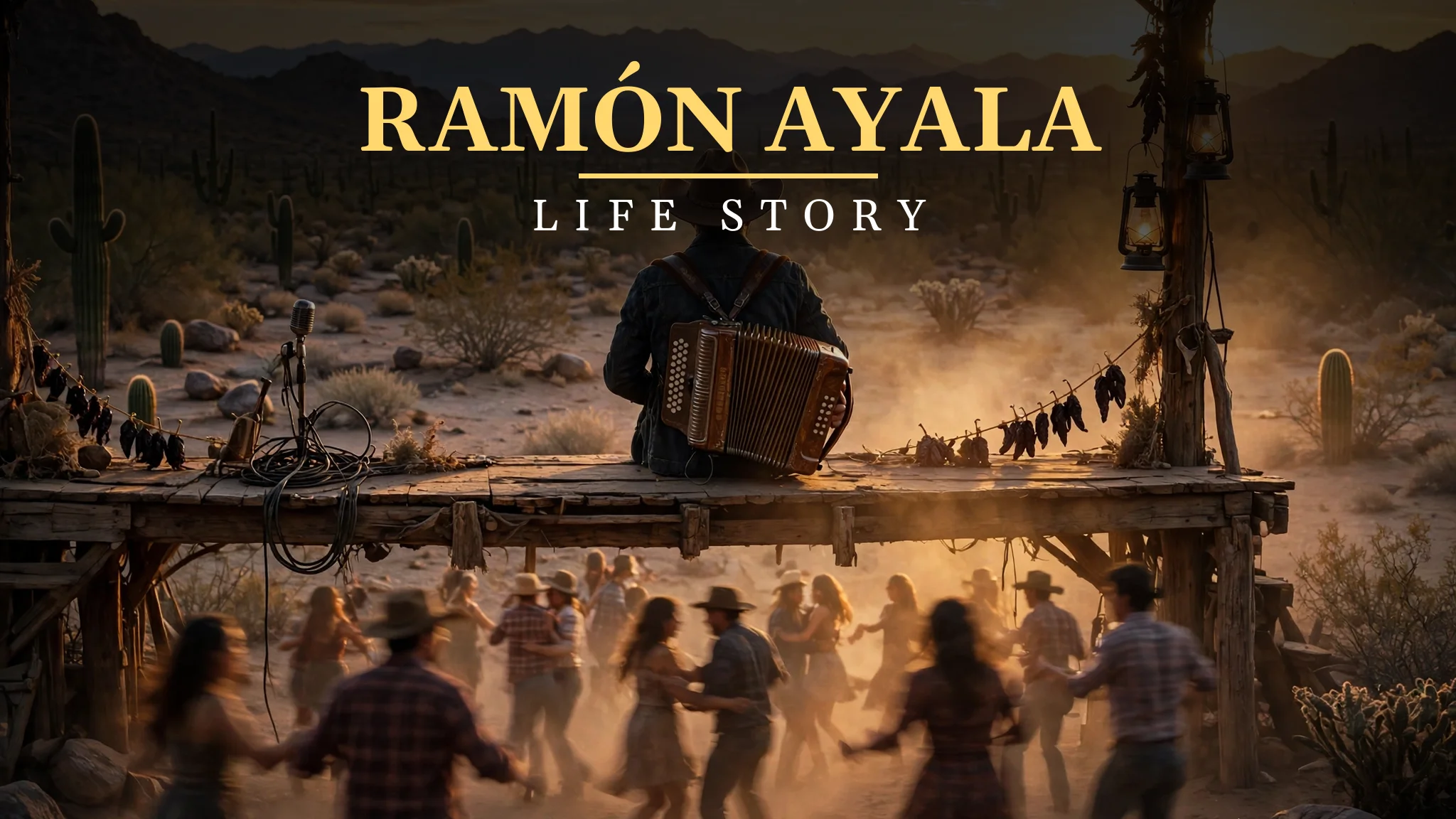
I want to add one more thought, about the desert in his cover image, because it is part of who he is. He stands on a wooden platform in the desert at sunset, with his accordion, with lanterns, and with couples dancing below, and that image feels warm, open, and full of life. It is an image of a singer who belongs to the north, to the desert, and to the people who dance to his music. I like that image, and I think it fits him. He is a king of the desert, and his music is the sound of that desert.
In the end, I think Ramon Ayala is a musician who deserves all the respect he receives, because he has given his life to his music, he has played for more than sixty years, and he has kept the tradition of norteno alive. I like his music, I like his accordion, and I like the way he carries himself. I hope he keeps playing for many years, and I hope more people discover his songs, because they deserve to be heard.
I think about the Grammy Award he has won, and about what it really means. An award is a prize, and it is nice to win one, but the real prize is the love of the audience, and Ramon has that in a way that few singers do. His fans play Tragos Amargos at parties, at weddings, and in their cars, and they teach the song to their children, and that is a kind of award that no jury can give. I think he understands that, and I think that is why he keeps playing, even after sixty years, because he cares about the song, not only about the prize, and that is a good thing.
I also think about his sons learning the accordion from him, and about how beautiful that is. A father teaching his son to play, a son carrying on the music of his father, and a family that has kept its tradition alive for three generations, is a story that touches me. It shows that music is not only a job. It is a family, a tradition, and a way of life, and Ramon has kept that tradition alive, and he has passed it on, just as his father passed it to him. I hope that tradition continues for many more years.
I think about life on the road, and about how hard it must be to tour for sixty years. Most people get tired after a few years of travelling, of late nights, and of time away from home, but Ramon has done it for a lifetime, and he has done it with the same accordion, the same voice, and the same love for his audience. That takes a kind of strength that I admire, because it is not only physical strength. It is also a strength of the heart, a love for music that is stronger than tiredness, and a respect for the audience that makes a singer show up, night after night, year after year, even when it would be easier to stay home.
Frequently Asked Questions
When and where was Ramón Ayala born?
Ramon Ayala was born on 8 December 1945 in Monterrey, Nuevo Leon, a large city in the north of Mexico. He grew up in a poor family, and he learned to play the accordion from his father, who was also a musician.
Why is Ramón Ayala called El Rey del Acordeón?
He is called El Rey del Acordeon, the King of the Accordion, because he is one of the greatest accordion players in norteno music, with a career of more than sixty years. His fast, clear, and emotional playing has made him a master of the instrument.
What group did Ramón Ayala form with Cornelio Reyna?
He formed Los Relampagos del Norte with Cornelio Reyna in the early 1960s, a duo that became one of the most important groups in norteno music. They recorded hits such as Ya No Llores and Hay Ojitos, before Cornelio left in 1971.
What are Ramón Ayala’s most famous songs?
His most famous songs include Tragos Amargos, Un Rinconcito en el Cielo, Chaparra de mi Amor, Gaviota, and Del Otro Lado del Porton. Those songs are still played at parties, at weddings, and on the radio across Mexico and the United States.
Did Ramón Ayala win a Grammy Award?
Yes, he has won a Grammy Award for his music, and he has been praised by critics and by other musicians for his long career and his accordion playing. His real success, though, is in the love of his audience, who have followed him for decades.
Is Ramón Ayala still performing today?
Yes, he continues to perform, record, and tour with Los Bravos del Norte, and his concerts are still full of fans who sing every word and dance to his music. He remains a living legend in norteno music, even after more than sixty years on stage.


