Raphael: The Life Story Behind Spain's Enduring Voice
In this post
Raphael has been singing for more than sixty years, and he is still standing on stage, still singing, and still filling concert halls. That alone makes him remarkable. Most singers have a few good years, and then they fade. Raphael has had six decades, and his voice, his energy, and his love for the stage have never left him. He is a child prodigy who became a star, a star who became a legend, and a legend who is still working, still touring, and still loved by audiences who span three generations.
He was born in Linares, a town in the south of Spain, and he was singing as a small child, with a voice that was clear, strong, and far beyond his years. He came to Madrid, he won contests, he represented Spain at Eurovision, and he became famous across the Spanish-speaking world. His songs, like “Yo soy aquél”, “Mi gran noche”, and “Digan lo que digan”, are part of the shared memory of Spain, and they are still sung today.
His life has also been a story of courage. He faced a serious illness, he had a liver transplant, and he came back to the stage. He has lived through changes in music, in fashion, and in the world, and he has adapted without losing himself. This is the story of Raphael, a singer who has never stopped, and who has become one of the most enduring voices in Spanish music.
A Child Prodigy in Linares
Miguel Rafael Martos Sánchez was born on 5 May 1943 in Linares, a town in the province of Jaén, in Andalusia. His family was ordinary, and his childhood was simple, but his voice was extraordinary. As a small child, he sang in the church choir, and people who heard him were amazed by the clarity and the power of his voice. He was only a boy, but he sang like a grown man, with a control and a feeling that was rare at any age.
His family moved to Madrid when he was young, and he continued to sing. He took part in singing contests, and he won them. He was a child star, and his voice was his gift. He sang in the choir, he sang on the radio, and he began to be noticed by people in the music business. His talent was clear, and his family supported him, helping him to develop his voice and to find opportunities to perform.
He was not a normal child. While other boys played in the street, he was practising, singing, and performing. He learned discipline early, and he learned that a voice is a gift that must be cared for. He took lessons, he worked hard, and he dreamed of becoming a famous singer. His childhood was shaped by music, and music became his life.
Linares stayed in his heart, and he often speaks about his home town with love. He is proud of where he came from, and he has returned there many times. He is a singer from Andalusia, and he carries the warmth and the passion of the south with him wherever he goes.
Madrid, Contests, and a Young Star
In Madrid, the young Raphael continued to win singing contests, and his reputation grew. He was a teenager with a powerful voice, and he was ready for a professional career. He signed with a record company, he released his first records, and he began to perform on television and on stage. His early songs were romantic ballads, and they suited his voice, which was high, clear, and full of emotion.
He became known for his dramatic style of singing. He did not just stand still and sing. He moved, he gestured, and he acted out the songs, using his whole body to express the feeling. His performances were theatrical, and they made him stand out from other singers. His audience loved the drama, and his concerts became events, full of energy and emotion.
In the early 1960s, he began to tour, and his fame grew across Spain. He was a young star, and his face appeared on magazine covers. He was handsome, talented, and hard-working, and he had a voice that was unlike any other. He was not a passing fashion. He was a singer with a real gift, and his career was just beginning.
His early success was built on hard work. He performed constantly, he recorded new songs, and he learned how to handle the pressure of fame. He was still young, but he was already a professional, and he took his work seriously. That seriousness would carry him through a career that would last for more than sixty years.
Eurovision and Yo Soy Aquél
In 1966, Raphael represented Spain at the Eurovision Song Contest with the song “Yo soy aquél”, which means “I Am That One”. The song became one of his most famous, and it is still one of the best-known Spanish Eurovision songs. He finished seventh in the contest, but the song was a hit, and it made him famous across Europe. His performance was dramatic and powerful, and it showed the world what Spanish music could be.
He returned to Eurovision the following year, in 1967, with the song “Hablemos del amor”, and he finished sixth. Two years at Eurovision, back to back, made him a star in Europe, and his records were played in many countries. He was no longer just a Spanish singer. He was a European star, and his voice was known far beyond Spain.
His songs from this period, including “Yo soy aquél” and “Digan lo que digan”, became classics. “Digan lo que digan”, which means “Whatever They Say”, is a song about staying true to yourself, about not listening to gossip, and about being proud of who you are. It became an anthem for his fans, and it is still sung today. The song’s message, that you should be yourself no matter what others say, fitted Raphael perfectly, because he had always been himself, on stage and off it.
Through the late 1960s, his fame grew. He toured Latin America, where his concerts were major events, and his records sold in huge numbers. He was a star across the Spanish-speaking world, and his voice was one of the most recognisable in music. He had become a legend, and he was still in his twenties.
Mi Gran Noche and the Height of Fame
In the 1970s and 1980s, Raphael continued to release hit songs, and his career reached new heights. One of his most famous songs from this period is “Mi gran noche”, which means “My Great Night”, a joyful, fast song that became a party favourite. The song is still played at celebrations, at weddings, and on the radio, and it is one of the most loved Spanish pop songs of all time. Its energy, its rhythm, and Raphael’s powerful voice made it unforgettable.
He also had hits with songs like “Como yo te amo”, a dramatic ballad that showed the power of his voice, and “En carne viva”, a song that became a classic. His albums sold well, his concerts were full, and his name was known in every Spanish-speaking country. He toured constantly, performing in Spain, in Latin America, and in the United States, and his shows were famous for their energy and their drama.
His style was theatrical, and he never apologised for it. He wore elegant clothes, he moved across the stage, and he sang with his whole body. Some critics said he was too dramatic, but his fans loved it. They came to his concerts to see a show, and he gave them one. He was a performer in the old sense, a man who believed that a concert should be an event, not just a set of songs.
During these years, he also became a family man. He married Natalia Figueroa, a journalist and writer, in 1972, and they had three children. His family gave him stability, and he spoke about them with love. He balanced his touring with his family life, and he tried to be present for his children, even while his career kept him travelling. His marriage has lasted for more than fifty years, and it is one of the longest and most admired in Spanish show business.
Illness, a Transplant, and a Brave Return
In the early 2000s, Raphael faced the greatest challenge of his life. He became seriously ill, and he was diagnosed with a liver disease that threatened his life. In 2003, he received a liver transplant, a major operation that saved his life. The experience was frightening, and it changed him. He spoke about it openly, thanking the doctors, the nurses, and the donor, and he became an advocate for organ donation, encouraging people to think about giving life to others.
His recovery was long and hard, but he was determined to return to the stage. He worked to rebuild his strength, he practised his voice, and he prepared for his comeback. When he returned to perform, his fans welcomed him with warmth and with tears. It was a moment of courage, and it showed that his love for music was stronger than his illness. He had faced death, and he had come back to sing.
Since the transplant, he has continued to perform, to record, and to tour, and his energy is remarkable for a man of his age. He has spoken about the transplant as a second chance, and he has used that chance well. He sings with the same passion, he tours with the same energy, and he treats every concert as a gift. His story is an inspiration to people who have faced illness, and it shows that a second chance can be used to do great things.
He has also used his fame to support organ donation, speaking about it in interviews and at events. He knows that his life was saved by a donor, and he wants others to have the same chance. That work is a real part of his legacy, and it shows a man who understands that fame can be used for good.
Sixty Years On Stage and Still Singing
Today, Raphael is in his eighties, and he is still performing. He tours Spain and Latin America, he records new albums, and his concerts are still full of fans, young and old, who sing his songs with him. He has released many albums, he has won many awards, and he has been honoured in Spain and in Latin America for his contribution to music. His career has lasted for more than sixty years, and it shows no sign of ending.
His longevity is remarkable. He has survived changes in music, from the ballads of the 1960s to the pop of today, and he has adapted without losing himself. He still sings his classic songs, and he still sings new ones, and his audience loves both. He is a bridge between generations, a singer who connects grandparents, parents, and children, all of whom know his songs.
His legacy is not only about his hits. It is about his endurance, his courage, and his love for the stage. He has shown that a singer can have a long career, if he takes care of his voice, works hard, and never stops loving what he does. He is a model for any artist who wants to last, and his life is a proof that passion does not have to fade with age.
Today, Raphael is remembered as one of the greatest singers in Spanish music, a voice that has lasted for six decades, and a man who has never stopped singing. His story is a story of talent, of hard work, of courage, and of a love for music that has never died.
The Theatre of a Concert
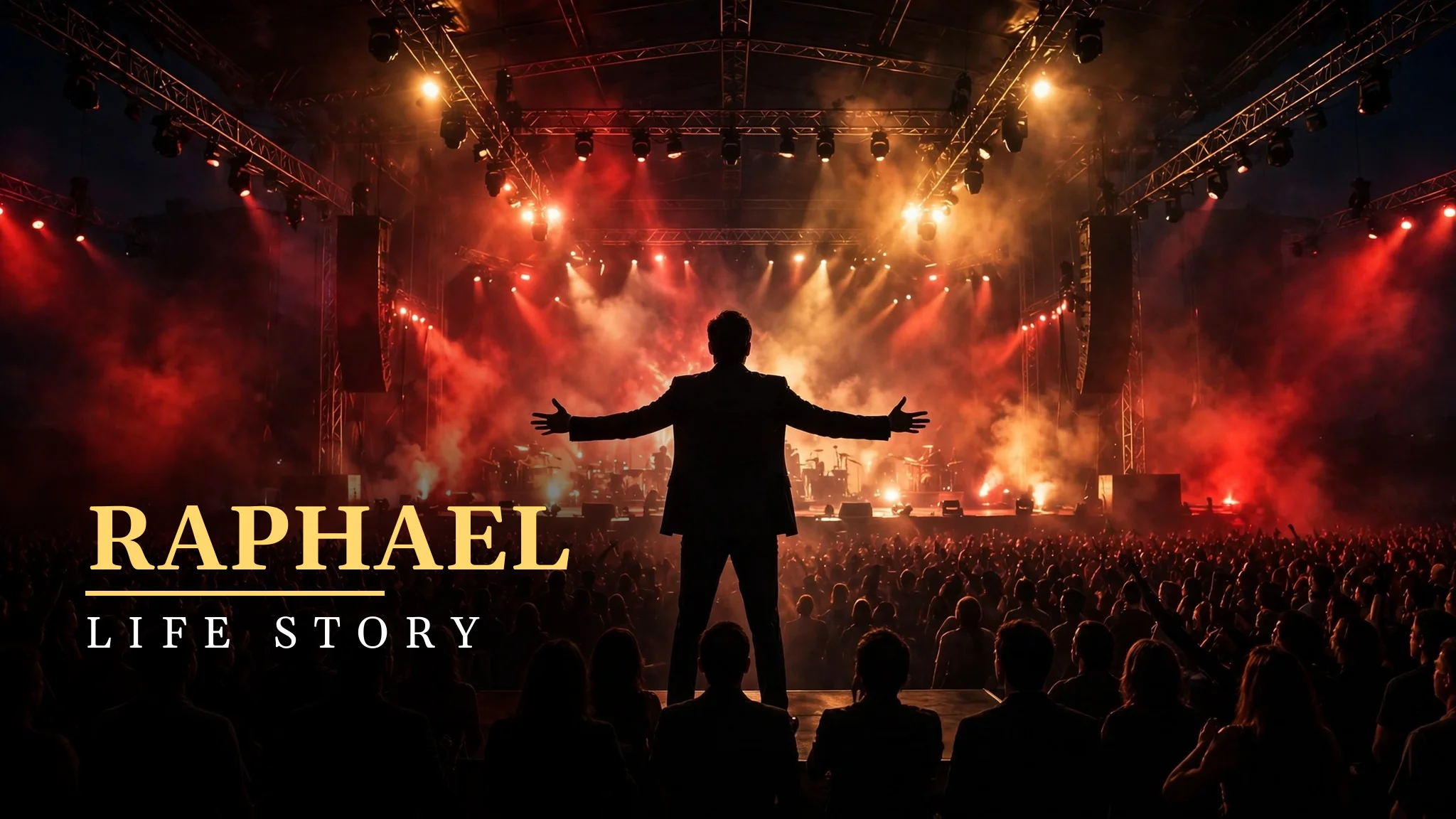
Raphael’s concerts are not like other concerts. They are theatre, and he is an actor as much as a singer. He moves across the stage, he gestures with his hands, he opens his arms wide, and he uses his whole body to tell the story of each song. His performances are dramatic, and they are deliberate. He has studied the stage, he knows how to hold an audience, and he uses every part of himself to do it. His fans do not just come to hear his voice. They come to see a show, and he gives them one, every time.
That theatrical style was there from the beginning, when he was a young singer with a powerful voice and a dramatic manner. Some critics said he was too much, too dramatic, too old-fashioned, but his fans disagreed. They loved the drama, because it made the songs feel bigger, more important, and more alive. A ballad sung quietly can be beautiful, but a ballad sung with drama can be unforgettable, and Raphael’s ballads are unforgettable because he gives them everything he has.
His stage presence is also a matter of discipline. He rehearses, he plans his movements, and he takes care of his voice, so that he can perform at a high level, night after night, even in his eighties. That discipline is the result of decades of work, and it is one of the reasons his concerts are still so good. He does not rely on luck. He relies on preparation, on practice, and on a deep respect for his audience.
That respect is clear in every concert. He thanks his fans, he talks to them, and he sings the songs they love, as well as new ones. He does not take his audience for granted, and he does not assume that they will come back. He earns their return, one concert at a time, by giving them a show that is worth remembering. That is a professional attitude, and it is one that has kept him on stage for more than sixty years.
Awards and a Lifetime of Honours
Over a career of more than sixty years, Raphael has received many of the highest honours in Spanish and Latin music. He has won awards in Spain, in Latin America, and in other countries, and he has been recognised for his voice, for his albums, and for his contribution to popular music. His awards fill a room, but they are not the most important part of his story. The most important part is the love of his audience, which has lasted longer than any award.
He has been honoured with gold and platinum records, for albums that sold in huge numbers, and he has received lifetime achievement awards, which recognise a career that has lasted for decades. Those awards are a fitting tribute, because a lifetime achievement is exactly what Raphael has built: a lifetime of singing, of performing, and of giving pleasure to millions of people. He did not achieve it in a year. He achieved it over sixty years, one concert, one album, and one song at a time.
He has also been honoured in his home town of Linares, where he is a beloved figure, and in Madrid, where he built his career. Streets, awards, and tributes bear his name, and his place in Spanish culture is secure. He is not just a singer. He is a national figure, a man whose voice is part of the shared memory of a country, and whose songs are known by grandparents, parents, and children alike.
Those honours are well deserved, but Raphael himself has always said that the greatest honour is the applause of his audience. When thousands of people stand, clap, and sing along to his songs, that is a reward that no award can match. He has received that reward, night after night, for more than sixty years, and it is the reason he keeps singing. The awards are in a room. The applause is in his heart, and it is still there, every time he steps onto a stage.
A Career Across Three Generations
Raphael’s career has lasted so long that it now spans three generations of fans. Grandparents who heard him in the 1960s, parents who grew up with his songs in the 1980s, and children who discovered him through their families all sing his music together. That is a rare achievement, and it is one that few singers can match. Most artists are loved by one generation, and then forgotten. Raphael is loved by three, and his concerts are full of families, with people of all ages singing the same songs.
That generational reach is possible because his songs are timeless. A ballad about love, a party song about a great night, and a song about staying true to yourself do not go out of fashion. They speak to feelings that are always true, and they work for a teenager as well as for a grandmother. His music is not tied to one decade. It is tied to the human heart, and the heart does not change with fashion.
His concerts reflect that mix of ages. He sees young people in the audience, singing “Mi gran noche” with joy, and he sees older fans, singing “Yo soy aquél” with tears in their eyes. Both are real, and both are part of the same show. He does not play only for the young, or only for the old. He plays for everyone, and everyone feels welcome. That inclusiveness is a large part of why his career has lasted so long.
That three-generation audience is also a sign of the trust he has built. Families pass his music down, from parent to child, because they believe it is worth passing on. A song that a mother teaches her daughter is a song that has become part of a family’s history, and Raphael’s songs have become part of many families’ histories. That is a legacy that no award can match, and it is one that he has earned, one concert, one album, and one song at a time.
His career is a reminder that great music does not belong to one age. It belongs to everyone, and it can bring people together, across generations, in a shared moment of joy. When a grandmother, a mother, and a daughter sing together at a Raphael concert, they are not just enjoying a show. They are sharing a memory, and that memory will stay with them long after the concert is over.
My Take:
When I think about Raphael, the first thing that amazes me is how long he has been singing. More than sixty years is not a career. It is a lifetime, and it is a lifetime spent on stage, in front of audiences, singing songs that people love. Most singers are lucky to have ten good years. Raphael has had six times that, and he is still going. I think that is because he truly loves to sing, and that love has never left him. You cannot fake that kind of love for sixty years. It has to be real, and his is real.
I also think about his voice, and how it has carried him through all those years. It is a powerful voice, high and clear, and it is a voice that can fill a theatre without a microphone. He takes care of it, he practises, and he respects it. That is a lesson for any singer. A voice is a gift, but it is also a responsibility, and Raphael has treated his voice with respect for his whole life. That is why it is still strong in his eighties, when many singers have lost theirs.
What I find most moving about his story is his liver transplant and his return to the stage. To face a serious illness, to have a major operation, and to come back and sing again takes a kind of courage that is hard to describe. Many people would have retired, and no one would have blamed them. He did not. He recovered, he returned, and he sang with the same passion as before. I think that shows that music was not just his job. It was his life, and he was not willing to give it up. That is a powerful thing, and it is an inspiration to anyone who has faced a serious illness.
I also admire his marriage, which has lasted for more than fifty years. In a world where celebrity marriages often end quickly, his has lasted, and it has been a source of strength for him. He married Natalia Figueroa in 1972, and they have three children together. That stability has helped him to keep going, to stay grounded, and to remember that there is a life beyond the stage. I think that is an important part of his story. Fame can make a person selfish, but a good marriage can keep a person human, and Raphael’s marriage has done that for him.
I have to be honest about one thing, and that is that his style is not for everyone. Some people find his performances too dramatic, too theatrical, or too old-fashioned, and they prefer singers who are more natural or more modern. I understand that, but I do not think it is a fair criticism to say that a singer should be quiet in order to be good. Raphael’s drama is part of who he is, and it is part of why his fans love him. He gives them a show, and a show is what they came for. I would rather see a singer who gives everything on stage than a singer who holds back.
I also think about his songs, and how they have become part of the culture of Spain. “Mi gran noche” is played at every party, “Yo soy aquél” is known by everyone, and “Digan lo que digan” is a message that people carry with them. Those songs are not just hits. They are part of the shared memory of a country, and they connect people across generations. A grandmother, a mother, and a daughter can all sing “Mi gran noche” together, and that is a beautiful thing. Music that brings generations together is rare, and Raphael’s music does it.
What I learn from his story is that endurance is a talent. It is not enough to be talented for a year. You have to be talented, and hard-working, and disciplined, for decades, and that is a different kind of skill. Raphael has that skill, and he has used it well. He has taken care of his voice, he has taken care of his health, and he has kept his love for music alive. That is a lesson for anyone who wants a long career, in any field. Talent gets you started, but endurance keeps you going, and endurance is built one day at a time.
In the end, I think Raphael matters because he has shown that a singer can last, can grow, and can keep singing for a lifetime. He is a voice that has been with Spain for more than sixty years, and he is still here, still singing, still filling concert halls. That is a remarkable achievement, and I hope he keeps singing for as long as he can, because the world is better with his voice in it.
I also think about Linares, and how the town shaped him. It is a town in Andalusia, a place of sun, of music, and of a proud, warm people. To grow up there, singing in the church choir, must have given a young boy a sense of the power of music, of how a voice can fill a church, and how it can move people to tears. I think that early experience stayed with him, and it is why his concerts feel like a kind of ceremony, a moment when a voice fills a room, and everyone listens. He learned to sing in a church, and he has carried that feeling with him for his whole life.
I think about his childhood, and how different it was from other children’s. While other boys played in the street, he was practising, singing, and performing. That must have been lonely at times, because a child who is different is often left out. But it also gave him a gift, a voice, and a purpose, and that purpose carried him through his life. I think that is a lesson for parents of talented children: talent needs care, it needs support, and it needs patience, and Raphael’s family gave him all three.
I also think about Eurovision, and how important it was for Spain. In the 1960s, Eurovision was a big stage, watched by millions of people, and to represent your country there was a great honour. Raphael did it twice, in 1966 and 1967, and his songs became famous across Europe. I think that was a turning point, because it showed the world that Spanish music could be modern, dramatic, and powerful. He was an ambassador for his country, and he did his job well, with a voice that no one could forget.
I want to say something about his song “Digan lo que digan”, and why its message matters. The song says, whatever they say, I will be myself, and I will not listen to gossip. That is a brave message, and it is one that Raphael has lived. He has always been himself, on stage and off it, and he has not let critics, or fashion, or gossip change him. I think that is a lesson for anyone who feels judged. Other people will always talk, but you do not have to listen. You can be yourself, and you can be proud of it, and that pride is a kind of freedom.
I also think about his wife, Natalia Figueroa, and their marriage of more than fifty years. In a world where celebrity marriages often end quickly, theirs has lasted, and it has been a source of strength for him. I think that stability has helped him to keep going, to stay grounded, and to remember that there is a life beyond the stage. A good marriage is a gift, and Raphael’s marriage is one of the best parts of his story. It shows that fame does not have to destroy a family, if the family is built on love, on respect, and on a shared life.
I think about his children, too, and about what it must have been like to grow up with a father who is a legend. It must have been both wonderful and hard, wonderful because the house was full of music, and hard because the father’s shadow is very long. I hope his children found their own way, and I hope they know that their father’s legacy is not a burden, but a gift. The gift is not the fame. It is the music, and the music belongs to everyone who loves it.
I also think about the liver transplant, and how it changed him. To face death, to receive a new liver, and to come back to life is a profound experience, and it must have given him a new view of the world. He has spoken about it openly, and he has become an advocate for organ donation, encouraging people to give life to others. That work is a real part of his legacy, and it shows a man who understands that his life was saved by a stranger, and who wants to repay that gift by helping others. That is a beautiful thing, and it is one of the best parts of his story.
I think about his concerts in Latin America, and how they must feel. To sing in Mexico City, in Buenos Aires, in front of tens of thousands of people who know your songs, who sing them with you, and who love you, must be an extraordinary experience. It is also a responsibility, because those fans have travelled, have paid, and have waited to see you. Raphael takes that responsibility seriously, and he gives his concerts everything he has. I think that is why his fans are so loyal. They know that he will not let them down.
I also think about the future, and about how long he can keep singing. He is in his eighties now, and he is still performing, still touring, and still singing with power. I do not know how long he will continue, but I hope it is for many more years, because his voice is a treasure, and the world is better with it. When he finally stops, it will be the end of an era, the end of more than sixty years of music, and his absence will be felt deeply.
In the end, I come back to the simple idea that endurance is a talent. It is not enough to be talented for a year. You have to be talented, and hard-working, and disciplined, for decades, and that is a different kind of skill. Raphael has that skill, and he has used it well. He has taken care of his voice, he has taken care of his health, and he has kept his love for music alive. That is a lesson for anyone who wants a long career, in any field: talent gets you started, but endurance keeps you going, and endurance is built one day at a time, one concert at a time, one song at a time.
I also think about his song “Como yo te amo”, and how it shows the power of his voice. The song is a dramatic ballad about a love that is deep, painful, and true, and Raphael sings it with a feeling that makes the listener believe every word. I think that song is a good example of what he does best: he takes a feeling, he gives it a voice, and he makes it unforgettable. When I hear that song, I feel the love, the pain, and the hope, all at once, and that is a rare thing for a singer to achieve.
I think about the future, and about how long he can keep singing. He is in his eighties, and he is still performing, still touring, and still singing with power. I do not know how long he will continue, but I hope it is for many more years, because his voice is a treasure, and the world is better with it. When he finally stops, it will be the end of an era, and his absence will be felt deeply, by his fans, by his family, and by everyone who loves Spanish music.
I also think about the lesson of his life for young singers. He started as a child, he worked hard, and he built a career that has lasted for more than sixty years. That is not luck. It is the result of talent, of discipline, and of a love for music that has never died. Young singers who want a long career should look at Raphael, and learn from him: take care of your voice, work hard, respect your audience, and never stop loving what you do. Those are simple lessons, but they are the ones that matter, and Raphael has lived them, for a lifetime.
Frequently Asked Questions
Where was Raphael born?
Raphael was born on 5 May 1943 in Linares, a town in the province of Jaén in Andalusia, Spain. He sang in the church choir as a small child, and his family later moved to Madrid, where his professional career began.
What song did Raphael sing at Eurovision in 1966?
He represented Spain at Eurovision in 1966 with the song “Yo soy aquél”, which became one of his most famous songs. He returned to Eurovision the following year with “Hablemos del amor” and finished sixth.
What is Raphael’s most famous party song?
His most famous party song is “Mi gran noche”, a joyful and fast song that is still played at celebrations, weddings, and on the radio across the Spanish-speaking world. It is one of the most loved Spanish pop songs of all time.
Did Raphael have a liver transplant?
Yes, in 2003 he received a liver transplant after being diagnosed with a serious liver disease. The operation saved his life, and he has since become an advocate for organ donation, encouraging people to consider giving life to others.
Who is Raphael married to?
He has been married to Natalia Figueroa, a journalist and writer, since 1972. They have three children together, and their marriage is one of the longest and most admired in Spanish show business.
How long has Raphael been singing?
He has been singing professionally for more than sixty years, since he was a child prodigy in the 1950s. He continues to tour, record, and perform in Spain and Latin America in his eighties.


