Rashed Al-Majed: The Life Story Behind Saudi Arabia's Beloved Singer
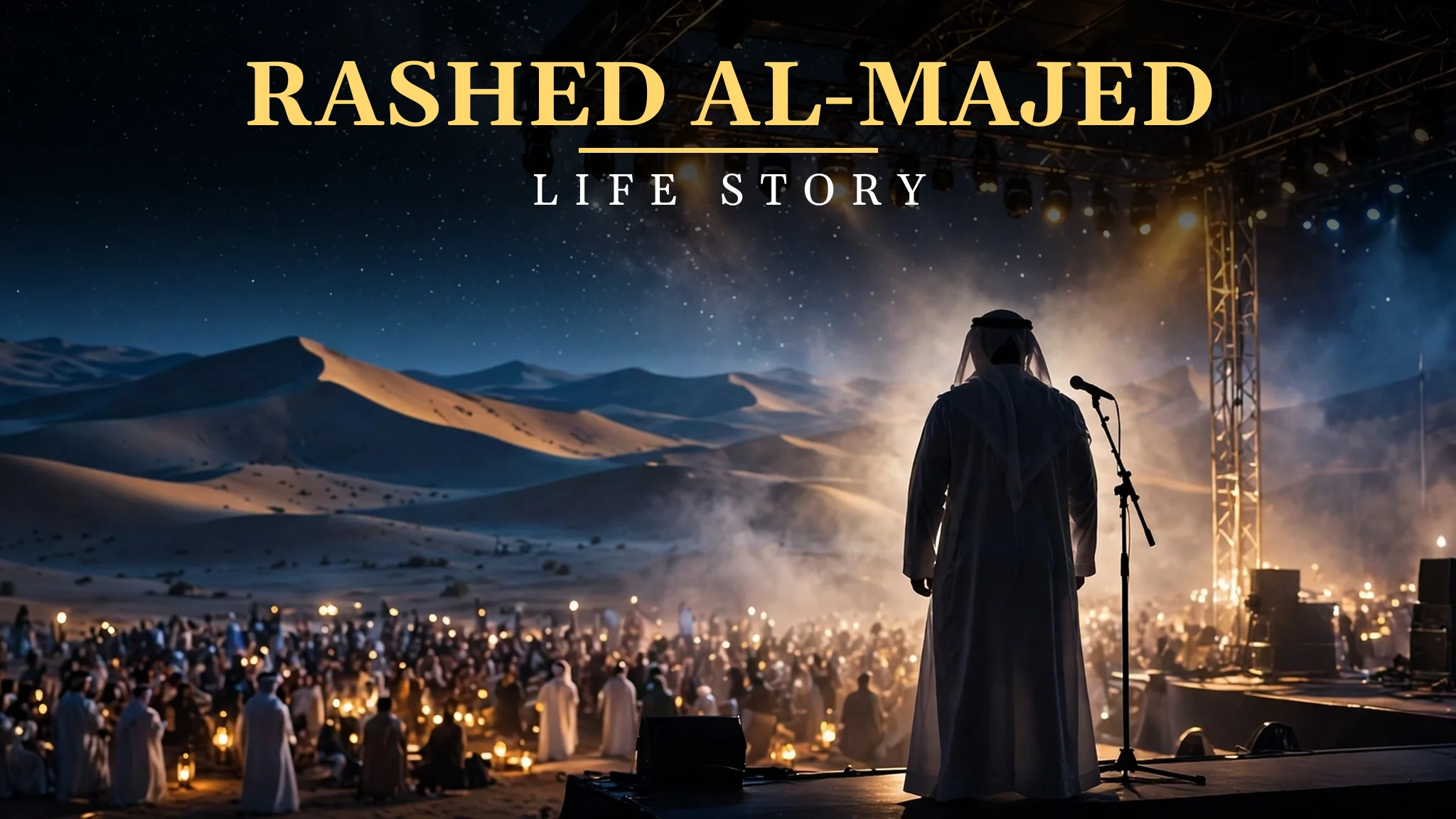
In this post
- Born in Bahrain, Raised in Saudi Arabia
- A Teenage Debut and the First Albums
- The 1990s and the Rise of a Gulf Star
- Romantic Songs and a Voice People Trust
- Producer, Platinum Records, and Building an Industry
- Concerts Across the World and the Jenadriyah Honour
- Staying Loved for Forty Years
- Later Life, New Concerts, and a Lasting Legacy
- My Take:
There are singers who become famous for a single song, and there are singers who become famous for a whole life of singing. Rashed Al-Majed belongs to the second group. For more than forty years, his voice has been one of the most loved sounds in Saudi Arabia and across the Gulf. His songs are romantic, they are emotional, and they are sung by people who have loved, who have lost, and who have waited. When a Rashed Al-Majed song plays at a wedding, in a car, or in a home, people know the words, and they sing along. That is the mark of a singer who has become part of people’s lives, not only part of their radios.
He began as a teenager, in 1984, when most boys his age were still at school and thinking about their futures. He was already singing, already recording, and already finding an audience. He did not become famous in a single night. He built his fame slowly, album by album, concert by concert, until his name was known in every Gulf country. He has released almost forty records, he has performed in many countries, and he has become one of the largest music producers in the Middle East. His story is a story about talent, about hard work, and about a voice that has stayed loved for decades.
What makes his story interesting is not only the singing. It is the way he grew from a young singer into a businessman, a producer, and a figure who helped shape the music industry of the Gulf. He did not only sing songs. He built a company, he helped other artists, and he took part in the national festivals of Saudi Arabia. He is a singer, but he is also a builder, and his life shows how a talented boy can become a man who shapes the music of a whole region.
Born in Bahrain, Raised in Saudi Arabia
Rashed Al-Majed was born on 27 July 1969 in Bahrain, and he grew up in Saudi Arabia, where his family lived. Bahrain and Saudi Arabia are close neighbours, and many families live between the two countries, crossing the causeway for work, for family, and for life. Rashed’s childhood was shaped by both places: by the sea of Bahrain and by the cities of Saudi Arabia, especially the Eastern Province, where he spent much of his youth. He grew up in a world where Gulf music was part of daily life, where songs played on the radio, at weddings, and in the home.
His family was not a family of famous singers, and his childhood was ordinary in many ways. He went to school, he played with friends, and he listened to the music that was around him. The Gulf in the 1970s was a place of change, with new cities growing, new roads being built, and new music coming from Egypt, from Lebanon, and from the Gulf itself. A boy growing up in that world heard many kinds of songs, and he learned to love the sound of the Gulf, with its rhythms, its poetry, and its feeling for love and for home.
He began to sing as a boy, and people noticed his voice early. It was a warm voice, with a romantic quality, and it suited the songs about love that were popular in the Gulf. He sang at home, he sang for his family, and he sang for his friends. His family encouraged him, and they saw that he had a talent that was worth developing. He was not pushed into singing by anyone. He wanted to sing, and he worked at it, practising, listening to older singers, and learning how to use his voice.
When he was fifteen, his life changed. In 1984, he began his professional career, and he released his first work as a singer. To start a career at fifteen is a remarkable thing, and it shows both his talent and his courage. He was still a schoolboy, but he was already a recording artist. He had to learn how to be a singer and a student at the same time, how to work in a studio, and how to perform for an audience. He learned quickly, and his early work found listeners who liked his voice and his romantic style.
A Teenage Debut and the First Albums
Rashed’s debut in 1984 was the beginning of a long career, and his early albums established him as a young singer with a real future. The Gulf music world in the 1980s was full of older singers, and a teenager had to work hard to be taken seriously. Rashed did that work. He chose songs that suited his voice, he worked with composers and poets, and he recorded with care. His early songs were romantic, they were about love and longing, and they were sung in the Gulf dialect that his audience knew and loved. That dialect was important, because it made his songs feel close to home.
He was helped in those early years by people in the music industry who saw his talent and who wanted to support him. Producers, composers, and radio stations gave him chances, and he took them. He sang on the radio, he performed at events, and his name began to spread beyond his home city. In the Gulf, a singer’s reputation grows by word of mouth, by people playing a cassette for their friends, and by songs being heard at weddings. Rashed’s songs travelled in that way, from one home to another, from one city to another, until he was known across the Gulf.
His voice was his greatest asset, and he took care of it. A romantic singer needs a voice that can be soft and strong at the same time, a voice that can whisper a line of love and then rise to a powerful note. Rashed’s voice could do both, and that range made his songs memorable. He also learned how to choose a song, which is a skill that many singers never learn. A good song needs a good melody, good words, and a singer who understands both. Rashed understood that, and he built his career on choosing songs that were worth singing.
By the end of the 1980s, he was no longer a teenage newcomer. He was a known singer, with albums behind him, with fans in many countries, and with a future that looked bright. He had survived the hardest part of a singer’s life, which is the beginning, when nobody knows your name and every chance matters. He had taken those chances, and he had made them count. The 1990s would bring him even greater fame, and he was ready for it.
The 1990s and the Rise of a Gulf Star
The 1990s were the years when Rashed Al-Majed became a star across the Arab world. He released album after album, and his songs were played on radio stations in Saudi Arabia, in Bahrain, in Kuwait, in Qatar, in Oman, and in the United Arab Emirates. His romantic songs, with their emotional themes, struck a chord with listeners who were living through the changes of the Gulf: new cities, new wealth, new lives, and old feelings that had not changed. His songs spoke about love in a way that felt true, and people responded to that truth.
He also began to perform in concerts in many countries, and his live performances became an important part of his career. A Rashed Al-Majed concert was an event where the audience sang along, where couples held hands, and where people felt the songs in their hearts. He was not a singer who hid behind a band or behind a stage show. He stood on the stage, he sang, and his voice did the work. His concerts drew large crowds, and they made him one of the most popular live singers in the Gulf.
In those years, he also took part in the Jenadriyah festival, the national festival of Saudi Arabia, where he performed in the operetta, the large musical work that opens the festival. He took part in the operetta more than eight times, which is a remarkable record, and it showed how much he was trusted by his country. The operetta is not a small show. It is a national event, watched by millions, and it tells the story of Saudi Arabia, its history, and its people. To sing in it is an honour, and Rashed sang in it again and again.
His fame also spread beyond the Gulf. He performed in Egypt, in Lebanon, in Jordan, and in Europe, in France and in the United Kingdom, for Arab audiences living abroad. For Arabs far from home, his voice was a link to the Gulf, to the songs they had grown up with, and to the life they had left. He understood that, and he sang for them with the same feeling he brought to his concerts at home. His career had become international, but his heart had stayed in the Gulf, and his songs had stayed true to the place where he began.
Romantic Songs and a Voice People Trust
Rashed Al-Majed is known above all for his romantic songs, and it is worth asking why those songs have lasted so long. Romantic songs are easy to write badly, and many singers have made romantic songs that are forgotten in a year. Rashed’s romantic songs are different, because they are honest. They do not only talk about the joy of love. They talk about the pain of waiting, about the sadness of parting, and about the hope that love will return. His voice carries those feelings with a sincerity that listeners can hear, and that sincerity is why his songs are still played decades after they were recorded.
He has released almost forty records, which is a very large body of work, and it shows how hard he has worked. Each record needed new songs, new composers, new poets, and new ideas. He did not repeat himself. He tried new sounds, he worked with different writers, and he kept his music fresh. That is not easy over forty years, because a singer can easily fall into a habit, singing the same kind of song again and again. Rashed avoided that habit by listening to new music, by working with young composers, and by staying curious about his art.
His songs often have emotional and romantic themes, and that is a deliberate choice. He knows his audience, and he knows what they want from him. They want songs that speak about their own lives, about love, about longing, and about the heart. He gives them those songs, and he gives them with a voice that has grown richer with age. A young singer can sing about love, but an older singer who has lived through love, through loss, and through time can sing about it with a depth that a young singer cannot match. Rashed’s voice has that depth now, and it is one of the reasons his later work is so loved.
He is also known for his work as a producer, and for his business sense. He owns the Art Jazeera channel, and he owns a fifty percent stake in Platinum Records, with the MBC Group. That makes him one of the largest producers in the Middle East, and it shows that he is not only a singer. He is a man who understands the music industry, who invests in it, and who helps other artists. He has used his success to build something larger than himself, and that is a part of his story that deserves to be remembered.
Producer, Platinum Records, and Building an Industry
As Rashed’s career grew, he began to think about the music industry itself, and about how it could be built up in the Gulf. He did not want to be only a singer who waited for producers to call him. He wanted to be a producer himself, a man who could help other singers, who could invest in new talent, and who could shape the future of Gulf music. He became a record producer, and he built a business that has become one of the most important in the Middle East.
His stake in Platinum Records, which he owns in partnership with the MBC Group, gave him a central place in the Arab music industry. Platinum Records works with many of the most famous singers in the Arab world, and it produces albums, videos, and concerts. Rashed’s role in that company is not only about money. It is about taste, about choosing artists, about deciding which songs to record, and about helping young singers find their way. He has used his experience, gained over forty years, to guide others, and that guidance has helped the industry grow.
He also owns the Art Jazeera channel, which is a part of his business empire. A channel, a record company, and a singing career together make him a powerful figure in Arab music, and they show how far he has come from his teenage debut in 1984. He started as a boy with a voice, and he became a man with a voice, a company, and a vision. That journey is not only about talent. It is about hard work, about learning the business, and about taking risks.
His work as a producer has also helped him stay relevant as a singer. By working with young artists, he has stayed close to new sounds, new ideas, and new audiences. He has not become a singer who only lives in the past. He is a singer who is still part of the present, because his business keeps him in touch with what is happening now. That is a smart way to build a career, and it is one of the reasons he has lasted for more than forty years in a business where many singers fade after a few years.
Concerts Across the World and the Jenadriyah Honour
Rashed Al-Majed has performed in many countries, and his concerts have taken him far from the Gulf. He has sung in Saudi Arabia, in Bahrain, in Kuwait, in Qatar, in Oman, in Egypt, in Lebanon, in Jordan, in France, and in the United Kingdom. Each concert was a chance to meet a new audience, and each audience taught him something about his own music. Arab audiences in London and Paris, far from home, listened to his songs with a special feeling, because his voice reminded them of the Gulf they had left. He sang for them with care, and he gave them an evening that felt like home.
His concerts in Saudi Arabia have been among the most important of his career. In recent years, as Saudi Arabia has opened up to large concerts and festivals, Rashed has been a central figure, performing at major events in Riyadh and Jeddah. These concerts have drawn huge crowds, and they have shown that his popularity has not faded with time. Young people who were not alive when he began his career now come to his concerts, and they sing his old songs with him. That is a sign of a singer whose work has crossed generations.
The Jenadriyah festival deserves a special place in his story. The festival is Saudi Arabia’s national celebration of its heritage, and its operetta is its most important artistic event. Rashed has taken part in the operetta more than eight times, singing with other artists in a large, staged work that tells the story of the nation. To be asked once is an honour. To be asked more than eight times is a sign of deep trust. It shows that his country sees him not only as a popular singer, but as a voice of Saudi Arabia itself, a singer who can be trusted with its most important stage.
He has also performed at weddings, at private events, and at national celebrations, and his songs have become part of the soundtrack of life in the Gulf. A song that is played at a wedding becomes part of a family’s memory, and Rashed’s songs have become part of many families’ memories. That is a kind of fame that cannot be bought, and it cannot be made by marketing alone. It is made by a voice, by songs, and by years of being there for people in their happiest and saddest moments.
Staying Loved for Forty Years
To stay loved for forty years is one of the hardest things a singer can do. Many singers have a few good years, and then they fade, because the audience moves on, because new singers appear, and because tastes change. Rashed Al-Majed has not faded. He has stayed, and he has stayed loved, because he has understood something important: that a singer must grow with his audience, and must respect them. He has not tried to be young forever. He has grown older with his fans, and his songs have grown with them, from the love songs of youth to the deeper songs of a man who has lived.
He has also stayed close to his roots. He sings in the Gulf dialect, he sings about love and longing, and he sings with a voice that has not changed its character. He has tried new sounds, but he has not abandoned the sound that made him famous. That balance, between the new and the old, is hard to keep, and he has kept it. His fans trust him because they know what to expect from him, and they also know that he will surprise them, gently, with something new.
His long career has also been helped by his work as a producer. By staying in the music business, by working with young artists, and by investing in the industry, he has stayed in touch with the present. He is not a singer who lives only in the past, remembering his old hits. He is a singer who is still making music, still performing, and still part of the world of today. That is why young people know his name, and why his concerts still draw large crowds.
He has faced the usual challenges of a long career: the pressure to stay relevant, the competition from younger singers, and the changes in how people listen to music, from cassettes to streaming. He has met those challenges by doing what he has always done: singing well, choosing good songs, and respecting his audience. That simple approach has carried him through forty years, and it is likely to carry him further. His story is not finished, and his voice is still being heard.
Later Life, New Concerts, and a Lasting Legacy
In recent years, Rashed Al-Majed has continued to perform, to record, and to take part in the cultural life of Saudi Arabia. He has performed at major festivals, he has released new work, and he has remained one of the most respected names in Gulf music. His concerts in Riyadh and Jeddah have been large events, and they have shown that his audience is still there, still loyal, and still growing. He has become a living legend, a singer whose name is known to every generation in the Gulf.
His legacy is not only in his records. It is in the music industry he helped build, in the artists he has supported through Platinum Records, and in the standard he set for Gulf singers. He showed that a singer from the Gulf could have a long career, could build a business, and could be respected across the Arab world. He showed that romantic songs, sung with honesty, could last for decades. And he showed that a teenage singer, starting in 1984, could become one of the most important figures in Middle Eastern music.
He is also a reminder that fame, when it is built on work, lasts longer than fame built on a single moment. He did not become famous because of one song or one television show. He became famous because he sang, year after year, and because people trusted his voice. That trust is his greatest achievement, and it is the reason his name is still spoken with love in Saudi Arabia and across the Gulf.
Today, Rashed Al-Majed is still active, still singing, and still producing. His story is still being written, and his voice is still part of the life of the Gulf. The boy who began at fifteen has become a man whose music has shaped a generation, and whose work will be remembered long after he has stopped singing. His legacy is secure, because it is built on songs that people carry in their hearts, and songs like that do not fade.
My Take:
When I think about Rashed Al-Majed, the first thing that comes to my mind is how long he has lasted, and how rare that is. He started in 1984, when he was fifteen, and he is still singing and still loved more than forty years later. I have seen many singers who were famous for a year or two, and then disappeared. Rashed did the opposite. He stayed, he worked, and he built a career that has lasted longer than most people’s working lives. That kind of staying power does not happen by luck. It happens because a person works hard, makes good choices, and respects the people who listen to him.
What I admire most about him is his voice, and the way he uses it to sing about love. His songs are romantic, but they are not silly. They are about the real feelings of love: the joy, the waiting, the pain, and the hope. When he sings, I believe him, because his voice sounds like a man who has felt those things himself. Many singers can sing a love song, but few can make you feel that the song is true. Rashed can, and that is why his songs are still played at weddings and in homes across the Gulf. They are not just songs. They are part of people’s lives.
I also admire the way he grew from a singer into a producer and a businessman. He did not only sing. He built a company, he invested in Platinum Records, and he helped other artists. That takes a different kind of talent, the talent of seeing the bigger picture, and of building something that will last. I think that is a smart way to live a life in music, because a singer’s voice will one day grow old, but a company, a record label, and a reputation for helping others can last longer. He understood that, and he acted on it, and I respect him for it.
His work at the Jenadriyah festival is another part of his story that moves me. To sing in the national operetta more than eight times is a great honour, and it shows that his country trusts him. The operetta is not a pop concert. It is a national event, and it tells the story of Saudi Arabia. To be part of it again and again means that Rashed is not only a popular singer. He is a voice of his nation, a man who can be trusted with its most important stage. That is a responsibility, and he has carried it well.
I think about his teenage debut, and I wonder what it must have been like to start a career at fifteen. Most fifteen-year-olds are thinking about school, about friends, and about growing up. Rashed was already recording, already performing, and already being judged by an audience. That is a lot of pressure for a boy, and it could have broken him. Instead, it made him stronger. He learned early how to work, how to choose songs, and how to handle fame. Those lessons stayed with him, and they are part of why he has lasted so long. He grew up in public, and he grew up well.
If I am honest, I also think about the limits of his music. He is a romantic singer, and he has stayed close to romantic songs for his whole career. Some people might say that he should have tried more kinds of music, and that he should have taken more risks. I understand that view, but I do not agree with it completely. He knew what he was good at, and he did it well. A singer who tries to do everything often ends up doing nothing well. Rashed chose his path, and he walked it with care. That is a form of wisdom, even if it means that his music does not surprise people as often as it might.
I also think about the Gulf, and about how its music has changed over forty years. When Rashed began, the Gulf was a different place, with fewer concerts, fewer channels, and fewer ways for a singer to be heard. Today, there are huge festivals, streaming services, and audiences across the world. Rashed has lived through all of that change, and he has adapted to it without losing himself. He still sings in the Gulf dialect, he still sings about love, and he still sounds like Rashed Al-Majed. That is a remarkable achievement in a world that changes so fast.
What I learn from his life is that a career is built one song at a time, and one year at a time. He did not become a legend in a single night. He became a legend by singing, by recording, by performing, and by working, year after year, for more than forty years. That is a lesson for any young person who wants a career in music: do not wait for a single big moment to save you. Build your career slowly, with good songs and hard work, and the big moments will come. Rashed’s life proves that, because his big moments came after years of steady work.
I think about his fans, too, and about the loyalty they have shown him. A fan who has listened to a singer for forty years is not a casual listener. That fan has grown up with the singer, has married to his songs, has raised children to his songs, and has grown old with his songs. That kind of loyalty is precious, and it is earned, not bought. Rashed earned it by being there, by singing well, and by respecting his audience. I hope he knows how much that loyalty means, because it is the greatest reward a singer can receive.
His business success also teaches me something about planning for the future. A singer’s voice is a gift, but it is also a job, and a job needs a plan. Rashed planned. He invested, he built a company, and he made sure that his success would last beyond his singing. That is a practical lesson, and it is one that many artists forget. They earn money, they spend it, and they have nothing left when their fame fades. Rashed did the opposite. He built something that will last, and that is a wise way to live.
I also admire the way he has stayed close to his roots, even as he became rich and famous. He could have moved to another country, or changed his style to please a foreign audience, but he did not. He stayed a Gulf singer, singing Gulf songs, for Gulf people, and for Arabs everywhere. That loyalty has made his music stronger, because it comes from a real place, and it speaks to real people. A singer who forgets where he comes from often loses his voice. Rashed never forgot, and his voice has stayed strong because of it.
I think about the young singers who look up to him, and I hope they learn the right lessons from his life. They should learn that talent matters, but that hard work matters more. They should learn that choosing good songs matters, and that respecting your audience matters. They should learn that building a career takes time, and that there are no shortcuts. Rashed’s life is a lesson in all of those things, and it is a lesson that is worth studying. He did not take shortcuts, and he did not cheat. He worked, and he earned his place.
If I had to choose one word to describe him, I would choose “steady”. He is a steady singer, a steady businessman, and a steady man. He does not make headlines for scandal, he does not seek attention, and he does not try to be shocking. He works, he sings, and he builds. That steadiness is not exciting in the way that a scandal is exciting, but it is more valuable, because it lasts. In a world where so many stars rise and fall in a year, a steady star is a rare and precious thing. Rashed Al-Majed is such a star, and I think he deserves to be celebrated for it.
I also think about the future, and about what his legacy will be. His records will remain, his company will remain, and his songs will be sung at weddings for many years to come. But his greatest legacy may be the example he set: that a boy from the Gulf, starting at fifteen, can become one of the most important figures in Arab music, not by luck, but by work, by talent, and by respect for his audience. That example will inspire young singers for a long time, and it will remind them that a long career is possible, if they are willing to work for it.
In the end, I think Rashed Al-Majed’s life is a reminder that love songs, sung with honesty, never go out of fashion. People will always fall in love, they will always wait, they will always miss the ones they love, and they will always need songs that say what they feel. Rashed has spent forty years giving them those songs, and he is still giving them today. That is a life’s work, and it is a work to be proud of. I hope he keeps singing, and I hope his voice is heard for many more years, because the Gulf needs its romantic voice, and it has found it in him.
I also think about the cassettes and the radios that carried his early songs, and about how music travelled in the Gulf in the 1980s. There was no streaming, no social media, and no easy way to find a new singer. A song travelled because a person played a cassette for a friend, or because a radio station played it, or because it was heard at a wedding. Rashed’s songs travelled in that slow, human way, and they earned their fame one listener at a time. That kind of fame is stronger than the fame that comes from a single viral video, because it is built on people choosing to listen again and again.
Another thing I respect is that he did not let his business success change his singing. A man who owns a record company could easily stop singing and only manage others, but Rashed kept singing. He kept standing on stage, he kept recording, and he kept meeting his audience. That tells me that singing is not only his job. It is his love, and he would sing even if he did not need the money. That love is what his audience hears, and it is why they stay loyal to him after so many years.
I think about the operetta at Jenadriyah once more, and about what it means to be trusted with a nation’s story. A pop singer is trusted with a song, but a singer in the operetta is trusted with a history. Rashed was trusted with that history more than eight times, and he did not let his country down. That is a different kind of success from selling records, and it is a success that matters more, because it comes from the people, not from the charts. I hope he is proud of it, because he should be.
His story also reminds me that age is not an enemy for a singer who has taken care of his voice. A young voice is fresh, but an older voice has depth, and Rashed’s voice has grown deeper and richer with time. He sings now with the weight of forty years behind him, and that weight makes his love songs more moving, not less. I think young singers should listen to his later work, not only his early hits, because it shows what a voice can become when it is used with care for a lifetime.
Finally, I want to say that I hope his example helps young Gulf singers to think about the long term. A career is not a race to become famous in a year. It is a journey that takes decades, and it needs patience, good songs, and respect for the audience. Rashed Al-Majed has shown that journey is possible, and he has shown it with his own life. That is a gift to the next generation, and it is a gift that will keep giving for many years.
I will remember him as a singer who began as a boy and became a legend, not by chasing fame, but by singing well, year after year, and by building something that will last. His voice is the sound of the Gulf at its most romantic, and it is a sound that has comforted millions of people. That is a legacy to be proud of, and it is a story worth telling in full.
Frequently Asked Questions
When was Rashed Al-Majed born and when did he start singing?
Rashed Al-Majed was born on 27 July 1969 in Bahrain and grew up in Saudi Arabia, and he began his professional singing career in 1984, when he was fifteen years old.
How many records has Rashed Al-Majed released?
He has released almost forty records in his career, which has lasted for more than forty years, and his songs are known for their emotional and romantic themes.
What is Rashed Al-Majed’s role at the Jenadriyah festival?
He has performed in the Jenadriyah national operetta more than eight times, singing in the large musical work that opens Saudi Arabia’s national heritage festival.
What business does Rashed Al-Majed own in music?
He owns the Art Jazeera channel and a fifty percent stake in Platinum Records with the MBC Group, making him one of the largest music producers in the Middle East.
Where has Rashed Al-Majed performed in concert?
He has performed across Saudi Arabia, Bahrain, Kuwait, Qatar, Oman, Egypt, Lebanon, Jordan, France, and the United Kingdom, for audiences in the Gulf and abroad.
What kind of songs is Rashed Al-Majed known for?
He is known for romantic songs in the Gulf dialect, with emotional themes about love, longing, and waiting, sung in a warm voice that his audience trusts.
Is Rashed Al-Majed still performing today?
Yes, he is still active, performing at major festivals and concerts in Saudi Arabia and recording new work after more than forty years in music.


