Ray Charles: The Life Story Behind the Genius of Soul
In this post
- Greenville and the Blindness
- Seattle and the Early Records
- I Got a Woman and the Birth of Soul
- Georgia on My Mind and the Pop Charts
- Modern Sounds in Country and Western Music
- The Piano and the Voice
- The Arrest and the End of Heroin
- The Later Years and the Duets
- The Final Years and the Farewell
- The Legacy of the Genius
- My Take:
Ray Charles was born on 23 September 1930 in Albany, Georgia, and he grew up in Greenville, Florida, in a poor family that lived in a small house owned by a white family for whom his mother worked. When he was five he watched his younger brother drown in a washtub, a memory that stayed with him for the rest of his life, and by the time he was seven he was completely blind, the result of glaucoma that had taken his sight gradually. His mother, Aretha, sent him to the Florida School for the Deaf and Blind in St. Augustine, where he learned to read Braille and to play the piano, and where he discovered that music was the thing he could do better than anyone.
At the school Charles learned classical piano and organ, and he also listened to the popular music of the day, including the records of Nat King Cole and Charles Brown, whose smooth style he copied in his early years. When his mother died in 1945, he was fifteen and on his own, and he left Florida for Seattle, where he began playing in clubs and recording his first songs. The early records were pleasant but unremarkable, imitations of other singers, and it took him several years to find the sound that was his own.
The sound arrived in the mid-1950s, when Charles began to mix gospel, blues and rhythm and blues into something new. I Got a Woman, recorded in 1954, took the structure of a gospel song and filled it with a secular lyric, and it became a hit and a scandal in equal measure. The records that followed, including What’d I Say in 1959 and Georgia on My Mind in 1960, made him one of the most famous singers in America, and his 1962 album Modern Sounds in Country and Western Music did something no Black artist had done before, taking country songs to the top of the pop charts.
Charles died on 10 June 2004 in Beverly Hills, California, at the age of 73, after a career that lasted almost sixty years. He had recorded hundreds of songs, won twelve Grammy Awards, and changed the sound of American music twice, once with soul and once with country. This is his life story, from a small town in Florida to the top of the charts.
Greenville and the Blindness
Ray Charles Robinson was born on 23 September 1930 in Albany, Georgia, to Bailey Robinson, a labourer, and Aretha Robinson, a sharecropper’s daughter, and the family soon moved to Greenville, Florida, where they lived in a small cabin on the property of a white family named the Pitmans. Aretha worked as a cook and laundress for the Pitmans, and the young Ray grew up around their house, listening to the radio and to the music that came from the local church. He was a bright child, and his mother taught him to be independent, telling him that his blindness was not an excuse for anything.
When Ray was five, his younger brother George, who was four, drowned in a washtub outside their house while Ray watched, unable to help. The memory haunted him for the rest of his life, and he spoke about it rarely, but friends said it shaped his determination to survive on his own terms. Not long afterwards he began to lose his sight, the result of glaucoma, and by the age of seven he was completely blind. His mother, who had little money and no experience of blindness, made a decision that changed his life, sending him to the Florida School for the Deaf and Blind in St. Augustine.
At the school, which was segregated, Charles learned to read and write Braille, to type, and to play the piano and the organ. He also learned to play the clarinet and the saxophone, and he listened to the records that the teachers played, including classical music and the popular songs of the day. He was a quick learner, and he could play a song after hearing it once, a skill that astonished his teachers. When he was fifteen, his mother died, and he left the school and set out on his own, carrying a small bag and a determination to make a living from music.
Seattle and the Early Records
After leaving Florida, Charles travelled to Seattle, Washington, where a friend had told him there was work for musicians. He arrived in 1948, at seventeen, and he began playing piano in clubs on Jackson Street, the centre of the city’s Black entertainment district. He formed a trio, modelled on Nat King Cole’s, and he sang in a smooth, gentle style that was popular at the time. He also met Quincy Jones, then a young trumpet player, who became a lifelong friend and who later arranged many of his records.
In 1949 Charles made his first recordings for a small label called Down Beat, including Confession Blues, which was a modest regional hit. The records were pleasant and well played, but they sounded like imitations of Cole and Charles Brown, and they did not make him famous. He moved to Los Angeles, where he recorded for Swing Time Records, and he began to develop a rougher, more gospel-influenced style, but the breakthrough was still a few years away. He married Eileen Williams in 1951, a marriage that lasted less than a year, and he struggled with money and with the heroin habit that would trouble him for the next fifteen years.
The turning point came in 1952, when he signed with Atlantic Records, a young label run by Ahmet Ertegun and Jerry Wexler. Ertegun and Wexler gave him the freedom to record what he wanted, and they encouraged him to draw on the gospel music he had grown up with. The first Atlantic records were still in the smooth style, but by 1954, with I Got a Woman, he had found the sound that would make him famous, a sound that mixed the church with the nightclub in a way no one had done before.
I Got a Woman and the Birth of Soul
I Got a Woman was recorded in November 1954, and it was based on a gospel song called It Must Be Jesus, which Charles had heard sung in church. He kept the melody and the structure, including the call-and-response between the singer and the band, and he replaced the religious lyric with a song about a woman who treats him well. The record reached number one on the rhythm and blues chart, and it became a hit, but it also caused a scandal, because churchgoers accused him of taking sacred music and using it for secular purposes. Charles did not apologise, and the record became the template for a new kind of music.
The new music was called soul, and Charles was its inventor. He took the emotional intensity of gospel, the rhythm of the blues, and the polish of popular song, and he combined them into a style that was both sacred and profane. The records that followed, including Hallelujah I Love Her So in 1956 and What’d I Say in 1959, extended the formula, and What’d I Say, with its suggestive lyrics and its electric piano riff, became his biggest hit, reaching the top ten on the pop chart and selling more than a million copies. The song’s call-and-response section, in which Charles and his backing singers trade moans and shouts, was so suggestive that some radio stations banned it, which only made it more popular.
Charles’s band in these years was the best in rhythm and blues, and it included the saxophonist David Fathead Newman, who had played with him since the Florida school days, and the Raelettes, a group of female backing singers whose harmonies became a signature of his sound. The band toured constantly, playing theatres and dance halls across America, and Charles, who travelled with his own bus and his own cook, was one of the highest-paid Black entertainers in the country. He was also one of the most respected, and younger musicians, from Sam Cooke to Aretha Franklin, studied his records closely.
Georgia on My Mind and the Pop Charts
Georgia on My Mind was written in 1930 by Hoagy Carmichael and Stuart Gorrell, and Charles had known it for years before he recorded it in 1960 for ABC-Paramount, the label he had moved to after leaving Atlantic. His version was slow and tender, with a string orchestra behind his piano and voice, and it reached number one on the pop chart, his first record to do so. The song became his signature, and in 1979 the state of Georgia adopted it as its official state song, an honour that Charles treasured, and that he celebrated by performing it at the state capitol.
The move to ABC-Paramount gave Charles more money and more control, and he used it to record the music he wanted, including the country album that would become his most surprising success. He also recorded Hit the Road Jack in 1961, a duet with Margie Hendrix of the Raelettes that reached number one, and Unchain My Heart in 1961, both of which became standards. His voice in these years was at its peak, a rich baritone that could be tender on a ballad and rough on a blues, and his piano playing, which had always been underrated, was the foundation of every record.
Charles was also becoming a public figure beyond music. He refused to play segregated venues in the South, and in 1961 he was banned from performing in Georgia after he cancelled a concert in Augusta in protest against segregation. The ban lasted for years, and it cost him money, but he held to it, and when the state honoured him in 1979, the gesture was understood as an apology. He was not a political activist in the usual sense, but he used his fame to insist on being treated with dignity, and the stand he took was remembered long after the ban was lifted.
Modern Sounds in Country and Western Music
In 1962 Charles recorded Modern Sounds in Country and Western Music, an album of country songs arranged with strings, horns and a big band, and sung in his unmistakable style. The album was a gamble, because no Black artist had ever made a country album, and the label expected it to fail. Instead it became one of the best-selling albums of the year, reaching number one on the pop chart and producing two hit singles, I Can’t Stop Loving You, which reached number one, and You Don’t Know Me. The album’s success surprised everyone, including Charles himself, and it changed the way the music business thought about genre.
The album worked because Charles treated the country songs with the same seriousness he brought to gospel and blues. He did not parody them, and he did not smooth them out. He sang them straight, finding the emotion in the lyrics and letting his voice carry it, and the arrangements, by Marty Paich and Sid Feller, gave the songs a warmth and a sweep that suited him. The record showed that a great song could cross any boundary, and it opened the door for other Black artists to record country music, and for country artists to record soul.
A second volume followed later in 1962, and it was also a success, though not as large as the first. Charles continued to record country songs throughout his career, and he returned to the genre in his final years, recording duets with country singers including Willie Nelson, who became a close friend. The Modern Sounds albums remain his most unlikely achievement, and they are still cited as proof that talent matters more than category, and that a great singer can sing anything.
The Piano and the Voice
Charles’s piano playing was the foundation of his music, and it was more sophisticated than most listeners realised. He had been trained in classical music at the Florida school, and he could play Bach and Chopin, but he chose to play in the blues and gospel styles, using the piano to drive the band and to answer his own voice. His playing was rhythmic and percussive, with a left hand that kept the beat and a right hand that danced around the melody, and other pianists studied it closely. He played the piano on almost every record he made, and it was as much his signature as his voice.
His voice was a rich baritone that could be gentle on a ballad and raw on a blues, and it carried the grain of a life lived hard. He sang with a directness that made every lyric feel personal, and he had a way of holding a note just a fraction longer than expected, which gave his singing a sense of suspense. He also used his voice as an instrument, moaning, shouting and laughing in the middle of a song, and the Raelettes answered him, creating a conversation that was the heart of his sound.
He was also a gifted arranger and bandleader, and he rehearsed his band relentlessly, insisting on precision and on swing in equal measure. He could hear a wrong note from across a room, and he would stop a rehearsal to fix it, but he was also generous with his musicians, paying them well and keeping them employed for years. Many of his band members stayed with him for decades, and they spoke of him with a mixture of fear and love, the way musicians often speak of a great leader.
The Arrest and the End of Heroin
Charles had used heroin since the early 1950s, and the habit had cost him money, health and marriages, but he had managed to keep it hidden from the public for years. In 1965 he was arrested at Boston’s Logan Airport after customs agents found heroin in his luggage, and the arrest became national news. He faced a prison sentence, but he agreed to enter a rehabilitation clinic in Los Angeles, and he spent a year getting clean. The experience changed him, and he never used heroin again, though he continued to drink and to smoke marijuana for the rest of his life.
The arrest also changed his music. The records he made after 1965 were more varied and more reflective, and he began to record songs that spoke directly about his life, including Let’s Go Get Stoned in 1966, a hit that winked at his reputation, and Eleanor Rigby, a Beatles song that he turned into a soul ballad. He also became more open about his past, talking in interviews about the addiction and about the brother he had lost as a child, and the honesty made him a more compelling figure.
He was married twice, first to Eileen Williams in 1951, a marriage that lasted less than a year, and then to Della Beatrice Howard Robinson in 1955, a marriage that lasted until 1977 and produced three sons, Ray Jr., David and Robert. He also had nine other children by different women, and his personal life was complicated and often painful, but he remained close to his children, and he left his estate to them in a trust that was designed to provide for their education and their futures.
The Later Years and the Duets
Charles worked steadily through the 1970s, 1980s and 1990s, recording albums, touring the world and appearing on television, where his performance of America the Beautiful became a fixture of national celebrations. He recorded duets with younger singers, including Billy Joel, and he appeared in the film The Blues Brothers in 1980, playing a music store owner in a scene that introduced him to a new generation. He also recorded a series of albums for Warner Brothers and later for his own label, Crossover Records, which he founded in the 1980s.
In 2003 he recorded Genius Loves Company, an album of duets with artists including Norah Jones, Elton John, Bonnie Raitt and Willie Nelson, and the album became a critical and commercial success, winning eight Grammy Awards after his death, including Album of the Year. The recordings were made while Charles was already ill, and his voice was weaker than it had been, but the feeling in them was undiminished, and the duets showed how much younger musicians revered him. The album was his final statement, and it was a fitting one, a celebration of collaboration and of song.
Charles also became a familiar voice in American advertising, recording the jingle for Pepsi and appearing in commercials that played on his image as a genial, unmistakable presence. He was honoured with the Kennedy Center Honors in 1986, and he received the Presidential Medal of Freedom in 2004, shortly before his death. He performed at the inauguration of President Ronald Reagan in 1985, and his version of America the Beautiful was played at national events for decades, becoming almost as familiar as the national anthem.
The Final Years and the Farewell
Charles’s health declined in his final years, and he suffered from liver disease and hip problems that made touring difficult. He gave his last public performance in 2004, at a concert in Los Angeles, and he spent his final months at home in Beverly Hills, cared for by his family and his staff. He died on 10 June 2004, at the age of 73, of liver failure, and the news led the broadcasts around the world. His funeral was held in Los Angeles, and it was attended by hundreds of musicians, including Stevie Wonder, who sang at the service, and Willie Nelson, who had been his friend for decades.
He was buried at Inglewood Park Cemetery in Los Angeles, and his estate, which included his recordings, his publishing and his personal effects, was placed in a trust for his children. The Ray Charles Foundation, which he established, continues to support music education and research into hearing disorders, a cause that was close to him because of his own blindness. His home in Los Angeles, with its studio and its collection of pianos, has been preserved as a museum.
The film Ray, released in 2004 and starring Jamie Foxx, introduced his life to a new generation, and Foxx won the Academy Award for Best Actor for his performance. The film was praised for its honesty about Charles’s addiction and his personal life, and it renewed interest in his recordings, which sold in large numbers after its release. Charles had cooperated with the filmmakers before his death, and the film stands as the most complete portrait of his life on screen.
The Legacy of the Genius
Charles’s influence on American music is immense. He invented soul music by mixing gospel and blues, and he showed that a Black artist could succeed in country music, in pop and in jazz, without being confined to a single category. His recordings are studied in music schools as examples of phrasing, arrangement and emotional directness, and his voice is one of the most imitated in popular music. Singers from Stevie Wonder to Van Morrison have named him as their primary influence, and his songs are covered in every genre.
His twelve Grammy Awards, including a Lifetime Achievement Award in 1987, reflect a career that spanned six decades and touched every part of American music. He was inducted into the Rock and Roll Hall of Fame in 1986, in its first class, and into the Country Music Hall of Fame in 2021, a rare double honour that reflects the range of his achievement. His recordings are in the Library of Congress, and his version of Georgia on My Mind is the official state song of Georgia, an honour no other popular singer has received.
Today Charles is remembered as one of the great voices of the twentieth century, and his music is played every day somewhere in the world. He was born in poverty, he lost his sight as a child, and he lost his brother and his mother before he was sixteen, but he built a career that changed the sound of American music. His life is a reminder that talent, given time and care, can overcome almost anything, and his songs remain the proof.
My Take:
What I admire about Ray Charles is that he was blind, and he became a legend, through talent, through hard work, and through a piano, and that is a hopeful message, for anyone who has a disability. He was a boy from Greenville, Florida, who lost his sight at seven, and who learned to play the piano at a school for the blind, and who became the Genius of Soul, and that is a story that inspires me, because it shows that a disability does not have to define you, and that talent can lift you up, and that music can change your life, and Ray proved it, in every song he played, and in every song he sang, and that is why he is a legend.
Georgia on My Mind is the song I think about most, because it is one of the most beloved songs ever recorded, and Ray’s performance is at its heart. He sang it, with a voice that was warm, and that was soulful, and that made it feel personal, and that is a gift that few singers possess, the gift of making a song feel like it was written for you, and Ray had it, and he used it, in Georgia on My Mind, and in every song he sang, and that is why the song became the state song of Georgia, and why it is still sung today, by singers who wish they could sing like Ray, and by audiences who love it, because it is a song about home, and home is something we all understand.
I Got a Woman is a song I love, because it fused gospel and rhythm and blues, and it created soul music, a song that was both sacred and secular, and that made audiences dance, and that became a hit, and that is still played today, as one of the most important recordings in the history of American music, a recording that took the sound of the Black church, and brought it to the nightclub, and to the radio, and that made soul music, a genre that would dominate American music, for the next twenty years, and that is a legacy that will never fade, and that is a part of why Ray is the Genius, and why his music is still important today, more than seventy years after I Got a Woman was recorded.
Modern Sounds in Country and Western Music is an album I love, because it showed that Ray could sing country, and make it beautiful, and that a Black singer could sing country, and be accepted, by white audiences, and by Black audiences, and that is a testament to his talent, and to his courage, and to the power of a great musician, who, even when he is taking a risk, can make it work, and that is a lesson worth remembering, for anyone who wants to take a risk, because Ray took a risk, and he succeeded, and his album became a classic, and it is still listened to today, by people who love country, and who love soul, and who want to hear them fused, in a way that only Ray could do.
The lesson I take from Ray is that a disability does not have to define you. He was blind, and he became a legend, through a piano, and through a voice, and that is a lesson for anyone who has a disability, or who feels different, because Ray shows that you can be blind, and you can still see, through music, and you can still be great, and that is a powerful message, and it is one that I will carry with me, always, because the world needs more people like Ray Charles, who do not let their disabilities define them, and who use their talents to become great, and to change the world, through music, and through a piano, and through a voice, that will never be forgotten.
I also think about his recovery from heroin addiction, because it is a part of his story that is both sad and inspiring, and it shows that you can overcome addiction, if you have the determination, and the support, and Ray did, after more than twenty years of addiction, and he never used heroin again, a remarkable achievement, and that is a testament to his strength, and to his belief in himself, and that is a lesson worth remembering, for anyone who has struggled with addiction, because it shows that recovery is possible, even after many years, and that a great career can continue, after recovery, and that is a hopeful message, and one that Ray embodied, in every song he sang, after 1965.
His piano playing is something I admire, because he played with a feeling that was rare, and that made his piano sound like it was singing, and that is a gift that few pianists possess, the gift of making a piano sing, and Ray had it, and he used it, in every song he played, and that is why his recordings are still studied today, by musicians who want to learn how to play the piano, and who listen to Ray, and who try to understand his genius, and who know they never will, because it was unique, and it was Ray’s, and it was a gift, and that gift is still here, in recordings that are more than sixty years old, and that are still powerful, still moving, and still relevant, today.
Finally, I believe Ray Charles was one of the greatest musicians who ever lived, and his recordings are classics that will be played for as long as music is played. He was the Genius, he was the Genius of Soul, and he was a legend, and his story is one of talent, determination, and a life lived with a piano. He will always be remembered as the man who invented soul music, and as the man who sang Georgia on My Mind, and who made us believe, for a moment, that home is a place, and that it is beautiful.
One more thing I want to say is that his appearance in The Blues Brothers, in 1980, introduced him to a new generation, and it showed that he was still great, and still relevant, and still capable of making an audience dance, and that is a testament to his talent, and to his determination, and to the power of a great musician, who, even when he is old, can still sing, and can still move an audience, with a piano, and with a voice, and with a smile, that will never be forgotten, and that is a legacy that will never fade, and a life that will always be remembered, as one of the greatest in the history of music.
When I think about Greenville, Florida, his childhood home, I think about how far he travelled, from a blind boy in a small town in the segregated South, to the most famous musician in the world, and how much he achieved. He was a boy who lost his sight, and who lost his brother, and who became a legend, and that is a story that inspires anyone who has lost someone, because it shows that you can survive loss, and you can become great, and you can find a new family, in music, and in soul, and that is a hopeful message, and one that Ray embodied, in every song he sang, and in every concert he gave.
I will end by saying that listening to Ray Charles play was a privilege, and I am grateful to have heard his piano. He was a master, he was a genius, and he was a legend, and those three things together make a great musician. He is the Genius, he is the Genius of Soul, and he is Ray Charles, and he will always be remembered as such, as a legend, and as a piano that will never be forgotten.
There is a final thought I want to leave with, and it is about the line from Georgia on My Mind, where he sings, Georgia, Georgia, the whole day through, just an old sweet song, keeps Georgia on my mind, a line that has stayed with me, because it is a lesson about home, about longing, and about love. Ray sang that line with a warmth that has stayed with me, because it is a lesson about life, about home, and about being human. That is the power of his singing: it teaches us how to live, and it makes us better people, by showing us that home matters, and that longing for home is a universal feeling, and that is a lesson I will carry with me, always.
And if you have never heard Georgia on My Mind, listen to it, because it is one of the great songs of all time, and Ray’s performance is at its heart. Listen to it for the story, for the piano, and for the voice, and for the man who sang it with a warmth that is unforgettable. That is the Ray Charles I will remember: not just the musician, but the man, who was warm, soulful, and great, and who will never be forgotten.
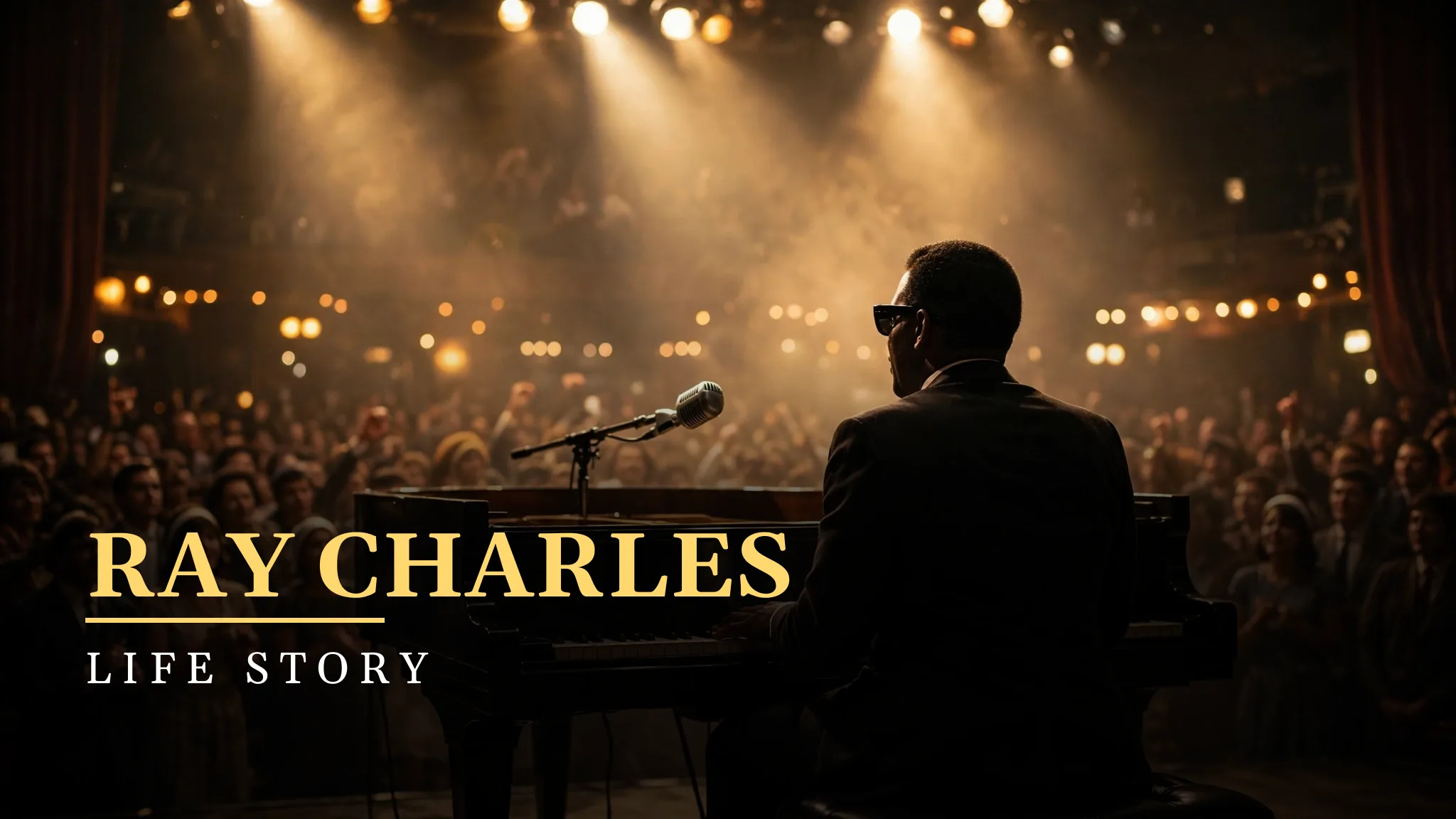
One last memory: the image of him in dark sunglasses, smiling, playing a piano, on a stage, with a band behind him, and an audience that loves him, and that is listening, and that is feeling, and that is a beautiful thing. That image is iconic, and it is beautiful, and it is the image that will define him forever. He was the Genius, and he was Ray Charles, and he was the Genius of Soul.
His legacy will live on through his recordings, through his piano, and through the generations of musicians he inspired, who heard his piano and wanted to play the way he played. That is a fitting legacy for a man who defined soul, and who did it with a piano and a voice that will never be forgotten. He is gone, but his music remains, and his name will be remembered as one of the greats.
Finally, I want to say thank you, Ray Charles, for Georgia on My Mind, for I Got a Woman, and for a life lived with a piano and a voice. You were a great musician, and you were a great man, and the world is a better place because you were in it. Your music is still here, your legacy is still here, and your example is still here, and that is a life that mattered, and a life that will never be forgotten.
And one more thing: if you are a musician, play like Ray, because he is the musician every musician deserves to be, a musician who plays with his heart, and who makes an audience feel. Play like Ray, the way Ray Charles played, and the world will be a better place for it, because the world needs more musicians like him, who play with soul, with feeling, and with humanity.
There is a last lesson in his life that I carry with me, and it is this: do not let your disability define you, because a disability is a part of you, but it is not all of you, and Ray did not let his blindness define him, and he became a legend, through a piano, and through a voice, and that is a lesson worth remembering, and it is one I will carry with me, always, because the world needs more people like Ray Charles, who do not let their disabilities define them, and who use their talents to become great.
One final thought: his twelve children are a testament to his life, because he was a father, in his own way, and he loved his children, and they loved him, and that is a legacy that matters, in its own way, alongside his music and his voice, because his family is his greatest legacy, and they have honoured him, by being themselves, just as he was himself, and that is a beautiful thing, and it is a part of his story that shows him as a father, not just as a musician, and that is a legacy that will never fade.
And if you ever doubt that music can change the world, remember Ray Charles, because he did, with a piano, and with a voice, and his difference is still felt today, in every soul song, in every piano, and in every voice that sings with soul, and that is a legacy that will last, long after his piano is heard, because his music is still here, and his influence is still here, and that is a gift that will never fade.
There is one more thing I want to say, and it is about his sunglasses, because he wore dark sunglasses, and they became his signature, a symbol of his blindness, and of his style, and it is a part of his image that is iconic, and that is still remembered today, as a symbol of Ray Charles, and of a man who was blind, and who saw more clearly than most people who can see, and that is a beautiful thing, and it is a part of his story that shows him as a man, not just as a musician, and that is a legacy that matters, in its own way, alongside his music and his voice.
His story also reminds me that a blind boy from Florida can become a legend, if he has talent, determination, and a piano, and that is a hopeful message for anyone who feels different, or who feels disadvantaged. Ray was blind, and he was poor, and he became one of the greatest musicians in history, because he embraced who he was, and he used his talent to become great. That is a lesson worth remembering, for every blind person out there, and for every person who dreams of being a musician.
I also want to mention his producers, Ahmet Ertegun and Jerry Wexler, because they believed in him, and they gave him the freedom to record what he wanted, and that is a reminder that a producer who believes in an artist can change their life, and that Ray was lucky to have Ertegun and Wexler, and that they were lucky to have Ray, and that is a beautiful thing, and it is a part of his story that shows the power of belief, and of a producer who cares, and who does the right thing.
And finally, I think about the fact that he lived to 73, and that he played for more than fifty years, and that is a reminder that a long career, lived with soul, is a beautiful thing. He was the Genius until the end, and he was himself until the end, and that is a life worth living, and a life worth remembering, and I am grateful to have learned about it, and to have shared it with you.
Frequently Asked Questions
When was Ray Charles born?
Ray Charles was born on 23 September 1930 in Albany, Georgia, USA. He grew up in Greenville, Florida, lost his sight to glaucoma by age seven, and learned piano at the Florida School for the Deaf and the Blind.
What is Ray Charles most famous for?
He is most famous for inventing soul music with I Got a Woman, and for Georgia on My Mind, Hit the Road Jack, What’d I Say, and the album Modern Sounds in Country and Western Music.
Why was Ray Charles called the Genius?
He was called the Genius because he fused gospel, blues, jazz, and country into soul music, played piano and sang with extraordinary feeling, and did it all while blind from childhood.
When did Ray Charles die?
He died on 10 June 2004 in Beverly Hills, California, at the age of 73, of liver disease, after a career of more than fifty years as a singer and pianist.
What is Georgia on My Mind?
Georgia on My Mind, recorded in 1960, became a number one hit and was made the official state song of Georgia in 1979. It is one of the most beloved songs Ray Charles ever recorded.
Did Ray Charles overcome heroin addiction?
Yes. He was addicted to heroin for more than twenty years, was arrested in 1965, entered rehabilitation, quit cold turkey, and never used heroin again.


